Bull. Fac. Educ. Hirosaki Univ. 91 : 85'"'"'95 (Mar. 2004)
Language Learning Strategy Use
by Japallese Senior High Sellool Students
B *AIWi~~'r. J: ~ ~ m~~jJ~~~m
Rideo KOJIMA *, Chieko YOSHIKAWA * *
IJ\~.~ ~~*. *JII t'f~~**
Abstract
In the learner-centered classroom, teachers should be interested in helping students learn how to learn and develop learner autonomy. This study aims to investigate the tendencies of language learning strategy use by Japanese high school students and to consider some implications for learner strategy training. Oxford's (1990) Strategy Inventory for Language Learning (SILL) was administered to 198 first-year senior high school students. As a result, we found various features of their strategy use. Findings indicate that metacognitive strategies would be a key for them to be better learners and that language learning strategy training will help them become more autonomous in their EFL (English as a foreign language) learning.
Keywords:language learning strategies, learner autonomy, learner strategy training
1. Introduction
In recent years, our thinking in EFL instruction has gradually shifted from a teacher-centered to a leamer-centered focus. In the leamer-centered communicative classroom, teachers should encourage students not only to learn communicative English, but also to learn how to learn and develop learner autonomy, defined as a willingness on the part of the learner to take responsibility for their own learning (Sinclair et al 2000). As Oxford (1990) suggests, language learning strategies contribute to this main goal. Language learning strategies have been in the limelight since the late 1970s and the investigations of language learning strategies have advanced our understanding of the processes which learners use to develop their communication skills and learner autonomy in language learning. Thus, Japanese teachers of English need to help learners develop autonomy and communicative competence through learner strategy training in the daily classroom.
However, there have been few attempts at language learning strategy training in Japan. This may be partly because Japanese teachers of English do not have discretionary power in deciding curriculum since they have to follow the Course of the Study by Monbukagakusho, and partly because they themselves have had little experience in learner-centered, strategies-based EFL learning and teaching since they started learning English. Thus, it is taken for granted that teachers of English should give much knowledge to students. However, this alone will not lead to better learning or learner autonomy.
This study aims to examine the tendencies of language learning strategy use which can be
*
1jb1W*¥~W¥{$~1H~~WMlt~Department of English, Faculty of Education, Hirosaki University
* *
1jb1W*¥*¥rm~W¥liJf9tf4Graduate School of Education, Hirosaki University.
capitalized on to promote autonomous learning and to consider some implications for learner strategy training at the senior high school level. Since this is also a pilot study for action research which is to be done next year, analysis among the classes was conducted.
2. Purposes of the study
This research is motivated by the necessity to identify the present situation of language learning strategy use and to apply the implications for further research.
The specific purposes of this study are:
(1) To identify the range., type and frequency of language learning strategy use by Japanese high school students
(2) To consider points to keep in mind when learning strategy training is conducted in the actual classroom setting.
3. Research questions
The following research questions are asked in this study:
(1) What strategies are Japanese high school students interested in?
(2) What do they think is important in learning English?
(3) What strategies do they use the most?
(4) Is there any correlation among the strategy uses?
4. Method 4. 1 Subjects
The subjects of the investigation were 198 Japanese public senior high school students (95 boys and 103 girls) in Aomori Prefecture, with false beginner to high beginner levels of English.
They were in the first grade, consisting of four comprehensive classes (labeled Class A, Class B, Class C, and Class D) and one scientific and mathematic class (Class E). Almost all of them would like to continue to higher education after graduation.
4.2 Material
The instrument used in the data collection was the Strategy Inventory for Language Learning (SILL), version 7.0 (Oxford 1990), accompanied by a questionnarie which asked about what strategies the subjects had interest in and what they deemed important in learning English. The SILL conducted here is adapted from a Japanese version of Oxford's SILL (Shishido & Ban 1992). The SILL, a self-reporting questionnaire, is for students of English as a second or foreign language requiring answers to 50-item questions on language learning strategy use on the basis of a five-point Likert scale ranging from "never or almost never true" to "always or almost always true." The SILL is designed to help students understand better how they learn a new language and the information helps them become better learners. The SILL considers six categories as follows (Oxford 2001:167-169):
(1) Memory strategies help learners link a new item with something known. These devised are useful for memorizing information in an orderly string (e.g. acronyms) in various ways.
(2) Cognitive strategies help learners make and strengthen associations between new and already-known information and facilitate the mental restructuring of information.
(3) Compensation strategies for speaking and writing help learners make up for missing knowledge when using English in oral or written communication, just as the strategy of guessing from the context while listening and reading compensates for a knowledge gap.
(4) Metacognitive strategies help learners manage: (1) themselves as learners, (2) the general learning process and (3) specific learning tasks.
(5) Affective strategies include identifying one's feelings (e.g. anxiety, anger and contentment) and becoming aware of the learning circumstances or tasks that evoke them.
(6) Social strategies facilitate learning with others and help learners understand the culture of the language they are learning.
4. 3 Procedure
In November 2003 each home room teacher supervised the subjects and collected the data.
Before starting, each teacher was supposed to explain what the survey was for and to give instruction how to conduct the questionnaire in Japanese. The subjects were told that the questionnaire to be distributed contained questions about their use of English learning strategies, and that all the answers would be neither correct nor wrong. At the end of the questionnaire they were asked to state their impressions of the SILL. The questionnaire administration took approximately 20 minutes for each class. The statistical analyses to answer the research questions were carried out with SPSS 11.5 J for Windows.
5 . Results and discussion
5. 1 Learning strategy frequencies
The mean scores of six categories of learning strategies are reported in Table 1, with all means except affective strategies falling between 2.6 and 3.1 on a scale of 1 to 5, that is, within a range which Oxford (1990) defines as a medium use (2.5"'""3.4). Differences on the basis of sex were not noted in this study, unlike Oxford et a1. (1988) and Lee (2003).
Table 1. Descriptive Data for the SILL Descriptions
Memory Strategies Cognitive Strategies Compensation Strategies Metacognitive Strategies Affective Strategies Social Strategies
Mean 2.73 2.89 3.07 2.60 2.32 3.14
Max 4.22 4.64 4.83 4.67 4.16 4.83
Min 1.0 1.0 1.0 1.0 1.0 1.0
SD .58 .61 .64 .70 .65 .72 (n=198)
As seen in Table 1,social strategies, which include asking questions, cooperating with others, and empathizing with others, are used the most frequently (M=3.14) , followed by compensation (M=3.08), cognitive (M=2.89), memory (M=2.73), metacognitive (M=2.60), and affective strategies (M=2.32). The preference of social strategies allows for the inference that the students consider cooperation enjoyable and helpful in learning English. The high preference of compensation strategies implies that the students in this high school tend to make an effort by working out a strategy based on communicative demands of the situation. The Japanese pedagogical background could explain why affective strategies are reportedly rarely used. In the first place, affective factors are for the most part neglected in Japanese education. Secondly, the students find it unnecessary to work out affective strategies in learning a foreign language. They can do without working affective strategies in knowledge-oriented EFL instruction in Japan.
However, in reporting on their impression regarding the SILL most students use metacognitive strategies unconsciously, but they do not notice that they are using such strategies. If they understand their present learning styles and strategies more specifically, they will be able to
learn how to learn effectively and how to control their own learning.
5. 2 Correlation of strategies
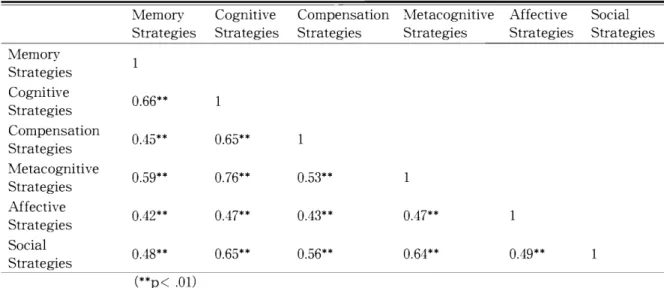
Pearson's correlation coefficient was calculated to examine the correlations among strategy uses. The relationship between how the six categories of language learning strategies are related to each other is shown in Table 2. The strongest significant relationship was between metacognitive and cognitive strategies (r=0.76) , followed by between cognitive and memory strategies (r=0.66). Cognitive strategies have strong correlation with all other strategies except affective strategies. This means that the students who use cognitive strategies are often inclined to use other strategies, too. In contrast, affective strategies, which are the least frequently used, do not have strong correlation with other strategies.
It is noteworthy that the correlation between social strategies and metacognitive strategies was also high. The students who use social strategies frequently use metacognitive strategies likewise. Social strategies are used when a student interacts with others, while metacognitive strategies are used when a student thinks about the mental processes used in the learning process, monitors learning while it is taking place, and evaluates learning after it has occurred.
Communicative interaction in the social context of the classroom can foster both strategies.
Table 2. Correlation Analysis among the SILL Categories
Memory Cognitive Compensation Metacognitive Affective Social Strategies Strategies Strategies Strategies Strategies Strategies Memory
Strategies 1 Cognitive
0.66** 1
Strategies Compensation
0.45** 0.65** 1
Strategies Metacognitive
0.59** 0.76** 0.53** 1
Strategies Affective
0.42** 0.47** 0.43** 0.47** 1
Strategies Social
0.48** 0.65** 0.56** 0.64** 0.49** 1
Strategies
(**p< .01)
The results of the mean scores of the SILL of each class are shown in Table 3. No significant difference was noted among the classes with respect to total scores. However, there is a significant difference between Class B and Class D in relation to cognitive strategies and metacognitive strategies (p< .01). This research did not associate learning strategies and proficiency. Even if Class B uses more strategies than Class D, it does not mean that Class B has greater proficiency of English. It could be possible that Class D feels learning strategies are unnecessary in learning English. However, the questionnaire indicates a fact from another point.
The Class D accounts for 36 percent of students who feel themselves passive in or have negative attitude about learning English (see Appendix 2).
Clearly it is also necessary to get information about learners' needs or characteristics of individuals in a qualitative way although some guesses are possible in a quantitative research.
The integration of quantitative and qualitative data analysis will help us understand the real situation. This means that strategies frequency and preference depends on the characteristics of each class and that strategy training should be adapted to each class context.
Table 3. Mean Scores of the SILL in each class
Class N Memory Cognitive Compensation Metacognitive Affective Social Avg.
Strategies Strategies Strategies Strategies Strategies Strategies
A 40 2.73 2.83 2.94 2.49 2.28 3.05 2.72
B 41 2.85 3.08 3.17 2.88 2.27 3.33 2.94
C 39 2.75 2.88 3.11 2.73 2.38 3.23 2.84
D 37 2.61 2.68 2.93 2.40 2.20 3.01 2.62
E 41 2.70 3.03 3.21 2.56 2.48 3.09 2.85
total 198 2.74 2.91 3.08 2.62 2.33 3.16 2.79
5. 3 Interest in specific learning strategies
As shown in Table 4 the most popular strategies are cognitive strategies, while the least popular ones are metacognitive strategies. About half of the students find cognitive strategies interesting (49.0 percent), and only about a sixth think that metacognitive ones are interesting (17.2 percent). These results show that the students are concerned more with grade-getting and that they want to acquire techniques to gain grammatical knowledge or to enhance vocabulary in a traditional academic environment in Japan. It is true that understanding and controlling cognitive processes may be one of the most essential skills that classroom teachers can help second language learners develop (Anderson 2002), but metacognitive strategies are crucial in learning a foreign language because they involve thinking about the learning process, planning for learning, monitoring of comprehension or production while it is taking place, and evaluating learning after the language activity is completed. Students without metacognitive approaches are essentially learners without direction or opportunity to review their progress, accomplishments, and further learning directions (0' Malley et al 1985). However, the subjects in this study did not indicate an interest in them. They have not been taught to exert control over their own learning. They may think that metacognitive strategies have nothing to do with learning a foreign language. What urges them to study English might simply be succeeding in an entrance examination or getting a good grade.
Table 4. How many students have interest in each category?
Class N Memory Cognitive Compensation Metacogniti ve Affective Social Strategies Strategies Strategies Strategies Strategies Strategies
(%) (%) (%) (%) (%) (%)
A 40 7(17.5) 18 (45.0) 8 (20.0) 707.5) 15 (37.5) 13 (32.5)
B 41 10 (24.4) 22 (53.7) 5 (12.2) 7(17.1) 502.2) 14(34.1)
C 39 9 (23.1) 14 (35.9) 9 (23.1) 9 (23.1) 10 (25.6) 10 (25.6)
D 37 4 (10.8) 19 (51.3) 12 (32.4) 6 (16.2) 708.9) 7 (18.9)
E 41 13 (31.7) 24 (58.5) 12 (29.3) 5 (12.2) 809.5) 4 (9.8)
Total 198 43 (21.7) 97 (49.0) 46 (23.2) 34 (17.2) 45 (22.7) 48 (24.2) N. B. The subjects are told to choose two strategies at most.
5.4 Important elements in leaning English
As seen in Figure 1, many respondents think that learners' attitudes toward English learning and learning procedures are the most important of all, followed by teaching methods and teachers' attitudes. There are fewer respondents who think that environment, materials, and curriculum are important. That is, they think that people involved in a language classroom are more important than impersonal things. In other words, environment, materials and curriculum
are third-party and out of reach of them and students have little power to improve them.
About 25 percent of the students find the SILL interesting or a good chance to review their own way of studying (see Appendix 2). Considering these responses, it is apparent that while teaching methods are seen as important, some of them might have noticed the role of a learner by just responding to the SILL and have realized the potential to "know how" to learn. Teaching methods, although viewed as important by learners, is just one aspect of language teaching (Tudor 1993). Only a good teaching method will not always bring forth a good learner. Teachers also need to take responsibility for language teaching, to make an effort to teach effectively, or to have courage to change their attitudes toward students if students feel uncomfortable. Itis not so simple to change environment, materials, and curriculum, but it is possible to change learners' attitudes, learning procedure, and teaching methods when both learners and a teacher cooperate together.
learners' attitudes learning procedures environment teachers' attitudes teaching methods materials curriculum
- r- - ~I--
, - -,--
125 123
I 37
58
I 104
I 28 22
10 number of studentsI
o
20 40 60 80 100 120 140N. B. The subjects are told to choose three items at most.
Figure1.What is important in learning English?
6. Conclusion and implications
In this study, the tendencies of language learning strategy use by Japanese high school students have been examined. The findings regarding the research questions are as follows:
(l) What strategies are the subjects interested in?
More than half of the subjects have interest in cognitive strategies. This shows that students do not always have interest in the strategies which they often use, as will be referred to below.
(2) What do they think is important in learning English?
The subjects consider learners' attitudes or learning procedures as important, followed by teaching methods. This means that, in addition to aspects of teaching, learners realize that they, through both attitudes and procedures, also contribute to effective learning of English.
(3) What strategies do they use the most?
The subjects reported using social strategies the most, followed by compensation strategies. The least used strategies were reported to be affective strategies, which fell below the overall average.
(4) Is there any correlation among the strategy uses?
All of the strategies are correlated with each other, with the correlation between cognitive strategies and metacognitive strategies the highest. This shows that metacognitive strategies would be a key for students to be better learners; this even though they do not indicate an interest in and are probably not aware of the importance of metacognitive strategies
Synthesizing these findings leads to the conclusion that learners need to be introduced to and be provided with language learning strategy training. There have been a great number of experiments all over the world regarding strategy training. However, little strategy training has been done in Japanese high schools. Moreover, questions regarding how strategy training should be conducted or whether strategy training really results in enhancing students' proficiency remain. At the same time almost any strategy can lead to failure if used inappropriately (McDonough 1995). Given the potential of language learning strategy training, we should avoid such failure. There are some broader implications for further research considering these findings in this study.
(1) Data should be collected in both a quantitative way and a qualitative vvay.
Information should be collected from a variety of means: questionnaires, interviews, observation, and proficiency tests. For example, the strategy training provided to the students in this study should focus on effective use of social strategies, which students predominantly use. This strategy training, however, should also introduce affective strategies and metacognitive strategies, which students rarely use. However, a questionnaire based on independent student response will be to identify only conscious strategies use (Hedge 1993). Therefore, we need to use as many sources of information as possible. We should investigate the situations which students are in, their needs, individual characteristics, and learning strategy use. Their preferences and beliefs will affect whether strategy training will be effective (Usuki 1996). There have been few questionnaires to examine language learning strategies Japanese students' use in the EFL classroom. In students'impression of the SILL as examined here in, some students thought it difficult to answer, and a few did not understand the meaning of the questions. This means that the SILL is not completely suitable for Japanese learners of English. We need to adjust the questionnaire according to the characteristics of learners that we are now in charge of.
(2) Language learning classrooms should be learner-centered.
As shown in the data regarding what learners saw as important in learning English, most students think that learners are the most important element. It is important for not only a teacher but a learner to take responsibility for language learning. That is why the EFL classroom should be leamer-centered. This does not mean that there is nothing that teachers can do. Teachers should work together with students. Usuki (1997) suggests carrying out learner training to raise the learners' awareness of their own learning methods by using journal writing, self-evaluation sheets, and strategy instructions. Nunan (2002) also suggests that language classrooms should have a dual focus -not only on teaching language content, but also on developing learning processes through action research. More and more attention should be focused on learners themselves. The potential of the learner- centered classrooms may be verified in the fact that, as shown in the strategy use data, learners are indeed using social strategies. Such cooperative effort is an important part of the leamer-centered classroom.
(3) Strategies should be introduced by pairing some strategies in a natural classroom setting.
As shown in the correlation analyzed data, there is a variety of correlation among strategy uses. O'Malley et a1. (1985) suggest that strategy training to new tasks can be maximized by pairing cognitive strategies with appropriate metacognitive strategies. In their studies, such strategy training went successfully. Similarly, there was strong correlation between cognitive strategies and metacognitive strategies in this study. Although students take
interest in only cognitive strategies not metacognitive strategies, pairing some strategies would be an effective way of undertaking strategy training.
The powerful aspect of the correlation of strategy use can be best realized in the natural classroom setting, rather than through explicit strategy training. We should introduce strategy training in a natural classroom setting, as O'Malley and Chamot (1990) demonstrate in a successful experiment with strategy training in such an environment. Most teachers in Japan are not given extra time for doing other things in addition to the established educational curriculum. The time available is an important element when undertaking strategy training. A variety of methods that can be achieved within the limited time should be embedded into everyday class. For example, a task with learning strategy practice may be effective in introducing a new learning strategy. Also, students can be given homework concerning language learning strategies. The more frequently students use learning strategies, the more autonomous they will become.Itis ideal that students will come to use language learning strategies more autonomously in the future.
The biggest objective of education is to develop independent learners so that they can learn for themselves, even outside the classroom or even after graduation. Learning strategy training has the potential to help learners develop both communicative competence and learner autonomy in their EFL learning. It is essential for us teachers to explore effective strategy training and to promote research in this area in Japanese secondary education.
References
Anderson, N. J (2002, April) . The role of metacognition in second language teaching and learning. (ERIC Document Reproduction Service No. EDO-FL-01-10L Retrieved October 2, 2003 from http://www.cal.org/ericcll/digest/OllOanderson.html
Hedge, T. (1993). Key concepts in ELT. ELT Journal, 47(1),92-93.
Lee, K. O. (2003 September). The relationship of school year, sex and proficiency on the use of learning strategies in learning English of Korean junior high school students. Asian- EFL-Journal. Retrieved from October 2, 2003 from http://wwisian-efl-journal.com/sept 03 sub4.htm.
McDonough, S. (1995). Strategy and skill in learning a foreign language. Edward Arnold.
Nunan, D. (2002). Learner strategy training in the classroom: An action research study. In Richards, D. C. & Renandya, W. A. (edsJ, Methodology in language teaching: An anthology of current practice. 133-143. Cambridge: Cambridge University Press.
O'Malley, J M., Chamot, A. U, .Stewner-Manzanares, G., Russo, R., & Kupper, 1. (1985).
Learning strategy applications with students of English as a second language. TESDL Quarterly, 19 (3) , 557-584.
O'Malley, J M. & Chamot, A. U. (1990). Learning strategies in second language acquisition. UK:
Cambridge University Press.
Oxford, R., Nyikos, M., & Ehrman, M. (1988). Vive la Difference? Reflections on sex differences in use of language learning strategies. Foreign Language Annals, 21 (4),321-329
Oxford, R. 1. (1990). Language learning strategies: What every teacher should know. New York:
Newbury House/Harper& Row.
Oxford, R. 1. (2001). Language learning strategies. In Carter, ]. & Nunan, D. (edsJ. The Cambridge guide to teaching English to speakers of other languages, 166-172. Cambridge:
Cambridge University Press.
Sinclair, B., McGrath,1., & Lamb T. (2000). Learner autonomy, teacher autonomy: future directions.
Longman.
Tudor, 1. (1993). Teacher roles in the leamer-centered classroom. ELT Journal, 47(1), 22-31.
E3;f1t~E8*c. (Usuki). (1996). A ~ 77:/-. ~ v-':::'/'l'~~COOTQ~~~.The Language Teachel; 20 (6), 23-26.
E3;f1t~E8*c (Usuki). (1997). '¥3J§l:{f0)§ $~0)~~1~:§ $'¥3J§l~O)fl~;a)(tO)~j]*. The Language Teacher, 21 (10), 41-49.
Appendix1
i3iH~,¥3J§l0)t::660)A ~ 77:/ - (h~~
*mfO
~~Strategy Inventory for Language Learning 7.0 ~& R. Oxford
m~
:. (j)~ ~1§~~7- ~=;T:;-~1tlj:, m=8~1§ib9v'Ij:9i-OO~1§'!:: L -C(j)~~1§~~~fflI~fFPX: ~nt::
t
(j)-C T 0 ~~1§~~ (~~T9 ~t:~"t:f~ )(:$:;6)*~c.~n -Cv'9 (j)-c,
a:itL-C~%1v-C<
tt.~v'o .:cL-c, JjIJ*~(j)@]:g:ffl*JH;:.:c(j))((j)I*J?G;6){X(j)@]:g: (1, 2 , 3 , 4 , 5) (j) Enl;:ib -C Ij: t: 9;6::.~~c.AL-C-r~v'o 1. ~~, ib9v'(j:tl.!::Ivt:'ib-C(j:t:Gf~v'
2. JJfl1if;ib-Clj:t:Gf~v'
3. v
,<
G;6::. ib -C Ij: t: 9 4. JJfl1if; ib -C Ij: t: 95. 1if; I;:, ib 9 v'Ij:Il.!::Ivt:' ib -C Ij: t: 9
/"-~A
a. ~~1§-CT-CI;:~"0 -Cv'9 :. .!:: .!::*JT L
<
~~Lt:: :..!:: .!::(j)~f* ~ ~;t 90 b. Jt;t~Tv'J: 5I;:)((j)r:p(;:*JT~1§~An-Cf~50c. ~~1§~Jt;t 9t::601;:, *JT L
<
~"0 t::~1§ (%~1§) (j)i'f.!::.:c(j)~~1§(j) ~) - :;~~~iFE{f~It90 d. ~~1§;6:>f~:bn9~~iL.\I;:#Bv'-C*JT~1§~Jt;t 90e. *JT~1§~Jt;t9(j)I;:, [Pj~i'f~M=~~1§.!::-*tl;:~;t90 (would, could, should~) f. ~~1§~~;t9(j)(;:~~1§r!J&~f~50
g. *JT~1§~Jtf$:-C*~L-c~;t90 h. ~~(j)1f~~J:
<
T90i. *JT~1§~Jt;t 9(j)I;:.:c(j)~1§;6:>ib"0tc*(j)~-:;, ~~, ib 9v'tj:te -C~ t::~ffif~t:'(j)fliTIi~~c.ttL-C:f3
<0
/'\-~ B a. *JT~1§~Jt;t 9 t::60I;:, ~@]~v't:: f) ~"0t::f)T 9 0 b. ~~~£3:00~1§.!::T9A(j)J:5I;:~I5T:' .!::~iL.\;6:>It90 c. ~~1§(j)§€i'f**~~T90
d. ~"0-Cv'9~~1§~v'0v'0f~)(~nu;:An-Cf~50 e. f_tuj!'8I;:~~1§-C~~15 ~ ~il6O90
f. ~~(j)Tv~*@~~@ (~.M~) ~~90 g. ~jffi-C)(~~7Etf(j);6:>~LV'o
h. ~~1§-C)~, ),/~-:;, **~, ¥~-ff~~<o
i. :9H1§(j):&)(~7-:\=-~ /'7" ('2'-"0 .!::~%Ji..!::9) L, {I}{f!W(;:m"0-ca:iti~
<
~%tfo j. ~~1§(j)*JT~1§I;:f.l)J::~1§~B*~1§(j)r:pI;:~To (fJU 7Jv/')7"-.!::calendar)k. ~~0)$~~/'\7-/ C~~J~IL {ljrPJ) ~5!~t1J::> J:::-t00 1. trfiJ:.Lv'~~~j§~J:7}ML-C ];tpt~~]0:>J:::-t00
Wtl unforgettable ~un/ forget / able J::: 7}M L l ,
:e
IE /~h0/ -c?~0~ ~h0 -=- J:::iJ:;-c?~fJ v')m. v'"t v'"t~lE3*~j§~~ ~2:fJv' J: :>~~iL\iJ:;t100 n. ~JC/vtt~ ~v'tc~ Ltc.-=-J:::~~~j§-c?~*~-t 00
/'\- 1'-
c
a. ~GfJv,~~j§~f!I!~~LJ::>J:::, )(0)$-c?}lilW-t00
b. ~~-c?0)~~15$, ~~fJ~iJ:;}i~n'~iJ:.fJv,ft¥:/x.7,T~ -~{t:>0 c. ~~-c?~~fJ~j§iJ:;7}iJ:.GfJv,ft¥, §7}-c?~~~fF ~te-to
d. ~~j§~~JCD>ft¥, -~j§-~j§I!i¥:j:-c?~A.fJv'o
e. ftl!0)AiJ:;{X~~~~j§-c?M J::: 8 :>iJ:.}l~UL J: 5 J:::iL.\iJ:;t10 0 f. ~~j§O)~~iJ:;,~,v'~iJ:.fJv,ft¥,fPJ1::ttpt~M:~~~1D~{t:> 0
/'\- 1'-D a. V'0v'0fJ1J$~5!~t1l~~~{~:>J: :>~~iL,iJ:;t1 00
b. §7}0)~~O)ra9Jiv'~~~~~,-i--=-iJ:.G¥/v-c?l:JiLJ::> J:::~1J-t00
c. ftl!O)AiJ:;~~~{~0lv'0ft¥VJ:, ~$-t00
d. {fhtc~~j§¥1~l1~f~~fJ0tCY)~~~J:J:::' :> Ltc G J:v'iJ:'iL,iJ:;v1 00 e. 7,7:/.::r.-Jv~.lLl~~j§0)¥~~~+7}ft¥ra9~tbl00
f. ~~-c?~~.::r.~7-~3/~J:::h0A~~-to
g. -c?~0~~~~-c?~D>.~~~-to
h. ~~O)tt~~~l@jY)0tcY)O)ajmfUJ§~iJ:;tb00 (1}tl ~~2*&J&f~, TOEFL§t~~)
i. §7}O)~~j§¥~O)*~~~~V'l~
*-
00/'\- 1'-E
a. ~~j§~{t:> O)~~§{~iJ:;fJv'J:::~vJ:, 1t,~t 1)7'/ 77,-t 0 J: 5iL,iJ:;t100 b. ra9Jiv'~~h -r~~j§~~I5-tJ: 5 §7}~IJJb'! -to
c. :>'!<V'0tCJ:::~, §7}~vlY)00
d. ~~~~5~LlV'0 J::: ~~~0 lV' 0ft¥, §7}iJs~*LlV'0iJ:.*$gjlf~~fJ0lV'0iJ:.~~< 0 e. E3~2.v~~~j§¥~~~OO-t0§7}0)~'IW~:j:~WY)00
f. ~~j§~~5~L lV' 0 ft¥, §7}iJ:;J:::' :>~1:lV' 0 iJ:.ftl!O)A~~ ~15-t0
/'\- 1'- F
a. ~~iJ:;:biJ:.GfJV'J:::~,\1>0< ~~I5Ll'bG:>iJ:., 'b5-&80ltG50 b. ~I5LlV'0ft¥, A LT~~~0)7t1:.~~ra9Jiv'~mLl 'b G :> 0
c. ~7~7"Jv-7°-c?~~~~5~-t0~~, fltil¥Jv~J&~*JiD>o d. jj;l0tCJ:::~, ALT~~~0)7t1:.~~WJt1~*y)00
e. ~~-c?jlfrR9~-t00
f. ~~~~I5TAkO))()rt~¥bJ::>~~IL,iJ:;~100 ttrR9 A tbfJtcO)'I1JjIJ~f!£*-l <tt2:v'o
jlfrR9 B §7}iJ:;-:i=J1.pt~M:0tc/'\-1'-~~Jft:*2~'!-c?O~D~#t1l<tt2:v'o
1{rR9 C ~~¥~-c?--:i=*~fJt O)vJ:MttJ:::,~,v''!-tiJ:.?
Jft:*
3~'! -c?O~D~#t1l<tt2:V'o jlfrR9 D -=-0)~~~~0 tc~~~:t3:j:~ <tt2:V'o(Adapted from ~?JN• . {.f*c~(Shishido,T. & Ban, N.). (1992). ~8ffl¥~7,1'-77:/- :)t}.OO~f!£~ljiiJ:;
~0 l :t3iJ:.fJt1hvj'fJGfJv \-=- J:::j fLAH. The author added parenthetical references to the questions which seemed difficult to answer.)
Appendix 2
The impressions after taking the SILL
Class Class Class Class Class
Total
A B C D E
This kind of test is interesting 4 4 1 1 10
This kind of test is difficult 1 3 1 4 5 14
I feel myself negative or not strongly motivated 1 2 2 6 6 17
This is a good chance to review my way of learning. 7 7 6 7 3 30
This gives a chance to think many things. 2 5 7
Communication is important. 1 2 3 2 8
Few strategies apply to me. 3 1 3 2 9
My score is low. 4 1 1 1 7
I understand my idea or attitude. 7 4 3 2 1 17
I understand many kinds of learning. 2 2 3 7
I have to study more. 2 4 4 1 2 13
I notice there are many strategies I haven't done. 2 3 1 2 8
I find no interest in it. Nothing particular. 3 1 1 1 6
I am surprised to find my way of learning. 2 2 4
I do not know what this research is for. 4 3 7
I have to study more positively. 3 2 3
I would like to know how to study. 2 3 1 5
My way of studying is bad. 1 2 3
I will set my goal from now on. 2 1 1 4
I I do not know well about affective strategies. 2 1 3
N.B. The impressions which the only one person gave are omitted.
(Accepted on January 15, 2004)