粘性流の粒子問相互作用の高速、
高精度数値計算法
京大人環 市來健吾 (Kengo Ichiki)
Graduate School of Human and Environmental Studies,
Kyoto Univ.
1
Introduction
Microstructure of suspensions have been attractingmanyattentions of researchers in physics and chemical engineering. Stokesian Dynamics method has developed for many-particle
system first under the free boundary condition by [6] and shortly extended to that under
the periodic boundary condition by [2] (see also [1]).
Although the Stokesian Dynamics method was successful in some respect, recently two major difficulties are recognized. One is its heavy calculation, because of which the size of the system to simulate is limited around a few hundred particles, and the other is the limitation of its approximation up to so-called $FTS$ version where only force, torque and
stresslet are considered and higher force moments
are
neglected in the multipole expansion of the velocity.In this workweconsider rigid spherical particles under the free boundary condition where Brownian motion and inertialeffects of fluid are negligible; that is, Pecletnumber is infinite
and particle Reynolds number is zero. The main purpose of this work is to establish the
formulation and the implementation into the numerical schemes, so that the applications
for interestingphenomena are outside of the scope.
2
Multipole
expansion
2.1
Expansion
of velocity
field
Velocity disturbance $v(x)$ caused by rigid particles is written by so-called single-layer
po-tentials ([14]) as
where $N$ is the number of particles, $S_{\alpha}$ is the surface of particle a, $u$ is the fluid velocity,
$u^{\infty}$ is the velocity in
case
without$\mathrm{p}\mathrm{a}\mathrm{r}\mathrm{t}\mathrm{i}_{\mathrm{C}1\mu}\mathrm{e}\mathrm{s}$, is the viscosity of the fluid, $f$ isforce density
on the surface $y$, and $\mathrm{J}(r)$ is Oseen tensor given by
$\sqrt ij(r)=\frac{1}{r}(\delta_{ij}+\frac{r_{i}r_{j}}{r^{2}})$ . (2)
We adopt the Einstein convention for repeated indices throughout this paper. We
can
expand $y$ in the $\mathrm{r}\mathrm{i}\mathrm{g}\mathrm{h}\mathrm{t}-\mathrm{h}\mathrm{a}\mathrm{n}\mathrm{d}_{-\mathrm{s}}\mathrm{i}\mathrm{d}\mathrm{e}$of (1) at the centre of particle $x^{\alpha}$as
$v_{i}(_{X})= \sum_{\alpha=1}Nm=0\sum J^{()..(m)}ij,k(p’m.X-x)\alpha \mathcal{F}_{j,k}\ldots(\alpha)$, (3)
where$p’$ is the order of truncation (discussed in detail in
\S 2.4),
$\mathcal{F}_{j,k}^{(.)}m..(\alpha)$ is theforcemomentof particle $\alpha$ defined by
$\mathcal{F}_{j,k}^{(m)}\ldots(\alpha)=-\int_{S_{\alpha}}dS(y)(y-x^{\alpha})_{k}^{m}\ldots f_{j(y)}$ , (4)
and
$J_{ij,k}^{(m)} \ldots(r)=\frac{1}{8\pi\mu}\frac{1}{m!}[(-\nabla)^{m}k\cdots J_{i}j](r)$. (5)
2.2
Boundary conditions
We introduce $f$ in (1) or $F$in (3) as aparameter tomatch the boundary conditions for the
velocity. In order to specify all elements of$F$in (3), we need thesame number of boundary
conditions on the velocity. There are, at least, three approaches; the boundary collocation
method, the method using velocity derivatives, and the method using velocity moments.
In the boundary collocation method by [7], we directly apply the boundary conditions
on a finite number of points on the surface called the collocation points. Another way is to consider velocity derivatives $\mathcal{V}$ at the centre ofparticle defined by
$\mathcal{V}_{i,\downarrow}^{(n}..().x^{\alpha})=\frac{1}{n!}[\nabla_{l}^{n}\ldots vi](x)\alpha$. (6)
This approach is also simple, however, the velocity derivatives $\mathcal{V}$ have two disadvantages;
the symmetry is different from that of the force moments $F$, and the velocity derivatives
for the self part becomes singular in the expansion (3).
As the other way,
we
introduce velocity moments $\mathcal{U}$ defined byvelocity derivatives $\mathcal{V}$, but the two difficulties
are
completelyovercome.
The velocity atthe surface is given by $v(y)=U^{\alpha}+\Omega^{\alpha}\cross(y-x^{\alpha})+\mathrm{E}^{\alpha}\cdot(y-x^{\alpha})$, where $U^{\alpha},$ $\Omega^{\alpha}$, and
$\mathrm{E}^{\alpha}$
are
the translational velocity, the angular velocity, and the rate ofstrain for particle $\alpha$relative to the imposed flow $u^{\infty}$.
The linear set of equations relating the velocity moments and the force moments
are
obtained by applying the surface integral in (7) for (3)
as
$\mathcal{U}_{i,\iota}^{(n)}\ldots(\alpha)=\beta\sum_{=1m}\sum_{=0}^{p’}\mathcal{M}i,l\cdot\cdot;j)(n.’ m,(k\cdots\alpha, \beta)\mathcal{F}(mNj,k\cdot)..(\beta)$ , (8)
where
$\mathcal{M}_{i,l\cdot\cdot k}^{(n.’m)};j,\cdots(\alpha, \beta)=\frac{1}{4\pi a^{2}}\int_{S_{\alpha}}ds(y)(y-x^{\alpha})_{l}^{n}\ldots J^{(m}ij,k\cdot()..-x^{\beta})y$. (9)
We call (8)
or
in the abbreviate form$\mathcal{U}=\mathcal{M}\cdot F$ (10)
as
the generalized mobility problem and the matrix A4as
the generalized mobility matrix. In the followingwe
often omit indices and arguments in this way, just for simplicity.For the practical calculation of the generalized mobility problem which is the main aim
of this work, we split the velocity moments $\mathcal{U}$ into two parts–self part $\mathcal{U}^{s}$ and non-self
part $\mathcal{U}’$
as
$\mathcal{U}=\mathcal{U}^{s}+u’$. (11)
This is because $J$ is much easier than A4 to calculate. The self part $\mathcal{U}^{s}$ is written as
$\mathcal{U}^{S}=\mathcal{M}s$ . $\mathcal{F}$, (12)
where the selfpart ofthe mobility matrix$\mathcal{M}^{s}$ is given by
$\mathcal{M}^{s(n}i,\iota^{m)}.’\cdot\cdot;j,k\cdots i,\iota;j,k=\mathcal{M}^{(..)}n.’ m\ldots(\alpha, \alpha)=\frac{1}{4\pi a^{2}}\int_{|r|=a}ds(r)r_{l}^{n}\ldots J_{ij}(,m_{k})\ldots(r)$. (13)
It is found that $\mathcal{M}^{s(n,m)}$ has the following properties: (i) it is non-zero only when
$n$ and $m$
are
both odd or both even, and (ii) it iszero
for $m\geq n+2$. For the non-self part, it isconvenient to consider the relation between velocity moments $\mathcal{U}’$ and velocity derivatives $\mathcal{V}’$ where dash denotes the non-self part. First
we
define the non-self part of the velocitydisturbancecaused by particles $\beta\neq\alpha$
as
and the non-selfpart of the velocity derivatives $\mathcal{V}’$ as
$\mathcal{V}^{J(m)}(\alpha)=\frac{1}{m!}[\nabla^{m}v_{i}^{\prime^{\alpha}}](x^{\alpha})$. (15)
Expanding the velocity $v^{;\alpha}$ at the centre $x^{\alpha}$
as
$v_{i}^{\prime\alpha}(y)= \sum_{m=0}\nu_{i,k}’(m.)..(\alpha \mathrm{I}(y-x^{\alpha})_{k}m\ldots,$ (16)
the non-self part of the velocity moment for particle $\alpha$ is written by that of the velocity
derivatives
as
$\mathcal{U}_{i,l}^{\prime(n)}\ldots(\alpha)=\sum_{0m=}^{n+2}\mathcal{V}^{;}m.(i,k\alpha()..)\frac{1}{4\pi a^{2}}\int s_{\alpha})dS(y(y-X^{\alpha})\iota n..+.mk\cdots$ . (17)
2.3
Reduction of
moments
When we need to solve
some
elements of the force moments by the other force moments andappropriate elements of the velocity moments, we should reduce the degrees of freedom.
The reduction related to the nature of the velocity field itself–the incompressibility and
the biharmonic nature–are already discussed in
\S 2.2.
There is another dependenceamong
elements of the moments from the nature ofspherical particles.
For velocity moments $\mathcal{U}_{i,k}^{(m)}\ldots$, there is obvious
symmetry of indices $k\cdots$
.
From thissym-metry, independent number of elements at $m\mathrm{t}\mathrm{h}$ order becomes $(m+1)(m+2)/2$ .
We call the form of this reduction as the ‘symmetric form’.
From the
definitiOn.
of the moments, the higher rank depends on the lower rank in the way of$\mathcal{U}_{j_{Ss}k}^{(n+.)},2..=a^{2}\mathcal{U}_{j,k}^{(n)}\ldots\cdot$ (18)
To reduce this dependence, it is convenient to introduce the irreducible tensor which is
symmetric and traceless. The reduction for a$p$-rank tensor $A_{i}^{p}\ldots$ is given by [5]
as
$\hat{A}_{i}^{p}\ldots=\sum_{0k=}^{[}a_{k}^{p}\delta(i_{1}i23i_{4}\delta_{i}iA^{p}p/2]\ldots)\delta_{i}\cdots 2k-12ki2k+1ipS_{1}s_{1}\cdots S_{k^{S_{k}}}$, (19)
where
$a_{k}^{p}=(-1)^{k} \frac{p!}{(p-2k)!}\frac{(2p-2k-1)!!}{(2p-1)!!(2k)!!}$. (20)
For example, we have the following relations for$p=2$ and 3;
$\hat{A}_{ijk}^{3}=A3-\frac{1}{5}((ijk)ijA(k_{S}S)jkA3+\delta 3\delta+i_{S}S)\delta(kiA3)(jSs)$ . (22)
The parentheses around the indices in (19) indicate the symmetrization for the indices.
For the nloments in
our
case, the indices are symmetric by the definition,so
thatwe
do not need tocare
about the symmetrization. By this reduction, the number of independentelements on $m\mathrm{t}\mathrm{h}$ order becomes $2m+1$.
We write this reduction operator as $\prime \mathrm{p}$
and the inverse operator (recovery operator) as
2.
By these operators, irreducible moments $\hat{\mathcal{U}}$and $\hat{\mathcal{F}}$
are
related as$\hat{\mathcal{U}}=P\cdot \mathcal{M}\cdot Q\cdot\hat{\mathcal{F}}$
, (23)
which
we
call the irreducible generalized mobility problem. The concrete procedure to calculate (23) is discussed in\S 2.4
and the application of the boundary conditions for it is discussed in\S 2.5.
2.4
Truncation
The truncation implicitly introduced in (3) should be considered on the irreducible form (23) where the independent elements
are
explicitly specified; that is, we introduce the order of truncation $p$ as the maximum order of$\hat{\mathcal{U}}$
and $\hat{F}$
in (23).
The practical calculation of (23) is given as the following six-step procedure for particles
$\alpha=1,$ $\cdot$ $\cdot$,$N$ where we write the order of truncation
$p$ explicitly:
$\mathrm{i}$. Recover the force moments $F$ by the irreducible force moments $\hat{\mathcal{F}}$
as the input by
$[_{F^{(2})}^{\tau^{(}}\mathcal{F}^{()}F^{(p}.\cdot.)p+p+10)$
$(\alpha)=$
$(\alpha)$ . (24) $\mathrm{i}\mathrm{i}$. Calculate the non-self part of the velocity derivatives$\mathcal{V}’$ from $F$ by
$( \alpha)=\sum_{\beta\neq\alpha}[\mathcal{K}^{(_{\mathrm{P}+}2,0)}\mathcal{K}^{(0}.\cdot.’0)$ $..$. $\mathcal{K}^{(+2^{+}2)}\mathcal{K}^{(,.\cdot.)}p,p+0_{p2}$
$(x^{\alpha}-y)\beta$
.
$(\beta)$, (25)where
$\mathrm{i}\mathrm{i}\mathrm{i}$. Convert the velocity derivatives $\mathcal{V}’$ to the velocity moments $\mathcal{U}’$ by (17)
as
$(\alpha)=$
$\cdot\cdot$ ..
$\cdot$.
. $\cdot$ . .$\cdot$ . $D^{(}D^{(0}p,p’+p)2)$ $D^{(p’ p1}D^{(0},p+1)+)$ $D^{(p,p}D^{(p)}0,+2+2)]\cdot$ $(\alpha)$, (27) where $D^{(n,m)}= \frac{a^{n+m}}{4\pi}\int_{|\hat{r}|=1}dS(\hat{r})\hat{r}^{n+m}$. (28)$\mathrm{i}\mathrm{v}$. Calculate the selfpart of the velocity moment $\mathcal{U}^{s}$ by
$(\alpha)=$
$(\alpha)$ , (29) where $\mathcal{M}^{s}$ is given by (13).$\mathrm{v}$. Calculate the velocity moments $\mathcal{U}$ summing the self part and the non-self part as
$(\alpha)=(\alpha)+\lceil_{u^{(p}}^{\mathcal{U}’},\cdot.\cdot(0))](\alpha)$. (30)
$\mathrm{v}\mathrm{i}$. Reduce the velocity moments $\mathcal{U}$ into $\hat{\mathcal{U}}$
as
$[_{\hat{\mathcal{U}}^{(p)}}^{\hat{\mathcal{U}}^{(0}}.\cdot.)$
$(\alpha)=$
$(\alpha)$. (31)The above six-step procedure as a whole could be recognized as a subroutine of (23) which
$\hat{\mathcal{U}}\mathrm{h}\mathrm{a}.\mathrm{s}$
theirreducibleforcemoment$\hat{\mathcal{F}}$
as
the inputand returns the irreducible velocity moment
It should be noted that even in the truncation at order$p$ on
$\hat{\mathcal{F}}$
and $\hat{\mathcal{U}}$
in (23), we have to
recover force moments up to order $p+2$, calculate the velocity derivatives with order$p+2$,
and then, convert them into the velocity moments with order $p$. Therefore the truncation
$\kappa_{\overline{\aleph}^{-}}$
$r$
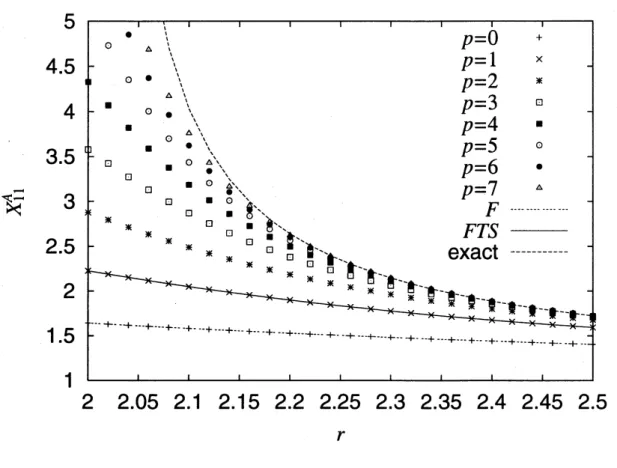
Figure 1: The scalar function $X_{11}^{A}(r)$ of the two-body resistance problem for various case. $‘ F$’ and $‘ FTS$’
show the corresponding values obtained by the analytical expressions and ‘exact’ shows the results by Jeffrey&Onishi (1984). The results by the present formulation
2.5
Higher
version
for
rigid
particles
For the check of the formulation and the implementation,
we
calculate the two-bodyre-sistance matrix for $p=0,1,$$\cdots,$$7$ and compare them to the exact solution by [11]. In
addition, we
can
compare the results with the analytical forms of the scalar functions.Figure 1 shows
one
of the scalar functions in the resistance matrix$X_{11}^{A}(r)$ for variouscases.
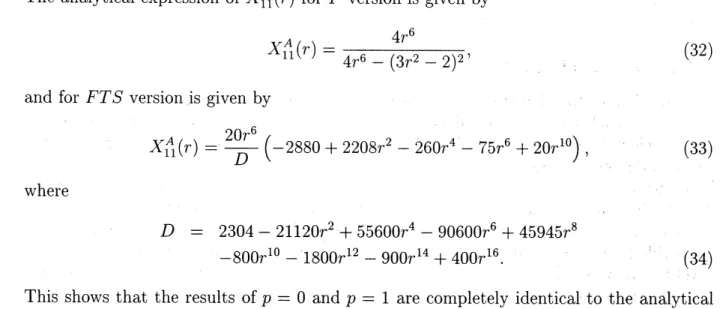
The analytical expression of$X_{11}^{A}(r)$ for $F$ version is given by
$X_{11}^{A}(r)= \frac{4r^{6}}{4r^{6}-(3r-22)2}$, (32)
and for $FTS$ version is given by
$X_{11}^{A}(r)= \frac{20r^{6}}{D}(-2880+2208r^{2}-260r^{4}-75r6+20r^{10})$, (33)
where
$D$ $=$ $2304-21120_{r}2+55600r^{4}-90600r6+45945r^{8}$
$-8\mathrm{o}\mathrm{o}_{r^{1}-}01800_{r}12-900_{r}14+400_{r^{16}}$. (34)
This shows that the results of$p=0$ and $p=1$ are completely identical to the analytical results and converge to the exact solution
as
$parrow\infty$.3
Fast scheme
The bottleneck in the Stokesian Dynamics method is in the inversion of the mobility matrix. Therefore we need to improve the calculation of the linear set of equations faster than
$O(N^{3})$. As suggested by [10], the application of conjugate-gradient type iterative methods
is the first step for the improvement. The iterative method for the Stokesian Dynamics method gives an $O(N^{2})$ scheme at best, consisting only of the calculation of the
dot-product between the mobility matrix and the force moment, which would be the next
bottleneck. The fast multipole method, which is a simple extension of the conventional multipole expansion, is applicable for the calculation and gives
an
$O(N)$ scheme witha
good convergence.
Before proceedingwe consult the cost of calculation in the six-stepprocedureto seewhere
the next bottleneck is. The steps except for (ii) are the calculation for each particles, and therefore the cost is $O(N)$. On the other hand, the calculation ofthe step (ii) contains the
FMM is originally developed by [8] for Laplace problem in two- and three-dimensions with non-adaptive tree-structure, and is extendedshortly to adaptive
one
by [3]. The application to the $1\mathrm{o}\mathrm{W}^{-}\mathrm{R}\mathrm{e}\mathrm{y}\mathrm{n}\mathrm{o}\mathrm{l}\mathrm{d}\mathrm{S}$-number flows is shown by [19]. The aim of our formulation of FMMis to make the scheme for free boundary condition with
a
simple formulation, while $[19]’ \mathrm{s}$formulation is for periodic boundary condition and is so complicated. We only consider
the non-adaptive scheme in this work.
3.1.1 Outline of FMM
Our aim is now to calculate $\mathcal{V}’(\alpha)$ defined by (25) efficiently. The point of FMM is that
we
treat particlesas a
group not only for $\beta’ \mathrm{s}$ in the force moments $\mathcal{F}(\beta)$ but also for $\alpha’ \mathrm{s}$in the velocity derivatives $\mathcal{V}’(\alpha)$ in (25). In other words,
we
expand not only $y$ but also $x$on the integral equation (1).
To make an efficient procedure to calculate the velocity derivatives, we introduce hierar-chical cell-structure and formulate the calculations between the levels of the cell-structure. First we define the primary cell at level $0$ which contains all particles. At the next level 1,
we divide the primary cell into $2^{3}$ cells called ‘children.’ This division is repeated up to the
level $l_{m}$, where the cells are called ‘leaves’. All cells except for leaves have 8 children and
all cells except for the primary cell have their ‘parent’ cell.
Firstwe are going to formulate the basic formulae to shift the origin of the force moments and that of the velocity derivatives, and then, to discuss the concrete implementation of FMM.
3.1.
$\cdot$2.
$\mathrm{S}\mathrm{h}\mathrm{i}\mathrm{f}\mathrm{t}’$. -operation of force moments
We describe the transformations of the origin ofmoments here. We would like torepresent the moments with the origin $x_{2}$ by $F(x_{1})$. From the definition, the moments with $x_{2}$ is
given by
$F_{i,k}^{(m)} \ldots(_{X_{2}})=\int dS(y)(y-x_{2})km\ldots fi(y)$
.
(35)Here $(y-X_{2})^{m}$ could be written by the linear combination of $(y-X1)^{i}$ and $(x_{1}-X_{2})^{j}$
where
$i+j=m$
. By the ‘binomial theorem for 3-dimensional vectors’, weare
able totransform $F(x_{1})$ to $F(x_{2})$ uniquely. The point of the binomial theorem for vectors is the
non-commutable property;
$aibj\neq b_{i}a_{j}$. (36)
The expansion ofpower of the
sum
of two vectors $a$ and $b$ is, though, straightforward. Wejust write down explicitly for lower powers;
$F_{i,j}^{(1)}(x2)$ $=$ $r_{j}\mathcal{F}_{i}^{(}(0)x_{1})+F_{i.j}^{(1)}(X1)$
$\mathcal{F}_{i,jk}^{(2)}(x2)$ $=$ $r_{jk}^{2()}\mathcal{F}_{i}0(x_{\iota}\mathrm{I}+r_{j}F_{i,k}^{(1)}(x_{1})+r_{k}\tau_{i,j(x)}^{(}1)1+\mathcal{F}_{i,jk}^{(2)}(x_{1})$,
(38) (39) where $r=x_{1}-x_{2}$. If the order of$F(x_{1})$ and $\mathcal{F}(x_{2})$ is the same, they
are
equivalent; thatis, $\mathcal{F}(x_{2})$ calculated by.the definition and by the transformation above
are
identical. Wedenote this transformation by matrix $S_{F}$
as
$F(x_{2})=S_{F}(x_{2,1}X)\cdot \mathcal{F}(x_{1})$. (40)
3.1.3 shift-operation of velocity derivatives Here we describe the $\mathrm{t}\mathrm{r}\mathrm{a}\mathrm{n}\sim$
.sformation of the origin of velocity derivatives. By the definition
$\mathcal{V}_{i,k}^{(m}..().)X_{1}=\frac{1}{m!}[\nabla^{m}k\cdots v_{i}](X1)$, (41)
the velocity disturbance at $x$ around $x_{1}$ is given by
$v_{i}(x)= \sum_{m=0}\mathcal{V}^{()}i,k\cdot(m..x_{1})(x-X_{1})^{m}k\cdots$. (42)
From the above equation, we get the transformation among the velocity derivatives
as
$\mathcal{V}_{i,l}^{(n.)}..(x_{2})=\sum m=n{}_{m}C_{n}\mathcal{V}_{i}^{(m)},k\cdots l\cdots(x_{1})(x_{2}-x_{1})^{m}k\cdots-n$, (43)
or introducing the operator $S_{V}$ as
$\mathcal{V}(x_{2})=SV(_{X}2, X1)\cdot v(_{X_{1})}.$ (44)
3.1.4 Procedure of FMM
In the calculation of FMM, there are mainly two stages: upward-pass where the force moments of the cells are calculated, and downward-pass where the velocity derivatives of the cells are calculated.
In the upward-pass, we calculate the force moments from particles in the cell $C$
$F(C)= \sum_{\beta\in C}SF(x_{C}, x_{\beta})\cdot F(\beta)$, (45)
for all cells in all levels. This is achieved efficiently
as
follows. First,we
calculate the forcemoment for leaves $L$ directly by the definition (45)
as
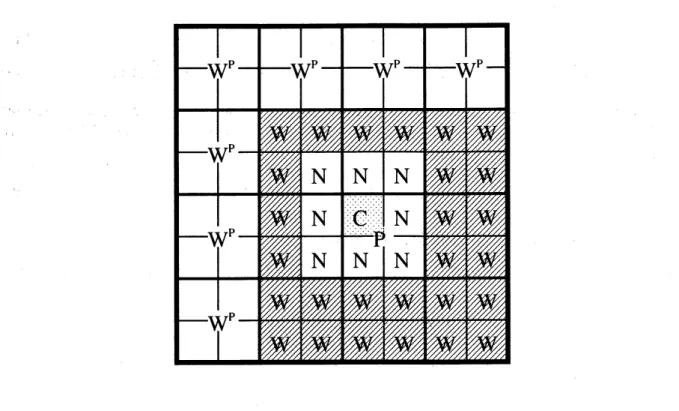
Figure 2: Cell structure in $2\mathrm{D}$. Well-separated cells of cell $C$ is denoted as $W$ and near
cells of cell $C$ including itself is denoted as $N$. Well-separated cells of$C’ \mathrm{s}$ parent cell $P$ is
denoted
as
$W^{P}$ whose childrenare
not $W’ \mathrm{s}$.where $F(\beta)$ is known variable for all particles $\beta$. The force moment of cell $P$ at the level $l$
is calculated by its children $C$ at the level $l-1$ by the shift operator $S_{F}$ as
$F(P)= \sum_{C\mathrm{o}\mathrm{f}P}^{8}S_{F}(XP, Xc)\cdot \mathcal{F}(c)$. (47)
By this recurrent relation, we
can
calculate all force moments at the levels from $l=l_{m}-1$to 2. It should be noted that the calculated values in the upward-pass is exactly the
same
with that by the definition (4) for the cells in principle, because the transformation of the origin of the moments (40) is exact. This gives a good check for the program.
The errors in this scheme appear at the truncation of the expansion and we have to keep
a
certain condition to get good estimations. For this purpose we introduce the near cells for a cell $C$ denoted by $N^{C}$ which does not satisfy the$\mathrm{c}\mathrm{o}\mathrm{n}\mathrm{d}\mathrm{i}\mathrm{t}\mathrm{i}_{0}\mathrm{n}..\cdot$ By the near cell
$N^{C}$, we
define well-separated cells $W^{C}$
as
follows;$\bullet$ $W^{C}$ is at the
same
level of$C$. $\bullet$ $W^{C}’ \mathrm{s}$parent is $N^{P}$.$\bullet$ $W^{C}$ is not $N^{C}$.
By the definitions, the most important property that the well-separated cells of$C$, those of
$C’ \mathrm{s}$ ancestors, and the
near
cell of $C$ cover all region of the primary cell without overlap issatisfied. The typical definition of $N^{C}$ is the nearest-neighbor cells including cell $C$ itself,
so
that there are $3^{3}$ cells at most. We denote thisas
$n_{s}=1$ where $n_{s}$ is the number
of spacing cells to the nearest well-separated cell. Figure 2 shows that the situation in two-dimensional
case
for simplicity. We note that this is not the only choice but wecan
choose $N^{C}$, for example,
as
the cells inside the square centred by $C$ with 5 times size of $C$$(n_{S}=2)$, where $5^{3}$ cells would be $N^{C}$ and the result would be more accurate.
In the downward-pass, we calculate the velocity derivatives in an efficient way. For this purpose, we introduce the velocity derivatives of the contributions from the $\mathrm{W}\mathrm{e}\mathrm{l}1_{- \mathrm{s}\mathrm{e}_{\mathrm{P}}\mathrm{a}}..\mathrm{r}$ated
cells of $C$ and $C’ \mathrm{s}$ ancestors defined by
$\mathcal{W}(C)=\sum_{\beta\not\in N^{c}}\mathcal{K}(c, \beta)\cdot \mathcal{F}(\beta)$. (48)
First we set
zero
for $\mathcal{W}’ \mathrm{s}$ at level 1 (at least), because the cells at the level has nowell-separated cell. By the transformation (44), we can calculate $\mathcal{W}(C)$ in terms of the parent’s
$\mathcal{W}(P)$ as
$\mathcal{W}(C)=S_{V}(xc, x^{P})\cdot \mathcal{W}(P)+\sum \mathcal{K}(C, W)\cdot F(W^{c}W)$, (49)
where the second term in the $\mathrm{r}\mathrm{i}\mathrm{g}\mathrm{h}\mathrm{t}-\mathrm{h}\mathrm{a}\mathrm{n}\mathrm{d}_{-}\mathrm{s}\mathrm{i}\mathrm{d}\mathrm{e}$is the contribution not included in $\mathcal{W}(P)$.
By this relation, we can calculate $\mathcal{W}$ for all cells at the levels from $l=2$ to $l_{m}$. Finally,
adding the contribution from the particles in the near cells, we get the velocity derivatives for the particle $\alpha$ by
$\mathcal{V}’(\alpha)=S_{V}(x, x\alpha L)\cdot \mathcal{W}(L)+\sum_{N^{L}\beta\in,\beta\neq\alpha}\mathcal{K}(\alpha, \beta)\cdot \mathcal{F}(\beta)$. (50)
3.1.5 Truncation
Generally errorson the multipole expansion is characterized by the order of truncation and the ratio $r/R$ where $r$ is the distance between the
source
and the expansion-point and $R$is that between the observation-point and the expansion-point. In the FMM procedure,
the ration $r/R$ is completely controlled by the number of spacing cell $n_{s}$ in the hierarchical
cell-structure as
$\frac{r}{R}\leq\frac{\sqrt{3}}{2(n_{s}+1)}$. (51)
If
we
truncate the force moments at the order $q$ in the calculation of (48),$\mathcal{K}^{(n,m)}$
for
up to $\mathcal{K}^{()}p+2,p+2$. This is because the resultant mobility problem (23) must bewell-defined.
Ifwe take larger $q$, we get more accurate
$\mathcal{V}’$. However we should note that (25) with the
truncation $p$ is
an
approximation itself. Theerror
introduced in (25) is not clear. This isbecause we truncate at the same order for interactions among all particles. The truncation
error
would be change due to the configuration; dilute systemsare
moreaccuratethandensesystems with the same truncation. The largest error in (25) would occurred on the nearest pair because $r$ is equal to $a$ and $R$ is minimized there. With $q=2(p+2)$, the standard
choice $n_{s}=1$ on FMM is equivalent to the existence of pair with $R=4/\sqrt{3}\approx 2.31$ which
would be appropriate for dense systems.
3.1.6 Cost-estimation
Now
we
roughly estimate the calculation-coston
the above non-adaptive FMM scheme.Givingforce moments for all particles as a trial values in the iteration, we can calculate by
the following steps:
$\mathrm{i}$. Assign the force moments for leaves $L$ by (46) with the cost
of $O(N)$.
$\mathrm{i}\mathrm{i}$. Calculate the force moments for cells above by (47) with the cost of
roughly $O(8n_{c})$
where $n_{C}$ is the number of cells in the hierarchy.
$\mathrm{i}\mathrm{i}\mathrm{i}$. Clear $\mathcal{W}$ at level 1 with the cost of$O(1)$
$\mathrm{i}\mathrm{v}$. Calculate $\mathcal{W}$ at the levels from $l=2$ to $l_{m}$ by (49) with the cost of $O(n_{C}(1+n_{W}))$
where $n_{W}$ is the number of well-separated cells for a cell.
$\mathrm{v}$. Calculate the velocity derivatives of particles by (50) with the cost of $O(N(1+n_{L}))$
where $n_{L}$ is the number of particles in a leaf cell.
The cost ofsteps (ii) and (iii) are negligible for large N. $n_{W}$ is constant with N. $n_{C}$ and
$n_{L}$
are
glvenas
$n_{c=} \sum^{l_{m}}8\iota=0\iota_{=}\frac{8^{\iota_{m}+}1-1}{7}$, (52)
$n_{L} \approx\frac{N}{8^{l_{m}}}$, (53)
where we expect that the configuration is homogeneous in the primary cell. If we choose
$l_{m}\approx\log N$, it is expected that $n_{C}$ is $O(N)$ and $n_{L}$ is $O(1)$. Therefore we could calculate $\mathcal{V}’$ for all particles with the cost of $O(N)$.
After the above calculation with five steps, we return to the step (iii) on the six-step
procedure in \S 2.4, and then we get the irreducible velocity moments $\hat{\mathcal{U}}$
corresponding to the trial force moments for the iteration method totally with the cost of $O(N)$.
1
1
1
$\mathrm{O}\mathrm{L}\supset$
$N$
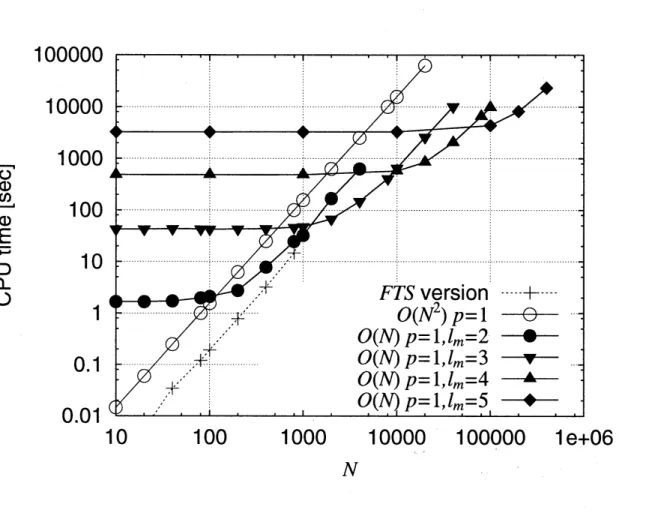
Figure 3: CPU times with the number of particles $N$. The truncation order in these
calculations is $p=1$ equivalent to $FTS$ version. The truncation order on FMM is $q=$
$2(p+2)$, the number of spacing cell is $n_{s}=1$, and themaximum levels are $l_{m}=2,3,4$ and
5. $‘ FTS$’ denotes the conventional Stokedian Dynamics for comparison.
3.2
Results
Here we utilize the $O(N^{2})$ and the $O(N)$ schemes in practice and check the performance.
The calculations
are
done by personal computer running the FreeBSD operating systemondual Pentium III processors of $550\mathrm{M}\mathrm{H}\mathrm{z}$with 1GB memory. The programs are
compi.led
bythe GNU $\mathrm{C}$ compiler optimized for the Pentium processor.
Figure 3 shows the CPU time on the calculation of (23) with the number of particles $N$
for several calculation schemes with $p=1$ which is equivalent to $FTS$ version. The result
denoted by $O(N^{2})$
uses
the six-step procedure in\S 2.4
and the results denoted by $O(N)$use
FMM procedureon
the step (ii) in the six-step procedure; that is (25). Wesee
that the CPU time of $O(N^{2})$ scheme is scaled by $N^{2}$ as expected. For $O(N)$ scheme witha
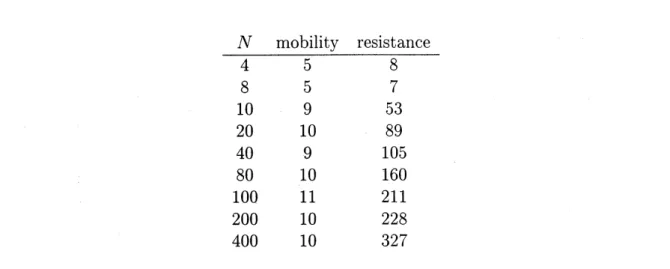
8 57 10 9 53 20 10 89 40 9 105 80 10 160 100 11 211 200 10 228 400 10 327
Table 1: Numbers of iteration for mobility and resistance problems of the simple cubic
configuration in FMM code with $p=1,$ $q=4$, and $l_{m}=2$ by $\mathrm{B}\mathrm{i}\mathrm{C}\mathrm{G}\mathrm{S}\mathrm{T}\mathrm{A}\mathrm{B}2$ method under
the accuracy $10^{-12}$.
fixed$l_{m}$,
we see
two regions where the CPUtime is almost constant with $N$ and where it isalmost scaled by $N^{2}$. The
crossover occurs
where the direct particle-to-particle calculationfor
near
cells with $O(N^{2})$ cost dominates the calculation for cells with $O(N^{0})$ cost for afixed $l_{m}$. As suggested in \S 3.1.6, we need to divide the system into finer cells for larger
$N$. In fact larger $l_{m}$ is fast for larger $N$ and the envelope line for $O(N)$ schemes is almost
scaled by $N$. The result denoted by $‘ FTS$’ is the calculation with the explicit form of the
mobilitymatrix shown in [6, Durlofsky et $al.(1987)$]. The generalization for the truncation
$p$ in $O(N^{2})$ scheme makes an extra cost. For higher versions, these behaviours
are
alsoobserved.
The choice of the schemes is independent from the types of the problem, because all problems-mobility, resistance,and mixed problems-consists of the irreducible generalized mobility equation (23) as the
core.
The total calculating cost depends on the number of iteration. Table 1 shows the number of iteration for mobility and resistance problems in FMM code. This shows that the mobility problem is solved with $O(N)$ cost, but theresistance problem need more iterations for larger $N$.
4
Conclusions
In this work, wehave shown the formulation of the hydrodynamic interaction among rigid spherical particles in low-Reynolds-number flows with free boundary condition by the mul-tipole expansion in real space and shown the generalized mobility problem which relates
the force moments to the velocity moments. By this formulation,
one
of the difficulties intruncation beyond $FTS$ version–is overcome. We have also shown the improvement of
the calculating speed which is the other difficulty in the Stokesian Dynamics method. First
we have shown the application of iterative method to solve the linear equations appeared in the highertruncations, and have given the $O(N^{2})$ scheme. Because we calculate not the
velocity moments but the velocity derivatives, the fast multipole method which is a natural extension of the conventional multipole expansioncan be easily applied andwe have shown the non-adaptive versionof the fast multipole method giving the $O(N)$ schemewith agood
convergence.
By thisscheme, the detailed hydrodynamicinteractions for huge conglomerate of particles
in
a
fluid which did not achievedso
far due to the heavy calculations (for example, thebreakup on falling in [17] and by shear in [12]$)$ are tractable. Not only for this type of
direct application, the formulation would be easily applicable for other problems such as
liquid-liquid systems and for periodic boundary condition, due to the simple formulation.
The adaptive version of the fast multipole method does not discussed in this work, but this would be important for the practical studies, because we usually meet the structures
or the patterns.in the systems and the non-adaptive version hardly handles the situations.
References
[1] BRADY, J. F.
&BOSSIS,
G. 1988 Stokesian dynamics. Annu. Rev. Fluid Mech. 20,111-157.
[2] BRADY, J. F., PHILLIPS, R. J., LESTER, J. C.
&
BOSSIS, G. 1988 Dynamic simulation of hydrodynamically interacting suspensions. J. Fluid Mech. 195, 257-280.[3] CARRIER, J., GREENGARD, L.
&
ROKHLIN, V. 1988 A fastadapti.ve
multipolealgorithm for particle simulations. J. Comput. Phys. 9, 669-686.
[4] CICHOCKI, B., $\mathrm{E}\mathrm{K}\mathrm{I}\mathrm{E}\mathrm{L}- \mathrm{J}\mathrm{E}\dot{\mathrm{Z}}\mathrm{E}\mathrm{w}\mathrm{s}\mathrm{K}\mathrm{A}$, M. L.,
&WAJNRYB,
E 1999 Lubricationcorrec-tions for three-particle contribution to short-time self-diffusion coefficients in colloidal
dispersions. J. Chem. Phys. 111, 3265-3273.
[5] DAMOUR, T.
&IYER,
B. R. 1991 Multipole analysis for electromagnetism and lin-earized gravity with irreducible Cartesian tensors. Phys. Rev. D43, 3259-3272. [6] DURLOFSKY, L., BRADY, J. F.&BOSSIS,
G. 1987 Dynamic simulation,of
hydro-dynamically interacting particles. J. Fluid Mech. 180, 21.
[7] GLUCKMAN, M. J., PFEFFER, R.
&WEINBAUM,
S. 1971 A new technique fortreating multiparticle slow viscous flow: axisymmetric flowpast spheres and spheroids. J. Fluid Mech. 50, 705-740.
Comput. Phys. 73, 325-348.
[9] GUTKNECHT, M. H. 1993 Variants ofBiCGStabfor matrices with complex spectrum.
SIAM J. Sci. Stat. Comp. 14, 1020-1033.
[10] ICHIKI, K.
&BRADY,
J. F. 2000 Many-body effects of matrix-inversion inlow-Reynolds-number hydrodynamics. Phys. Fluids.
[11] JEFFREY, D. J.
&ONISHI,
Y. 1984 Calculation of the resistance and mobility $\mathrm{f}\mathrm{u}\mathrm{n}\mathrm{c}_{-}$tions for two unequal spheres in $1\mathrm{o}\mathrm{W}^{-}\mathrm{R}\mathrm{e}\mathrm{y}\mathrm{n}\mathrm{o}\mathrm{l}\mathrm{d}\mathrm{s}$-number flow. J. Fluid Mech. 139,
261-290.
[12] KAO, S.
&MASON,
S. G. 1975 Dispersion of particles by shear. Nature 253, 619-621. [13] LADD, A. J. C. 1988 Hydrodynamic interactions inasuspensionofspherical particles.J. Chem. Phys. 88, 5051-5063.
[14] LADYZHENSKAYA, O. A. 1969 The mathematical theory
of
viscous incompressibleflow, 2nd edn. Goldon&Breach.
[15] MAZUR, P.
&VAN
SAARLOOS, W. 1982 Many-sphere hydrodynamic interactions and mobilities in a suspension. Physica A 115, 21-57.[16] Mo, G.
&SANGANI,
A. S. 1994 A method for computing Stokes flow interactionsamong spherical objects and its application to suspensions of drops and porous
parti-cles. Phys. Fluids 6, 1637-1652.
[17] NITSCHE, J. M.
&BATCHELOR,
G. K. 1997 Break-up of a falling drop containingdispersed particles. J. Fluid Mech. 340, 161-175.
[18] SAAD, Y.
&SHULTZ,
M. H. 1986 GMRES-ageneralized minimal residual algorithmfor solving nonsymmetric linear-systems. SIAM J. Sci. Stat. Comput. 7, 856-869.
[19] SANGANI, A. S.
&Mo,
G. 1996 An $O(N)$ algorithm for Stokes and Laplaceinter-$\dot{\mathrm{a}}$
ctions of particles. Phys. Fluids 8, 1990-2010.
[20] VAN DER VORST, H. A. 1992 BI-CGSTAB: A fast and smoothly converging variant
of BI-CG for the solution of nonsymmetric linear systems. SIAM J. Sci. Stat. Comp.
13, 631-644.