Dynamics
of
Vortical
Structure
in
a Homogeneous
Shear Flow
Shigeo Kida
TH
$\ovalbox{\tt\small REJECT}$R
RIMS, Kyoto UniversityMitsuru Tanaka
ffl
$\mathbb{E}$P
$|$
E
Faculty of Science, Kyoto University1.
Introduction
The coherent structures, suchastubesand layers of concentratedvorticity,observed
in fully developed turbulence have relativelylong lifetimes. They are considered to play
an essential role in turbulence dynamics. For example, the longitudinal vortex tubes
oriented nearly along the mean flow direction play an important role in the production
ofturbulenceenergy in wall turbulence. Regeneration mechanism of longitudinal vortex
tubes have been extensively investigated for this reason.(1-4) But their dynamics is not
wellunderstood yet and should be explored furthermore.
Here weconsider a homogeneous shear flow, which is one of the simplest flows with
non-zero mean flow profile. This would enable us to investigate vortical structures in
detail. Several direct numerical simulations(5-9) revealed that vortical structures that
are quite similar to those observed in a wall turbulence prevail also in homogeneous
shear turbulence. Rogers and Moin(6) observed a hairpin-shaped vortical structure in
a homogeneous shear flow with relatively weak strain. Lee et $al^{(7)}$ made comparisons
with the turbulent channel flows and found that if the mean shear rate is as strong as
that in the buffer layer of a wall turbulence, the streak structures can appear even in the
absence of a solid wall. There also exist longitudinal vortex tubes and vortexlayers(8,9)
which are observed in the wide rangeofshear strength and Reynolds number. Roughly
speaking, there are two types ofregeneration mechanisms of longitudinal vortex tubes
in wall turbulence. One is phenomena which take place at a wall. The other is the
inviscid one which may be attributed to the existence of a shear. In the research of
homogeneous shear flows we can investigate the effects of shear on the generation of
longitudinal vortex tubes separatelyfrom those of a wall.
In the present report we focus an attention to the vortical structures in a
them. In
\S 2
we briefly describe our numerical simulations.$\cdot$We examine the statistical
properties of vorticity vectors in
\S 3
and interactions betweenlongitudinal vortex tubesand vortex layers in
\S 4.
2. Numerical
Simulation
2.1 Basic Equation
We consider the motion of an incompressible viscous fluid in a linear mean shear
$U=(Sx_{2},0,0)$, (1)
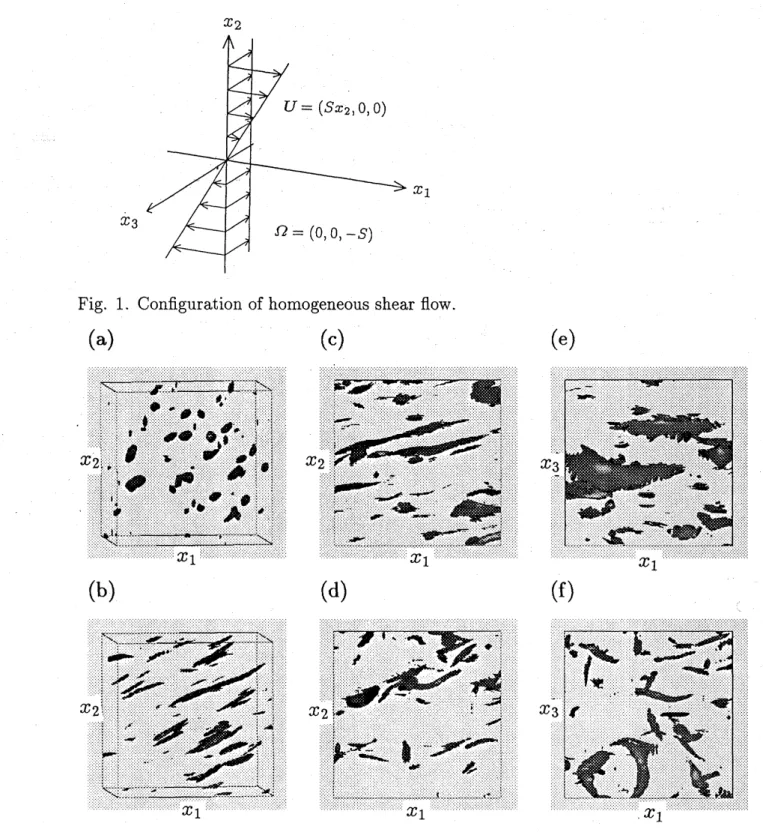
which is along the $x_{1}$-direction andvaries linearly with $x_{2}$ (Fig. 1). The mean vorticity
$\Omega$ is therefore uniform in space and is directed toward the negative
$x_{3}$-axis, that is
$\Omega=(0,0, -S)$
.
(2)Here, we call the $x_{1}-,$ $x_{2}$-and $x_{3}$-axes the streamwise, vertical, and spanwisedirections,
respectively. Time-evolution of the fluctuating velocity $u$ is described by the
Navier-Stokes equation
$\frac{\partial u_{i}}{\partial t}+Sx_{2}\frac{\partial u_{i}}{\partial x_{1}}+Su_{2}\delta_{i1}+uk\frac{\partial u_{i}}{\partial x_{k}}=-\frac{\partial p}{\partial x_{i}}+\nu\nabla^{2}u_{i}$ , $(i=1,2,3)$ (3)
supplemented by the continuity equation $\partial u_{j}/\partial x_{j}=0$, where $p$ is the pressure and $\nu$
is the kinematic viscosity of afluid. Thefluid density is assumed to be uniform and be
unity. A summation is taken over 1–3 for repeated subscripts.
By taking the curl of (3), we obtain the equation for the fluctuating vorticity
$(\omega=\nabla\cross u)$
$\frac{\partial\omega_{i}}{\Re}=-(Sx_{2}\frac{\partial\omega_{i}}{\partial x_{1}}+uk\frac{\partial\omega_{i}}{\partial x_{k}})+(S\omega_{2}\delta_{i1}-S\frac{\partial u_{i}}{\partial x_{3}}+\omega_{k}\frac{\partial u_{i}}{\partial xk})+\nu\nabla^{2}\omega_{i}$. (4)
The first and the second terms in the first brackets on the rhs of (4) represent the
advectionof vorticity bythemean shearandthefluctuatingvelocity, respectively. Three
terms in the second brackets describe a conversion offluctuating vorticity by the mean
shear, a conversion of the mean vorticity by the fluctuating field, and a conversion
of fluctuating vorticity by the fluctuating field, respectively. Finally, the last term
represents viscous diffusion.
Equation (3) is solved numerically in acoordinate systemwhich is advected by the
mean
flow.(5) The computation is carried out on 12$8^{}$ grid points in a rectangular box ofsides $4\pi\cross 2\pi\cross 2\pi$ by using the Fourier spectral$/Runge$-Kutta-Gill scheme. The initial
velocityfield is givenwith Fourier coefficientswithrandom phase and with a prescribed
energy spectrum of form $E(k)=ck^{4}\exp[-2k^{2}/k_{0}^{2}]$, where $c$ and $k_{0}$ are constants.
There are two non-dimensional parameters that characterize this problem. The
shear rate parameter
$S^{*}= \frac{u^{\prime 2}/\epsilon}{1/S}$
represents the ratio of the time-scale of the nonlinear interaction and that of the mean
shear.(7) Here, $u’$ is the rms offluctuating velocity and $\epsilon$ is the mean energy dissipation
rate. The Reynolds number
$R_{\lambda}= \frac{u^{\prime 2}/\epsilon}{1/\omega}$
represents the ratio of the time-scaleof the nonlinearinteraction and that of the viscous
effects, where$\omega’$ is the rms of vorticity. We here report the numerical results for
$S^{*}(0)=$
$16$ and $R_{\lambda}(0)=16^{(8,9)}$ The ratio of the rms ofvorticity and the shear rate is 1 at the
initialinstant and therefore the mean strain and the nonlinear self-interaction may play
comparable roles.
3.
Vortical Structures and
Vorticity
Vectors
3.1 Vortical Structures in Homogeneous Shear Turbulence
Many complicated vorticalstructures develop and interact with each other in
homo-geneous shear turbulence. There are three typical vortical stmctures; the longitudinal
vortex tubes nearly along to the streamwise direction, the lateral vortex tubes along
the spanwisedirection, and the vortex layerswith spanwise vorticity. Here, the vortical
structures are regarded as concentrated regions ofvorticity.
The spatial structure of vorticity field is visualized with the iso-surface ofvorticity
magnitude. In Figs. 2 we plot iso-surfaces at $St=0.4,2,8,14$inacubic domain of sides
$2 \pi\cross\frac{80}{128}$. The iso-surfaces at $St=8$ and $St=14$ are also seen
from.the
$x_{2}$-direction inFigs.(e) and (f), respectively. The vorticity field is isotropic at the initial instant and
regions of relativelyhigh vorticity are seenas vorticity blobs(figuresomitted). At earlier
times $(St=0.4)$ high-vorticity blobs are being stretchedin the direction inclined at $45^{o}$
to the downstream. Elongated high-vorticity regions are clearly seen at $St=2$
.
Thesethe longitudinal vortex tubes incline more toward the streamwise direction. As shown
in Figs. 2(c) and 2(e) high-vorticity regions at $St=8$ exhibit layer-like structures.
These vortex layers extend over several ten mesh-sizes in the streamwise direction and
nearly ten mesh-sizes in the spanwise. Vorticity vectors in the layers are directed along
the negative spanwise axis, that is, the direction of the mean vorticity. These vortical
structures break down at further later stages (Fig. $2(e)$). Lateral vortex tubes along
the spanwise direction are also seen in Fig. 2(f).
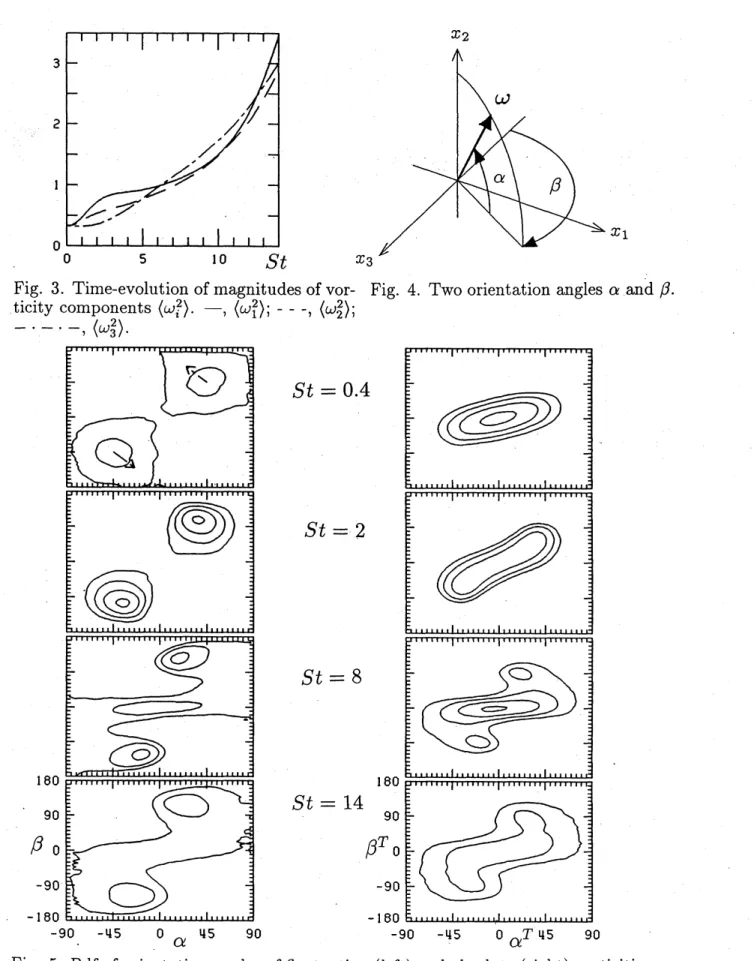
Figure 3 shows the time-evolution of magnitude of each component of vorticity
$\langle\omega_{i}^{2}\rangle,$$i=(1,2,3)$, where $\{$ $\}$ denotes the spatial average. Enstrophy $\omega^{;2}=\sum\langle\omega_{i}^{2}\rangle$
increases almost exponentially in time, whereas the behavior of each element is quite
complicated. In early stages $(0\leq St\leq 2)$ thestreamwisecomponent$\langle\omega_{1}^{2}\}$ growsrapidly,
which represents the generation and development oflongitudinal vortex tubes. In this
period the spanwise component $\langle\omega_{3}^{2}\rangle$ is almost invariant in time since vorticity lines are
not directly stretched in the spanwise direction by the mean shear. In the subsequent
period$(2\leq St\leq 5)$ the streamwise component increases only slowly in time, suggesting
that the development of longitudinal vortex tubes are balancedagainstviscous diffusion.
The spanwise component, on the other hand, exhibits a rapid growth after $St=2$,
which corresponds to the development of the vortex layers. As will be discussed in
\S 4,
the spanwise component of vorticity is generated from the shear vorticity througha spanwise vortex stretching and therefore has the same sign as the mean vorticity.
A rapid increase of the spanwise component is followed by a second rapid growth of
the streamwise component. Finally, the streamwise component becomes larger thanthe
spanwise. Longitudinal vortex tubes and vortex layers are observed as dominant vortical
stmctures in the earlier stage $(0\leq St\leq 6)$ and in the middle stage $(6 \leq St\leq 12)$,
respectively, as indicated by the fact that the streamwise and spanwise components are
the largest vorticity in the respective stages. At a further later stagelongitudinal
vortex
tubes constitute the dominant structures again.
Wehave observed the following scenario ofgeneration, development and breakdown
of vortical structures (see ref. (9)).
(i)The linear mean shear flow stretches a randomly distributed initial vorticity field
to generatelongitudinal vortex tubes. Theselongitudinalvortex tubes are subsequently
inclined more and more toward the streamwise direction increasing their strength.
Vor-ticityvectors inside longitudinal vortex tubes are less inclined than the tubes themselves.
which
stretches fluid elements in the spanwise direction most effectively to generatevortex
layers with spanwise vorticity. Vortex layers are observed to be wrapped intolongitudinal vortex tubes.
(iii) These vortex layers roll up into the lateral vortex tubes through the
Kelvin-Helmholtz
instability. These lateralvortextubes arestretchedanddeformedinto hairpinvortextubes and longitudinal vortex tubes by themean shear.
(iv) All of these typicalstructures break downinto adisordered weak vorticity field
through some instability mechanisms and complicated mutual-interactions.
Among these four processes, (ii) and (iii) are expected to play important roles in
the formation of vortical structures, that is, longitudinal vortex tubes are intensified
and regenerated by these processes. In the following we pay a special attention to the
process (ii), that includes interactions between longitudinal vortex tubes and vortex
layers.
3.2 Statistical Properties ofVorticity Vectors
In order to examine the distribution of direction of the vorticity vector
quantita-tively we introduce two orientation angles $\alpha$ and $\beta$, which are called the vertical and
horizontal angles, respectively (Fig. 4). We have the following relations,
$\{\begin{array}{l}\omega_{1}=\omega\cos\alpha\sin\beta,\omega_{2}=\omega\sin\alpha,\omega_{3}=-\omega\cos\alpha\cos\beta,\end{array}$ (5)
where $\omega=|\omega|$. Note that the origin $(\alpha, \beta)=(0^{o}, 0^{o})$ corresponds to the negative
$x_{3}$-axis, $i.e$
.
the direction of vorticity of the mean shear.Suppose that $P(t,\omega)$ is a probability density function (pdf) of vorticity vectors $\omega$
at time$\backslash t$. A pdf of the orientation angles ofvorticity(6) weighted by $\omega^{2}$ is giveby
$f(t, \alpha, \beta)\equiv c\int_{0}^{\infty}\omega^{2}P(t,\omega)\omega^{2}d\omega$, (6)
where $c$ is a normalization factor.
The change in time of vorticity vectors maygivehelpful informationfor
understand-ing of the dynamics of vortical stmctures. The time-evolution of the pdf is described
by
where $D\omega/Dt$ denotes the Lagrangian derivative ofvorticity vectors which is calculated
through the vorticity equation (4). The time-evolution of the pdfoforientation angles
is represented in the spherical coordinate system $(\omega, \alpha, \beta)$ by the equation
$\frac{\partial}{\partial t}f=2g_{\omega}-\frac{1}{\cos\alpha}\{\frac{\partial}{\partial\alpha}(g_{\alpha}\cos\alpha)+\frac{\partial}{\partial\beta}g\beta\}$, (7)
where
$g(t, \alpha,\beta)\equiv c\int_{0}^{\infty}\omega\frac{D\omega}{Dt}P\omega^{2}d\omega$ (8)
expresses the statistical change in time of direction of vorticity vectorspointing to the
direction of$\omega$
.
Notice that 2$g_{\omega}$ represents the change in time ofmagnitude of vorticityvectors, that is, the production rate of enstrophy.
Inorder to get information about the change in time of direction of vorticity vectors
we take time-derivatives of(5) to obtain the relationship between the time-derivative of
vorticity vectors and orientation angles $(\alpha, \beta)$,
$\frac{D\alpha}{Dt}=\frac{1}{\omega}(-\frac{D\omega_{1}}{Dt}\sin\alpha\sin\beta+\frac{D\omega_{2}}{Dt}\cos\alpha+\frac{D\omega_{3}}{Dt}\sin\alpha\cos\beta)$,
$\frac{D\beta}{Dt}=\frac{1}{\omega\cos\alpha}(\frac{D\omega_{1}}{Dt}\cos\beta+\frac{D\omega_{3}}{Dt}\sin\beta)$ .
The movement ofindividual orientation angles may be expressed by the pdf of $D\alpha/Dt$
and $D\beta/Dt$ weighted by $\omega^{2}$ as
$\frac{d\alpha}{dt}\equiv\int_{0}^{\infty}\omega^{2}\frac{D\alpha}{Dt}\omega^{2}d\omega=n_{\alpha}\cdot g$, $\frac{d\beta}{dt}\equiv\int_{0}^{\infty}\omega^{2}\frac{D\beta}{Dt}\omega^{2}d\omega=n_{\beta}\cdot g$, (9)
where $n_{\alpha}=(-\sin\alpha\sin\beta, \cos\alpha, \sin\alpha\cos\beta)$ and $n_{\beta}=(\cos\beta, 0, \sin\beta)/\cos\alpha$ in the physical
coordinate.
In Fig. 6 we show the weighted pdf of orientation angles of vorticity at $St=$
0.4, 2, 8, 14 (Eq(6)). The pdf’s for the fluctuating and the absolute vorticitiesareplotted
in the left and the right sides, respectively. Here, the absolute vorticity is defined as
$\omega^{T}=\Omega+\omega=(\omega_{1},\omega_{2},\omega_{3}-S)$
.
The distribution is symmetric with respect to theorigin, whichreflects theinvananceof the flowconfiguration by arotation ofangle $180^{o}$
around the $x_{3}$-axis. The pdf is normalized so that the integral over the whole angle
takes unity. Contour levels are 1, 2, 4,$\cdots$
.
First, we discuss the pdf for the fluctuating vorticity. At earlier times $(St=$
maximal
expansion of the mean shear $(Sx_{2},0,0)^{(6)}$ As time goes on, the peaks become sharper, representing longitudinal vortices are being generated. They move toward$(\alpha, \beta)=(0^{o}, \pm 180^{o})$
.
The decrease of $|\alpha|$ represents that the fluctuating vorticity tendstoincline toward the streamwise direction, while the increase of$|\beta|$ means that they are
turned
to the opposite to the vorticity of the mean shear. A mechanism of the changein direction of vorticity vector were investigated in ref. (9). The positions of the peaks
eventually stay around $(\alpha_{peak}, \beta_{peak})=\pm(20^{o}, 130^{o})$. These statistically equilibrium
angles should be maintained by some complicated dynamics of vortical
structures.
In a later period there appears two peaks at $(\alpha_{peak}^{T}, \beta_{peak}^{T})=\pm(20^{o}, 90^{o})$in the pdf
for the absolute vorticity, which also corresponds to the longitudinal vortex tubes. It
is interesting that the horizontal peak angle $\beta_{peak}^{T}$ is $\pm 90^{o},$ $i.e$
.
the absolute vorticityin the longitudinal vortex tubes are aligned perpendicularly to the mean vorticity. No
clear-cut explanation exists, however.
Inthe pdf for fluctuating vorticity there appears another peak around the origin at
$St=8$, which disappears at $St=14$
.
This peak corresponds to vortex layers generatedaround this period (see
\S 4).
Vorticity vectors corresponding to this peak are pointedto the direction of the mean shear vorticity. This peak is thin in horizontal angle $\beta$
and wide in vertical angle $\alpha$, which reflects wavy vortex layers in which the vorticity is
perpendicular to longitudinal vortex tubes.
Next, we examine the change in time of vorticity vectors. We consider the pdf
for absolute vorticity. In Fig. 6(a) we plot the production rate of enstrophy 2$g_{\omega}$ at
$St=8$
.
Positive regions are shaded. The pdf is normalized so that the total volumetakes unity as in the pdf of orientation angles. Note that $D\omega^{2}/Dt>0$ (see Fig. 3).
Contour levels are 1, 2,4, $\cdot\cdot,$$-1,$ $-2,$
$\cdot\cdot$. Vorticity is strengthened in the positive region
around the origin and is weakened in negative regions around the peaks corresponding
to the longitudinal vortex tubes $(\alpha, \beta)=(\pm 20^{o}, \pm 90^{o})$. The pdf takes very large values
at the origin, which means that vorticity vectors oriented in the direction of the mean
vorticity are most effectively stretched. On the other hand, the magnitude of vorticity
vectors in longitudinal vortex tubes tends to decrease in time. In fact, the stretching
termsin the second brackets in the rhs of (4) amplify inaverage all the vorticity vectors.
In thenegative regions, however, the effect of viscosity dominatesthat ofthe stretching.
Now,we consider thechangein timeofdirectionof vorticityvectors. In Fig. 6(b) we
plot the pdfof time-derivative field $(d\alpha/dt, d\beta/dt)$ of the orientation angles at $St=8$.
vectors. Contour lines of the pdf of the orientation angles are shown for reference (see
Fig. 5). The flow in the vectorfield has a peculiar feature. It migrates from the origin
to the right and left along a line $\beta^{T}=0$ up to $|\alpha^{T}|=40^{o}\sim 90^{O}$. Then the flow changes
its direction toward larger $|\beta^{T}|$ until $|\beta^{T}|=90^{o}\sim 120^{o}$
.
Remember that the pdf oftheorientation angles has peaks at $(\alpha_{peak}^{T}, \beta_{peak}^{T})=\pm(20^{o}, 90^{o})$ which roughly represents
the mean orientation of longitudinal vortex tubes. The flow tums around these peaks
and approaches $(\alpha_{peak}^{T}, \beta_{peak}^{T})=\pm(0^{o}, 90^{o})$
.
This flow pattem is commonly observed atother times $(St>2)$
.
Figure 6(c) illustrates the change in time ofvorticity vectors in the physical space.
Here, solid and blank arrows denote the directions of vorticity vectors and their
time-evolution. First, the vorticity vectors oriented to the direction of the mean vorticity
are inclined toward the $x_{2}$-direction. After they are inclined at $40^{o}\sim 90^{o}$ to the
neg-ative spanwise direction, they start turning toward the positive $x_{3}$-direction, $i.e$
.
theopposite to the mean vorticity. While the spanwise component of absolute vorticity
$\omega_{3}^{T}$ approaches zero, it begins to lean toward the
$x_{1}$-direction. Taking the results in
Figs. 6(a) and 6(b) into account, weunderstand that the vorticity generated around the
direction of the mean vorticity is transferred to the streamwise direction and is
dissi-pated there. Equation (7) gives the change in time of the pdf of the orientation angles.
The first and the second terms in the rhs of (7) represent the contribution from vortex
stretchingand tilting, respectively. Thefirst termdominates the second around the
ori-gin, whereas they are comparable around the peaks corresponding to the longitudinal
vortex tubes.
4.
Interactions
between
Longitudinal
Vortex Tubes and Vortex
Layers
4.1 Development of Vortex Layers due to PairsofLongitudinalVortex Tubes
We consider here a mechanism of generation of vortex layers which are observed
in the iso-vorticity surfaces $($Fig. $2(c,$ $e))$. Figure 7 illustrates a generation mechanism.
Longitudinal vortex tubes induce straining flows perpendicular to themselves. These
straining flows distort the vorticity field in a random way, which in average stretches
fluid elements. The spanwise component of absolute vorticity dominates the other
components, since the mean vorticity is along the negative spanwise axis. Therefore, the
stretchingin the spanwise direction maymost effectively contribute to magnify vorticity
an extremely strong spanwise expansion can be generated by combined effects of two
pairs of vortex tubes arranged as shown schematically in Fig. 7. If they happen to
be arranged in this way, a strong vortex layer with spanwise component of vorticity is
generated
between them. In Figs. 8 we plot the streamwise vorticity $\omega_{1}$ on the $(x_{3}, x_{2})$plane. It is positive (in clockwise rotation) in white regions, while it is negative (in
counterclockwise rotation) in dark regions. The vorticity and velocity perpendicular to
the plane are represented bylines in Figs. 8(a) and 8(b), respectively. A thin horizontal
region of concentrated vorticityin the center of Fig. 8(a) represents the cross-section of
a large vortex layer seen in Fig. 2(e). It is clearly seen that the vortex layer is being
intensified due tothe strainingflows (spanwise expansion) induced byfour(twonegative
and two positive) longitudinal vortex tubes.
4.2 Wrapping of Vortex Layer into Longitudinal Vortex Tube
Themovement of vorticity vector as shown in Fig. 6(c) may represents awrapping
process of vortex layers intolongitudinalvortex tubes. In Figs. 9 we sketch a longitudinal
vortex tube and a vortex layer. Figure 9(b) represents a cross-section of the structure.
The longitudinal tube and the layer are oriented nearly to the streamwise direction
(see Figs. 2). The mean flow comes out of the page and the mean vorticity points to
the right. As shown in Fig. 5 the absolute vorticity vectors point to the direction of
the mean vorticity in the vortex layer and are nearly aligned with the structure in the
longitudinal vortextube. The layeris deformed by the flow induced by the longitudinal
vortex tube as shown in Fig. 9(b). At the same time vorticity vectors in the layer are
turned toward the $x_{2}$-direction and then to the positive $x_{3}$-direction. The mean flow
increases vertically, which inclines the vorticity vectors toward the $x_{1}$-direction (see also
a discussion in
\S 5).
This is typically an inviscid phenomenon (remember that vorticitylines are material in an inviscid fluid). Such behavior of vorticity vectors is consistent
with the change illustrated in Fig. 6(c). In short, vorticity vectors are tilted toward the
streamwise direction rotating around the longitudinalvortex tubes.
It is seen in Figs. 8 that a vortex layer in the center is being wrapped into a
longitudinalvortex tube, one of the fourvortextubes that contribute to the development
of the vortex layer. A three dimensional view of Figs. 8 is drawn in Fig. 10. Grey
regions $(\omega_{3}^{T}\leq-5S)$ and black regions $(\omega_{1}\leq-3.2S)$ correspond to the vortex layer
and the strongest longitudinal vortex tube in Fig. 8, respectively. Black lines represent
the absolute vorticity lines starting at points in the vortex layer which are denoted by
that the flow configuration is invariant under a $180^{o}$-rotation around $x_{3}$-axis. It is
clearly seen that inside the vortex layer vorticity lines are tilted toward the $-x_{2^{-}},$ $x_{3^{-}}$,
and then to the $-x_{1}$-directions. A similar behavior of vorticity lines is observed in a
turbulent boundary
layer.(1)
5. Summary and
Discussions
We have examined interactions between longitudinal vortex tubes and vortex
lay-ers. Longitudinal vortex tubes induce straining flows around them, which stretches
fluid elements in the spanwise direction most effectively to generate vortex layers with
spanwise vorticity. An extremely strong spanwise expansion of fluid elements can be
induced effectively by combined effects of two pairs of vortex tubes arranged as shown
schematically in Fig. 7. Most ofspanwise vorticilyis created by this process. Since
lon-gitudinal vortex tubes induce swirling motions perpendicular to themselves, vorticity
lines thus stretched are tilted toward the $x_{2}$-direction. Generation of vertical vorticity
$\omega_{2}$ is mainly due to the rotation of vorticity lines (in vortexlayers) around longitudinal
vortex tubes. Since the mean shear converts vorticity from the vertical to the
stream-wise components (see thefirst term in the second brackets in the rhs of(4)), the vertical
vorticity may be regarded as a source of the streamwise vorticity.
The generation mechanism of the streamwisevorticity, however, seems to be quite
complicated. Suppose that longitudinal vortex tubes are aligned along the direction
inclined at $\alpha\approx 20^{o}$ to the streamwise axis. We introduce a new coordinate system
$(x_{s}, x_{n}, x_{3})$ along the structure. The time-evolution of the structural component of
vorticity$\omega_{\theta}$ is governed by
$\frac{D\omega_{s}}{Dt}=S(\omega_{s}\sin\alpha\cos\alpha-\omega_{n}\sin^{2}\alpha-\frac{\partial u_{3}}{\partial x_{s}}\cos^{2}\alpha)+\omega_{s}\frac{\partial u_{s}}{\partial x_{s}}-\frac{\partial u_{s}}{\partial x_{n}}\frac{\partial u_{3}}{\partial x_{s}}+\frac{\partial u_{s}}{\partial x_{3}}\frac{\partial u_{n}}{\partial x_{s}}+\nu\nabla^{2}\omega_{s}$
.
(10)
If the fluctuating field is uiiiform in the structural direction, eq.(10) is reduced to
(ne-glecting the viscous term)
$\frac{D\omega_{s}}{Dt}=S\omega_{1}\sin\alpha$. (11)
This tells us that the structural component ofvorticity can be created only if vortical
stmctures (vortex layers) contain the streamwise component of vorticity. Therefore,
a conversion of vorticity from vertical to streamwise components should be caused by
non-uniformityinthe $x_{s}$-directionratherthanthe vertical inclination of thestructureto
role, especially in the regions oflarge$\omega_{2}$ which corresponds wavy vortex layers. Vortex
layers deformed as shown in Fig. 9(b) may be stretched in the streamwise direction by
this term, when they are modulated in the streamwise ($\approx$ structural) direction or are
kinked in the spanwise direction.
It is desirable to examine how the growth of $\omega_{1}$ leads to the generation of
lon-gitudinal vortex tubes. There are several regeneration processes of longitudinal tubes
observed so far: awrapping of vortex layers into longitudinal vortextubes,(1) a roll-up
of vortex layers into lateral vortex tubes and their subsequent deformation to hairpin
vortices,(4,9) a roll-up of vortex layers in which streamwise component of vorticity is
magnified while they are inclined toward streamwise direction.(10) It may be of primary
importance to verify which one is dominant.
References
(1) J. Jim\’enez and P. Moin, “The minimal flow unit in near-wall turbulence,” J. Fluid
Mech. 225 (1991) 213.
(2) J.W. Brooke and T.J. Hanratty, “Origin of turbulent-producing eddies in a channel
flow,” Phys. Fluids A 5 (1993) 1011.
(3) P.S. Bernard, J.M. Thomas and R.A. Handler, “Vortex dynamics and the production
of Reynolds stress,” J. Fluid Mech. 253 (1993) 385.
(4) N.D. Sandham and L. Kleiser, “The late stages of transition to turbulence in channel
flow,” J. Fluid Mech. 245 (1992) 319.
(5) R.S. Rogallo, “Numerical experiments in homogeneous turbulence”, NASA Tech.
Memo. 81315 (1981).
(6) M.M. Rogers and P. Moin, “The stmcture of the vorticity field in homogeneous
turbulence flows”, J. Fluid Mech. 176 (1987) 33.
(7) M.J. Lee, J. Kim, and P. Moin, “Structure of turbulence at high shear rate”, J. Fluid
Mech. 216 (1990) 561.
(8) S. Kida and M. Tanaka, “Reynolds stress and vortical structure in a uniformly
sheared turbulence”, J. Phys. Soc. Jpn. 61 (1992) 4400.
(9) S. Kida and M. Tanaka, “Dynamics of vortical structures in a homogeneous shear
flow”, J. Fluid Mech. (1994) (in print).
(10) J. Jim\’enez and P. Orlandi, “The rollup of a vortex layer near a wall”, J. FluidMech.
Fig. 1. Configuration of homogeneous shear flow.
$($
a
$)$ $($c
$)$ $($e
$)$(b)
(d)
(f)
Fig. 2. Iso-surfaces of vorticity magnitude. (a) $St=0.4,0\leq x_{1}/\triangle x_{1}\leq 40,0\leq x_{2}/\triangle x_{2}\leq$
$80_{0\leq x_{3}/\triangle x_{3}\leq 80}80^{0\leq x_{3}/\triangle x_{3}\leq 80,|\omega}|_{\omega|=32S=2.5\omega,(c)St=8,65\leq x_{1}/\triangle x_{1}\leq 105_{7}40\leq}^{=2.2S.=2.2\omega’,(b)St=2,20\leq x_{1}/\triangle x_{1}\leq 60,0\leq x_{2}/\triangle x_{2}\leq}$
$x_{2}/\triangle x_{2}\leq 120,30\leq x_{3}/\triangle x_{3}\leq 110,$ $|\omega|=4.5S=2.4\omega’,$ $(d)St=14,45\leq x_{1}/\triangle x_{1}\leq$
$85,47\leq x_{2}/\triangle x_{2}\leq 127,47\leq x_{3}/\triangle x_{3}\leq 127,$ $|\omega|=8.9S=3.0’\omega$‘. Iso-surfaces at (e)
$x_{2}$
Fig. 3. Time-evolution of magnitudes ofvor- Fig. 4. Two orientation angles $\alpha$ and $\beta$
.
ticity components $\langle\omega_{i}^{2}\rangle$. –, $\langle\omega_{1}^{2}\rangle;---,$ $\langle\omega_{2}^{2}\rangle$;
-. $–$
.
$-,$ $\langle\omega_{3}^{2}\rangle$.
Fig. 8. Distribution of$\omega_{1}$ in the $(x_{3}, x_{2})$ plane with (a) the vorticity and (b) the velocity
(b)
Fig. 9. Sketch of wrapping ofa vortex layer into a longitudinal vortex tube.
Fig. 10. Three dimensional view of wrapping of vortex lines. $St=8$. Black and
grey
represent regions $\omega_{1}\leq-3.2S$ and $\omega_{3}^{T}\leq-5S$, respectively. $8\leq x_{1}/\triangle x_{1}\leq 25,0\leq$