Japan Advanced Institute of Science and Technology
JAIST Repository
https://dspace.jaist.ac.jp/Title Framework for Virtual Knowledge City: A Case of City Dalian, China
Author(s) Zhongtuo, Wang; Donghua, Pan Citation
Issue Date 2005-11
Type Conference Paper
Text version publisher
URL http://hdl.handle.net/10119/3837
Rights ⓒ2005 JAIST Press
Description
The original publication is available at JAIST Press http://www.jaist.ac.jp/library/jaist-press/index.html, IFSR 2005 : Proceedings of the First World Congress of the International
Federation for Systems Research : The New Roles of Systems Sciences For a Knowledge-based Society : Nov. 14-17, 2047, Kobe, Japan, Symposium 6, Session 2 : Vision of Knowledge Civilization Tradition versus Globalization
Framework for Virtual Knowledge City:
A Case of City Dalian, China
Zhongtuo Wang, Donghua Pan
Dalian University of Technology, 116024, Dalian China email: [email protected] [email protected]
ABSTRACT
In this paper, the role and framework of virtual knowledge city are investigated. Knowledge and innovation capacities are at the core of the fast growing knowledge economy. The creation of new knowledge mainly takes place in cities, where knowledge is produced, processed, exchanged and marketed. In the recent years a new theme of "knowledge city" came to the front. This is an integrated model having science, technology, supporting activities as well as normal city functions and organically integrated. There are two kinds of understanding or models for knowledge city, the model of real world and the model of virtual knowledge city. The former includes the geographical components, technical facilities, and people. The latter includes the technological and social networks and knowledge resources. The paper studies the tasks addressed by the virtual knowledge city and describes a frame work of Dalian Virtual Knowledge City.
Keywords: Knowledge economy, Knowledge creation,
Knowledge city, Virtual knowledge city
1. INTRODUCTION
We are at the dawn of a new era in history. The later half of the twentieth century witnessed the beginning of the "Information Age” based on the information technologies (ITs). The competitive power of a nation is determined by the rate at which the nation improves technologies. During the last three decades ITs have rapidly developed spread from military technology and international finance to industrial production systems and offices, and on to homes connected. It is converging to emerge as one of the fundamental production forces.
The Internet in the late 1990s made more people have access to more types and quantities of information than ever before. ITs are empowering dramatic and rapid change in all societies with consequential impacts on the welfare of the members of those societies.
The prime example of the breadth and magnitude of change made possible by the IT revolution is the globalization of the economy, a radical restructuring and dispersal of economic activities around the world, coordinated via digital information exchanges.
The network economy is an open system that exploits information through the application of specialized yet coordinated knowledge to improve productivity, in some cases simultaneously reducing inputs of all classic factors of production. Knowledge is a production factor that can produce non-linear productivity improvements. Just-in-time (JIT) and supply chain management (SCM) are examples.
The networked economy is arguably "the knowledge economy." Production systems are increasingly de-materializing their processes, putting much emphasis in information as added value, and depending on knowledge as crucial input. It can be empirically argued that at the source of productivity and competitiveness there is the capacity to generate new knowledge and process relevant information efficiently. The key focus is made on knowledge production and commercialisation, on the commoditisation of knowledge which has become possible. It is this that can be called a new paradigm of economic development. To be sure, information technologies empower humankind with the ability incessantly to feed knowledge back into knowledge, experience into experience. The pivotal role of knowledge in the Information Age substantiates the “human capital”. The growing class of “knowledge worker” does not produce any tangible product, but continuously transforms knowledge and information into new knowledge and information.
2. KNOWLEDGE CITY
Cities as the engines of economic growth are concentrations of physical and human capital, production and consumption. Cities are increasingly
recognized as critical to both economic prosperity and quality of life. They are the spaces in which most businesses and people invest, work and live.
Knowledge and innovation capacities are at the core of the knowledge economy. Among regions and industries the intellectual capital is the knowledge embedded in its people. Today the knowledge, skills, experience and innovation potential of talented individuals has greater value than capital equipment or even capital itself. Talented individuals are highly mobile and can reward those regions that attract them. The creation of new knowledge mainly takes place in cities, where knowledge is produced, processed, exchanged and marketed. Cities are best endowed with knowledge infrastructure (universities, research institutes, libraries etc.). Cities are also best endowed with transportation and information infrastructure well connected to the global economy.
To attain a competitive advantage in the knowledge economy, urban center must access, create and utilize human capital. Cities that tap knowledge assets will benefit from the talent that attract to fuel local economic growth.
In the knowledge economy, one of the driving forces of innovation is the exchange of tacit knowledge among knowledge workers. Knowledge is codified at global level, while tacit at local level. Cities are good environment for tacit knowledge exchange.
In the recent years a new theme of "knowledge city" came to the front. This is an integrated model having science, technology, supporting activities as well as normal city functions side by side and organically integrated. The research, innovation and commercial activities should be imbedded in an environment, which has all the functions of a global city. It is not too large in physical space, but large enough to belong to the global network of the business community and with a local research base belonging to the global scientific community.
The local knowledge infrastructure includes economic, social and cultural knowledge networks of the city, particularly place-specific knowledge resources.
There are two kinds of understanding or models for knowledge city, the model of real world and the model of virtual knowledge city. The former includes the geographical components, technical facilities, and people. The latter includes the technological and social networks and knowledge resources.
The knowledge city has instruments to access to the new communication technologies and make knowledge accessible to citizens.
A new educational paradigm paving the way to the Knowledge Society is e-learning, that is, the electronic learning, based on the comprehensive use of new information and educational technologies.
3. VIRTUAL KNOWLEDGE CITY
One of the main aims of establishing the virtual knowledge city is to develop an intellectual environment in municipal entities with focus on progressive technologies and the Knowledge Economy. The tasks addressed by the virtual knowledge city are as follows:
educational activities, computer literacy promotion;
providing broad access to information resources (including access with the use of electronic libraries);
the implementation of various levels of educational programmes with the use of electronic tools;
consulting services, including small business development assistance;
building the knowledge bases of territorial entities in various lines of knowledge;
coordination of activities in project and programme implementation at municipal entities based on Information Technologies.
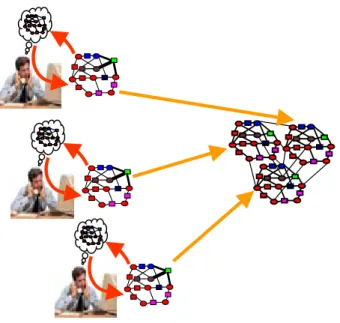
The infrastructure has a multi-network structure, which, like any network, comprises both nodes and interconnections. The components of the local knowledge infrastructure should be considered to include a) organizations and people as “knowledge nodes,” and b) interconnections between knowledge nodes. Organizations, whether private, nonprofit civic sector or public sector are obvious candidates for consideration as knowledge nodes.
Individually, people can also be considered as “knowledge nodes” of the local knowledge infrastructure as well, each with his/her own unique package of specialized knowledge and experiences to contribute. Compared to organizations, people, viewed abstractly, are “knowledge nodes” with higher levels of tacit knowledge that is more deeply integrated, the integration being much less bounded by conscious classification and design.
As important as the organization and individual knowledge nodes, the interconnections between the nodes are also critical parts of the definition of the (networked) local knowledge infrastructure. Interconnections may primarily support economic exchanges (e.g. goods and services plus all of the supporting coordination), but may also support social exchanges and cultural exchanges, in any combination. Each interconnection is conditioned by the participating knowledge nodes that are engaged in the exchanges, i.e. each node engages in an interconnection for some purpose. Both nodes and interconnections are part of a network and the definition of each is incomplete without the other.
A community collaboration may range from a single informal get together to discuss a pressing issue, to periodic meetings of neighbors or ‘communities of interest,’ or, at the other extreme, well-established community organizations with dedicated resources. The complementarity of node and interconnection is especially relevant for less established community collaborations, which often have more purpose than dedicated resources.
Cities offer a wide choice of (potential) interconnections for organizations and individuals, whether seeking prosaic exchanges or unusual, innovative synergies. A goal of management of the local knowledge infrastructure should therefore be to increase the opportunities, for individuals and organizations, to tap (other) locally available knowledge resources either directly or in multi-party collaborations.
The local knowledge infrastructure therefore should not be thought of as intangible or indefinable, a "quality" too "soft" or ethereal to be identified. Nor is it related to just one segment of urban life confined, for example, to just "community," or "economic" development. Purposeful development and management of a local knowledge infrastructure can be an explicit function of local governance, and like other public infrastructure, the local knowledge infrastructure can be viewed as an underlying base facility managed for the benefit of all stakeholders of the city.
The growth of successful knowledge cities is dependent on three interrelated processes that create and transfer tacit knowledge in cities: local knowledge creation, transfer of knowledge from external sources and transfer of that knowledge into productive activities. Researchers need to focus on processes for the creation and transfer of tacit knowledge in cities, and designers and policy makers of knowledge-based cities need to focus on creating tacit knowledge in cities.
4. THE VIRTUAL KNOWLEDGE CITY OF DALIAN
In the recent years, many cities in the world are planed to reform into knowledge cities. In China, there are several high-tech parks but has not appeared the knowledge city.
Dalian is a coastal city in the northeast part of China. It is founded in the year 1899. The city's human society can be traced as far back as 17000 years. Dalian became a coastal open city in 1984 under the ratification of the central government. It has attracted a large number of hi-tech professionals and is a choice place for high-tech industries. There are many high-tech enterprises including the knowledge-intensive companies.
Fig 1. Knowledge Network
In Dalian not only the industry, but also the progress of science and technology is undergoing. There are over 15 Universities and Colleges, and many research institutions. The museums of Nature, of History and of Conchology are well known all over the country.
Initiated by the municipal government of Dalian, a plan to build a virtual knowledge city on the metropolitan area network is undertaking.
The virtual knowledge city can be translated to the metaphor of a geographical map. We can think that the virtual knowledge city is composed of different districts. In the case of Dalian, there are 7 districts named:
Agriculture District High-tech District Manufacture District Software District
Education and training District
Technology-exchange and marketing District Museum District.
In each district there are knowledge repositories and electronic discussion rooms. A district is a collection of buildings owned and managed by a knowledge department or leader. It is a means of storage and may offer more places for dynamic activities like chat rooms, video rooms, discussion groups.
Citizens may be frequent, self-motivated users. Management may decide that all users should have access to certain buildings. The more important is that knowledge user automatically identifies both visually and conceptually what they need.
The virtual knowledge city of Dalian will organize 5 core activities:
Attracting and retaining knowledge workers Creating new knowledge
Applying new knowledge Making new integrations Developing new growth clusters.
5. REFERENCES
[1] J.E. Stiglitz, “ Public Policy for a Knowledge Economy”, Department for Trade and Industry and Center for Economic Policy Research, London, Jan. 27, 1999
[2] I. Nonaka, Takeuchi, I., The Knowledge-Creating Company – How Japanese Companies Create the Dynamics of Innovation, Oxford University Press, Oxford. 1995
[3] Castells, Manuel.. The Informational City, London: B. Blackwell. 1989
[4] Zhongtuo Wang, Knowledge Systems Engineering, (in Chinese),Science Press, Beijing China, 2003 Fig 3. Dalian TV-Center
Fig 4. Dalian Nature Museum