Monitoring the Effects of the Solar I Oil
Spill on the Benthic Infaunal Assemblages of
the Taklong Island National Marine
Reserve(TINMAR), Southern Guimaras,
Philippines
著者
Norte-Campos Annabelle G.C. del, Genito
Genibeth E.
journal or
publication title
鹿児島大学水産学部紀要=Memoirs of Faculty of
Fisheries Kagoshima University
volume
特別号(2010)
page range
3-7
The MT Solar I oil spill on August 11, 2006 is considered as the largest oil spill incident in the Philippines. It released 200,000 to 300,000 liters of highly toxic bunker fuel,
con-taminating around 24 km2 hectares of coastline and habitats in
Guimaras, specifically affecting 1,100 hectares of the Taklong Island National Marine Reserve (TINMAR) (http://www.ndcc. gov.ph). The spread path of the spill is shown in Fig. 1. While a rapid assessment of the extent of its impact on marine habi-tats was initiated, there is a need for continuing monitoring because its effects on the organisms, especially on submerged, generally non-motile ones, may not be immediately detected. The benthos comprise animals or plants living in, on, or in close association with the sea bed. Conventionally, these organisms are sub-divided on the basis of size, into micro-, meio-, macro-, and megafaunal components. The macrob-enthos are the organisms retained on a 0.5-1mm sieve. This includes nematodes, polychaetes, bivalves, amphipods, and
decapod crustaceans1-3).
The benthic biota possess a number of important attributes that justify their inclusion in marine monitoring programs concerned with biological impact. They are generally
seden-tary and intimately associated with the seabed4) which makes
them reliable biological mirrors of any activity affecting the
habitat. Furthermore, they respond to pollutant stresses2,5-7) in
varying sensitivities, thus making it possible to identify subtle
effects of pollutants as reflected in changes in community
structure8). The nature and time-scales of the earliest response
to waste inputs of benthic organisms occur at various levels of biological organization, ranging from hours to days in the sub-cellular level, to seasons to years in the community level. Any change occurring in benthic communities due to waste discharge may thus be viewed as end-points of a hierarchical
Monitoring the Effects of the Solar I Oil Spill on the Benthic Infaunal
Assemblages of the Taklong Island National Marine
Reserve(TINMAR), Southern Guimaras, Philippines
Annabelle G.C. del Norte-Campos & Genibeth E. Genito
Abstract
The effects of the Solar I oil spill on the mean densities (ind.・m-2) and species richness of the macrobenthic infaunal assemblages
of the Taklong Island National Marine Reserve (TINMAR) were monitored. Time series comparisons in 14 stations sampled before (2002) the oil spill and after (2007-present) were made. A drastic decrease in densities (54%) and richness (63%), as well as the dis-appearance of oil-sensitive gammarid amphipods were noted right after the spill (Sept 2006), and are taken as clear direct impacts of the oil. A surge of densities, re-appearance of amphipods, and occurrence of polychaete larval stages during the first quarter of the two years of monitoring, on the other hand, suggest that recruitment took place and altogether further suggest that recovery is under-way.
Marine Biology Lab, Division of Biological Sciences, College of Arts & Sciences, University of the Philippines in the Visayas, Miagao, Iloilo
Fig. 1. Map and coordinates of stations fixed for the 2nd year of the
long-term benthic community survey in Taklong Island Na-tional Marine Reserve (TINMAR), Guimaras, Philippines. Note: Station numbers follow those in the baseline
4 Mem. Fac. Fish. Kagoshima Univ., Special Issue (2010)
sequence of adaptive or degenerative responses, and it is the nature and time scales of changes occurring at this level that are likely to be of greatest significance in terms of effects on
other sources4). In a review by Gray9), of a variety of known
responses of benthic communities on stress, those which have been documented are reduced diversity, retrogression to op-portunist species, and reduction in size.
The aim of the study was to investigate and monitor the
ef-fects of the Solar I oil spill on the mean density (ind・m-2) and
species richness of the macroinfaunal assemblages in TIN-MAR.
Materials and Methods
Field sampling for the long term monitoring of macroben-thic infauna in TINMAR was conducted bi-monthly in 14 stations (Fig. 1). Macrobenthic infauna were sampled using a
corer (area = 57.78 cm2) pushed into the sediment to a depth
of 10 cm. Collected samples were preserved in 10% buffered seawater-formalin solution with Rose Bengal dye.
In the laboratory, sediment samples were sieved through a 500 µm mesh screen and stained organisms retained were hand-sorted, counted, and identified. Polychaetes were identi-fied, whenever possible, down to the species level using
vari-ous taxonomic literatures, such as Fauvel10), Fauchald11) and
Higgins and Thiel12). The rest of the macrofauna were
identi-fied only up to class or family level.
Time series comparisons were made between the 14
sta-tions common among the present study, the pre-spill 200213),
and post-spill rapid assessment14). ANOVA Single Factor was
performed on the data set to test the significance of differences in mean density and species richness between sampling dates.
Results and Discussion
The overall mean density of macrobenthos from the 14 sta-tions sampled quarterly for the second year of the long-term
monitoring program is 11,008 ind・m-2 + 11,150 (0 to 43,092).
This is lower and more variable compared to the first year
(14,676 ind・m-2 + 9,281)15). Comparison of density
distribu-tions among the four quarters (Figs. 2a-d) reveals generally low densities, with one or two outlying stations (e.g. stn 12 in March, stn 20 in May, and stn 27 in September and Decem-ber) that account for the high variability. Moreover, patterns of density distributions show consistency with the first year, i.e. relatively northern stations have higher densities.
The time-series comparison of the four sampling periods is
shown in Fig. 3. In this study, density was highest in March
(16,369 ind・m-2), providing further empirical evidence that
recruitment takes place during the first quarter of the year, as
shown in the 1st year of monitoring, where density was
high-est in the month of February 200715). As in 2007, there is a
declining pattern observed in this study, with a drastic drop
(2,820 ind.・m-2) in September 2008. While there is a general
observation of low densities in the second half of the year, it is also possible that decreased density in September 2008 is a vestigial effect of a disturbance brought about by a tropical
Fig. 2. Density (ind・m-2) distribution of macrobenthos sampled
quar-terly in 14 stations in TINMAR, Guimaras, Philippines for the long-term monitoring program Year2 (Mar-Dec 2008).
Fig. 3. Comparison of mean densities (ind・m-2) of macrobenthos in
14 stations sampled in TINMAR for the following periods: (A) pre-spill, (B) rapid assessment, (C) Yr 1 monitoring, (D) Yr 2 monitoring.
storm in June 2008, with Panay as the hardest hit area. This occurrence may have heightened the physical mixing of the water column and lowered the salinity by means of increased
rainfall (Fig. 4)16), consequently altering the ambient
condi-tions with which organisms are adapted to. It was observed that while oil pollution sensitive gammarid amphipods
dis-appeared in September 200614), they have remained present
in September 2008 (Table 1). As in the case of the Amoco Cadiz oil spill, there was a remarkable decrease in the num-ber of amphipod species (e.g. memnum-bers of the gammaridean family Ampeliscidae) that was well correlated with the
pol-lution17). Furthermore, it has been demonstrated repeatedly
in experimental studies that amphipods are more sensitive to
hydrocarbon pollution than are polychaetes or decapods17,18).
Moreover, bivalves, which are also considered to be relatively k-selected organisms, even showed an increase in mean
den-sity from 236 ind・m-2 in September 200614) to 251 ind・m-2 in
September 2008. Thus, the oil spill affected the macrobenthic community in a target-specific manner (i.e. alteration of the species composition) while a naturally occurring phenomenon such as a tropical storm may have reduced abundances with-out affecting the macrobenthic composition.
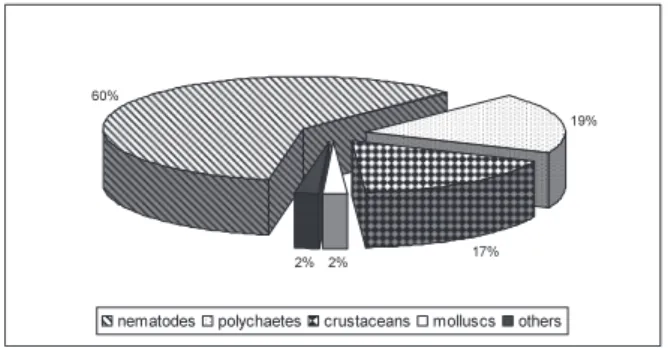
Nematodes dominated the macrobenthic community with a 60% relative composition, followed by the polychaetes (19%) and the crustaceans (17%) (Fig. 5). Albeit there is no marked
shift in community composition, in the 1st year of
monitor-ing, polychaetes dominated the macrobenthic composition, followed by the nematodes. The shift in dominance observed in this study could not be accounted at present, however, poly-chaetes and nematodes are normally co-dominants, and this shift may just be a part of the natural variability of generation times of these organisms.
Conclusions and Recommendation
An increase in macrobenthic density, the consistent surge in densities in the first quarter of the year, both interpreted as indications of recruitment, and the reappearance of hydrocar-bon-sensitive gammarid amphipods all suggest that recovery is underway. Moreover, the occurrence of a tropical storm in June 2007 illustrated the difference in effects of a natural phe-nomenon to that of an oil spill event. With the former, there is only reduction in abundances, while the latter further alters the species composition. The study of the intertidal macrobenthic community is recommended to complement results for the subtidal community.
Acknowledgments
This project is indebted to Dr. Wilfredo L. Campos for helping coordinate the activities of this project and providing suggestions useful for planning the budget, and to the research assistants of the Ocean and Marine Bio Laboratories for assis-tance in the field. The travel grant from the Japan Society for the Promotion of Science (JSPS) for the first author to present the paper in Kagoshima is also acknowledged.
Fig. 4. Monthly average rainfall (mm) from a 24-hour observation for Jan-Oct 2008. Source: National Mango Research and Devel-opment Center Weather Station, Jordan, Guimaras.
Fig. 5. Relative composition of major macrobenthic groups in the 14 stations sampled in TINMAR for the long-term monitoring program Year2.
6 Mem. Fac. Fish. Kagoshima Univ., Special Issue (2010) Ta bl e 1. R el at iv e co m po si tio n of th e to p 10 m ac ro be nt hi c in fa un a in T IN M A R a cr os s al l s am pl in g pe ri od s of th e lo ng -t er m m on ito ri ng p ro gr am y ea r2 . O ve ra ll M ar -0 8 M ay -0 8 Se p-08 D ec -0 8 Ta xa /S pe ci es % Ta xa /S pe ci es % Ta xa /S pe ci es % Ta xa /S pe ci es % Ta xa /S pe ci es % ne m at od e 59 .6 6 ne m at od e 59 .0 4 ne m at od e 71 .3 7 ne m at od e 67 .2 2 ne m at od e 37 .2 8 ta na id 8. 47 ta na id 10 .3 3 ta na id 10 .5 9 bi va lv e 8. 89 Exo gone sp. 10 .0 7 Exo gone sp. 4. 16 ga m m ar id 4. 40 Ma gelona sp. 3. 33 Exo gone sp. 6. 11 Ma gelona sp. 4. 95 ga m m ar id 2. 67 ha rp ac tic oi d 3. 64 Par aonis/P ar aonides 1. 76 Eusyllis sp. 3. 89 ga m m ar id 4. 24 Ma gelona sp. 2. 35 Exo gone dispar 3. 06 Exo gone sp. 1. 67 os tr ac od 2. 78 ta na id 3. 89 ha rp ac tic oi d 2. 21 Dorvillea sp. 2. 49 bi va lv e 1. 57 ga m m ar id 1. 67 Aricidea sp. 3. 53 bi va lv e 1. 57 cu m ac ea n 1. 34 Aricidea sp. 1. 47 Nematoner eis sp. 1. 67 C ap ite lli da e 3. 36 Aricidea sp. 1. 49 Pa ra on id ae 1. 24 os tr ac od 1. 27 Dorvillea sp. 1. 11 ha rp ac tic oi d 2. 65 os tr ac od 1. 32 os tr ac od 1. 15 ca la no id 0. 88 Questa sp. 1. 11 Heter omastus sp. 2. 30 Dorvillea sp. 1. 21 Syllis sp. 1. 05 ha rp ac tic oi d 0. 78 A utolytus sp. 0. 56 Par aonis/P ar aonides 2. 30 cu m ac ea 1. 94 Su m 85 .0 9 87 .7 5 94 .7 1 95 .0 0 76 .5 0 N 56 14 14 14 14 M ea n D en si ty ( in d・ m -2 ) 11 00 8 16 36 9 15 97 8 28 20 88 66 SD 11 15 0 16 73 0 32 66 3 41 36 94 65
References
1) Nybakken, J.W. (1997). Marine Biology: An Ecological
Ap-proach 4th Ed. Addison-Wesley Educational Publishers Inc., USA.
2) Gray, J.S. (1981). The Ecology of Marine Sediments: An Intro-duction to the Structure and Function of Benthic Communities. Cambridge University Press.
3) Steele, J.H. (1974). The Structure of Marine Ecosystems. Har-vard University Press, Cambridge, Massachusetts.
4) Rees, H.L., C. Heip, M. Vincx, and M.M. Parker (1991). Benthic communities: Use in monitoring point-source discharges, in Int l Council Explor. Sea Tech. Rep. No. 16 . Copenhagen, Denmark. 5) Bilyard, G.R. (1987). The value of benthic infauna in marine
pol-lution monitoring studies. Mar. Pollut. Bull., 18:581-585. 6) Hartley, J.P. (1982). Methods for monitoring offshore
macroben-thos. Mar. Pollut. Bull., 13:150-154.
7) Pearson, T.H. and R. Rosenberg (1978). Macrobenthic succession in relation to organic enrichment and pollution of the environ-ment. Oceanogr. Mar. Biol. Ann. Rev., 16:229-311.
8) Gray, J.S., K.R. Clarke, R.M. Warwick, and G. Hobbs (1990). Detection of initial effects of pollution on marine benthos: an ex-ample from the Ekofisk and Eldfisk oilfields, North Sea. Mar. Ecol. Prog. Ser., 66:285-299.
9) Gray, J.S. (1989). Effects of environmental stress on species rich assemblages. Biol. J. Linn. Soc., 37:19-32.
10) Fauvel, P. (1953). Annelida: Polycheta, in The Fauna of India in-cluding Pakistan, Ceylon, Burma and Malaya . Allahabad, p. 507. 11) Fauchald, K. (1977). The Polychaete Worms. Definition and keys
to the Orders, Families, and Genera. Natural History Museum of Los Angeles County. The Allan Hancock Foundation. Univ. of S. Calif. Sci. Ser., 28:1-188.
12) Higgins, R.P. and H. Thiel (1988). Introduction to the study of meiofauna. Smithsonian Inst. Press, Wash. D.C.
13) Nacionales, E.B. and W.L. Campos (2004). Macrobenthic assem-blages in Taklong Island National Marine Reserve, Southern Gui-maras. UPV J. Nat. Sci., 9(1):30-44.
14) del Norte-Campos, A.G.C. and E.N. Nacionales (2008). Assess-ment of the impact of the Solar 1 oil spill on the infaunal assem-blages of southern Guimaras, Philippines. Mar. Res. Indonesia,
33(2):213-220.
15) del Norte-Campos, A.G.C and G.E. Genito. Monitoring the Ef-fects of the Solar I Oil Spill on the Benthic Infaunal Assemblages in Southern Guimaras, Philippines. UPV J. Nat. Sci. (submitted). 16) National Mango Research and Development Center (NMRDC)
Weather Station. Monthly Weather Observation (January-Octo-ber, 2008).
17) Dauvin, J.C. (1982). Impact of Amoco Cadiz oil spill on the muddy fine sand Abra alba and Melinna palmata community from the Bay of Morlaix. Estuarine, Coastal and Shelf Science,
14:517-531.
18) Elmgren, R., S. Hansson, U. larrson, B. Sundelin, and P.D. Boehm (1983). The Tsesis oil spill: acute and long-term impact on the benthos. Mar. Biol., 73:51-65.