
Importance of two river mouths in the southern Izu Peninsula of Japan as habitats for endangered macrobenthic species.
13
0
0
全文
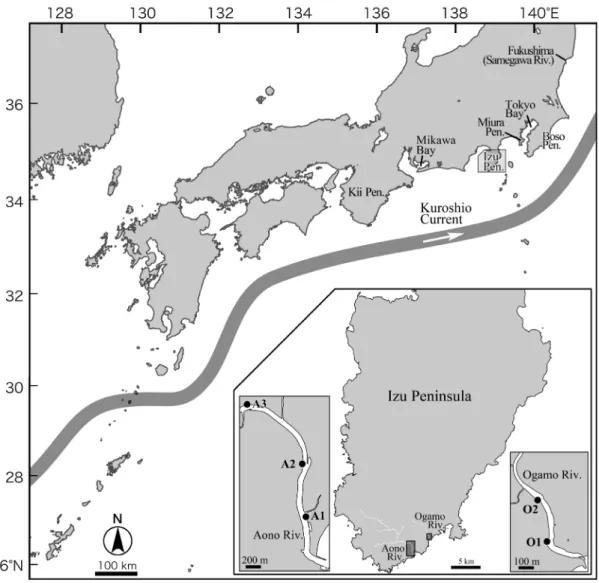
(2) Materials and Methods. invertebrates inhabited these areas with various Study site. environments, 2) identify the endangered species, as designated by the Red Lists issued by the. The. Aono. River. mouth. (34º38ʹ04.99ʺ–. Ministry of the Environment, Government of. 34º38ʹ51.76ʺ N, 138º53ʹ11.54ʺ–138º52ʹ37.19ʺ E),. Japan (2017, 2020), and 3) determine, by. located near Minami-Izu Town, southern Izu. reviewing previous studies, whether or not such. Peninsula, (Shizuoka Prefecture), provides an. endangered species had attained their distribution. intertidal habitat characterized by mud flats, gravel,. range limits. Finally, an evaluation was made. cobble stones, oyster beds and salt marshes. (Figs.. regarding. future. 1 and 2; Table 1). Vegetation at the sampling sites. conservation efforts for the Aono and Ogamo. included the common reed Phragmites australis,. River mouths.. semi-mangrove a plants (Nakanishi 2001), such as. the. appropriateness. of. Fig. 1. Map of the study region in southern Izu Peninsula, Japan. Three sampling sites for Aono River (A1, A2, and A3) and 2 for Ogamo River (O1, O2) are also shown. Aquatic Animals | February 16, 2021 | Yuhara et al. AA2021-5. 2.
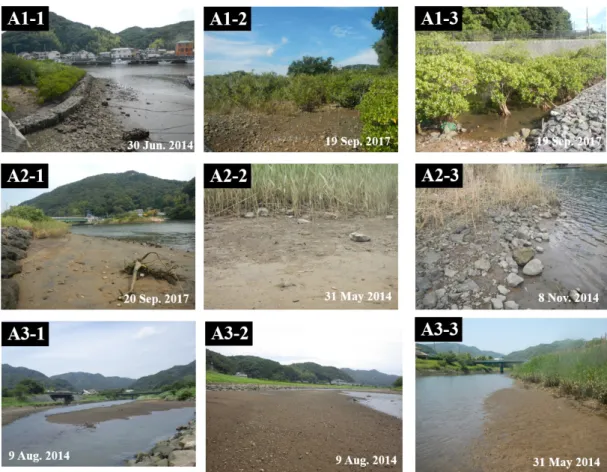
(3) Fig. 2. Three sampling sites in the Aono River mouth. A1, located 0.8 km from the river mouth, is a protected area for mangroves, designated by Shizuoka Prefecture. A1-1 shows mud flat, gravel, cobble stone, oyster bed, and salt marsh habitats, A1-2, the common reed Phragmites australis and semimangrove plant Hibiscus hamabo, and A1-3, the mangrove Kandelia obovata. A2 was located 1.4 km from the river mouth. A2-1 shows sandy-mud flat habitat, A2-2, sandy-mud flat habitat with the common reed P. australis, and A2-3, cobblestone habitat. A3 was located 2.7 km from the river mouth. A3-1 and 2 show sandy flat, gravel, and cobblestone habitats, and A3-3, gravel habitat with the common reed P. australis. Hibiscus hamabo, and the mangrove Kandelia. moutha. obovata, which was introduced in 1958 from. 138º55ʹ07.04ʺ–138º55ʹ05.46ʺ. Iriomote Island, a subtropical region of Japan,. intertidal habitats similar to those of the Aono. (Iijima and Hayashi 1999; Masuda 1999). The. River mouth. Vegetation at the sampling sites. characteristics of three sampling sites at the Aono. included the common reed P. australis, sedge. River mouth (A1, A2, and A3) are summarized in. Carex scabrifolia, and semi-mangrove plants H.. Table 1, and the locations and landscapes are. hamabo. The characteristics of these two sites (O1. shown in Figs. 1 and 2, respectively. Site A1. and O2) are detailed in Table 1, and locations and. included a protected area of mangrove forests,. landscapes are shown in Figs. 1 and 3, respectively.. (34º39ʹ19.53ʺ–34º39ʹ27.25ʺ E),. N, provides. designated by the prefectural authority (Fig. 2). The. Ogamo. River. mouth,. located. Data collection. on. approximately a 3.5 km a east of a the Aono River. Surveys were performed during daytime low. Aquatic Animals | February 16, 2021 | Yuhara et al. AA2021-5. 3.
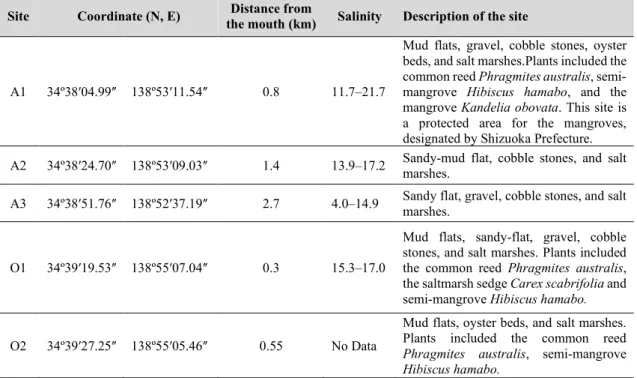
(4) Table 1. Sampling sites located on the Aono (A1, A2, and A3) and Ogamo Rivers (O1and O2), southern Izu Peninsula, Japan (see Fig. 1). Site. Coordinate (N, E). Distance from the mouth (km). Salinity. Description of the site Mud flats, gravel, cobble stones, oyster beds, and salt marshes.Plants included the common reed Phragmites australis, semimangrove Hibiscus hamabo, and the mangrove Kandelia obovata. This site is a protected area for the mangroves, designated by Shizuoka Prefecture. Sandy-mud flat, cobble stones, and salt marshes.. A1. 34º38ʹ04.99ʺ. 138º53ʹ11.54ʺ. 0.8. 11.7–21.7. A2. 34º38ʹ24.70ʺ. 138º53ʹ09.03ʺ. 1.4. 13.9–17.2. A3. 34º38ʹ51.76ʺ. 138º52ʹ37.19ʺ. 2.7. 4.0–14.9. Sandy flat, gravel, cobble stones, and salt marshes.. 15.3–17.0. Mud flats, sandy-flat, gravel, cobble stones, and salt marshes. Plants included the common reed Phragmites australis, the saltmarsh sedge Carex scabrifolia and semi-mangrove Hibiscus hamabo.. No Data. Mud flats, oyster beds, and salt marshes. Plants included the common reed Phragmites australis, semi-mangrove Hibiscus hamabo.. O1. O2. 34º39ʹ19.53ʺ. 34º39ʹ27.25ʺ. 138º55ʹ07.04ʺ. 138º55ʹ05.46ʺ. 0.3. 0.55. tide in May, August, November, and December. deposited in the Osaka Museum of Natural History. 2014, March 2015, May 2016, August and. or the Museum of Natural and Environmental. September 2017, and October 2018 at the five. History, Shizuoka.. sampling sites (Table 1). At each site, a 30-min. Salinity of river waters was measured in August. survey was conducted qualitatively by two or more. 2017 at survey sites A1, A2, A3, and O1 during. investigators for collecting epifaunal and mobile. low tide, using a hand-held conductivity meter. benthos on the substrate by hand. In March 2015. (CM-31P, TOA-DKK) placed in river water 1 cm. and August 2017, the sediment was excavated. above the sediment. The measurements were. (approximately 20 cm depth) and sieved using a 1-. conducted for three times with a 3 to 5 m interval. mm mesh sieve to collect infaunal invertebrate. at each sampling point.. animals. The collected specimens were fixed with. Results. 5 % seawater formalin, then stored in 70 % ethanol, and identified to the lowest possible taxonomic. Seventy-four taxa, representing 17 gastropods,. level using the available taxonomic literature. In. eight bivalves, nine annelids, and 40 arthropods. this study, the macrobenthic invertebrate species,. (31 decapods and nine others) (Table 2), were. which assessed as Vulnerable (VU), Near. recorded at the intertidal zones of the Aono and. Threatened (NT) and Data Deficient (DD) by the. Ogamo River mouths. Regard to the Aono River. Red List of Ministry of the Environment (Ministry. sites, 59 macrobenthic animal species were. of the Environment 2017, 2020), were defined as. recorded, representing 11 gastropods, two bivalves,. “Endangered species”. Almost specimens were. nine annelids, and 37 arthropods (29 decapods and. Aquatic Animals | February 16, 2021 | Yuhara et al. AA2021-5. 4.
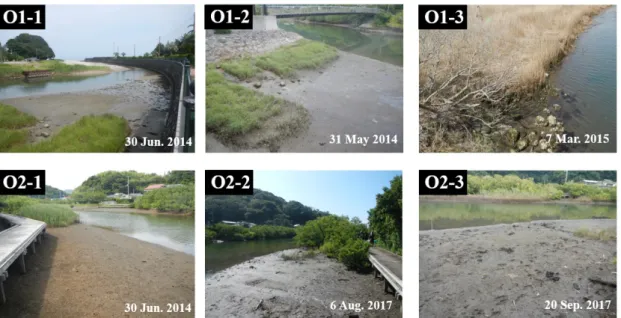
(5) Fig. 3. Two sampling sites in the Ogamo River mouth. O1 was located 0.3 km, and O2 was 0.55 km from the river mouth. O1-1 and 2 show sandy flat habitat with the saltmarsh sedge Carex scabrifolia, and O13, mud flat and cobblestone habitat with the common reed Phragmites australis. O2-1 shows mud flat habitat with the common reed P. australis, O2-2, mud flat habitat with the semi-mangrove plant Hibiscus hamabo, and O2-3, mud flat and oyster bed habitats. eight others) (Table 2). Seventeen species were. gastropod. considered the endangered ones (Ministry of the. Isognomon ephippium. Short descriptions and. Environment 2017, 2020). The salinities of sites. photographs (Fig. 4) of both species are provided. A1, A2 and A3 were showed the range of 4.0-21.7,. herein.. Cerithium. coralium. and. bivalve. regarding brackish water (Table 1). As for the Ogamo River sites, 59 macrobenthic animal. Order indet.. species were recorded, 16 gastropods, seven. Family Potamididae. bivalves, three annelids, and 33 arthropods (27. Cerithium coralium Kiener, 1841. decapods and six others) (Table 2).. Threatened category: NT (Near Threatened). Nineteen. species. were. considered. the. Material examined: OMNH-Mo39087; Shell. endangered ones (Ministry of the Environment. height 22.3 mm, Shell length 7.9 mm, Table 2; Fig.. 2017, 2020). The salinity of site O1 ranged of 15.3-. 3B.. 17.0 (Table 1), almost half salinity of the seawater.. Diagnosis: Shell tall, with short siphonal canal.. In total, 24 endangered species (Fig. 4), consisted. Whorls weakly inflated, with three spiral ribs. of three vulnerable, 20 near threatened, and one. crossed by narrower axial ribs forming granules at. data. the. intersections. Color uniformly dark brown. The. Environment 2017, 2020) were recorded over the. collected specimens corresponded closely to the. intertidal zones of the two river mouths.. descriptions of C. coralium provided by Hasegawa. deficient. species. (Ministry. of. In addition, two of new distributional records on. (2017).. southern e Izu e Peninsula e were established for the. Geographical distribution: C. coralium is widely. Aquatic Animals | February 16, 2021 | Yuhara et al. AA2021-5. 5.
(6) Fig. 4. Endangered and newly recorded species of macrobenthic animals collected from the Aono and Ogamo Rivers mouths, southern Izu Peninsula, Japan. A: Phenacolepas pulchella, B: Cerithium coralium, C: Cerithidea moerchii, D: Angustassiminea castanea, E: Assiminea aff. parasitologica, F: Acteocina koyasensis, G: Isognomon ephippium, H: Gari crassula, I: Gari chinensis, J: Grandidierella osakaensis, K: Pyrhila pisum, L: Clistocoeloma villosum, M: Orisarma intermedium, N: Parasesarma affine, O: Parasesarma tripectinis, P: Chasmagnathus convexus, Q: Helicana japonica, R: Pseudohelice subquadrata, S: Parapyxidognathus deianira, T: Ptychognathus capillidigitatus, U: Ptychognathus ishii, V: Deiratonotus japonicus, W: Macrophthalmus banzai, X: Austruca lactea, Y: Tubuca arcuata. Yellow bar indicates 1cm and white bar indicates 1 mm. Cerithium coralium (B) and Isognomon ephippium (G) are new distributional records in this study area. Aquatic Animals | February 16, 2021 | Yuhara et al. AA2021-5. 6.
(7) distributed on Kii Peninsula, and southwards to the. in Tokyo Bay representing 26 gastropods, 20. tropical Indo-Pacific, and north eastern Indian. bivalves, 17 annelids, and 33 arthropods (27. Ocean.. decapods and six others) (Yuhara et al. 2013) and. Habitat: C. coralium were found on muddy flats. 140 taxa in the Samegawa River, Fukushima. in brackish water at site O1 of Ogamo River mouth.. Prefecture representing 22 gastropods, 24 bivalves, 25 annelids, and 33 arthropods (26 decapods and. Order Ostreida. 22 others) (Kanaya et al. 2019). The present study. Family Isognomonidae. showed that the arthropods were almost equivalent. Isognomon ephippium (Linnaeus, 1758). numbers though the taxon number of gastropods,. Material examined: OMNH-Mo39088; Shell. bivalves, and annelids were low. The endangered species in prior reports recorded. height 63.1 mm, Shell length 49.5 mm, Table 2;. 29 species in Mikawa Bay (Ministry of the. Fig. 3G. medium-sized,. Environment 2019), 29 species in Tokyo Bay. suborbicular,. (Yuhara et al. 2013), and 26 species in the. relatively thick to thin, weakly convex. Umbo. Samegawa River (Kanaya et al. 2019). The present. terminal,. area. study for the southern Izu Peninsula is consistent. relatively wide, with several multivincular pits.. with these prior reports, with a roughly equivalent. Outer surface purplish, imbricated with micaceous. number of endangered species based on the Red. growth lamellae. Inner surface pearly. The. List of Ministry of the Environment. The relatively. collected specimens corresponded closely to the. high number of the endangered species may have. descriptions of I. ephippium provided by Hayami. been occurred in the southern Izu Peninsula due to. (2017).. the variety of habitats, including bare tidal flats,. Diagnosis: subequivalve,. Small. or. linguiform. projecting. to. forward.. Cardinal. salt marshes, and semi-mangrove, despite the very. Geographical distribution: I. ephippium is widely. distributed. on. Kii. Peninsula,. small tidal flats.. and. However, the following 15 endangered species,. southwards to the tropical Indo-Pacific. Habitat: I. ephippium were attached intertidally. specific to the southwest Pacific Japanese coast. to concrete blocks in brackish water at site O1 of. suggesting that these populations are nearly their. Ogamo River mouth.. northeastern distribution limits, are worthy of further mention, having been classified into three. Discussion. distribution patterns: 1) The gastropod Cerithium. The Aono and Ogamo River mouth surveys. coralium (Fig. 4B) is suggested as extending its. resulted in identification of 74 macrobenthic taxa.. distribution eastward from Kii Peninsula to Izu. Significantly, 24 endangered species were found,. Peninsula, the species being primarily distributed. comprising 32.4 % of the total species recorded.. southwest from Kii Peninsula, with a stable. Faunal surveys of adjacent East Japan tidal flats,. population at Tanabe Bay, southernmost Kii. utilizing similar survey methods, recorded 98 taxa. Peninsula (Sakamoto and Wada 2016). 2) The. Aquatic Animals | February 16, 2021 | Yuhara et al. AA2021-5. 7.
(8) amphipod Grandidierella osakaensis (Fig. 4J) and. Nakashizuka 2016; Kanaya et al. 2016). As a result,. brachyuran crabs Parasesarma tripectinis (Fig.. many macrobenthic animals became extinct or. 4O),. 4R),. endangered in these regions (Furota 2007; Yuhara. Macrophthalmus banzai (Fig. 4W), and Austruca. et al. 2013; Yuhara et al. 2016; Kanaya et al. 2019).. lactea (Fig. 4X), recorded in the present study,. Accordingly, it is of utmost importance that these. have been sporadically detected on Miura. depleted regions may be supplied with planktonic. Peninsula, east of Izu Peninsula (Kishi et al. 2013,. larvae from southwestern zones such as Izu. 2015; Ariyama and Taru 2017; Ito and Suguro. Peninsula,. 2018; Ito and Shimazu 2018). 3) The snail. community assemblages disrupted by natural. Phenacolepas pulchella (Fig. 4A), bivalves Gari. disasters and human activities. The present. crassula (Fig. 4H) and G. chinensis (Fig. 4I),. inventory will also serve as a faunal reference for. brachyuran crabs Clistocoeloma villosum (Fig. 4L),. conservation management in these study areas, and. Pseudohelice. subquadrata. (Fig.. to. recover. their. macrobenthic. 4S),. will aid future monitoring under any future. Ptychognathus capillidigitatus (Fig. 4T), P. ishii. environmental changes occurred in southern Izu. (Fig. 4U), Deiratonotus japonicus (Fig. 4V), and. Peninsula.. Parapyxidognathus. deianira. (Fig.. Tubuca arcuata (Fig. 4Y), all recorded during the Acknowledgments. present study, have been rarely recorded on the coastal areas of southern Boso Peninsula or Tokyo. The authors thank the Biology Club of Shimoda. bay (Asakura and Moriue 2007; Yuhara and. High School for field assistance, and the Shizuoka. Aizawa 2016; Inui et al. 2019; Takakura and. Prefectural Government for cooperation to conduct. Komai 2019).. the study in the protected mangrove forest survey. The inventory compiled here of macrobenthic. site of the Aono River mouth. We also thank Dr.. fauna inhabiting the intertidal zones of two river. Graham S. Hardy (Whangarei, New Zealand), who. mouths in southern Izu Peninsula suggests that. revised an early draft of the manuscript. We also. these study sites are important habitats for many. thank Dr. So Ishida (Osaka Museum of Natural. macrobenthic invertebrates, with respect to a. History) and Dr. Koichi Shibukawa (Museum of. number of endangered species. By comparison,. Natural and Environmental History, Shizuoka),. human activities and natural disasters have. who managed the voucher specimens deposited in. severely modified the Japanese Pacific coastal area. their museums. We are also grateful to the editor. of northeast of Tokyo Bay. Tokyo Bay itself. and two anonymous referees for constructive. having lost approximately 90 % of previous tidal. comments on the manuscript. This research was. flat areas since the end of the 1970s (Furota 2007).. partially supported by “FreeWill,” a Social. In the Tohoku region, the Great East Japan. Contribution Club of Ricoh Group in Japan.. Earthquake caused extensive tsunamis, creating. References. intense high impact disturbances to diverse. Ambe, D., Imawaki, S., Uchida, H., Ichikawa, K. (2004). Estimating the Kuroshio axis south of. ecosystems along the coastline (Urabe and. Aquatic Animals | February 16, 2021 | Yuhara et al. AA2021-5. 8.
(9) Japan using combination of satellite altimetry and drifting buoys. J. Oceanogr. 60: 375−382. Ariyama, H., Taru, M. (2017). Three species of Grandidierella (Crustacea: Amphipoda: Aoridae) from coastal areas of the Tohoku and Kanto-Tokai Districts, East Japan, with the description of two new species. Spec. Divers. 22: 187−200. Asakura, A., Moriue, M. (2007). Brachyuran crabs in river mouths and estuaries of Chiba Prefecture, Japan. Aquabiology. 29: 355−365. (in Japanese with English abstract) Furota, T. (2007). Tokyo Bay. In: The 7th National Survey on the Natural Environment: Shallow Sea Survey (Tidal Flats). Biodiversity Center, Nature Conservation Bureau, Ministry of the Environment, Fujiyoshida, p. 39–47 (In Japanese). Fukuda, H. (2020). Gari chinensis, Nuttalia japonica. In: Red data book in Okayama. Okayama Prefectural Government, Okayama, pp. 600, 606 (in Japanese) Hasegawa, K. (2017). Family Certhiidae. In: Okutani, T. (Ed.), Marine Mollusks in Japan, second ed., 2 vols. Tokai University Press, Hiratsuka, p. 788–793. Hayami, I. (2017). Family Isognomonidae. In: Okutani, T. (Ed.), Marine Mollusks in Japan, second ed., 2 vols. Tokai University Press, Hiratsuka, p. 1182. Iijima, Y., Hayashi, Y. (1999). Mangrove (Kandelia candel) research at South-Izu. Macro. Rev. 11: 49–56. (in Japanese with English abstract). Inui, N., Yamakawa, U., Maruyama, T., Kato, S., Sakai, T., Sato, T. (2019). Eleven noteworthy records of crab species collected from rivers flowing into Sagami Bay and adjacent waters, Japan, Bull. Kanagawa Prefect. Mus. (Nat. Sci.). 48: 43–54. Ito, T., Shimazu, T. (2018). Record of Macrophthalmus banzai Wada and Sakai, 1989, in Kanagawa Prefecture, Japan. Nat. Hist. Rep. Kanagawa. 39: 43–45. (in Japanese with English abstract) Ito, T., Suguro, N. (2018). Crabs observed at the estuary areas around Sagami Bay with the northernmost records of some rare species. Cancer. 27: 17–27. (in Japanese with English abstract) Kanaya, G., Taru, M., Miura, O., Yuhara, T., Unagami, T., Tanaka, M., Mori, K., Aoki, M., Nakai, S., Itoh, H., Inoue, T., Suzuki, T. (2016). Impacts of the 2011 tsunami on tidal flat ecosystems: future perspectives for conservation of macrozoobenthic biodiversity. Researches of Environmental. Creation from Disaster. IAIA16 Conf. Proc., 1–5. Kanaya, G., Taru, M., Yuhara, T., Unagami, T., Miura, O., Nakai, S., Itoh, H., Suzuki, T. (2019). Macrozoobenthos of the Samegawa River (Iwaki, Fukushima Prefecture) and the Momiya River (Hitachi, Ibaraki Prefecture) tidalflats, Japan: diversity shifts following the 2011 earthquake and impacts of ongoing restoration works. Jpn. J. Benthol. 73: 84–101. (in Japanese with English Abstract) Kishi, Y., Ogura, M., Era, H., Yana, H. (2013). Invertebrate biodiversity at Koajiro mud flat — a preliminary list of RD species. Hiyoshi Rev. Nat. Sci. Keio Univ. 54: 71–84. (in Japanese with English abstract) Kishi, Y., Ogura, M., Era, H., Yanase, H. (2015). Invertebrate biodiversity at Koajiro mud flat: the second list of RD species. Hiyoshi Rev. Nat. Sci. Keio Univ. 58: 19–31. (in Japanese with English abstract) Masuda, S. (1999). Plantation of mangrove at the Aono River in Minami-Izu town, Shizuoka Prefecture, Japan. Macro Rev. 11; 63–70. (in Japanese with English abstract) Ministry of the Environment. (2017). The red list of the threatened marine species. https://www.env.go.jp/press/103813.html (accessed 7 February 2021). Ministry of the Environment. (2019). Summary report of Coastal Area Survey (Rocky shore, Tidal flats, Seagrass beds and Algal beds) on Monitoring sites 1000 project in FY20082016. Biodiversity Center of Japan, Ministry of the Environment, Yamanashi. (in Japanese) Ministry of the Environment. (2020). Red List 2020 of Ministry of the Environment, Government of Japan. http://www.env.go.jp/press/107905.html (accessed 7 February 2021). Nakanishi, H. (2001). Distribution and population of Hibiscus hamabo Siebold et Zucc. In: The Association of Commemorate the Retirement of Prof. Dr. Sigetoshi Okuda (Ed.), Studies on the vegetation of alluvial plains. The Association to Commemorate the Retirement of Prof. Dr. Shigetoshi Okuda, Yokohama. p. 37–46. (in Japanese with English abstract) Otsuka, K. (1985). Characteristics of the Kuroshio in the vicinity of the Izu Ridge. J. Oceanogr. Soc. Jpn. 41: 441–451. Sakamoto, H., Wada, K. (2016). Distribution and life history of the rare tideland snails of Cerithium coralium (Cerithiidae). The Nanki Seibutu. 58: 115–120. (in Japanese) Takakura, H., Komai, T. (2019). New records of a. Aquatic Animals | February 16, 2021 | Yuhara et al. AA2021-5. 9.
(10) semiterrestrial sesarmid crab Clistocoeloma villosum (A. Milne-Edwards,1869) (Crustacea: Decapoda: Brachyura: Grapsoidea) from Izu and Boso Peninsulas, Japan. Cancer. 28: 25–31. Tanaka, H., Shibagaki, K., Ikezawa, H., Kanezawa, A., Wada, K. (2004). Occurrence of two species of fiddler crab (Decapoda, Ocypodidae) on the tidal flat of the Aono River, Izu peninsula, Shizuoka Prefecture, Japan. Jpn. J. benthol. 59: 8–12. (in Japanese with English abstract) Urabe, J., Nakashizuka, T. (2016). Ecological impacts of tsunamis on coastal ecosystems. Springer Japan, Tokyo. Yamano, H., Sugihara, K., Nomura, K. (2011). Rapid poleward range expansion of tropical reef corals in response to rising sea surface temperatures. Geophys. Res. Lett. 38: L04601.dhttps://doi.org/10.1029/2010GL046474. Yokooka, H., Yuhara, T., Tagashira, R.(2015). First record of Ptychognathus capillidigitatus (Crustacea: Decapoda: Varunidae) in Shizuoka Prefecture, Japan. Cancer. 24: 39– 45. (in Japanese). Yuhara, T., Taru, M., Furota, T. (2013). Distribution of macrobenthos species in Tokyo Bay and the importance of artificial channels for the conservation of endangered macrobenthos species. Jpn. J. Benthol. 68: 16–27 (in Japanese with English Abstract) Yuhara, T., Takagi, S., Furota, T. (2016). Distribution and habitat condition of the endangered benthic animals associated with salt marsh in Tokyo Bay, Japan. Jpn. J. Benthol. 70: 50–64. (in Japanese with English Abstract) Yuhara, T., Aizawa, K. (2016). Confirming of the fiddler crab Uca arcuata at the mouth of Obitsu River in Tokyo bay. Biol. Soc. Chiba. 65: 52–54. (in Japanese with English abstract) Yuhara, T., Yokooka, H. (2019). Life history of the sesarmid crab, Clistocoeloma villosum,on the southern coast of the Izu Peninsula, central Japan. Plankton Benthos Res. 14: 8−13.. Received: 16 January 2021 | Accepted: 13 February 2021 | Published: 16 February 2021. Aquatic Animals | February 16, 2021 | Yuhara et al. AA2021-5. 10.
(11) Aquatic Animals | February 16, 2021 | Yuhara et al. AA2021-5. 11. Gastropoda. sMollusca. Bivalvia. Class. sPhylum. Cerithium coralium Cerithidea moerchii Angustassiminea castanea. Cerithiidae. Potamididae. Assimineidae. Bursatella leachii. Pyramidellidae. Order indet.. Psammobiidae. Veneridae. Cardiida. Venerida. Ruditapes philippinarum. Nuttallia japonica. Gari chinensis. Gari crassula. Barbatia virescens. Isognomon ephippium. Arcidae. Pteriidae. Arcida. Saccostrea spp.. Ostreidae. Ostreida. Musculista senhousia. Mytilidae. Mytilida. Cingulina circinata. Acteocina koyasensis. Aplysiidae. Olivella japonica. Olividae. Aplysiida. Reticunassa festiva. Nassariidae. "Assiminea" japonica. "Assiminea" hiradoensis. Assiminea aff. parasitologica. Angustassiminea aff. satumana. Batillaria attramentaria. Batillariidae. Phenacolepas pulchella. Clithon retropictum. Clithon faba. Lunella correensis. Cephalaspidea Tornatinidae. Neogastropod. Order indet.. Neritidae. Phenacolepadidae. Turbinidae. Cycloneritida. Family. Trochida. Order. ○. ● ○ ● ○. ○. ○. ○ ○. ○. ○. ○ ○ ○. ○ ● ○. A2. A1. ○. ○ ○. ○ ○. A3. Aono River. ○ ○ ● ● ○ ○. ○ ○. ● ○ ○ ○ ○ ●. ●. ○ ○ ○ ● ○ ●. O1. ○. ○. ● ○ ○. ●. ○. O2. Ogamo River OMNH-Mo39259. Voucher Number. SPMN-MO 1017 SPMN-MO 1021. SPMN-MO 1014. SPMN-MO 1029. NT†. SPMN-MO 1030. SPMN-MO 1020, OMNH-Mo39088. OMNN-Mo39313. SPMN-MO 1031. SPMN-MO 1027. OMNH-Mo39252. SPMN-MO 1024. SPMN-MO 1023. SPMN-MO 1022. OMNH-Mo39267. SPMN-MO 1015, OMNH-Mo39258 SPMN-MO 1001, 1006, 1008, 1026, 1032, OMNHMo39246, 39248, 39254, 39257, 39260. SPMN-MO 1002, 1009, 1018. SPMN-MO 1025. OMNH-Mo39251. SPMN-MO 1019, OMNH-Mo39087. SPMN-MO 1013, OMNH-Mo39250, 39253, 39255. SPMN-MO 1011, OMNH-Mo39249. SPMN-MO 1004, 1010, OMNH-Mo39256. SPMN-MO 1003, 1005. NT. NT. NT. NT. NT. VU. NT. Red list. Table 2. Inventory of benthic macroinvertebrates recorded in the Aono and Ogamo River mouths. “○” indicates presence of taxa at each sampling site. “●” indicates presence of endangered species included in the Red List 2020 (Ministry of the Environment, 2020) and Red List of threatened marine species (Ministry of the Environment, 2017). VU: Vulnerable, NT: Near Threatened, DD: Data deficient. “OMNH” and “SPMN” indicate to have been deposited in “Osaka Museum of Natural History” and “Museum of Natural and Environmental History, Shizuoka”, respectively..
(12) Aquatic Animals | February 16, 2021 | Yuhara et al. AA2021-5. 12. s. Arthropoda. (Polychaeta). sAnnelida. Nereididae. Spionidae. Capitellidae. Cirratulidae. Sabellidae. Spionida. Order indet.. Cirratulida. Sabellida. Family. Phyllodocida. Order. Amphipoda. Malacostraca. Upogebia yokoyai Pagurus minutus Pyrhila pisum Scylla cf. serrata Metopograpsus thukuhar Chiromantes haematocheir. Upogebiidae. Paguridae. Leucosiidae. Portunidae. Grapsidae. Sesarmidae. Parasesarma affine. Orisarma intermedium. Orisarma dehaani. Clistocoeloma villosum. Penaeidae gen. sp.. Penaeidae. Decapoda. Gnorimosphaeroma sp. or spp.. Sphaeromatidae Sinelobus aff. stanfordi. Ligia cinerascens. Ligiidae. Tanaididae. Cyathura cf. muromiensis. Sinocorophium sp.. Monocorophium cf. uenoi. Grandidierella osakaensis. Grandidierella japonica. Fistulobalanus albicostatus. Anthuridae. Corophiidae. Aoridae. Balanidae. Pontodrilus cf. litoralis. Laonome sp.. Cirriformia sp.. Capitella sp.. Notomastus sp.. Pseudopolydora cf. kempi. Prionospio japonica. Hediste diadroma. Namanereis littoralis species group. Tanaidacea. Isopoda. Thecostraca. Hexanauplia. (Oligochaeta) Crassiclitellata Megascolecidae. Class. sPhylum. Table 2 (continued). ●. ○ ○ ●. ○. ○ ○ ○ ○. ○ ○ ○ ●. ○ ○. ○. ○. ○ ●. ● ○. ○ ○ ○. ○ ○. ○. ○. A3. ○ ○ ● ○. ○. ○. ○. ○. ○ ○. ○ ○ ○ ○ ○. ○ ○ ○. A2. Aono River A1. ○ ●. ○ ○. ○ ○ ○ ○ ○ ○ ○ ●. ○ ○. ○. ○ ○. O1. ○ ●. ○. ● ○. ○. O2. Ogamo River. NT. NT. NT. NT. DD. Red list. OMNH-Ar12151. OMNH-Ar12141. OMNH-Ar12100, 12128, 12138. OMNH-Ar12166. OMNH-Ar12129, 12140, 12146. OMNH-Ar12158. OMNH-Ar12102, 12155. SPMN-CR 27. SPMN-CR 17, 30. SPMN-CR 16. SPMN-CR 26. SPMN-CR 23. OMNH-Ar12157. OMNH-Ar12108, 12150. SPMN-CR 5, 15. SPMN-CR 20. SPMN-CR 21, 24. OMNHAr-10299, 10300, 12125. SPMN-CR 18, 19, 22, 25. OMNH-Ar6910, 6911. SPMN-OI 3. OMNH-Iv6909. SPMN-OI 1, SPMN-OI 5. OMNH-Iv6908. OMNH-Iv6907, 6912. OMNH-Iv6906, 6913. OMNH-Iv6905. SPMN-OI 4, OMNH-Iv6910, 6911. OMNH-Iv6904. Voucher Number.
(13) Aquatic Animals | February 16, 2021 | Yuhara et al. AA2021-5. 13. Class. Order. Total taxa. Ocypodidae. Macrophthalmida. Ilyoplax pusilla. Dotillidae. 74. Tubuca arcuata. Austruca lactea. Macrophthalmus japonicus. Macrophthalmus banzai. Scopimera globosa. Deiratonotus japonicus. Ptychognathus ishii. Ptychognathus capillidigitatus. Parapyxidognathus deianira. Hemigrapsus takanoi. Hemigrapsus penicillatus. Eriocheir japonica. Pseudohelice subquadrata. Helice tridens. Helicana japonica. Chasmagnathus convexus. Parasesarma tripectinis. Parasesarma pictum. Parasesarma bidens. Camptandriidae. Varunidae. Family. ○ ●. ○ ●. 40. ● ●. ○. ○ ○ ● ● ●. 59. 42. ○ ○ ○ ● ● ● ● ○ ○. ○ ○ ○ ● ● ● ● ○ ○. 32. 51. ○. ○ ○. ●○. ○ ● ○ ○ ○ ●. ●. ● ○. ○ ●. ○ ○. O1. 59. 25. ●. ● ○. ● ○. ●. ○. ○. ○ ○ ● ●. O2. Ogamo River. ○ ○. ○ ○ ● ● ○ ○. ○ ○ ● ●. A3. A2. Aono River A1. †: Treated as Gari minor in Ministry of the Environment (2020) (see Fukuda 2020).. sPhylum. Table 2 (continued). OMNH-Ar12152. 24. OMNH-Ar12111 VU. OMNH-Ar12106, 12130. SPMN-CR 29. OMNH-Ar12116, 12137. VU. NT. SPMN-CR 4 OMNH-Ar12107, 12115, 12121, 12131. SPMN-CR 2, 7, 8, 11, OMNH-Ar12125, 12165, 12169 NT. SPMN-CR 1, 3, 12. OMNH-Ar12153. SPMN-CR 10, OMNH-Ar12104. NT. NT. NT. OMNH-Ar12103, 12114, 12133, 12149. OMNH-Ar12154. SPMN-CR 9, 14. OMNH-Ar12098, 12112, 12127, 12139, 12144. SPMN-CR 28. NT. OMNH-Ar12101, 12109, 12142, 12145, 12167. NT. OMNH-Ar12147. OMNH-Ar12113, 12123, 12134. OMNH-Ar12099, 12110, 12126, 12148, 12168. Voucher Number. NT. NT. Red list.
(14)
図
+3


関連したドキュメント
Standard domino tableaux have already been considered by many authors [33], [6], [34], [8], [1], but, to the best of our knowledge, the expression of the
The edges terminating in a correspond to the generators, i.e., the south-west cor- ners of the respective Ferrers diagram, whereas the edges originating in a correspond to the
H ernández , Positive and free boundary solutions to singular nonlinear elliptic problems with absorption; An overview and open problems, in: Proceedings of the Variational
The only thing left to observe that (−) ∨ is a functor from the ordinary category of cartesian (respectively, cocartesian) fibrations to the ordinary category of cocartesian
If condition (2) holds then no line intersects all the segments AB, BC, DE, EA (if such line exists then it also intersects the segment CD by condition (2) which is impossible due
Keywords: Convex order ; Fréchet distribution ; Median ; Mittag-Leffler distribution ; Mittag- Leffler function ; Stable distribution ; Stochastic order.. AMS MSC 2010: Primary 60E05
It is suggested by our method that most of the quadratic algebras for all St¨ ackel equivalence classes of 3D second order quantum superintegrable systems on conformally flat
In Section 3, we show that the clique- width is unbounded in any superfactorial class of graphs, and in Section 4, we prove that the clique-width is bounded in any hereditary
