How to
Optimally Measure
a Momentum on a
Half Line
in Quantum
Mechanics
1Yutaka Shikano and
Akio
HosoyaDepartment of Physics,
Tokyo Institute of Technology
Abstract
We cannot perform the projective measurement of a momentum on a half line
since it is not an observable. Nevertheless, we would like to obtain some physical
information of the momentum on a half line. We define an optimality for
mea-surement as minimizing thevariance between an inferred outcome ofthe measured system beforea measuringprocess anda measurementoutcome ofthe probesystem
after themeasuring process, restricting our attention to the covariant measurement
studied by Holevo. Extending the domain of the momentum operator on ahalf line by introducing a two dimensional Hilbert space to be tensored, we make it self-adjoint and explicitly construct a model Hamiltonian for the measured and probe
systems. By taking the partial trace over the newly introduced Hilbert space, the
optimal covariant positive operator valued measure (POVM) ofa momentum on a
half line is reproduced. We physically describe the measuring process to optimally evaluate the momentum ofa particle on a half line.
1
Introduction
Quantum theory begins in 1899 with the discovery of the Planck law in black body
radiation. Its formulation
was
initiated by Heisenberg and Schr\"odinger respectively. In1932,
von
Neumann
mathematicallyformulated
quantum mechanics [2]as
the followingpostulates.
Postulate 1 (Representations of states and observables). $\mathcal{A}ny$ quantum system $S$ is
as-sociated with
a
separable Hilbert space $\mathcal{H}_{S}$, called the state spaceof
S. $\mathcal{A}ny$ quantum stateof
$S$ is the element $|\psi\rangle$of
the Hilbert space and is represented in one-to-onecorrespon-dence by
a
positive operator $\rho=|\psi\rangle\langle\psi|$ with unit trace, calleda
density opemtor. $\mathcal{A}ny$observable
of
$S$ is represented in one-to-one correspondence bya
self-adjoint operator $A$densely
defined
on
$\mathcal{H}_{S}$.Postulate 2 (Schr\"odinger equation).
If
$S$ is isolated in a time interval $(t, t’)$, there is aunitary operator $U$ such that
if
$S$ is in$\rho$ at $t$ then $S$ is in $\rho=U\rho U^{\uparrow}at$ $t’$.
Postulate 3 (Born formula). Any observable $A$ takes the value in
a
Borelset
$\Delta$ in any$\rho$
with the probabilityTr$[E^{A}(\Delta)\rho]$, where $E^{A}(\Delta)$ is thespectral projection
of
A correspondingto $\Delta$.
Postulate 4 (Composition rule). The composite system $S+S’$ is the tensor product
$\mathcal{H}_{S}\otimes \mathcal{H}_{S^{t}}$
of
their state spaces.lThis proceeding is for the talk at RIMS Research Meeting ”Micro-Macro Duality in Quantum
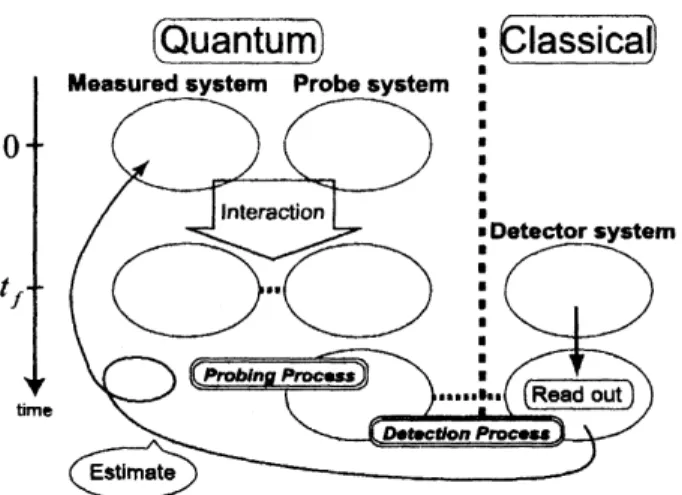
Figure 1:
Scheme
of measuring processes.We switch
on
the interaction between the
measured
and probe systems in the first step to obtain the measurement outcome oftheprobe system in the secondstep. We infer the observable of the measured system
at
$t=0$from the outcome of the probe system at $t=t_{f}$ in the third step.
Whilehe discussedmeasuringprocesses, he failed togivethe mathematicalpostulateof
measurement. Thereafter
Ozawa
introducedthe postulate ofmeasurement [3] toconsiderthe measured system and probe system.
Postulate 5 (Representation of generalized measurement). When any observable $A$
of
the measured system is measured in any state $\rho_{sys}$
before
measurement,we
obtain that thestate
after
measurement is $M(\Delta)\rho_{sys}=\ulcorner fr_{en\tau},[U(\rho_{sv^{g}}\otimes\rho_{prob})U^{\uparrow}]$ and $A$ takes the value ina
Borel set $\Delta$ with the probability $Tr_{sys}[\rho_{sys}M(\Delta)]$, where the time evolution opemtor isdefined
on
the composite system $\mathcal{H}_{sys}\otimes \mathcal{H}_{prob}$.$M(\Delta)$ is often
called
positive operatorvaluedmeasure
(POVM)or
completely positivetracepreserving (CPTP) map of measurement. The concept ofmeasurement is illustrated
in Fig. 1.
So
measurement is represented by aPOVM
whilean
interaction betweena
measured and probe system is not known. To consider
an
experimental setup ofmeasure-ment,
we
need to knowthe interaction. Wenow
derive the measurement interaction froma given POVM under
a
specific condition about measurement of a momentumon
a halfline.
For measuring processes,
we
shall consideran
optimal measurement initiated byHel-strom $[$4]. He
defined
an
optimality ofa
measuring process to minimize the variancebetween
an
outcome of a measured systembefore
the interaction anda
measurementout-come
ofa
probe systemafter
the interaction. The optimal measurement sets upper limitsto
a
POVM. In thispaper,we
explicitly constmct amodel Hamiltonian whichreproducesthe optimal POVM in a special case, while a general method is not available to construct
a
measurementmodel
froma
givenPOVM.
This paper has two main results. One is to explicitly construct
an
optimal covariantmeasurement model Hamiltonian to
measure
a momentum ofa
particle. Incase
ofa
whole line, optimal covariant measurement corresponds to projective measurement, that
half line system using the optimal covariant measurement model. Throughout this paper,
we
take the unit $\hslash=1$.2
Review
of Optimal
Covariant Measurement
Let
us
considera
measuring process described byan
interaction betweena
measuredsystem and a probe system,
the
latter of which is the part of the measuring apparatusas
a
whole. To establish the relationship between the measured and probe systems,we
consider the momentum space $\Omega=\mathbb{R}$ and a projective unitary representation ofthe shift
group
of$\Omega$. Stonc’s theorem tellsus
that the unitary representation is given by$parrow V_{p}=e^{-i\rho\hat{x}}$, (1)
where
$\hat{x}$ isthe
position operator.Definition 1. A
POVM
$M(dp)$ is covanant vnth respect to the representation $parrow V_{p}$if
$V_{p}^{\dagger}M(\Delta)V_{p}=M(\Delta_{-p})$, $p\in\Omega$ (2)
for
any
$\Delta\in \mathcal{A}(\Omega)$, where$\Delta_{p}=\{p’|p’=p+p’’, p’’\in\Delta\}$ (3)
is the image
of
the set $\Delta$ under thetransformation
$p$ and$\mathcal{A}(\Omega)$ is the Borel $\sigma- field$
of
$\Omega$.The covariant POVM has the property in the following form by using the Bom
for-mula [2, 9], $Pr\{\hat{p}\in\Delta_{p}\Vert\rho_{p+p_{0}’}\}=Tr\rho_{p+p_{0}’}M(\Delta_{p})$ $=TrV_{-p}\rho_{p_{0}’}V_{-\rho}^{\dagger}M(\Delta_{p})$ $=T\}\rho_{p_{0}’}V_{p}^{\underline{\dagger}}M(\Delta_{p})V_{-p}$ $=Tr\rho_{p_{0}’}M(\Delta)$ $=Pr\{\hat{p}\in\Delta\Vert\rho_{p_{0}’}\}$. (4)
That is, when the measured system is arbitrarily shifted, the measurement outcome is
shifted by the
same
amount. This idealized measurement is called a covanantmeasure-ment. The curious point is to correspond to the opitmal POVM under an unbiased
condition by Hayashi and Sakaguchi [5] and
more
realistic measuring device is subject toan
unbiased condition only locallyas
discussed byHotta
andOzawa
[6].By
von Neumann’s
spectral theorem, any Hilbertspace
$\mathcal{H}$can
be formally describedas
the direct integral ofa
Hilbertspace
$\mathcal{H}_{x}$,$\mathcal{H}=\int\oplus \mathcal{H}_{x}dx$, (5)
so
that any state vector $\psi\in \mathcal{H}$ is described by the vector-valued function $\psi=[\psi_{x}]$ with$\psi_{x}\in \mathcal{H}_{x}$ introducing a convenient notation $[\cdot][7,9]$. There, a position operator $\hat{x}$ acts
as
multiplication operatorsin this notation. The
same
notation $[\cdot]$ is used foran
operator-valued function. A kernel $[K(x, x’)]$, where $K(x, x’)$ is a mappingfrom $\mathcal{H}_{x’}$ to $\mathcal{H}_{x}$ for all$x$ and $x’$, defines an operator$\hat{K}$ on
$\mathcal{H}$. We can write
$\hat{K}\psi=[K(x, x^{l})][\psi_{x’}]=[\int K(x, x’)\psi_{x’}dx’]$ . (7)
The equation (6) and (7)
can
be rephrased by the bracket notationas
$\hat{x}|\psi\rangle=\int dx|x)x\langle x|\psi)$, (8)
$\hat{K}|\psi\rangle=/dx/dx’|x\rangle K(x, x’)\langle x’|\psi\rangle$, (9)
respectively. Also
we
express thenorm
in $\mathcal{H}_{x}$as
1
$\Vert_{x}$.
We are now
ina
position to explicitly describe the covariantPOVM
as
follows.Theorem 1 (Holevo [7]). Any covamant POVMin $\mathcal{H}$ has the
form
$M(dp)=[K(x, x’)e^{i(x-x’)p} \frac{dp}{2\pi}]$ , (10) $\prime inh_{l}ere[K(x, x’)]$ is apositive
definite
kernel satisfying $K(x,x)\equiv I_{x}$, the identity mappingfrom
$\mathcal{H}_{x}$ toitself.
In the above discussion,
we
have assumed that system and probe observablesare
isometric to obtain (10)
as
thePOVM.
The proof ofTheorem
1 is given in Appendix Aof $[1|$.
Next
we
tum toa
measuring process. First,we
couplea
measured system toa
probesystem. Second, the combined system is evolved in time. Finally,
we
measure
the probeobservable. The sequence of processes enables
us
to retrospectively evaluate the systemobservable at the starting time by the measurement outcome of the probe observable at
the end time (See Fig. 1).
So we
define the optimal covariant measurementas
an
optimalevaluation of the syst$em$ observable by the outcome ofthe probe observable.
Let us
assume
that $W(p-P)$ isa
deviation function, which expresses the variancebetween the inferred “measurement” outcom$ep$ of the system momentum before the
interaction and the measurement outcome $P$ofthe probe momentumafter the interaction,
satisfying
$W(p)=-/e^{ipx}\tilde{W}(dx)$, (11)
for
an
even
finite
measure
$\tilde{W}(dx)$on
$\mathbb{R}$. Letus
consider the conditionto
minimize thevariance
$R_{\rho} \{\Lambda I\}=\int_{\Omega}W(p-P)\mu_{\rho}(dp)$, (12)
where $\mu_{\rho}(dp)\equiv$ Tlr$\rho M(dp)$ is the probability distribution for the pure state $\rho=|\psi\rangle\langle\psi|$.
Because of covariance,
we
rewrite (12)as
$R_{0}\{M\}=/\Omega^{W(p)\mu_{\rho 0}(dp)}$
where
$\Phi_{\rho}(x)\equiv/\iota^{e^{ixp}\langle\psi|M(dp)\psi\rangle}$ (14)
is
a
characteristic function of $\mu_{\rho}(dp)$. We get from Eq. (10)$\Phi_{\rho}(x)=/\langle\psi_{\mu}|K(\mu, \mu-x)\psi_{\mu-x}\rangle d\mu$. (15)
Since the integral
converges
by the Cauchy-Swartz inequality and the condition $K(x, x)=$$I_{x}$, $Re\Phi_{\rho}(x)\leq\Phi_{*}(x)\equiv/\Vert\psi_{\mu}\Vert_{\mu}\Vert\psi_{\mu-x}\Vert_{\mu-x}d\mu$, (16)
so
that $R_{0} \{M\}\geq-/\int\Vert\psi_{\mu}\Vert_{\mu}\Vert\psi_{\mu-x}\Vert_{\mu-x}d\mu\tilde{W}(dx)$ $\equiv R_{0}\{M_{0}\}$, (17) where $M_{0}(dp)=[ \frac{\psi_{x}\cdot\psi_{x}^{\dagger}}{\Vert\psi_{x}||_{x}\Vert\psi_{x}’,\Vert_{x’}}e^{i(x-x’)p}\frac{dp}{2\pi}]$, (18)by transforming $\mu-x$ to $x^{l}$. Note that Eq. (18) does not depend
on
the choice of thedeviation function $W(p-P)$ because of the covariance. In the
case
of the whole linesystem, the optimal covariant
POVM
(18) in the bracket notationexpresses
$M_{0}(dp)= \int_{R}dx\int_{R}dx’|x)e^{i(x-x’)p}\frac{dp}{2\pi}\langle x’|$, (19)
noting that the normalized term $\frac{\psi_{x}\psi^{t},}{\Vert\psi_{x}\Vert_{x}||\psi_{x},\Vert_{x}}$ is the identity in the bracket notation. Using
the Fourier transformation,
$|p \rangle=\frac{1}{\sqrt{2\pi}}/\mathbb{R}^{dxe^{ipx}|x\rangle}$
’ (20)
Eq. (19) is transformed to the following equation,
$M_{0}(dp)=|p\rangle\langle p|dp$, (21)
to obtain the projective measurement of
a
momentumon a
whole line. To summarize theabove discussion,
we
obtain the optimal covariant POVM (18) to minirnize the estimatedvariance between the system and probe observables [7, 8]. We emphasize that Eq. (18)
remains valid
even
whenwe
change the domain of $x$.
3
Optimal
Measurement
Model
on a
Whole
Line
Intheprevious section,
we
haveobtained the optimal covariant POVM. Weare
now
goingto explicitly construct a Hamiltonian for
a
measurement model to realize the POVM.the system observable for a given Hamiltonian of
a
combined system, it is not to find aHamiltonian from agiven POVM. In the two dimensional case, there is a way to construct
a
modelHamiltonian
froma
given POVM [11]. Once the Hamiltonian for the combinedsystem is found,
we
can
physically realize the given POVM in principle. In the infinitedimensionalcase,
we
heuristically explore the optimal covariantPOVM for the momentumin measuring processes in the following way. In this section, we preparatively discuss
measurement of the momentum of
a
particleon a
whole line and then apply the resultsto that
on
a half line
in the next section. To makeour
exposition shorter,we
assume
thatthe wave functions $\{\psi_{x}\}$
are
normalized and themeasure
$\frac{d}{2}R\pi$ is omitted in Eq. (18). ThenEq. (18) is simply
$M_{0}=[\psi_{J_{x}}\cdot\psi_{x}^{\dagger},e^{i(x-x’)p}]$ . (22)
Let
us
considera
model
Hamiltonian[12],$\hat{\mathcal{H}}_{c,om}=\frac{1}{2m}\hat{p}^{2}+\frac{1}{2M}\hat{P}^{2}+g\hat{P}\hat{x}\delta(t)+\frac{m\omega^{2}}{2}\hat{x}^{2}$
$\equiv\hat{\mathcal{H}}_{0}+g\hat{P}\hat{x}\delta(t)$, (23)
where
a
pair $(\hat{x},\hat{p})$are
the position and thc momentum operators of the measuredsys-tem,
a
pair $(\hat{X},\hat{P})$are
those of the probe system and $\delta(t)$ is the Dirac $\delta$-function. ThisHamiltonian
is modeled from the following consideration. We take the potential of themeasured system
as a
harmonic oscillator for simplicity and the probe system is assumedto be a free particle system. Furthermore, the interaction is assumed to be instantaneous
with
a
coupling constant $g$. The interaction term $g\hat{x}\hat{P}\delta(t)$ is chosen by the followingrea-soning. Because of the covariance, i.e., the measurement value $\tilde{P}$
of the probe observable
corresponds to the “measurement” value
$\tilde{p}$ ofthe system observable at
a
certain time, weare
led toan
interaction of the momentum $\hat{P}$ of the probe system. Since the exponentsin the optimal covariant POVM (22) has a quadratic form, a possible interaction term is
either $g\hat{x}\hat{P}$
or
$g\hat{p}\hat{P}$. The latter is excluded because it does not influence the momentumof the measured system.
Let
us
assume
that the measured system itself is weakly coupled toa
bulk system atzero
temperature.We
consider the measuringprocess
from the time $t=0-$ to $t=t_{f}$.Fkom Eq. (23) the evolution operator $\hat{U}$ becomes
$\hat{U}=$ Texp $(-i \int_{0-}^{t_{f}}\hat{\mathcal{H}}_{com}dt)$
$=$ Texp $(-i/\epsilon t_{f}\hat{\mathcal{H}}_{0}dt)\exp(-i/-\epsilon\epsilon g\hat{P}\hat{x}\delta(t)dt)$
$=T$ cxp $(-il^{t_{f}}\hat{\mathcal{H}}_{0}dl)$ cxp $(-ig\hat{P}\hat{x}(0))$ , (24)
where $\epsilon$ is an infinitesimal positive parameter and $T$ stands for the time-ordered product.
We construct the Kraus operator$[\hat{\mathcal{A}}_{xx’}]$ from the evolution operator
as
follows. Giventhe initial probe stat$e|\tilde{P}\rangle$,
an
eigenstat$e$ of the momentum $\hat{P}$ oftheFigure 2: An optimal covariant measurement model. By the instantaneous interaction
between the measured and probe systems, the measured system is entangled with the
probe system.
On
the other hand, the measured system is coupled with the bulk systemat
zero
temperature to dissipate theenergy
of themeasured
system. Thuswe
optimallyevaluate the system observable at $t=0$ inferred from the outcome of the probe system
at $t=\infty$ by the momentum conservation law.
that
$\hat{A}_{xx’}=/\langle P|\langle x|\hat{U}|x’\rangle|\tilde{P}\rangle dP$
$= \sum_{j}\langle x|$Texp
$(-i \int_{\epsilon}^{t_{f}}\hat{\mathcal{H}}_{0}dt)|j\rangle\psi_{x,j}^{\dagger}\exp(-ig\tilde{P}x(0))$
$arrow\psi_{x}\cdot\psi_{x}^{\dagger},$$\exp(-ig\tilde{P}x(0))$
a
$s$ $t_{f}arrow\infty$, (25)where $|P\rangle$ is
an
eigenstate of $\hat{P},$$\psi_{x_{2}j}$ is
a wave
function corresponding to the j-thenergy
eigenstate $|j\rangle$ and $\psi=[\psi_{x}]$ is the ground state of the free Hamiltonian
$\hat{\mathcal{H}}_{0}$. In the last
line of (25), the ground state is pickcd up in the limit $t_{f}arrow\infty$, or physically speaking,
we
measure
the prob$e$ observable after sufficient time passes. $Re$call that the standard$i\epsilon$ prescription [13] implicitly
assumes
that the measured system itself is weakly coupledto the bulk system at
zero
temperature. The equation (25) is the matrix element of theKraus
operator $[\hat{\mathcal{A}}_{xx’}]$.From
the Kraus operator,we
calculate thePOVM as
$M=[ \int\hat{A}_{x’ x}^{\dagger},,A_{xx’’}dx^{l/}]=[\psi_{x}^{\dagger},$
.
$\psi_{J_{x}}\exp(-ig\tilde{P}\{x(0)-x’(0)\})]$ . (26)We identify $g\tilde{P}$ with the measurement outcome $P$ itself ofthe probe observable to
repro-duce the optimal covariant POVM (22)
on a
whole line.Now, we physically describe how
we
optimally infer the momentum of the measuredsystem just before the measuring process. First,
we
couple the measured system to theprobe syst$em$ instantaneously. Second,
we
keep the measured system in contact with thebulk system at
zero
temperature and wait for a sufficiently long time. Since theenergy
ofthe measured system is dissipated to the bulk system, the
state
of themeasured
system$\omegaarrow 0$ of the interaction Hamiltonian (23), the momentum ofthe measured system$p_{sys,\infty}$
becom
es zero
at $t_{f}=\infty$. Accordingto the momentum conservation law, we obtain$p_{sy0}6,+p_{p,0}=p_{sys,\infty}+p_{p,\infty}=p_{p,\infty}$, (27)
where $p_{sys,t}$
and
$p_{p,t}$are
the
momenta
ofthe measured
system and the probe system ata
time $t$.
Since we
can
control the probe system,we
can
precisely infer the “measurement”value $p_{9ys,0}$ ofthe momentum of the measured system at the beginning ofthe measuring
process from the measurement outcome $p_{p,\infty}$, which we
measure
in the probe system at$t_{f}=\infty$ (See Fig. 2). If $\omega$ of the Hamiltonian (23)
were
finite, the variance of themomentum of the measured system would remain finite due to the
zero
point oscillationand Eq. (27) would be modified.
Although
we
have assumed that the potential of themeasured
system is given bythe harmonic oscillator, the potential could actually be any
convex
function since the $i\epsilon$prescription picks up the ground state at $t_{f}arrow\infty$.
4
Quantum
Mechanics
on a
Half Line
According to the functional analysis,
on
which the mathematical foundation ofquantummechanics [2] is based,
an
operator $\hat{A}$ is symmetric if $\hat{\mathcal{A}}=\hat{A}\dagger$,where $\hat{\mathcal{A}}\dagger$
is the Hermite
conjugate. Further,
a
symmetric operator $\hat{A}$is self-adjoint if$\mathcal{D}(\hat{A})=\mathcal{D}(\hat{A}\dagger)$, where $\mathcal{D}(\hat{A})$
is the domain of the operator $\hat{A}_{-}$
In quantum mechanics, the observables
are
definedas
self-adjoint operators, which have real spectra [14]. Symmetric operators, however, do
not necessarily have
a
real spectrum. We need to classify symmetric operators intoself-adjoint operators, essentially self-self-adjoint operators, self-self-adjoint extendable operators and
non-self-adjoint extendable operators (for the definitions,
see
the book [14]).A
criterionis known
as
the deficiency theorem (See Appendix A).Let
us
specifically considera
quantum systemon a
half line $\mathbb{R}+\equiv[0, \infty)$.
Therehave been
many
works conceming this problem since the beginning of quantummechan-ics [15, 16, 17], e.g., the singular potential [18, 19, 20, 21]. Recently, Ful\"op et al. have
studied boundaryeffects [22, 23, 24] and Twamley and Milburn havediscussed
a
quantummeasurement model
on a
halfline by changing the coordinate $x\in \mathbb{R}_{+}$ to log$x\in \mathbb{R}[25|$.In the following consideration, we characterize the half linc system as follows. Let
us
take a Hilbert space $\mathcal{H}_{+}\equiv \mathcal{L}^{2}(\mathbb{R}_{+})$ and
a
momentum operator$\hat{p}_{+}$ in $\mathcal{H}_{+}$ defined by$\hat{p}_{+}\psi(x)=\frac{1}{i}\frac{d}{dx}\psi(x)$,
$\mathcal{D}(\hat{p}_{+})=\{\psi\in \mathcal{H}_{+};\psi(0)=0,$ $I_{0}^{\infty}| \frac{d}{dx}\psi(x)|^{2}dx<\infty\}$ (28)
Then we can see that $\hat{p}+$ is symmetric since
$\langle\phi|\hat{p}_{+}\psi\rangle=\frac{1}{i}/0\infty\overline{\phi(x)}\frac{d}{dx}\psi(x)dx$
$=[ \frac{1}{i}\overline{\phi(x)}\psi(x)]_{0}^{\infty}-\frac{1}{i}/0^{\infty}\frac{d}{dx}\overline{\phi(x)}\psi(x)dx$
$=/0^{\infty}\overline{\frac{1}{i}\frac{d}{dx}\phi(x)}\psi(x)dx$
$=\langle\hat{p}1\phi|\psi\rangle$, (29)
$\psi\in \mathcal{D}(\hat{p}_{+})$ $\phi\in \mathcal{D}(\hat{p}_{+}^{\dagger})$, (30)
where $\hat{p}_{+}^{\dagger}=\frac{1}{i}\frac{d}{dx}$ with
$\mathcal{D}(\hat{p}_{+}^{\dagger})=\{\psi\in \mathcal{H}_{+};\int_{0}^{\infty}|\frac{d}{dx}\psi(x)|^{2}dx<\infty\}$ . (31)
Therefore
we
conclude
that
$(\hat{p}_{+}, \mathcal{D}(\hat{p}_{+}))\subsetneq(\hat{p}_{+}^{\dagger}, \mathcal{D}(\hat{p}_{+}^{\dagger}))$ since $\mathcal{D}(\hat{p}_{+})\neq \mathcal{D}(\hat{p}_{+}^{\dagger})$. So
themomentum operator $\hat{p}+$ on a half line is symmetric but not self-adjoint, i.e., not
an
observable.
5
Optimal
Measurement
Model
on a
Half
Line
Let
us
apply the optimal measurement model to the half line system.We
have alreadyseen that the momentum operator (28) is not self-adjoint. First,
we
extend the domainof$\hat{p}+\acute{a}$ la Naimark
so
that the extended operator $\hat{p}$ is self-adjoint. The extended Hilbertspace is
$\mathcal{H}=\mathcal{H}_{+}\otimes \mathcal{H}_{2}$, (32)
where $\mathcal{H}\equiv \mathcal{L}^{2}(\mathbb{R}),$ $\mathcal{H}_{+}\equiv \mathcal{L}^{2}(\mathbb{R}_{+})$ and $\mathcal{H}_{2}$ is the two
dimensional
Hilbertspac
$e$of
the twolevel system with the orthonormal bases $|0\rangle$ and $|1\rangle$, often called the minimum Naimark
extension. We choose the form of the extended momentum operator
as
$\hat{p}=\hat{p}+\otimes|0\rangle\langle 0|-\hat{p}_{+}\otimes|1\rangle\langle 1|$. (33)
By the unitarytransformation $\Pi_{1}$, which isthe space inversion aroundthe
zero
point onlyfor the spin state $|1)$, the Hilbert space $\mathcal{H}$ is unitarily equivalent to
$\mathcal{H}=\mathcal{H}_{+}\otimes|0\rangle+\mathcal{H}_{-}\otimes|1\rangle=\mathcal{H}_{+}\oplus \mathcal{H}_{-}$, (34)
where $\mathcal{H}_{-}\equiv \mathcal{L}^{2}(\mathbb{R}_{-})$ and $R_{-}\equiv(-\infty, 0]$. Then
we
transform the extended momentumoperator (33) by $\Pi_{1}$
as
Figure
3:
A Naimark extension. Anauxiliary two dimensional Hilbert space$\mathcal{H}_{2}$ istensoredto the Hilbert space $\mathcal{H}_{+}$ to prepare the two (original and copied) Hilbert spaces. Then
we
spatially invert the copied Hilbert space aroumd the
zero
point. Finally, we combine theoriginal andinverted Hilbert spaces toobtain theextended Hilbert
space,
$\mathcal{H}=\mathcal{H}_{+}\otimes \mathcal{H}_{2}=$$\mathcal{H}_{+}\oplus \mathcal{H}_{-}$.
where $\hat{p}_{+}$ and $\hat{p}_{-}$
are
momentum operators, which have the following domains$\mathcal{D}(\hat{p}_{+})=\{\psi\in \mathcal{H}_{+};\psi(0)=0,$ $/0 \infty|\frac{d}{dx}\psi(x)|^{2}<\infty\}$
$\mathcal{D}(\hat{p}_{-})=\{\psi\in \mathcal{H}_{-)}\cdot\psi(0)=0,$$/-0 \infty|\frac{d}{dx}\psi(x)|^{2}<\infty\}$ , (36)
respectively. Then the extended operator$\hat{p}$ is self-adjoint extendable since the domain is
the Hilbert
space
for the whole line system. Fora
more
precise argument, see Appendix$A$, where the choice of a boundary condition $\psi(0)=0$ is also justified. These operations
are
exhibited in Fig. 3.We
adopt the form of the model Hamiltonian (23) with$\hat{p}$ being replaced by the righthand side of (35) and $x\in \mathbb{R}$,
so
that all the operators in theHamiltonian
(23)are
self-adjoint to construct the optimal covariant
measurement
in thesame
wayas
described inSec. 3. We, then, calculate the Kraus operator from the model Hamiltonian using the $i\epsilon$
prescription. Since
we
have chosen $\psi(0)=0$,we
end up with the ground state with oddparity with the
energy
$\frac{3}{2}\omega$. The Kraus operator is then$\Pi_{1}[\hat{A}_{xx’}|\Pi_{1}^{\dagger}=[\psi_{J_{x+}}\cdot\psi_{x_{+}}^{\dagger},\exp(-igP_{+}x_{+}(0))]\otimes|0\rangle\langle 0|$
$+[\psi_{x-}\cdot\psi_{x_{-}}^{\dagger},\exp(-igP_{-}x_{-}(0))]\otimes|1\rangle\langle 1|$
.
(37)From Eq. (25), the Kraus operator (37) gives the following POVM,
$\Pi_{1}M_{0}\Pi i=[\psi_{x+}\cdot\psi_{x_{+}’}^{\dagger}e^{i(x-x_{+}’)p+]}+\otimes|0)\langle 0|+[\psi_{x-}\cdot\psi_{x_{-}}^{\dagger},e^{i(x--x_{-}’)p-]}\otimes|1\rangle\langle 1|$
.
(38)By taking the partial
trace
over
$\mathcal{H}_{2}$,we
obtain the reducedPOVM
$\tilde{M}_{0}\equiv Tr_{2}M_{0}$
up to a normalization constant. Here in Eq. (39), we have transformed (38) back to $M_{0}$
by the unitary operator $\Pi_{1}$ and reproduced the optimal covariant POVM (22) restricted
to positive parameters $x$ and $x$‘.
Finally.
we
calculate the probability distribution of the momentumon
a
half line inthe optimal
case.
Asan
example, letus
assume
thepure
state $\rho=[\phi_{x_{+}}\cdot\phi_{x_{+}}^{\dagger},]$, which isa plane wave with a momentum $p_{true}$,
$\phi_{x_{+}}=Ae^{ip_{true}x+}$, (40)
for the measured system before the measuring process. We
assume
that the state (40)is properly localized to be
an
element of the Hilbert space $\mathcal{H}_{+}$. The state (40), $\phi_{x+}$, isrelaxed by the measuring process to the ground stat$e\psi_{x_{+}}\in \mathcal{H}_{+}$ given by
$\psi_{x+}=2(\frac{(m\omega)^{3}}{\pi})^{\frac{1}{4}}x_{+}\exp(-\frac{m\omega}{2}x_{+}^{2})$ .
(41)
Then
we
obtain the probabilitydistribution of
the momentum as
Tr$(\rho\tilde{M}_{0})=$ Tr $([\phi_{x_{+}’’}\cdot\phi_{x_{+}}^{\dagger},][\psi_{x+}\cdot\psi_{x_{+}^{l}}^{\dagger},$ $e^{i(x_{+}-x_{+}’’)p]})$
$= \int\int\dagger\uparrow i(x_{+}-x’’)p$
$=16 \sqrt{\frac{\pi}{(m\omega)^{3}}}|A|^{2}(p-p_{true})^{2}\exp(-\frac{1}{m\omega}(p-p_{true})^{2})$ , (42)
which has two peaks at $p=p_{true}\pm\sqrt{m\omega}$ and vanishes at $p=p_{true}$. If
we
take $\omegaarrow 0$, i.e.,the
me&sured
system is a free particle system,we can
precisely evaluate the momentumof the plane
wave
sincewe
obtain Tr$(\rho\tilde{M}_{0})=\delta(p-p_{tru\epsilon})$.Otherwise
there remainsuncertainty by quantum
zero
point oscillation and the momentum with themaximum
probability deviates by $\sqrt{m\omega}$ from the precise momentum $p_{true}$. When the potential of
the measured syst$em$ is
a
generalconvex
function, the probability distribution for themomentum becomes the modulus square of the Fourier transformation of the odd parity
ground state
wave
function.To summarize this section, we have obtained the optimal covariant POVM
on
a
halfline, which enables
us
to explicitly construct the measuring process of the momentum ona
half line.6
Summary and
Discussion
We have considered the optimal covariant measurement of momenta
on
a
half
line. Sincethe momentum operator$\hat{p}_{+}=\frac{1}{i}\frac{d}{dx}$ on
a
half line isnot self-adjoint, i.e., notan
observable.By applying the Naimark extension, the measured system is extended to the whole line
and the momentum operator on the extended system becomes self-adjoint. Then
we
havediscussed the optimal covariant measurement model
on
the extended system. By applyingHolevo’s works [7, 8, 9, $10|$, wehave obtained the optimal covariant POVM in the optimal
system
before
the interaction and the measurement outcome of the probe system afterthe interaction.
To realize
physical systems,we
have explicitlyconstructed
the modelHamiltonianfor the measured andprobe systems and coupled the measured system tothe
bulk system at zero temperature for infinitely long time. Wehave shownthat the optimal
covariant
POVM
coincides with the calculatedPOVM
from the model Hamiltonian.As
a result,
we
have presented the optimal covariant measurement model. Thenwe
havephysically explained the optimal covariant measuringprocess. By taking the partial trace
over
the auxiliaryHilbertspace
$\mathcal{H}_{2}$,we
have described the optimal covariant measurementmodel forthe momentum
on
a
half line and calculated the optimalprobabilitydistributionofthe momentum
on
a half line ina
specialcase.
The following points remain to be clarified. First,
we
haveonly discussed the covariantcase.
Peres and Scudo, however, pointed out that the covariant measurementmay
not beoptimal and mentioned counterexamples in quantum phase
measurement
[26].We
haveto check whether the optimality for any
measurement
is the optimal covariantmeasure-ment in
our
setupor
not. Second, Ozawa have recently constructed anew
Heisenberguncertainty principle [27, 28]. The inequality expresses a quantum limit of measuring
processes. It will be interesting to examine Ozawa’s inequality in
our
framework.Fi-nally,
we
have presented the model Hamiltonian (23) to physically realize the optimalcovariant
POVM
(18). We do not knowa
general method to construct a Hamiltonianfrom
an
arbitraryPOVM.
Our
analysis may bea
clue to the general method to solve theinverse problem. Furthermore, to demonstrate the measurement model experimentally,
experimental setups remain to be considered for
our
proposed model Hamiltonian.A
Deficiency
Theorem
We
referthereader to the book [29] and the paper [30] fordetails. We shall givea
criterionfor closed symmetric operators to be self-adjoint operators.
Let
us
assume
that $(\hat{A}, \mathcal{D}(\hat{\mathcal{A}}))$ is densely defined, symmetric and closed. Onedefines
the deficiency subspaces$\mathcal{N}_{\pm}$ by, for a fixed $\gamma>0$,
$\mathcal{N}_{+}=\{\psi\in \mathcal{D}(\hat{A}^{\uparrow});\hat{A}^{\uparrow}\psi=i\gamma\psi\}$ (43)
$\mathcal{N}_{-=}\{\psi\in \mathcal{D}(\hat{A}\dagger);\hat{A}^{\dagger}\psi=-i\gamma\psi\}$ (44)
ofrespective dimensions$n+$ and$n_{-}$, which arecalledthe deficiency indices of theoperator
$\hat{A}$ and denoted by a pair
$(n_{+}, n_{-})$. The following theorem holds.
Theorem 2 (Deficiency theorem). For any closed symmetric opemtor$\hat{\mathcal{A}}$
utth deficiency
indices
$(n_{+}, n_{-})_{f}$ thereare
three possibilities:1. $\hat{A}$
is self-adjoint
if
and onlyif
$n+=n_{-}=0$.2. $\hat{\mathcal{A}}$
has self-adjoint extensions
if
and onlyif
$n+=n_{-}$. There evists one-to-one$\mathcal{N}_{-}correspondence$ between self-adjoint extension
of
$\hat{A}$ and unitary maps
from
$\mathcal{N}_{+}$ toThis theorem is firstly discussed by Weyl [31] and generalized by
von
Neumann [32].Let
us
apply this theorem to the momentum operator (28)on
a
half line. First,we
solve the
differential
equations,$\hat{p}_{+}\psi_{\pm}(x)=-i\frac{d}{dx}\psi_{\pm}(x)=\pm i\gamma\psi_{\pm}(x)$, (45)
where $\gamma$ is real and positive to obtain
$\psi_{\pm}(x)\sim e^{\mp\gamma x}$
.
(46)Becauseof$\psi\in \mathcal{L}^{2}(\mathbb{R}_{+})$, only$\psi_{+}(x)$ is allowed. Therefore,
we
obtain the deficiency indices$($1,$0)$ and conclude, by the deficiency theorem, $\hat{p}_{+}$ has
no
self-adjoint extension.As
another example,we
show that the extended momentum operator (33) isself-adjoint
extendable. We obtain the
deficiency indices $(0,1)$of
$-\hat{p}_{+}$ in thesame
way.
So
the
deficiencyindices of
theextended momentum
operator (33)are
(1, 1)and
the operatoris self-adjoint extendable by the deficiency theorem.
Since
the self-adjoint extension isparametrized by $U(1),$ $\psi(0+)=e^{i\theta}\psi(0-)$ where $\theta\in \mathbb{R}$,
we
havea
freedom to choose theboundary conditions at the origin by that amount. The boundary condition $\psi(0)=0$
chosen in the main text, which
comes
from the physical requirement to the half linesystem, is mathematically legitimate in the extended system because it is
a
specialcase
ofthe $U(1)$ variety.
Acknowledgement
We would like to
thank
Mr.Yasumichi
Matsuzawa, Mr. Takahiro Sagawa and Prof.Shogo Tanimura for useful comments and
Prof.Msssnao Ozawa
for his kind suggestion.References
[1] Y. Shikano and A. Hosoya, e-Print:
arXiv:0710.1724.
[2] J.
von
Neumann, Mathematische Grundlagen der Quantumechanik (Springer, Berlin,1932), [Mathematical
foundations
of
quantum mechanics (Princeton UniversityPress, Princeton, 1955).
1
[3] M. Ozawa, J. Math. Phys. 25,
79-87
(1984).[4]
C.
W. Helstrom, Int. J. Theor. Phys. 11,357-378
(1974).[5] M. Hayashi and F. Sakaguchi,
J.
Phys.A
33,7793
(2000).[6] M. Hotta and M. Ozawa, Phys. Rev. A 70,
022327
(2004).[7$|$ A.
S.
Holevo, Rep. Math. Phys. 13,379-399
(1978).[9] A. S. Holevo, Probabilistic and statistical aspects
of
quantum theory (North-Holland,Amsterdam, 1982).
[10] A. S. Holevo, Statistical Structure
of
Quantum Theory (Springer, Berlin, 2001).[11] M. A. Nielsen and I. L. Chuang, Quantum Computation and Quantum
Information
(Cambridge University Press, Cambridge, 2000).
$[12|$ This operator is, in general, not symmetric. In fact
we
need check that this operatoris self-adjoint but do not explicitly construct the self-adjoint operator, for example
taking relatively bounded.
[13]
E. S. Abers and B. W.
Lee, Phys. Rep. 9,1-141
(1973).[14] N. I.
Akhiezer
and I. M. Glazman, Theoryof
Linear Opemtors in Hilbert Space(Dover, New York, 1993).
[15] F. Rellich, Math. Ann. 122,
343-368
(1950).[16] T. E. Clark, R.
Menioff
and D. H. Sharp, Phys.Rev.
$D22,3012- 3016$ (1980).[17] E. Farhi and S. Gutmann, Int. J. Mod. Phys. A 5,
3029-3051
(1990).[18] K. M. Case, Phys. Rev. 80,
797-806
(1950).[19] A. M. Krall, J. Diff. Eq. 45, 128-138 (1982).
[20]
A.
N. Gordeyev andS.
C. Chhajlany, J. Phys. A 30,689&6909
(1997).[21] T. F\"ul\"op, e-Print: $arXiv:0708.0866$.
[22] T. F\"ul\"op, T. Cheon and I. Tsutsui, Phys. Rev. A 66, 052102 (2002).
[23] I. Tsutsui, T. F\"ul\"op and T. Cheon, J. Phys. A 36,
275-287
(2003).[24] T. F\"ul\"op, Ph.D. thesis, University of Tokyo,
2005.
[25] J. Twamley and G. J. Milburn, New J. of Phys. 8, 328 (2006).
[26] A. Peres and P. Scudo, J. Mod. Phys. 49, 1235-1243 (2002).
[27] M. Ozawa, Phys.
Rev.
A 67,042105
(2003).[28] M.
Ozawa,
Ann. Phys. 311,350-416
(2004).[29] M. Reed and B. Simon, Methods
of
Modem Mathematical Physics $\Pi$, FourierAnal-ysis, Self-Adjointness (Academic Press, New York, 1975).
[30]
G. Bonneau, J. Faraut
andG.
Valent, Am. J. Phys. 69,322-331
(2001).[31] H. Weyl, Math. Ann. 68, 220-269 (1910).