Symmetry-Breaking Bifurcation
of
Radially Outgoing
Flow
between Two
Disks
同志社大 ・工 水島 二郎 (Jiro MIZUSHIMA)
田中秀和 (Hidekazu TANAKA)
Department of Mechanical Engineering, Doshisha University
1. Introduction
Radiallyoutgoingflow between two parallel circular disks isasimple model for flows inthe injection
molding of plastic, hydrostatic air bearings and centrifugal compressor diffusers. The local Reynolds
number defined by usingthe half distance between two circular disks and the local representative velocity
decreases as the flow goesdownstream between two disks.
Appearance of separationvortices in the flow field was reported by $\mathrm{I}\mathrm{s}\mathrm{h}\mathrm{i}\mathrm{z}\mathrm{a}\mathrm{w}\mathrm{a}^{1,2)}$, that
isexplained by
the presenceofanadverse pressuregradient at small radii. He analyzed the flow by applying the boundary
layer theorywith aseries-expansion method for the inlet region and with amomentum-integral methodfor
the downstream region onthe assumption ofsymmetricflowfield, and predicted the threshold Reynolds
number$Re_{\mathrm{t}}$forthe appearance of the separationvorticesas $Re_{\mathrm{t}}\sim 100$
.
Itisadded that Ishizawaassumedauniform flow at the inlet section and the non-dimensional inlet radius, the ratio of the inlet radius to
the half width between two disks, being unity. The separation vortices were also found to appear in the
numerical results by$\mathrm{R}\mathrm{a}\mathrm{a}1^{3)}$
who made numerical calculations of the steady-state solution by using finite
difference approximation on the assumption of symmetric flow field along the center line between two
disks for the sameflow field as Ishizawa treated. However, the value of the throshold Reynolds number
evaluated by Raal is 60 which differs significantly from the value $Re_{\mathrm{t}}\sim 100$predicted by Ishizawa.
Mochizuki and $\mathrm{Y}\mathrm{a}\mathrm{n}\mathrm{g}^{4)}$ investigated the instability of the flow numerically and experimentally. The
flow-visualization method wasemployedintheir experiments and the dynamical vorticity transport
equa-tions were solved by using finite difference approximation without assuming the symmetry along the
centerline between two disks in numerical simulations. They observed oscillatory flows above acritical
Reynolds number, and evaluated the value of the critical Reynolds number numerically and
experi-mentally, where agood accordance between numerical and experimental evaluations was shown. The
non-dimensionalinlet radius they adopted is
13.3
which differs from the value of Ishizawa or Raal. So,the direct comparison of the results obtained by Mochizuki and Yang with those by Ishizawa and Raal
is difficult. However it isconcluded that the flow field is symmetric below the critical Reynolds number
and the flow becomes oscillatory, which inevitably accompanies asymmetric flow fields.
Instability of radialoutgoingflowbetween two parallel circular disks andits transitionis investigated
by numerical simulations and the linear stability analysis in the present paper. We adopt the same
configuration of the problem with $\mathrm{I}\mathrm{s}\mathrm{h}\mathrm{i}\mathrm{z}\mathrm{a}\mathrm{w}\mathrm{a}^{1,2)}$
and $\mathrm{R}\mathrm{a}\mathrm{a}\mathrm{l}.3$)
The effect of the value of the non-dimensional
inlet radiusonthetransition flowisalso considered. Axisymmetric incompressible flow fieldisassumed,
but the symmetry along the centerline between two disks is not assumed. An analysis of the asymptotic
solutionin the far field from the center is also given
数理解析研究所講究録 1285 巻 2002 年 122-129
2. Formulation
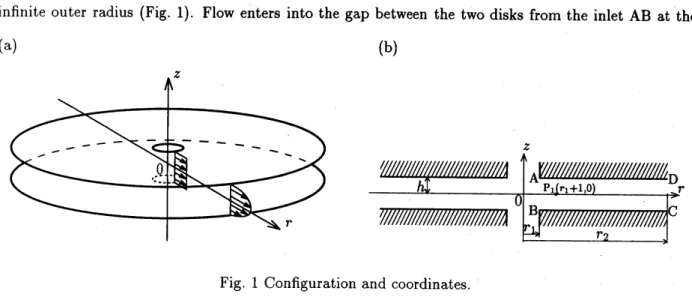
Consider aradiallyoutgoingflow between two parallel circular disks with the spacing $2h^{*}$ and the
infinite outer radius (Fig. 1). Flow enters into the
gap
between the two disks from the inlet AB at the(a) (b)
Fig. 1Configuration and coordinates.
inner radius $r_{1}^{*}$ with auniform velocity profile. We define two non-dimensional
parameters, i.e., the
Reynolds number and the non-dimensional inlet radius, as
$Re \equiv\frac{Q^{*}}{4\pi\nu h^{*}}$,
$r_{1}\overline{=}r_{1}^{*}/h^{*}$, (1)
where $Q^{*}$ is the volumetricflow rate through the gap between two disks and
$\nu$ isthe kinematic viscosity
ofthe fluid.
2.1 Fundamental equation
Weintroduce the stream function $\psi(r, z, t)$ for the axisymmetric flow in the cylindricalcoordinates.
The governing equations for the vorticity component $\omega(r, z, t)$ in the circumferential direction and the
stream function $\psi(r, z, t)$ are written in anon-dimensional form as
$\frac{\partial\omega}{\partial t}-\frac{1}{r}\frac{\partial(\psi,\omega)}{\partial(r,z)}-\frac{1}{r^{2}}\frac{\partial\psi}{\partial z}\omega$ $= \frac{1}{Re}\Delta\omega$, (2)
$\omega=\frac{1}{r}D^{2}\psi$, (3)
where
$\frac{\partial(f,g)}{\partial(r,z)}\equiv\frac{\partial f}{\partial r}\frac{\partial g}{\partial z}-\frac{\partial f}{\partial z}\frac{\partial g}{\partial r}$ , $\Delta\equiv\frac{\partial^{2}}{\partial r^{2}}+\frac{1}{r}\frac{\partial}{\partial r}+\frac{\partial^{2}}{\partial z^{2}}-\frac{1}{r^{2}}$ , $D^{2} \equiv\frac{\partial^{2}}{\partial r^{2}}-\frac{1}{r}\frac{\partial}{\partial r}+\frac{\partial^{2}}{\partial z^{2}}$,
and all the physical variables are made non-dimensionalby using the representative length $h^{*}$ and the
representative velocity $Q^{*}/4\pi h^{*2}$
.
The flow is assumed to enter the inlet (AB in Fig. 1) with auniform velocity profile so that the
boundary condition is written as
$\psi=z$, $\omega=0$, $(r=r_{1})$. (4)
The boundary condition at the twodisks isthe nonslip boundary condition that is expressed by
$\psi=\pm 1$, $\omega=\frac{1}{r}\frac{\partial^{2}\psi}{\partial z^{2}}$
, $(z=\pm 1)$, (5)
where the complex signs are taken in the same order. The flow field is assumed to extend to infinitely
large radius, therefore the flow field has the asymptotic velocity at sufficiently large distance from the
center, whichisderived inthe next subsection. Then the boundary condition at the end of computational
domain (CD in Fig. 1) is expressed as
$\psi=\frac{1}{2}(3z-z^{3})+\frac{3}{8Re}(\frac{1}{7}z-\frac{11}{35}z^{3}+\frac{1}{5}z^{5}-\frac{1}{35}z^{7})\frac{1}{r^{2}}$,
$\omega$ $= \frac{3}{Re}(\frac{1}{7}z-\frac{11}{35}z^{3}+\frac{1}{5}z^{5}-\frac{1}{35}z^{7})\frac{1}{r^{5}}-3\frac{z}{r}+\frac{3}{4Re}(-\frac{33}{35}z+2z^{3}-\frac{3}{5}z^{5})\frac{1}{r^{3}}$,
$(r=r_{2})$. (6)
2.2 Asymptotic solutionfor far field
It is expected that the outgoing flow between two disks approaches to the fully developed plane
Poiseuille flow far downstream. We make an asymptotic analysis to derive the profile of the flow field at
far distance. Anew variabledefined by
$\xi=\frac{1}{r}$, (7)
is introduced, then the flow region is transformed from $r$ $=[r_{1}, \infty)$ to $\xi=[0,1/r_{1}]$
.
Steady flow field isassumed at very far distance, therefore Eqs. (2) and (3) are rewritten as
$\xi^{3}\frac{\partial\psi}{\partial\xi}\frac{\partial}{\partial z}\Lambda\psi-\xi^{3}\frac{\partial}{\partial\xi}\Lambda\psi-\xi^{2}\frac{\partial\psi}{\partial z}\Lambda\psi=\frac{1}{Re}\Lambda^{2}\psi$, (8)
at fardownstream, where
$\Lambda=\xi^{4}\frac{\partial^{2}}{\partial\xi^{2}}+3\xi^{2}\frac{\partial}{\partial\xi}+\frac{\partial^{2}}{\partial z^{2}}$
.
We explore the solution $\psi(\xi, z)$ of Eq. (8) in aseries of expansionin$\xi(=1/r)$ expressed as
$\psi(\xi, z)=\psi_{0}+\xi\psi_{1}+\xi^{2}\psi_{2}+O(\xi^{3})$, (9)
where only the terms up to $O(\xi^{2})$ are retained. The boundary conditions for the expansion coefficients
$\psi_{n}$ are written as
$\psi_{0}=\pm 1$, $\frac{\partial\psi_{0}}{\partial z}=0$, $(z=\pm 1)$,
$\psi_{n}=0$, $\frac{\partial\psi_{n}}{\partial z}=0$, $(z=\pm 1)$, (10)
where the complex signs should be taken in the same order and $n$ should taken to be 1or 2. By
substituting the expansion (9) into Eq. (8) andequating the terms with the
same
power of4, we obtainthe equationsfor $\psi_{n}$, $(n =0,1,2)$
.
After solving the resultant equation for$\psi_{n}$, we obtain the asymptoticexpression of$\psi$ at large distance asexpressed as
$\psi(r, z)=\frac{1}{2}(3z-z^{3})+\frac{3}{8Re}(\frac{1}{7}z-\frac{11}{35}z^{3}+\frac{1}{5}z^{5}-\frac{1}{35}z^{7})\frac{1}{r^{2}}$
.
(11)where the solutions are expressed in $r$by substituting $r$$=1/\xi$
.
The asymptotic solution (11) is adoptedastheboundarycondition forournumerical simulations and thenumerical calculationsofthe steady and
symmetric solutions
2.3 Steady and symmetric solution
Steady and symmetricsolution along the centerline between two disksexists regardless of the
mag-nitude ofthe Reynolds number, which is unstable at the Reynolds numbers above acritical value. The
steady and symmetricsolution$(\overline{\psi},\overline{\omega})$satisfies the steady-state equations, whichareobtained bydropping
the terms with time derivative$\partial/\partial t$ in Eq. (2).
The steady and symmetric solutioncan be calculated in the upper or lower half domain ofABCD
in Fig. 1therefore the boundary conditionon the centerline between the two disks is expressed as
$\overline{\psi}=0$, $\overline{\omega}=0$, $(z=0)$
.
(12)The boundary conditions for $(\overline{\psi},\overline{\omega})$ at the inlet
$r=r_{1}$, the outlet$r=r_{2}$ andthe top orthe bottom disks
are the same as that of Eqs. (2) and (3).
2.4 Disturbance equation
We consider adisturbance $(\psi’, \omega’)$ added to the steady and symmetric solution $(\overline{\psi},\overline{\omega})$ and express
the stream function and the vorticity $(\psi, \omega)$ as $\psi=\overline{\psi}+\psi’$ and $\omega$ $=\overline{\omega}+\omega’$ to investigate the stability
of the steady and symmetric solution. The linear disturbance equations are obtained by substituting
the expressions for $\psi=\overline{\psi}+\psi’$ and $\omega$ $=\overline{\omega}+\omega’$ into Eqs. (2) and (3), subtracting the steady-state
equations, and neglecting the higher order terms than the linear terms concerning the disturbance $\psi’$
and $\omega’$. Furthermore, the solution
$(\psi’, \omega’)$ can be shown to have the form of $\psi’=\hat{\psi}\exp(\lambda t)$, and
$\omega’=\hat{\omega}\exp(\lambda t)$, then substitution of these expression into $(\psi’, \omega’)$ leads the equations for $(\hat{\psi},\hat{\omega})$ as
$\lambda\hat{\omega}-\frac{1}{r}\{\frac{\partial\overline{\psi}}{\partial r}\frac{\partial\hat{\omega}}{\partial z}+\frac{\partial\hat{\psi}}{\partial r}\frac{\partial\overline{\omega}}{\partial z}-\frac{\partial\overline{\psi}}{\partial z}\frac{\partial\hat{\omega}}{\partial r}-\frac{\partial\hat{\psi}}{\partial z}\frac{\partial\overline{\omega}}{\partial r}\}-\frac{1}{r^{2}}\{\frac{\partial\overline{\psi}}{\partial z}\hat{\omega}+\frac{\partial\hat{\psi}}{\partial z}\overline{\omega}\}=\frac{1}{Re}\Delta\hat{\omega}$, (13)
$\hat{\omega}=\frac{1}{r}D^{2}\hat{\psi}$. (14)
The boundary conditionsfor $(\hat{\psi},\hat{\omega})$ are written as
$\hat{\psi}=0$, $\hat{\omega}=0$, $(r=r_{1}, r_{2})$,
$\hat{\psi}=0$, $\hat{\omega}=\frac{1}{r}\frac{\partial^{2}\hat{\psi}}{\partial z^{2}}$
, $(z=\pm 1)$
.
(15)The disturbance equation can be soIved in the upper or lower halfdomainofABCD in Fig. 1therefore
the boundary conditionon the centerline between the two disks isexpressed as
$\hat{\psi}(r, z)=\hat{\psi}(r, -z)$, $\hat{\omega}(r, z)=\hat{\omega}(r, -z)$, $(z=0)$
.
(16)3. Numerical method
3.1 Numerical simulation
In numerical simulations by the time marching method, anequally spaced mesh system with $\Delta r=$
$\Delta z=5\cross 10^{-2}$ is used. The vorticity transport equation is solved by the Runge-Kutta method with
the fourth-0rder accuracy in time together with the second-0rder accuracy ofcentral finite difference in
space. The time increment At ischosen as $\Delta t=1\cross 10^{-4}$. The Poisson equation is discretized by the
second-0rder central finite difference and solved by the SOR method, where the relaxation factor $\epsilon$ is
taken as $\epsilon=1.82$
3.2 Steady and symmetric solution and linear stability analysis
Both the steady-state vorticity transport equation and the Poisson equation are solved by the SOR
iterative method to calculatesteady and symmetricsolutions. Spatial derivatives areapproximated by the
second-0rder finite differences. The relaxation factor$\epsilon$ forthe SORmethodisdetermined by considering
the aspect ratio and the Reynolds number in the range $0.1<\epsilon<1.0$
.
In order to calculate unstablesteady and symmetric solutions above acriticalReynoldsnumber, the SORmethod isutilized under the
symmetry conditionalongthe centerline between two disks. This method is used also for the numerical
evaluation of the linear growth rate.
4. Numerical results
4.1 Flow patterns and bifurcation
(a) (b)
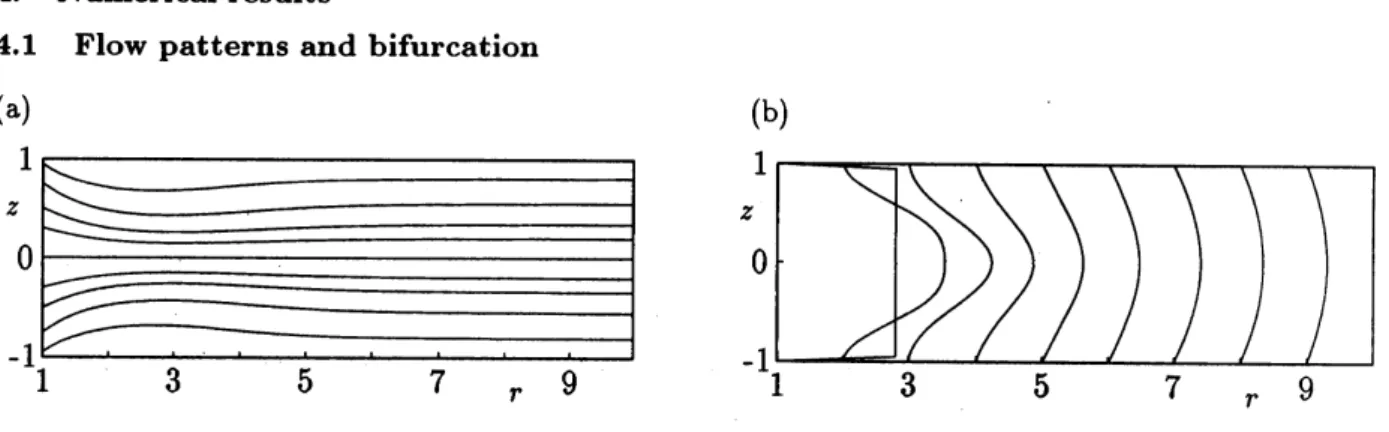
Fig. 2Flow pattern. $Re=40$,$r_{1}=1$
.
(a) Streamlines, (b) Velocity profiles.For thecase ofthe non-dimensional inlet radius$r_{1}$ $=1$, we have done numericalsimulationsfor the
Reynolds numbers in the range of $10\leq Re\leq 200$
.
The outgoing flow is symmetric at small Reynoldsnumbers. Atypical example of such asteady and symmetric flow is shown in Fig. 2for $Re=40$.
Streamlines for the symmetric flow is depicted in Fig. 2(a) and the velocity profiles in the z-direction
isshown in Fig. 2(b). The streamlines gather together just downstream ofthe inlet as seen in Fig. 2
(a), where jet-like flow is observed in Fig. 2(b). Another flow pattern shown in Fig. 3 $(Re=50)$ is
also asteady and symmetricflow, but differs from that in Fig. 2in presence of separation vortices. The
separation vortices in Fig. 3(a) are formed lying in $r$ $=1.85-3.55$near both the upper andlower walls.
(a) (b)
Fig. 3Flow pattern. $Re=50$,$r_{1}=1$
.
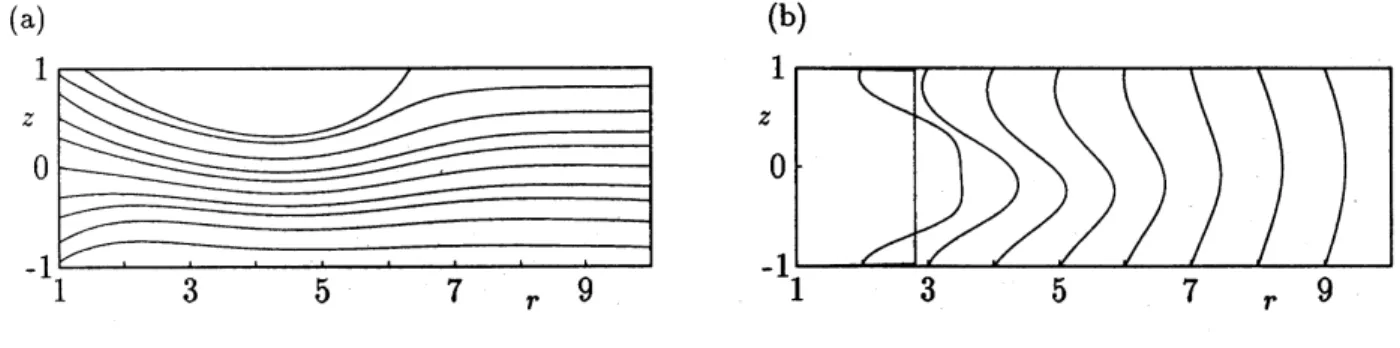
(a) Streamlines, (b) Velocity profiles.The flowpatternobtainedinnumericalsimulations at$Re=70$issteady, butasymmetricas depicted
in Fig. 4. The stream coming from the inlet is seen to bend on the lower wall. We can easily imagine
another asymmetric flow, which bendson the upper wall from thesymmetryconsideration of the system.
Such asteady and asymmetric flow has not been reported before. The separation-vortex region in Fig. 4
(a) (b)
Fig. 4Flow pattern. $Re=70$,$r_{1}=1$
.
(a) Streamlines, (b) Velocity profiles.(a) is larger than that in Fig. 3(a), and the separation vortexlies in $r=1.5-6.3$near the upper wall.
Fig. 5Bifurcation diagram, $r_{1}=1$.
We have confirmed by numerical calculations of the steady-state equationsthat the symmetric flow
also does exist at $Re=70$. The asymmetric flow is thought to appear due to the instability of the
symmetricflow. In order to investigatethebifurcation ofsteady-state solution,weobtainthe bifurcation
diagram by adopting arepresentation value $v_{1}$, the velocity in $z$-direction at arepresentation point $\mathrm{P}_{1}$
$[(r, z)=(2, \mathrm{O}),\mathrm{F}\mathrm{i}\mathrm{g}.1]$. The bifurcation diagram is depicted in Fig. 5. The bifurcation is determined as
apitchfork bifurcation from the relation $v_{1}^{2}\propto$ $(Re -Re_{\mathrm{c}})$, and the critical Reynolds number $Re_{\mathrm{c}}$ being
62.7.
4.2 Linear stability analysis
We investigatethe linearstability ofthe steady and symmetric solution whichis abasic solution of
theoutgoingflowfor thecaseof thenon-dimensionalinlet radius $r_{1}=1$. We have solved the steady-state
equations numerically to obtain the steady andsymmetricsolutions $(\overline{\psi},\overline{\omega})$ and also solved Eqs. (13) and
(14) to evaluate the lineargrowth rate Afor the steady andsymmetricsolutions. Typical examples ofa
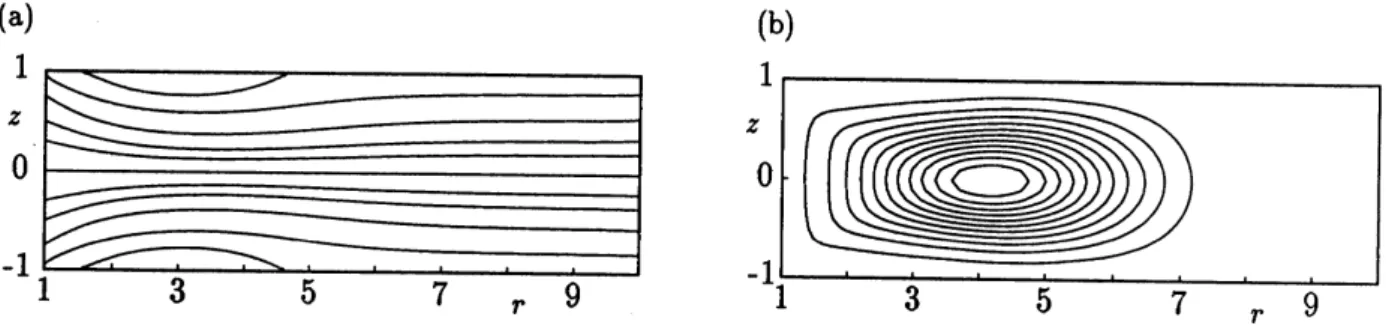
steadyandsymmetricflowandalineardisturbance areshownin Fig. 6forthe Reynolds number$Re=64$.
Figure 6(a) shows the streamlines of the steady and symmetricsolution, and the disturbance obtained
by solving Eqs. (13) and (14) is depicted in Fig. 6(b). The disturbance hassignificant magnitude in a
(a) (b)
Fig. 6Flow pattern. $Re=64$,$r_{1}=1$
.
Streamlines, (a) Unstablesymmetricflow, (b) Disturbance,limited region
near
the inlet, which makes thesymmetricflow to bend on one wall in that region.Fig. 7Linear growth rate $\lambda$,
$r_{1}$ $=1$
.
Thelinear growth rate Ais evaluated forvariousReynoldsnumbers, whichisshown in Fig. 7for the
non-dimensionalinlet radius$r_{1}=1$
.
The critical Reynoldsnumber$Re_{\mathrm{c}}$ is determined as $Re_{\mathrm{c}}=62.8$fromFig. 7for the non-dimensionalinlet radius $r_{1}=1$
.
The relativeerror
between the values of $Re_{\mathrm{c}}=62.7$obtained from the bifurcation diagramand $Re_{\mathrm{c}}=62.8$from the linear stability analysis is about 0.16%,
which shows the consistency between the two values.
We have evaluated the critical Reynolds number $Re_{\mathrm{c}}$ for others values of the non-dimensional inlet
radus$r_{1}$ and depicted themagainst$r_{1}$ inFig. 8in therangeof$0.5\leq r_{1}$ $\leq 3$
.
The flowissymmetric attheReynolds number under the solid line in Fig. 8, but becomes asymmetricat the Reynoldsnumber above
the line. The steady and asymmetricflow may make atransition into an oscillatoryflow above another
Reynolds number, say $Re_{\mathrm{c}}’$
.
However, it may be possible that the steady andsymmetric flow makes a
transition into anoscillatory flow without experiencing anasymmetricflow for the non-dimensionalinlet
radii $r_{1}$ much larger than 3. The critical Reynolds number $Re_{\mathrm{c}}’$ mayapproach to 5771, where the plane
Poiseuille flow becomes unstable
Fig. 8Critical Reynolds number and $r_{1}$ : the non-dimensional inlet radus.
5. Conclusions
We made an asymptotic analysis for the flow profile at far distance and confirmed the flow field
approaches to the fully developed plane Poiseuille flow there. We have done numerical simulations,
numerical calculations of the steadysymmetric solutions and their linear stabilityanalysisfor theoutgoing
flow with finite difference approximations. As results, we found that the flow is symmetric at small
Reynolds numbers, but becomes asymmetric above acritical Reynoldsnumber. The transition into the
asymmetric flow is determineddue to apitchfork bifurcation judging fromthe relation $v_{1}^{2}\propto(Re-62.7)$
for the non-dimensional inlet radius $r_{1}=1$
.
The critical Reynolds number obtained from the linearstability analysis is62.8 which is in good agreement with the critical value62.7 evaluated by numerical
simulationdata. Thelarger the value of the non-dimensional inlet radii $r_{1}$ is, the largerthe valueof the
critical Reynolds numbers $Re_{\mathrm{c}}$ for atransition into asymmetricflow becomes.
References
1) S. Ishizawa, Bulletin of JSME, 8, 353-367 (1965).
2) S. Ishizawa, Bulletin ofJSME, 9, 86-103 (1966).
3) J. D. Raal, J. Fluid Mech., 85, 401-416 (1978).
4) S. Mochizuki and W. J. Yang, J. Fluid Mech., 154, 377-397 (1985)