A duality theorem for
a
three-phase
partition
problem
三相分割問題に対する双対定理
H. Kawasaki (Kyushu University)
川崎英文 (九州大学大学院数理学研究院) \dagger
Abstract Thethree-phase partition problem is to divide
a
given domain $\Omega\subset \mathbb{R}^{2}$into three
subdomains with
a
triplejunction havingleast interfacial
area.
Recently,we
proposeda
duality theorem fora
three-phase partition problem in [5].We
introduced
a
notion ofseparationof threeconvex sets
by triangles todefine a dualproblem. In this paper, we explain its outline.
1. Introduction
The three-phase partition problem is to divide
a
given domain $\Omega\subset \mathrm{R}^{2}$ intothree subdomains with
a
triple junction having least interfacialarea
(Fig. 1.1).FIGURE
1.1.
Three-phase partition problemSternberg and Zeimer [7] and Ikota and Yanagida [1] formulated this problem
as a
variational problem and discussed stabilityofstationary solutions. However,since the shortest
curve
joiningtwo points $X_{0}$ and $X_{i}$ is the line segment $[X_{0}, X_{i}]$, itcan
be formulated as an extremal problems ina
Euclidean space. From thispoint ofview,
we
discussed stability andstudied its game-theoretic aspect in $[2][3]$.
Further,
we
gave a
duality theorem foran
extremal problem $(P_{0})$ induced fromthe three-phase partition problem in [4].
$(P_{0})$ Minimize
$f(X_{0}, \ldots, X_{3}):=\sum_{:=1}^{3}||X_{i}-X_{0}||$
subject to $X_{0}\in\Omega,$ $X_{i}\in C_{i}(i=1,2,3)$,
where $||\cdot||$ denotes the Euclidean
norm
and $C_{1}(i=1,2,3)$ are closedconvex
setswith non-empty interior in $\mathbb{R}^{2}$
such that $\Omega:=\mathrm{c}1(\bigcap_{;_{=1}}^{3}C_{i}^{c})$ is non-empty (Fig. 1.2).
Moreover,
we
improved the duality theoremso
that the dual problem does notThis research is partially supported by Kyushu Univ. 21st Century COE Program
(Devel-opment of Dynamic Mathematics with High Functionality) and the Grant-in Aid for General
ScientificResearch from the JapanSociety for the PromotionofScience $1434\mathrm{t}\mathrm{K}\mathrm{I}37$
.
$\uparrow \mathrm{k}\mathrm{a}\mathrm{w}\mathrm{a}\mathrm{s}\mathrm{a}\mathrm{k}\mathrm{i}\Phi \mathrm{a}\mathrm{t}\mathrm{h}$
.
kyushu-u.$\mathrm{a}\mathrm{c}$.
jp, Faculty ofMathematics, KyushuUniversity 33, FukuokaFIGURE 1.2. Primal problem $(P_{0^{\backslash }})$
include the variables of the primal problem in [5]. The aim of this paper is to
state the outlineof $[4][5]$
.
In this paper
we use
the following notations. For anyclosedconvex
sets$C_{1}$ and$C_{2}$,
we
define $d(C_{1}, C_{2}):= \min\{||X_{1}-X_{2}|||X_{i}\in C_{i}(i=1,2)\}$. We denote by$N(X_{i;}C_{i})$ thenormal
cone
of$C_{i}$ at $X_{i}$, that is,$N$($X_{i}$; Ci) $:=\{\mathrm{Y}\in \mathbb{R}^{n}|\mathrm{Y}^{T}(X-X_{i})\leq 0\forall X\in C_{i}\}$
.
2. First-order optimality condition
As is easily seen from Fig. 1.2, $\Omega$ is not always a
convex
set. So the primalproblem $(P_{0})$ is not
a
convex
programming problem in general. We modify it sothat it becomes
a convex
programming problem.$(P)$ Minimize
$\sum_{i=1}^{3}||X_{i}-X_{0}||$
subject to $X_{0}\in \mathbb{R}^{2},$ $X_{i}\in C_{i}(i=1,2,3)$
.
The only difference is that $\Omega$ is replaced by $\mathbb{R}^{2}$
.
We saya feasible
solution $(X_{0}, \ldots, X_{3})$ for $(P_{0})$ (or $(P)$) non-degenerate if $X_{0}$ does not coincide with any$X_{i}(i=1,2,3)$
.
FIGURE 2.1. Young’s law and the transversality condition
Theorem 2.1. Let $(X_{0}, \ldots , X_{3})$ be
a
non-degenerate minimal solutionfor
$(P_{0})$.
Then it is
a
minimum solutionfor
$(P)$.
Further, itsatisfies
Young’s lawand the transversality condition
$X_{0}-X_{i}\in N(X_{1;}C_{i})$ $(i=1,2,3)$
.
(2.2)Proof. Thereexists
an
openconvex
neighborhood$C_{0}$of$X_{0}$ such that$(X_{0}, \ldots,X_{3})$is
a
minimum pointof
$f$on
$C:=C_{0}\cross C_{1}\mathrm{x}C_{2}\mathrm{x}C_{3}$.
Since
$f$and
$C$are
convex, $(X_{0}, \ldots,X_{3})$ isa
minimumpointof
$f$on
$R^{n}\mathrm{x}$Ci
$\mathrm{x}C_{2}\mathrm{x}C_{3}$.
Hence
itis
a
minimum
solution for $(P)$
.
According toKuhn-Tucker’s
theorem,see
e.g. Rockafellar
[6],there
exist multipliers $\lambda_{i}\geq 0(i=1,2,3)$such
that $0\in R^{4_{\hslash}}$ belongsto
thesubdifferential of the
Lagrangefunction
$L(X_{0}, \ldots,X_{3}):=\sum_{:=1}^{3}||X_{1}-X_{0}||+\sum_{:,1=1}^{3}\lambda_{i}\delta(X_{i}|C_{i})$,
where$\delta(X_{i}|C_{i})$ denotesthe characteristic function of$C_{1}$
.
Picking up$X_{0}$-componentofthe subdifferential $\partial L$,
we
have$n_{1}+n_{2}+n_{3}=0\in R^{n}$, (2.3)
where $n_{i}:=(X_{0}-X_{i})/||X_{i}-X_{0}||$
,
which implies Young’s law. Pickingup
$X_{1^{-}}$component $(i=1,2,3)$ of$\partial L$
,
we
have $0\in-n_{i}+\lambda_{1}N(X_{i};C_{i})$, which
impliesthe
transversalitycondition.
Remark 2.1. In $[1][2][3][7]$, smooth
cases were
studied. Then the transversalitycondition $(\mathit{2}.Z)$ becomes $a$ orthogonality condition, that is, $X_{0}-X_{1}$ touches the
boundary $\partial\Omega$ at right angles.
3.
SeParation
bya
triangleIn this section,
we
first review classical duality theorems in brief. Next,we
introduce separation
of
threeconvex
sets bya
triangle.$,\mathrm{O}\mathrm{n}\mathrm{e}$ of the simplest duality theorems is the following. Let $C_{1}$ be
a
non-emptyconvex
set in$\mathrm{R}^{2}$and $A\not\in C_{1}$
a
point.Then the
primal problem isMinimize $||X_{1}-A||$
$(P_{1})$
subject
to
$X_{1}\in C_{1}$.
Its dual problem $(D_{1})$ is to maximize the distance from $A$ to
a
hyperplane $H$that separates $A$ and $C_{1}$
.
Wecan
rephrase itas
maximizing the width ofa
riverthat separates $A$ and $C_{1}$ (Fig. 3.1), where
a
river stands for thearea
sandwichedbetween two parallel lines.
FIGURE
3.1.
Dual problem $(D_{1})$ isto maximize the widthofa
riverIf we replace $A$ with a
convex
set $C_{2}$ such that $C_{1}\cap C_{2}=\phi$, then the primalproblem becomes
as
follows.Minimize
11
$X_{1}-X_{2}||$$(P_{2})$
subject to $X_{1}\in C_{i}(i=1,2)$
.
Its dual problem $(D_{2})$ is to minimize the width of
a
river that separates $C_{1}$and
$C_{2}$ (Fig. 3.2).FIGURE
3.2.
Dual problem $(D_{2})$ is to maximizethe
width of
a
riverthat separates $C_{1}$ and $C_{2}$
.
If
we
take the epigraph epi$f:=\{(x, r)|f(x)\leq \mathrm{r}\}$ ofa convex
function
$f$ andthe hypograph $\mathrm{h}\mathrm{y}\mathrm{p}g:=\{(x, r)|r\leq g(x)\}$ of a
concave
function $g$ as $C_{1}$ and $C_{2}$,respectively, and
measure
the width of the river in the vertical direction, thenduality between $(P_{2})$ and $(D_{2})$ becomes to Fenchel’s duality,
see e.g.
[6, Theorem31.1].
FIGURE
3.3.
Fenchel’s duality theoremTherefore, classical dual problems
can
be described in terms of riversor
hy-perplanes separating two
convex
sets. In this paper,we
introduce the notion oftriangles separating three convex sets in order to definethe dual problem for the
three-phase partition problem $(P)$
.
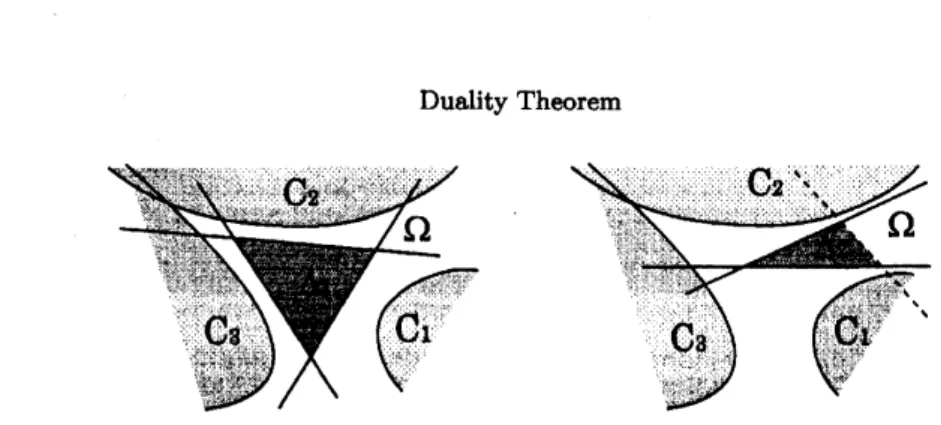
Deflnition 3.1.
We
say thata
triangle $\Delta\subset\Omega$ separates $\{C_{i}\}_{i=1}^{3}$if
thereare
threeclosed
half
spaces $\{H_{i}^{-}\}_{i=1}^{3}$ such that$Ci\subset H_{1}^{-}for$$eve\eta i$ and A $= \bigcap_{i=1}^{3}H_{i}^{+}$, where $H_{i}^{+}$ denotes the closedhalf
space
opposite to $H_{1}^{-}$ (Fig. 3.4).Before defining the dual problem, let
us
consider the specialcase
that $\Omega$ isa
triangle determined by three closed half spaces.
Lemma 3.1. $(\mathrm{I}4])$ When $\Omega$ is
a
tfiangle in $\mathbb{R}^{2}$,
it holds thatFIGURE 3.4.
$\Delta_{1}$ separates $\{C_{1}\}_{i=1}^{3}$, and $\Delta_{2}$does
not separate $\{C_{i}\}_{i=1}^{3}$.
So
we
define the dual problemas
follows.
$(D)$ Maximize the smallest height of
a
triangle that separates $\{C_{1}\}_{i=1}^{3}$.The following is the main result.
Theorem
3.1.
([5]) Let $(X_{0}, \ldots, X_{3})$ bea
non-degenerate minimal solutionfor
$(P_{0})$
.
Then
it isa
minimumsolution
for
$(P)$and the
strong duality relationshipholds.
$\sum_{:=1}^{3}||X_{i}-X_{0}||=\min(P)=\max(D)$
.
(3.1)Remark 3.1.
Since
the maximum valuefor
$(D)$ is attained bya
regu$lar$ triangle,we
may restrict
triangles to regular triangles in $(D)$.
However, it is clear thatregular triangles are not enough when $\Omega$ is a (general) triangle. That’s why
we
defined
thedual
problem with (general) triangles.Corollary
3.1.
When $\Omega\dot{u}$ bounded,the dual
problemcan
be simplifiedas
follows.
$(D)$
Maximize
the smallest heightof
a
triangle contained in$\Omega$.
Indeed, let $\Delta$ be
an
arbitrary triangle contained in $\Omega$.
Then, by separationtheorem, there exists
a
closedhalf space
$H_{1}^{+}$. $\supset\Delta$ such that $C_{1}\subset H_{i}^{-}$ for each$i=1,2,3$
.
Since $\Delta_{1}:=\bigcap_{\dot{\iota}=1}^{3}H_{i}^{+}$ iscontained in theboundedset $\Omega,$ $\Delta_{1}$isatriangle.Further, since $\Delta\subset\Delta_{1}$, the smallest height of $\Delta$ is bounded from above by the
smallest height of$\Delta_{1}$ (Fig. 3.5).
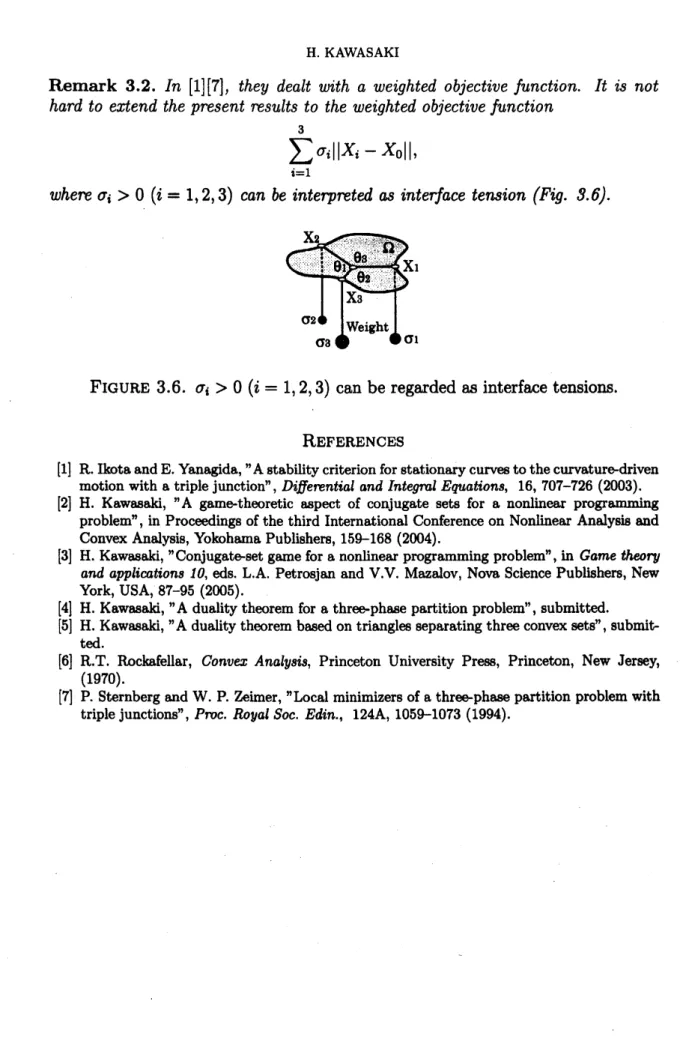
Remark 3.2. In $[1][7]$
,
they dealt with a weighted objectivefunction.
It is nothard to extend the present results to the weighted objective
function
$\sum_{i=1}^{3}\sigma_{i}||X_{i}-X_{0}||$,
where
$\sigma_{1}>0(i=1,2,3)$can
be intefpretedas
interface
tension (Fig. S.6).FIGURE
3.6.
$\sigma_{i}>0(i=1,2,3)$can
be regardedas
interface tensions. REFERENCES[1] R. Ikotaand E. Yanagida,“Astability criterion forstationarycurvestothecurvature-driven
motion with atriple junction”,
Differential
and Integral Equations, 16, 707-726 (2003).[2] H. Kawasaki, ”A $\mathrm{g}\mathrm{a}\mathrm{m}\mathrm{e}- \mathrm{t}\mathrm{h}\infty \mathrm{r}\mathrm{e}\mathrm{t}\mathrm{i}\mathrm{c}$ aspect of conjugate sets for a nonlinear $\mathrm{p}\mathrm{r}\mathrm{o}\mathrm{g}\mathrm{r}\mathrm{a}\mathrm{n}\mathrm{L}\underline{\min}\mathrm{g}$
problem”,in Proceedingsof the third International Conferenceon NonlinearAnalysis and Convex Analysis,YokohamaPublishers, 159-168 (2004).
[3] H. Kawasaki, “$\mathrm{C}\mathrm{o}\mathrm{n}\mathrm{j}\mathrm{u}\mathrm{g}\mathrm{a}\mathrm{t}\triangleright \mathrm{s}\mathrm{e}\mathrm{t}$game for anonlinear programming problem”, in Gametheory
and applications 10, \’es. L.A. Petrosjanand V.V. Mazalov, Nova SciencePublishers, New
York, USA, 87-95 (2005).
[4] H. Kawash, “Adualitytheorem forathree-phase partition problem”, submitted.
[5] H. Kawasaki,“Adualitytheorembasedontrianglesseparatingthreeconvexsets”, submit-ted.
[6] R.T. Rockafellar, Convex Analysis, Princeton University Press, Princeton, New Jersey, (1970).
[7] P. Sternberg and W. P. Zeimer, “Local minimizers of athree-phase partition problemwith