
近畿大学学術情報リポジトリ
16
0
0
全文
(2) Kinki University English Journal No. 1. Introduction While most teachers perhaps use intuitive ideas to understand motivation in their students, motivation researchers have made numerous attempts to discover the theoretical principles underlying motivation. Although there is much disagreement over the precise nature of motivation, all motivational researchers agree that motivation is a complex and multi-faceted construct. In cognitive motivational psychology, motivation is considered not as a product but as a process whereby goal-oriented activity is instigated and sustained (Pintrich & Schunk, 1996), and tends to be conceptualized using an expectancy-value framework. Unlike early behavioral theories of motivation, expectancy-value theories are based on the belief that humans are innately active learners and decision makers, which led to another humanistic assumption that humans are subjectively aware of themselves and their situations. Weiner (1991, p. 922) has called such an assumption a "Godlike metaphor": individuals are rational decision makers, rational scientists, and judges. Consequently, the current focus in cognitive motivational research is placed more on how humans decide which goals to achieve and how they direct their innate motivation to learn in order to achieve the goals they set. Although there are various theories that include expectancy and/or value frameworks of motivation (e.g., Bandura, 1993; Battle, 1965, 1966; Crandall, 1969; Crandall, Karkovsky, & Preston, 1962; Eccles, 1983, 1984a, b; Eccles, Adler, Futterman, Goff, Kaezala, Meece, & Midgley, 1983; Eccles, Adler, & Meece, 1984; Eccles, Wigfield, Flanagan, Miller, Reuman, & Yee, 1989; Feather, 1982, 1988, 1992; Schunk, 1991; Wigfield, 1994; Wigfield & Eccles, 1992), the expectancy-value theory proposed by Eccles and Wigfield (Eccles, 1983; Eccles et al., 1983; Eccles et al., 1984; Eccles, Lord, & Midgley, 1991; Eccles & Wigfield, 1995; Wigfield, 1994; Wigfield & Eccles, 1992; Wigfield, Eccles, & Pintrich, 1996) will be summarized here as it is most closely related to the theoretical framework of this study. Eccles and Wigfield (1995) argue that motivational behaviour can be mainly explained by two constructs: expectancy for success in a given task and the value the individual associates with success in that task. In this model, expectancy for success is predicted by their perceptions of task difficulty and their expectation of their ability to perform that task. For example, if our students have a belief that they are good at English and that it is not that difficult a task, they have high expectations for studying English. On the other hand, value beliefs are perceived values that individuals 54.
(3) Multi-dimensional Aspects of Motivation and their Relationship with Proficiency (Mori). attach to success in a certain task and consist of four sub components: attainment value, intrinsic value, extrinsic utility value, and cost. Attainment value denotes the individual's perceived importance of success in a given task with reference to their perception of how significant a task is to their self-schema or identity. Intrinsic value refers to the enjoyment that task engagement brings about whereas extrinsic utility value refers to the usefulness of the task in terms of an individual's future goals. The last component, cost, signifies individuals' perceived negative consequences of engaging in the task. Cost in this case includes not only monetary cost but also time-related and emotional cost. Although expectancy-value theories have had great influence on motivational research in the field of SLA, Gardner's socio-educational model of motivation (Gardner, 1979, 1980, 1985, 1988, 2000, 2001; Gardner & MacIntyre, 1993) is still the most well-known and frequently cited motivational framework in the field. Gardner contends that motivation to learn a second language is unique in that the degree of success in language learning is affected by a learner's attitudes toward the target community. Based on such an assumption, unlike many other cognitive psychology theories of motivation which tend to focus on learners' achievement motivation, Gardner and his associates' model emphasized learners' beliefs about the second language they are learning and the culture where the language is spoken. Although Gardner's models of motivation have been modified over time, the following categories of variables are included in one form or another: (a) motivation, (b) integrativeness, and (c) attitudes toward the learning situation. According to Gardner, motivation, in this case, is a combination of effort to learn the language, desire to learn the language, and attitudes toward learning the language. On the other hand, integrativeness is measured by three sub-tests: (a) attitudes toward the target group, (b) interest in foreign language, and (c) integrative orientation; whereas attitudes toward the learning situation is measured by two sub-tests: (a) attitudes toward the learning course, and (b) attitudes toward the language teacher. Later, Tremblay and Gardner (1995) extended Gardner's socio-educational model of motivation by incorporating new elements, namely goal salience, valence, and self-efficacy, from expectancy-value and goal theories. Among those motivational variables, the present study referred to attitudes toward the target group and effort to learn the language partly to see whether our EFL students' attitudes toward English speaking culture and people are a distinctive construct that is related to their achievement behavior.. 55.
(4) Kinki University English Journal No.1. In sum, this study attempted to investigate the following research questions:. 1. What constitutes English learning motivation and attitudes among a sample of Japanese university students? 2. Is there any relationship between motivational and attitudinal 'constructs and proficiency?. Methods Participants. The participants in the study were 159 first-year university students in six different required English classes (English 2) taught by three instructors including the researcher. They were all non-English majors, and placed in the upper six of 13 classes in the department based on their performance on the placement test. The classes met twice a week.. Procedure. All first year students were required to take the TOEIC before the second semester ended in the faculty where this research was carried out. As part of English 2, the participants also took the TOEIC test in December. Although there was no clear guideline regarding how much time should be devoted to teaching TOEIC, the instructors were expected to familiarize their students with the test since the TOEIC scores would be 20 percent of their grades. The participants also took a motivation-attitude questionnaire approximately two weeks before the TOEIC.. Motivation Questionnaire. The questionnaire, consisting of 34 seven-point Likert scale items, was developed and administered in Japanese (see Appendix A for the details of the questionnaire and Appendix B for its English translation). Of all the items, 29 items were written referring mainly to the expectancy-value theory and partly to Gardner's socioeducational model. To be specific, the constructs in this questionnaire include expectancy for success in learning English, attainment value, intrinsic value, extrinsic utility value, and cost of learning English taken from expectancy-value theory as well as Gardner's concepts of attitudes toward target group, and effort. Furthermore, five TOEIC related items were added to examine if the students' attitude toward TOEIC is a distinguishable motivational aspect and can be a direct predictor of their actual 56.
(5) Multi-dimensional Aspects of Motivation and their Relationship with Proficiency (Mori). TOEIC scores. Results Descriptive Statistics for the TOEIC Test. Table 1 shows the means and standard deviations of the TOEIC scores. The total of 689 first-year students including 159 of those who participated in this study took the test. Considering the total score of TOEIC is 990, the mean of 416 indicates that the test was rather difficult for the participants. However, compared with the mean score of 350 for all the students who took the test, the participants can be regarded as above-average students in the department. More importantly, the descriptive statistics presented here suggested normal distribution of the data, which allowed further statistical analyses. Table 1. Descriptive statistics for the TOEIC. Total Score Listening Reading. N. Minimum. Maximum. Mean. Std. Error. Std. Dev. 159 159 159. 210 95 100. 665 380 295. 415.84 223.67 192.16. 5.93 4.05 3.38. 74.82 51.09 42.71. Motivational Factors. In order to determine the interrelationship among the questionnaire items, a principal components analysis was performed. Principal components analysis is a statistical technique used to detect some kind of structure in the relationships between variables by grouping closely related variables (in this case questionnaire items) together into components or factors. The number of factors to be extracted in this study was based on the following criteria: 1. Minim urn eigen val ues of 1. 0. 2. Each factor contains individual items with a mInImum loading of .32. (Tabachnick & Fidell, 1996) 3. Eigenvalues appear before the decrease of eigenvalues level off on the scree plot. To determine the best items for each of the motivational sub-components, any items which did not load on any factors at >.45 were eliminated (items 26, 30, 32, 33 and 34). After varimax rotation, a four-factor solution was chosen, which accounted for 56.4% of the total variance (see Table 2). After the items mentioned above were. 57.
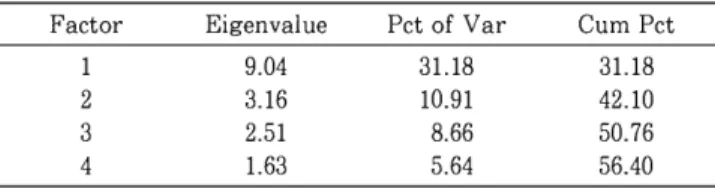
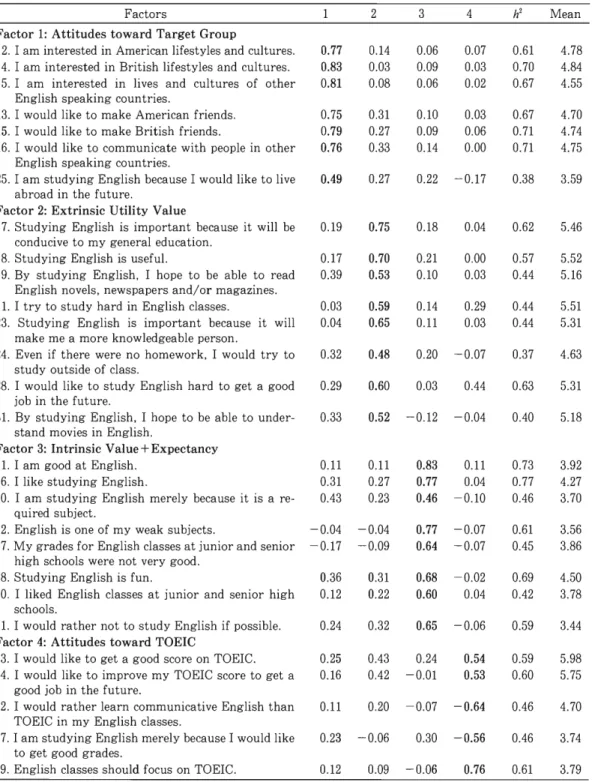
(6) Kinki University English Journal No.1. eliminated, the reliability of the questionnaire using Cronbach's alpha was .92. Table 2.. Principal components analysis summary: Engenvalues and percent of variance explained. Factor. Eigenvalue. Pct of Var. Cum Pet. 1 2 3 4. 9.04 3.16 2.51 1.63. 31.18 10.91 8.66 5.64. 31.18 42.10 50.76 56.40. Table 3 shows a summary of principal components analysis. With principal components analysis, the researcher is expected to examine the items that load on each factor and define the factors in a manner that most makes sense. For instance, by looking at the items loading on Factor 1, one can realize that all of the items are somewhat related to students' attitudes toward English speaking communities and their people. Thus, it is reasonable to define this factor as Attitudes toward Target Group. Factor 2 is also fairly clear as most of the items are concerned with participants' perceived usefulness of learning English. Since they match the definition of extrinsic utility value in expectancy-value theory, Factor 2 was referred to as Extrinsic Utility Value. Compared with Factors 1 and 2, Factor 3 is less straightforward. According to expectancy-value theory, expectancy for success and intrinsic value are independent constructs; however, items predicted to be indicative of expectancy for success, and intrinsic value loaded together on Factor 3. Therefore, Factor 3 can be best described as Intrinsic Value and Expectancy. Factor 4 is not ambiguous as all four TOEIC related items loaded together, thus defined as Attitudes toward TOEIC. Table 3 also shows the mean scores of the questionnaire items arranged according to the factors on which they loaded. By closely examining the mean score of each item, it seems that we can discern a general motivational trend among the participants. The trend might be summarized as follows:. 1. The mean scores of the items on Factor 1 are all above 4 except for the one indicating students' interest in studying abroad. This result may indicate that the students have fairly positive attitudes toward English speaking cultures and people. 2. The mean scores of the items on Factor 2 were among the highest, which might imply that the students recognize the usefulness of learning English. 3. The mean scores of the items on Factor 3 show that students may not have confidence in their English ability, or enjoy studying English very much. 58.
(7) Multi-dimensional Aspects of Motivation and their Relationship with Proficiency (Mori). 4. The mean scores of the items on Factor 4 clearly show the students' desire to get a good score on TOEIC and their belief that getting a good TOEIC score may help find a good job. Table 3. Principal components analysis summary: Factor loadings and communalities. 2. 3. 4. h2. 0.77 0.83 0.81. 0.14 0.03 0.08. 0.06 0.09 0.06. 0.07 0.03 0.02. 0.61 0.70 0.67. 4.78 4.84 4.55. 0. 75 0.79 0.76. 0.31 0.27 0.33. 0.10 0.09 0.14. 0.03 0.06 0.00. 0.67 0.71 0.71. 4.70 4.74 4.75. 0.49. 0.27. 0.22. -0.17. 0.38. 3.59. 0.19. 0.75. 0.18. 0.04. 0.62. 5.46. 0.17 0.39. 0.70 0.53. 0.21 0.10. 0.00 0.03. 0.57 0.44. 5.52 5.16. 0.03 0.04. 0.59 0.65. 0.14 0.11. 0.29 0.03. 0.44 0.44. 5.51 5.31. 0.32. 0.48. 0.20. -0.07. 0.37. 4.63. 0.29. 0.60. 0.03. 0.44. 0.63. 5.31. 0.33. 0.52. -0.12. -0.04. 0.40. 5.18. 0.11 0.31 0.43. 0.11 0.27 0.23. 0.83 0.77 0.46. 0.11 0.04 - 0.10. 0.73 0.77 0.46. 3.92 4.27 3.70. -0.04 -0.17. -0.04 -0.09. 0.77 0.64. -0.07 -0.07. 0.61 0.45. 3.56 3.86. 0.36 0.12. 0.31 0.22. 0.68 0.60. - 0.02 0.04. 0.69 0.42. 4.50 3.78. 0.24. 0.32. 0.65. -0.06. 0.59. 3.44. 0.25 0.16. 0.43 0.42. 0.24 -0.01. 0.54 0.53. 0.59 0.60. 5.98 5.75. 0.11. 0.20. - 0.07. - 0.64. 0.46. 4.70. 0.23. - 0.06. 0.30. -0.56. 0.46. 3.74. 0.12. 0.09. -0.06. 0.76. 0.61. 3.79. Factors Factor 1: Attitudes toward Target Group 2. I am interested in American lifestyles and cultures. 4. I am interested in British lifestyles and cultures. 5. I am interested in lives and cultures of other English speaking countries. 13. I would like to make American friends. 15. I would like to make British friends . 16. I would like to communicate with people in other English speaking countries. 25. I am studying English because I would like to live abroad in the future. Factor 2: Extrinsic Utility Value 7. Studying English is important because it will be conducive to my general education. 8. Studying English is useful. 9. By studying English. I hope to be able to read English novels. newspapers and/or magazines. 11. I try to study hard in English classes. 23. Studying English is important because it will make me a more knowledgeable person. 24. Even if there were no homework. I would try to study outside of class. 28. I would like to study English hard to get a good job in the future . 31. By studying English. I hope to be able to understand movies in English. Factor 3: Intrinsic Value+ Expectancy 1. I am good at English. 6. I like studying English. 10. I am studying English merely because it is a requi red subject. 12. English is one of my weak subjects. 17. My grades for English classes at junior and senior high schools were not very good. 18. Studying English is fun. 20. I liked English classes at junior and senior high schools. 21. I would rather not to study English if possible. Factor 4: Attitudes toward TOEIC 3. I would like to get a good score on TOEIC. 14. I would like to improve my TOEIC score to get a good job in the future. 22. I would rather learn communicative English than TOEIC in my English classes. 27. I am studying English merely because I would like to get good grades. 29. English classes should focus on TOEIC.. 59. Mean.
(8) Kinki University English Journal No. 1. Similar trends, namely positive attitudes toward the target group, low expectancy and intrinsic value, and high extrinsic utility value, were consistently found in previous studies (Mori, 2003, 2004, 2007; Mori & Gobel, 2002, 2005, 2006).. Gender Differences in Motivation. In order to examine whether there is a significant difference between male and female students in motivation, an analysis of variance (ANOV A) was performed on four dependent variables: Attitudes toward Target Group, Extrinsic Utility Value, Intrinsic Value & Expectancy, Attitudes toward TOEIC. With the use of Wilks' criterion, the combined dependent variables were significantly affected by the independent variable, gender. As shown in Table 4, the results of an ANOV A indicate that male and female students differ significantly in Attitudes towards Target Group: female students scored significantly higher than male students. This result is in congruent with the results of previous studies (Mori & Gobel, 2005, 2006). Table 4. Analysis of variance of motivational subscales between male and female students. TOEIC Socre Attitudes twd Target Group Extrinsic Utility Value Intrinsic Value + Expectancy Attitudes twd TOEIC. Sum of Squares. Mean Square. F. Sig.. 10863.53 5.46 0.80 3.47 0.12. 10863.53 5.46 0.80 3.47 0.12. 1.95 5.63 0.80 3.53 0.12. 0.16. 0.02 0.37 0.06 0.73 ' 1'. Relationship between the Motivational Scales and TOEIC Scores. A multiple regression was performed with the TOEIC scores as a dependent variable, and factor scores for the four motivational variables as independent variables. A multiple regression analysis is a technique used to determine whether any of the independent variables can be predictors of the dependent variable. In other words, in this case, a multiple regression analysis was performed to decide whether any of the identified aspects of motivation could successfully predict students' TOEIC scores. Table 5 reports the unstandardized regression coefficients (B), the standard error of the unstandardized regression coefficients (Std. Error), the standardized regression coefficients (Beta), t-test evaluating the significance of the difference of the B coefficients from 0 (t), and the p level (Sig). Notice that the regression coefficient for Attitudes toward Target Group and Intrinsic Value & Expectancy are significant suggesting that information regarding differences in students' Attitudes toward Target 60.
(9) Multi-dimensional Aspects of Motivation and their Relationship with Proficiency (Mori). Group and Intrinsic Value & Expectancy can be used to predict student performance on the test (see Table 6). Table 5. Summary of multiple co"elation analysis of the motivational scales with TOEIC scores as the dependent variable R. R Square. Adjusted R Square. Std. Error of the Estimate. 0.405. 0.164. 0.141. 68.29609. Table 6. Regression analysis of the motivational scales with the TOEIC scores Unstandardized Coefficients (Constant) Attitudes twd Target Group Extrinsic Utility Value Intrinsic Value + Expectancy Attitudes twd TOEIC. Standardized Coefficien ts. B. Std. Error. Beta. 418.28 11.73 - 4.22 25.79 - 8.37. 5.56 5.58 5.58 5.58 5.58. 0.16 - 0.06 0.35 - 0.11. t. Sig.. 75.26 2.10 -0.76 4.63 -1.50. 0.00 0.04 0.45 0.00 0.14. Discussion and Conclusion As many previous studies have suggested, the findings of this study once again reminded us that motivation is a multi-faceted and complex construct. Among the five motivational constructs proposed in expectancy-value theory, only extrinsic utility value clearly emerged as an independent factor. On the other hand, despite Eccles and Wigfield's claim that expectancy for success and intrinsic value are two distinct constructs, the two constructs loaded together on the same factor in this study. This might suggest that they are so closely related that they may be inseparable in many cases. These findings are partially in keeping with the results of previous research (Mori, 2002, 2003, 2007). It is also interesting to note that all of the items concerning students' attitudes. toward target group loaded together, which might suggest that attitudes toward cultures and people of English speaking communities is a distinguishable construct as Gardner proposes. What is also worthy of ,note is the fact all of the TOEIC related items were not intermingled with any other motivational items. This finding may indicate that those who like studying English and have strong interest in English speaking cultures may not necessarily be interested in getting a good score on the TOEIC while those who do not like studying English and have negative attitudes toward target language cultures could have desire to get a high score on the TOEIC test. 61.
(10) Kinki University English Journal No.1. When it comes to the relationship between motivation and proficiency measured by TOEIC scores, students' perceived intrinsic value and expectancy for success was found to be a significant predictor of their test performance. Although this finding does not suggest any causality (i.e., whether they are good at English because they like it or they like English because they are good at it), it is not intuitively hard to see the connection. Moreover, if intrinsic value is closely related to expectancy for success as the findings in this study indicate, we might also notice an important circular relationship comprised of intrinsic value, expectancy for success and proficiency that can be either beneficial or detriment to our students. Our job as teachers is then to promote the belief that linguistic competence is changeable and controllable and continuously provide them with successful learning experiences before they fall into the state of learned helplessness. Interestingly, although students' attitudes toward TOEIC were not found to predict their TOEIC scores, their attitudes toward English speaking cultures and people were. This is actually good news for those who believe that teaching a foreign language is more than just teaching a set of rules or preparing students for tests such as the TOEIC. In such a case, teachers should be encouraged to spend some class time fostering cultural awareness and emphasizing the links between language and culture. Taking the present research results into account, this is particularly important for male students who have less favorable attitudes towards the target culture. References Bandura, A. (1993). Perceived self-efficacy in cognitive development and functioning. Educational Psychologist, 28, 117-148.. Battle, E. (1965). Motivational determinants of academic task persistence. Journal of Personality and Social Psychology, 2, 209-218.. Battle, E. (1966). Motivational determinants of academic competence. Journal of Personality and Social Psychology, 4, 634-642.. Crandall, V. C. (1969). Sex differences in expectancy of intellectual and academic reinforcement. In C. P. Smith (Ed.), Achievement-related motives in children. New York: Russell Sage Foundation. Crandall, V. C., Karkovsky, W., & Preston, A. (1962). Motivational and ability determinants of young children's intellectual achievement behavior. Child Development, 33, 643-661. 62.
(11) Multi-dimensional Aspects of Motivation and their Relationship with Proficiency (Mori). Eccles, J. (1983). Expectancies, values and academic behaviors. In J. T. Spence (Ed.). Achievement and achievement motives. San Francisco: Freeman.. Eccles, J. (1984a). Sex differences in achievement patterns. In T. Sonderegger. (Ed.), Nebraska Symposium on motivation (Vol. 32). Lincoln, NE: University of Nebraska. Press. Eccles, J. (1984b). Sex differences in mathematics participation. In M, Steinkamp & M. L. Maehr. (Eds.), Advances in motivation and achievement (Vol.2). Greewich, CT: JAr press. Eccles, J., Adler, T. F., Futterman, R., Goff, S. B., Kaezala, C. M., Meece, J., & Midgley, C. (1983). Expectancies, values and academic behavior. In J. T. Spence (Ed.), Achievement and achievement motives. San Francisco: W. H. Freeman.. Eccles, J., Adler, T. F., & Meece, J. (1984). Sex differences in achievement: A test of alternate theories. Journal of Personality and Social Psychology, 46, 26-43. Eccles, J., Lord, S., & Midgley, C. (1991). What are we doing to early adolescents? The impact of educational contexts on early adolescents. American Journal of Education, 99, 521-542. Eccles, J., Wigfield, A., Flanagan, C., Miller, C., Reuman, D., & Yee, D. (1989). Se1£concepts, domain values, and self-esteem: Relations and changes at earlyadolescence. Journal of Personality, 57, 283-310.. Eccles, S., & Wigfield, A. (1995). In the mind of the actor: the structure of adolescents achievement task values and expectancy-related beliefs. Personality and Social Psychology Bulletin, 21, 215-225.. Feather, N. (1982). Human values and the prediction of action: An expectancy-valence analysis. In N. T. Feather (Ed.), Expectations and actions: Expectancy-value models in psychology (pp. 263-289). Hillsdale, NJ: Erlbaum.. Feather, N. (1988). Values, valences, and course enrollment: Testing the role of personal values within an expectancy-value framework. Journal ofEducational Psychology, 80, 381-39l.. Feather, N. (1992). Values, valences, expectations, and actions. Journal of Social Issues, 48, 109-124.. Gardner, R. C. (1979). Social-psychological aspects of second language acquisition. In H. Giles & R. St. Clair (Eds.), Language and social psychology. Oxford: Blackwell. Gardner, R. C. (1980). On the validity of affective variables in second language acquisition: conceptual, contextual, and statistical considerations. Language Learning, 30, 63.
(12) Kinki University English Journal No.1. 255-70. Gardner. R. C. (1985). Social psychology and second language learning. London: Edward Arnold. Gardner, R. C. (1988). The socio-educational model of second-language learning: assumptions, findings, and issues. Language Learning, 38, 101-126. Gardner, R. C. (2000). Correlation, causation, motivation and second language acquisition. Canadian Psychology, 41, 1-24. Gardner, R. C. (2001). Integrative motivation and second language acquisition. In Dornyei, Z., & Schmidt, R. (Eds.), Motivation and second language acquisition (pp. 1-19). Honolulu: University of Hawai'i, Second Language Teaching & Curriculum Center. Gardner, R. C., & MacIntyre, P. D. (1993). A student's contributions to second language learning. Part II: Affective variables. Language Teaching, 26, 218-233. Mori, S. (2002). Redefining motivation to read in a foreign language. Reading in a Foreign Language, 14(2), 91-110.. Mori, S. (2003). Motivational contribution to how much students read in English. Journal of Kyoto Tachibana Women's University Research Institute for Foreign Language Education, II, 23-33.. Mori, S. (2004). Significant motivational predictors of the amount of reading. RELC Journal, 35, 63-81.. Mori, S. (2007). Relationship between attitudes and gain scores on TOEIC-based proficiency test. The Proceedings of JALT 2006. Mori, S., & Gobel, P. (2002). Predicting persistence: A motivational study. The Proceedings of the Fourth Temple University Japan Applied Linguistics Colloquium, 55-66.. Mori, S., & Gobel, P. (2005). Gender, motivation, and attendance among university students. The Proceedings of JALT 2004, 290-302. Mori, S., & Gobel, P. (2006). Motivation and gender in Japanese EFL classroom. System, 34(2), 194-210. Pintrich, L., & Schunk, H. (1996). Motivation in education: Theory, research, and applications. Englewood Cliffs, NJ: Prentice Hall. Schunk, D. H. (1991). Self-efficacy and academic motivation. Educational Psychologist, 26, 207-231. Tabachnick, G. & Fidell, S. (1996). Using multivariate statistics (3 rd ed.). New York: HarperCollins College. Tremblay, P. F., & Gardner, R. C. (1995). Expanding the motivation construct In 64.
(13) Multi-dimensional Aspects of Motivation and their Relationship with Proficiency (Moii). language learning. Modern Language Journal, 79, 505-520. Weiner, B. (1991). Metaphors in motivation and attribution. American Psychologist, 46,. 921-930. Wigfield, A. (1994). Expectancy-value theory of achievement motivation: A developmental perspective. Educational Psychology Review, 6, 49-78. Wigfield, A., & Eccles, J. (1992). The development of achievement task values: A theoretical analysis. Developmental Review, 12, 265-310. Wigfield, A., Eccles, J., & Pintrich, P. R. (1996). Development between 11 and 25. In Berliner, D., & Calfee, R. (Eds.). Handbook of educational psychology. New York; Macmillan.. Appendix A Motivation Questionnaire. :wr"" ~~,4; L', ~ n"C'n, ~ <IPJ~ It t,n '0. QCfO) 1 7J~ i; 7. 2. IPJ~. It tJ ~ ' 0. 3. c!>. i; 7J~. c ~ ,;t'tlPJ~ It tJ ~ ' 0. 4. c!>. i; L'. t> tJ ~ ' 0. "* L'L' t> c t> E1 ?to)~~1:i!i~' t> ?. c ~ , ;t It IPJ ~-t 7.>. 5. c!>. 6. IPJ~-t 7.> 0. i; 7J~. 7 iJF'M"l: IPJ~-t 7.>. 0). I: -;>' )v~ It "Cr ~ ~ ' 0. 0. 0. 1234567 1 234 5 6 7 1234567 1 234 5 6 7 1234567 1 234 5 6 7 1 2 345 6 7. 1 2 345 6 7 1 234 567. 1 234 567 1 2 345 6 7 1234567 1234567 1 2 345 6 7 1 2 345 6 7. 65.
(14) Kinki University English Journal No.1. 1234567 1234567 1234567 1 234 5 6 7 1 2 345 6 7 1 2 345 6 7 1234567 1234567 1234567 1 2 3 456 7 1234567 1234567 1 234 5 6 7 1234567 1 2 345 6 7 1 2 345 6 7 1 2 3 456 7 1234567 1 2 345 6 7. Appendix B English Translation of the Questionnaire. Read the following statements and choose the number that best matches your opinion of each statement. 1. strongly disagree. 5. slightly agree. 2. disagree. 6. agree. 3. slightly disagree. 7. strongly agree. 4. neither agree or disagree 1. I am good at English. 2. I am interested in American lifestyles and cultures. 3. I would like to get a good score on TOEIC. 4. I am interested in British lifestyles and cultures. 66.
(15) Multi-dimensional Aspects of Motivation and their Relationship with Proficiency (Mori). 5. I am interested in lives and cultures of other English speaking countries.. 6. I like studying English. 7. Studying English is important because it will be conducive to my general education. 8. Studying English is useful. 9. By studying English, I hope to be able to read English novels, newspapers and/ or magaZInes. 10. I am studying English merely because it is a required subject. 11. I try to study hard in English classes. 12. English is one of my weak subjects. 13. I would like to make American friends 14. I would like to make British friends. 15. I would like to improve my TOEIC score to get a good job in the future. 16. I would like to communicate with people in other English speaking countries. 17. My grades for English classes at junior and senior high schools were not very good. 18. Studying English is fun. 19. Studying English is important because it will broaden my view. 20. I liked English classes at junior and senior high schools. 21. I would rather not to study English if possible. 22. I would rather learn communicative English than TOEIC in my English classes. 23. Studying English is important because it will make me a more knowledgeable person. 24. Even if there were no homework, I would try to study outside of class. 25. I am studying English because I would like to live abroad in the future. *26. I would like to use the English I studied when I travel overseas. 27. I am studying English merely because I would like to get good grades. 28. I would like to get a job that uses the English I studied. 29. English classes should focus on TOEIC. *30. I procrastinate about doing my homework/assignments until right before the due date. 31. By studying English, I hope to be able to understand movies in English. *32. I work on my assignments according to a preplanned schedule. *33. I work on my assignments just to the extent that I will not fail a class. 67.
(16) Kinki University English Journal No.1. *34. Studying English is a waste of time. Note: Items with *represent the eliminated items.. 68.
(17)
図


+2

関連したドキュメント
In this paper, we study the generalized Keldys- Fichera boundary value problem which is a kind of new boundary conditions for a class of higher-order equations with
Answering a question of de la Harpe and Bridson in the Kourovka Notebook, we build the explicit embeddings of the additive group of rational numbers Q in a finitely generated group
We give a Dehn–Nielsen type theorem for the homology cobordism group of homol- ogy cylinders by considering its action on the acyclic closure, which was defined by Levine in [12]
In order to be able to apply the Cartan–K¨ ahler theorem to prove existence of solutions in the real-analytic category, one needs a stronger result than Proposition 2.3; one needs
Key words and phrases: Monotonicity, Strong inequalities, Extended mean values, Gini’s mean, Seiffert’s mean, Relative metrics.. 2000 Mathematics
In section 4, we consider another boundary controllability problem for the higher order linear Schr¨ odinger equation, in which only the value of the first spatial derivative (at x =
While conducting an experiment regarding fetal move- ments as a result of Pulsed Wave Doppler (PWD) ultrasound, [8] we encountered the severe artifacts in the acquired image2.
We will reprove some known results and prove some new results on interpolation by polynomials by interpreting the norms of the interpolation operators as the recovery constants..
