Poverty : GNH begins in the Classroom
著者(英)
Singye Namgyel, Akinobu Kawai
journal or
publication title
Journal of the Open University of Japan
volume
31
page range
47-54
year
2014-03-20
Role of Teachers in alleviating Cultural Poverty:
GNH begins in the Classroom
Singye NAMGYEL and Akinobu KAWAI
文化的貧困撲滅における教員の役割
─GNH(国民総幸福)は教室から─
シンゲィ・ナムギャル
1),河 合 明 宣
2)ABSTRACT
Preservation and Promotion of Culture is one of the four pillars of Gross National Happiness (GNH), a development philosophy adopted by the Bhutanese Government. The purpose of this paper is to situate cultural values and practices of the psychological wellbeing domain proposed by the Centre for Bhutan Studies (2009) in a Bhutanese primary school classroom. The paper reports research which explored the role of a teacher in alleviating “cultural poverty”. The study employed an ethnographic design. It involved observations of classroom interactions in a primary school, specifically the roles of a teacher in promoting some of the fundamentals of culture. In-depth interviews supplemented observations. The findings on cultural values and practices from a small organizational unit such as a classroom inform its scope and challenges at a larger systemic and societal level.
要 旨
文化の保護と振興は、ブータン政府が策定した発展の哲学である国民総幸福(GNH:Gross National Happiness) の4つの柱の一つである。本稿の目的は、ブータン研究所(2009)が提唱した心理的幸福達成の領域における文化 的価値とその実践(cultural values and practices of the psychological wellbeing domain)がブータン小学校教室の 授業では、どのように関連付けられているか明らかにすることである。本稿は「文化的貧困」の撲滅(alleviating cultural poverty)において教師が果たす役割を明らかにした研究を事例として紹介する。 ここでは民族誌学的方法を用いる。小学校教室での指導における教師と生徒とのやりとり、特にいくつかの文化基 盤の理解を促進する際に教師が果たす役割についての観察を含んでいる。さらにこれらの観察は綿密なインタビュー により補完された。 小さな組織としての教室における文化的価値とその育成を目指す実践から得られた成果は、より大きな組織や社会 における展望と課題を提示するであろう。 1) リグスマ連合会教授(元ブータン王立大学シェルブツェ・カレッジ学長) 2) 放送大学教授(「社会と産業コース」)
1) Singye Namgyel (PhD), Professor, Rigsum Group of Institutions, Thimphu, Bhutan, [email protected] 2) Akinobu Kawai, Professor, The Open University of Japan
放送大学研究年報 第31号(2013)47-54頁
Journal of The Open University of Japan, No. 31(2013)pp. 47-54
キーワード:GNH(国民総幸福)、文化的価値、文化の育成、若者の暴力、文化的貧困
Key words:Gross National Happiness (GNH), Cultural Values, Cultural Practices, Youth Violence, Cultural Poverty.
1.Introduction
The foundation of a childʼs development must begin in a classroom. Primary education is vital to his/her growth and progress to be a productive youth and a citizen who is sound physically, emotionally, intellec-tually, morally, socially, aesthetically, and culturally. Although all these aspects of development of a child are closely interrelated culture is considered a whole-some developmental tool that must enhance individu-als becoming civilized beings (TCBS, 2009).
Recent youth related violence in Bhutan has caught the attention of media and people of all walks of life in Bhutanese society. Law enforcing agencies are en-gaged in investigating the cases and putting the per-petrators to tasks. Media reports on youth violence ranged from vandalism of properties, and gang fights, to serious stabbing and killing. They maintain that most of the culprits are school dropouts and unem-ployed youths. Some of them are caught and made to face the law including going behind bars. But the trend continues.
It appears these youth who participate in violent acts missed an important aspect of development at their prime age- the cultural aspect. Studies suggest that the lack of cultured behaviour or “cultural pover-ty” results in violence. While school children spend their time at home with parents they also spend much of their quality time at school with teachers and peers. Therefore we believe that the study, “Role of Teach-ers in Alleviating Cultural Poverty:Proposition of a baseline for measuring Cultural Poverty” is timely. The alleviation of cultural poverty has the potential to enhance happiness. The following questions guided our study:
1) How does teachersʼ classroom interaction impact on cultural development of students?
2) What are the classroom activities that facilitate cultural development of students?
3) What is the relationship between cultural develop-ment and youth violence?
4) What is the baseline for measuring cultural pover-ty?
2.Literature Review
The section presents a brief literature review on concepts and forms of culture and Gross National Hap-piness (GNH);poverty and cultural poverty;and types, causes and consequences of youth violence.
Culture, Cultural Values and Gross National Happi-ness (GNH)
In generic terms authors on culture discuss cultural heritage in two categories:Tangible and Intangible. Namgyel (2005;2008) expands the two categories of cultural heritage in the Bhutanese context. They are tangible:Dzongs, scriptures, classical music, stupa, monuments;and in-tangible:food habits, dances, dress, language, and other cultural expressions. A de-tailed discussion of these categories and lists is not within the purview of this paper. However, the infor-mation is helpful in making reference to the culture,
“Preservation and Promotion of Cultural Heritage”
presented by the Centre for Bhutan Studies (CBS, 2009), which is one of the four pillars of Gross Happi-ness (GNH). The Centre for Bhutan Studies (2009) further details this pillar into four domains of (1) Cul-tural Diversity and Resilience, (2) Community Vitali-ty, (3) Time Use and (4) Psychological Wellbeing. Each of these four domains has a number of values and practices (Photo. 1). The values and practices from the Psychological Wellbeing domain are consid-ered here because of its comprehensiveness and rele-vancy to primary school classroom. Cultural Values include compassion, generosity, forgiveness, calm-ness, gratitude, truthfulcalm-ness, reciprocity, faircalm-ness, family closeness, hospitality, and cooperation.
Cultur-al Practices include volunteering, donation, communi-ty participation, strong family ties, saving life, partici-pation in prayers and ritual.
The concept of Gross National Happiness (GNH) as an alternative to a more conventional philosophy to development has brought many brains and minds to the debating table and has critiqued human beingsʼ at-titudes and behaviour toward the surroundings that they live in. The Prime Minister of Bhutan, Jigme Y. Thinley maintains that GNH in the end and Culture in particular is all about relationship (Thinley, 2009).
Cultural values cement family, and societal relation-ships and the quality of relationship must begin in a classroom. Namgyel (2010) translates some of these values into daily classroom manner:
Let me select a couple of values and practices that may have a significant bearing on children in a classroom:gratitude and truthfulness. The simple gesture of a teacher and his/her use of lan-guage plays a huge role in translating these val-ues into actions that have a lasting impact on the childʼs psychological well-being. Say ʻthank youʼ to a student for doing any task with a genuine gesture, and teach them to show gratitude to any-one who does something for a common good. Demonstrate a sense of appreciation to someone for trying to do anything;teach the students to appreciate their friendsʼ success, achievements, their teachersʼ hard labour, governmentʼs sup-port and consideration, and the like (Namgyel, 2010, p.1).
One unique feature of this great philosophy is that it can be brought to a small unit as a classroom.
Dasho Karma Uraʼs (2009) “A Proposal for GNH Value Education in Schools” is telling in that he sug-gests four channels, namely rituals (prayers), medita-tion, classroom teaching and community services learning through SUPW (Socially Useful and Produc-tive Works) to impart value education in schools. Cul-tural values, ethics, manners and moral complement and supplement each other. In the same vein, Ura (2009) presents six aspects of moral personhood
in-cluding “reason, values, emotion, character, behavior and identity” (p.58). Descriptors (see Ura, 2009, p.58) for each of these aspects are useful indicators to gauge the possession or absence of cultural values in a child or a person.
There is an assumption that the cultural values pro-posed by the CBS (2009) and others, if instilled at the prime age in primary schooling, will assist children to grow into contented youths and productive citizens with full of happiness. Akhtar (2010) presents four re-lated and occasionally overlapping varieties of happi-ness:pleasure-based happiness (elation), assertion-based happiness (joy), merger-assertion-based happiness (ecstasy), and fulfillment-based happiness
(content-ment). Whether happiness and its elements are coined in Bhutanese context, Japanese context or else-where the intended purpose is the same, that is, to bring peace and harmony to humankind. In other words in one way or another values listed are to bring elation, joy, ecstasy or contentment. Deprivation of
this state of well-being according to Schimmel (2007) is ill-being.
Poverty and Cultural Poverty
Poverty is a worldwide issue and much has been discussed and debated about it, but the reports and re-search on the subject remain largely in terms of eco-nomic parameters that encompass adequacy of food, cloths, money, and shelter. Academics in more recent times however have challenged the conventional di-mensions and definitions of poverty. For example, Barford (2009) proposes some departures from this conventional economically focused poverty:
I will outline some problems with the current way we think and speak about poverty, consider how some academics think about this, and what we can do to challenge it. The aim is not to deny the existence of unnecessary suffering due to a lack of access to basic resources such as food se-curity, durable shelter, and a safe environment, but to consider the problems arising from how we talk about issues, and to propose some alterna-tives (p.5).
Although the author does not seem to project in any sense the poverty relating to culture an element of
“safe environment” is relevant here. “Culturally safe
environment” is as important as “physically safe envi-ronment”, deficiency of this aspect is a serious depri-vation.
Many authors suggest the inclusion of other dimen-sions of human deprivation while discussing poverty. Baruah (2009) maintains that “what constitutes pov-erty and well-being has been significantly broadened beyond a narrow income definition to include other di-mensions of human deprivation” (p.14). Similar claims have been made by others on the dimensions of pover-ty, namely social exclusion, vulnerabilipover-ty, lack of satis-faction of basic needs, relative deprivation, marginal-ization, and low income (Carol, Wendy, Beverly & Sheppard, 2009). Baruah (2009) and Carol et al. (2009) present another dimension of poverty as “de-privation”. Therefore, a working definition of cultural poverty, we are tempted to coin, is a deficiency or lack of basic human values and compassion.
One fact that seems to cut across while discussing poverty in economic terms is the daily income on which an individual survives. World Bank and other similar agencies use reference lines set at $1 and $2 per day (Barford, 2009;Baruah, 2009). In the same vein, howsoever subjective, baseline for cultural pov-erty can be set at whether or not someone possesses
values and practices, civic sense and basic compas-sion. Anything less is assumed to be suffering from cultural poverty. More on this is presented elsewhere in this paper.
Youth Violence:Types, Causes, Consequences
Youth violence has become a global phenomenon of major concern. Several studies (for example, OʼDon-nell, Roberts & Schwab-Stone, 2011;Ryan, Shorey, Cornelius & Idema, 2011) show that students in some countries (Gambia, South Africa for instance) report-ed witnessing someone threatenreport-ed with serious physi-cal harm, beaten up or mugged, attacked or stabbed with a knife/piece of glass, or seriously wounded in an incident of violence. Others reported being beaten up or mugged during the past year, and nearly a quarter reported being threatened with serious physical harm. Bhutan has not been spared from youth vio-lence. The news reporter of KUENSEL, Samten Wangchuk (February, 12, 2012), says that “January (of 2012) alone saw six stab cases this year in the country, February began with one at the capital city and so begins this new year” (p.1). Every other day there is coverage in the media on violence involving youths:theft cases, vandalism, assault, or stabbing. This section presents a brief review of literature on vi-olence, youth violence in particular encompassing types, causes, gravity and consequences, the purpose of which is to cross reference with cultural values. Types of violence typically depend on the context of a society, some of which are crosscutting across the globe. However, a study carried out in South Africa is considered here because of its comprehensive cover-age of the issue. Abrahams (2010) presents types of violence in South African context to include Institu-tional violence, Gang violence, Urban violence, and Xenophobic violence. While the other types of vio-lence listed here are familiar, viovio-lence relating to xe-nophobia warrants some elaboration. Researchers, such as Abrahams (2010) describe xenophobia as, “in-tense or irrational dislike or fear of people from other countries” (p.512). Xenophobia thus, is a show of ha-tred of strangers or foreigners, coupled with fear and distrust. The hatred is demonstrated through violence in the form of brutal assaults, with a purpose of ethnic cleansing and mass expulsion. This type of violence is still prevalent in some countries. Causes of youth vio-lence are multi-faceted and their consequences too disturbing. Literature suggests some common causes:(1) exposure to violent environment, (2) low educational qualification, (3) high unemployment, (4) the weakening of social organizations, especially at the family and community level, (5) unjust system,
(6) substance abuse, (7) poverty, and (8) learning environment (Stewart, Harlow & DeBacco, 2011; Hungerford, Ogle & Clements, 2010;Carol et al., 2009). For example, Hungerford et al. (2010) cite ear-lier research findings that children exposed to their vi-olent parents and intimate partners have been associ-ated with a wide range of problems, including symptoms of post-traumatic stress disorder, internal-izing problems such as anxiety and depression, exter-nalizing problems such as aggression, low self-es-teem, difficulties in peer relationships, and lower verbal and reading ability.
The paradox is that there appears to be intra-cause-and-effect within the causes, meaning one cause of violence is also the cause of another cause, suggesting a vicious cycle. A case in point is low edu-cational qualification leads to unemployment, which leads to poverty. Carol et al. (2009) report that men-tal health and mood states of adolescents are associat-ed with the financial difficulties of their parents. Fur-thermore, negative changes in the parent-adolescent relationship are observed, “resulting to depressions, sense of helplessness, feelings of shame and inferiori-ty, greater risk for teen suicide, symptoms of vio-lence” (p.25). Further there are:depressive symp-toms, anxiety, problematic behaviours, mental disorders, substance abuse, poor academic achieve-ment, with one or more of these leading to violent acts. A vicious cycle in play is the relationship be-tween substance abuse and poverty, and bebe-tween substance abuse and criminal offending, contributing to problematic social behaviours.
A similar study reports that psychosocial risk be-haviours follow this order:depression, self-harm, vio-lence, suicide. Some early behaviors appear to be mi-nor such as colouring hair and dressing (Rutledge, Don & Micah, 2008). The symptoms the study cau-tions include desires to harm others, plan to access weapons, self-harm behaviours such as cutting, scor-ing, scratchscor-ing, history of past violence or aggression, threats, angry outbursts, cruelty to animals, or being a disciplinary problem. The study suggests a number of useful preventive measures wherein the roles of a counselor in association with teachers, administrators, parents, and students are of utmost importance and can make a difference. School personnel can follow three steps to deal with the issue:(a) Content Ex-pertise (provide educational programs, open-door-policy to facilitate access to students), (b) Identifying At-Risk Teens/youths, and (c) Intervention.
3.Method
The study employed an ethnographic design (Cre-swell, 2007) within the qualitative research approach. The study site was confined to a small primary school (Photo. 2). The researchers conducted unstructured interviews (Namgyel, 2011) with the principal and one of the teachers from the school. Observations of teaching were done to determine the first hand inter-action of teacher and students in the classroom. Review of related literature on culture, GNH, pover-ty and youth violence is the hallmark of the method in this study. Findings from the literature and data from observation and interviews are discussed, themes pro-posed and conclusions drawn.
Discussion, Findings and Conclusion
One of the purposes of this study was to situate cul-tural values and practices in a Bhutanese primary school classroom and explore how a teacher plays in-strumental roles in alleviating a “cultural poverty”. First it is imperative to revisit the Cultural Values, i.e., compassion, generosity, forgiveness, calmness, gratitude, truthfulness, reciprocity, fairness, family closeness, hospitality, and cooperation and the
Cultur-al Practices, i.e., volunteering, donation, community participation, strong family ties, saving life, and partic-ipation in prayers and ritual (CBS, 2009). This section on discussion is presented under the themes, causes of cultural poverty and ways to alleviate cultural pover-ty. The study proposed a baseline model for recording and measuring cultural poverty.
Causes of Cultural Poverty
The study found that poverty to a great extent is discussed in terms of economic parameters. Although some researchers (Baruah, 2009;Carol et al., 2009)
suggest departures from conventional descriptions of poverty by presenting other dimensions namely social exclusion, deprivations, so forth but none of them mention deprivation of culture. Observations of class-room interactions show that a teacherʼs classclass-room management has the potential to significantly impact on the cultural growth and development of a child. The teacher taught “Reading Thermometer” to Class IV of 18 students (11 girls and 7 boys). He gave a class assignment to label diagrams of a thermometer following the questions. The students checked or crossed the answers of their friends. This excited them and there was an air of interest. There was some degree of truthfulness and reciprocity in that teacher corrected right/wrong answer then and there by supporting or rejecting the evaluation done by stu-dents. The use of positive reinforcement such as “all correct” and “good” motivated students.
Compassion, generosity, forgiveness, calmness must come with an enabling environment and ade-quate resources. Teachers in a primary school teach at least 35 of 38 periods in a week. Over burdening with teaching workload and scarce resources have the potential of posing the threat to sidelining some of the values. However, what is heartening is that one can notice icons and symbols of cultural heritage in the school, namely temple, and structured cultural activi-ties organized through culture clubs.
One other cause concerns the growing youth relat-ed crimes and violence especially in urban towns. The cause of youth violence as discussed elsewhere in the paper is multi-faceted. Stewart et al. (2011), Hunger-ford et al. (2010) and Carol et al. (2009) list some of the causes of youth violence:exposure to violent en-vironment, low educational qualification, high unem-ployment, substance abuse, poverty, learning environ-ment. Two observations are considered pertinent here. One, when the learning environment is not
ambient in their prime age it is possible to impact them with some negativity and over time at later age they become violent. Two, young primary school stu-dents (for that matter any student) live in a society where they are too exposed to violence in and around them. The rippling effect of prevalent youth violence has potential to become a cause for upcoming youth to become violent.
Alleviation of Cultural Poverty begins in the class-room
Alleviation of cultural poverty will go a long way to-wards preventing youth violence and related issues that the society is grappling with. Although this is a societal responsibility, this study puts a classroom
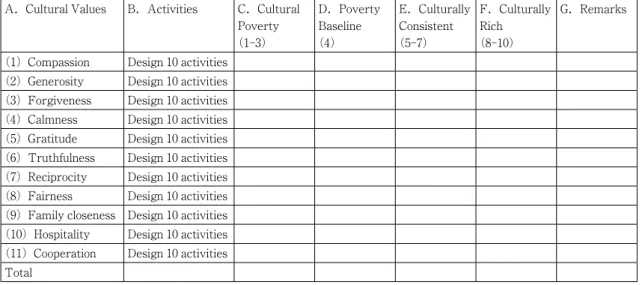
Directions to use the baseline table
Table A has a set of Cultural Values (1-11) where-as Table B hwhere-as Cultural Practices (1-6). Within these tables, Column B, indicates that the teacher is to de-sign 10 activities related to each of the values and practices that are doable, practical and understand-able to the level of students. During the month each student is to mark whether or not he/she carried out or practiced or demonstrated the possession of those values and practices. If the teacher is confident that students have attained a high level of integrity moni-toring and assessing of their performance, then it may be left to the individual students themselves or peer assessment.
The suggested frequency of assessment of cultural poverty (or cultural richness) is once a month. How-ever, it is left to the judgment of a teacher and the stu-dent concerned on the necessity of assessment and its frequency:monthly, fortnightly or weekly. The judg-ment could also include whether or not to assess all values and practices or to observe a selection of items.
Interpretation of scores
Now refer to Columns A to G. Column A is the list of values and practices suggested by CBS (2009). B is the list of activities that a teacher is to design, if rele-vant, in consultation with students. It is important that every student performs different activities to ca-ter to all or most of the values and practices, not sim-ply repeating one or two of them. If, in case an activity is to be performed regularly (for example, prayers) it should be counted as one activity.
The main point here is the Cultural Poverty Base-teacher at the centre of the stage and challenges him/
her with the role of alleviating cultural poverty. Let us revisit Namgyel (2010) and Ura (2009) who offer sug-gestions and strategies to alleviate cultural poverty. Namgyel (2010) is down to earth and specific about classroom interactions between a teacher and stu-dents. Among others, being truthful, showing grati-tude, saying thank you, demonstration of genuine goodwill gesture, exhibiting compassion, are testimo-ny of a teacher being role model. Similarly, Uraʼs (2009) six aspects of moral personhood:reason,
val-ues, emotion, character, behavior and identity, and their descriptors supplement classroom values and practices suggested by Namgyel (2010) (Photo. 3, 4). Classroom observation reveals that the teacherʼs use of language and the tone of interaction either com-forts or threatens students in the classroom. This, ei-ther positive or negative, is going to have a lasting im-pact on the childʼs psychological well-being. It is imperative that a teacher is mindful of his/her class-room manner, in all aspects:body, speech and mind. Absence of vices and negativities and ensuring an am-bient atmosphere in the classroom is one of the many steps to alleviating cultural poverty.
Proposition of a baseline model for assessing Cul-tural Poverty
The study proposed a baseline for recording and measuring cultural poverty. Descriptions of Table A and Table B, and directions on how to use them are presented.
line is set at 4 points out of 10. If a student scores just 4 it is considered to be a bare minimum pass mark and he/she is living on baseline of poverty. But any score below it, i. e., 1-3, is below baseline and therefore a student is destined to be living in the world of Cultural Poverty. It is the responsibility of teachers, students
themselves, parents, and stakeholders concerned to help save students from this cauldron. In severe cas-es, if a studentʼs acts are detrimental to cultural val-ues and practices, meaning if his/her average scores happen to be zero or minus points the student is
la-Table A Baseline for monthly performance in Cultural Values A.Cultural Values B.Activities C.Cultural
Poverty (1-3) D.Poverty Baseline (4) E.Culturally Consistent (5-7) F.Culturally Rich (8-10) G.Remarks
(1)Compassion Design 10 activities (2)Generosity Design 10 activities (3)Forgiveness Design 10 activities (4)Calmness Design 10 activities (5)Gratitude Design 10 activities (6)Truthfulness Design 10 activities (7)Reciprocity Design 10 activities (8)Fairness Design 10 activities (9)Family closeness Design 10 activities (10)Hospitality Design 10 activities (11)Cooperation Design 10 activities
Total
Table B Baseline for monthly performance in Cultural Practices A.Cultural Practices B.Activities C.Cultural
Poverty (1-3) D.Poverty Baseline (4) E.Culturally Consistent (5-7) F.Culturally Rich (8-10) G.Remarks
(1)Volunteering Design 10 activities (2)Donation Design 10 activities (3)Community
participation
Design 10 activities (4)Strong family ties Design 10 activities (5)Saving life Design 10 activities (6)Participation in
prayers and ritual.
Design 10 activities
Total
Photo. 5 Girls Study in Hostel Photo. 6 Primary Students Pray in a Morning
Carol, D., Wendy, D., Beverly, M. & Sheppard, K. (2009). Poverty and adolescent mental health. Journal of
Child and Adolescent Psychiatric Nursing, 22(1), 23-32
Creswell, J. W. (2007). Qualitative inquiry & research
design:Choosing among five approaches. Thou-sand Oaks:Sage.
Hungerford, A., Ogle, R., & Clements, C. (2010). Chil-drenʼs exposure to intimate partner violence:Rela-tions between parent-child concordance and chil-drenʼs adjustment. Violence and Victims, 25(2), 185-201.
Namgyel, S. (2005). Arak Culture:An Intangible Cultural Heritage of Bhutan. In T. Phuntsho (Ed.), Tangible
and Intangible Culture of Bhutan(pp.259-283). Paro:National Museum of Bhutan.
Namgyel, S. (2008). The significance of rimdro in Bhutan. In R. Mason, & F. Rennie (Eds.), Bhutan:Ways of Knowing, Library of Congress, USA:Information Age Publishing.
Namgyel, S. (2010). Reorienting classroom interaction.
In-ternational Seminar Magazine, New Delhi. Namgyel, S. (2011). Quality of Education in Bhutan:
Historical and Theoretical Understanding Matters. DSB:Thimphu.
OʼDonnell, D., Roberts, W., & Schwab-Stone, M. (2011). Community violence exposure and post-traumatic stress reactions among Gambian youth:the moderat-ing role of positive school climate. Soc Psychiat
Epi-demiol, 46, 59-67.
Rutledge, C., Don, R., & Micah, S. (2008). Vulnerable Goth teens:The role of schools in this psychosocial high-risk culture. The Journal of School Health, 78(9), 459-464.
Ryan C. Shorey, R., Cornelius, T., & Idema, C. (2011). Trait anger as a mediator of difficulties with emotion regulation and female-perpetrated psychological ag-gression. Violence and Victims, 26(3), 271-282. Schimmel, J. (2007). Development as happiness:The
sub-jective perception of happiness and UNDPʼs analysis of poverty, wealth and development. J Happiness
Stud, 10, 93-111.
Stewart, A., Harlow, D., & DeBacco, K. (2011). Studentsʼ experience of synchronous learning in distributed en-vironments. Distance Education, 32(3), 357-381. The Centre for Bhutan Studies (2009). Gross national
happiness:Survey findings 2007-2008. CBS:
Thimphu.
Thinley, J. Y. (2009). The first report of honourable
prime minister to the third session of the first par-liament on the state of the nation. Royal Government of Bhutan:Thimphu.
Ura, K. (2009). A proposal for GNH value education in
schools. Gross National Happiness Commission: Thimphu.
Wiley, A., Siperstein, G., Forness, S. & Brigham, F. (2010). School context and the problem behavior and social skills of students with emotional disturbance,
Child Fam Stud, 19, 451-461.
(2013年11月4日受理) beled to be living in Severe Cultural Poverty. Column
E (5-7) is Culturally Consistent and Column F (8-10) is the domain of Culturally Rich. Column G is for re-cording remarks, if any. Therefore depending upon the performance a student may live in “Severe Cultur-al Poverty” or “CulturCultur-ally Rich” or just at the “Base-line”.
An important message however is that the exercise should not be carried out for the sake of filling in box-es and record keeping. This should have a lasting im-pact on students both in values and practices, so that they do not grow into youths who self-harm by abus-ing substances, who vandalize properties for fun, who rob shops and individuals, or who stab with an intent to kill another human being (Photo. 5, 6).
4.Conclusion
Due to the small scale nature of this qualitative re-search it is not possible to generalize its findings. However, owing to its in-depth and uniquely emer-gent themes its findings may find merit in some ways. The researchers may be permitted to express their fi-nal word thus:humankind is likely to suffer famine and poverty of a different kind, that of culture. Cultur-al Poverty has the potentiCultur-al to be a terror of the next century. This study, despite its limitations, discussed literature on related topics, to bring home the impor-tance of culture and suggested ways to alleviate the poverty in question. Here the physician, the economist who should begin the task of alleviation is the teacher. Youth violence and related issues are presented to make the point that deficiency of culture can be a cause. Alternatively youth violence is the conse-quence of that poverty. A point of delight of this study is the proposition of “Cultural Poverty Baseline”. Al-though the authors intended the utility of the template in Bhutanese schools it however can be tried in any other context and society, if it deems merits.
References
Abrahams, D. (2010). A synopsis of urban violence in South Africa. International Review of the Red Cross, 92(878), 495-520.
Akhtar, S. (2010). Happiness:Origins, forms and techni-cal relevance. The American Journal of
Psychoanal-ysis, 70, 219-244.
Barford, A. (2009). Challenging assumptions:World pov-erty-what can we do about it? Geography, 94(3), 215-218.
Baruah, B. (2009). Monitoring progress towards gender-equitable poverty alleviation:the tools of the trade.