1.
は じ め に地震発生と地殻流体との関連性については,長年に わたって議論がおこなわれてきた(e.g., Mogi, 1989;
Hainzl and Fischer, 2002; Miller
et al., 2004; Vidaleet al., 2006)。しかしながら,地殻流体がどのような
メカニズムで地震を励起しているのか,という地震発 生過程を考える上で根本的な問題に関しては未だ明ら
かにされていない。その一つの原因として,地震発生 域において地殻流体の存在が地殻構造(地震学・電磁 気学的)の異常として捉えられた事例が非常に限られ ることが挙げられる。地殻流体が地震発生過程に果た す役割を明らかにするためには,空間解像度のより高 い地下構造を把握する必要がある。
日本列島には世界でも稀な高感度及び広帯域な定 常 地 震 観 測 網(e.g., 防 災 科 学 技 術 研 究 所
High- Sensitivity Seismograph Network(Hi-net)
,FullRange Seismograph Network of Japan(F-net)
)が10年以上前から整備されている。これらの地震観測
総 説
稠密地震波観測に基づく地震発生と地殻流体
加 藤 愛太郎
*(2012年6月29日受付,2012年10月1日受理)
“Role of crustal fluids on earthquakes inferred from dense seismic observations”
Aitaro K
ATO**
Earthquake Research Institute, The University of Tokyo, 1-1-1 Yayoi, Bunkyo-ku, Tokyo 113-0032, Japan
The very dense and well-covered ray-paths from the many earthquake clusters recorded by portable seismic stations provide us excellent opportunities to image detailed crustal structures and to determine hypocenters and stress field with high-accuracy within the seismogenic zone.
Based on these high-resolution images, I here review roles of crustal fluids on earthquake gen- erations, in terms of, 1) inland large earthquakes, 2) slow slips along the subduction zone boundary, 3) non-volcanic swarms. The presence of crustal fluids in source regions of the inland large earthquakes is expected to weaken the crustal material, causing local contractive defor- mation of the crust. Stress loading through the weak crust reactivates pre-existing weak faults within ancient rift systems, leading to devastating intraplate earthquakes in northeast Japan.
Recent studies of slow earthquakes point to the involvement of high pore fluid pressures near the plate boundary in the occurrence of slow earthquakes. In Tokai region, it has been revealed that combination of dehydration fluids with heterogeneous fluid transport properties in the overlying fore-arc plate generates variations of fluid pressures along the downgoing plate boundary, which in turn controls the occurrence of slow earthquakes along the plate boundary.
Beneath the non-volcanic seismic swarm region in Wakayama district, presence of crustal fluids has been demonstrated based on slow velocity and high conductive anomalies. Crustal fluids de- hydrated from the subducting oceanic crust could infiltrate into the mantle wedge and crust, leading up to the intensive non-volcanic seismic swarm.
Key words: Crustal fluid, Inland large earthquake, Slow slip, Non-volcanic swarm
*東京大学地震研究所
〒113―0032 東京都文京区弥生1―1―1
Chikyukagaku(Geochemistry)46,191―203(2012)
網では地上回線や衛星回線を経由して,ほぼリアルタ イムに連続波形データが収録されており,常に地震活 動のモニタリングが行われている(e.g., Okadaet al.,
2004; Obara
et al., 2005)。上記の定常地震観測網の 設 置 間 隔 は 約20〜30 kmで あ り,マ グ ニ チ ュ ー ド(M)7程度の震源域の大きさに概ね一致する。地震 発生域の地下構造を推定するためには,自然地震を用 いた地震波トモグラフィーという手法が有効である。
但し,地震波トモグラフィーの空間解像度は観測点の 設置間隔で概ね制限されるので,定常地震観測網の データのみを使用する限り,20 km程度の大きさに 対応した不均質構造しか捉えることができない。仮に 大きさ5 kmの地殻流体の塊が存在していた と し て も,その存在を確かめることは困難な状況である。ま た,震源分布についても同様に,公開されている震源 カタログ(気象庁一元化処理震源)の位置には数
km
の誤差がともなう。特に,地下構造が複雑な地域にお いてはその影響が顕著である(e.g.,Sakai
et al.,2005)
。より空間解像度の高い地下構造のイメージングや高精度な震源分布を推定するためには,定常観測 点の間を補間するように高密度な地震観測網を展開し て波形データを取得する必要がある。
近年,小型で設置が容易な簡易型地震観測装置が開 発され,数ヶ月から半年間にわたってサンプリング周 波数100〜200 Hzで時刻精度の高い連続観測が可能 となった。簡易型地震計は乾電池やバッテリーで駆動 するため,商用電源のない山間部でも観測が可能であ る。これらの簡易型地震計を高密度に展開すること で,地下構造の空間解像度が数
km
へと飛躍的に増加 し,世界屈指の解像度のイメージが得られるように なってきた。本総説では,著者の研究グループが実施 した高密度地震観測で得られた研究成果を中心に,1)内陸地震と地殻流体,2)ゆっくり滑りと地殻流
体,3)非火山性群発地震と地殻流体,の3つの観点 から地殻流体が地震発生過程に果たす役割について議 論したい。2.
内陸地震と地殻流体日本海東縁に沿って,地殻変動データ解析や地質学 的手法によりひずみ集中帯の存在が報告されている
(Sagiyaet al., 2000; Okamuraet al., 2007)。このひ ずみ集中帯内では,1964年新潟地震や1983年日本海 中部地震など他の地域に比べて被害地震が集中して発 生する傾向が強いことが指摘されている(Sagiya et
al.,
2000)
。このひずみ集中帯に位置する中越地域で,2004年新潟県中越地震と2007年新潟県中越沖地 震 が 至 近 距 離(約30 km)で 相 次 い で 発 生 し た
(Fig. 1)。複数の研究グループにより,2つの地震発 生後に高密度な余震観測網が展開され,これらの波形 データを用いたデータ解析が精力的に行われた(e.g.,
Kato
et al., 2005, Matsumotoet al., 2005; Okada et al., 2005; Katoet al., 2006, 2008a, 2009, 2010a)。そ の結果,中越地震震源域の上盤には,堆積層に対応す る低速度層が厚く堆積していることが示された。その 低速度層の下側には,年代の古い基盤岩(30 Ma)に 相当する高速度体が存在し,越後山脈へと続く。中越 地震は堆積層の厚みが南東へ向けて徐々に薄くなり,堆積盆地の縁に位置する盆地境界型断層の一部で発生 したことが明らかになった(Sato and Kato, 2005;
Kato
et al., 2006, 2009)。Kato
et al.(2006, 2009)によると,中越地震の震源域では,基盤岩の上面形状が階段状のステップをと もないな が ら 西 側 に 向 か っ て 深 く な る 特 徴 を 示 す
(Figs. 2 and 3)。さらに,速度構造と余震面の形状 を基に,基盤内に北西側傾斜の幅5〜10 kmのブロッ ク構造を読み取ることができる。余震の面状分布の浅 部延長部に基盤上面の階段状のステップ構造が対応し
Fig. 1 Map of areas focused in this article with fo- cal mechanisms of recent large inland earth- quakes. Red triangles and lines denote loca- tions of active volcanoes and active faults.
Yellow shade is the Niigata-Kobe Tectonic
Zone (NKTZ) derived from GPS network
(Sagiya, 2000).
ており,中越地震やその余震活動はブロック境界,即 ち,既存の断層面上で発生したと考えられる。ちなみ に,基盤上面の階段状のステップ構造は,中越地震震 源域の南西部で実施された超高密度余震観測により高 精 度 に イ メ ー ジ ン グ さ れ て お り(Kato et al.,
2010a)
,基盤岩上面のステップ構造と余震活動とに強い相関が見られる。
中越地震の震源域より西側の長岡平野に入ると,基 盤岩の上面は最も深くなり,堆積層の厚さが8 kmほ どに達する窪地(DCTZ in Figs. 2 and 3)が,中越 地域全体にわたって広域的に存在する(Kato et al.,
2009)
。したがって,この窪地は日本海拡大を担ったリフト軸の一部であった可能性が挙げられる。窪地の 西側では,基盤岩の上面は急に浅くなる。また,南東 傾斜のブロック構造が支配的となり,中越沖地震の震 源域にむかって基盤岩の上面は徐々に深くなる特徴を 示す。また,中越沖地震の震源域では,北東へむかう につれ,北西傾斜の基盤構造が徐々に発達し,局所的 に基盤上面が深さ5 kmと浅くなる(Fig. 2A)。中越 沖地震発生時の動的破壊過程は,北西傾斜の断層面の 深部から始まり,途中から南東傾斜の断層面に乗り 移った可能性が指摘されており(Kato et al., 2008a;
Takenaka
et al., 2009; Aochi and Kato 2010),震源 近傍の北西傾斜の基盤構造が動的破壊過程に影響を与 えた可能性が考えられる。中越地震と中越沖地震の余震分布の特徴として,
50
〜60度の高角度に傾斜した北西傾斜の余震面の存在 が挙げられる。中越地方では,最大主圧縮軸が水平面 内に分布するため,このような高角度に傾斜した断層 面を動かすためには,破壊力学的考察から断層の破壊 強度を下げる必要がある(Kato et al., 2006; Sibson,
2007)
。破壊強度を下げるためには,高圧流体や粘土鉱物などの存在が必要となるだろう。つまり,断層強 度は全体的には低いことが想像される。
基 盤 岩 上 面 の 凹 凸 構 造 は,日 本 海 拡 大 時(〜15
Ma)に形成されたリフト構造を反映するものと考え
られる(Sato, 1994)。リフト形成期には,引張応力 場によって複数の正断層が形成され,その後,このリ フトの上部には分厚い堆積層が積もり,リフト構造は 地中深部へ埋没し,約3 Maに応力場が引張場から圧 縮場へ変わることで正断層が逆断層として再活動を起 こしている(インバージョンテクトニクス)と推定さ れる。以上より,中越地震と中越沖地震の発生に,リ フト内に発達した力学的に弱い既存断層の再活動が関Fig. 2 Depth sections of the P-wave velocity (V
p)
model along W35N-E35S lines in the source regions of the 2004 Niigata Chuetsu and 2007 Niigata Chuetsu-Oki earthquakes (Kato
et al., 2009). Relocated aftershocks(gray circles) distributed within±2.5 km of each line are superimposed. From NE to SW; (A) Y=10 km, (B) Y=5 km, (C) Y=0 km, (D) Y=−5 km, (E) Y=−10 km.
Masked areas correspond to low model reso-
lution. White curves denote iso-velocity con-
tours of
Vp=5.7 km/s (top of the basement),and white broken lines show faults sug-
gested from aftershock streaks, top surface
geometries of the basement, or velocity
changes within the basement. DCT means
the deep central trough. Blue and red ar-
rows at the top of each section correspond to
surface locations of the Shibata-Koide Tec-
tonic Line (SKTL) and the coast line. Mo-
ment tensor solutions for the 2004 and 2007
Niigata earthquakes (NIED) are shown us-
ing a lower hemisphere projection rotated
into the plane of the section.
与した可能性が十分考えられる。
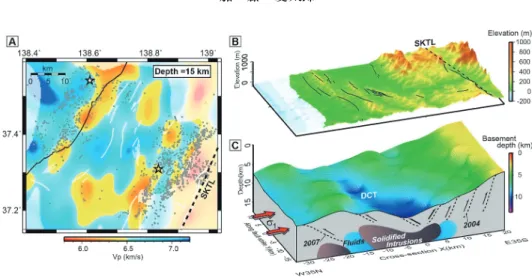
既存の正断層を再活動させるためには,その断層へ の応力蓄積過程が必要不可欠である。いくら力学的に 弱い断層があったとしても,断層を動かす駆動力であ る応力が作用しない限り,地震性のすべりを引き起こ すことは困難であろう。内陸地震の応力蓄積過程に関 するモデルとして,Iioet al.(2002)により,地震発 生域下部の局所的な深部すべりモデルが提唱されてい る。Katoet al.(2009)によると,中越地震・中越沖 地震の震源域直下の深さ15 km程度に局在化した低 速度体(Vp=6.1〜6.3 km/s)が存在することが指摘 されている(Fig. 3A)。中越地震の震源域の下部 に は,電磁気学的調査によりこの低速度体におおむね一 致 す る 低 比 抵 抗 体 が イ メ ー ジ ン グ さ れ て い る
(Uyeshima et al., 2005)。低速度,且つ,低比抵抗 という性質から,震源域直下に局在化した地殻流体が 存在すると解釈するのがもっともらしいと思われる。
仮に震源断層下に地殻流体が存在すると,変形強度が 周囲よりも低下するため(Carter and Tsenn, 1987;
Kato
et al., 2003),変形が局所化する。この地殻深部の局在化した変形により,その上部に位置するリフト 内の既存断層への応力集中が生じることが予想され
る。それにより,リフト内の既存断層が再活動し,中 越地震・中越沖地震が発生したという定性的モデルが 考えられる(Figs. 3B and 3C)。即ち,日本海拡大時 に形成された過去のリフト構造に由来する不均質構造 が,現在の地震発生・地殻活動に対して強い影響を及 ぼしている点は注目すべき特徴である(Kato et al.,
2009)
。実際,Shibazaki and Kato(2012)は,P波速度 構造から震源域の摩擦係数の不均質分布を仮定し,数 値シミュレーションにより中越地震・中越沖地震発生 の再現を試みている。このシミュレーションによる と,低速度を示す領域に変形が局在化するため,その 周辺で断層運動が生じることが示されており,前述の 定性的モデルの数値的な記述に対応する。しかしなが ら,既知の一部の活断層の運動を記述できないなど改 善すべき点が残されており,今後の課題である。ま た,自然地震を用いた広域トモグラフィーにより,震 源域のより深部に位置する下部地殻から上部マントル にかけても,地震波速度の低速度異常が指摘されてい る(Nakajima and Hasegawa, 2008)。これらの低速 度異常は,震源域直下で見られた地殻流体の供給源で あるかもしれない。
Fig. 3 Low velocity zones in the deep crust and three-dimensional perspective
views of active tectonics in the Chuetsu area. (A) Map views of
Vpstruc-
tures at 15 km depth. Yellow and white stars denote hypocenters of the
2004 and 2007 mainshocks. Major active faults are drawn as white lines. A
broken line indicates the SKTL (Kato
et al., 2009). (B) Topography, overwhich active faults are drawn as solid lines. The broken line indicates the
SKTL. (C) Perspective image of the top of the basement (depth to
Vp=5.7km/s) with interpretations. Dominant reactivated normal faults are drawn
as broken lines with arrows showing slip directions during compressional
inversion. Red arrows indicate the inferred direction of the regional maxi-
mum stressσ
1.
同様に,2007年能登半島地震の震源域においても
(Fig. 1),過去のリフト構造に由来すると考えられ る地下構造がイメージングされている(Kato et al.,
2008a)
。本震の断層面は傾斜角が60度と2004年中越地震と同様に高角度であり,高速度の上盤と低速度の 下盤との境界付近に位置する。下盤側の浅部には堆積 層に相当する厚さ数
km
の顕著な低速度層が存在す る。これらの構造も,日本海拡大に関連したリフト構 造由来のものと考えられる。さらに興味深いことに,本震の震源直下は低速度,且つ,低比抵抗な領域とし て特徴付けられ,地殻流体が存在していることが示唆 される(Kato et al.,
2008b; Yoshimura
et al.,2008)
。余震の波形データから震源域の応力場を推定した結果によると,深さ0〜4 kmにおいては横ずれ タイプの地震が主であるが,深さ6 km以深では逆断 層タイプへと変化する(Katoet al., 2011)。この応力 場の深さ変化を説明する一つの定性的なモデルとし て,地震発生層の直下における高圧流体の存在が候補 として挙げられる(Fig. 4)。この高圧流体の浮力に より,上部地殻全体が上へ押し上げられ(ヒンジ軸が 最大水平圧縮軸σh
maxに平行と仮定),最少水平圧縮応 力(σhmin)が浅部では減少し,逆に深部では増加する。
この最少主応力の深さ変化により,横ずれタイプから 逆断層タイプへの応力場の深さ変化が説明できる。以 上から,中越地域と同様に,地殻流体の作用により過
去のリフト構造内に残された既存断層が再活動した結 果,2007年能登半島地震が発生したと解釈できる。
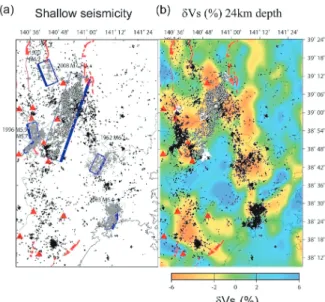
東北地方の前弧側においても,2003年宮城県北部 地震や2008年岩手・宮城内陸地震で観察されたよう に,日本海拡大時に形成された過去のリフト構造の再 活動と考えられる活発な地震活動が生じた(Kato et al., 2006; Okada et al., 2007)。また,これらの内陸 地震の震源域の直下深さ20〜30 kmに低速度体が存 在することが指摘されている(Okadaet al., 2010)。 これらの下部地殻内の低速度体の分布と上部地殻で生 じる地震活動帯との分布には空間的に強い相関が見ら れる(Fig. 5)。また,これらの地震活動帯に対応し
Fig. 5 Comparison of the spatial distribution of shallow seismicity and lower crustal struc- ture in the focal area of the 2008 Iwate- Miyagi Nairiku earthquake (Okada
et al.,2010). (a) Epicenter of shallow seismicity (depth<45 km) is denoted by a small cross.
The blue rectangle shows the horizontal pro- jection of the plausible fault of the earth- quake with amagnitude>5.5 (bold line de- notes the shallower edge of the fault). The aftershocks of these earthquakes are shown by small gray crosses (Umino
et al., 2000).Red triangles and bold red lines (boxes) de- note quaternary volcanoes and active faults, respectively. White star and small circles denote the mainshock and the aftershocks of the 2008 earthquake, respectively. (b) Vs perturbation at a depth of 24 km. The white cross denotes the low-frequency micro- earthquakes.
Fig. 4 Schematic image of the depth variations in
the stress field and a hypothetical fluid res-
ervoir beneath the mainshock hypocenter
(yellow star) in the 2007 Noto Hanto earth-
quake (Kato
et al., 2011). The lengths of vec-tors are scaled to the magnitudes of the
principal stresses that they represent. The
fault plane is shown as a shaded, inclined
surface. Red arrows, slip directions derived
from a finite source model [Ozawa
et al.,2008].
て,測地学的・地質学的にも歪みの集中が報告されて いる(e.g., Hasegawaet al., 2009)。震源域直下に見 られた低速度体は,沈み込む太平洋スラブから解放さ れて上昇した地殻流体(メルトや水等)に対応すると 考えられる。このような地殻流体は東北地方の脊梁に 位置する活火山へ主に供給されると同時に,火山フロ ントよりも前弧域に位置する内陸地震の震源域直下へ も供給されている(Nakajima and Hasegawa, 2003,
Hasegawa
et al., 2009)。したがって,地殻流体がも たらす地殻深部の弱化により,上部地殻に局所的な歪 みの集中が生じ,その結果として活発な地震活動が帯 状に起きていると解釈される。中部日本のひずみ集中 帯に位置する跡津川断層域においても,震源域の直下 に低速度体の存在が示唆されている(Nakajimaet al.,2010)
。これらの地殻流体の起源は,中部日本に南側から沈み込むフィリピン海プレートから解放された流 体 で は な い か と 議 論 さ れ て い る(Nakajima
and Hasegawa, 2007)
。以上のように,地殻流体による地殻深部の局所的な 弱化がもたらす不均質な変形が,上部地殻内に存在す る既存断層に対して応力集中を引き起こし,内陸地震 の発生に関与していると考えられる。地殻流体は内陸 地震の発生に至る応力蓄積過程の一役を担っている可 能性が高い(e.g., Katoet al., 2009; Hasegawaet al.,
2009)
。3.ゆっくり地震と地殻流体
ゆっくり地震とは,通常の地震に比べて断層面が ゆっくりと滑る現象のことである。近年,以前に比べ て高感度且つ高密度な地震・地殻変動観測網の構築に より,世界中のプレート境界面上において,ゆっくり 地震が続々と検出され,その全貌が徐々に明らかに なってきている(e.g., Dragert et al., 2001; Obara,
2002; Obara
et al., 2004; Ito et al., 2007; Peng andGomberg, 2010)
。特に,深部低周波微動は,日本のHi-net
観測網のデータを解析することで発見された現象であり(Obara,
2002)
,この研究分野において 世界を先導している。通常の地震の継続時間は地震 モーメントの三分の一乗に比例するが,ゆっくり地震 の継続時間は地震モーメントの一乗に比例して増加す るという特徴が報告されている(Ide et al., 2007)。 例えば,深部低周波微動・地震(M 1〜2)は約1秒程 度,深部超低周波地震(M 3〜4)は20秒程度,短期 的なゆっくり滑り(M 5.5〜6)は数日程度,長期的なゆっくり滑り(M 6〜7)は数年程度の継続時間を 有する。これらの多くは,プレート境界面上の固着域 から安定すべり域への遷移的なプレート間カップリン グを反映するすべり現象と考えられている。また,こ れらの深部低周波微動・低周波地震やゆっくり滑りの 発生には,海洋性地殻内の高間隙水圧との関連が指摘 されている(e.g., Kodairaetal., 2004; Shelly et al.,
2006; Liu and Rice, 2007; Audetetal., 2009; Song
etal., 2009)。四国西部の微動発生域や,カナダのカス
ケディア沈み込み帯で生じるゆっくり滑り域に存在す る海洋性地殻は,ポアソン比が高い特徴を有する。深 部低周波微動活動は,潮汐変動や表面波の伝播などの 微弱な応力変化でも励起される現象であり(e.g., Mi-
yazawa and Mori, 2005; Miyazawa and Brodsky, 2008; Nakata
et al., 2008; Ide, 2010),ゆっくり滑り が起きている領域の強度が極めて弱く,間隙水圧が非 常に高いことが予想されている。しかしながら,海洋 性地殻内の高間隙水圧の沈み込み方向の分布や,その 起源に関する我々の知見は限られており,ゆっくり地 震に対する理解の妨げとなっている。Kato
et al.(2010b)は,東海地震の固着域深部から長期的ゆっくり滑り域と深部低周波微動域を横断す る直線状の測線において,高密度な臨時地震観測点を 展開した(Fig. 1)。レシーバー関数解析から,沈み 込む海洋性地殻の上面と下面を特徴づける不連続面 が,北西方向に低角度(約15度)に傾斜しているこ とが明瞭に示 さ れ た(Fig. 6B)。さ ら に,深 さ 約28
km
に,陸のモホ面に対応する不連続面が存在し,海 洋性地殻の上面と接触する。沈み込む海洋性地殻内の 地震波速度構造に注目してみると,海洋性地殻は,平 均的に低速度・高ポアソン比(Vp/Vs比)の傾斜した 帯として特徴づけられる。また,速度低下・高ポアソ ン比の異常の大きさは深さ方向に変化することが初め て示された(Figs. 6B〜6D)。即ち,長期的ゆっくり 滑りによるモーメント解放量の最も大きな領域では,海洋性地殻内に顕著な低速度・高ポアソン比の異常域 が現れる。この異常域の地震波速度は,通常の海洋性 地殻の速度に比べて有意に低下する。室内実験で得ら れ た 弾 性 波 速 度 の 測 定 結 果 を 参 考 に す る と
(Christensen, 1984; Peacock et al., 2011),この領 域には高圧流体,もしくは大量の流体の存在が示唆さ れる。この領域には沈み込んだ流体に富んだ海嶺の存 在が,制御震源探査(Kodairaet al., 2004)によって 指摘されている。長期的ゆっくり滑り発生域のスラブ
内地震の活動度は,他の深さに比べて極めて低く,高 圧流体の影響によるものと考えられる。さらに,この 領域の直上に位置する上盤内の地殻下部には明瞭な高 速度体が存在する。この高速度体の内側では微小地震 がほとんど発生していない。一つの解釈として,この 上盤内の高速度体は比較的均質で流体を通しにくい性 質 を 有 し,海 洋 性 地 殻 内 の 高 圧 流 体 を シ ー ル す る キャップ・ロックとしての機能を果たしているかもし れない。
長期的ゆっくり滑り域に対して,より深部に位置す る低周波地震・微動域では,海洋性地殻内に低速度・
高ポアソン比の異常域が依然として存在するものの,
異常の程度が長期的ゆっくり滑り域で見られた異常に 比べて明らかに低下する(Figs. 6B〜6D)。室内実験 で得られたポアソン比の流体圧依存性を示した測定結 果に基づくと(Peacock et al., 2011),流体圧が減少 するとポアソン比も下がることが報告されている。
よって,この速度構造の深さ変化は,深部低周波地 震・微動域において海洋性地殻内の流体圧の低下,も しくは,流体量の減少が起きていることを意味する。
この原因として,海洋性地殻内の高圧流体の一部が,
深部低周波地震・微動域の直上に位置するマントル・
ウェッジ内へ漏れていることが考えられる。実際,マ ントル・ウェッジ内の地震波速度は,乾いた橄欖岩に 比べて有意に低い値を示し,海洋性地殻から漏れた流 体によって橄欖岩の蛇紋岩化が進行していると予想さ れる。マントル・ウェッジ内の平均的な地震波速度を 計算すると,P波速度7.2 km/s,S波速度は4.0 km/s となる。室内実験で計測された高温型蛇紋岩アンチゴ ライトの弾性波速度(Christensen, 2004)をもとに 蛇紋岩化率を推定すると,橄欖岩のおよそ60%近く が蛇紋化している必要がある(Fig. 7)。蛇紋岩化し たマントル・ウェッジの存在は,深部低周波微動活動 が活発なカスケディアやコスタリカ沈み込み帯でも指 摘されている(Bostock, et al., 2002; DeShon and
Schwartz, 2004)
。深部低周波地震・微動域の上限は,プレート境界の 等深度線にほぼ平行で,空間的にシャープな境界とし て特徴づけられる(Ide, 2010; Obara, 2010)。これ は,マントル・ウェッジと海洋性地殻が接する場所を 境に,それよりも深部のマントル・ウェッジの先端直 下で,深部低周波地震・微動が発生していることを意 味する(Fig. 7)。低周波微動はプレートの等深度線 に沿って概ね分布するものの,それとは直交した方向 Fig. 6 Depth sections of seismic velocities and re-
ceiver functions beneath the linear seismic array in Tokai district (Kato et al., 2010b).
(A) Profile of slip rate of the long-term slow slip event (LTSS) with histograms of LFEs determined by JMA near the section from 2001 to 2008 (gray bars). (B) P-wave velocity perturbationδVp/Vp. (C) S-wave velocity per- turbationδVs/Vs. (D)Vp/Vsratio. (E) Receiver function results. Relocated hypocenters are plotted for events within 10 km of each cross -section indicating regular earthquakes (Gray circles are relocated earthquakes ob- served by the linear array. Crosses repre- sent earthquakes from 2003 to 2007 relo- cated in the final velocity model) and red stars indicating low-frequency earthquakes (LFEs). Gray-masked areas represent re- gions of poor resolution. Our interpretation of seismic structure is superimposed on each section. The contours of the subducting oce- anic crust are drawn based on the receiver function image. SBG: Sanbagawa metamor- phic belt, NSM: Northern Shimanto accre- tionary complex, SSM: Southern Shimanto accretionary complex.
(沈 み 込 み 方 向 に ほ ぼ 平 行)に 筋 状 の 分 布 も 示 す
(Ide, 2010)。この筋状の分布は,マントル・ウェッ ジ内の蛇紋岩の不均質分布を捉えている可能性もあ る。
Kato
et al.(2010b)によると,長期的ゆっくり滑りは,前弧側の上盤プレートと沈み込む海洋性地殻が 接する境界で主に発生する。一方,深部低周波地震・
微動は,蛇紋岩化したマントル・ウェッジと海洋性地 殻が接する境界で発生する(Fig. 7)。このように,
長期的ゆっくり滑りと深部低周波地震・微動域は,プ レート境界面上に位置するものの,上盤物質の構成岩 石種が大きく異なることが明らかとなった。ゆっくり 滑りと相関の高い異常構造が沈み込む海洋性地殻内に 存在するとともに,流体圧が相対的に大きいほどゆっ くり滑りの継続時間が長くなるという特徴が見られ た。
4.
非火山性群発地震と地殻流体気象庁一元化処理震源データによると,日本列島の 多くの場所で微小地震が時間的・空間的にクラスター を形成していることがわかる。これらは,大地震の余 震活動や火山活動にともなう地震活動だけなく,現在 の火山フロントから遠く離れた領域で発生する非火山 性の群発地震活動にも対応する。しかしながら,この ような非火山性群発地震活動の発生メカニズムに関す る知見は非常に乏しいのが現状である。室内での破壊 実験に基づく研究によると,間隙水圧による有効圧力 の減少や応力腐食破壊(電気化学作用による強度の低
下)によって微小破壊(AE)が励起されると考えら れている。AEの発生領域と間隙水圧の増加領域が一 致しており,AEの励起は流体起源であることを強く 支持する(e.g., Schubnel et al., 2007)。このことを 根拠に,海外ではボヘミアやイタリア北部地域におい て群発地震活動の震源データのみを用いて,CO2流体 の 地 殻 内 へ の 貫 入 と の 関 連 が 議 論 さ れ て い る が
(Hainzl and Fischer, 2002; Milleret al., 2004),流 体の存在を示す地殻構造に基づく証拠は得られていな い。国内では,臨時地震観測網のデータを用いて,非 火山性群発地震が活発な和歌山地域の南部(Fig. 1)
でトモグラフィー解析がおこなわれている(Kato et
al., 2010c)。それによると,非火山性群発地震が発生
する領域(深さ4〜6 km)は,P波速度が標準的速度 構造モデルよりも若干低速度を示し,且つ,低ポアソ ン比(低
Vp/Vs〜1.65)として特徴づけられる(Fig. 8 A)
。地殻内流体が存在すると,その場所は周囲より も低速度になるため,非火山性群発地震の発生域に地 殻内流体が存在することを示唆する。また,低いポア ソン比は,比較的丸い形状をしたクラック内に水が存 在するモデルで定性的には説明が可能である(Takei,2002)
。また,深さ6 km以浅の震源は,鉛直に立った面状分布を示し地殻流体の貫入を表す可能性が考え られる。さらに,群発地震は顕著な高速度体の周辺,
特に上面付近に分布する。この高速度体は,室内実験 で測定された弾性波速度を参考にすると,花崗閃緑岩 などの貫入岩体に対応すると解釈できる(Katoet al.,
2010c)
。この貫入岩体の上部で熱水循環が生じるこFig. 7 Schematic interpretations of seismic structures in Tokai district
(Kato
et al., 2010b). Fluid pressuresPfwithin the subducting oce-
anic crust are color coded to magnitude. Green arrows denote po-
tential fluid pathways in the subduction zone.
とで非火山性群発地震が発生しているという仮説が提 唱された(Fig. 8B)。
しかしながら,和歌山地域の地殻浅部から沈み込む フィリピン海プレートに至る大規模な構造は把握され ていなかった。Katoet al.(2012)は,和歌山地域を 横断する長さ約90 kmの南北測線上に高密度な地震 計アレイを展開し,地殻浅部からスラブにいたる地殻 流体のイメージングを試みた。その結果,和歌山地域 の地震活動は深さ10 km以浅に位置し,地震発生層 の下限が活動域の中心部では縁辺部に比べて浅くなる 上に凸状の形状を示すことが明らかになった。地震発 生域の深部延長部には顕著な低速度体が存在し,地殻 下部まで低速度を示す。この低速度体の分布と活発な 非火山性群発地震の分布との間には,明瞭な空間的な 対応関係が見られる。2009年度に地震発生域の南部 で取得された比抵抗構造(上嶋・他,私信)を参考に すると,この低速度体は地殻内の流体である可能性が 高い。したがって,地震発生域の深部延長部に存在す る地殻流体が,非火山性群発地震の発生と密接な関連 があることが明らかとなった。
紀伊半島南部の前弧域の地殻下部でも,沈み込むス ラブから解放された流体と考えられる低速度体がイ メージングされた。この低速度体は,地殻浅部方向へ 延びる形状を示す。この低速度体も,過去に取得され
た比抵抗構造(Umedaet al., 2006)を参考にすると,
低比抵抗体に対応しており,沈み込むスラブから前弧 域への流体供給が進行していることを意味する。この ような沈み込むスラブから上方へ延びる形状を示す低 速度体は,東海地域の中央構造線の北側でも確認され ている(Figs. 6 and 7)(Katoet al., 2010b)。また,
ニュージーランドの南島でも,スラブ由来の地殻流体 を表す低比抵抗体が上盤内の活断層直下で捉えられて いる(Wannamakeret al
, 2009)
。スラブから解放さ れた流体が上盤内へ注入することで,沈み込み帯の流 体循環の一プロセスを担っていると考えられる。また,和歌山地域に南方から沈み込むフィリピン海 プレートの海洋性地殻が明瞭にイメージングされた。
和歌山地域に向かって,海洋性地殻の沈み込み角度は 徐々に高角になる。さらに,紀伊半島南部で低速度層 として見える海洋性地殻は,和歌山地域の深部(深さ
45〜55 km)で,高速度層へ変化する。沈み込みにと
もなう海洋性地殻の高速度化は,海洋性地殻内の玄武 岩が脱水変成作用によりエクロジャイト化しているこ とを意味する(e.g., Fukaoet al., 1983)。一方,陸の モホ面は群発地震発生域の南部で徐々に浅くなり,マ ントル・ウェッジ先端で不明瞭となる。このような特 徴は,カスケディア沈み込み帯のマントル・ウェッジ でも報告されており,マントル・ウェッジの低速度化Fig. 8 Velocity structures and the schematic interpretations of a non-
volcanic swarm area in Wakayama district (Kato
et al., 2010c). (A)Depth sections of the velocity models of
Vpand
Vp/V
s. Relocated
earthquakes (gray circles) distributed within±1.5 km of the section
are superimposed. Masked areas marked by gray color correspond to
low model resolution. White broken lines outline the prominent high
-velocity body. (B) Schematic interpretations. Circulating hydrother-
mal fluids and fluid pressure fluctuations, driven by the thermal
anomaly of the solidified diorite, trigger the seismic swarm.
を意味するかもしれない。ただし,前述の東海地域で は,陸のモホ面が海洋性地殻の上面と交わっており,
マントル・ウェッジの性質が和歌山と東海で異なり興 味深い点である(Katoet al., 2010b)。
5.
まとめと今後の展望本総説では,著者の研究グループが実施した高密度 地震観測で得られた高解像度の地下構造を中心に,
1)内陸地震と地殻流体,2)ゆっくり滑りと地殻流
体,3)非火山性群発地震と地殻流体,の3つの観点 から地殻流体と地震発生との関連について述べた。そ れぞれ異なるテクトニクスにおかれた地域にも関わら ず,どの地域にも共通して,地殻流体の存在を示唆す る地殻構造の異常が見られた。即ち,内陸地震・非火 山性群発地震の発生域では地震発生層深部において,ゆっくり地震の発生域では海洋性地殻やマントル・
ウェッジに,地殻流体が存在している可能性が高く,
地震・地殻活動の発生に寄与していると考えられる。
2011年東北地方太平洋沖地震発生後には,日本列島
の各地で誘発地震が発生した。このような誘発地震の 発生に対 し て も 地 殻 流 体 の 関 与 が 示 唆 さ れ て い る(Tonget al., 2012; Katoet al., 2013)。このように,
地殻流体が地震発生過程に対して重要な役割を担って いるという仮説は妥当と思われる。しかしながら,現 状では低速度・低比抵抗という情報を手掛かりに地下 構造を定性的に解釈しているに過ぎない。地下にある 岩石種の分布や,地震波の散乱・異方性といった別の 情報も利用して,流体の量・分布・形態等のより定量 的な解釈を目指す努力が必要である。さらに,現状で は地震発生と地殻流体との空間的な相関についての議 論に留まっている点も問題である。今後は,流体移動 や流体圧の時間変化の検出を通して,地殻流体と断層 運動との時間的な対応関係に焦点を絞った研究が欠か せないであろう。
謝 辞
岩森光氏,匿名の査読者と雑賀敦氏には,本総説を 執筆するに際して大変有益なコメントを頂きました。
ここに記して感謝致します。
引 用 文 献
Aochi, H. and Kato, A. (2010) Dynamic rupture of cross- cutting faults: Possible rupture process of the 2007 Mw 6.6 Niigata-Ken Chuetsu-Oki earthquake. Journal of
Geophysical Research,115, B05310, doi: 10.1029/2009 JB 006556.
Audet, P., Bostock, M. G., Christensen, N. I. and Peacock, S.
M. (2009) Seismic evidence for overpressured subducted oceanic crust and megathrust fault sealing.Nature,457, 76―78.
Bostock, M. G., Hyndman, R. D., Rondenay, S. and Peacock, S. M. (2002) An inverted continental Moho and serpenti- nization of the forearc mantle.Nature,417, 536―538, doi:
10.1038/417536a.
Carter, N. L. and Tsenn, M. C. (1987) Flow properties of con- tinental lithosphere.Tectonophysics,136, 27―63.
Christensen, N. I. (1984) Pore pressure and oceanic crustal seismic structure.Geophysical Journal of the Royal As- tronomical Societ,79, 411―423.
Christensen, N. I. (2004) Serpentinites, Peridotites, and Seis- mology. International Geology Revie, 46, 795―816, doi:
10.2747/0020-6814.46.9.795
DeShon, H. R. and Schwartz, S. Y. (2004) Evidence for ser- pentinization of theforearc mantle wedge along the Ni- coya Peninsula, Costa Rica. Geophysical Research Let- ters,31, L21611, doi: 10.1029/2004 GL021179.
Dragert, H., Wang, K. and James, T. S. (2001) A silent slip event on the deeper Cascadia subduction interface.Sci- ence,292, 1525―1528, doi: 10.1126/science.1060152.
Fukao, Y., Hori, S. and Ukawa, M. (1983) A seismological con- straint on the depth of thebasalt-eclogite transition in a subducting oceanic crust.Nature,303, 413―415.
Hainzl, S. and Fischer, T. (2002) Indications for a succes- sively triggered rupture growth underlying the 2000 earthquake swarm in Vogtland/NW Bohemia.Journal of Geophysical Research,107(B12), 2338, doi: 10.1029/2002 JB001865.
Hasegawa, A., Nakajima, J., Uchida, N., Okada, T., Zhao, D., Matsuzawa, T. and Umino, N. (2009) Plate subduction, and generation of earthquakes and magmas in Japan as inferred from seismic observations: An overview.Gond- wana Research,16, 370―400.
Ide, S., Beroza, G. C., Shelly, D. R. and Uchide, T. (2007) A scaling law forslow earthquakes.Nature,447, 76―79, doi:
10.1038/nature 05780.
Ide, S. (2010) Striations, duration, migration, and tidal re- sponse in deep tremor.Nature,466, 356-359, doi: 10.1038 /nature 09251.
Iio, Y., Sagiya, T., Kobayashi, Y. and Shiozaki, I. (2002) Water-weakened lower crust and its role in the concen- trated deformation in the Japanese Islands. Earth and Planetary Science Letters,203, 245―253.
Ito, Y., Obara, K., Shiomi, K. Sekine, S. and Hirose, H. (2007) Slow earthquakescoincident with episodic tremors and slow slip events.Science,315, 503―506, doi: 10.1126/sci- ence.1134454.
Kato, A., Ohnaka, M. and Mochizuki, H. (2003) Constitutive properties for the shear failure of intact granite in seis-
mogenic environments. Journal of Geophysical Re- search.,108(B1), 2060, doi: 10.1029/2001 JB000791.
Kato, A., Kurashimo, E., Hirata, N., Sakai, S., Iwasaki, T.
and Kanazawa, T. (2005) Imaging the source region of the 2004 mid-Niigata prefecture earthquake and the evo- lution of a seismogenic thrust-related fold. Geophysical Research Letters, 32, L07307, doi: 10.1029/2005 GL 022366.
Kato, A., Sakai, S., Hirata, N., Kurashimo, E., Iidaka, T., Iwasaki, T. and Kanazawa, T. (2006) Imaging the seismic structure and stress field in the source region of the 2004 mid-Niigata Prefecture Earthquake: Structural zones of weakness, seismogenic stress concentration by ductile flow.Journal of Geophysical Research,111, B08308, doi:
10.1029/2005 JB004016.
Kato, A., Sakai, S., Kurashimo, E., Igarashi, T., Iidaka, T, Hirata, N., Iwasaki, T., Kanazawa, T. and Group for the aftershock observations of the 2007 Niigataken Chuetsu- oki Earthquake (2008a) Imaging heterogeneous velocity structures and complex aftershock distributions in the source region of the 2007 Niigataken Chuetsu-oki Earth- quake by a dense seismic observation.Earth Planets and Space,60, 1111―1116.
Kato, A., Sakai, S., Iidaka, T., Iwasaki, T., Kurashimo, E., Igarashi, T., Hirata, N., Kanazawa, T. and Group for the aftershock observations of the 2007 Noto Hanto Earth- quake (2008b) Three-dimensional velocity structure in the source region of the Noto Hanto Earthquake in 2007 imaged by a dense seismic observation. Earth Planets and Space,60, 105―110.
Kato, A., Kurashimo, E., Igarashi, T., Sakai, S., Iidaka, T., Shinohara, M. Kanazawa, T., Yamada, T., Hirata, N. and Iwasaki, T. (2009) Reactivation of ancient rift systems triggers devastating intraplate earthquakes.Geophysical Research Letters, 36, L05301, doi: 10.1029/2008 GL 036450.
Kato, A., Iidaka, T., Iwasaki, T., Hirata, N. and Nakagawa, S.
(2010a) Reactivations of boundary faults within a buried ancient rift system by ductile creeping of weak shear zones in the overpressured lower crust: the 2004 mid- Niigata Prefecture Earthquake.Tectonophysics,486, 101
―107.
Kato, A., Iidaka, T., Ikuta, R., Yoshida, Y., Katsumata, K., Iwasaki, T., Sakai, S., Thurber, C., Tsumura, N., Yamaoka, K., Watanabe, T., Kunitomo, T., Yamazaki, F., Okubo, M., Suzuki, S. and Hirata, N. (2010b) Variations of fluid pressure within the subducting oceanic crust and slow earthquakes. Geophysical Research Letters, 37, L 14310, doi: 10.1029/2010 GL043723.
Kato, A., Sakai, S., Iidaka, T., Iwasaki T. and Hirata, N.
(2010c) Non-volcanic seismic swarms triggered by circu- lating fluids and pressure fluctuations above a solidified diorite intrusion. Geophysical Research Letters, 37, L 15302, doi: 10.1029/2010 GL043887.
Kato, A., Sakai, S., Iidaka, T., Iwasaki, T., Kurashimo, E., Igarashi, T., Hirata, N., Kanazawa, T., Katsumata, K., Takahashi, H., Honda, R., Maeda, T., Ichiyanagi, M., Yamaguchi, T., Kosuga, M., Okada, T., Nakajima, J., Hori, S., Nakayama, T., Hasegawa, A., Kono, T., Suzuki, S., Tsumura, N., Hiramatsu, Y., Sugaya, K., Hayashi, A., Hirose, T., Sawada, A., Tanaka, K., Yamanaka, Y., Nakamichi, H., Okuda, T., Iio, Y., Nishigami, K., Miyazawa, M., Wada, H., Hirano, N., Katao, H., Ohmi, S., Ito, K., Doi, I., Noda, S., Matsumoto, S., Matsushima, T., Saiga, A., Miyamachi, H., Imanishi, K., Takeda, T., Asano, Y., Yukutake, Y., Ueno, T., Maeda, T., Matsuzawa, T., Sekine, S., Matsubara, M. and Obara, K.
(2011) Anomalous depth dependency of the stress field inthe 2007 Noto Hanto, Japan, earthquake: Potential in- volvement of a deep fluid reservoir.Geophysical Research Letters,38, L06306, doi: 10.1029/2010 GL046413.
Kato, A., Saiga, A., Takeda, T. and Iwasaki, T. (2012) Fluids dehydrated from the subducting oceanic crust and non- volcanic seismic swarms. Joint Symposium of Misasa- 2012 and Geofluid-2, Misasa, Tottori, Japan.
Kato, A., Igarashi, T., Obara, K., Sakai, S., Takeda, T., Saiga, A., Iidaka, T., Iwasaki, T., Hirata, N., Goto, K., Miyamachi, H., Matsushima, T., Kubo, A., Katao, H., Yamanaka, Y., Terakawa, T., Nakamichi, H., Okuda, T., Horikawa, S., Tsumura, N., Umino, N., Okada, T., Ko- suga, M., Takahashi, H. and Yamada, T. (2013) “Imaging the source regions of normal faulting sequences induced by the 2011 M9.0 Tohoku-Oki earthquake”,Geophys. Res.
Lett., in press.
Kodaira, S., Iidaka, T., Kato, A., Park, J. -O., Iwasaki, T. and Kaneda, Y. (2004) High pore fluid pressure may cause si- lent slip in the Nankai Trough.Science,304, 1295―1298.
Liu, Y. and Rice, J R. (2007) Spontaneous and triggered aseis- mic deformation transients in a subduction fault model.
Journal of Geophysical Research, 112, B09404, doi:
10.1029/2007 JB004930.
Matsumoto, S., Iio, Y., Matsushima, T., Uehira, K. and Shibutani, T. (2005) Imaging of S-wave reflectors in and around the hypocentral area of the 2004 mid-Niigata Pre- fecture Earthquake (M 6.8).Earth Planets and Space,57, 557―561.
Miller, S. A., Collettini, C., Chiaraluce, L., Cocco, M., Barchi, M. and Kaus, B. J. P. (2004) Aftershocksdriven by a high- pressure CO2sourceat depth.Nature,427, 724―727, doi:
10.1038/nature 02251.
Miyazawa, M. and Mori, J. (2005) Detection of triggered deep low-frequency events from the 2003 Tokachi-oki earth- quake. Geophysical Research Letters, 32, L10307, doi:
10.1029/2005 GL022539.
Miyazawa, M. and Brodsky, E. E. (2008) Deep low-frequency tremor that correlates with passing surface waves.Jour- nal of Geophysical Research,113, B01307, doi: 10.1029/
2006 JB004890.
Mogi, K. (1989) The mechanism of the occurrence of the Mat- sushiroearthquake swarm in central Japan and its rela- tion to the 1964 Niigata earthquake, Tectonophysics, 159, 109―119, doi: 10.1016/0040-1951(89)90173-X.
Nakajima, J., Kato, A., Iwasaki, T., Ohmi, S., Okada, T., Takeda, T. and The Japanese University Group of the Joint Seismic Observations at NKTZ (2010) Deep crustal structure around the Atotsugawa fault system, central Japan: A weak zone below the seismogenic zone and its role in earthquake generation.Earth Planets and Space, 62, 555―566.
Nakajima, J. and Hasegawa, A. (2003) Tomographic imaging of seismic velocitys tructure in and around the Onikobe volcanic area, northeastern Japan: implications for fluid distribution.Journal of Volcanology and Geothermal Re- search,127, 1―18.
Nakajima, J. and Hasegawa, A. (2007) Deep crustal structure along the Niigata-Kobe Tectonic Zone, Japan: Its origin and segmentation.Earth Planets and Space,59, e5―e8.
Nakajima, J. and Hasegawa, A. (2008) Existence of low- velocity zones under the source areas of the 2004 Chuetsu and 2007 Chuetsu-Oki earthquakes inferred- from travel-time tomography.Earth Planets and Space, 60, 1127―1130.
Nakata, R., Suda, N. and Tsuruoka, H. (2008) Non-volcanic tremor resulting from the combined effect of Earth tides and slow slip events.Nature Geoscience,1, 676―678.
Obara, K. (2002) Nonvolcanic deep tremor associated with subduction in southwest Japan.Science,296, 1679―1681, doi: 10.1126/science.1070378.
Obara, K. (2010) Phenomenology of deep slow earthquake family in southwest Japan: Spatiotemporal characteris- tics and segmentation.Journal of Geophysical Research, 115, B00 A25, doi: 10.1029/2008 JB006048.
Obara, K., Hirose, H., Yamamizu, F. and Kasahara, K. (2004) Episodic slow slip events accompanied by non-volcanic tremors in southwest Japan subduction zone.Geophysi- cal Research Letters, 31, L23602, doi: 10.1029/2004 GL 020848.
Obara, K., Kasahara, K., Hori, S. and Okada, Y. (2005) A densely distributed high-sensitivity seismograph net- work in Japan: Hi-net by National Research Institute for Earth Science and Disaster Prevention.Review of Scien- tific Instruments,76, 021301, doi: 10.1063/1.1854197.
Okada, T., Umino, N., Matsuzawa, T., Nakajima, J., Uchida, N., Nakayama, T., Hirahara, S., Sato, T., Hori, S., Kono, T., Yabe, Y., Ariyoshi, K., Gamage, S., Shimizu, J., Suganomata, J., Kita, S., Yui, S., Arao, M., Hondo, S., Mizukami, T., Tsushima, H., Yaginuma, T., Hasegawa, A., Asano, Y., Zhang, H. and Thurber, C. (2005). After- shock distribution and 3 D seismic velocity structure in and around the focal area of the 2004 mid Niigata prefec- ture earthquake obtained by applying double-difference tomography to dense temporary seismic network data.
Earth Planets and Space,57, 435―440.
Okada, T., Hasegawa, A., Suganomata, J., Umino, N., Zhang, H. and Thurber, C. H. (2007) Imaging the heterogeneous source area of the 2003 M 6.4 northern Miyagi earth- quake, NE Japan, by double-difference tomography.Tec- tonophysics,430, 67―81.
Okada, T., Umino, H. and Hasegawa, A (2010) Deep structure of the Ou mountain range strain concentration zone and the focal area of the 2008 Iwate-Miyagi Nairiku earth- quake, NE Japan - Seismogenesis related with magma and crustal fluid.Earth Planets and Space,62, 347―352.
Okada, Y., Kasahara, K., Hori, S., Obara, K., Sekiguchi, S., Fujiwara, H. and Yamamoto, A. (2004) Recent progress of seismic observation networks in Japan-Hi-net, F-net, K- NET and KiK-net-. Earth Planets and Space, 56, xv- xxviii.
Okamura, Y., Ishiyama, T. and Yanagisawa, Y (2007) Fault- related folds above the source fault of the 2004 mid- Niigata Prefecture earthquake, in afold-and-thrust belt caused by basin inversion along the eastern margin of the Japan Sea.Journal of Geophysical Researcz,112, B 03 S08, doi: 10.1029/2006 JB004320.
Ozawa, S., Yarai, H., Tobita, M., Une, H. and Nishimura, T.
(2008) Crustal deformation associated with the Noto Hanto earthquake in 2007 in Japan.Earth Planets and Space,60, 95―98.
Peacock, S. M., Christensen, N. I., Bostock, M. G. and Audet, P. (2011) High pore pressures and porosity at 35 km depth in the Cascadia subductionzone. Geology, 39(5), 471-474, doi: 10.1130/G31649.1.
Peng, Z. and Gomberg, J. (2010) An integrated perspective of the continuum between earthquakes and slow-slip phe- nomena.Nature Geoscience,3, 599―607.
Sagiya, T., Miyazaki, S. and Tada, T. (2000) Continuous GPS array and present-day crustal deformation of Japan.
Pure and Applied Geophysics,157, 2303―2322.
Sakai, S., Hirata, N., Kato, A., Kurashimo, E., Iwasaki, T.
and Kanazawa, T. (2005) Multi-fault system of the 2004 Mid-Niigata Prefecture Earthquake and its aftershocks.
Earth Planets and Space,57, 417―422.
Sato, H. (1994) The relationship between late Cenozoic tec- tonic events andstress field and basin development in northeast Japan. Journal of Geophysical Research, 99, 22261―22274.
Sato, H. and Kato, N. (2005) Relationship between geologic structure and the source fault of the 2004 Mid-Niigata Prefecture Earthquake, central Japan.Earth Planets and Space,57, 453―457.
Schubnel, A., Thompson, B. D., Fortin, J., Guéguen, Y. and Young, R. P. (2007) Fluid-induced rupture experiment on Fontainebleau sandstone: Premonitory activity, rupture propagation, and aftershocks.Geophysical Research Let- ters,34, L19307, doi: 10.1029/2007 GL031076.
Shelly, D. R., Beroza, G. C. and Ide, S. (2006) Low-frequency
earthquakes in Shikoku, Japan, and their relationship to episodic tremor and slip. Nature, 442, 188―191, doi:
10.1038/nature 04931.
Shibazaki, B. and Kato, A. (2012) Modeling the development of a complex fault configuration in the source region of two destructive intraplate earthquakes in the mid- Niigata region.Tectonophysics, in press.
Sibson, R. H. (2007) An episode of fault-valve behaviour dur- ing compressional inversion?−The 2004 MJ 6.8 mid- Niigata Prefecture, Japan, earthquake sequence. Earth and Planetary Science Letters,257, 188―199.
Song, T. -R. A., Helmberger, D. V., Brudzinski, M. R., Clayton, R. W., Davis, P., Perez-Campos, X. and Singh, S.
K. (2009) Subducting slab ultra-slow velocity layer coinci- dent with silent earthquakes in southern Mexico. Sci- ence,324, 502―506.
Takei, Y. (2002) Effect of pore geometry on VP/VS: From equi- librium geometry to crack, Journal of Geophysical Re- search,107(B2), 2043, doi: 10.1029/2001 JB000522.
Takenaka, H., Yamamoto, Y. and Yamasaki, H. (2009) Rup- ture process at the beginning of the 2007 Chuetsu-oki, Niigata, Japan, earthquake. Earth Planets Space, 61, 279―283.
Tong, P., Zhao, D. and Yang, D. (2012) Tomography of the 2011 Iwaki earthquake (M 7.0) and Fukushima nuclear power plant area.Solid Earth,3, 43―51.
Umeda, K., Ogawa, Y., Asamori, K. and Oikawa, T. (2006) Aqueous fluids derived from a subducting slab: observed
high 3 He emanation and conductive anomaly in a non- volcanicregion, Kii Peninsula, southwest Japan.Journal of Volcanology and Geothermal Research,149, 47―61.
Uyeshima, M., Ogawa, Y., Honkura, Y., Koyama, S., Ujihara, N., Mogi, T., Yamaya, Y., Harada, M., Yamaguchi, S., Shiozaki, I., Noguchi, T., Kuwaba, Y., Tanaka, Y., Mochido, Y., Manabe, N., Nishihara, M., Saka, M. and Serizawa, M. (2005) Resistivity imaging across the source region ofthe 2004 mid-Niigata Prefecture earthquake (M 6.8), central Japan.Earth Planets and Space, 57, 441―
446.
Vidale, J. E., Boyle, K. L. and Shearer, P. M. (2006) Crustal earthquake bursts in California and Japan: Their pat- terns and relation to volcanoes. Geophysical Research Letters,33, L20313, doi: 10.1029/2006 GL027723.
Wannamaker, P., Caldwell, T. G., Jiracek, G. R., Maris, V., Hill, G. J., Ogawa, Y., Bibby, H. M., Bennie, S. L. and Heise, W. (2009) Fluid and deformation regime of an ad- vancing subduction system at Marlborough, New Zea- land.Nature,460, 733―736, doi: 10.1038/nature 08204.
Yoshimura, R., Oshiman, N., Uyeshima, M., Ogawa, Y., Mishina, M., Toh, H., Sakanaka, S., Ichihara, H., Shiozaki, I., Ogawa, T., Miura, T., Koyama, S., Fujita, Y., Nishimura, K., Takagi, Y., Imai, M., Honda, R., Yabe, S., Nagaoka, S., Tada, M. and Mogi, T. (2008) Magnetotellu- ric observations around the focal region of the 2007 Noto Hanto Earthquake (Mj 6.9), Central Japan.Earth Plan- ets and Space,60, 117―122.