Deep-sea Decapod Crustaceans from off the Japanese Coast of the Sea of Japan
Hironori Komatsu
Department of Zoology, National Museum of Nature and Science, 4–1–1 Amakubo, Tsukuba-shi, Ibaraki, 305–0005 Japan
E-mail: [email protected]
Abstract: Decapod crustaceans from off the Japanese coast of the Sea of Japan, collected during a
five-year project of the National Museum of Nature and Science, Tokyo,
“Research on Deep-seaFauna of the Sea of Japan,” are reported. The collection consists of one species of dendrobranchiate Penaeidae, 22 species of three caridean families (Crangonidae, Hippolytidae and Pandalidae), four species of anomuran Paguridae, and four species of brachyuran Oregoniidae. Of these one crangonid species, Paracrangon sp., could not be identified with any previously known species. Male speci- mens of crangonid species, Metacrangon obliqua Komai, 2012, and hippolytid species, Lebbeus polyacanthus Komai, Hayashi and Kohtsuka, 2004, are recorded for the first time. The biogeography and the bathymetric distribution of the recorded species are briefly discussed.
Key words: Crustacea, Decapoda, Dendrobranchiata, Caridea, Anomura, Brachyura.
Introduction
Knowledge on the decapod crustacean fauna in the Japanese coast of the Sea of Japan has been accumulated and reviewed by Motoh (2003, 2007, 2008) with a total of 565 species. But the deep-water decapod crustacean fauna is at present only known from rather a few studies, although the area constitutes a major fishery ground in our country. The first organized biological survey of the continental shelf of Japan, conducted by S. S. Soyo-maru of the Imperial Fishery Experimental Station of Tokyo, during 1923–1930, included the Sea of Japan. A collection of decapod crustaceans made by this survey was reported by Yokoya (1933), in which twenty-two species were recorded from the Sea of Japan at depths greater than 200 m. Other published works containing collections from the area include Kikuchi (1932), Rathbun (1932), Urita (1934), Yamamoto (1950), Miyake (1957, 1982), Kamita (1963), Kishida (1963), Miyake and Hayashi (1967), Hayashi (1976, 1977, 1992a, 2010), Omori (1976), Suzuki (1979), Doi (1989), Honma and Muraoka (1992), Komai and Amaoka (1992), Komai (1994, 1997, 1999, 2012), Kim and Natsukari (2000), Kim and Komai (2002), Komai and Kim (2004), Komai et al. (2004), Motoh and Toyoda (2005), Asakura (2006), Motoh and Yamaguchi (2009), Motoh et al. (2011), and Takeda et al. (2011).
Since 2009, in cooperation with the Fisheries Research Agency (FRA), the National Museum
and Nature and Science, Tokyo, has been carrying out a series of trawl surveys along the western
coast of Honshu, extending from Akita Prefecture to Shimane Prefecture, with the purpose of
understanding the faunal component and distribution of organisms in the bathyal zone down to
2300 m. The present paper is a report on the decapod crustaceans collected in 2009 and 2010
using T/V Tanshu-maru of Kasumi High School, Hyogo Prefecture. Material collected during the KT-10-8, KT-11-18 and KT-11-9 cruises of R/V Tansei-maru of the Japan Agency for Marine- Earth Science and Technology (JAMSTEC) to the Sea of Japan and further cruises in 2007, 2010, 2012, and 2013 of R/V Soyo-maru (FRA) is also included to the collections, as these col- lections contain samples from continental shelf to bathyal zone to 2400 m. Thirty-two species are recorded here, of which one crangonid species is not identified as any previously known species.
The collections of decapod crustaceans are referred to one species of one dendrobranchiate fam- ily (Penaeidae), 22 species of three caridean families (Crangonidae, Hippolytidae and Pandali- dae), four species of one anomuran family (Paguridae), and four species of one brachyuran fam- ily (Oregoniidae). Of these one crangonid species, Paracrangon sp., could not be identified with any previously known species. Male specimens of one crangonid species, Metacrangon obliqua Komai, 2012, and one hippolytid species, Lebbeus polyacanthus Komai, Hayashi and Kohtsuka, 2004, are recorded for the first time.
Materials and Methods
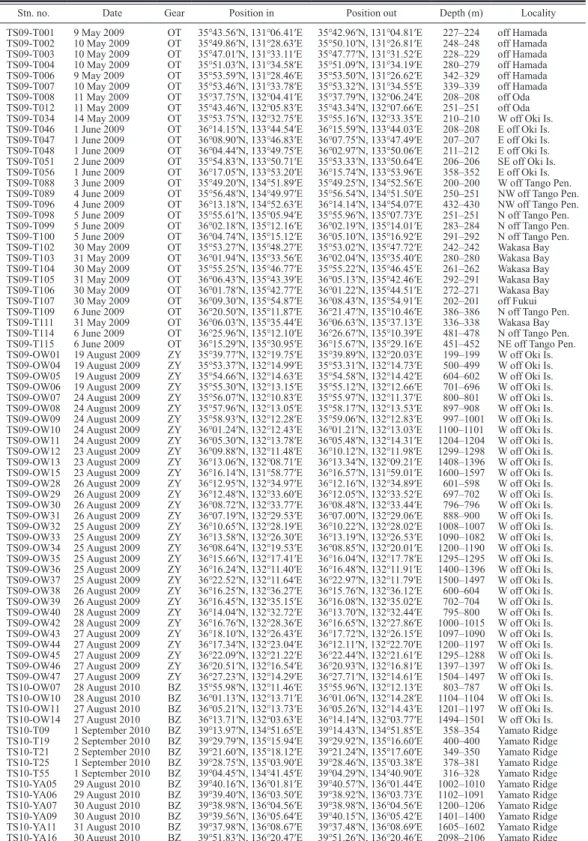
This study primarily deals with the specimens of decapod crustaceans collected from off the Japanese coast of the Sea of Japan, using T/V Tanshu-maru of Kasumi High School, Hyogo Pre- fecture (used gears include otter trawl and beam trawl with 8 m span opening), R/V Tansei-maru of the Japan Agency for Marine-Earth Science and Technology (JAMSTEC) (used gear was beam trawl with 3 m span opening) and R/V Soyo-maru of the FRA (used gear was beam trawl, dredge and baited trap). Data of sampling stations of T/V Tanshu-maru and R/Vs Tansei-maru and Soyo-maru are summarized in Tables 1–3, respectively. Only representative specimens were preserved for species by species at each station as voucher, and therefore the numbers of speci- mens do not reflect the real abundance. Since the fishery important species, Chionoecetes opilio and C. japonicus, were used for a resource stock assessment by the FRA, only a few specimens were preserved for these species. Specimens were fixed in 80% ethanol or 10% formalin and pre- served in 75% ethanol. All the specimens examined are deposited in the National Museum of Nature and Science, Tsukuba (NSMT).
Measurements of specimens are provided as follows: the postorbital carapace length (cl) for shrimps, the shield length (sl) for hermit crabs, and the carapace breadth (cb) brachyuran crabs.
In the brachyuran crabs, the carapace breadth was measured across the greatest breadth exclud-
ing lateral spines. Synonymy is restricted to the records from the Japanese coast of the Sea of
Japan occurring at depths greater than 200 m. Within each suborder or infraorder, families, gen-
era and species are arranged in alphabetical order. When possible, size of specimens is summa-
rized for each species. For carideans, maximum size is given for each sex, and size range of
ovigerous females, are given. Other abbreviations used in the text are: juv., juvenile; ovig., ovig-
erous.
Table 1. Sampling data of T/S Tanshu-maru cruises. Abbreviations for sampling gear: OT, otter trawl; BZ and ZY, beam trawl.
Stn. no. Date Gear Position in Position out Depth (m) Locality
TS09-T001 9 May 2009 OT 35°43.56′N, 131°06.41′E 35°42.96′N, 131°04.81′E 227–224 off Hamada TS09-T002 10 May 2009 OT 35°49.86′N, 131°28.63′E 35°50.10′N, 131°26.81′E 248–248 off Hamada TS09-T003 10 May 2009 OT 35°47.01′N, 131°33.11′E 35°47.77′N, 131°31.52′E 228–229 off Hamada TS09-T004 10 May 2009 OT 35°51.03′N, 131°34.58′E 35°51.09′N, 131°34.19′E 280–279 off Hamada TS09-T006 9 May 2009 OT 35°53.59′N, 131°28.46′E 35°53.50′N, 131°26.62′E 342–329 off Hamada TS09-T007 10 May 2009 OT 35°53.46′N, 131°33.78′E 35°53.32′N, 131°34.55′E 339–339 off Hamada TS09-T008 11 May 2009 OT 35°37.75′N, 132°04.41′E 35°37.79′N, 132°06.24′E 208–208 off Oda TS09-T012 11 May 2009 OT 35°43.46′N, 132°05.83′E 35°43.34′N, 132°07.66′E 251–251 off Oda TS09-T034 14 May 2009 OT 35°53.75′N, 132°32.75′E 35°55.16′N, 132°33.35′E 210–210 W off Oki Is.
TS09-T046 1 June 2009 OT 36°14.15′N, 133°44.54′E 36°15.59′N, 133°44.03′E 208–208 E off Oki Is.
TS09-T047 1 June 2009 OT 36°08.90′N, 133°46.83′E 36°07.75′N, 133°47.49′E 207–207 E off Oki Is.
TS09-T048 1 June 2009 OT 36°04.44′N, 133°49.75′E 36°02.97′N, 133°50.06′E 211–212 E off Oki Is.
TS09-T051 2 June 2009 OT 35°54.83′N, 133°50.71′E 35°53.33′N, 133°50.64′E 206–206 SE off Oki Is.
TS09-T056 1 June 2009 OT 36°17.05′N, 133°53.20′E 36°15.74′N, 133°53.96′E 358–352 E off Oki Is.
TS09-T088 3 June 2009 OT 35°49.20′N, 134°51.89′E 35°49.25′N, 134°52.56′E 200–200 W off Tango Pen.
TS09-T089 4 June 2009 OT 35°56.48′N, 134°49.97′E 35°56.54′N, 134°51.50′E 250–251 NW off Tango Pen.
TS09-T096 4 June 2009 OT 36°13.18′N, 134°52.63′E 36°14.14′N, 134°54.07′E 432–430 NW off Tango Pen.
TS09-T098 5 June 2009 OT 35°55.61′N, 135°05.94′E 35°55.96′N, 135°07.73′E 251–251 N off Tango Pen.
TS09-T099 5 June 2009 OT 36°02.18′N, 135°12.16′E 36°02.19′N, 135°14.01′E 283–284 N off Tango Pen.
TS09-T100 5 June 2009 OT 36°04.74′N, 135°15.12′E 36°05.10′N, 135°16.92′E 291–292 N off Tango Pen.
TS09-T102 30 May 2009 OT 35°53.27′N, 135°48.27′E 35°53.02′N, 135°47.72′E 242–242 Wakasa Bay TS09-T103 31 May 2009 OT 36°01.94′N, 135°33.56′E 36°02.04′N, 135°35.40′E 280–280 Wakasa Bay TS09-T104 30 May 2009 OT 35°55.25′N, 135°46.77′E 35°55.22′N, 135°46.45′E 261–262 Wakasa Bay TS09-T105 31 May 2009 OT 36°06.43′N, 135°43.39′E 36°05.13′N, 135°42.46′E 292–291 Wakasa Bay TS09-T106 30 May 2009 OT 36°01.78′N, 135°42.77′E 36°01.22′N, 135°44.51′E 272–271 Wakasa Bay TS09-T107 30 May 2009 OT 36°09.30′N, 135°54.87′E 36°08.43′N, 135°54.91′E 202–201 off Fukui TS09-T109 6 June 2009 OT 36°20.50′N, 135°11.87′E 36°21.47′N, 135°10.46′E 386–386 N off Tango Pen.
TS09-T111 31 May 2009 OT 36°06.03′N, 135°35.44′E 36°06.63′N, 135°37.13′E 336–338 Wakasa Bay TS09-T114 6 June 2009 OT 36°25.96′N, 135°12.10′E 36°26.67′N, 135°10.39′E 481–478 N off Tango Pen.
TS09-T115 6 June 2009 OT 36°15.29′N, 135°30.95′E 36°15.67′N, 135°29.16′E 451–452 NE off Tango Pen.
TS09-OW01 19 August 2009 ZY 35°39.77′N, 132°19.75′E 35°39.89′N, 132°20.03′E 199–199 W off Oki Is.
TS09-OW04 19 August 2009 ZY 35°53.37′N, 132°14.99′E 35°53.31′N, 132°14.73′E 500–499 W off Oki Is.
TS09-OW05 19 August 2009 ZY 35°54.66′N, 132°14.63′E 35°54.58′N, 132°14.42′E 604–602 W off Oki Is.
TS09-OW06 19 August 2009 ZY 35°55.30′N, 132°13.15′E 35°55.12′N, 132°12.66′E 701–696 W off Oki Is.
TS09-OW07 24 August 2009 ZY 35°56.07′N, 132°10.83′E 35°55.97′N, 132°11.37′E 800–801 W off Oki Is.
TS09-OW08 24 August 2009 ZY 35°57.96′N, 132°13.05′E 35°58.17′N, 132°13.53′E 897–908 W off Oki Is.
TS09-OW09 24 August 2009 ZY 35°58.93′N, 132°12.28′E 35°59.06′N, 132°12.83′E 997–1001 W off Oki Is.
TS09-OW10 24 August 2009 ZY 36°01.24′N, 132°12.43′E 36°01.21′N, 132°13.03′E 1100–1101 W off Oki Is.
TS09-OW11 24 August 2009 ZY 36°05.30′N, 132°13.78′E 36°05.48′N, 132°14.31′E 1204–1204 W off Oki Is.
TS09-OW12 23 August 2009 ZY 36°09.88′N, 132°11.48′E 36°10.12′N, 132°11.98′E 1299–1298 W off Oki Is.
TS09-OW13 23 August 2009 ZY 36°13.06′N, 132°08.71′E 36°13.34′N, 132°09.21′E 1408–1396 W off Oki Is.
TS09-OW15 23 August 2009 ZY 36°16.14′N, 131°58.77′E 36°16.57′N, 131°59.01′E 1600–1597 W off Oki Is.
TS09-OW28 26 August 2009 ZY 36°12.95′N, 132°34.97′E 36°12.16′N, 132°34.89′E 601–598 W off Oki Is.
TS09-OW29 26 August 2009 ZY 36°12.48′N, 132°33.60′E 36°12.05′N, 132°33.52′E 697–702 W off Oki Is.
TS09-OW30 26 August 2009 ZY 36°08.72′N, 132°33.77′E 36°08.48′N, 132°33.44′E 796–796 W off Oki Is.
TS09-OW31 26 August 2009 ZY 36°07.19′N, 132°29.53′E 36°07.00′N, 132°29.06′E 888–900 W off Oki Is.
TS09-OW32 25 August 2009 ZY 36°10.65′N, 132°28.19′E 36°10.22′N, 132°28.02′E 1008–1007 W off Oki Is.
TS09-OW33 25 August 2009 ZY 36°13.58′N, 132°26.30′E 36°13.19′N, 132°26.53′E 1090–1082 W off Oki Is.
TS09-OW34 25 August 2009 ZY 36°08.64′N, 132°19.53′E 36°08.85′N, 132°20.01′E 1200–1190 W off Oki Is.
TS09-OW35 25 August 2009 ZY 36°15.66′N, 132°17.41′E 36°16.04′N, 132°17.78′E 1295–1295 W off Oki Is.
TS09-OW36 25 August 2009 ZY 36°16.24′N, 132°11.40′E 36°16.48′N, 132°11.91′E 1400–1396 W off Oki Is.
TS09-OW37 25 August 2009 ZY 36°22.52′N, 132°11.64′E 36°22.97′N, 132°11.79′E 1500–1497 W off Oki Is.
TS09-OW38 26 August 2009 ZY 36°16.25′N, 132°36.27′E 36°15.76′N, 132°36.12′E 600–604 W off Oki Is.
TS09-OW39 26 August 2009 ZY 36°16.45′N, 132°35.15′E 36°16.08′N, 132°35.02′E 702–704 W off Oki Is.
TS09-OW40 28 August 2009 ZY 36°14.04′N, 132°32.72′E 36°13.70′N, 132°32.44′E 795–800 W off Oki Is.
TS09-OW42 28 August 2009 ZY 36°16.76′N, 132°28.36′E 36°16.65′N, 132°27.86′E 1000–1015 W off Oki Is.
TS09-OW43 27 August 2009 ZY 36°18.10′N, 132°26.43′E 36°17.72′N, 132°26.15′E 1097–1090 W off Oki Is.
TS09-OW44 27 August 2009 ZY 36°17.34′N, 132°23.04′E 36°12.11′N, 132°22.70′E 1200–1197 W off Oki Is.
TS09-OW45 27 August 2009 ZY 36°22.09′N, 132°21.22′E 36°22.44′N, 132°21.61′E 1295–1288 W off Oki Is.
TS09-OW46 27 August 2009 ZY 36°20.51′N, 132°16.54′E 36°20.93′N, 132°16.81′E 1397–1397 W off Oki Is.
TS09-OW47 27 August 2009 ZY 36°27.23′N, 132°14.29′E 36°27.71′N, 132°14.61′E 1504–1497 W off Oki Is.
TS10-OW07 28 August 2010 BZ 35°55.98′N, 132°11.46′E 35°55.96′N, 132°12.13′E 803–787 W off Oki Is.
TS10-OW10 28 August 2010 BZ 36°01.13′N, 132°13.71′E 36°01.06′N, 132°14.28′E 1104–1104 W off Oki Is.
TS10-OW11 27 August 2010 BZ 36°05.21′N, 132°13.73′E 36°05.26′N, 132°14.43′E 1201–1197 W off Oki Is.
TS10-OW14 27 August 2010 BZ 36°13.71′N, 132°03.63′E 36°14.14′N, 132°03.77′E 1494–1501 W off Oki Is.
TS10-T09 1 September 2010 BZ 39°13.97′N, 134°51.65′E 39°14.43′N, 134°51.85′E 358–354 Yamato Ridge TS10-T19 2 September 2010 BZ 39°29.79′N, 135°15.94′E 39°29.92′N, 135°16.60′E 400–400 Yamato Ridge TS10-T21 2 September 2010 BZ 39°21.60′N, 135°18.12′E 39°21.24′N, 135°17.60′E 349–350 Yamato Ridge TS10-T25 1 September 2010 BZ 39°28.75′N, 135°03.90′E 39°28.46′N, 135°03.38′E 378–381 Yamato Ridge TS10-T55 1 September 2010 BZ 39°04.45′N, 134°41.45′E 39°04.29′N, 134°40.90′E 316–328 Yamato Ridge TS10-YA05 29 August 2010 BZ 39°40.16′N, 136°01.81′E 39°40.57′N, 136°01.44′E 1002–1010 Yamato Ridge TS10-YA06 29 August 2010 BZ 39°39.40′N, 136°03.50′E 39°38.92′N, 136°03.73′E 1102–1091 Yamato Ridge TS10-YA07 30 August 2010 BZ 39°38.98′N, 136°04.56′E 39°38.98′N, 136°04.56′E 1200–1206 Yamato Ridge TS10-YA09 30 August 2010 BZ 39°39.56′N, 136°05.64′E 39°40.15′N, 136°05.42′E 1401–1400 Yamato Ridge TS10-YA11 31 August 2010 BZ 39°37.98′N, 136°08.67′E 39°37.48′N, 136°08.69′E 1605–1602 Yamato Ridge TS10-YA16 30 August 2010 BZ 39°51.83′N, 136°20.47′E 39°51.26′N, 136°20.46′E 2098–2106 Yamato Ridge TS13-YA13 30 August 2013 BZ 39°46.41′N, 136°11.31′E 39°46.31′N, 136°11.95′E 1803–1808 Yamato Ridge
Table 2. Sampling data of R/V Tansei-maru KT-10-8, KT-11-8 and KT-11-9 cruises. Abbreviation for sampling gear:
BT, beam trawl with 3 m span opening.
Stn. no. Date Gear Position in Position out Depth (m) Locality
KT-10-08-Es1 26 May 2010 BT 42°03.68′N, 139°32.89′E 42°05.09′N, 139°33.96′E 501–535 off Esashi KT-10-08-Es2 26 May 2010 BT 42°05.07′N, 139°36.40′E 42°03.13′N, 139°36.76′E 670–671 off Esashi KT-10-08-Es3 26 May 2010 BT 42°03.89′N, 139°40.79′E 42°01.72′N, 139°39.68′E 839–821 off Esashi KT-10-08-R1 23 May 2010 BT 45°36.25′N, 140°54.73′E 45°35.66′N, 140°54.09′E 178–190 off Rebun I.
KT-10-08-R2 23 May 2010 BT 45°27.25′N, 140°20.90′E 45°26.15′N, 140°21.94′E 402–393 off Rebun I.
KT-10-08-R3 23 May 2010 BT 45°27.21′N, 140°06.48′E 45°26.09′N, 140°08.45′E 615–594 off Rebun I.
KT-10-08-R4 23 May 2010 BT 45°25.45′N, 139°57.25′E 45°23.98′N, 139°57.27′E 710–742 off Rebun I.
KT-10-08-R5 23 May 2010 BT 45°23.90′N, 139°47.95′E 45°22.24′N, 139°46.23′E 889–671 off Rebun I.
KT-10-08-R6 23 May 2010 BT 45°23.03′N, 139°31.93′E 45°22.17′N, 139°28.35′E 1324–1440 off Rebun I.
KT-10-08-T1 21 May 2010 BT 40°53.90′N, 140°00.04′E 40°53.28′N, 139°58.62′E 350–315 off Tsugaru Pen.
KT-10-08-T2 21 May 2010 BT 40°55.82′N, 139°54.84′E 40°53.96′N, 139°53.88′E 679–715 off Tsugaru Pen.
KT-10-08-T3 21 May 2010 BT 40°57.96′N, 139°53.01′E 40°58.86′N, 139°52.87′E 851–839 off Tsugaru Pen.
KT-10-08-T4 22 May 2010 BT 41°12.91′N, 139°47.05′E 41°10.68′N, 139°48.19′E 1584–1704 off Tsugaru Pen.
KT-11-08-R3 23 May 2011 BT 44°05.15′N, 140°00.44′E 44°05.02′N, 140°01.67′E 988–880 off Rumoi KT-11-09-E1 29 May 2011 BT 41°52.01′N, 139°33.90′E 41°52.94′N, 139°34.33′E 247–222 off Esashi KT-11-09-E2 29 May 2011 BT 41°50.26′N, 139°34.03′E 41°48.70′N, 139°34.18′E 388–538 off Esashi KT-11-09-E3 29 May 2011 BT 41°47.46′N, 139°34.49′E 41°48.96′N, 139°34.88′E 635–563 off Esashi KT-11-09-E4 29 May 2011 BT 42°03.91′N, 139°40.11′E 42°03.38′N, 139°39.98′E 787–802 off Esashi KT-11-09-K2 3 June 2011 BT 35°46.11′N, 134°30.94′E 35°46.57′N, 134°32.09′E 204–204 off Kasumi KT-11-09-K3 2 June 2011 BT 35°54.85′N, 134°18.60′E 35°55.17′N, 134°20.08′E 411–370 off Kasumi KT-11-09-K4 2 June 2011 BT 35°59.92′N, 134°20.58′E 35°59.61′N, 134°18.82′E 611–613 off Kasumi KT-11-09-K5 2 June 2011 BT 36°22.25′N, 134°23.61′E 36°20.18′N, 134°22.84′E 1290–1277 off Kasumi KT-11-09-M2 28 May 2011 BT 44°40.48′N, 140°02.38′E 44°39.53′N, 140°02.83′E 198–206 Musashi Bank KT-11-09-M3 28 May 2011 BT 44°37.21′N, 139°56.68′E 44°36.29′N, 139°57.82′E 413–407 Musashi Bank KT-11-09-M4 28 May 2011 BT 44°35.38N, 139°52.93′E 44°34.32′N, 139°53.70′E 608–627 Musashi Bank KT-11-09-M5 28 May 2011 BT 44°31.41′N, 139°47.13′E 44°29.91′N, 139°47.96′E 1035–1080 Musashi Bank KT-11-09-M6 28 May 2011 BT 44°16.68′N, 139°36.85′E 44°14.25′N, 139°37.25′E 1461–1421 Musashi Bank KT-11-09-N2 1 June 2011 BT 37°57.06′N, 136°56.60′E 37°57.04′N, 136°58.23′E 203–203 N off Noto Pen.
KT-11-09-N3 1 June 2011 BT 38°03.25′N, 136°53.39′E 38°03.82′N, 136°55.13′E 403–414 N off Noto Pen.
KT-11-09-N4 1 June 2011 BT 38°08.04′N, 136°49.64′E 38°09.00′N, 136°51.20′E 617–604 N off Noto Pen.
KT-11-09-T2 31 May 2011 BT 37°28.77′N, 137°29.07′E 37°29.53′N, 137°28.63′E 207–258 Toyama Bay KT-11-09-T3 31 May 2011 BT 37°29.18′N, 137°33.25′E 37°29.35′N, 137°31.96′E 383–443 Toyama Bay KT-11-09-T4 1 June 2011 BT 37°19.80′N, 137°33.38′E 37°20.02′N, 137°34.20′E 562–574 Toyama Bay KT-11-09-T5 1 June 2011 BT 37°18.45′N, 137°31.77′E 37°18.66′N, 137°32.85′E 794–790 Toyama Bay KT-11-09-T6 1 June 2011 BT 37°28.29′N, 137°45.89′E 37°26.70′N, 137°44.59′E 1488–1564 Toyama Bay
Table 3. Sampling data of R/V Soyo-maru 2007, 2010, 2012, and 2013 cruises. Abbreviations for sampling gear: BT, beam trawl; TR, baited trap.
Stn. no. Date Gear Position in Position out Depth (m) Locality
SO07-C1 22–23 July 2007 TR 39°24.0′N, 135°12.3′E 39°23.9′N, 135°12.8′E 301–311 Yamato Ridge SO07-C1-B 22 July 2007 BT 39°24.9′N, 135°14.3′E 39°24.9′N, 135°13.4′E 312–321 Yamato Ridge SO07-C2 21–22 July 2007 TR 39°56.1′N, 136°03.6′E 39°57.1′N, 136°04.0′E 1290–1297 N of Yamato Ridge SO07-C2-B 21 July 2007 BT 39°54.6′N, 136°07.8′E 39°56.4′N, 136°07.1′E 1360–1333 N of Yamato Ridge SO07-C4 25–26 July 2007 TR 42°59.1′N, 139°59.6′E 42°59.2′N, 140°01.9′E 1341–994 off Iwanai SO07-C4-B1 25 July 2007 BT 43°00.4′N, 139°57.2′E 43°00.5′N, 139°59.4′E 1607–1280 off Iwanai SO07-C4-B2 25 July 2007 BT 42°53.7′N, 139°59.4′E 42°54.3′N, 140°01.1′E 843–800 off Iwanai
SO10-C4 19–20 July 2010 TR 39°59.2′N, 135°57.8′E 39°59.2′N, 135°57.4′E 1371–1384 slope of Yamato Ridge SO10-C4-B 19 July 2010 BT 39°59.2′N, 135°57.7′E 39°59.0′N, 135°57.7′E 1377–1377 slope of Yamato Ridge SO12-C13 26–27 July 2012 TR 39°20.0′N, 135°01.9′E 39°20.0′N, 135°02.2′E 302–304 Yamato Ridge SO12-C13-B 26 July 2012 BT 39°20.5′N, 135°02.8′E 39°20.0′N, 135°03.2′E 306–308 Yamato Ridge SO12-C15 23–24 July 2012 TR 42°56.2′N, 139°59.1′E 42°56.6′N, 139°58.2′E 1140–1332 off Iwanai SO12-C15-B2 23 July 2012 BT 42°58.2′N, 139°58.7′E 42°58.5′N, 139°58.0′E 1376–1432 off Iwanai SO13-C4 21–22 July 2013 TR 42°56.1′N, 139°59.0′E 42°57.3′N, 139°58.8′E 1132–1225 off Iwanai SO13-C4-B 21 July 2013 BT 42°57.6′N, 139°59.7′E 42°58.6′N, 139°59.9′E 1280–1334 off Iwanai SO13-C5 27–28 July 2013 TR 45°05.0′N, 140°30.0′E 45°05.2′N, 140°30.3′E 326–328 off Rebun SO13-C5-B 27 July 2013 BT 45°05.4′N, 140°30.7′E 45°05.1′N, 140°31.3′E 331–332 off Rebun
Taxonomic Account Suborder Dendrobranchiata
Family Penaeidae
Metapenaeopsis mogiensis mogiensis (Rathbun, 1902) [Japanese name: Mogi-ebi]
(Fig. 1A)
Material examined. KT-11-9-N2, 1 ♀ (cl 8.1 mm), NSMT-Cr 22398.
Distribution. Crosnier (1991) divided Metapenaeopsis mogiensis into three subspecies, of which the nominotypical form is restricted to Japanese waters, occurring in waters around Kyushu, Sea of Japan (Ishikawa and Shimane Prefecture), Pacific side (Suruga Bay and Sagami Bay); sublittoral to 200 m (Hayashi, 1992b; this study).
Suborder Pleocyemata Infraorder Caridea Family Crangonidae Argis hozawai (Yokoya, 1939) [Japanese name: Hime-kuro-zako-ebi]
Argis hozawai – Komai and Amaoka, 1992: 25, figs. 1–4; Motoh and Toyoda, 2005: 35.
Fig. 1. A. Metapenaeopsis mogiensis mogiensis (Rathbun, 1902), female (cl 8.1 mm), NSMT-Cr 22398, KT-
11-9-N2, off Noto Peninsula; B, Lebbeus polyacanthus Komai, Hayashi and Kohtsuka, 2004, male (cl
9.3 mm), NSMT-Cr 22587, SO07-C1-B, Yamato Ridge; C–D, Metacrangon obliqua Komai, 2012, male (cl
5.9 mm), NSMT-Cr 22492, KT-11-9-E1, off Esashi, Hokkaido; E–F, Metacrangon robusta (Kobjakova, 1935),
male (cl 7.8 mm), NSMT-Cr 22493, KT-11-9-M2, Musashi Bank.
Material examined. KT-10-8-R1, 6 ♀♀ (cl 9.6–13.9 mm), NSMT-Cr 22399; KT-11-9-N2, 1 ♂ (cl 9.7 mm), 2 ♀♀ (cl 15.4, 19.6 mm), 1 ♀ with bopyrids in branchial chamber (cl 15.1 mm), NSMT-Cr 22400.
Distribution. Restricted to East Asian waters, including Sea of Okhotsk, Sea of Japan southward to Korea, Hokkaido to off Onahama, Fukushima Prefecture; 10–310 m (Komai and Amaoka, 1992; Komai and Komatsu, 2009).
Argis lar (Owen, 1839) [Japanese name: Kuro-zako-ebi]
Argis lar – Suzuki, 1979: 292, fig. 34; Doi, 1989: 53; Motoh and Toyoda, 2005: 34.
Material examined. TS09-T102, 1ovig. ♀ (cl 29.1 mm), 4 ♀♀ (cl 26.0–32.2 mm), NSMT- Cr 22401; TS09-T107, 1 ♀ (cl 13.2 mm), 3 ♀♀ with bopyrids in branchial chamber (cl 20.2–
22.0 mm), NSMT-Cr 22402; KT-10-8-T1, 4 ♀♀ (cl 10.3–25.8 mm), NSMT-Cr 22403; KT- 11-9-E1, 2 ♂♂ (cl 9.7, 10.5 mm), 4 ♀♀ (cl 13.0–23.2 mm), NSMT-Cr 22404; KT-11-9-K2, 6 ♀♀
(cl 17.7–27.3 mm), NSMT-Cr 22405; KT-11-9-M2, 5 ♂♂ (cl 7.0–8.9 mm), 25 ♀♀ (cl 8.0–
25.3 mm), 1juv. (cl 9.0 mm), NSMT-Cr 22406; KT-11-9-T2, 1ovig. ♀ (cl 25.8 mm), 4 ♀♀ (cl 23.9–32.4 mm), NSMT-Cr 22407.
Remarks. Although Doi (1989) recorded this species from Toyama Bay at the depths of 306–1345 m, it is highly likely that he confused Argis lar with A. toyamaensis (Yokoya, 1933).
The available data and the present material suggest that A. lar does not extend to depths greater than 350 m.
Distribution. Northern North Pacific, including Sea of Japan, northern Japan, Sea of Okhotsk, Bering Sea to Strait of Georgia, Chukchi Sea; 10–350 m (Butler, 1980; Komai and Komatsu, 2009). In Japanese waters, occurring in waters around Hokkaido, Sea of Japan south- ward to Shimane Prefecture, Pacific side southward to Miyagi Prefecture (Kim, 2000; Komai and Komatsu, 2009).
Argis toyamaensis (Yokoya, 1933) [Japanese name: Toge-zako-ebi]
Nectocrangon toyamaensis Yokoya, 1933: 39, fig. 20.
Argis dentata – Ito, 1978: 138.
Nectocrangon dentata – Suzuki, 1979: 293, fig. 34–35; Doi, 1989: 53. [Not Argis dentata (Rathbun, 1902)]
Argis toyamaensis – Komai, 1997: 144, figs. 8–11, 16–20; Hayashi, 2010: 479, figs. 609i–j, 611l–m, 612 m–o.
Material examined. TS09-OW04, 1ovig. ♀ (cl 22.3 mm), 1 ♀ (cl 35.9 mm), NSMT-Cr 22408; TS09-OW05, 1ovig. ♀ (cl 27.9 mm), 2 ♀♀ (cl 29.1, 35.9 mm), NSMT-Cr 22409; TS09- OW06, 1ovig. ♀ (cl 27.1 mm), 1 ♀ (cl 29.5 mm), NSMT-Cr 22410; TS09-OW07, 1ovig. ♀ (cl 25.7 mm), 2 ♀♀ (cl 32.5, 33.8 mm), NSMT-Cr 22411; TS09-OW08, 1 ♂ (cl 19.6 mm), 1ovig. ♀ (cl 25.4 mm), 2 ♀♀ (cl 27.5, 27.6 mm), NSMT-Cr 22412; TS09-OW09, 2 ♂♂ (cl 22.1, 25.1 mm), 2ovig. ♀♀ (cl 23.0, 27.5 mm), NSMT-Cr 22413; TS09-OW10, 1 ♂ (cl 20.4 mm), 1ovig. ♀ (cl 21.4 mm), 2 ♀♀ (cl 22.9, 27.5 mm), NSMT-Cr 22414; TS09-OW11, 1ovig. ♀ (cl 26.0 mm), 2 ♀♀
(cl 18.0, 25.8 mm), NSMT-Cr 22415; TS09-OW12, 3 ♀♀ (cl 18.2–24.1 mm), NSMT-Cr 22416;
TS09-OW13, 2ovig. ♀♀ (cl 22.5, 25.7 mm), 2 ♀♀ (cl 17.5, 22.5 mm), NSMT-Cr 22417; TS09-
OW15, 1 ♂ (cl 15.5 mm), 2 ♀♀ (cl 23.0, 24.3 mm), NSMT-Cr 22418; TS09-OW28, 1ovig. ♀ (cl
27.4 mm), 1 ♀ (cl 26.8 mm), NSMT-Cr 22419; TS09-OW29, 1ovig. ♀ (cl 27.1 mm), 1 ♀ (cl
28.1 mm), NSMT-Cr 22420; TS09-OW30, 1ovig. ♀ (cl 33.5 mm), 1 ♀ (cl 29.8 mm), NSMT-Cr 22421; TS09-OW31, 1ovig. ♀ (cl 25.8 mm), 1 ♀ (cl 28.3 mm), NSMT-Cr 22422; TS09-OW32, 1ovig. ♀ (cl 24.0 mm), 3 ♀♀ (cl 23.3–30.6 mm), NSMT-Cr 22423; TS09-OW33, 2ovig. ♀♀ (cl 24.4, 25.6 mm), 2 ♀♀ (cl 24.0, 26.7 mm), NSMT-Cr 22424; TS09-OW34, 1 ♂ (cl 23.2 mm), 2ovig. ♀♀ (cl 23.2, 25.5 mm), 1 ♀ (cl 26.2 mm), NSMT-Cr 22425; TS09-OW35, 1ovig. ♀ (cl 23.7 mm), 3 ♀♀ (cl 14.4–25.3 mm), NSMT-Cr 22426; TS09-OW36, 1ovig. ♀ (cl 24.4 mm), 3 ♀♀
(cl 15.8–21.0 mm), NSMT-Cr 22427; TS09-OW37, 4 ♀♀ (cl 19.6–24.4 mm), NSMT-Cr 22428;
TS09-OW38, 2 ♂♂ (cl 21.7, 31.0 mm), 1 ♀ (cl 24.9 mm), NSMT-Cr 22429; TS09-OW39, 1ovig.
♀ (cl 27.7 mm), 2 ♀♀ (cl 29.7, 33.3 mm), NSMT-Cr 22430; TS09-OW40, 1ovig. ♀ (cl 27.3 mm), 1 ♀ (cl 33.9 mm), NSMT-Cr 22431; TS09-OW42, 1ovig. ♀ (cl 24.9 mm), 1 ♀ (cl 28.5 mm), NSMT-Cr 22432; TS09-OW43, 1ovig. ♀ (cl 23.8 mm), 1 ♀ (cl 28.1 mm), NSMT-Cr 22433;
TS09-OW44, 1ovig. ♀ (cl 24.5 mm), 1 ♀ (cl 26.5 mm), NSMT-Cr 22434; TS09-OW45, 1ovig. ♀ (cl 25.5 mm), 1 ♀ (cl 26.3 mm), NSMT-Cr 22435; TS09-OW46, 1ovig. ♀ (cl 26.6 mm), 1 ♀ (cl 23.5 mm), NSMT-Cr 22436; TS09-OW47, 1ovig. ♀ (cl 23.2 mm), 1 ♀ (cl 18.2 mm), NSMT-Cr 22437; TS09-T104, 4 ♀♀ (cl 15.1–17.4 mm), NSMT-Cr 22438; TS09-T106, 2 ♀♀ (cl 15.1, 15.7 mm), NSMT-Cr 22439; TS09-T114, 1 ♀ (cl 26.6 mm), NSMT-Cr 22440; TS10-OW11, 3 ♂♂
(cl 13.5–13.9 mm), NSMT-Cr 22441; TS10-OW14, 6 ♂♂ (cl 12.2–14.7 mm), 1 ♀ (cl 21.3 mm), NSMT-Cr 22442; KT-10-8-Es2, 1 ♂ (cl 13.1 mm), 6 ♀♀ (cl 13.5–28.0 mm), NSMT-Cr 22443;
KT-10-8-Es3, 1ovig. ♀ (cl 28.3 mm), 5 ♀♀ (cl 12.8–23.9 mm), NSMT-Cr 22444; KT-10-8-R2, 2ovig. ♀♀ (cl 26.0, 27.6 mm), 1 ♀ (cl 19.3 mm), NSMT-Cr 22445; KT-10-8-R3, 3 ♀♀ (cl 15.0–
20.7 mm), NSMT-Cr 22446; KT-10-8-R4, 4 ♀♀ (cl 20.4–28.5 mm), NSMT-Cr 22447; KT- 10-8-R5, 3 ♀♀ (cl 25.8–27.8 mm), NSMT-Cr 22448; KT-10-8-R6, 3 ♀♀ (cl 19.5–25.1 mm), NSMT-Cr 22449; KT-10-8-T1, 1 ♀ (cl 25.4 mm), NSMT-Cr 22450; KT-10-8-T2, 1 ♂ (cl 14.2 mm), 2ovig. ♀♀ (cl 29.2, 31.3 mm), 3 ♀♀ (cl 25.0–29.6 mm), NSMT-Cr 22451; KT- 10-8-T3, 1ovig. ♀ (cl 26.9 mm), 4 ♀♀ (cl 21.6–27.7 mm), NSMT-Cr 22452; KT-10-8-T4, 4 ♀♀
(cl 16.7–23.9 mm), NSMT-Cr 22453; KT-11-8-R3, 2 ♀♀ (cl 20.3, 22.3 mm), NSMT-Cr 22454;
KT-11-9-E3, 2ovig. ♀♀ (cl 27.5, 29.9 mm), 3 ♀♀ (cl 26.4–28.2 mm), NSMT-Cr 22455; KT- 11-9-E4, 2ovig. ♀♀ (cl 25.8, 32.8 mm), 3 ♀♀ (cl 19.0–25.2 mm), NSMT-Cr 22456; KT-11-9-K3, 2ovig. ♀♀ (cl 24.6, 32.3 mm), 3 ♀♀ (cl 18.4–22.3 mm), NSMT-Cr 22457; KT-11-9-K4, 5 ♀♀ (cl 19.0–34.4 mm), NSMT-Cr 22458; KT-11-9-K5, 3 ♂♂ (cl 12.3–15.0 mm), 2ovig. ♀♀ (cl 23.9, 25.3 mm), 6 ♀♀ (cl 12.1–25.1 mm), NSMT-Cr 22459; KT-11-9-M3, 2ovig. ♀♀ (cl 28.4, 29.0 mm), 3 ♀♀ (cl 21.2–31.6 mm), NSMT-Cr 22460; KT-11-9-M4, 1ovig. ♀ (cl 31.0 mm), 3 ♀♀
(cl 21.7–32.3 mm), NSMT-Cr 22461; KT-11-9-M5, 1 ♂ (cl 13.5 mm), 2ovig. ♀♀ (cl 25.0, 28.0 mm), 2 ♀♀ (cl 19.8, 24.5 mm), NSMT-Cr 22462; KT-11-9-M6, 1ovig. ♀ (cl 23.1 mm), 5 ♀♀
(cl 18.4–27.8 mm), NSMT-Cr 22463; KT-11-9-N3, 1ovig. ♀ (cl 26.4 mm), 4 ♀♀ (cl 18.8–
31.6 mm), NSMT-Cr 22464; KT-11-9-N4, 6 ♂♂ (cl 10.7–15.3 mm), 2ovig. ♀♀ (cl 26.7, 31.9 mm), 8 ♀♀ (cl 16.3–33.4 mm), 1juv. (cl 11.6 mm), NSMT-Cr 22465; KT-11-9-T3, 1ovig. ♀ (cl 27.8 mm), 4 ♀♀ (cl 18.3–31.9 mm), NSMT-Cr 22466; KT-11-9-T4, 5 ♀♀ (cl 16.2–27.7 mm), NSMT-Cr 22467; KT-11-9-T5, 3ovig. ♀♀ (cl 26.4–32.2 mm), 2 ♀♀ (cl 25.9, 27.9 mm), NSMT- Cr 22468; KT-11-9-T6, 1ovig. ♀ (cl 22.3 mm), 9 ♀♀ (cl 11.0–24.8 mm), NSMT-Cr 22469; SO07- C2, 1 ♀ (cl 14.0 mm), NSMT-Cr 22470; SO07-C2–B, 1juv. (cl 6.8 mm), NSMT-Cr 22471; SO07- C4, 2 ♂♂ (cl 12.1, 12.6 mm), 6 ♀♀ (cl 8.0–15.9 mm), 1juv. (cl 6.3 mm), NSMT-Cr 22472;
SO07-C4-B1, 1 ♂ (cl 12.1 mm), 3 ♀♀ (cl 10.1–23.6 mm), NSMT-Cr 22473; SO07-C4-B2, 1ovig.
♀ (cl 29.7 mm), 3 ♀♀ (cl 14.1–28.2 mm), NSMT-Cr 22474; SO10-C4-B, 1 ♀ (cl 22.4 mm),
NSMT-Cr 22475; SO10-C4, 1 ♀ (cl 22.2 mm), NSMT-Cr 22476; SO12-C15, 1 ♀ (cl 26.4 mm),
2juvs. (cl 11.3, 12.1 mm), NSMT-Cr 22477; SO13-C4, 2 ♀♀ (cl 15.6, 17.6 mm), NSMT-Cr
22478; SO13-C4-B, 1juv. (cl 4.5 mm), NSMT-Cr 22479; SO13-C5-B, 3ovig. ♀♀ (cl 25.4–
27.7 mm), 1 ♀ (cl 32.0 mm), 1juv. (cl 9.6 mm), NSMT-Cr 22480.
Size. Largest male cl 31.0 mm, largest female 35.9 mm, ovigerous females cl 21.4–32.8 mm.
Distribution. Probably endemic to the Sea of Japan from off Hokkaido Prefecture south- ward to Shimane Prefecture, Russian Far East, Korea; 150–2090 m (Kobjakova, 1937; Komai, 1997; Sokolov, 2001; Kim and Choi, 2006; Hayashi, 2010), most abundant at depths of 450–
850 m (Ito, 1978)
Crangon dalli Rathbun, 1902 [Japanese name: Mizo-ebijako]
Material examined. TS09-OW01, 1ovig. ♀ (cl 19.2 mm), 3 ♀♀ (cl 13.2–13.3 mm), 1 ♀ with bopyrid parasite in right branchial chamber (cl 11.4 mm), NSMT-Cr 22481; TS09-T002, 1 ♀ (cl 16.5 mm), NSMT-Cr 22482; TS09-T003, 1 ♂ (cl 17.7 mm), NSMT-Cr 22483; TS09-T008, 1 ♂ (cl 15.4 mm), 3 ♀♀ (cl 15.4–18.6 mm), NSMT-Cr 22484; TS09-T104, 1 ♀ (cl 13.5 mm), NSMT- Cr 22485; TS09-T107, 1 ♂ (cl 13.5 mm), 4 ♀♀ (cl 12.0–13.0 mm), NSMT-Cr 22486; KT- 11-9-T2, 2 ♂♂ (cl 9.6, 11.1 mm), 8 ♀♀ (cl 9.4–11.9 mm), NSMT-Cr 22487; KT-11-9-T2, 5 ♀♀
(cl 12.1–15.4 mm), NSMT-Cr 22488.
Distribution. North Pacific, Puget Sound to Sea of Japan; Bering Sea; Chukchi Sea; sub- tidal to 630 m (Butler, 1980; Hayashi and Kim, 1999). In Japanese waters, occurring in Hok- kaido, northeastern Honshu southward to Fukushima Prefecture, and Sea of Japan southward to Shimane Prefecture (Hayashi and Kim, 1999; this study).
Mesocrangon intermedia (Stimpson, 1860) [Japanese name: Naka-ebijyako]
Mesocrangon intermedia – Komai,1994b: 97.
Material examined. KT-10-8-R1, 4 ♀♀ (cl 6.8–9.1 mm), 23juvs. (cl 3.8–5.5 mm), NSMT- Cr 22489; KT-11-9-E1, 2 ♀♀ (cl 8.4, 9.9 mm), NSMT-Cr 22490; KT-11-9-M2, 5 ♂♂ (cl 5.0–
7.4 mm), 27 ♀♀ (cl 4.3–8.6 mm), 2juvs. (cl 3.6–4.0 mm), NSMT-Cr 22491.
Distribution. Bering Sea, Okhotsk Sea, Japan (Hokkaido and Sagami Bay); 18–400 m (Fujiya et al., 2013).
Metacrangon obliqua Komai, 2012 (Figs. 1C–D, 2)
Metacrangon obliqua Komai, 2012: 47, figs. 24–25, 41.
Material examined. KT-11-9-E1, 5 ♂♂ (cl 5.0–7.4 mm), 1ovig. ♀ (cl 9.8 mm), 8 ♀♀ (cl 5.0–9.9 mm), 2juvs. (cl 3.6, 4.4 mm), NSMT-Cr 22492.
Notes on males. Rostrum (Fig. 2A) slightly ascending; anterior and posterior middorsal teeth more produced than in females; outer flagellum of antennule (Fig. 2B) overleaching distal margin of lamella of antennal scale by 0.6 length, consisting of 11 (n=2) or 14 (n=3) articles.
Appendix masculina typical of genus, as illustrated (Fig. 2C).
Remarks. This is the first record of male specimen of this species. Females agree well with the original description by Komai (2012).
Distribution. Known only from southwestern off Hokkaido, Sea of Japan; 222–300 m
(Komai, 2012; this study).
Metacrangon robusta (Kobjakova, 1935) (Figs. 1E–F, 3)
Material examined. KT-11-9-M2, 1 ♂ (cl 7.8 mm), 3ovig. ♀♀ (cl 10.5–12.1 mm), 15 ♀♀ (cl 6.7–11.5 mm), NSMT-Cr 22493.
Notes on male. Anterior and posterior middorsal teeth (Fig. 3A) more produced than in females; branchiostegal tooth slightly directed outward in dorsal view; outer flagellum of anten- nule (Fig. 3B) overreaching distal margin of lamella of antennal scale by 0.7 length, consisting of 16 articles.
Remarks. The present specimens agree well with the redescription by Komai (2012) based on the female specimens collected from the Sea of Okhotsk except for some morphological fea- tures of male. This is the first record of the species from off the Japanese coast of the Sea of Japan.
Distribution. Sea of Japan (Peter the Great Bay and Hokkaido) and Sea of Okhotsk;
50–1380 m (Komai, 2012; this study).
Neocrangon communis (Rathbun, 1899) [Japanese name: Futa-toge-ebijyako]
Neocrangon communis – Yokoya, 1933: 34; Suzuki, 1979: 294.
Material examined. TS09-T003, 1 ♀ (cl 14.0 mm), NSMT-Cr 22494; TS09-T056, 1 ♀ (cl
Fig. 2. Metacrangon obliqua Komai, 2012, male (cl 5.9 mm), NSMT-Cr 22492, KT-11-9-E1, off Esashi, Hok- kaido. A, carapace, lateral view (setae omitted); B, anterior part of carapace and cephalic appendages, left side, dorsal view (setae omitted); C, endopod and appendix masculina of left second pleopod, posterior view.
Scale: 2 mm for A, B; 1 mm for C.
13.8 mm), NSMT-Cr 22495; TS09-T102, 2 ♀♀ (cl 14.9, 15.6 mm), NSMT-Cr 22496; TS09-T104, 8 ♀♀ (cl 13.4–17.0 mm), NSMT-Cr 22497; TS09-T106, 1ovig. ♀ (cl 16.8 mm), NSMT-Cr 22498;
KT-10-8-Es1, 1ovig. ♀ (cl 15.6 mm), 1 ♀ (cl 17.0 mm), NSMT-Cr 22499; KT-10-8-R1, 2 ♂♂ (cl 7.1, 7.9 mm), 4 ♀♀ (cl 7.5–12.9 mm), 34juvs. (cl 4.1–6.6 mm), NSMT-Cr 22500; KT-10-8-T1, 3 ♀♀ (cl 9.2–14.1 mm), 1juv. (cl 6.8 mm), NSMT-Cr 22501; KT-11-9-M2, 1 ♂ (cl 10.2 mm), 1ovig. ♀ (cl 12.8 mm), 3 ♀♀ (cl 8.1–10.5 mm), NSMT-Cr 22502; KT-11-9-M4, 1 ♂ (cl 10.8 mm), NSMT-Cr 22503; KT-11-9-N3, 2 ♂♂ (cl 12.3, 14.4 mm), 1ovig. ♀ (cl 15.0 mm), NSMT-Cr 22504; KT-11-9-N4, 1 ♀ (cl 12.2 mm), NSMT-Cr 22505; KT-11-9-T3, 2ovig. ♀♀ (cl 15.1, 15.7 mm), 3 ♀♀ (cl 12.9–15.8 mm), NSMT-Cr 22506; SO13-C5-B, 2 ♂♂ (cl 8.8, 11.0 mm), 1ovig. ♀ (cl 14.5 mm), NSMT-Cr 22507.
Remarks. Komai and Komatsu (2009) remarked that the Japanese specimens differed from the American specimens in the relatively large cornea of the eye and the proportionally longer antennal scale. Molecular comparison is needed to clarify if the two separate populations are dis- tinct.
Distribution. North Pacific, San Diego to Sea of Japan; Bering Sea; Chukchi Sea;
16–1537 m (Butler, 1980). In Japanese waters, occurring in Hokkaido, northeastern Honshu, and Sea of Japan, ranging from Hokkaido southward to Shimane Prefecture (Motoh, 2008; Komai and Komatsu, 2009; this study).
Fig. 3. Metacrangon robusta (Kobjakova, 1935), male (cl 7.8 mm), NSMT-Cr 22493, KT-11-9-M2, Musashi
Bank. A, carapace, lateral view (setae omitted); B, anterior part of carapace and cephalic appendages, left side,
dorsal view (setae omitted). Scale: 2 mm.
Neocrangon sagamiensis (Balss, 1913) [Japanese name: Soko-ebijyako]
Material examined. KT-11-9-N3, 1 ♀ (cl 11.3 mm), NSMT-Cr 22508.
Distribution. Known from the Pacific coast of Japan from off Miyako, Iwate Prefecture to East China Sea, Sea of Japan (Ishikawa Prefecture, Kyoto Prefecture and southern Korea); 150–
400 m (Uchino et al., 1982; Komai and Komatsu, 2009; this study).
Paracrangon echinata Dana, 1852 [Japanese name: Kajiwara-ebi]
Paracrangon echinata – Komai and Kim, 2004: 516, figs. 2–4.
Material examined. TS09-T107, 1 ♀ (cl 13.9 mm), NSMT-Cr 22509.
Distribution. North Pacific, Sea of Japan to La Jolla, California, 18–250 m (Butler, 1980;
Komai and Kim, 2004). In Japanese waters, occurring in Hokkaido, northeastern Honshu south- ward to Miyagi Prefecture, and Sea of Japan southward to Shimane Prefecture (Sato and Kato, 1996; this study).
Paracrangon sp.
(Fig. 4A, B)
Material examined. KT-11-9-K2, 1 ♀ (cl 10.7 mm), NSMT-Cr 22510.
Remarks. Among the seven known species of Paracrangon, the present specimen resem- bles P. echinata Dana, 1851 and P. abei Kubo, 1937 in the faintly branched subbranchial carina of the carapace, having a pair of submedian teeth on anterior part of the telson, the carpi of the fourth and fifth pereopods being distinctly shorter than the propodi, but can be distinguished from both species by the very short rostrum with only 1 ventral tooth (vs. 1 dorsal and 2 ventral teeth), having 1 blunt tooth on the lateral face of the sixth abdominal somite (vs. 2 sharp teeth), and 2 small spines on the cardiac region (vs. without spine or tubercle). It may represent an undescribed species, however, but a final decision is postponed until additional specimens are collected.
Rhynocrangon sharpi (Ortmann, 1896) [Japanese name: Tsuno-ebijyako]
(Fig. 4C, D)
Rhynocrangon sharpi – Kim and Natsukari, 2000: 38, figs. 2–4.
Material examined. KT-10-8-R1, 1juv. (cl 4.0 mm), NSMT-Cr 22511; KT-11-9-E1, 1 ♀ (cl 10.7 mm), NSMT-Cr 22512.
Distribution. Bering Sea, Alutian Islands, Alaska, northern Kurile Islands, central and northern coast of Sea of Japan; 30–270 m (Kobjakova, 1937; Kim and Natsukari, 2000).
Family Hippolytidae Eualus biunguis (Rathbun, 1902)
[Japanese name: Hasami-mo-ebi]
Spirontocaris biunguis – Yokoya, 1933: 27, fig. 9.
Eualus biunguis – Suzuki, 1979: 290; Doi, 1989: 54; Motoh and Yamaguchi, 2009: 215.
Material examined. TS09-OW04, 1ovig. ♀ (cl 19.8 mm), 1 ♀ infected with bopyrids (cl 16.8 mm), NSMT-Cr 22513; TS09-OW05, 2ovig. ♀♀ (cl 19.5, 20.8 mm), 2 ♀♀ infected with bopyrids (cl 15.6, 18.9 mm), NSMT-Cr 22514; TS09-OW06, 1ovig. ♀ (cl 18.2 mm), 1 ♀ (cl 16.3 mm), NSMT-Cr 22515; TS09-OW07, 2ovig. ♀♀ (cl 19.5, 20.3 mm), 1 ♀ (cl 18.0 mm), NSMT-Cr 22516; TS09-OW08, 1 ♂ (cl 16.1 mm), 1ovig. ♀ (cl 18.6 mm), 1 ♀ (cl 21.0 mm), 1 ♀ infected with bopyrids (cl 18.9 mm), NSMT-Cr 22517; TS09-OW09, 2ovig. ♀♀ (cl 18.1, 20.4 mm), 2 ♀♀ (cl 14.9, 16.4 mm), NSMT-Cr 22518; TS09-OW10, 2ovig. ♀♀ (cl 15.0, 15.0 mm), 3 ♀♀ (cl 10.1–16.5 mm), NSMT-Cr 22519; TS09-OW11, 2 ♀♀ (cl 9.5, 15.5 mm), 2 ♀♀ infected with bopyrids (cl 16.1, 17.2 mm), NSMT-Cr 22520; TS09-OW12, 2 ♀♀ (cl 14.3, 17.2 mm), 1 ♀ infected with bopyrids (cl 18.0 mm), NSMT-Cr 22521; TS09-OW28, 2ovig. ♀♀
(cl 20.0, 20.5 mm), 1 ♀ (cl 16.4 mm), 2 ♀♀ infected with bopyrids (cl 18.6, 20.2 mm), NSMT-Cr 22522; TS09-OW29, 1ovig. ♀ (cl 19.6 mm), 1 ♀ (cl 17.9 mm), 1 ♀ infected with bopyrids (cl 20.2 mm), NSMT-Cr 22523; TS09-OW30, 2ovig. ♀♀ (cl 19.8, 20.4 mm), 2 ♀♀ infected with bopyrids (cl 18.6, 19.0 mm), NSMT-Cr 22524; TS09-OW31, 1ovig. ♀ (cl 19.3 mm), 1 ♀ infected with bopyrids (cl 19.8 mm), NSMT-Cr 22525; TS09-OW32, 1 ♂ (cl 16.6 mm), 2ovig. ♀♀ (cl 17.7, 18.4 mm), 1 ♀ infected with bopyrids (cl 17.6 mm), NSMT-Cr 22526; TS09-OW33, 1ovig.
♀ (cl 18.1 mm), 2 ♀♀ (cl 17.2, 18.9 mm), 1 ♀ infected with bopyrids (cl 17.9 mm), NSMT-Cr 22527; TS09-OW34, 3 ♀♀ (cl 14.1–16.6 mm), NSMT-Cr 22528; TS09-OW35, 1 ♀ (cl 16.9 mm), 2 ♀♀ infected with bopyrids (cl 17.3, 17.8 mm), NSMT-Cr 22529; TS09-OW38, 2ovig. ♀♀ (cl 18.2, 19.4 mm), 1 ♀ infected with bopyrids (cl 18.2 mm), NSMT-Cr 22530; TS09-OW39, 1ovig.
♀ (cl 19.4 mm), 1 ♀ (cl 19.7 mm), NSMT-Cr 22531; TS09-OW40, 1ovig. ♀ (cl 15.5 mm), 1 ♀ (cl 16.0 mm), NSMT-Cr 22532; TS09-OW42, 1ovig. ♀ (cl 17.4 mm), 1 ♀ (cl 15.7 mm), NSMT-Cr 22533; TS09-OW43, 1ovig. ♀ (cl 20.3 mm), 1 ♀ infected with bopyrids (cl 16.1 mm), NSMT-Cr 22534; TS09-OW44, 1 ♀ infected with bopyrids (cl 15.5 mm), NSMT-Cr 22535; TS09-OW45, 2 ♀♀ (cl 14.9, 15.0 mm), NSMT-Cr 22536; TS09-T096, 1ovig. ♀ (cl 14.3 mm), NSMT-Cr 22537;
TS09-T114, 2 ♀♀ infected with bopyrids (cl 18.4, 19.9 mm), NSMT-Cr 22538; TS10-OW07,
Fig. 4. A–B, Paracrangon sp., female (cl 10.7 mm), NSMT-Cr 22510, KT-11-9-K2, off Kasumi, Hyogo Prefec-
ture; C–D, Rhynocrangon sharpi (Ortmann, 1896), female (cl 10.7 mm), NSMT-Cr 22512, KT-11-9-E1, off
Esashi, Hokkaido.
3ovig. ♀♀ (cl 19.3–19.4 mm), NSMT-Cr 22539; TS10-OW10, 2 ♂♂ (cl 14.7, 17.3 mm), 2 ♀♀ (cl 12.6, 13.8 mm), NSMT-Cr 22540; TS10-OW11, 2 ♀♀ (cl 12.7, 13.8 mm), 2 ♀♀ infected with bopyrids (cl 12.8, 14.9 mm), NSMT-Cr 22541; KT-10-8-Es2, 2ovig. ♀♀ (cl 16.1, 18.4 mm), 2 ♀♀ (cl 19.4, 20.3 mm), 1 ♀ infected with bopyrids (cl 17.5 mm), NSMT-Cr 22542; KT- 10-8-Es3, 4 ♂♂ (cl 15.1–16.9 mm), 3ovig. ♀♀ (cl 17.0–18.5 mm), 4 ♀♀ (cl 15.2–21.0 mm), 2 ♀♀ infected with bopyrids (cl 16.9, 16.9 mm), NSMT-Cr 22543; KT-10-8-R3, 2ovig. ♀♀ (cl 17.5, 17.5 mm), 4 ♀♀ (cl 13.9–16.4 mm), NSMT-Cr 22544; KT-10-8-R4, 2 ♂♂ (cl 15.1, 15.3 mm), 4ovig. ♀♀ (cl 18.0–19.7 mm), 1 ♀ (cl 12.9 mm), 1 ♀ infected with bopyrids (cl 19.5 mm), NSMT-Cr 22545; KT-10-8-R5, 3ovig. ♀♀ (cl 19.3–20.4 mm), 2 ♀♀ (cl 16.9–
18.2 mm), NSMT-Cr 22546; KT-10-8-T2, 1 ♀ (cl 14.5 mm), 1 ♀ infected with bopyrids (cl 14.5 mm), NSMT-Cr 22547; KT-10-8-T3, 1 ♂ (cl 14.0 mm), 3ovig. ♀♀ (cl 15.4–19.9 mm), 8 ♀♀
(cl 14.2–17.1 mm), 1 ♀ infected with bopyrids (cl 17.9 mm), NSMT-Cr 22548; KT-11-8-R3, 4 ♀♀ (cl 14.9–19.9 mm), NSMT-Cr 22549; KT-11-9-E3, 5 ♀♀ (cl 14.6–19.7 mm), 3 ♀♀ infected with bopyrids (cl 14.3–17.6 mm), NSMT-Cr 22550; KT-11-9-E4, 1 ♂ (cl 16.6 mm), 2ovig. ♀♀ (cl 20.2, 21.2 mm), 2 ♀♀ (cl 18.9, 19.3 mm), 1juv. (cl 7.9 mm), NSMT-Cr 22551; KT-11-9-K4, 3ovig. ♀♀ (cl 18.3–21.1 mm), 2 ♀♀ infected with bopyrids (cl 16.3, 17.9 mm), NSMT-Cr 22552;
KT-11-9-K5, 3ovig. ♀♀ (cl 17.1–18.5 mm), 2 ♀♀ (cl 16.8, 17.1 mm), 1 ♀ infected with bopyrids (cl 18.8 mm), NSMT-Cr 22553; KT-11-9-M4, 1 ♀ (cl 16.9 mm), 3 ♀♀ infected with bopyrids (cl 14.2–16.0 mm), 1juv. (cl 6.7 mm), NSMT-Cr 22554; KT-11-9-M5, 1 ♂ (cl 14.6 mm), 5ovig. ♀♀
(cl 15.9–19.1 mm), 4 ♀♀ (cl 13.5–18.6 mm), NSMT-Cr 22555; KT-11-9-N3, 1 ♀ (cl 11.3 mm), NSMT-Cr 22556; KT-11-9-N4, 2 ♂♂ (cl 15.4, 15.9 mm), 5ovig. ♀♀ (cl 17.8–20.1 mm), 5 ♀♀ (cl 13.5–18.5 mm), 1 ♀ infected with bopyrids (cl 17.7 mm), NSMT-Cr 22557; KT-11-9-T4, 2 ♀♀
infected with bopyrids (damaged), NSMT-Cr 22558; KT-11-9-T5, 3ovig. ♀♀ (cl 19.0–21.1 mm), 2 ♀♀ (cl 18.7, 19.4 mm), NSMT-Cr 22559; KT-11-9-T6, 2 ♀♀ (cl 7.6, 12.2 mm), 7juvs. (cl 4.2–
5.3 mm), NSMT-Cr 22560; SO07-C4, 7 ♂♂ (cl 8.8–15.3 mm), 13 ♀♀ (cl 9.8–14.2 mm), 2 ♀♀
infected with bopyrids (cl 11.1, 14.0 mm), NSMT-Cr 22561; SO07-C4-B1, 3ovig. ♀♀ (cl 18.1–
19.0 mm), 2 ♀♀ (cl 13.7, 16.6 mm), NSMT-Cr 22562; SO12-C15-B2, 1 ♀ (cl 13.5 mm), NSMT- Cr 22563; SO12-C15, 2 ♀♀ (cl 13.6, 17.6 mm), NSMT-Cr 22564; SO13-C4, 1ovig. ♀ (cl 16.0 mm), 2 ♀♀ (cl 14.2, 16.4 mm), NSMT-Cr 22565; SO13-C4-B, 2ovig. ♀♀ (cl 13.7, 17.2 mm), 3 ♀♀ (cl 11.3–13.8 mm), NSMT-Cr 22566.
Size. Largest male cl 17.3 mm, largest female 21.2 mm, ovigerous females cl 13.7–21.2 mm.
Distribution. North Pacific, ranging from Oregon to Sea of Japan, including Bering Sea;
90–2090 m (Komai and Komatsu, 2009). In Japanese waters, known from Hokkaido, northeast- ern Honshu, and Sea of Japan, ranging from Hokkaido to Shimane Prefecture (Miyake and Hayashi, 1967; Motoh, 2008; Komai and Komatsu, 2009; this study)
Eualus kuratai Miyake and Hayashi, 1967 [Japanese name: Kurata-mo-ebi]
Material examined. TS09-T034, 3 ♀♀ (cl 12.8–13.8 mm), NSMT-Cr 22567; TS09-T051, 3 ♀♀ (cl 12.2–13.4 mm), NSMT-Cr 22568; TS09-T089, 1 ♀ (cl 12.6 mm), NSMT-Cr 22569;
TS09-T100, 1 ♀ (cl 12.5 mm), NSMT-Cr 22570; KT-11-9-N2, 1 ♂ (cl 6.7 mm), 4 ♀♀ (cl 8.2–
9.2 mm), NSMT-Cr 22571.
Distribution. Previously known from waters around Hokkaido and northeastern Honshu
southward to Iwate Prefecture; 100–467 m (Komai and Komatsu, 2009). The present material
extends the geographical range of this species southward to Shimane Prefecture in the Sea of
Japan.
Eualus spathulirostris (Yokoya, 1933) [Japanese name: Yokoya-tsuno-mo-ebi]
Material examined. TS09-OW01, 1 ♂ (cl 5.4 mm), NSMT-Cr 22572; KT-11-9-N2, 1 ♂ (cl 5.8 mm), 1ovig. ♀ (cl 6.3 mm), 8 ♀♀ (cl 5.3–5.8 mm), NSMT-Cr 22573.
Distribution. East Asia endemic, occurring in Hokkaido, northeastern Honshu southward to Ibaraki Prefecture, Sea of Japan southward to Tsushima Strait, and Yellow Sea (Komai et al., 1992; Komai & Komatsu, 2009; this study).
Lebbeus groenlandicus (Fabricius,1775) [Japanese name: Ibara-mo-ebi]
Spirontocaris groenlandicus – Yokoya, 1933: 24.
Lebbeus groenlandicus – Suzuki, 1979: 290; Doi, 1989: 54; Hayashi, 1992a: 120.
Material examined. TS09-T006, 1juv. (cl 10.8 mm), NSMT-Cr 22574; TS09-T051, 1 ♂ (cl 30.5 mm), 1 ♀ (cl 34.3 mm), NSMT-Cr 22575; TS09-T111, 2 ♀♀ (cl 27.3, 28.2 mm), NSMT-Cr 22576; KT-11-9-M2, 1 ♀ (cl 7.8 mm), NSMT-Cr 22577.
Distribution. Greenland southward to Massachusetts Bay, Arctic Canada, Bering Sea to Puget Sound, Sea of Okhotsk, and Sea of Japan; 2–518 m (Hayashi, 1992a). In Japanese waters, known from Hokkaido and Sea of Japan, ranging from Hokkaido to Yamaguchi Prefecture (Hayashi, 1992a).
Lebbeus longipes (Kobjakova, 1936) [Japanese name: Ashinaga-ibara-mo-ebi]
Lebbeus longipes – Hayashi, 1976: 17; 1992a: 126, fig. 9; Doi, 1989: 54; Motoh and Yamaguchi, 2009: 216, fig. 3G.
Material examined. TS10-T55, 1 ♂ (cl 14.4 mm), 4ovig. ♀♀ (cl 13.1–15.6 mm), 8 ♀♀ (cl 13.1–15.0 mm), NSMT-Cr 22578; SO07-C1, 1 ♂ (cl 12.2 mm), 1ovig. ♀ (cl 16.1 mm), 1 ♀ (cl 7.7 mm), 1juv. (cl 4.9 mm), NSMT-Cr 22579; SO07-C1-B, 1 ♂ (cl 9.8 mm), 2 ♀♀ (cl 5.6, 10.0 mm), 1 ♀ with bopyrids (cl 11.8 mm), NSMT-Cr 22580; SO12-C13-B, 12 ♂♂ (cl 8.2–
14.9 mm), 1ovig. ♀ (cl 15.8 mm), 14 ♀♀ (cl 4.8–12.4 mm), NSMT-Cr 22581; SO12-C13-B, 1ovig. ♀ (cl 14.9 mm), NSMT-Cr 22582; SO12-C13-B, 1 ♂ (cl 12.2 mm), NSMT-Cr 22583;
SO12-C13, 1ovig. ♀ (cl 16.6 mm), 18 ♀♀ (cl 12.3–15.3 mm), NSMT-Cr 22584; SO12-C13, 1ovig. ♀ (cl 15.9 mm), NSMT-Cr 22585.
Distribution. Known only from the Sea of Japan, occurring in Hokkaido southward to Toyama Prefecture in the Japanese coast; 167–1380 m (Hayashi, 1992a).
Lebbeus polyacanthus Komai, Hayashi and Kohtsuka, 2004 [Japanese name: Torafu-ibara-mo-ebi]
(Figs. 1B, 5)
Lebbeus polyacanthus Komai, Hayashi and Kohtsuka, 2004: 109, figs. 4–6; Motoh and Yamaguchi, 2009: 216, fig. 3H.
Material examined. TS10-T55, 4 ♀♀ (cl 13.4–16.4 mm), NSMT-Cr 22586; SO07-C1-B,
1 ♂ (cl 9.3 mm; damaged), 1ovig. ♀ (cl 14.5 mm), 1 ♀ (cl 5.0 mm), 1juv. (cl 3.4 mm), NSMT-Cr
22587; SO12-C13-B, 1 ♀ (cl 12.0 mm), NSMT-Cr 22588; SO12-C13, 6 ♀♀ (cl 12.8–16.2 mm),
NSMT-Cr 22589; SO12-C13, 1 ♀ (cl 17.4 mm), NSMT-Cr 22590.
Notes on male. Rostrum (Fig. 5A) 0.64 times of carapace length, slightly falling short of distal margin of first article of antennular peduncle, armed with 8 moderately large teeth on dor- sal margin including 3 teeth on carapace, armed with 3 small teeth in distal 0.3 of ventral margin, last tooth posterior to level of anteriormost tooth of dorsal series.
Antennular peduncle (Fig. 1B) more elongate than in females, reaching 0.82 of antennal scale. Outer flagellum elongate, flattened, 1.6 times of carapace length, slightly tapered in distal half; inner flagellum also elongate, 1.3 times of carapace length.
Endopod of first pleopod (Fig. 5B) with well-developed appendix interna. Appendix mascu- lina (Fig. 5C) about half length of appendix interna, bearing several long spiniform setae; appen- dix internra with very short hooked setae on distal 0.15 of mesial margin.
Remarks. This is the first record of male specimen of the species, but the abdomen behind the third somites is broken.
Distribution. Known only from the Sea of Japan, occurring in Yamato Ridge, Toyama Bay, and west coast of Noto Peninsula; 250–400 m (Komai et al., 2004; this study)
Spirontocaris brevidigitata Kobjakova, 1935 [Japanese name: Toge-mo-ebi]
Spirontocaris spinus – Hayashi, 1977: 177, figs. 8–9; Suzuki, 1979: 289. [Not Spirontocaris spina (Sowerby, 1805)]
Spirontocaris spina – Motoh and Yamaguchi, 2009: 215. [Not Spirontocaris spina (Sowerby, 1805)]
Material examined. TS09-T012, 1 ♀ (cl 16.8 mm), NSMT-Cr 22591; TS09-T098, 1 ♀ (cl 17.3 mm), NSMT-Cr 22592; TS09-T099, 1 ♀ (cl 15.0 mm), NSMT-Cr 22593; TS09-T100, 2ovig.
♀♀ (cl 12.4, 16.7 mm), NSMT-Cr 22594; TS09-T104, 2ovig. ♀♀ (cl 15.6, 16.6 mm), NSMT-Cr 22595; TS09-T105, 4ovig. ♀♀ (cl 15.7–18.9 mm), 3 ♀♀ (cl 15.1–16.6 mm), NSMT-Cr 22596;
TS09-T106, 2ovig. ♀♀ (cl 16.9, 18.2 mm), 3 ♀♀ (cl 16.2–17.8 mm), NSMT-Cr 22597; KT- 10-8-Es1, 1 ♀ (cl 15.7 mm), NSMT-Cr 22598; KT-10-8-R1, 15 ♂♂ (cl 3.6–4.6 mm), 36 ♀♀ (cl 3.6–6.2 mm), NSMT-Cr 22599; KT-10-8-T1, 1 ♀ (cl 14.8 mm), NSMT-Cr 22600; KT-11-9-T3,
Fig. 5. Lebbeus polyacanthus Komai, Hayashi and Kohtsuka, 2004, male (cl 9.3 mm), NSMT-Cr 22587, SO07-
C1-B, Yamato Ridge. A, carapace, lateral view; B, endopod of left first pleopod, posterior view; C, endopod
and appendix masculina of left second pleopod, posterior view. Scale: 2 mm for A; 1 mm for B; 0.5 mm for C.
1ovig. ♀ (cl 12.7 mm), NSMT-Cr 22601.
Distribution. Sea of Japan southward to southwestern part of Korea, Sea of Okhotsk, north- eastern Honshu; 60–1380 m, but usually 150–400 m (Komai and Komatsu, 2009).
Family Pandalidae Pandalopsis japonica Balss, 1914 [Japanese name: Morotoge-aka-ebi]
Pandalopsis japonica – Suzuki, 1979: 287; Doi, 1989: 54; Motoh and Yamaguchi, 2009: 218, fig. 4D
Material examined. TS09-T004, 5 ♀♀ (cl 26.3–28.7 mm), NSMT-Cr 22602; TS09-T006, 1 ♀ (cl 28.2 mm), NSMT-Cr 22603; TS09-T007, 1 ♂ (cl 18.0 mm), NSMT-Cr 22604; TS09-T089, 1 ♀ (cl 30.3 mm), NSMT-Cr 22605; TS09-T103, 1ovig. ♀ (cl 32.0 mm), 7 ♀♀ (cl 19.4–30.4 mm), NSMT-Cr 22606; KT-11-9-E1, 3 ♀♀ (cl 22.8–24.8 mm), NSMT-Cr 22607; KT-11-9-K3, 1 ♂ (cl 16.9 mm), 1 ♀ (cl 20.9 mm), NSMT-Cr 22608.
Distribution. Sea of Japan from Sakhalin to Oki Islands and Korea, Sea of Okhotsk, and Pacific coast of eastern Hokkaido; 180–530 m (Komai, 1994a; Hayashi, 2008a).
Pandalus eous Makarov, 1935 [Japanese name: Hokkoku-aka-ebi]
Pandalus borealis – Suzuki, 1979: 287; Doi, 1989: 54.
Pandalus eous – Komai, 1999: 1293, figs. 12–13; Motoh and Yamaguchi, 2009: 216, fig. 4B
Material examined. TS09-T096, 1ovig. ♀ (cl 31.9 mm), 1 ♀ (cl 31.5 mm), NSMT-Cr 22609; TS09-T104, 2 ♀♀ (cl 20.2, 30.4 mm), NSMT-Cr 22610; TS09-T109, 30 ♂♂ (cl 12.9–
27.1 mm), NSMT-Cr 22611; TS09-T109, 2 ♂♂ with bopyrids in branchial chamber (cl 22.2, 26.5 mm), NSMT-Cr 22612; TS09-T115, 4 ♂♂ (cl 20.3–25.2 mm), NSMT-Cr 22613; TS10-T09, 1 ♀ with bopyrids in branchial chamber (cl 27.7 mm), NSMT-Cr 22614; TS10-T55, 1 ♂ (cl 25.5 mm), NSMT-Cr 22615; KT-10-8-Es1, 1 ♂ (cl 21.2 mm), 1ovig. ♀ (cl 24.9 mm), 1 ♀ (cl 30.6 mm), 1juv. (cl 9.2 mm), NSMT-Cr 22616; KT-10-8-Es2, 2 ♀♀ (cl 24.5, 25.3 mm), NSMT-Cr 22617; KT-10-8-R1, 3juvs. (cl 9.8–10.1 mm), NSMT-Cr 22618; KT-10-8-R2, 1ovig. ♀ (cl 27.4 mm), 1 ♀ (cl 28.8 mm), NSMT-Cr 22619; KT-10-8-R3, 3ovig. ♀♀ (cl 27.6–29.8 mm), NSMT-Cr 22620; KT-10-8-T1, 1 ♂ (cl 19.8 mm), 1juv. (cl 10.2 mm), NSMT-Cr 22621; KT- 10-8-T2, 1ovig. ♀ (cl 31.1 mm), 3 ♀♀ (cl 27.7–31.1 mm), NSMT-Cr 22622; KT-11-9-E1, 2 ♂♂
(cl 22.7, 24.9 mm), 3ovig. ♀♀ (cl 27.5–28.7 mm), NSMT-Cr 22623; KT-11-9-K4, 3ovig. ♀♀ (cl 28.9–32.4 mm), 2 ♀♀ (cl 30.4, 30.5 mm), NSMT-Cr 22624; KT-11-9-M2, 3 ♂♂ (cl 13.1–
24.8 mm), 5juvs. (cl 8.0–10.9 mm), NSMT-Cr 22625; KT-11-9-M3, 3 ♂♂ (cl 22.4–24.8 mm), 2ovig. ♀♀ (cl 25.6, 28.0 mm), NSMT-Cr 22626; KT-11-9-N3, 4 ♂♂ (cl 19.5–24.3 mm), 1ovig. ♀ (cl 31.4 mm), 1 ♀ (cl 31.1 mm), 3juvs. (cl 14.8–15.2 mm), NSMT-Cr 22627; KT-11-9-N4, 1 ♂ (cl 26.5 mm), 3ovig. ♀♀ (cl 26.9–29.2 mm), 3 ♀♀ (cl 27.4–33.4 mm), NSMT-Cr 22628; KT- 11-9-T3, 4 ♂♂ (cl 18.2–25.1 mm), 2 ♀♀ (cl 27.2, 28.8 mm), 1juv. (cl 15.0 mm), NSMT-Cr 22629;
KT-11-9-T4, 5ovig. ♀♀ (cl 25.6–33.2 mm), NSMT-Cr 22630; SO07-C1, 2 ♀♀ (cl 27.2, 28.8 mm), NSMT-Cr 22631; SO07-C1-B, 1 ♀ (cl 31.4 mm), NSMT-Cr 22632; SO10-C4-B, 1ovig. ♀ (cl 27.8 mm), 1 ♀ (cl 24.6 mm), NSMT-Cr 22633; SO12-C13, 1ovig. ♀ (cl 30.2 mm), 2 ♀♀ (cl 32.8, 33.2 mm), NSMT-Cr 22634; SO12-C13, 1 ♀ (cl 30.1 mm), NSMT-Cr 22635;
SO13-C5-B, 8 ♂♂ (cl 8.9–24.4 mm), 1 ♀ (cl 27.1 mm), NSMT-Cr 22636.
Size. Largest male cl 27.1 mm, largest female 33.4 mm, ovigerous females cl 24.9–33.2 mm.
Distribution. North Pacific, Sea of Japan to Puget Sound, Washington State; Bering Sea;
Chukchi Sea; 16–1380 m (Butler, 1980; Komai, 1999). In Japanese waters, occurring in Hok- kaido, Sea of Japan southward to Tottori Prefecture, northeastern Honshu southward to Choshi, Chiba Prefecture (Komai and Komatsu, 2009).
Pandalus hypsinotus Brandt, 1851 [Japanese name: Toyama-ebi]
Pandalus hypsinotus – Urita, 1934: 258, figs. 1–2; Suzuki, 1979: 286; Doi, 1989: 54.
Material examined. TS09-T098, 2 ♂♂ (cl 33.5, 38.1 mm), NSMT-Cr 22637; KT-10-8-R1, 1 ♂ (cl 30.7 mm), 1transitional ♂ (cl 37.6 mm), NSMT-Cr 22638; KT-11-9-E1, 2 ♂♂ (cl 29.8–
31.2 mm), 1 ♀ (cl 43.8 mm), NSMT-Cr 22639; SO13-C5, 2 ♂♂ (cl 20.3, 20.6 mm), NSMT-Cr 22640.
Distribution. North Pacific, Sea of Japan to British Columbia, Canada; Bering Sea;
5–501 m (Butler, 1980; Komai, 1999). In Japan, occurring in Hokkaido, Sea of Japan southward to Wakasa Bay, northeastern Honshu southward to Miyagi Prefecture (Komai, 1999; Hayashi, 2008b).
Infra Order Anomura Family Paguridae
Elassochirus cavimanus Miers, 1879 [Japanese name: Goto-yadokari]
Eupagurus cavimanus – Yokoya, 1933: 81
Pagurus cavimanus – Miyake, 1957: 87; Kishida, 1963: 43, figs. 10–11; Suzuki, 1979: 300.
Material examined. TS09-T088, 1 ♂ (sl 9.3 mm), NSMT-Cr 22641; TS09-T107, 2 ♂♂ (sl 11.6, 15.0 mm), 2 ♀♀ (sl 13.9, 13.9 mm), NSMT-Cr 22642; KT-11-9-K2, 5 ♂♂ (sl 5.4–13.7 mm), NSMT-Cr 22643; KT-11-9-T2, 1 ♂ (sl 7.4 mm), NSMT-Cr 22644.
Distribution. Widespread in the North Pacific, from the Sea of Japan to British Columbia, Canada; 36–400 m (McLaughlin, 1974). In Sea of Japan, occurring in Hokkaido southward to Tottori Prefecture (Motoh, 2007).
Labidochirus anomalus (Balss, 1913) [Japanese name: Nihon-samehada-hon-yadokari]
Eupagurus anomalus – Yokoya, 1933: 80
Material examined. KT-11-9-K2, 2 ♂♂ (sl 7.7–11.3 mm), NSMT-Cr 22645.
Distribution. Known only from East Asia, occurring in coast of Siberia, Hokkaido, northeast- ern Honshu, Sea of Japan southward to Tottori Prefecture, and Nagasaki Prefecture; 7–270 m (Yokoya, 1933; Minemizu, 2000; Motoh, 2007)
Pagurus rathbuni Benedict, 1892 [Japanese name: Rathbun-hon-yadokari]
Pagurus rathbuni – Kishida, 1963: 43, figs. 7–8.
Material examined. TS09-T034, 1 ♂ (sl 16.1 mm), 1 ♀ (sl 12.8 mm), NSMT-Cr 22646;
TS09-T047, 2 ♂♂ (sl 10.8, 12.3 mm), NSMT-Cr 22647; TS09-T048, 1 ♂ (sl 13.1 mm), NSMT-Cr
22648; TS09-T102, 1 ♂ (sl 9.9 mm), NSMT-Cr 22649; KT-10-8-R2, 1 ♂ (sl 10.1 mm), NSMT-Cr 22650; KT-10-8-T1, 5juvs. (sl 2.3–4.7 mm), NSMT-Cr 22651; KT-11-9-E2, 1 ♂ (sl 3.0 mm), NSMT-Cr 22652; KT-11-9-E3, 3 ♂♂ (sl 4.5–6.0 mm), 6ovig. ♀♀ (sl 6.9–8.1 mm), NSMT-Cr 22653; KT-11-9-M4, 4 ♂♂ (sl 8.9–10.3 mm), 5 ♀♀ (sl 4.8–7.7 mm), NSMT-Cr 22654; KT- 11-9-N3, 3 ♂♂ (sl 4.3–5.8 mm), 4 ♀♀ (sl 3.2–7.6 mm), NSMT-Cr 22655; KT-11-9-T2, 1 ♂ (sl 6.9 mm), NSMT-Cr 22656; KT-11-9-T3, 9 ♂♂ (sl 4.3–8.5 mm), 5 ♀♀ (sl 3.1–5.8 mm), 1juv. (sl 2.9 mm), NSMT-Cr 22657; KT-11-9-T4, 1 ♂ (sl 4.5 mm), NSMT-Cr 22658; SO13-C5-B, 2 ♂♂ (sl 4.8, 8.8 mm), NSMT-Cr 22659.
Distribution. Sea of Japan southward to Shimane Prefecture, Hokkaido, Sea of Okhotsk, Bering Sea, Chukchi Sea, Arctic Ocean to Point Barrow, 9–635 m (McLaughlin, 1974; Motoh, 2007; Komatsu and Komai, 2009; this study). Present record extends its bathymetrical range deeper to 635 m.
Pagurus trigonocheirus Stimpson, 1858 [Japanese name: Mitsukado-hon-yadokari]
Eupagurus trigonocheirus – Yokoya, 1933: 83.
Pagurus trigonocheirus – Suzuki, 1979: 300.
Material examined. TS09-T001, 1 ♂ (sl 14.2 mm), NSMT-Cr 22660; TS09-T002, 2 ♂♂ (sl 13.2, 18.1 mm), 4 ♀♀ (sl 8.3–13.5 mm), NSMT-Cr 22661; TS09-T003, 4 ♂♂ (sl 13.6–17.8 mm), NSMT-Cr 22662; TS09-T004, 4 ♂♂ (sl 15.5–17.4 mm), NSMT-Cr 22663; TS09-T006, 2 ♂♂ (sl 15.1, 17.6 mm), 1 ♀ (sl 14.8 mm), NSMT-Cr 22664; TS09-T046, 1 ♂ (sl 17.2 mm), NSMT-Cr 22665; TS09-T047, 1 ♂ (sl 18.8 mm), NSMT-Cr 22666; TS10-T25, 1 ♂ (sl 17.5 mm), NSMT-Cr 22667.
Distribution. Sea of Japan southward to Shimane Prefecture, Pacific coast of northeastern Honshu, Hokkaido, Sea of Okhotsk, Kurile Islands to Kamchatka, Bering Sea to Arctic Ocean;
subtidal to 497 m (McLaughlin, 1974; Asakura, 2006; Motoh, 2007; Komatsu and Komai, 2009;
this study).
Infraorder Brachyura Family Oregoniidae
Chionoecetes japonicus Rathbun, 1932 [Japanese name: Beni-zuwai-gani]
Chionoecetes japonicus Rathbun, 1932: 32; Yamamoto, 1950: 519, fig. 1; Kamita, 1963: 26, fig. 2; Suzuki, 1979: 311;
Honma and Muraoka, 1992: 41; Takeda et al., 2011: 44, fig. 14(55).
Material examined. TS09-OW31, 3juvs. (cb 10.2–12.5 mm), NSMT-Cr 22668; TS09- OW32, 1juv. (cb 13.9 mm), NSMT-Cr 22669; TS09-OW32, 1 ♂ (cb 85.4 mm), 1ovig. ♀ (cb 70.3 mm), NSMT-Cr 22670; TS09-OW45, 1young ♂ (cb 16.5 mm), NSMT-Cr 22671; TS10- YA05, 1juv. (cb 8.1 mm), NSMT-Cr 22672; TS10-YA06, 1juv. (cb 9.1 mm), NSMT-Cr 22673;
TS10-YA07, 8juvs. (cb 8.3–9.3 mm), NSMT-Cr 22674; TS10-YA09, 2juvs. (cb 8.5, 8.6 mm), NSMT-Cr 22675; TS10-YA11, 1young ♀ (cb 11.1 mm), 1juv. (cb 8.6 mm), NSMT-Cr 22676;
TS10-YA16, 1juv. (cb 8.6 mm), NSMT-Cr 22677; TS13-YA13, 1young ♀ (cb 11.2 mm), NSMT-
Cr 22678; KT-10-8-Es3, 1 ♂ (cb 89.2 mm), NSMT-Cr 22679; KT-10-8-R3, 1young ♂ (cb
30.1 mm), NSMT-Cr 22680; KT-10-8-R5, 1 ♂ (cb 97.8 mm), NSMT-Cr 22681; KT-10-8-R5,
2young ♀♀ (cb 26.2, 38.9 mm), NSMT-Cr 22682; KT-10-8-R6, 1 ♂ (cb 79.6 mm), NSMT-Cr
22683; KT-10-8-R6, 2young ♀♀ (cb 17.0, 23.1 mm), NSMT-Cr 22684; KT-10-8-T2, 1 ♂ (cb 84.7 mm), NSMT-Cr 22685; KT-10-8-T4, 1ovig. ♀ (cb 65.8 mm), NSMT-Cr 22686; KT-11-9-E3, 1young ♀ (cb 13.1 mm), NSMT-Cr 22687; KT-11-9-K2, 3young ♀♀ (cb 13.5–19.3 mm), NSMT- Cr 22688; KT-11-9-K5, 1 ♂ (cb 41.8 mm), 1young ♀ (cb 43.6 mm), NSMT-Cr 22689; KT- 11-9-M4, 2young ♂♂ (cb 15.6, 16.8 mm), 2young ♀♀ (cb 15.3, 20.1 mm), NSMT-Cr 22690; KT- 11-9-M5, 1young ♂ (cb 15.4 mm), 1young ♀ (cb 9.6 mm), NSMT-Cr 22691; KT-11-9-M5, 1 ♂ (cb 71.7 mm), NSMT-Cr 22692; KT-11-9-M6, 3 ♂♂ (cb 33.1–43.6 mm), 2young ♀♀ (cb 28.1–
40.7 mm), NSMT-Cr 22693; KT-11-9-N4, 3young ♂♂ (cb 14.7–18.3 mm), 7young ♀♀ (cb 13.0–
28.1 mm), NSMT-Cr 22694; KT-11-9-T5, 1 ♂ (cb 77.0 mm), NSMT-Cr 22695; KT-11-9-T6, 2young ♂♂ (cb 23.4, 34.3 mm), 1ovig. ♀ (cb 57.4 mm), NSMT-Cr 22696; SO07-C4-B2, 1 ♂ (cb 99.6 mm), NSMT-Cr 22697; SO10-C4-B, 3 young ♂♂ (cb 22.0–48.8 mm), 1ovig. ♀ (cb 66.3 mm), NSMT-Cr 22698; SO12-C15-B2, 1 ♂ (cb 84.3 mm), 1ovig. ♀ (cb 69.9 mm), NSMT-Cr 22699.
Distribution. Restricted to East Asian waters: Sea of Japan southward to Shimane Prefec- ture, Pacific coast of northern Japan southward to Sagami Bay, Sea of Okhotsk; 450–2500 m (Vinogradov, 1950; Sakai, 1976; Takeda and Miyauchi, 1992; Ikeda, 1998). Young female speci- mens were solely collected from off Kasumi, Hyogo Prefecture, at relatively shallow water (203 m deep) by present study.
Chionoecetes opilio (O. Fabricius, 1788) [Japanese name: Zuwai-gani]
Chionoecetes opilio – Yokoya, 1933: 165; Suzuki, 1979: 309; Honma and Muraoka, 1992: 40; Takeda et al., 2011: 45, fig. 14(56).
Chionoecetes opilio elongatus – Kamita, 1963: 26, fig. 1.
Material examined. TS10-T19, 1young ♀ (cb 13.3 mm), NSMT-Cr 22700; TS10-T21, 1juv.
(cb 6.9 mm), NSMT-Cr 22701; KT-10-8-R2, 1young ♀ (cb 70.0 mm), NSMT-Cr 22702; KT- 10-8-R3, 1young ♂ (cb 26.2 mm), NSMT-Cr 22703; KT-11-9-E2, 1young ♂ (cb 13.8 mm), 1young ♀ (cb 12.9 mm), NSMT-Cr 22704; KT-11-9-E3, 9 ♂♂ (cb 13.5–44.5 mm), 3 ♀♀ (cb 17.8–24.2 mm), NSMT-Cr 22705; KT-11-9-K3, 2 ♀♀ (cb 25.8, 77.2 mm), NSMT-Cr 22706; KT- 11-9-M3, 1young ♀ (cb 56.4 mm), NSMT-Cr 22707; KT-11-9-M4, 1 ♂ (cb 49.0 mm), NSMT-Cr 22708; KT-11-9-N2, 1young ♂ (cb 17.5 mm), NSMT-Cr 22709; KT-11-9-N3, 3 ♂♂ (cb 23.1–
50.7 mm), 1young ♂ (cb 13.6 mm), 1young ♀ (cb 37.0 mm), NSMT-Cr 22710; KT-11-9-T2, 1 ♂ (cb 77.6 mm), 1young ♀ (cb 40.1 mm), NSMT-Cr 22711; KT-11-9-T3, 2young ♀♀ (cb 33.0, 61.7 mm), NSMT-Cr 22712; SO13-C5-B, 1 ♂ (cb 67.5 mm), 1young ♂ (cb 24.0 mm), 1ovig. ♀ (cb 67.9 mm), NSMT-Cr 22713.
Distribution. Sea of Japan southward to coast of Korea, Pacific coast of Japan southward to Choshi, Chiba Prefecture, Northeast Siberia, Kamchatka, Okhotsk Sea, Bering Sea, Arctic Alaska, West Greenland, 20–1200 m deep (Sakai, 1976).
Hyas alutaceus Brandt, 1851 [Japanese name: Hiki-gani]
Hyas coarctatus alutaceus – Honma and Muraoka, 1992: 39; Takeda et al., 2011: 45, fig. 14(58).
Material examined. TS09-T111, 1ovig. ♀ (cb 47.1 mm), NSMT-Cr 22714; TS10-T55,
1young ♂ (cb 15.1 mm), 1ovig. ♀ (cb 32.1 mm), 1young ♀ (cb 23.2 mm), NSMT-Cr 22715; KT-
Table 4. Checklist of deep-water species of decapod crustaceans known from the Japanese coast of the Sea of Japan, occurring at depths greater than 200 m. *: species not represented in the present collection.
Taxa Source
Suborder Dendrobranchiata Family Penaeidae
Metapenaeopsis mogiensis mogiensis (Rathbun, 1902) this study Suborder Pleocyemata
Infraorder Caridea Family Crangonidae
Aegaeon lacazei (Gourret, 1887) * Kikuchi (1932; as Egeon habereri)
Argis hozawai (Yokoya, 1939) Komai and Amaoka (1992); Motoh and Toyoda (2005); this study
Argis lar (Owen, 1839) Suzuki (1979); Doi (1989); Motoh and Toyoda (2005); this study
Argis toyamaensis (Yokoya, 1933) Yokoya (1933); Ito (1978; as A. dentata); Suzuki (1979; as Nectocrangon dentata); Doi (1989; as N. dentata); Komai (1997); Hayashi (2010); this study
Crangon affinis De Haan,1849
* Yokoya (1933)
Crangon dalli Rathbun, 1902 this study
Mesocrangon intermedia (Stimpson, 1860) Komai (1994); this study Metacrangon obliqua Komai, 2012 Komai (2012); this study Metacrangon robusta (Kobjakova, 1935) this study
Neocrangon communis (Rathbun, 1899) Yokoya (1933); Suzuki (1979); this study Neocrangon sagamiensis (Balss, 1913) this study
Paracrangon abei Kubo, 1937* Suzuki (1979)
Paracrangon echinata Dana, 1852 Komai and Kim (2004); this study
Paracrangon sp. this study
Rhynocrangon sharpi (Ortmann, 1896) Kim and Natsukari (2000); this study Sclerocrangon boreas (Phipps, 1774)* Suzuki (1979); Miyake (1982); Doi (1989)
Sclerocrangon salebrosa (Owen, 1839) * Yokoya (1933; as S. gasuyebi); Kim & Komai (2002) Family Hippolytidae
Birulia kishinouyei (Yokoya, 1930) * Suzuki (1979)
Eualus biunguis (Rathbun, 1902) Yokoya (1933); Suzuki (1979); Doi (1989); this study Eualus kuratai Miyake and Hayashi, 1967 this study
Eualus middendorffi Brashnikov, 1907