著者 KONNO Yoshinori
出版者 法政大学イノベーション・マネジメント研究センタ
ー journal or
publication title
Working paper series
volume 58
page range 1‑40
year 2008‑09‑26
URL http://hdl.handle.net/10114/11293
Yoshinori Konno
Suppliers' Performance and Transactions with
Customers: Role of the Advanced R&D Collaboration between Automakers and Suppliers in the Japanese Automotive Industry
2008/09/26
No. 58
Suppliers' Performance and Transactions with Customers:
Role of the Advanced R&D Collaboration between Automakers and Suppliers in the Japanese Automotive Industry
Yoshinori Konno
Associate Professor, Faculty of Business Administration, Hosei University
1. Introduction
In many industries, the importance of the R&D collaboration is rapidly increasing now a day, because technologies have been more complicated and changed far more rapidly, market needs have further upgraded, the variety of goods have increased substantially and product lifecycles have been shortened drastically (e.g., Wheelwright and Clark, 1992). Also knowledge for researching, developing and commercializing new products has increased extremely (e.g., Badaracco, 1991). Consequently it is no longer realistic for any one company alone to cover all product development processes, and moreover, it is now essential for all companies to collaborate with others in order to improve the quality, to reduce the cost, and to shorten the lead-time of R&D (e.g., Henderson and Cockburn, 1994).
The Japanese auto sector is one of the industries wherein inter-firm collaboration in product development processes plays a key role. The typical passenger car contains 20,000 to 30,000 components.
As much as 70% of these components are provided by outside suppliers. These outside suppliers are often involved in design as well as manufacturing and may account for 50% or more of engineering costs.
In addition, a car is a typical product for integral architecture. Functional and structural interdependency is complicated between components comprising a car. The interfaces between these components are not standardized. It is difficult to develop an excellent car without knowledge of the entire car or individual components. In the Japanese auto industry, automakers accumulate knowledge on the entire vehicle, while automotive suppliers store knowledge on individual components. When new technologies or new-concept components are developed, automakers and suppliers must make joint development arrangements in order to integrate their knowledge (e.g., Takeishi, 2003).
In this respect, numerous studies in Japan and abroad since the mid-1980s have drawn a conclusion
(e.g., Womack et al., 1990; Clark and Fujimoto, 1991; Cusumano and Takeishi, 1991; Nishiguchi, 1994;
Dyer, 1996; Sako, 1996; Sako and Helper, 1998; Wasti and Liker, 1999): “Japanese automakers have maintained their respective long-term cooperative business relations with a limited number of suppliers and are conducting close information exchanges and coordination with them, based on their strong mutual trust. Very close collaboration between automakers and their respective suppliers have covered even product development processes. This is the source of the Japanese auto industry’s international competitiveness.” Moreover, since vehicle development lead times have shortened, research and development collaboration between automakers and their respective suppliers have been further enhanced (e.g., Konno, 2002).
However, vehicle development projects are not limited to improvements in existing technologies.
They may include the development of advanced technologies for new-concept automotive components and new elemental technologies (e.g., materials). This type of technology development is known as advanced research and development (R&D). Advanced R&D of new technologies may precede or be integrated with new vehicle development projects.
Some studies have mentioned that automakers and their respective suppliers cooperate closely even for such advanced R&D activities (e.g., Ueda, 1995). However, most of the earlier studies analyzed individual product development projects and discussed factors affecting them, such as development lead times, development man-hours, and product quality, thereby failing to cover collaboration between automakers and their respective suppliers in the development of advanced technologies. Some studies that covered such collaboration were limited to qualitative analyses, lacking quantitative analyses.
Therefore, this paper first aims to specify the realities of recent collaboration between Japanese automakers and their respective suppliers in the development of advanced technologies in a quantitative manner. Second, this paper aims to generate and limitedly test hypotheses on the relationship between suppliers' collaboration with automakers in advanced technology development and suppliers' performances, focusing mainly on the suppliers’ transaction networks with customers (automakers).
The remainder of this paper unfolds as follows. First, in Section 2, we briefly review the related literature to specify problems that this paper addresses. We analyze the realities of advanced technology development collaboration, based on data of automakers' co-patent applications in Section 3, based on our questionnaire survey data in Section 4. Section 5 generates hypotheses, and Section 6 tests the hypotheses through a statistical analysis. Section 7 covers the conclusion and discussions.
2. Literature Review
2.1. Studies on R&D Collaboration between Japanese Automakers and Their Respective Suppliers A great number of empirical studies have found that the R&D collaboration management of Japanese automotive industry had special features that wasn’t seen in other countries.
First of all, at least in the 1980’s, the in-house production ratio of Japanese automakers was comparatively lower than those of US and European automakers. Also, the Japanese components suppliers provided more parts development and design competency as compared to their US and European counterparts. This played an important role in strengthening the Japanese automaker’s ability to design and develop vehicles with less manpower and within a shorter timeframe.
For example, Clark and Fujimoto (1991) estimated that the more extensive involvement of suppliers and the strong supplier relationships of Japanese automakers accounted for one-third of their advantage in product development hours in the second half of the 1980s. They also statistically demonstrated that suppliers also appeared to account for four to five months of the Japanese advantage in product development lead-time.
Secondly, the Japanese automotive industry’s manufacturer-supplier business relationships tended to be longer lasting, continuous, and cooperative. The Japanese automakers provided its respective suppliers with detailed evaluation and technical guidance in both production technology and product technology.
Suppliers could expect stable, mid/long-term contractual relationships as well as some sort of technical assistance from automakers. Therefore, they were able to safely make facility investment or strengthen the R&D system, and they also tended to commit to reducing cost and improving quality on a long-term basis for their clients.
For example, Asanuma(1989) and Cusumano and Takeishi(1991) shown that contracts between Japanese automakers and first-tier suppliers tend to last as long as the production of the components in question continue (usually until the next model change, or about four years). Furthermore, although there are possibilities of competition for a new contract against other suppliers when model changes happen, the relationship (i.e., a bundle of the contracts) with the automaker tended to last beyond the term of each individual contract. In other words, for a given components category (e.g., lamp), the transactions of suppliers for each automaker tended to be fairly stable for a long time.
Sako(1996), for example, shows that the Japanese suppliers participating in a suppliers' association tend to make longer-range transactions with the automaker and invest more in R&D. She insisted, an important mechanism that the Japanese automakers tend to utilize for technology transfer and information
sharing is the suppliers' association (kyoryoku-kai) organized by each Japanese assembler. Dyer and Nobeoka(2000) also argued that Toyota's supplier association (Kyoho-kai) functions quite effectively in information sharing, joint problem-finding and problem-solving.
Lastly, in Japan, automakers and suppliers also frequently exchanged information and often worked together in resolving problems. Any modification in the final phase of a product development project consumes far more time and cost than in the initial phase. Therefore, it is important for automakers to have close communications with their suppliers from an early stage of projects and adopt suppliers' ideas when fixing component specifications. In this respect, it was especially common for suppliers to take the
“Design-in” approach, in which they would dispatch their employees to client sites as “guest engineers”
who would participate in joint development projects. This close and frequent communication between automakers and suppliers enabled them to identify and solve problems at an early stage of development, which consequently resulted in high-quality production and development.
Instead of comparing automaker-supplier R&D collaboration in Japan, Europe and the United States, Takeishi (2003) looked into differences between Japanese automakers regarding R&D collaboration. This study found that the quality of the component design developed jointly by an automaker and a supplier is related to three areas of the automaker's supplier management: problem-solving pattern, communication pattern, and knowledge level. In particular, the automaker's early, integrated problem-solving process with the supplier, frequent face-to-face communication between the automaker and the supplier, and the level of architectural knowledge for component coordination by the automaker's engineers, all have a positive effect on component design quality. The analysis has also further indicated that the automaker's integrated problem-solving process with the supplier is related to effective internal coordination inside the automaker's organization - within various engineering functions and between engineering and purchasing functions, implying that effective external coordination needs effective internal coordination.
In short, Japanese automakers have outsourced R&D operations more aggressively than their U.S.
and European counterparts and have far closer communications with their respective suppliers for developing new products. Such closer communications have allowed automakers and their respective suppliers to find and solve problems in early stages, contributing much to improving their product development performances and the Japanese automotive industry's international competitiveness.
2.2. A Definition of “Advanced Technology Development”
However, vehicle development projects are not limited to specific development projects for specific car models. They include the development of advanced technologies for new-concept automotive
components and new elemental technologies. We define this type of development activities as “advanced technology development.”
Generally, in practice, companies' R&D operations are divided into four phases -- "basic research"
for production of new scientific knowledge, "applications research" translating such knowledge into prototypes for applicable technologies, "advanced development," and "product development" for preparation of products for market sales and production processes. "Advanced development" is positioned between the final portion of "applications research" and the initial portion of "product development,"
serving as a bridge between research and development divisions (Fujimoto, 2001). Even if laboratories1 in charge of basic and applications research produce excellent elemental technologies, these technologies may usually have problems and be difficult to commercialize without additional efforts. Those technologies often have to be upgraded through operations including the development of mass production technologies for lowering production costs and of technologies for improving resistance to heat, vibration, pressure, dust, water and oil, and so on. Covering these operations is “advanced development.”
In the Japanese auto industry, development operations before design approvals are also called
"advanced development" in practice (Fujimoto, 2001). In general, "advanced development" projects cover not only the improvement of existing technologies but also the development of new-concept automotive components and new elemental technologies (including new materials, devices2 and production technologies) and require significantly long lead times. Therefore, these projects are set to begin before operations to design specific car models.
Such advanced development begins at various timings depending on components, technologies and automakers. Roughly speaking, in many cases advanced development begins two to four years before mass production of a specific vehicle and in other cases four to eight years before it. In the former case, specific car model are set as goals for the advanced development operations. In the latter case, however, advanced development is carried out based on the technology roadmaps, specific car models are not necessarily set as goals.
The advanced development starts for four-to-eight-year goals, with below three cases; (1) engines, transmissions, suspensions and other core components covering basic vehicle performances are concerned, (2) major component changes (to modules or systems) are planned, or (3) large-scale materials changes
1 Applications and basic research bases for three leading Japanese automakers are Toyota Central R&D Labs., Inc. for Toyota in Nagakute, Aichi Prefecture, the Research Center for Nissan in Yokosuka, Kanagawa Prefecture, and the Fundamental Technology Research Center of Honda R&D Co. for Honda in Wako, Saitama Prefecture.
2 Out of sub-parts of automotive components, electronic sub-parts (including semiconductors for controlling automotive components) with specific functions are called "devices" in this paper.
are planned. R&D operations for technologies to be commercialized in more than eight years may be classified as applications or basic research.
In practice, the concept of “advanced technology development” in this paper roughly corresponds to
“advanced development,” although strictly speaking the former covers some portions of basic and application research. Hereinafter, the term of "advanced technology development" is treated as the same as "advanced development."
2.3. Moves for Collaboration in Advanced Technology Development
Generally, management for collaboration in advanced technology development is far more difficult than the outsourcing of ordinary “product development” activities. There are three reasons behind this.
First, in advanced technology development projects, the most serious concern for both parties (automakers and suppliers) is “diffusion risk” or “knowledge spill-over risk” for the information exchanged through collaboration partners. For example, if a certain multiclient supplier, although not intentionally, leaks critical information about client A to client B, it could result in losing a technological edge of client A over client B. In the automotive industry, suppliers that have developed new technologies for automakers may have incentives to sell components containing these new technologies to other automakers in order to promptly recover development costs. If automakers' new technologies swiftly become available for their rivals through such sales promotion efforts by their suppliers, however, these automakers' opportunity losses may be enormous3. As a matter of course, automakers may be able to prevent technology spillovers by concluding NDA (Non-Disclosure Agreements) with their suppliers.
Even if parties signed NDA, however, it is difficult to prove illegal activity or wrongdoing on an objective basis.
Furthermore, under joint technology development projects, it could be difficult for both parties to evaluate each other's efforts or contributions. Automakers and their respective suppliers can develop new useful technologies only by sharing cutting-edge technologies and know-how and by repeating trials and errors while maintaining close exchange of information. As such process of knowledge transfer, fusion and creation is interactive, very complex and invisible, it is extremely difficult to manage. In addition,
3 By the time a component is reverse engineered by competitors, a typical automaker will still be ahead in product development time, typically by months, maybe even years. Since the development of a new vehicle may take more than 18 months after a design approval, the first automaker may be expected to maintain technological superiority for at least more than two years. However, critical information that leaks out to competitors at the product development stage through suppliers utilizing the same or similar designs or technologies for different customers causes that first automaker to face a steep loss in its first-mover advantages.
even if an automaker and a supplier succeeded in generating new innovative technologies, it is difficult to measure how much of the contribution was made by which party, or how much of the resulting profits should be attributed to which party. This “measurement problem” is the second reasons.
Third, because of a high level of uncertainty in advanced technology development projects, both parties could find it difficult to precisely forecast in advance what each of them need to do, to what extent, and what level of resources need to be provided. Therefore, a change of plans is often inevitable, and with them conflicts occur between the two parties.
In conclusion, it is very difficult for automakers and suppliers to control the advanced technology development projects only through contracts. In order to have successful collaboration in advanced technology development, “higher-level management of the inter-firm relationships” beyond the contractual relationships is necessary. Building up strong mutual trust based on close communications under long cooperative relations are firstly required, and making up a lot of co-routines for collaboration such as guidelines for the way to manage project team across boundaries, to disclose technology and know-how mutually, to revise a plan again, to negotiate the distribution of a result, and so on, are also inevitable (e.g., Sako, 1992; Dyer, 1996).
Japanese automakers, however, have expanded their scope of collaboration with their suppliers into advanced technology development activities. For example, Toyota Motor Corp. created the fourth development center (run mainly by the Higashifuji Laboratory) in September 1992 to enhance advanced development of elemental technologies for engines and electronics. Nissan Motor Co. opened the Nissan Advanced Technology Center in May 2007 to consolidate and enhance advanced development functions.
Advanced development has also spread to cover collaboration between automakers and their respective components suppliers. Some studies (e.g., Konno, 2002; Konno, 2004; Fujimoto, Ku, Konno, 2006; Konno, 2007a; Konno, 2007b) note that automakers and their respective components suppliers have enhanced their collaboration in advanced development.
In the past, automakers and their respective components suppliers had given priority to management of in upgrading component cost efficiency, quality and development lead times to satisfactory levels in specific car model development projects. In contrast, collaboration between automakers and their respective components suppliers at present has expanded to cover advanced development beyond specific car model development projects. Advanced development itself has grown more important.
There are three factors behind the expansion of collaboration between automakers and their respective components suppliers in advanced technology development.
The first factor is that new car development lead times have become even shorter. Japanese automakers have been shortening lead times for new vehicle development again since the second half of the 1990s (Nobeoka and Fujimoto, 2004). At present, the average lead time for new vehicle development after design approvals is 18 to 20 months for full model changeovers or 10 to 12 months for derivative models. Therefore, major technical problems must be solved before the commencement of new vehicle development projects so that mainly adaptive designs are made in the product/process engineering phase after design approvals. If not, components development may fail to fall within a lead time for the development of new vehicle.
The second factor is that new materials development and introduction, downsizing and weight reductions, computerization, information and other technological innovations have made fast progress amid a rapid increase in development costs for automakers. Such fast progress in innovations has forced automakers to cooperate with their respective components suppliers in the development of advanced and alternative technologies excluding a limited range of core technologies.
For example, a lot of new modules and systems have been rapidly introduced. While components are treated in spatially and physically larger units than in the past, moves have increased to functionally integrate small parts within such units. New design concepts for components also have been proposed and implemented one after another. In order to improve vehicles' basic functions (running, turning and stopping), safety and comfortableness, automakers have tended not only to upgrade the performance of the engine, braking, steering, suspension and other individual systems and individual parts but also to link multiple relevant systems together. Furthermore, over the past decade, automakers have switched from metallic materials to plastic materials, from steel to aluminum, and from conventional steel sheets to high-tensile sheets in a bid to reduce vehicle weights and improve fuel efficiency.
The last factor is that a lot of leading automotive components suppliers have improved their R&D capabilities recently. Many leading automotive components suppliers created laboratories or divisions for basic research and advanced development in and after the first half of the 1980s. Regarding technologies inherent to components, suppliers have generally outperformed automakers in research and development capability.
As Konno(2008) shows, primary components suppliers' joint patents with automakers account for only 5-10% of these components makers' total patent applications. The remaining 90-95% of components makers' patent applications represent their independent R&D achievements. Furthermore, for example, even Toyota has sent their employees as “guest engineers” to leading components markers. These indicate component makers' excellent technological capability.
The development of new-concept components and of new technologies that are involved in them may require fundamental changes in manufacturing methods, equipment and assessment standards as well as designs. Therefore, massive time and resources must be put into R&D operations. Furthermore, a process is required to well mix automakers' knowledge (architectural knowledge) about entire vehicles with components makers' knowledge (component knowledge) inherent to individual components (Takeishi, 2003). It is thus indispensable for automakers and their respective components suppliers to collaborate in the development of advanced technologies while sharing cutting-edge technologies and know-how (e.g. Konno, 2007a; Konno; 2007b).
2.4. Unexplored topics
As mentioned above, some studies have found that Japanese automakers and their respective suppliers have cooperated even in advanced technologies operations that have grown more important in the Japanese automotive industry. However, most of the past studies have limited their research coverage to factors affecting development lead times, development man-hours and products quality regarding specific development projects for specific products, such as the Mark X launched in 2007. Some studies that covered collaboration between automakers and their respective component suppliers in advanced technology development were limited to qualitative analyses, lacking quantitative analyses.
Therefore, this paper first aims to analyze as quantitatively as possible the reality of recent collaboration between Japanese automakers and their respective suppliers in developing advanced technologies. This paper will conclude that since collaboration between automakers and their respective suppliers has been expanding into the development of advanced technologies, suppliers that have the capability to participate in such development projects have developed closer relations with automakers than others.
Second, this paper aims to generate and test hypotheses on the relationship between suppliers' collaboration with automakers in advanced technology development and suppliers’ performances, based on the inference from the "social network theory." This paper will conclude that suppliers that can cooperate with their respective main customer automakers in advanced technology development, while at the same time maintain business relations with a wide range of other customers, tend to outperform other suppliers.
3. Analysis of Automakers’ Joint Patent Applications
This section examines between automakers and their respective suppliers in the development of advanced technologies through an analysis of automakers’ joint patent applications.
3.1. Data Source
In this Section, nine Japanese automakers’ patent applications that were filed to Japan’s Patent Office over 12 years between 1993 and 2004 and released in the official patent gazette were subject to the analysis. The nine automakers included Toyota Motor Corp., Nissan Motor Co., Honda Motor Co., Mitsubishi Motors Corp., Mazda Motor Corp., Suzuki Motor Corp., Daihatsu Motor Co., Fuji Heavy Industries Ltd., and Isuzu Motors Ltd. Applicants (multiple applicants for one patent application are all counted as applicants), publication numbers, application dates, names, international patent classification (first invention information subclasses), inventors, and other patent application data were entered into a spreadsheet software. Then, we conducted a patent map analysis of joint patents or patents for which applications were filed jointly by automakers and their suppliers.
Joint patent applications are those for which both automakers and their respective suppliers are applicants in connection with the development of advanced technologies that can be identified as novel or inventive. Thus, joint patents represent inventions to which both automakers and their suppliers have contributed4. Therefore, there may be small inaccuracies with the utilization of joint patent applications as an indicator of successful advanced technology collaboration5.
3.2. Overview of Automakers’ Patent Applications
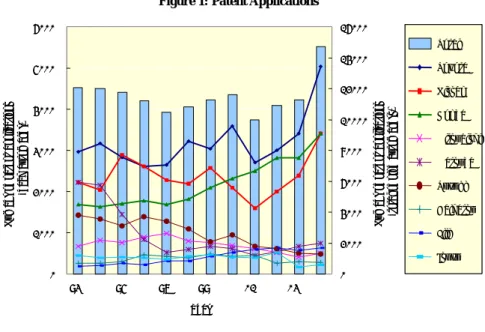
First, we would like to review the overall trend. Figure 1 indicates the total number of patent
4 Inventions subjected to patent applications are published in the official gazette 18 months after these applications have been filed with Japan’s Patent Office. Applications enter an examination process only if applicants request examination and pay examination fees. If novelty or inventiveness isn’t identified in inventions, patents are not awarded. This means that patents are only awarded to a minor portion of patent applications.
Many applications are filed for defensive purposes. Manufacturing know-how and other technologies that may be difficult for rivals to imitate are not necessarily subject to patent applications. Due to these factors, there are various limitations on using patent data for a performance index.
However, no alternative objective indicators exist for successful advanced technology development. Moreover, since patent applications are filed at some cost, technologies subject to patent applications have probably been screened by applicants and can be expected to feature some kind of novelty or inventiveness. In this sense, patent data utilized as an indicator of successful advanced technology development may be permitted.
5 Multiple applicants for a single patent may not necessarily have made the same contributions to a particular invention. The applicants often assess their respective contributions to an invention subject to their patent application and agree on how to share gains from the patent, as “Toyota 70% and Denso 30%”. Although such agreements is not apparent in patent application data, all applicants should have made some contribution to the invention. In this sense, there may be small inaccuracies with the utilization of joint patent applications as an indicator of successful advanced technology development collaboration.
applications for each of the nine automakers between 1993 and 2004.
The figure shows that the nine automakers’ total patent applications began to increase around 2002 and scored a sharp increase in 2004. Breaking down these patent applications by automaker, we find that Toyota, Nissan, and Honda account for a dominant share of the total. The three firms accounted for approximately 60%–70% of the nine automakers’ total patent applications. In 2004, the three firms’ share rose to 80%. Patent applications from the others have been falling or leveling off. Thus, Toyota, Nissan, and Honda have effectively been leading the development of advanced technologies in the Japanese auto industry.
3.3. Overview of Automakers’ Joint Patent Applications
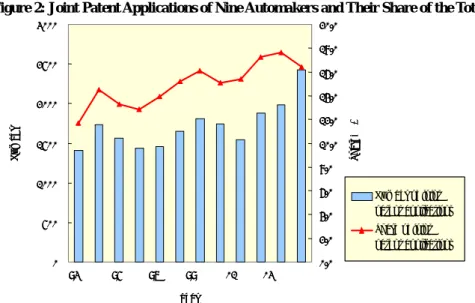
Next, we would like to review the overall trend of patent applications filed jointly by automakers and their respective suppliers. Figure 2 indicates the total number of joint patent applications for the nine automakers and their share of total patent applications between 1993 and 2004.
Figure 2 shows that the total number of joint patent applications and the nine firms’ share of the total patent applications have continued at a rough upward trend, although some fluctuations were observed for some years. Notably, joint patent applications appear to have increased since the total patent applications of the nine firms began to rise in 2002. The joint patent applications’ share of the total also indicates a rough upward trend.
Figure 1: Patent Applications
0 1000 2000 3000 4000 5000 6000
Year Numberofpatentapplications (eachautomaker)
0 2000 4000 6000 8000 10000 12000 14000 16000
Numberofpatentapplications (totalofnineautomakers)
Total Toyota Nissan Honda Mitsubishi Matsuda Suzuki Daihatsu Fiji Isuzu
93 95 97 99 01 03
0 1000 2000 3000 4000 5000 6000
Year Numberofpatentapplications (eachautomaker)
0 2000 4000 6000 8000 10000 12000 14000 16000
Numberofpatentapplications (totalofnineautomakers)
Total Toyota Nissan Honda Mitsubishi Matsuda Suzuki Daihatsu Fiji Isuzu
93 95 97 99 01 03
Figure 3 indicates the number of joint patent applications and the share of the total for the three largest Japanese automakers—Toyota, Nissan, and Honda—between 1993 and 2004. This figure indicates that Toyota features a greater number of joint patent applications and a higher share of the total patent applications than the other two6.
Figure 4 indicates the number and percentage share of patent applications that each of the three largest automakers filed jointly with two or more suppliers.
A patent application filed by three or more companies may represent not only dyad collaboration between an automaker and one of its suppliers but also horizontal collaboration between suppliers. The number and percentage share of such co-patents can be seen as an indicator of their tendency to coordinate many large-scale advanced R&D collaboration projects that have to unite two or more different component and elemental technologies. In this type of large-scale advanced technology development collaboration, management is more difficult. Since suppliers who participate in it are not direct competitors (technical expertise is different) but are potential competitors with each other, suppliers often aren’t willing to share intellectual property to with other parties, resulting in a project failure.
This figure shows that Toyota features a far higher number and percentage share than the others for joint patent applications involving three or more applicants. Of course, Toyota has mainly filed co-patents with Toyota-affiliated suppliers such as Toyota Central R&D Labs. Inc., Denso Corp., and Aisin Seiki Co.
However, Toyota’s R&D collaboration partners have not been limited to its affiliates. Toyota has also made aggressive efforts to coordinate many large-scale R&D projects that include two or more non-affiliate suppliers. In one case, Toyota filed joint patent applications for some telecommunications technologies in 1999 aiming to get a defect-standards with five other suppliers—three (Aisin AW Co., Denso Corp., Fujitsu Ten Ltd.) are Toyota-affiliated suppliers and two (Pioneer Corp. and Matsushita Electric Industrial Co.) are non- affiliated suppliers.
In short, Japanese automakers have thus expanded collaboration with their respective suppliers into the development of advanced technologies. Amid this general trend, Toyota has also made aggressive efforts to coordinate the joint style advanced technology development projects that include two or more suppliers and horizontal collaboration between suppliers. In terms of quantitative achievements through such collaboration, Toyota has progressed far ahead of other Japanese automakers.
6 Figures 3 and 4 do not make adjustments for Toyota’s joint patent applications with Toyota Central R&D Labs. Inc. and Honda’s joint applications with Honda R&D Co., although these R&D firms have personnel exchanges with their respective parent companies and are positioned as consolidated subsidiaries forming a component of their respective parents’ R&D divisions. This means there is some upward bias for these companies. However, even if such adjustments are made, a conclusion here may remain unchanged.
Figure 2: Joint Patent Applications of Nine Automakers and Their Share of the Total
Figure 3: Joint Patent Applications and the Share of the Total for Each Automaker
Figure 4: Joint Patent Applications Involving Three or More Applicants for Each Automaker
0 500 1000 1500 2000 2500 3000
Year
Number
0.0 2.0 4.0 6.0 8.0 10.0 12.0 14.0 16.0 18.0 20.0
Share(%)
Number of joint patent applications Share of joint patent applications
93 95 97 99 01 03
0 500 1000 1500 2000 2500 3000
Year
Number
0.0 2.0 4.0 6.0 8.0 10.0 12.0 14.0 16.0 18.0 20.0
Share(%)
Number of joint patent applications Share of joint patent applications
93 95 97 99 01 03
0 500 1000 1500 2000 2500 3000
Year
Numberofjointpatentapplications
0.0 5.0 10.0 15.0 20.0 25.0 30.0 35.0 40.0
Shareofjointpatentapplocations(%)
Other's total number Honda's number
Nissan's number
Toyota's number
Other's total share
Honda's share
Nissan's share
Toyota's share
93 95 97 99 01 03
0 500 1000 1500 2000 2500 3000
Year
Numberofjointpatentapplications
0.0 5.0 10.0 15.0 20.0 25.0 30.0 35.0 40.0
Shareofjointpatentapplocations(%)
Other's total number Honda's number
Nissan's number
Toyota's number
Other's total share
Honda's share
Nissan's share
Toyota's share
93 95 97 99 01 03
0 50 100 150 200 250 300 350 400
Year Numberofjointpatentapplications involvingthreeormoreapplicants
0.0 1.0 2.0 3.0 4.0 5.0 6.0 7.0 8.0
Shareofjointpatentapplications involvingthreeormoreapplicants(%)
Other's total number Honda's number Nissan's number Toyota's number Other's total share Honda's share Nissan's share Toyota's share
93 95 97 99 01 03
0 50 100 150 200 250 300 350 400
Year Numberofjointpatentapplications involvingthreeormoreapplicants
0.0 1.0 2.0 3.0 4.0 5.0 6.0 7.0 8.0
Shareofjointpatentapplications involvingthreeormoreapplicants(%)
Other's total number Honda's number Nissan's number Toyota's number Other's total share Honda's share Nissan's share Toyota's share
93 95 97 99 01 03
4. Analyzing Suppliers’ Questionnaire Surveys
As indicated in the previous section, collaboration between automakers and their respective suppliers in the development of advanced technologies has been expanding in the Japanese auto industry. In a bid to examine how business relations between automakers and their respective suppliers have changed in line with such expanding collaboration, we would like to analyze a questionnaire survey of first-tier automotive suppliers that was conducted in November 2003 with Mr. Takahiro Fujimoto, a professor of Tokyo University, and Mr. Ku Seunghwan, then assistant professor at Kyoto Sangyo University.
4.1. Survey Data Sources and Outline
In the above questionnaire survey, we sent questionnaires to 340 first-tier automotive suppliers among the members of the Japan Auto Components Industries Association. Of these, 150 firms returned responses, resulting in a response rate of approximately 44.1%.
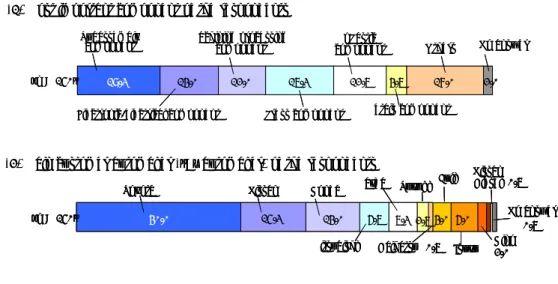
In the questionnaire, the suppliers were first requested to select their most important product (component). Then, they were asked about their business relations with their main customer automaker regarding their most important product (component). The components chosen as the most important are spread over seven categories: subassembly components, electronic/electrical components, machining processing components, press components, plastic components, metals (molding/casting) components, and others. Of the total, subassembly components accounted for 19%; press components, 17%, and electronic and electrical components, 14%. The main customer automaker mentioned by the questionnaire respondents were Toyota (40%), Nissan (15%), Honda (14%), Mitsubishi (7%), and Matsuda (7%). These percentages roughly represent their respective domestic auto production shares.
Figure 5: Outline of Component Transactions (1)
(1) Most important component of the respondents
(2) Main customer automaker (“A” automaker) of the respondents
19.3 14.0 12.0 17.3 12.7 4.7 18.0 2.0
Subassembly component
Electronic/electrical component
Machining processing component
Press component pPastic component
Metals component
Others No answer
(n = 150)
Toyota Nissan Honda
Mitsubishi
Mazda Suzuki
Daihatsu Fuji
Isuzu Hino Nissan Diesel
40.0 15.3 14.0 6.7 7.3 2.7
0.7 4.0 6.0
2.0 0.7
(n = 150) No answer0.7
(1) Most important component of the respondents
(2) Main customer automaker (“A” automaker) of the respondents
19.3 14.0 12.0 17.3 12.7 4.7 18.0 2.0
Subassembly component
Electronic/electrical component
Machining processing component
Press component pPastic component
Metals component
Others No answer
(n = 150)
Toyota Nissan Honda
Mitsubishi
Mazda Suzuki
Daihatsu Fuji
Isuzu Hino Nissan Diesel
40.0 15.3 14.0 6.7 7.3 2.7
0.7 4.0 6.0
2.0 0.7
(n = 150) No answer0.7
Toyota Nissan Honda
Mitsubishi
Mazda Suzuki
Daihatsu Fuji
Isuzu Hino Nissan Diesel
40.0 15.3 14.0 6.7 7.3 2.7
0.7 4.0 6.0
2.0 0.7
(n = 150) No answer0.7
Of the suppliers, 58% stated that they “undertook more than half of the development workload”
themselves. When queried on the change in the percentage over the past four years, 56% responded that they observed an upward trend. These results reveal that many suppliers are responsible for a rather high ratio of the component development.
With regard to the suppliers’ transactions with automakers, 69% belonged to the “approved drawing components7,” 17% belonged to the “assigned drawing components8,” and 10% belonged to the
“detailed-controlled drawing components9.” “Supplier proprietary components” were subjected to 3% of these transactions. These data indicate that suppliers participated in detailed engineering as part of the development of components in more than 86% (combining the approved drawing components and assigned drawing components) of the total transactions.
With regard to competition, 67% of the responding suppliers stated that they were selected by development competitions. Some 23% stated they received exclusive orders from automakers. The remaining 11% cited biddings.
The respondents were also requested to select the most important capability from the five alternatives for winning a competition. The most important capability, selected by 53%, was proposing and developing new component technologies or new-concept components beyond the improvement of existing technologies. The second most important capability, selected by 23%, was lowering costs through manufacturing process improvements. The third, selected by 17%, was reducing costs through design improvements. The fourth, selected by 4%, was developing components in accordance with specifications provided by automakers. The fifth, selected by 3%, was guaranteeing quality and just-in-time delivery.
7 Under the approved drawing components’ practice, a supplier conducts detailed engineering based on rather rough specifications provided by the customer automaker. After the automaker approves the drawings, the supplier owns the final drawings and produces components based on it for delivery to the automaker. See Asanuma (1989) and Fujimoto (1999).
8 Under the assigned drawing components practice, a supplier conducts detailed engineering based on the customer automaker’s basic drawing. The automaker owns the final drawing. This type of component is positioned between the approved drawing components and the detailed-controlled drawing components. See Fujimoto (1999).
9 Under the detailed-controlled drawing components practice, an automaker undertakes detailed engineering for a component. Further, the automaker owns the final drawing and presents it to a supplier for production. See Asanuma (1989) and Fujimoto (1999).
Figure 6: Outline of Component Transactions (2)
Decrease
3.6 2.7 2.7
36.3 42.3 14.1
2.0
1 2 (No change)3 4 5 No answer
Increase Average
(n = 150)
20%-30% 50%-60% 80%-90%
(n = 150) 9.3 6.7 6.01.3
4.74.0 9.3 14.2 17.3 13.3 6.7
0%-10%
10%-20%
30%-40%
40%-50% 60%-70%
70%-80% 90%-100% No answer
(1) Amount of development workload that the respondents undertook
(2) Change in this ratio over the last 4 years
(3) Type of component transaction
(4) Type of competition
(5) Most important capability
10.0 16.7 69.3 2.71.3
Detailed-controlled drawing component
Assigned drawing component Approved drawing component
Supplier proprietary component
(n = 150)
No answer
Development competition Exclusive orders Bidding
No answer 0.7
(n = 150) 10.79.9 67.367.4 21.322.0
23.4 2.8 17.7 4.3 51.1
22.7 2.7 17.3 4.0 52.7 0.7
No answer
(n = 150)
Proposing and developing new component technologies or new-concept components beyond improvement in existing technologies Lowering costs through
manufacturing process improvements
Reducing costs through
design improvements
Developing components in accordance with specifications
given by automakers
Guaranteeing quality and just-in-time delivery Decrease
3.6 2.7 2.7
36.3 42.3 14.1
2.0
1 2 (No change)3 4 5 No answer
Increase Average
(n = 150)
Decrease
3.6 2.7 2.7
36.3 42.3 14.1
2.0
1 2 (No change)3 4 5 No answer
Increase Average
(n = 150)
20%-30% 50%-60% 80%-90%
(n = 150) 9.3 6.7 6.01.3
4.74.0 9.3 14.2 17.3 13.3 6.7
0%-10%
10%-20%
30%-40%
40%-50% 60%-70%
70%-80% 90%-100% No answer
20%-30% 50%-60% 80%-90%
(n = 150) 9.3 6.7 6.01.3
4.74.0 9.3 14.2 17.3 13.3 6.7
9.3 6.7 6.01.3
4.74.0 9.3 14.2 17.3 13.3 6.7
0%-10%
10%-20%
30%-40%
40%-50% 60%-70%
70%-80% 90%-100% No answer
(1) Amount of development workload that the respondents undertook
(2) Change in this ratio over the last 4 years
(3) Type of component transaction
(4) Type of competition
(5) Most important capability
10.0 16.7 69.3 2.71.3
Detailed-controlled drawing component
Assigned drawing component Approved drawing component
Supplier proprietary component
(n = 150)
No answer
10.0 16.7 69.3 2.7
10.0 16.7 69.3 2.71.3
Detailed-controlled drawing component
Assigned drawing component Approved drawing component
Supplier proprietary component
(n = 150)
No answer
Development competition Exclusive orders Bidding
No answer 0.7
(n = 150) 10.79.9 67.367.4 21.322.0
Development competition Exclusive orders Bidding
No answer 0.7
(n = 150) 10.79.9 67.367.4 21.322.0
23.4 2.8 17.7 4.3 51.1
22.7 2.7 17.3 4.0 52.7 0.7
No answer
(n = 150)
Proposing and developing new component technologies or new-concept components beyond improvement in existing technologies Lowering costs through
manufacturing process improvements
Reducing costs through
design improvements
Developing components in accordance with specifications
given by automakers
Guaranteeing quality and just-in-time delivery
23.4 2.8 17.7 4.3 51.1
22.7 2.7 17.3 4.0 52.7 0.7
No answer
(n = 150)
Proposing and developing new component technologies or new-concept components beyond improvement in existing technologies Lowering costs through
manufacturing process improvements
Reducing costs through
design improvements
Developing components in accordance with specifications
given by automakers
Guaranteeing quality and just-in-time delivery
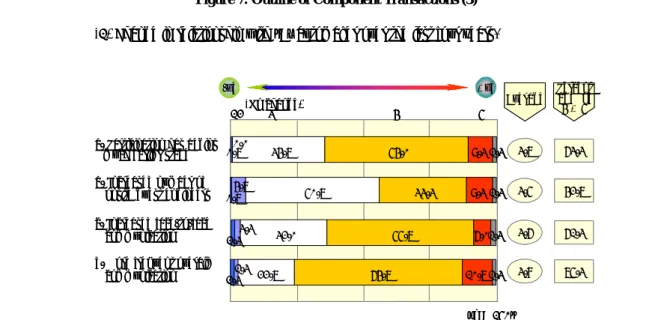
Regarding the relationship with a main customer automaker, 63% of the responding suppliers selected
“Started to participate in development activities from a much earlier stage than before,” 43% selected “We have increased the number of onsite guest engineers who work at the main customer automaker,” 62%
selected “Face-to-face communication during the development process increased,” and 75% selected
“There was more frequent overall communication (includes all forms of communication—emails, phone calls, and face-to-face).” These results suggest that the relationship between suppliers and their main customer automakers is becoming tighter and closer with regard to R&D activities.
In the recent Japanese auto industry, as indicated above, major suppliers have deepened relations with their main customer automakers. Meanwhile, in order to survive fierce competition, suppliers are required to have the capability to develop new cutting-edge components or technologies beyond improvements in existing technologies.
Figure 7: Outline of Component Transactions (3) (1) Change in relationship with “A” automaker over the last four years,
a. Participation has begins much earlier stage b. Increased number of
onsite guest engineers c. Increased face-to-face
communication d. More frequent overall
communication
63.3
42.7
61.3
75.3 3.7
3.5
3.6
3.8 0.70.0
34.7 54.0 9.3 1.3
0.74.7 50.7 33.3 9.3 1.3
1.33.3 32.0 55.7 6.01.3
1.31.3 22.7 64.7 10.7 1.3
12 3 4 5
Average Percent age of 4 + 5
-ve +ve
(No change)
(n = 150)
(1) Change in relationship with “A” automaker over the last four years,
a. Participation has begins much earlier stage b. Increased number of
onsite guest engineers c. Increased face-to-face
communication d. More frequent overall
communication
63.3
42.7
61.3
75.3 3.7
3.5
3.6
3.8 0.70.0
34.7 54.0 9.3 1.3
0.74.7 50.7 33.3 9.3 1.3
1.33.3 32.0 55.7 6.01.3
1.31.3 22.7 64.7 10.7 1.3
12 3 4 5
Average Percent age of 4 + 5
-ve +ve
-ve +ve
(No change)
(n = 150)
4.2. Stages for R&D
Next, we would like to examine the reality of collaboration in the development of advanced technologies.
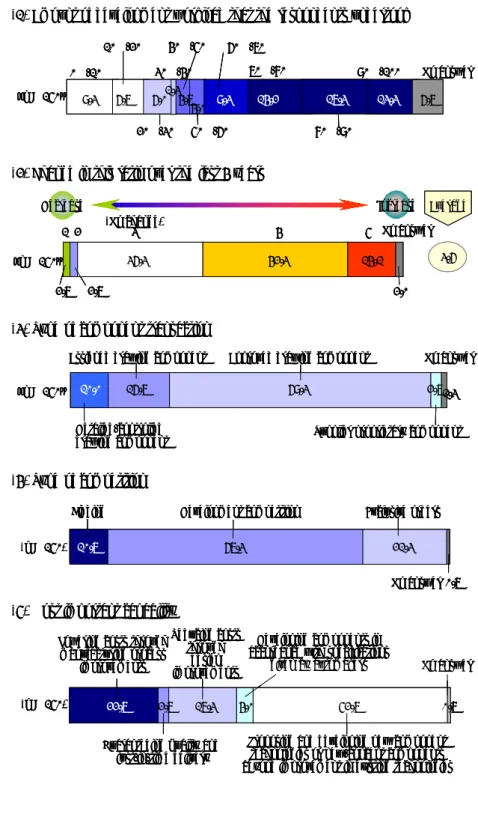
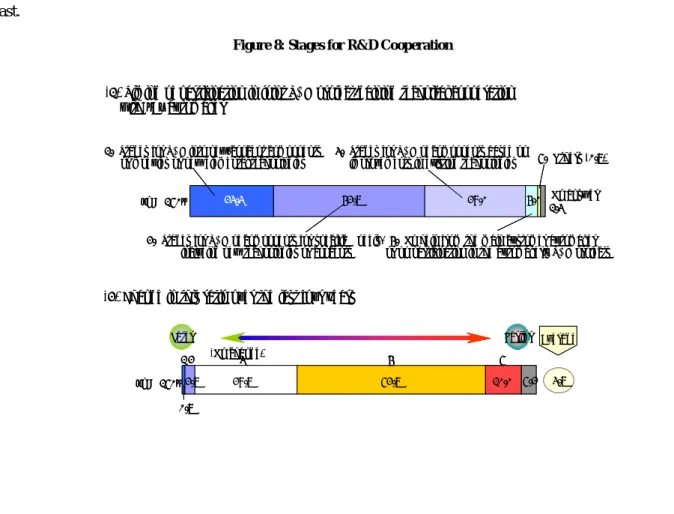
Responses to Question 1 on the stages for R&D collaboration with a major customer automaker or receiving assistance from such collaboration are compiled in Figure 8. Of the total responding suppliers, 23% selected “Stages for R&D into new-concept components or modules, or new elemental technologies (such as new materials), including pilot studies on technologies that are not planned for specific models”;
43% selected “Stages for R&D of components for specific models, including new technologies or concepts beyond improvements in existing technologies or products”; 28% selected “Stages for R&D of components based on improvements in existing products”; 3% selected “No help from the main customer automaker or no participation in the automaker’s R&D projects”; and 1% for “Others.” Based on discussions in Section 2, the advanced technology development collaboration is identified for the first and second cases.
And when queried about any change in the timing of starting collaboration over the past four years, 63% stated that they began to cooperate with the main customer automakers at an earlier time than in the past.
Figure 8: Stages for R&D Cooperation
(1) Timing of participation in joint R&D project/gaining technical cooperation with “A” automaker
(2) Change in this ratio over the last four years
1. Stages for R&D into new-concept components or modules or new elemental technologies
(n = 150) 23.3 42.7 28.0 4.0
1.3 No answer
2. Stages for R&D of components for specific Models, including new technologies or concepts
5. Others (0.7)
4. No help from the main customer automaker or no participation in the automaker’s R&D projects 3. Stages for R&D of components based on
improvements in existing technologies
0.7
2.7 28.7 52.7 10.0
1 2 3 4 5
Later
(No change)
Earlier
3.7 Average
(n = 150) 5.2
(1) Timing of participation in joint R&D project/gaining technical cooperation with “A” automaker
(2) Change in this ratio over the last four years
1. Stages for R&D into new-concept components or modules or new elemental technologies
(n = 150) 23.3 42.7 28.0 4.0
1.3 No answer
2. Stages for R&D of components for specific Models, including new technologies or concepts
5. Others (0.7)
4. No help from the main customer automaker or no participation in the automaker’s R&D projects 3. Stages for R&D of components based on
improvements in existing technologies
0.7
2.7 28.7 52.7 10.0
1 2 3 4 5
Later
(No change)
Earlier
3.7 Average
(n = 150) 5.2
Consequently, a majority of suppliers are now cooperating with their respective customer automakers even in the development of advanced technologies at an earlier time than before.
4.3. R&D and Inter-firm Relations
Next, we used the questionnaire survey data to consider any differences between suppliers that cooperate and those thadvanced technology developmento not cooperate with the main customer automakers in the development of advanced technologies.
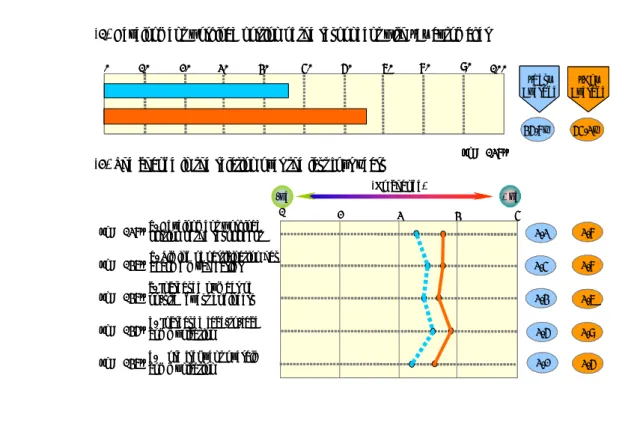
The suppliers’ average workload portion of their joint R&D operations with their main customer automakers was significantly higher (the significance level at 1% int-test) for suppliers cooperating with automakers in advanced technology development than for those refraining from such collaboration. With regard to any change in such workload portion over the past four years, the former (suppliers cooperating with automakers in advanced technology development operations) pointed to a more significant expansion (1%) than the latter (those refraining from such collaboration). With regard to relations with main customer automakers, the former feature collaboration in earlier R&D stages (1%) as compared to the latter, a faster increase (5%) in face-to-face communications, a faster increase (5%) in overall
Figure 9: Advanced technology R&D Cooperation and Business Relations
(2) The change in the relation over the last four years
3.8
3.8
3.7 3.3
3.5
3.4
3.6
3.2 3.6
-ve (No change) +ve
1 2 3 4 5
3.9
(1) Development workload portion of the respondent with “A” automaker
“No”
Average
“Yes”
Average
65.3%
46.8%
%
10 20 30 40 50 60 70 80 90 100
0
(n = 138)
(n = 138)
(n = 147)
(n = 147)
(n = 146)
(n = 147)
a. Development workload portion of the respondent b. Timing of participation has become much earlier c. Increased number of on-site guest engineers d. Increased face-to-face communication e. More frequent overall communication
(2) The change in the relation over the last four years
3.8
3.8
3.7 3.3
3.5
3.4
3.6
3.2 3.6
-ve (No change) +ve
1 2 3 4 5
3.9
(1) Development workload portion of the respondent with “A” automaker
“No”
Average
“Yes”
Average
65.3%
46.8%
%
10 20 30 40 50 60 70 80 90 100
0
(n = 138)
“No”
Average
“Yes”
Average
65.3%
46.8%
%
10 20 30 40 50 60 70 80 90 100
0
(n = 138)
(n = 138)
(n = 147)
(n = 147)
(n = 146)
(n = 147)
a. Development workload portion of the respondent b. Timing of participation has become much earlier c. Increased number of on-site guest engineers d. Increased face-to-face communication e. More frequent overall communication