Belle II in e?e?→μ?μ?(e±μ?) Plus Missing Energy Final States
Author I. Adachi, P. Ahlburg, H. Aihara, N. Akopov, A. Aloisio, N. Anh Ky, D. M. Asner, H.
Atmacan, T. Aushev, V. Aushev, T. Aziz, V.
Babu, S. Baehr, P. Bambade, Sw. Banerjee, V.
Bansal, M. Barrett, J. Baudot, J. Becker, P.
K. Behera, J. V. Bennett, E. Bernieri, F. U.
Bernlochner, M. Bertemes, M. Bessner, S.
Bettarini, F. Bianchi, D. Biswas, A. Bozek, M.
Bracko, P. Branchini, R. A. Briere, T. E.
Browder, A. Budano, L. Burmistrov, S. Bussino, M. Campajola, L. Cao, G. Casarosa, C. Cecchi, D. Cervenkov, M.‑C. Chang, R. Cheaib, V.
Chekelian, Y. Q. Chen, Y.‑T. Chen, B. G.
Cheon, K. Chilikin, K. Cho, S. Cho, S.‑K.
Choi, S. Choudhury, D. Cinabro, L. Corona, L.
M. Cremaldi, S. Cunliffe, T. Czank, F.
Dattola, E. De La Cruz‑Burelo, G. De Nardo, M.
De Nuccio, G. De Pietro, R. de Sangro, M.
Destefanis, S. Dey, A. De Yta‑Hernandez, F. Di ...
journal or
publication title
Physical Review Letters
volume 124
number 14
page range 141801
year 2020‑04‑06
Publisher American Physical Society.
Rights (C) 2020 American Physical Society.
Author's flag publisher
URL http://id.nii.ac.jp/1394/00001685/
doi: info:doi/10.1103/PhysRevLett.124.141801
Creative Commons Attribution 4.0 International(https://creativecommons.org/licenses/by/4.0/)
Search for an Invisibly Decaying Z
0Boson at Belle II in e
+e
−→ μ
+μ
−ðe
μ
∓Þ Plus Missing Energy Final States
I. Adachi,21,18 P. Ahlburg,95H. Aihara,111 N. Akopov,117A. Aloisio,86,33N. Anh Ky,30,12 D. M. Asner,2 H. Atmacan,97 T. Aushev,56V. Aushev,78T. Aziz,79V. Babu,10S. Baehr,44P. Bambade,49Sw. Banerjee,100 V. Bansal,69M. Barrett,21 J. Baudot,94J. Becker,44P. K. Behera,24J. V. Bennett,104E. Bernieri,38F. U. Bernlochner,95M. Bertemes,27M. Bessner,98 S. Bettarini,89,36F. Bianchi,91,39D. Biswas,100A. Bozek,63M. Bračko,102,77P. Branchini,38R. A. Briere,4T. E. Browder,98 A. Budano,38L. Burmistrov,49S. Bussino,90,38M. Campajola,86,33L. Cao,95G. Casarosa,89,36C. Cecchi,88,35D.Červenkov,6 M.-C. Chang,15R. Cheaib,96V. Chekelian,54Y. Q. Chen,107Y.-T. Chen,61B. G. Cheon,20K. Chilikin,50K. Cho,46S. Cho,118 S.-K. Choi,19S. Choudhury,23D. Cinabro,115L. Corona,89,36L. M. Cremaldi,104S. Cunliffe,10T. Czank,112F. Dattola,10 E. De La Cruz-Burelo,5G. De Nardo,86,33M. De Nuccio,10G. De Pietro ,90,38R. de Sangro,32M. Destefanis,91,39S. Dey,81 A. De Yta-Hernandez,5 F. Di Capua,86,33 Z. Doležal,6 I. Domínguez Jim´enez,85 T. V. Dong,16 K. Dort,43D. Dossett,103 S. Dubey,98 S. Duell,95G. Dujany,94S. Eidelman,3,65,50M. Eliachevitch,95J. E. Fast,69 T. Ferber,10D. Ferlewicz,103 G. Finocchiaro,32S. Fiore,37A. Fodor,55F. Forti,89,36B. G. Fulsom,69E. Ganiev,92,40M. Garcia-Hernandez,5R. Garg,70 V. Gaur,114A. Gaz,58,59A. Gellrich,10J. Gemmler,44T. Geßler,43R. Giordano,86,33A. Giri,23B. Gobbo,40R. Godang,108 P. Goldenzweig,44B. Golob,99,77P. Gomis,31W. Gradl,42E. Graziani,38D. Greenwald,80Y. Guan,97C. Hadjivasiliou,69
S. Halder,79T. Hara,21,18O. Hartbrich,98K. Hayasaka,64H. Hayashii,60C. Hearty,96,29 M. T. Hedges,98 I. Heredia de la Cruz,5,9M. Hernández Villanueva,104 A. Hershenhorn,96T. Higuchi,112 E. C. Hill,96M. Hoek,42 C.-L. Hsu,110Y. Hu,28T. Iijima,58,59K. Inami,58G. Inguglia,27J. Irakkathil Jabbar,44A. Ishikawa,21,18 R. Itoh,21,18 Y. Iwasaki,21W. W. Jacobs,25 D. E. Jaffe,2 E.-J. Jang,19H. B. Jeon,48 S. Jia,1 Y. Jin,40 C. Joo,112 K. K. Joo,8 J. Kahn,44 H. Kakuno,84A. B. Kaliyar,79J. Kandra,6G. Karyan,117Y. Kato,58,59T. Kawasaki,45B. H. Kim,74C.-H. Kim,20D. Y. Kim,76 K.-H. Kim,118S.-H. Kim,20Y. K. Kim,118Y. Kim,47T. D. Kimmel,114H. Kindo,21,18C. Kleinwort,10P. Kodyš,6T. Koga,21
S. Kohani,98I. Komarov,10S. Korpar,102,77 N. Kovalchuk,10T. M. G. Kraetzschmar,54P. Križan,99,77R. Kroeger,104 P. Krokovny,3,65T. Kuhr,51J. Kumar,4M. Kumar,53R. Kumar,72K. Kumara,115S. Kurz,10A. Kuzmin,3,65Y.-J. Kwon,118 S. Lacaprara,34C. La Licata,112L. Lanceri,40J. S. Lange,43K. Lautenbach,43I.-S. Lee,20S. C. Lee,48P. Leitl,54D. Levit,80 L. K. Li,97Y. B. Li,71J. Libby,24K. Lieret,51L. Li Gioi,54Z. Liptak,98Q. Y. Liu,16D. Liventsev,114,21S. Longo,113T. Luo,16
Y. Maeda,58,59 M. Maggiora,91,39E. Manoni,35S. Marcello,91,39C. Marinas,31A. Martini,90,38 M. Masuda,13,68 T. Matsuda,105 K. Matsuoka,58,59 D. Matvienko,3,50,65F. Meggendorfer,54J. C. Mei,16F. Meier,11 M. Merola,86,33 F. Metzner,44 M. Milesi,103 C. Miller,113K. Miyabayashi,60H. Miyake,21,18 R. Mizuk,50K. Azmi,101G. B. Mohanty,79 T. Moon,74T. Morii,112H.-G. Moser,54F. Mueller,54F. J. Müller,10Th. Muller,44G. Muroyama,58R. Mussa,39E. Nakano,67 M. Nakao,21,18M. Nayak,81G. Nazaryan,117D. Neverov,58C. Niebuhr,10N. K. Nisar,106S. Nishida,21,18K. Nishimura,98
M. Nishimura,21B. Oberhof,32K. Ogawa,64Y. Onishchuk,78H. Ono,64Y. Onuki,111 P. Oskin,50H. Ozaki,21,18 P. Pakhlov,50,57G. Pakhlova,56,50 A. Paladino,89,36A. Panta,104 E. Paoloni,89,36H. Park,48 B. Paschen,95A. Passeri,38
A. Pathak,100 S. Paul,80T. K. Pedlar,52I. Peruzzi,32R. Peschke,98R. Pestotnik,77M. Piccolo,32L. E. Piilonen,114 V. Popov,56,50C. Praz,10E. Prencipe,14M. T. Prim,44M. V. Purohit,66P. Rados,10R. Rasheed,94S. Reiter,43M. Remnev,3,50
P. K. Resmi,24I. Ripp-Baudot,94M. Ritter,51G. Rizzo,89,36L. B. Rizzuto,77S. H. Robertson,55,29D. Rodríguez P´erez,85 J. M. Roney,113,29 C. Rosenfeld,109 A. Rostomyan,10N. Rout,24G. Russo,86,33D. Sahoo,79Y. Sakai,21,18S. Sandilya,97
A. Sangal,97L. Santelj,99,77 P. Sartori,87,34 Y. Sato,82V. Savinov,106B. Scavino,42J. Schueler,98C. Schwanda,27 R. M. Seddon,55Y. Seino,64A. Selce,35K. Senyo,116C. Sfienti,42C. P. Shen,1J.-G. Shiu,61B. Shwartz,3,50A. Sibidanov,113 F. Simon,54R. J. Sobie,113A. Soffer,81A. Sokolov,26E. Solovieva,50S. Spataro,91,39B. Spruck,42M. Starič,77S. Stefkova,10
Z. S. Stottler,114R. Stroili,87,34J. Strube,69M. Sumihama,17,68 T. Sumiyoshi,84 D. J. Summers,104 S. Y. Suzuki,21,18 M. Tabata,7 M. Takizawa,73,22,75 U. Tamponi,39S. Tanaka,21,18K. Tanida,41N. Taniguchi,21P. Taras,93F. Tenchini,10 E. Torassa,34K. Trabelsi,49T. Tsuboyama,21,18M. Uchida,83K. Unger,44Y. Unno,20S. Uno,21,18Y. Ushiroda,21,18,111 S. E. Vahsen,98R. van Tonder,95G. S. Varner,98K. E. Varvell,110A. Vinokurova,3,65L. Vitale,92,40A. Vossen,11M. Wakai,96
H. M. Wakeling,55W. Wan Abdullah,101 C. H. Wang,62M.-Z. Wang,61A. Warburton,55M. Watanabe,64J. Webb,103 S. Wehle,10C. Wessel,95J. Wiechczynski,36H. Windel,54E. Won,47B. Yabsley,110S. Yamada,21W. Yan,107S. B. Yang,47
H. Ye,10J. H. Yin,28M. Yonenaga,84 C. Z. Yuan,28Y. Yusa,64L. Zani,89,36 Z. Zhang,107 V. Zhilich,3,65Q. D. Zhou,21 X. Y. Zhou,1 and V. I. Zhukova50
(Belle II Collaboration)
Editors' Suggestion Featured in Physics
Brookhaven National Laboratory, Upton, New York 11973
3Budker Institute of Nuclear Physics SB RAS, Novosibirsk 630090
4Carnegie Mellon University, Pittsburgh, Pennsylvania 15213
5Centro de Investigacion y de Estudios Avanzados del Instituto Politecnico Nacional, Mexico City 07360
6Faculty of Mathematics and Physics, Charles University, 121 16 Prague
7Chiba University, Chiba 263-8522
8Chonnam National University, Gwangju 61186
9Consejo Nacional de Ciencia y Tecnología, Mexico City 03940
10Deutsches Elektronen–Synchrotron, 22607 Hamburg
11Duke University, Durham, North Carolina 27708
12Institute of Theoretical and Applied Research (ITAR), Duy Tan University, Hanoi 100000, Vietnam
13Earthquake Research Institute, University of Tokyo, Tokyo 113-0032
14Forschungszentrum Jülich, 52425 Jülich
15Department of Physics, Fu Jen Catholic University, Taipei 24205
16Key Laboratory of Nuclear Physics and Ion-beam Application (MOE) and Institute of Modern Physics, Fudan University, Shanghai 200443
17Gifu University, Gifu 501-1193
18The Graduate University for Advanced Studies (SOKENDAI), Hayama 240-0193
19Gyeongsang National University, Jinju 52828
20Department of Physics and Institute of Natural Sciences, Hanyang University, Seoul 04763
21High Energy Accelerator Research Organization (KEK), Tsukuba 305-0801
22J-PARC Branch, KEK Theory Center, High Energy Accelerator Research Organization (KEK), Tsukuba 305-0801
23Indian Institute of Technology Hyderabad, Telangana 502285
24Indian Institute of Technology Madras, Chennai 600036
25Indiana University, Bloomington, Indiana 47408
26Institute for High Energy Physics, Protvino 142281
27Institute of High Energy Physics, Vienna 1050, Austria
28Institute of High Energy Physics, Chinese Academy of Sciences, Beijing 100049
29Institute of Particle Physics (Canada), Victoria, British Columbia V8W 2Y2
30Institute of Physics, Hanoi
31Instituto de Fisica Corpuscular, Paterna 46980
32INFN Laboratori Nazionali di Frascati, I-00044 Frascati
33INFN Sezione di Napoli, I-80126 Napoli
34INFN Sezione di Padova, I-35131 Padova
35INFN Sezione di Perugia, I-06123 Perugia
36INFN Sezione di Pisa, I-56127 Pisa
37INFN Sezione di Roma, I-00185 Roma
38INFN Sezione di Roma Tre, I-00146 Roma
39INFN Sezione di Torino, I-10125 Torino
40INFN Sezione di Trieste, I-34127 Trieste
41Advanced Science Research Center, Japan Atomic Energy Agency, Naka 319-1195
42Johannes Gutenberg-Universität Mainz, Institut für Kernphysik, D-55099 Mainz
43Justus-Liebig-Universität Gießen, 35392 Gießen
44Institut für Experimentelle Teilchenphysik, Karlsruher Institut für Technologie, 76131 Karlsruhe
45Kitasato University, Sagamihara 252-0373
46Korea Institute of Science and Technology Information, Daejeon 34141
47Korea University, Seoul 02841
48Kyungpook National University, Daegu 41566
49Laboratoire de l’Acc´el´erateur Lin´eaire, IN2P3/CNRS et Universit´e Paris-Sud 11, Centre Scientifique d’Orsay, F-91898 Orsay Cedex
50P.N. Lebedev Physical Institute of the Russian Academy of Sciences, Moscow 119991
51Ludwig Maximilians University, 80539 Munich
52Luther College, Decorah, Iowa 52101
53Malaviya National Institute of Technology Jaipur, Jaipur 302017
54Max-Planck-Institut für Physik, 80805 München
55McGill University, Montr´eal, Qu´ebec, H3A 2T8
56Moscow Institute of Physics and Technology, Moscow Region 141700
141801-2
57Moscow Physical Engineering Institute, Moscow 115409
58Graduate School of Science, Nagoya University, Nagoya 464-8602
59Kobayashi-Maskawa Institute, Nagoya University, Nagoya 464-8602
60Nara Women’s University, Nara 630-8506
61Department of Physics, National Taiwan University, Taipei 10617
62National United University, Miao Li 36003
63H. Niewodniczanski Institute of Nuclear Physics, Krakow 31-342
64Niigata University, Niigata 950-2181
65Novosibirsk State University, Novosibirsk 630090
66Okinawa Institute of Science and Technology, Okinawa 904-0495
67Osaka City University, Osaka 558-8585
68Research Center for Nuclear Physics, Osaka University, Osaka 567-0047
69Pacific Northwest National Laboratory, Richland, Washington 99352
70Panjab University, Chandigarh 160014
71Peking University, Beijing 100871
72Punjab Agricultural University, Ludhiana 141004
73Theoretical Research Division, Nishina Center, RIKEN, Saitama 351-0198
74Seoul National University, Seoul 08826
75Showa Pharmaceutical University, Tokyo 194-8543
76Soongsil University, Seoul 06978
77J. Stefan Institute, 1000 Ljubljana
78Taras Shevchenko National Univ. of Kiev, Kiev
79Tata Institute of Fundamental Research, Mumbai 400005
80Department of Physics, Technische Universität München, 85748 Garching
81Tel Aviv University, School of Physics and Astronomy, Tel Aviv, 69978
82Department of Physics, Tohoku University, Sendai 980-8578
83Tokyo Institute of Technology, Tokyo 152-8550
84Tokyo Metropolitan University, Tokyo 192-0397
85Universidad Autonoma de Sinaloa, Sinaloa 80000
86Dipartimento di Scienze Fisiche, Universit `a di Napoli Federico II, I-80126 Napoli
87Dipartimento di Fisica e Astronomia, Universit `a di Padova, I-35131 Padova
88Dipartimento di Fisica, Universit `a di Perugia, I-06123 Perugia
89Dipartimento di Fisica, Universit`a di Pisa, I-56127 Pisa
90Dipartimento di Matematica e Fisica, Universit`a di Roma Tre, I-00146 Roma
91Dipartimento di Fisica, Universit `a di Torino, I-10125 Torino
92Dipartimento di Fisica, Universit `a di Trieste, I-34127 Trieste
93Universit´e de Montr´eal, Physique des Particules, Montr´eal, Qu´ebec, H3C 3J7
94Universit´e de Strasbourg, CNRS, IPHC, UMR 7178, 67037 Strasbourg
95University of Bonn, 53115 Bonn
96University of British Columbia, Vancouver, British Columbia, V6T 1Z1
97University of Cincinnati, Cincinnati, Ohio 45221
98University of Hawaii, Honolulu, Hawaii 96822
99Faculty of Mathematics and Physics, University of Ljubljana, 1000 Ljubljana
100University of Louisville, Louisville, Kentucky 40292
101National Centre for Particle Physics, University Malaya, 50603 Kuala Lumpur
102University of Maribor, 2000 Maribor
103School of Physics, University of Melbourne, Victoria 3010
104University of Mississippi, University, Mississippi 38677
105University of Miyazaki, Miyazaki 889-2192
106University of Pittsburgh, Pittsburgh, Pennsylvania 15260
107University of Science and Technology of China, Hefei 230026
108University of South Alabama, Mobile, Alabama 36688
109University of South Carolina, Columbia, South Carolina 29208
110School of Physics, University of Sydney, New South Wales 2006
111Department of Physics, University of Tokyo, Tokyo 113-0033
112Kavli Institute for the Physics and Mathematics of the Universe (WPI), University of Tokyo, Kashiwa 277-8583
113University of Victoria, Victoria, British Columbia, V8W 3P6
114Virginia Polytechnic Institute and State University, Blacksburg, Virginia 24061
115Wayne State University, Detroit, Michigan 48202
Alikhanyan National Science Laboratory, Yerevan 0036
118Yonsei University, Seoul 03722
(Received 24 December 2019; accepted 24 February 2020; published 6 April 2020) Theories beyond the standard model often predict the existence of an additional neutral boson, theZ0. Using data collected by the Belle II experiment during 2018 at the SuperKEKB collider, we perform the first searches for the invisible decay of aZ0in the processeþe−→μþμ−Z0and of a lepton-flavor-violating Z0ineþe−→eμ∓Z0. We do not find any excess of events and set 90% credibility level upper limits on the cross sections of these processes. We translate the former, in the framework of anLμ−Lτtheory, into upper limits on the Z0coupling constant at the level of5×10−2−1forMZ0≤6GeV=c2.
DOI:10.1103/PhysRevLett.124.141801
The standard model (SM) is a successful and highly predictive theory of fundamental particles and interactions.
However, it cannot be considered a complete description of nature, as it does not account for many phenomena, including dark matter.
The Lμ−Lτ extension of the SM [1,2] gauges the difference of the leptonic muon and tau number, giving rise to a new vector boson, theZ0. TheZ0couples to the SM only through theμ,τ,νμ, andντ, with coupling constantg0. TheLμ−Lτmodel is potentially able to address important open issues in particle physics, including the anomalies in the b→sμþμ− decays reported by the LHCb experiment [3], the anomaly in the muon anomalous magnetic moment ðg−2Þμ [4], and dark matter phenomenology, if extra matter is charged underLμ−Lτ[1,5]. We investigate here, for the first time, the specific invisible decay topology eþe−→μþμ−Z0,Z0→invisible, where the Z0 production occurs via radiation off a final state muon. The decay branching fractions (BF) to neutrinos are predicted to vary between 33% and 100% depending on theZ0mass[5]. This model (“standard Z0” in the following) is poorly con- strained at low masses. Related searches have been per- formed by the BABAR and CMS experiments for a Z0 decaying to muons[6,7]. Our search is, therefore, the first to have some sensitivity toZ0massesmZ0 <2mμ. If theZ0 is able to decay directly into a pair of dark matter particles χχ, one assumes BFð¯ Z0→χχÞ¯ ≈1 due to the expected much stronger coupling relative to SM particles. We provide separate results for this scenario, which is not constrained by existing measurements.
The second scenario we consider postulates the existence of a lepton-flavor-violating (LFV) boson, either a scalar or a vector (“LFV Z0” in the following) which couples to
leptons[8,9]. We focus on the LFVe−μcoupling. While the presence of LFV mediators can be constrained by measurements of the forward-backward asymmetry in eþe− →μþμ− [9,10], we present here a direct, model- independent search of eþe−→eμ∓Z0, Z0→invisible.
The presence of missing energy decays make these searches especially suitable for aneþe− collider.
The Belle II detector [11] operates at the SuperKEKB electron-positron collider [12], located at the KEK labo- ratory in Tsukuba, Japan. Data were collected at the center- of-mass (c.m.) energy of theϒð4SÞresonance from April to July 2018. The energies of the electron and positron beams are 7 and 4 GeV, respectively, resulting in a boost ofβγ¼ 0.28 of the c.m. frame relative to the lab frame. The integrated luminosity used in this analysis amounts to 276pb−1[13].
The Belle II detector consists of several subdetectors arranged around the beam pipe in a cylindrical structure. A superconducting solenoid, situated outside of the calorim- eter, provides a 1.5 T magnetic field. Subdetectors relevant for this analysis are briefly described here; a description of the full detector is given in Refs. [11,14]. The innermost subdetector is the vertex detector (VXD), which includes two layers of silicon pixels and four outer layers of silicon strips. Only a single octant of the VXD was installed during the 2018 operations[15]. The main tracking device (CDC) is a large helium-based small-cell drift chamber. The electromagnetic calorimeter (ECL) consists of a barrel and two end caps made of CsI(Tl) crystals. The z axis of the laboratory frame is along the detector solenoidal axis in the direction of the electron beam. “Longitudinal”and
“transverse” are defined with respect to this direction, unless otherwise specified.
The invisibleZ0signature is a peak in the distribution of the invariant mass of the system recoiling against a lepton pair.“Recoil”quantities such as mass and momentum refer to this system. They coincide withZ0properties in the case of signal events, and typically correspond to undetected SM particles in the case of background events. The analysis uses events with exactly two tracks, identified asμμoreμ, Published by the American Physical Society under the terms of
the Creative Commons Attribution 4.0 International license.
Further distribution of this work must maintain attribution to the author(s) and the published article’s title, journal citation, and DOI. Funded by SCOAP3.
141801-4
and minimal other activity in the ECL. The standard Z0 selection is optimized using simulated events prior to examining data; the same criteria, aside from an electron in the final state, are used for the LFV Z0 search. The dominant backgrounds are SM final states with missing energy and two tracks identified as leptons. These are radiative muon pairs [eþe−→μþμ−γðγÞ] with one or more photons that are not detected due to inefficiency or acceptance,eþe−→τþτ−ðγÞ, andeþe−→eþe−μþμ−with electrons outside the acceptance. Control samples are used to check background rates predicted by simulation and to infer correction factors and related uncertainties. Upper limits on the standardZ0cross section are computed with a counting technique in windows of the recoil mass distribu- tion. For the LFVZ0model-independent search, upper limits are interpreted in terms of signal efficiency times cross section. Details of each of these steps are described below.
Signal events are generated withMadGraph5[16] for standardZ0masses ranging from 0.5 to8GeV=c2in steps of 0.5GeV=c2. The following background sources are generated using the specified generators:eþe− →μþμ−ðγÞ (KKMC[17]);eþe−→πþπ−ðγÞ(PHOKHARA[18]);eþe−→ eþe−ðγÞ(BabaYaga@NLO[19]);eþe− →τþτ−ðγÞ(KKMC [17]withTAUOLA[20]);eþe− →eþe−μþμ−; andeþe−→ eþe−eþe− (AAFH [21]). The detector geometry and the interactions of the final state particles with the material are simulated using Geant4 [22] and the Belle II Analysis Software Framework[23].
The standard Z0 search uses the CDC two-track trigger, which selects events with at least two tracks with an azimuthal opening angle larger than 90°. The LFVZ0 search uses the ECL trigger, which selects events with total energy in the barrel and part of the end cap above 1 GeV. Both triggers reject events that are consistent with being Bhabha scatterings.
To reject spurious tracks and beam induced background,
“good” tracks are required to have transverse and longi- tudinal projections of the distance of closest approach with respect to the interaction point smaller than 0.5 and 2.0 cm, respectively. Photons are classified as ECL clusters with energy greater than 100 MeV, which are not associated with tracks. Quantities are defined in the laboratory frame unless specified otherwise. Events are required to pass the following selection criteria.
(1) Exactly two oppositely charged good tracks, with polar angles in a restricted barrel ECL acceptance θ∈
½37;120° and with azimuthal opening angle >90°, to match the CDC trigger requirement.
(2) Recoil momentum pointing into the ECL barrel acceptance θ∈½32;125°, to exclude inefficient regions where photons from radiative backgrounds can escape undetected. This selection is applied only for recoil masses below3GeV=c2; missed radiative photons are unlikely to produce higher masses.
(3) An ECL-based particle identification (PID) selection:
0.15< E <0.4 GeV and E=pc <0.4 for muons;
0.8< E=pc <1.2andE >1.5GeV for electrons, where Eis the energy of the ECL cluster associated to a track of momentump.
(4) No photons within a 15° cone around the recoil momentum direction in the c.m. frame, to suppress radi- ative lepton pair backgrounds.
(5) Total photon energy less than 0.4 GeV and no π0 candidates (pairs of photons with invariant masses within 10MeV=c2 of the nominalπ0 value).
After this selection, the background for recoil masses below7GeV=c2is dominated byeþe−→τþτ−ðγÞevents withτ →μ, or τ→π where the pion is misidentified as a muon.
In subsequent steps of the analysis, events are grouped into windows of recoil mass. The width of these windows is 2σ, whereσis the recoil mass resolution. It is obtained by fitting eachZ0recoil mass distribution with a sum of a Crystal Ball (CB)[24–26]and a Gaussian function with coincident peaks. The resolution is computed as the sum in quadrature of the CB and Gaussian widths weighted according to their contributions. The choice of 2σ maximizes a figure of merit (FOM) [27] over the full spectrum. Mass window widths vary from1150MeV=c2atMZ0 ¼0.5GeV=c2to a minimum of51MeV=c2atMZ0 ¼6.9GeV=c2. There are in total 69 mass windows below8 GeV=c2.
Studies with radiative muon pair events (μμγ sample) indicate that the recoil mass widths for data and simulation are consistent. No systematic uncertainty is assigned.
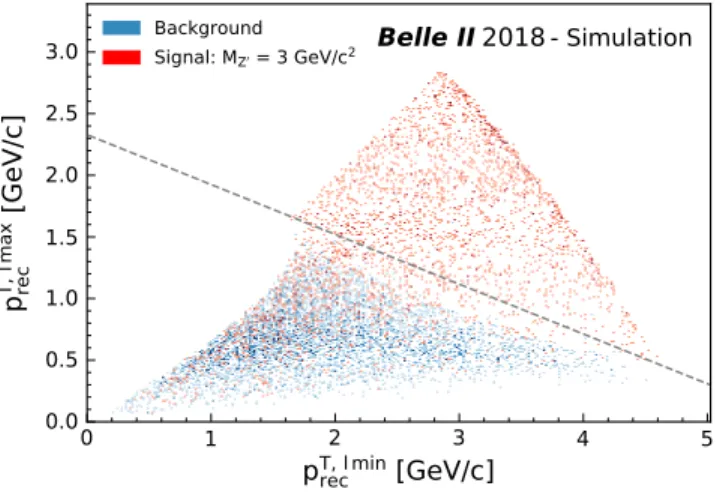
A final selection, denoted as“τsuppression,”exploits the kinematics of theZ0 production, which occurs radiatively from a final state muon, to further suppressτþτ−events in which the missing momentum arises from neutrinos from bothτdecays. The variables, defined in the c.m. frame, are the transverse recoil momentum with respect to the lepton with the higher momentum pT;lmaxrec , with respect to the lower momentumpT;lminrec , and the transverse momentum of the dilepton pair (pTμμorpTeμ). Figure1showspT;lmaxrec versus pT;lminrec for a standardZ0mass of3GeV=c2and for the total simulated background in the corresponding recoil mass window.
For the standardZ0search, a linear cut is imposed in the pT;lmaxrec –pT;lminrec plane and a simultaneous selection pTμμ>
pTcut where the cut values are determined using an optimi- zation procedure that numerically maximizes the FOM in each recoil mass window.pTcut is typically1.5–2.0GeV=c and is effective in suppressing the remainingμþμ−ðγÞand eþe−μþμ−backgrounds. For masses higher than7GeV=c2, signal and background overlap in thepT;lmaxrec –pT;lminrec plane and effective separation lines are not found. The same values are used for the LFVZ0 search.
Trigger, tracking, and particle identification efficiencies are studied on control samples. The performance of the CDC two-track trigger is studied on data samples, mostly radiative Bhabha scattering events, selected by means of
the ECL trigger. The efficiency is ð795Þ% when both tracks are within the acceptance of selection 1; the uncertainty is systematic and is due to kinematic depend- encies. The performance of the ECL trigger is studied using eþe−→μþμ−γ events with Eγ >1GeV that are selected with the CDC two-track trigger. The efficiency is found to be uniformlyð961Þ%in the ECL barrel region.
The tracking efficiency for data is compared to simu- lation using radiative Bhabha and eþe−→τþτ− events.
Differences are found to be 10% for two-track final states.
A 0.90 correction factor is applied to simulation, with a 4%
systematic uncertainty due to kinematic dependencies.
The PID efficiency for data is compared to simulation using samples of four-lepton events from two-photon mediated processes. Discrepancies at the level of 2% per track are found, resulting in a systematic uncertainty of 4%.
The selection criteria before theτsuppression are studied using signal-free control samples in data and simulation.
We use theμμγsample defined above and an analogously defined eμγ sample to check the low recoil mass region.
Kinematic quantities are computed without taking into account the presence of the photon. We also selectμμand eμsamples that satisfy requirements 1–5, but which fail the pT;lmaxrec –pT;lminrec requirement. These studies indicate that, factoring out the 0.90 tracking efficiency correction, the efficiency before theτsuppression is 25% lower forμþμ− events in data than in simulation, but agrees for eμ∓ events. A variety of studies failed to uncover the source of this discrepancy, which is consistently found to be inde- pendent of all checked quantities, including the recoil mass.
The background predictions from simulation and the signal efficiency are thus corrected with a scaling factor of 0.75 for μþμ− events. After the inclusion of these corrections, the background level before the τ suppression selection
statistical uncertainty [28], which is used as a systematic contribution. This is a strong constraint for the standardZ0 signal efficiency as well, as the topology of background and signal events (a pair of muons and missing energy) is identical for signal and background and the discrepancy in the measured yield is found not to depend on kinematic quantities (see above). Nevertheless, we conservatively assign a systematic uncertainty of 12.5% on the correction factor to the signal efficiency for the dimuon sample, half the size of the observed discrepancy.
To study the τ suppression, we use an eþe− sample selected using the same analysis criteria, but with both tracks satisfying the electron criteria in selection 3. The resulting sample includes eþe−γ, eþe−eþe− and τþτ− events where both leptons decay to electrons. The latter has the same kinematic features of the most relevant background source to both searches. Agreement between data and simulation is found after theτsuppression, within a 22% statistical uncertainty. This is taken as a systematic uncertainty on the background; no systematic uncertainty due to this effect is considered for the signal, as the selection has a high efficiency (around 50%, slightly depending on theZ0mass), and the distributions on which it is based are well reproduced in simulation.
After the corrections for the two-track trigger efficiency and for the data or simulation discrepancy inμþμ− events, signal efficiencies are found to range between 2.6% and 4.9% for Z0 masses below 7GeV=c2. Signal efficiencies are interpolated from the generatedZ0masses to the center of each recoil mass window. An additional binning scheme is introduced with a shift of a half bin, to cover hypothetical signals located at the border of two contiguous bins, where the signal efficiency is reduced. Systematic uncertainties are summarized in TableI.
The final recoil mass spectrum of the μþμ− sample is shown in Fig. 2, together with the expected background.
We look for the presence of possible local excesses by calculating for each recoil mass window the probability to obtain a yield greater or equal to that obtained in data given the predicted background, including statistical and system- atic uncertainties. No anomalies are observed, with all
TABLE I. Relative systematic uncertainties affecting theμþμ− andeμ∓ analyses.
Source μþμ− eμ∓
Trigger efficiency 6% 1%
Tracking efficiency 4% 4%
PID 4% 4%
Luminosity 0.7% 0.7%
τsuppression (background) 22% 22%
Background beforeτsuppression 2% 2%
Discrepancy inμμyield (signal) 12.5%
FIG. 1. pT;lmaxrec vs pT;lminrec distributions after the optimal pTμμ selection forMZ0¼3GeV=c2 signal (red) and for background (blue).pT;lmaxrec (pT;lminrec ) is the transverse recoil momentum with respect to the direction of the muon with maximum (minimum) momentum in the c.m. frame. The optimal separation line is superimposed.
141801-6
results below3σlocal significance in both the normal and shifted-binning options[28]. A Bayesian procedure[29]is used to compute 90% credibility level (C.L.) upper limits on the standardZ0cross section. We assume flat priors for all positive values of the cross section, while Poissonian likelihoods are assumed for the number of observed and simulated events. Gaussian smearing is used to model the systematic uncertainties. Results are cross-checked with log-flat priors and with a frequentist procedure based on the Feldman-Cousins approach [30] and are found to be
compatible in both cases [28]. Cross section results are translated into 90% C.L. upper limits on the coupling constantg0. These are shown in Fig.3, where only values g0≤1are displayed. The observed upper limits for models with BFðZ0→invisibleÞ<1 can be obtained by scaling the light blue curve as1= ffiffiffiffiffiffi
pBF .
The final recoil mass spectrum of the eμ∓ sample is shown in Fig. 4, together with background simulations.
Again, no anomalies are observed above3σ local signifi- cance[28]. Model-independent 90% C.L. upper limits on the LFV Z0 efficiency times cross section are computed using the Bayesian procedure described above and cross- checked with a frequentist Feldman-Cousins procedure (Fig. 5). Additional plots and numerical results can be found in the Supplemental Material[28].
0 0.5 1 1.5 2 2.5 3
0 100 200
Data = 276 pb-1
Ldt
Belle II 2018 e+e- + -()
)
-(
- + +e e
+-
e-
e+
e-
e+
3 3.5 4 4.5 5 5.5 6
0 5 10 15
Data = 276 pb-1
Ldt
Belle II 2018 e+e- + -()
)
-(
- + +e e
+-
e-
e+
e-
e+
6 6.5 7 7.5 8 8.5 9 9.5 10 10.5 11 0
0.5 1
Data = 276 pb-1
Ldt
Belle II 2018 e+e- + -()
)
-(
- + +e e
+-
e-
e+
e-
e+
0 1 2 3 4 5 6 7 8
2] Recoil mass [GeV/c 102
101
1 10 102
Counts
Data = 276 pb-1
Ldt
Belle II 2018
)
-(
- + +e e
)
-(
+
e-
e+ +-
e-
e+
e-
e+
FIG. 2. Recoil mass spectrum of theμþμ−sample. Simulated samples (histograms) are rescaled for luminosity, trigger (0.79), and tracking (0.90) efficiencies, and the correction factor (0.75, see text). Histogram bin widths indicate the recoil mass windows.
0 1 2 3 4 5 6 7 8
2] [GeV/c MZ
−4
10
−3
10
−2
10
−1
10 1
g
(obs.) 90% CL UL -Lτ
Lμ
inv)=1 (obs.) 90% CL UL , BF(Z'
-Lτ Lμ
expected UL -Lτ Lμ
inv)=1 expected UL , BF(Z'
-Lτ Lμ
= 276 pb-1
∫
LdtBelle II 2018
σ
±2 (g-2)μ
FIG. 3. 90% C.L. upper limits on coupling constantg0. Dark blue filled areas show the exclusion regions for g0 at 90% C.L., assuming theLμ−Lτpredicted BF forZ0→invisible; light blue areas are for BFðZ0→invisibleÞ ¼1. The solid and dashed lines are the expected sensitivities in the two hypotheses. The red band shows the region that could explain the muon anomalous magnetic momentðg−2Þμ2σ[1,5]. The step atMZ0¼2mμfor theLμ−Lτ exclusion region reflects the change in BFðZ0→ν¯νÞ.
0 0.5 1 1.5 2 2.5 3
2] < 3 [GeV/c M
0 20 40
60 Data
= 276 pb-1
Ldt
Belle II 2018 e+e- + -()
)
-(
+
e-
e+
+-
e-
e+
e-
e+
3 3.5 4 4.5 5 5.5 6
2] < 6 [GeV/c 3 < M
0 5 10
= 276 pb-1
Ldt
Belle II 2018 e+e- + -()
)
-(
+
e-
e+
+-
e-
e+
e-
e+
6 6.5 7 7.5 8 8.5 9 9.5 10 10.5 11 2]
> 6 [GeV/c M
0 0.5 1
= 276 pb-1
Ldt
Belle II 2018 e+ + -()
)
-(
+ +-
e
+-
e-
e+
e-
e+
2 0 2 4 6 8 10
2] Recoil mass [GeV/c
1 10
= 276 pb-1
Ldt
Belle II 2018
)
-(
+
e-
e+
)
-(
+
e-
e+
+-
e-
e+
e-
e+
0 1 2 3 4 5 6 7 8
2] Recoil mass [GeV/c 102
101
1 10 102
Counts
Data = 276 pb-1
Ldt
Belle II 2018
)
-(
+
e-
e+
)
-(
+
e-
e+
+-
e-
e+
e-
e+
FIG. 4. Recoil mass spectrum of theeμ∓ sample. Simulated samples (histograms) are rescaled for luminosity, trigger (0.79), and tracking (0.90) efficiencies. Histogram bin widths indicate the recoil mass windows.
0 1 2 3 4 5 6 7 8
2] Recoil mass [GeV/c 0
20 30 40 50 60 70 80
(obs.) 90% CL UL σ
ε
expected UL
Belle II 2018 = 276 pb-1
∫
Ldtinvisible) [fb]±μ± e- e+ (eσε
σ ε
. .
FIG. 5. 90% C.L. upper limits on efficiency times cross section ϵ×σ½eþe−→eμ∓invisible. The dashed line is the expected sensitivity.
Z0boson in the processeþe−→μþμ−Z0and for a LFVZ0 in the process eþe−→eμ∓Z0, using 276pb−1 of data collected by Belle II at SuperKEKB in 2018. We find no significant excess and set for the first time 90% C.L. upper limits on the coupling constantg0in the range5×10−2to 1 for the former case and to the efficiency times cross section around 10 fb for the latter. The full Belle II dataset, with better muon identification, a deeper knowledge of the detector, and the use of multivariate analysis techniques should be sensitive to the10−3–10−4 g0 region, where the ðg−2Þμ band currently lies.
We thank the SuperKEKB group for the excellent oper- ation of the accelerator; the KEK cryogenics group for the efficient operation of the solenoid; and the KEK computer group for on-site computing support. This work was sup- ported by the following funding sources: Science Committee of the Republic of Armenia Grant No. 18T-1C180; Australian Research Council and Research Grants No. DP180102629, No. DP170102389, No. DP170102204, No. DP150103061, No. FT130100303, and No. FT130100018; Austrian Federal Ministry of Education, Science and Research, and Austrian Science Fund No. P 31361-N36; Natural Sciences and Engineering Research Council of Canada, Compute Canada and CANARIE; Chinese Academy of Sciences and Research Grant No. QYZDJ-SSW-SLH011, National Natural Science Foundation of China and Research Grants No. 11521505, No. 11575017, No. 11675166, No. 11761141009, No. 11705209, and No. 11975076, LiaoNing Revitalization Talents Program under Contract No. XLYC1807135, Shanghai Municipal Science and Technology Committee under Contract No. 19ZR1403000, Shanghai Pujiang Program under Grant No. 18PJ1401000, and the CAS Center for Excellence in Particle Physics (CCEPP); the Ministry of Education, Youth and Sports of the Czech Republic under Contract No. LTT17020 and Charles University Grants No. SVV 260448 and GAUK 404316; European Research Council, 7th Framework PIEF- GA-2013-622527, Horizon 2020 Marie Sklodowska-Curie Grant Agreement No. 700525’NIOBE,’Horizon 2020 Marie Sklodowska-Curie RISE project JENNIFER Grant Agreement No. 644294, Horizon 2020 ERC-Advanced Grant No. 267104, and NewAve No. 638528 (European grants); L’Institut National de Physique Nucl´eaire et de Physique des Particules (IN2P3) du CNRS (France);
BMBF, DFG, HGF, MPG, and AvH Foundation (Germany); Department of Atomic Energy and Department of Science and Technology (India); Israel Science Foundation Grant No. 2476/17 and United States- Israel Binational Science Foundation Grant No. 2016113;
Istituto Nazionale di Fisica Nucleare and the Research Grants BELLE2; Japan Society for the Promotion of Science, Grant- in-Aid for Scientific Research Grants No. 16H03968, No. 16H03993, No. 16H06492, No. 16K05323,
No. 18H03710, No. 18H05226, No. 19H00682, No. 26220706, and No. 26400255, the National Institute of Informatics, and Science Information NETwork 5 (SINET5), and the Ministry of Education, Culture, Sports, Science, and Technology (MEXT) of Japan; National Research Foundation (NRF) of Korea Grants No. 2016R1D1A1B01010135, No. 2016R1D1A1B02012900, No. 2018R1A2B3003643, No. 2018R1A4A1025334, No. 2018R1A6A1A06024970, No. 2018R1D1A1B07047294, No. 2019K1A3A7A09033840, and No. 2019R1I1A3A01058933, Radiation Science Research Institute, Foreign Large-size Research Facility Application Supporting project, the Global Science Experimental Data Hub Center of the Korea Institute of Science and Technology Information and KREONET/
GLORIAD; Universiti Malaya RU grant, Akademi Sains Malaysia, and Ministry of Education Malaysia; Frontiers of Science Program Contracts No. FOINS-296, No. CB- 221329, No. CB-236394, No. CB-254409, and No. CB- 180023, and the Thematic Networks program (Mexico); the Polish Ministry of Science and Higher Education and the National Science Center; the Ministry of Science and Higher Education of the Russian Federation, Agreement No. 14.W03.31.0026; Slovenian Research Agency and research Grants No. J1-9124 and No. P1-0135; Agencia Estatal de Investigacion, Spain Grants No. FPA2014-55613- P and No. FPA2017-84445-P, and CIDEGENT/2018/020 of Generalitat Valenciana; Ministry of Science and Technology and Research Grants No. MOST106-2112-M-002-005- MY3 and No. MOST107-2119-M-002-035-MY3, and the Ministry of Education (Taiwan); Thailand Center of Excellence in Physics; TUBITAK ULAKBIM (Turkey);
Ministry of Education and Science of Ukraine; the U.S.
National Science Foundation and Research Grant No. PHY- 1807007 and No. PHY-1913789, and the U.S. Department of Energy and Research Grants No. DE-AC06-76RLO1830, No. DE-SC0007983, No. DE-SC0009824, No. DE- SC0009973, No. DE-SC0010073, No. DE-SC0010118, No. DE-SC0010504, No. DE-SC0011784, No. DE- SC0012704; and the National Foundation for Science and Technology Development (NAFOSTED) of Vietnam under Contract No. 103.99-2018.45.
[1] B. Shuve and I. Yavin,Phys. Rev. D89, 113004 (2014).
[2] W. Altmannshofer, S. Gori, S. Profumo, and F. S. Queiroz, J. High Energy Phys. 12 (2016) 106.
[3] R. Aaijet al.(LHCb Collaboration),Phys. Rev. Lett.113, 151601 (2014).
[4] G. W. Bennettet al.(Muon g-2 Collaboration),Phys. Rev. D 73, 072003 (2006).
[5] D. Curtin, R. Essig, S. Gori, and J. Shelton,J. High Energy Phys. 02 (2015) 157.
[6] J. P. Leeset al.(BABAR Collaboration),Phys. Rev. D94, 011102 (2016).
141801-8
[7] A. M. Sirunyan et al.(CMS Collaboration),Phys. Lett. B 792, 345 (2019).
[8] I. Galon and J. Zupan, J. High Energy Phys. 05 (2017) 083.
[9] I. Galon, A. Kwa, and P. Tanedo,J. High Energy Phys. 03 (2017) 064.
[10] J. Abdallahet al.(DELPHI Collaboration),Eur. Phys. J. C 45, 273 (2006).
[11] T. Abeet al.(Belle II Collaboration),arXiv:1011.0352.
[12] K. Akai, K. Furukawa, and H. Koiso (SuperKEKB Collaboration),Nucl. Instrum. Methods Phys. Res., Sect. A 907, 188 (2018).
[13] F. Abudin´enet al.(Belle II Collaboration),Chin. Phys. C 44, 021001 (2020).
[14] E. Kouet al.,Prog. Theor. Exp. Phys.2019, 123C01 (2019).
[15] A. Paladino,Proceedings of the 62nd ICFA ABDW on High Luminosity Circular e+e− Colliders (eeFACT’18), Hong Kong, China, 2018, ICFA ABDW on High Luminosity Circular e+e−Colliders Vol. 62 (2019), pp. 221–225,https://
doi.org/10.18429/JACoW-eeFACT2018-WEXBA06.
[16] J. Alwall, R. Frederix, S. Frixione, V. Hirschi, F. Maltoni, O.
Mattelaer, H. S. Shao, T. Stelzer, P. Torrielli, and M. Zaro, J. High Energy Phys. 07 (2014) 079.
[17] S. Jadach, B. F. L. Ward, and Z. Wąs, Comput. Phys.
Commun.130, 260 (2000).
[18] H. Czyż, M. Gunia, and J. H. Kühn,J. High Energy Phys. 08 (2013) 110.
[19] G. Balossini, C. Bignamini, C. M. C. Calame, G. Montagna, O. Nicrosini, and F. Piccinini,Phys. Lett. B663, 209 (2008).
[20] N. Davidson, G. Nanava, T. Przedzinski, E. Richter-Wąs, and Z. Wąs,Comput. Phys. Commun.183, 821 (2012).
[21] F. A. Berends, P. H. Daverveldt, and R. Kleiss,Nucl. Phys.
B253, 441 (1985).
[22] S. Agostinelliet al.(GEANT4Collaboration),Nucl. Instrum.
Methods Phys. Res., Sect. A506, 250 (2003).
[23] T. Kuhr, C. Pulvermacher, M. Ritter, T. Hauth, and N. Braun (Belle II Framework Software Group),Comput. Softw. Big Sci.3, 1 (2019).
[24] M. J. Oreglia, Ph.D. Thesis, Stanford University, 1980.
[25] J. E. Gaiser, Ph.D. Thesis, Stanford University, 1982.
[26] T. Skwarnicki, Ph.D. Thesis, Cracow INP and DESY, 1986.
[27] G. Punzi, eConfC030908, MODT002 (2003),https://arxiv .org/abs/physics/0308063.
[28] See Supplemental Material athttp://link.aps.org/supplemental/
10.1103/PhysRevLett.124.141801for additional plots.
[29] F. Beaujean, A. Caldwell, D. Greenwald, K. Kröninger, and O. Schulz, BAT Release, version 1.0.0 (2018), https://
zenodo.org/record/1322675.
[30] G. J. Feldman and R. D. Cousins, Phys. Rev. D57, 3873 (1998).