• 検索結果がありません。

TGF-β suppression of HBV RNA through AID-dependent recruitment of an RNA exosome complex

N/A
N/A
Protected

Academic year: 2021

シェア "TGF-β suppression of HBV RNA through AID-dependent recruitment of an RNA exosome complex"

Copied!
54
0
0

読み込み中.... (全文を見る)

全文

(1)

TGF‑β suppression of HBV RNA through

AID‑dependent recruitment of an RNA exosome complex

著者 劉 光?

著者別表示 Liu Guangyan journal or

publication title

博士論文本文Full 学位授与番号 13301甲第4274号

学位名 博士(医学)

学位授与年月日 2015‑06‑30

URL http://hdl.handle.net/2297/44568

doi: 10.1371/journal.ppat.1004780

(2)

PLOS Pathogens

TGF-β suppression of HBV RNA through AID-dependent recruitment of an RNA exosome complex

--Manuscript Draft--

Manuscript Number: PPATHOGENS-D-14-02213R2

Full Title: TGF-β suppression of HBV RNA through AID-dependent recruitment of an RNA exosome complex

Short Title: AID recruits the RNA exosome to degrade HBV transcripts

Article Type: Research Article

Section/Category: Virology

Keywords: AICDA, HBV, TGFβ, the RNA exosome

Corresponding Author: masamichi muramatsu, Ph.D.

Kanzawa University kanazawa, JAPAN Corresponding Author Secondary

Information:

Corresponding Author's Institution: Kanzawa University Corresponding Author's Secondary

Institution:

First Author: Guoxin Liang

First Author Secondary Information:

Order of Authors: Guoxin Liang

Guangyan Liu Kouichi Kitamura Zhe Wang

Sajeda Chowdhury Ahasan Md Monjurul Kousho Wakae Miki Koura Miyuki Shimadu Kazuo Kinoshita

masamichi muramatsu, Ph.D.

Order of Authors Secondary Information:

Abstract: Transforming growth factor (TGF)-β inhibits hepatitis B virus (HBV) replication although the intracellular effectors involved are not determined. Here, we report that reduction of HBV transcripts by TGF-β is dependent on AID expression which significantly

decreases both HBV transcripts and viral DNA, resulting in inhibition of viral replication.

Immunoprecipitation reveals that AID physically associates with viral P protein that binds to specific virus RNA sequence called epsilon. AID also binds to an RNA degradation complex (RNA exosome proteins), indicating that AID, RNA exosome, and P protein form a RNP complex. Suppression of HBV transcripts by TGF-β was

abrogated by depletion of either AID or RNA exosome components, suggesting that AID and the RNA exosome involve in TGF-β mediated suppression of HBV RNA.

Moreover, AID-mediated HBV reduction does not occur when P protein is disrupted or

when viral transcription is inhibited. These results suggest that induced expression of

AID by TGF-β causes recruitment of the RNA exosome to viral RNP complex and the

(3)

RNA exosome degrades HBV RNA in a transcription-coupled manner.

Suggested Reviewers: Nina Papavasiliou Rockefeller University

[email protected] Frederick W. Alt

Harvard University

[email protected] Cristina Rada

Cambridge University [email protected] Tsutomu Chiba

Kyoto University

[email protected] Nina Papavasiliou Rockefeller University

[email protected] Frederick W. Alt

Harvard University

[email protected] Cristina Rada

University of Cambridge School of Clinical Medicine [email protected]

Tsutomu Chiba Kyoto University

[email protected]

Opposed Reviewers: Michel C Nussenweig

Rockefeller University Due to competition Michel C Nussenweig Rockefeller University Competitiion

Additional Information:

Question Response

Data Availability

PLOS journals require authors to make all data underlying the findings described in their manuscript fully available, without restriction and from the time of

publication, with only rare exceptions to address legal and ethical concerns (see the PLOS Data Policy and FAQ for further details). When submitting a manuscript, authors must provide a Data Availability Statement that describes where the data underlying their manuscript can be found.

Your answers to the following constitute your statement about data availability and will be included with the article in the event of publication. Please note that simply stating ‘data available on request from the author’ is not acceptable. If, however, your data are only available

Yes - all data are fully available without restriction

(4)

upon request from the author(s), you must answer “No” to the first question below, and explain your exceptional situation in the text box provided.

Do the authors confirm that all data underlying the findings described in their manuscript are fully available without restriction?

Please describe where your data may be found, writing in full sentences. Your answers should be entered into the box below and will be published in the form you provide them, if your manuscript is accepted. If you are copying our sample text below, please ensure you replace any instances of XXX with the appropriate details.

If your data are all contained within the paper and/or Supporting Information files, please state this in your answer below.

For example, “All relevant data are within the paper and its Supporting Information files.”

If your data are held or will be held in a public repository, include URLs,

accession numbers or DOIs. For example,

“All XXX files are available from the XXX database (accession number(s) XXX, XXX)." If this information will only be available after acceptance, please indicate this by ticking the box below.

If neither of these applies but you are able to provide details of access elsewhere, with or without limitations, please do so in the box below. For example:

“Data are available from the XXX Institutional Data Access / Ethics Committee for researchers who meet the criteria for access to confidential data.”

“Data are from the XXX study whose authors may be contacted at XXX.”

* typeset

All relevant data are within the paper and its Supporting Information files

Additional data availability information:

(5)

We appreciate all reviewers’ comments and questions, which greatly improved our manuscript. The reviewers’ comments are in italics below.

Reviewer #1: In the revised submission Liang et al. have addressed many of the earlier concerns however some of the most important concerns still remain unaddressed.

HBV replicon cells do not represent a good model system to study host cell response to HBV infection. The observation made with replicon cells should be further substantiated using cell culture models which resemble natural HBV infection or in HBV stable cell lines harboring integrated HBV

transgene. This is essential to rule out any AID-mediated effect on transfected HBV plasmid and to ascertain that the observed inhibition of HBV replication is a post-transcriptional event.

Response

Thanks for reminding us this important question. As shown in our results,

experiments using HBV stable cell lines harboring an integrated HBV transgene were performed. First, a B cell line containing a chromosomally integrated HBV transgene (Fig. 3I–K) demonstrated that endogenous AID expression induced by cytokine stimulation (CIT) downregulates HBV RNA. Second, experiments using 7T7-8 cells, a stable Huh7 cell line that has the chromosomally integrated HBV transgene, demonstrated that TGF-1 downregulates HBV RNA and

TGF-1-mediated downregulation of HBV RNA is dependent on AID and Exosc3 (Fig. 7). Thus, we think that the experiments requested by reviewer 1 have been done.

In addition, we would like to add other evidences to strengthen our conclusion.

In this study, we excluded the possibility of an AID-mediated effect on transfected HBV plasmid based on three pieces of experimental evidence.

(1) The two HBV stable cell lines mentioned above rule out any artifacts due to transient transfection. (2) AID- and TGF-1-mediated HBV reductions were rescued by knocking down of RNA exosome proteins. (3) AID-mediated HBV

Response to Reviewers

(6)

reduction was no longer observed in the absence of intact HBV P protein, which cannot be explained by an AID-mediated effect on the HBV plasmid. If AID affects plasmids, AID should also affect the HBV P protein mutant replicon.

However, we did not observe AID-mediate HBV RNA downregulation in the mutant replicon.

As for an in vitro model mimicking natural HBV infection, our collaborator previously demonstrated that AID expression is induced by IL-1 stimulation in HBV-infected HepaRG cells and IL-1 restricts HBV replication in infected HepaRG cells. Moreover, Dr. Watashi showed that AID is essential for the antiviral activity of IL-1 (JBC 2013, Watashi et al.). Therefore, involvement of AID in an antiviral pathway against HBV was suggested using a HepaRG model of natural HBV infection in our previous collaborative study; however, the

molecular mechanism by which AID suppresses HBV replication was not determined at that time.

To further confirm the involvement of AID in TGF--mediated restriction of HBV replication in an HBV infection model, we asked our previous collaborators, Drs.

Wakita and Watashi, to send an HBV-producing cell line and NTCP-expressing HepG2 cells. Wakita’s group has demonstrated that they can infect their

NTCP-expressing HepG2 cells with HBV (BBRC 2013, 440:515). Those cell lines were received by us very recently (in Japan, material transfer of infectious research tool is time-consuming), and we performed a preliminary experiment of HBV infection by using their protocol, the results of which are shown below.

NTCP-expressing HepG2 cells were seeded with medium containing 4%

DMSO. HBV was concentrated in PEG.

NTCP-expressing HepG2 cells were

infected with HBV (8000 genome

equivalent / cell). One day after

infection, one group was treated with

(7)

TGF- and the other was not treated. After 3 days of TGF- treatment, cells were harvested for RT-qPCR to determine AID, GAPDH, and HBV mRNA levels.

Non-infected-NTCP HepG2 cells (treated with only PEG) were also used as a control. After normalization to GAPDH levels, the fold induction of AID and HBV RNA were determined. Cells infected with HBV but without TGF- treatment were defined as one-fold induction.

The results above indicate that TGF- upregulates AID mRNA, and

TGF-reduces HBV RNA levels in HBV-infected NTCP-HepG2 cells, which is consistent with our major claim in the manuscript; that is, AID downregulates HBV transcripts.

In summary, experimental evidence from two HBV stable cell lines (Figs. 3I–K and 7) and two natural infection models (attached Fig. 1, and our previous paper JBC 2013 Watashi et al.), ruled out an AID effect on transfected plasmid, and those results are consistent with AID-mediated HBV RNA reduction.

Reviewer #1

It is also important to consider viral escape strategies involving TGFb signaling which may have been developed in cells chronically infected, like HBV stable cell lines.

Response

Thank you for intriguing comment.

AID-mediated HBV RNA reduction depends on HBV P protein (Fig. 4C).

Logically, the more efficiently AID reduces HBV RNA, the lower the level of P protein. Under the condition where P protein is limiting, AID-mediated HBV RNA downregulation is relatively inefficient. We think that reducing the copy number of HBV genome per cell is a plausible escape mechanism in HBV infection.

It would be also possible for HBV to develop other escape mechanisms.

Therefore, we want to leave this question open for future study.

Reviewer #1

(8)

2) The microscopic analysis done is very weak. Proper confocal microscopy should be performed and images need to be captured at higher magnification to be able to properly discern various subcellular sites and precisely determine the colocalization between HBV P protein and AID.

Response

We do not have access to a confocal microscope; thus, we tried very hard to detect AID and HBV P proteins by immunostaining using conventional

fluorescence microscopy (together with the approach using GFP and DsRed fusion proteins, which was shown in the first revision).

However, high background fluorescence and/or low specific signals of AID and P proteins prevented us from conclusively interpreting the results.

Meanwhile, we demonstrated a complex formation between AID and P proteins by immunoprecipitation following subcellular fractionation (Supplementary Fig.

3).

Those results indicate that AID and P proteins form complexes in both the nucleus and cytoplasm. Moreover, we also determined the subcellular fraction containing the AID/exsoc3/HBV-RNA complex (Fig. 5 and Supplementary Fig. 4).

Since AID-mediated HBV RNA reduction was observed in the nuclear fraction (Supplementary Fig. 6), we think that AID, P protein, RNA exosomes, and HBV RNA form RNP complexes in both the nucleus and cytoplasm, and that RNA degradation occurs at least in the nucleus.

Reviewer #1

3) According to the authors AID and HBV P interact both in the cytoplasm and nucleus and all the HBV transcripts are likely affected. Which subcellular site is predominantly responsible for AID mediated degradation of HBV pgRNA.

Response

We appreciate this important question. Because AID, P protein, RNA exosome

as well as HBV RNA molecules distribute to both nucleus and cytoplasm, it is not

easy to conclude which subcellular site is predominantly responsible for AID

mediated HBV RNA reduction.

(9)

To this end, we biochemically fractionated nuclear RNA and cytoplasmic RNA and determined the subcellular fractions in which AID reduces HBV RNA. The results show that AID-dependent HBV RNA reduction is observed in both fractions. Since nuclear RNA is an upstream of cytoplasmic RNA, we think that nuclear HBV RNA may be a primary target for AID-mediated RNA reduction. In the revised manuscript, these results are shown as Supplementary Fig. 6, and the main text was modified accordingly (lines 244–248, in red).

However, we do not exclude that AID also triggers cytoplasmic viral RNA decay.

To conclude this, we need to find a condition that AID does not induce viral nuclear RNA but cytoplasmic RNA decay. At present, we have not found such a condition (like use mutant HBV, AID mutant or inhibition of AID nuclear export), and once this system is established, we can make a conclusion by experimental results.

Reviewer #1

Is HBV P protein required for the effect of AID on all other HBV transcripts?

Response Yes.

Northern blotting in Fig. 4 demonstrates that AID expression reduces all types of HBV RNA in the presence of P protein while AID does not change the pattern of HBV RNA, as detected by northern blot, in the absence of P protein. In the 1 st revised manuscript, we showed that all of HBV transcripts contain the eplison RNA structure that HBV P protein binds to. Therefore, HBV P protein is required for the effect of AID on all other HBV RNA.

Reviewer #1

4) Analysis of clinical samples from HBV patients would give more comprehensive understanding.

Response

(10)

This is an important analysis that we are also very interested. However, to add any relevant information from clinical samples, we would need to obtain RNA samples from liver biopsies within a very short period, which is not feasible.

Again, Japan has strict relevant laws not letting us to obtain patients’ samples in a short time.

Moreover, to add supportive evidence of AID-mediated HBV RNA reduction, we would need two types of liver samples (high and low AID expression).

Unfortunately, useful SNP markers associated with differential expression of AID or AID-deficient patients are not available in the public data base.

Reviewer #1

5) Recently a similar mechanism involving ZAP protein mediated

posttranscriptional degradation of HBV RNA has been reported (Mao et al, PLos Pathogens, 2013, e1003494). Is ZAP involved in AID mediated degradation of HBV RNA, the authors should silence ZAP and determine if AID activity is affected or not.

Response

Thank you for the excellent suggestion.

According to the study by Mao et al. (Plos Pathogenes 2013), transcriptional upregulation of ZAP expression by either IFN or IPS-1 is important for ZAP-mediated HBV RNA reduction, especially for the ZAP short form. To explore the potential involvement of ZAP in AID-mediated HBV RNA reduction, we determined ZAP mRNA expression levels, and RT-qPCR shows no change in ZAP expression by AID expression. These results are included in

Supplementary Fig. 2.

Next, as recommended by reviewer #1, we knocked down ZAP expression using siRNAs. The results demonstrated that knocking down of ZAP increases basal HBV RNA levels; however, it did not affect AID-mediated HBV RNA reduction.

We think that ZAP is dispensable for AID-mediated HBV RNA reduction. These results will help readers to understand AID-mediated HBV RNA reduction;

therefore, we mention knocking down of ZAP in the Discussion and the results

(11)

are shown as Supplementary Fig. 8 in the revised manuscript. (See lines 342–

351 in red)

Reviewer #2:

The authors answered all my questions. Most of the new data provided are satisfied, except for the following two points.

In Figure 2A, loading of the first lane has problem because the loading control GAPDH in this lane is much weaker than other lanes. The new figure is needed to replace this one.

Response

Thanks for this reminding.

We repeated the western blot and reconfirmed expression of FLAG-A3 proteins as well as GAPDH. Revised Fig. 2 was updated by replacing with new blots.

Reviewer #2

2) In Figure 5A, the labeling of the third lane is wrong, GFP-Exosec3 should be positive in this lane.

Response

Thank you very much. We corrected it.

(12)

TGF- β Suppression of HBV RNA through AID-dependent Recruitment of an RNA 1

Exosome Complex 2

Guoxin Liang, 1,2,4 Guangyan Liu, 1,4 Kouichi Kitamura, 1 Zhe Wang, 1 Sajeda Chowdhury, 1 3

Ahasan Md Monjurul, 1 Kousho Wakae, 1 Miki Koura, 1 Miyuki Shimadu, 1 Kazuo Kinoshita, 3 4

and Masamichi Muramatsu 1, * 5

6

1 Department of Molecular Genetics, Kanazawa University Graduate School of Medical 7

Science, Kanazawa, Japan. 2 Department of Microbiology and Immunology, Columbia 8

University, New York, NY, USA, 3 Evolutionary Medicine, Shiga Medical Center Research 9

Institute, Moriyama, Japan.

10

4 These authors contributed equally to this work.

11

*Correspondence: [email protected] 12

The authors declare no competing financial interests.

13 14 15

Manuscript

Click here to download Manuscript: Manuscript150226kk.docx

(13)

Abstract 16

Transforming growth factor (TGF)- β inhibits hepatitis B virus (HBV) replication although 17

the intracellular effectors involved are not determined. Here, we report that reduction of HBV 18

transcripts by TGF-β is dependent on AID expression, which significantly decreases both 19

HBV transcripts and viral DNA, resulting in inhibition of viral replication.

20

Immunoprecipitation reveals that AID physically associates with viral P protein that binds to 21

specific virus RNA sequence called epsilon. AID also binds to an RNA degradation complex 22

(RNA exosome proteins), indicating that AID, RNA exosome, and P protein form an RNP 23

complex. Suppression of HBV transcripts by TGF-β was abrogated by depletion of either 24

AID or RNA exosome components, suggesting that AID and the RNA exosome involve in 25

TGF-β mediated suppression of HBV RNA. Moreover, AID-mediated HBV reduction does 26

not occur when P protein is disrupted or when viral transcription is inhibited. These results 27

suggest that induced expression of AID by TGF- β causes recruitment of the RNA exosome 28

to viral RNP complex and the RNA exosome degrades HBV RNA in a transcription-coupled 29

manner.

30

31

32

33

34

35

36

37

38

39

(14)

40 41

Introduction 42

Hepatitis B virus (HBV) is recognized as the major causative factor of severe liver diseases 43

such as cirrhosis and hepatocellular carcinoma. The clinical outcomes and development of 44

hepatocellular carcinoma and cirrhosis are modulated by viral replication and antiviral 45

immunity against HBV [1]. After entry into the host hepatocyte, HBV forms covalently 46

closed circular DNA (cccDNA) in the nucleus and it initiates the transcription of viral RNAs, 47

including a replicative intermediate known as pregenomic (pg) RNA. Two viral proteins 48

(core and P protein) encapsidate pgRNA to form nucleocapsids, where P protein reverse- 49

transcribes pgRNA to produce relaxed circular (RC)-DNA. These nucleocapsids associate 50

with three types of viral surface proteins for secretion as infectious virions [1,2]. Although 51

the mechanism of HBV replication has been well studied, the mechanisms of antiviral 52

immunity against HBV remain unclear.

53 54

Several members of the apolipoprotein B mRNA editing enzyme catalytic polypeptide 55

(APOBEC) family were recently identified as new types of antiviral factors [3-5]. In humans, 56

the APOBEC family comprises at least 11 members, including activation-induced cytidine 57

deaminase (AID), APOBEC 1, 2, 3A, 3B, 3C, 3D, 3F, 3G, 3H, and 4. Most family members 58

deaminate cytidine bases on DNA and/or RNA to generate uridine [3-5]. Accumulating 59

evidence from in vitro experiments has further revealed that A3 proteins can inhibit the 60

replication of various types of viruses, including human immunodeficiency virus type 1 61

(HIV-1) and HBV [4,5]. Among APOBEC deaminases, the molecular mechanism of A3G 62

antiviral activity has been well characterized. In cases of HBV, A3G restricts viral replication 63

through hypermutation and inhibition of reverse-transcription [4,5]. AID is another member

64

(15)

of the APOBEC family [4,5] and was originally isolated as a cytidine deaminase that 65

triggered class switch recombination (CSR) and somatic hypermutation (SHM) of transcribed 66

immunoglobulin genes in B cells [6-9]. AID expression was recently shown to be upregulated 67

in human hepatocytes in vitro after stimulation with cytokines, including TGF- β 1, TNF α , 68

and IL-1 β and in the liver in chronic hepatitis patients, and AID involvement in viral 69

infection was suggested [10-17]. Higher serum TGF-β1 levels were reported in some HBV 70

infections in vivo [18,19], and TGF-β1 reduces HBV replication in vitro [18,20]. However, 71

the precise mechanisms remain elusive. In the present study, we examined the involvement of 72

AID in TGF-β1-mediated restriction of HBV replication. We have demonstrated that TGF- 73

β 1 induces AID expression in hepatocytes, which leads to the downregulation of HBV 74

transcripts and inhibition of nucleocapsid formation. AID-dependent downregulation of HBV 75

transcripts requires a viral RNA binding protein (P protein) and RNA exosome components.

76

These data suggest a novel antiviral pathway in which AID recruits the RNA exosome to 77

downregulate viral RNA in HBV infected hepatocytes.

78 79

Results 80

TGF- β 1-mediated anti-HBV activity 81

To investigate the involvement of APOBEC deaminases in TGF- β 1-mediated antiviral 82

activity against HBV, human hepatocytes (Huh7) were transfected with a HBV replicon 83

plasmid (pPB) [21] and the cells were then treated with TGF- β 1. Concentrations of 5 – 20 84

ng/mL TGF-β1 were used to match the range reported in chronic HBV and hepatocellular 85

carcinoma patients [19]. HBV replication was evaluated by measuring HBV transcript levels 86

using quantitative reverse transcription-polymerase chain reaction (qRT-PCR) (Fig. 1A) and 87

Northern blotting (Fig. 1D). Viral DNA in secreted virions was determined using qPCR (Fig.

88

(16)

1B), and nucleocapsid formation was estimated using native agarose gel electrophoresis 89

(NAGE). Subsequently, cytoplasmic nucleocapsid core protein and nucleocapsid associated 90

DNA (NC-DNA) levels were determined using western blotting and Southern blotting, 91

respectively (Fig. 1C). Collectively, TGF- β 1 dose-dependently inhibited the production of 92

HBV transcripts, nucleocapsid core protein, and nucleocapsid NC-DNA in both cytoplasmic 93

and secreted samples.

94 95

In further experiments, qRT-PCR was used to determine the expression of APOBEC 96

deaminases in the presence and absence of TGF-β1. Initially, relative expression levels of 97

APOBEC deaminases in non-stimulated Huh7 cells were determined. Huh7 cells expressed 98

all APOBEC3 deaminases. A3G and A3C were highly expressed among A3 deaminases (Fig.

99

1E), whereas APOBEC1 expression was not detected in Huh7 cells. In TGF- β 1-treated 100

Huh7 cells, expression of most APOBEC deaminases, including A3A, A3B, A3C, A3F, and 101

AID (Fig. 1F, upper and lower) was upregulated. Western blotting also detected AID protein 102

in TGF-β1-stimulated Huh7 cells (Fig. 1G).

103 104

TGF-β1-mediated reduction of HBV transcripts depends on AID expression 105

It has been demonstrated that APOBEC3 proteins suppress HBV replication in vitro [1,4,5].

106

HBV plasmids and APOBEC deaminase expression vectors were transfected into Huh7 cells, 107

and nucleocaspid formation was estimated using NAGE followed by Southern and western 108

blotting (NAGE assay). The expression of A3G and A3F, but not A3A, reduced NC-DNA 109

levels in cytoplasmic nucleocapsids but did not reduce nucleocapsid core protein levels (Fig.

110

2A). HBV virion DNA was also reduced by A3C, A3G and A3F expression, whereas total 111

HBV transcript levels were not affected by A3C, A3G or A3F (Fig. 2B and C). It was 112

proposed that minus-strand DNA synthesis was the primary target of A3G-mediated anti-

113

(17)

HBV activity in hepatocytes that were transiently transfected with HBV plasmids [1,4,5]. Our 114

results support this proposed mechanism of A3G antiviral activity. In contrast with A3 115

deaminases, the overexpression of AID reduced HBV transcript levels, nucleocapsid 116

formation, and virion secretion (Fig. 2A-C and Supplementary Fig. 1A and B). Nucleocapsid 117

NC-DNA levels were also reduced in AID-expressing cells, as indicated by Southern blotting 118

using purified nucleocapsid NC-DNA (Fig. 2D). Importantly, AID expression did not 119

suppress host cell gene transcripts (Supplementary Fig. 2), suggesting that AID expression 120

may specifically suppress viral RNA. In accordance with the HBV life cycle, these data 121

suggest that AID-mediated reduction of HBV transcripts leads to the downregulation of 122

nucleocapsid core protein and NC-DNA.

123 124

To investigate the contributions of APOBEC deaminases to TGF-β1-mediated anti-HBV 125

activity, small interfering (si) RNAs targeting specific deaminases were transfected with the 126

HBV plasmid into Huh7 cells. Cells were further treated with TGF-β1 to assess the effects 127

on TGF- β 1-mediated reduction of HBV transcripts. TGF- β 1 stimulation in siGFP- 128

transfected control cells reduced HBV transcript levels by 76% compared with non- 129

stimulated cells (Fig. 2E, top, lane 4 vs. 8). Transfection of siAID, siA3A, or siA3G 130

suppressed the corresponding endogenous genes by up to 51%, 40%, and 56%, respectively.

131

However, the knockdown of A3A and A3G did not affect TGF- β 1-mediated reduction of 132

HBV RNA in comparison with the siGFP control. In contrast, TGF- β 1-mediated 133

downregulation of HBV RNA was significantly attenuated by the knockdown of AID (Fig.

134

2E, top, lane 1 vs. 4). These data suggest that TGF- β 1-mediated downregulation of HBV 135

transcripts is dependent on endogenous AID expression. Partial rescue of HBV transcript 136

levels in siAID-transfected cells also suggests the involvement of either residual AID or other

137

(18)

unidentified effectors in TGF- β 1-mediated reduction of HBV transcripts.

138 139

AID expression levels required for initiating class switching are sufficient for AID- 140

mediated reduction of HBV transcripts 141

We previously demonstrated that the induction of AID in B cells triggers class switch 142

recombination (CSR) in immunoglobulin genes [7-9], which validates B cells as a model to 143

study AID functions. In addition, it is anticipated that peripheral blood mononuclear cells and 144

B cells can be extrahepatic reservoirs for HBV infection [22,23]. Thus, we investigated 145

whether endogenous AID expression that could trigger CSR is also sufficient to trigger a 146

reduction in HBV transcripts. AID expression and IgA class switching can be induced in 147

CH12F3-2 mouse B cells following co-stimulation with CD40 ligand, IL-4, and TGF-β1 148

(designated CIT) [6,24]. CH12F3-2 cells transiently transfected with the HBV plasmid were 149

divided into two groups, and were treated with (or without) CIT to induce IgA switching, a 150

GFP expression vector was co-transfected to verify transfection efficiency. At three days 151

post-transfection, HBV replication and CSR were determined (Fig. 3A-D), and showed that 152

CIT induced AID protein expression and initiated IgA class switching, as previously reported 153

[6,24]. Moreover, NAGE assays and qRT-PCR revealed that HBV transcripts, nucleocapsid 154

NC-DNA, and core protein were downregulated in CIT-stimulated cells, whereas the 155

expression of GFP remained intact after CIT stimulation (Fig. 3B, C). These data indicate 156

that CIT stimulation specifically inhibits HBV replication in mouse B cells. We further used 157

siRNAs against mouse AID (simAID-1 and -2) to assess the contribution of AID to the 158

suppression of HBV products in CIT-stimulated cells. Although simAIDs knocked down 159

endogenous AID transcripts to only 39% determined by qRT-PCR (Fig. 3E), western blotting 160

revealed clear suppression of endogenous AID protein levels (Fig. 3F). Furthermore, flow 161

cytometric analyses revealed that IgA class switching is attenuated by the knockdown of AID

162

(19)

(Fig. 3G), and qRT-PCR revealed that HBV transcript levels are inversely correlated with 163

AID expression and IgA switching efficiency (Fig. 3G, H). To avoid artifacts due to the 164

transfection process, a tetracycline-dependent stable line of the HBV replicon plasmid was 165

established in CH12F3-2 cells (CH12-HBV; Fig. 3I). CH12-HBV cells were treated with CIT 166

to induce IgA switching, and HBV transcript levels were determined. Subsequent qRT-PCR 167

analyses demonstrated significant reductions of HBV transcript levels upon IgA switching 168

(Fig. 3J–K). These data clearly demonstrate that endogenous AID expression sufficient to 169

trigger CSR is also sufficient to downregulate HBV transcripts.

170

Another putative activity of AID involves the initiation of somatic hypermutation (SHM) in 171

immunoglobulin variable genes [8,9],[25] previously demonstrated that human BL2 B cells 172

autonomously induce SHM, which is absent following AID gene disruption by gene targeting.

173

Thus, we transiently transfected the HBV replicon plasmid into BL2 cells and compared 174

HBV replication in Aicda+/+ and Aicda−/− BL2 cells. We previously demonstrated that 175

nucleocapsid NC-DNA and core protein are suppressed in Aicda+/+ in comparison with 176

Aicda − / − BL2 cells, although co-transfected GFP expression levels were similar in both cell 177

types [26]. Using identical samples, we here showed that HBV transcript levels in Aicda+/+

178

BL2 cells were almost 50% of those in Aicda−/− BL2 cells (Fig. 3L).

179

Both mouse and human B cell lines collectively demonstrated that endogenous AID activity 180

that can initiate either CSR or SHM of immunoglobulin genes is sufficient to trigger 181

downregulation of HBV transcripts.

182 183

AID-mediated downregulation of HBV transcripts requires intact P protein structure 184

To investigate the mechanism of AID-mediated downregulation of HBV transcripts, we 185

initially focus on the viral P protein, because AID, P protein and HBV transcripts form RNP

186

(20)

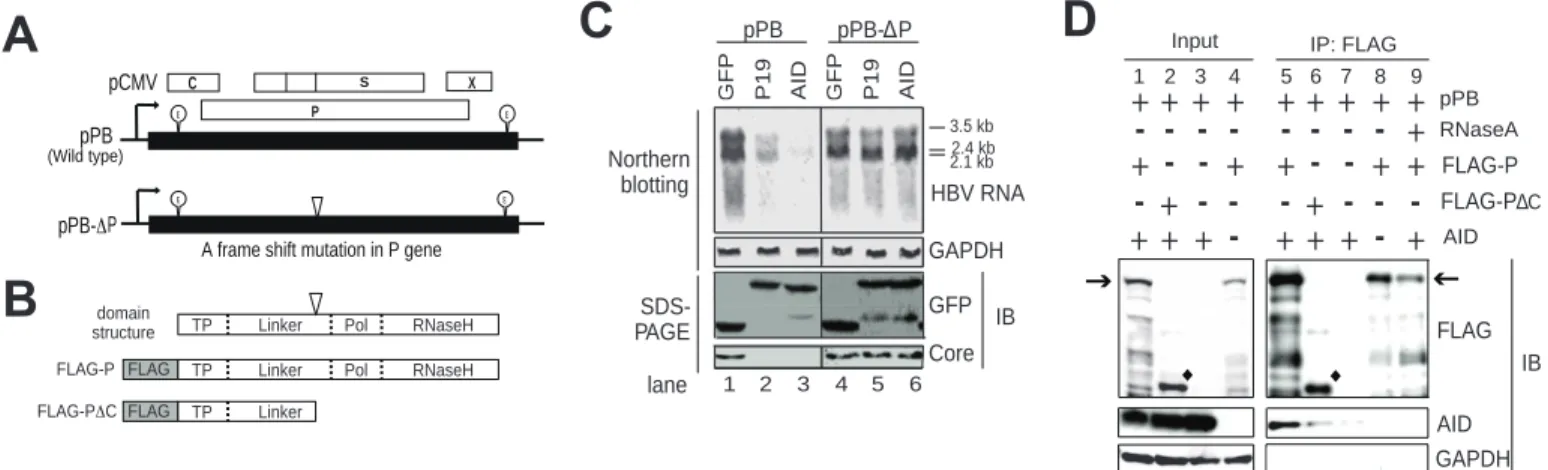
complex [26]. In these experiments, we applied a mutant HBV replicon plasmid (pPB- Δ P, 187

Fig. 4A) that expresses a mutant P protein lacking the C-terminal half including catalytic 188

DNA polymerase and RNase H domains [26]. Transfection with pPB- Δ P did not support 189

nucleocapsid DNA synthesis due to inhibition of reverse-transcription, although HBV 190

transcription and core protein synthesis remained intact in Huh7 cells (Fig. 4C, lanes 1 and 4).

191

AID-mediated downregulation of HBV transcripts was compared between pPB- and pPB-Δ 192

P-transfected Huh7 cells. As shown in Fig. 4C, AID-mediated downregulation of HBV 193

transcripts was not observed in pPB- Δ P-transfected Huh7 cells, indicating that AID- 194

mediated downregulation of HBV transcripts requires intact viral P protein.

195 196

The requirement of cytidine deaminase activity for AID was also investigated. AID mutant 197

P19 was isolated from a class switch deficient patient and the deaminase activity was 198

negligible owing to a missense mutation in catalytic cytidine deaminase domain [27]. P19 199

was then co-transfected with the wild-type HBV plasmid, and HBV transcript levels were 200

compared with that in wild-type AID controls. These experiments showed that the P19 201

mutant significantly reduced HBV transcript level, although less effectively than wild-type 202

AID (Fig. 4C). Therefore, under experimental conditions of AID over-expression, cytidine 203

deaminase activity is not exclusively required for AID-mediated downregulation of HBV 204

transcripts.

205 206

In subsequent experiments, we generated an expression vector (pFLAG-PΔC) for the mutant 207

P protein which was a corresponding mutant P protein produced from pPB- Δ P-transfected 208

cells (Fig. 4B). Then the physical association between AID and the mutant P protein was 209

examined. Immunoprecipitation analyses showed that wild type P protein co-precipitated 210

AID in an RNase A-sensitive manner (Fig. 4D, lane 5, 8, 9), whereas the mutant P protein

211

(21)

(FLAG-P Δ C) precipitated only trace levels of AID protein, suggesting that AID may not 212

efficiently form RNP complex with the mutant P protein in pPB-ΔP-transfected cells. To 213

explore which subcellular sites are responsible for AID and P protein interaction, cells were 214

biochemically fractionated into three fractions (cytoplasmic, soluble nuclear, and insoluble 215

nuclear) (Supplementary Fig. 3). Immunoprecipitation analyses using cytoplasmic and 216

soluble nuclear proteins revealed that AID can associate with P protein in both nucleus and 217

cytoplasm. It is of note that robust signals of AID and P proteins were found in the insoluble 218

fraction that contains chromatin and other nuclear proteins.

219 220

AID-mediated downregulation of HBV transcripts requires the RNA exosome complex 221

AID was recently shown to physically interact with RNA exosome proteins and promote CSR 222

in transcribed immunoglobulin genes [28,29]. The RNA exosome comprises a ring-like 223

structure and two catalytic components, and plays a major role in various RNA processing 224

and degradation pathways [30,31]. Exosome component 3 (Exosc3, also known as Rrp40) is 225

non-catalytic but is essential for the degradation and processing of target RNA, and the 226

knockdown of Exosc3 severely diminished the RNA exosome function [32]. Thus, we 227

investigated whether Exosc3 is involved in TGF- β 1-mediated downregulation of HBV 228

transcripts in Huh7 cells. As shown in Fig. 5A, immunoprecipitation of AID co-purified 229

Exosc3, but did not precipitate GAPDH or GFP. Exosc3 immunoprecipitation also co- 230

purified AID but not GAPDH or GFP (Fig. 5B), indicating a physical association between 231

AID and Exosc3 proteins. This study found a physical association between AID and the RNA 232

exosome proteins (Exosc 2, 3, 7) in Huh7 cells in the absence of HBV replication (Fig. 5D).

233

As expected, Exosc3 immunoprecipition also copurified with other RNA exosome proteins 234

(Exosc2 and 7) in Huh7 cells (Fig. 5D). Furthermore, we found that AID can also associate 235

with RNA exosome in both nucleus and cytoplasm (Supplementary Fig. 4A). Consistent with

236

(22)

AID-RNA exosome interaction, RNA exosome proteins localized to both cytoplasm and 237

nucleus (Supplementary Fig. 5A and B). We previously demonstrated a physical association 238

between HBV transcripts and AID in HBV-replicating Huh7 cells [26]. In current study, we 239

examined whether Exosc3 associates with HBV transcripts. As shown in Fig. 5C, qRT-PCR 240

analysis demonstrated enrichment of HBV but not HPRT transcripts in Exosc3 241

immunoprecipitates, which was observed only when AID was present (Fig. 5C, lane 1). This 242

is also true when nuclear or cytoplasmic Exosc3 was separately precipitated (Supplementary 243

Fig. 4B). AID-mediated downregulation of HBV transcripts was observed in both nucleus 244

and cytoplasm, and efficiency of downregulation was comparable between nucleus, 245

cytoplasm, and whole cell samples (Supplementary Fig. 6A and B). These results suggest that 246

AID recruits the RNA exosome proteins to HBV transcripts and AID downregulates HBV 247

RNA in nucleus.

248 249

To further confirm that the RNA exosome is involved in AID-mediated downregulation of 250

HBV transcripts, we used the siRNA knockdown of Exosc3, which is essential for the RNA 251

exosome function [32]. In these experiments, siRNAs against Exosc3 were co-transfected 252

with the HBV plasmid and AID (or GFP) expression vectors, and HBV replication was 253

determined. Northern blotting, NAGE assays, and qRT-PCR analyses showed the attenuation 254

of AID-mediated downregulation of HBV transcripts and nucleocapsid formation in siExosc3 255

transfectants (Fig. 5E-G). In contrast, AID, GFP, and GAPDH expression were not affected 256

by Exosc3 depletion (Fig. 5E, bottom). Importantly, knock down of Exosc3 did not increase 257

HBV RNA levels in GFP transfected samples. Moreover, siExosc3 transfection attenuated 258

TGF- β 1-mediated downregulation of HBV transcripts and nucleocapsid formation in a 259

similar manner to that observed after transfection with siAID (Fig. 6A-F). In further 260

experiments, knockdown of another RNA exosome component Exosc6 also attenuated TGF-

261

(23)

β 1-mediated downregulation of HBV transcripts and nucleocapsid formation, albeit less 262

effectively than the knockdown of siExosc3 and AID (Fig. 6A-F). Similarly, the contributions 263

of AID and Exosc3 to TGF- β 1-mediated downregulation of HBV transcripts were examined 264

in stably HBV-transfected Huh7 cells (7T7-8) [26]. The short hairpin (sh) RNA expressing 265

lentivirus was transduced into 7T7-8 cells, and two stable transfectants (shAID and 266

shExosc3) and a control transfectant (shLuc) were established after puromycin selection.

267

These cells were then cultured in the presence or absence of TGF- β 1 (Fig. 7A). Subsequent 268

qRT-PCR and western blotting showed reduced endogenous AID and Exosc3 expression (Fig.

269

7B-E). Comparison of HBV transcript levels between TGF- β 1-treated and non-treated 7T7- 270

8 cells revealed that TGF- β 1-mediated reduction of HBV transcripts is restored by the 271

knockdown of AID and Exosc3 (Fig. 7F). Taken together, these data indicate that RNA 272

exosome proteins (Exosc3 and Exosc6) and AID are required for TGF- β 1-mediated 273

downregulutation of HBV transcripts.

274 275

AID-mediated downregulation of HBV transcripts depends on transcription 276

Immunoglobulin gene diversification triggered by AID is coupled with the transcription of 277

immunoglobulin locus [8,9]. Here we examined whether AID-mediated HBV RNA 278

downregulation is also coupled with transcription using a transcription inhibitor actinomycin D 279

(ActD). Using a stable HBV transfectant (7T7-8), we generated experimental conditions in 280

which endogenous or ectopic AID is expressed in HBV-replicating cells. ActD was then added 281

to evaluate whether it could downregulate HBV RNA even in ActD-treated cells. As shown in 282

Fig. 8A and B, no significant synergistic reduction in HBV RNA levels by ActD and AID was 283

observed in TGF-β1-treated and AID-overexpressing cells, indicating that AID was unable to 284

reduce HBV RNA levels in ActD-treated cells. These results suggest that AID-mediated HBV

285

(24)

RNA downregulation depends on transcription, similar to the immunoglobulin gene 286

diversification triggered by AID.

287 288

Discussion 289

AID is a key molecule involved in the diversification of immunoglobulin genes [8,9], and 290

thus its role in B cells is well understood. AID expression has been also found in non-B cells 291

[11-13], however, its role in non-B cells remains elusive. In the present study, we assessed 292

AID involvement in TGF-β1-dependent anti-HBV activity and demonstrated the following:

293

(1) AID expression is upregulated in TGF- β 1-stimulated hepatocytes and reduces HBV 294

RNA levels (Fig. 1 and 2); (2) TGF- β 1-mediated downregulation of HBV transcripts is 295

inhibited by AID knockdown (Fig. 2); and (3) endogenous AID protein levels in B cells 296

capable of inducing immunoglobulin diversification also downregulate HBV transcript levels 297

in a transcription-coupled manner (Fig. 3 and 8). These data indicate that AID is involved in a 298

TGF-β1-mediated anti-HBV pathway.

299 300

Which part of the virus life cycle that is targeted by AID-mediated downregulation of HBV 301

transcripts? Another APOBEC protein, A3A, which was previously proposed to hypermutate 302

transfected plasmids in human peripheral monocytes [33]. However, AID did not change 303

HBV transcript levels in hepatocytes transfected with the mutant HBV replicon (pPB- Δ P) 304

(Fig. 4C). In contrast, HBV transcripts in hepatocytes transfected with the wild-type replicon 305

(pPB) were specifically downregulated by following the expression of AID expression (Fig. 2 306

and 4). Intact HBV transcript levels in AID-expressing pPB-ΔP transfectants suggest that 307

AID-mediated reduction of HBV transcripts is not due to plasmid targeting or promoter 308

interference by AID activity. Otherwise, targeting of HBV plasmid or promoter activity 309

would result in reduction of HBV transcripts in both pPB- and pPB- Δ P-transfectants

310

(25)

because those HBV plasmids share the exactly same DNA sequences except 4 base insertion 311

within P gene in pPB- Δ P. Previous our study demonstrated that chicken AID can 312

downregulate cccDNA of duck hepatitis virus in a uracil-DNA glycosylase (UNG)-dependent 313

manner [34], therefore, the next obvious candidate for AID target is cccDNA of HBV. We 314

determined cccDNA levels of transfectants using the rolling circle amplification (RCA) assay, 315

which specifically amplifies circular DNA, including cccDNA. As per our results, cccDNA 316

was clearly detected in a cccDNA-producing control cell line (HepG2.2.5) [10-15,35];

317

however, the HBV-replicating transfectants used in this study rarely produced cccDNA 318

(Supplementary Fig. 7A and B). Therefore, the majority of the HBV transcripts produced 319

from HBV transfectants in the present experimental systems are derived from HBV replicon 320

plasmids and not from cccDNA. That means that targeting of cccDNA does not explain the 321

observed downregulation of HBV transcripts in the present experimental systems. AID over- 322

expression was previously shown to deaminate nucleocapsid NC-DNA and encapsidated 323

pgRNA [10,13,26]. However, because NC-DNA is reverse transcribed from HBV pgRNA, 324

AID activity against NC-DNA fails to explain the downregulation of HBV transcripts.

325

Reduction of HBV RNA by the catalytically dead mutant AID (p19) indicates that 326

encapsidated pgRNA editing is distinct from AID-mediated reduction of HBV RNA. Thus, 327

we concluded that AID directly targets HBV transcripts.

328 329

The viral P protein is a reverse transcriptase that binds 5 ′ -epsilon RNA structure in pgRNA 330

and encapsidates pgRNA to the nucleocapsid [1,2] (see also Supplementary Fig. 1). It is 331

demonstrated that P protein can also bind 3 ′ -epsilon RNA structure present in 2.4-, 2.1-, and 332

0.7-kb viral mRNAs [36], indicating that P protein binds all types of HBV transcripts. AID 333

and TGF- downregulate HBV transcripts containing 3′-epsilon but not cellular transcripts 334

(Figs. 1D, 4C, 5E, 6A, and Supplementary Figs. 1, 2). AID-mediated HBV RNA reduction

335

(26)

did not occur in hepatocytes expressing a mutant P protein (Fig. 4C). We demonstrated that 336

AID can physically associate with viral RNP complexes comprising P protein [26] (Fig. 4).

337

Therefore, AID-mediated HBV RNA reduction is dependent on the presence of intact P 338

protein and P protein may determine the target specificity for AID-mediated HBV RNA 339

reduction.

340 341

Mao et al. recently reported that zinc finger antiviral protein (ZAP) inhibits the replication of 342

HBV by binding the 5 ′ -epsilon RNA structure of HBV and degrading viral RNA [37]. To 343

explore the molecular mechanism of AID-mediated downregulation of HBV transcripts, we 344

first investigated the possible involvement of ZAP. RT-qPCR revealed that AID expression 345

did not affect the level of ZAP mRNA (Supplementary Fig. 2). Knocking down of ZAP by 346

transfection of siRNAs against ZAP increased HBV RNA levels, which indicates that ZAP 347

reduces the basal level of HBV RNA; however, AID-mediated downregulation of HBV 348

transcripts was not affected by knocking down of ZAP expression (Supplementary Fig. 8).

349

These results imply that the ZAP antiviral pathway is dispensable for AID-mediated 350

downregulation of HBV transcripts.

351 352

Next, we explored the possible involvement of the RNA exosome. Basu et al. [29]

353

demonstrated that AID binds and recruits the RNA exosome complex to R-loop structures in 354

immunoglobulin genes. Here, we investigated whether AID forms a complex with RNA 355

exosome proteins in hepatocytes. The immunoprecipitation of AID and Exosc3 revealed the 356

formation of a RNP complex comprising AID and RNA exosome proteins in both nucleus 357

and cytoplasm of hepatocytes, and that HBV transcripts formed a specific complex with the 358

RNA exosome in an AID-dependent manner (Fig. 5, Supplementary Fig. 4). Furthermore, 359

AID-dependent downregulation of HBV transcripts was inhibited in the absence of the

360

(27)

essential RNA exosome component Exosc3 (Fig. 5). We also demonstrated that AID- 361

mediated downregulation of HBV transcripts does not occur when P protein loses the C- 362

terminus domain, which is essential for AID binding (Fig. 4C). Inhibition of transcription 363

resulted in blocking of AID-mediated downregulation of HBV transcripts (Fig. 8). Taken 364

together, we suggest that AID recruits the RNA exosome to transcribing HBV RNA through 365

an association with the P protein, and thereby downregulates HBV transcripts (Fig. 8C).

366 367

AID has been shown to reduce the transpositioning of the reverse transcriptase-dependent 368

retroelement L1 [14,15]. Moreover, MacDuff et al. demonstrated that a catalytically dead 369

mutant and wild-type AID suppress L1 transpositioning. Here, we showed that the AID- 370

mediated HBV RNA reduction depends on HBV reverse transcriptase (P protein), and 371

catalytically dead mutant AID (p19) reduces HBV transcript levels (Fig. 4). It would be 372

interesting to examine whether suppression of transpositioning by AID is also dependent on 373

the RNA exosome.

374

To our knowledge, this is the first study to show that AID mediates the downregulation of 375

viral RNA through the RNA exosome complex. However, further studies are required to 376

elucidate the mechanisms of AID-mediated HBV RNA downregulation, and to investigate the 377

involvement of AID in anti-HBV activity in vivo.

378 379

Materials and Methods 380

NAGE assays 381

NAGE assays were performed as previously described [20,26,38,39]. In brief, intact 382

nucleocapsid particles were separated from crude extracts of HBV-replicating cells using 383

agarose gel electrophoresis. Nucleocapsid particles within the gel were then denatured under 384

alkaline conditions, and were transferred onto nitrocellulose membranes (Roche).

385

(28)

Nucleocapsid DNA and core proteins were detected using Southern and western blotting with 386

a double-stranded HBV DNA probe spanning the whole viral genome and an anti-core 387

antibody, respectively.

388

Cell culture and transfection 389

Plasmids were transfected into Huh7 cells using CalPhos (Clontech) or Fugene 6 (Roche).

390

The total transfected plasmid per sample was normalized by supplementation with empty or 391

GFP expression plasmids. Co-transfection of plasmid and siRNA was performed using 392

lipofectamine 2000 according to the manufacturer’s instructions. Stealth-grade siRNA for 393

mouse and human AID, A3A, A3G, Exosc3, Exosc6, and control were purchased from 394

Invitrogen. In all transfection experiments, control siRNA was designed to differ from all 395

mammal transcripts. BL2 [25] and CH12F3-2 cell culture, CIT stimulation, and transfection 396

by electroporation were performed as previously described [24-26,40]. The HBV-replicating 397

Huh7 cell line (7T7-8) was established and described previously [26]. The pTre-HBV [41]

398

vector was transfected into tetracycline activator expressing CH12F3-2 cells (FTZ14 [42]) to 399

establish the CH12-HBV cell line. Subsequently, shLuc, shAID, and shExosc3 expressing 400

7T7-8 cells were established by infection with recombinant lentivirus followed by puromycin 401

selection. Recombinant lentiviruses were generated by transient transfection of shLuc-, 402

shAID-, and shExosc3-pLKO1-puro and packaging plasmids (pMD2.D and psPAX2, 403

Addgene plasmid 12259 and 12260, respectively, kind gifts of Dr. Trono) in 293T cells 404

according to the manufacturer’s instructions.

405 406

Expression vectors and reagents 407

Human TGF- β 1 and IL-4 were purchased from R&D systems. Actinomycin D was 408

purchased from Sigma-Aldrich. The HBV replicon plasmid (pPB) contains 1.04 copies of 409

HBV genomic DNA and expresses pgRNA under the control of the CMV promoter [21]. The

410

(29)

pPB- Δ P plasmid contains a frame-shift mutation in codon 306 of the P gene, leading to loss 411

of the C-terminal 539 amino acids, which comprise catalytic and RNase H domains [26].

412

Probe labeling and northern and Southern blots were developed using the AlkPhos direct 413

labeling system (Amersham). Signals for northern, Southern, and western blots were 414

analyzed using a LAS1000 Imager System (FujiFilm). Other expression vectors are listed in 415

Supplementary Table S1.

416 417

Immunoprecipitation and western blotting 418

Cells were lysed in buffer containing 50-mM Tris-HCl (pH 7.1), 20-mM NaCl, 1% NP-40, 1- 419

mM EDTA, 2% glycerol, and protease inhibitor cocktail (Roche). After centrifugation, 420

supernatants were incubated with the indicated antibodies and protein G sepharose (GE 421

Healthcare) or anti-FLAG M2 agarose beads (Sigma, A2220). For IP-qRT-PCR experiments, 422

cells were lysed with PBS containing 0.1% Tween 20, 1% triton-X, 1-mM EDTA, protease 423

inhibitor cocktail (Roche), and 2% glycerol. After centrifugation, crude lysates were 424

subjected to anti-FLAG M2 beads for 4 h. Immune complexes were washed in lysis buffer 10 425

times and were then washed in lysis buffer containing an additional 100-mM NaCl. FLAG- 426

Exosc3 and RNA complexes were eluted using free 3 × FLAG peptides (Sigma, F4799).

427

Western blotting was performed using standard methods with rabbit anti-GAPDH (Sigma, 428

G9545), mouse anti-FLAG (Sigma, F3165), rabbit anti-GFP (Clontech, 632376), anti-rabbit 429

Igs HRP (Biosource, ALI3404), anti-rat Igs HRP (Jackson ImmunoResearch, 712-035-153), 430

rabbit and mouse IgG TrueBlot (eBioscience, 18-8816, 18-8877), rat monoclonal anti-AID 431

(MAID2, eBioscience, 14-5959), rabbit anti-A3G[38], anti-core (Dako, B0586), anti-human 432

Exosc3 (GenWay Biotech, GNB-FF795C, F8130F), and isotype control (eBioscience 14- 433

4321) antibodies. To generate a polyclonal antibody against AID, the C-terminal AID peptide 434

(EVDDLRDAFRMLGF) was conjugated with cysteine and rabbits were immunized using

435

(30)

keyhole limpet hemocyanin (KLH). Subsequently, anti-AID rabbit serum and rat monoclonal 436

anti-AID were isolated and used in IP experiments. IgA class switching was determined by 437

detecting surface IgA expression using flow cytometry as previously described[7,24,40].

438 439

Quantitative PCR and RT-PCR 440

Total RNA was extracted using TRIsure (Bioline), was treated with DNase I (Takara) to 441

eliminate transfected plasmids, and was then re-purified using TRIsure. For qRT-PCR 442

analyses, 1 µg of total RNA was treated with amplification grade DNase I (Invitrogen) and 443

was then reverse-transcribed using oligo-dT or random primers with SuperScript III 444

(Invitrogen). Subsequently, cDNA was amplified using SYBR green ROX (Toyobo) with 445

MX3000 (Stratagene) according to the PCR protocol. A1, AID, A3A, A3B, A3C, A3D, A3F, 446

A3G, A3H, Exosc3, Exosc6, 18S ribosomal RNA, HPRT, and β-actin expression and HBV 447

transcription were determined using PCR conditions of 95°C for 1 min followed by 40 cycles 448

of 95°C for 15 s, 55°C for 30 s, and 70°C for 30 s, and one cycle of 95°C for 1 min, 55°C for 449

30 s, and 95°C for 30 s. For A3A amplification, an annealing temperature of 60°C was used.

450

Copy numbers of APOBECs were determined using plasmid standard curves for each 451

APOBEC (Fig. 2A). Fold induction of APOBEC expression following treatment of cells with 452

TGF-β1 was determined using the ΔΔCT method [43]. To eliminate transfected plasmids, 453

purified NC-DNA from secreted virions and cytoplasmic lysates was obtained after serial 454

DNase I digestion, proteinase K and SDS digestion, phenol–chloroform extraction, and 455

isopropanol precipitation. NC-DNA copy numbers were determined using a HBV plasmid 456

standard curve. Transcript expression levels in this study (except Fig. 2A) are presented as 457

fold induction relative to unstimulated cells. In transfection experiments, expression levels of 458

mock-, GFP-, siGFP-, and siLuc-transfected cells were defined as one. Expression levels in 459

qRT-PCR analyses were normalized to the amplification of internal controls (HPRT, β-actin,

460

(31)

or 18S ribosomal RNA). Primers are listed in Supplementary Table S2.

461 462

Statistical analysis 463

Differences were identified using the two-tailed unpaired Student’s t-tests and were 464

considered significant when P < 0.05.

465 466

Acknowledgments 467

We thank Drs. Chayama and C. A. Reynaud for providing pTre-HBV and AID-deficient BL2 468

cells, respectively. We also thank Ms. Imayasu for their technical support, and Dr. T. Honjo 469

for critically reviewing the manuscript.

470 471

Author Contributions 472

G.L., G.L., and K.K. performed the experiments. K.W, S.C., M.K., A.M., M. S., and W.Z.

473

assisted with the experiments. G.L., K.K. edited the manuscript, and M.M. directed the study 474

and wrote the manuscript.

475

References 476

1. Nguyen DH, Ludgate L, Hu J (2008) Hepatitis B virus-cell interactions and pathogenesis. J 477

Cell Physiol 216: 289-294.

478

2. Nassal M (2008) Hepatitis B viruses: reverse transcription a different way. Virus Res 134:

479

235-249.

480

3. Harris RS, Liddament MT (2004) Retroviral restriction by APOBEC proteins. Nat Rev 481

Immunol 4: 868-877.

482

4. Malim MH (2009) APOBEC proteins and intrinsic resistance to HIV-1 infection. Philos 483

Trans R Soc Lond B Biol Sci 364: 675-687.

484

5. Goila-Gaur R, Strebel K (2008) HIV-1 Vif, APOBEC, and intrinsic immunity.

485

Retrovirology 5: 51.

486

6. Muramatsu M, Sankaranand VS, Anant S, Sugai M, Kinoshita K, et al. (1999) Specific 487

expression of activation-induced cytidine deaminase (AID), a novel member of the 488

RNA-editing deaminase family in germinal center B cells. J Biol Chem 274: 18470- 489

18476.

490

7. Muramatsu M, Kinoshita K, Fagarasan S, Yamada S, Shinkai Y, et al. (2000) Class switch 491

recombination and hypermutation require activation-induced cytidine deaminase 492

(AID), a potential RNA editing enzyme. Cell 102: 553-563.

493

8. Muramatsu M, Nagaoka H, Shinkura R, Begum NA, Honjo T (2007) Discovery of

494

Figure 4 A X P       SC pPB (Wild type)

参照

関連したドキュメント

Three days after transfection, cccDNA from nuclear Hirt-extracted DNAs was amplified by RCA and digested with EcoRI to cleave the concatemer into monomers of

Regres- sion analyses of the sequence data for thermophilic, mesophilic and psychrophilic bacteria revealed good linear relationships between OGT and the dinucleotide com- positions

encap‐
sidated
PsV
DNA.
As
expected
from
the
decreased
L1
protein
levels
in
the
HSEs
compared


Second, it was revealed that ADAR1-mediated RNA editing positively regulates DHFR expression in human breast cancer-derived MCF-7 cells by destroying miR- 25-3p and miR-125a-3p

Northern blot analysis using 5’ portion of the chicken DDB1 cDNA as a probe detected a single transcript of ~ 4.3 kb in chicken DT40 cells as well as in human HeLa cells

Western blotting: The increased expression of EZH2 in carcinoma cells (TGBC2TKB) was reduced by SAHA (1.0 lM for 48 h) and EZH2 siRNA treatment, whereas EZH2 was not expressed in

Treatment with ONO-1301 increased hepatic HGF mRNA expression, but decreased the expressions of TGF-β1, connective tissue growth factor, α-smooth muscle actin, and type-I and

Keywords: homology representation, permutation module, Andre permutations, simsun permutation, tangent and Genocchi