COORDINATION STRUCTURE AND TRANSPORT
PROPERTIES IN LIB ELECTROLYTES: INFLUENCE OF MOLECULAR SIZE
著者 Takai Yoshihiro, Terai Yusuke, Saitoh Ken‑ichi, Takuma Masanori, Takahashi Yoshimasa, Sato Tomohiro
journal or
publication title
Science and technology reports of Kansai University = 関西大学理工学研究報告
volume 61
page range 1‑10
year 2019‑03‑20
URL http://hdl.handle.net/10112/16878
1 Science and Technology Reports of Kansai University No. 61, 2019
MOLECULAR DYNAMICS SIMULATION OF LI-ION
COORDINATION STRUCTURE AND TRANSPORT PROPERTIES IN LIB ELECTROLYTES:
INFLUENCE OF MOLECULAR SIZE
Yoshihiro Takai,1 Yusuke Terai,2 Ken-ichi Saitoh,2* Masanori Takuma,2 Yoshimasa Takahashi,2 and Tomohiro Sato2
(Received December 12, 2018)
Abstract
Lithium-ion batteries (LIBs) are currently attracting much attention because electric vehicles and large storage batteries are becoming widespread. For lightweight and efficient usability, LIB performance for safety, capacity, charge/discharge cycle characteristics, and electric current must be improved. Development of high performance LIB relies mostly on progress of materials used for electrolytes and electrodes. In particular, electrolytes are an important factor because they play a role in carrying charged substances, i.e. ions, between separated electrodes. The ion-carrying performance depends on the choice of electrolyte, and thus, in this study, we discuss the relationship between the geometric shape of molecules used as electrolytes and their physical properties, using molecular dynamics (MD) simulations. We showed that, as the smaller solvent is used, ionic conductivity of the system is further enhanced. MD simulations showed that there are two main reasons for this behavior. First, a smaller radius allows the solvent molecule to diffuse easily. Consequently, when solvent molecules frequently surround a lithium ion, and the diffusion coefficient of the lithium ion becomes larger. Second, because small solvent molecules naturally come close to ions, salt (composed of cations and anions) is forced to be dissociated because of the solvent molecules, and the degree of salt dissociation increases.
1. Introduction
The lithium-ion battery (LIB) has attracted much attention within the mobile device industry because smaller and lighter storage batteries with higher energy density, compared with conventional batteries, are required. In recent years, demand for large-sized storage batteries has also increased, so that natural (renewable) energy, such as sunlight and wind power, and electric/fuel cell vehicles can be used. To further improve the LIB performance, electrode and electrolyte materials need to be developed. For safety, solid electrolytes are likely to be preferable as electrolyte materials. However, they still exhibit a short battery life and a low ionic conductivity that are insufficient for the proposed uses, resulting from local 1 Engineering Science Major, Graduate School of Science and Engineering, Kansai University,
Suita, Osaka 564-8680, Japan
2 Department of Mechanical Engineering, Faculty of Engineering Science, Kansai University, Suita, Osaka 564-8680, Japan
* Corresponding author: Ken-ichi Saitoh
Email: [email protected], Tel: +81-6-6368-1121 ext. 6371, Fax: +81-6-6388-8785
deterioration of the material because of thermal expansion. However, conventional liquid electrolytes remain suitable for LIB systems because they have the potential to exert high ionic conductivity and to maintain a long life.
Liquid electrolytes can be adjusted systematically by choosing and mixing various compounds to exhibit the desired performance. However, there are hundreds of thousands of compounds that can be used in the liquid electrolyte solution, and it is necessary to optimize the electrolyte combination. Previous studies report that ionic conductivity depends on temperature, solution viscosity, degree of salt dissociation, and diffusion coefficient of ions 1) - 3). Additionally, there is also a certain “solvation”, which is the molecular and solvated structure where a lithium ion is sterically surrounded by several solvent molecules 4), 5). The solvation results from dissolution and dissociation of the lithium salt in the electrolyte liquid, which is determined by a tendency toward separation of anions and cations, and by dielectric polarization of solvent molecules, which is produced by the intensity of the Coulombic interaction (electrostatic force). Because lithium ions forming the solvation are thought to migrate through electrolyte liquids, it is crucial to understand the relationship between the physical (mainly, transport) properties and structure of lithium ions.
Thus, we investigated the physical and structural properties of electrolytes in LIBs to determine the best molecular structure for electrolytes, using the molecular dynamics (MD) method. This report discusses the effect of the solvent's molecular size on solvation structures and physical properties in LIB electrolytes.
2. Theory
The MD method analyzes the dynamic structure and properties of liquid or solid materials at an atomic or molecular level. The trajectory of all atoms or molecules in the material system is traced by numerically solving Newton's equation of motion over time. The basic equation to be solved in MD is as follows:
, (1)
where V is the total interatomic potential energy, and the force acting on an atom is obtained by differentiating V by its position ri. Usually, the total interatomic potential V is expressed by the sum of functions for bond length, bond angle, dihedral angle, and non-bonded interaction, as shown below in Eq. (2).
, (2)
where VNB is a non-bonded potential function that comprises van der Waals and Coulomb forces. VBOND, VBEND, VTOR, and VIMP are bonded potential functions that represent bond length, bond angle, torsion angle, and improper angle, respectively. In this study, molecular models were independently created by the authors using a program, “Antechamber”, and a second general AMBER force field (GAFF2) in a widely used molecular simulation software package,
“AmberTools17” 6). Each potential energy function is given by the following equations:
3 MOLECULAR DYNAMICS SIMULATION OF LI-ION COORDINATION STRUCTURE
AND TRANSPORT PROPERTIES IN LIB ELECTROLYTES:
INFLUENCE OF MOLECULAR SIZE
, (3)
, (4)
, (5)
, (6)
, (7)
where both εij and σij are constants depending on the pair of atomic species, qi and qj are the electric charges of the atoms i and j, and kij , kijk , and kijk are force constants. Other parameters and variables in Equations (3)–(7) are omitted here 6).
3. Computational Details and Models
MD simulations of the structural property and ionic conductivity were performed using
“GROMACS” 7), which is a general-use MD software package. Simulation models are construct- ed as described below. Electrolyte models are prepared by mixing 1.00 mol/L salt (lithium hexafluorophosphate: LiPF6) (1M-LiPF6) with a single solvent. These single solvents are: eth- ylene carbonate (EC), fluoro-ethylene carbonate (FEC), propylene carbonate (PC), butylene car- bonate (BC), γ-butyrolactone (GBL), γ-valerolactone (GVL), dimethyl carbonate (DMC), eth- yl-methyl carbonate (EMC), and diethyl carbonate (DEC). Among these solvents, EC, FEC, PC, BC, GBL, and GVL are high permittivity solvents (HPS) that have an ability to promote salt dissociation. However, DMC, EMC, and DEC are called low viscosity solvents (LVS) that have a role in lowering the electrolyte solution viscosity. To arrange molecules in the simulation cell, we used “packmol”8), which is a software that is suitable for creating the initial structure of the liquid when periodic boundary conditions are imposed on the cell. For temperature and pressure control, a Nose–Hoover thermostat 9), 10) and a Parrinello–Rahman barostat 11) were used, and the Particle Mesh Ewald (PME) method 12) was applied to effectively estimate the long-range Coulomb force. The Coulomb interaction using the Ewald method is divided into a short- and long-range parts. By setting the cut-off length of the short-range part, the Coulomb interaction can be obtained with sufficient accuracy using a cut-off length of 1.0 nm. First, the total system is subjected to MD calculations, initially using NVT and subsequently using NPT ensembles, each for a simulation time of 0.5 ns to complete the structural relaxation and densi- ty optimization. MD calculation with the NVT ensemble is again performed for 1.0 ns to evalu- ate the degree of salt dissociation and solvation structural properties. Finally, the non-equilibri- um calculation using an electric field of 0.8 V/nm is conducted under an NVT ensemble for 2.0 ns, and the ionic conductivity of the system is evaluated, where N is the number of particles, V
is the volume of the simulation cell, and P is the pressure. These variables are kept constant during the simulations. The NVT and NPT ensembles simulate the system at isothermal and constant volume, and at isothermal and isobaric pressure, respectively.
The degree of salt dissociation is defined as the ratio of Li+ ions to total LiPF6 when the P atom from PF6
- does not exist inside a sphere with a radius of 4.0 Å that is centered on any Li atom. In the expression, when the number of lithium ions in a state of dissociation is NLi and the total number of LiPF6 is NLiPF6, the degree of dissociation α, is defined by the following equation:
, (8)
To investigate the influence of molecular size of the solvent on ionic conductivity and salt dissociation, the molecular radius R of each solvent needs to be estimated. The density and volume of a simulation cell, ρ and V, are calculated during other NVT and NPT equilibrium simulations of a single solvent. The molecular radius of solvent R can them be estimated by Eq. (9), assuming that the volume of the molecules is equivalent to that of a sphere, as follows:
, (9)
where Vmol is the volume per molecule that is given by dividing V by the number of molecules N.
To improve the battery's performance, it is necessary to improve the electrolyte's ionic conductivity, κ. In this study, ionic conductivity during the non-equilibrium calculation can be estimated when a constant external electrical field of 0.8 V/nm is imposed in a single direction (x) onto the periodic basic cell (cubic shape) of the electrolyte 13). Thus, an electric current in the x direction at time t is given by:
, (10)
where qi is an electric charge and xi is an x position of the ion i, L is a cell length of each side of basic cell, and Δt is a time increment. Ionic conductivity κ is given by:
, (11)
where A is a cross-sectional area on the yz plane of the basic cell (=L2), and E is an applied external electric field.
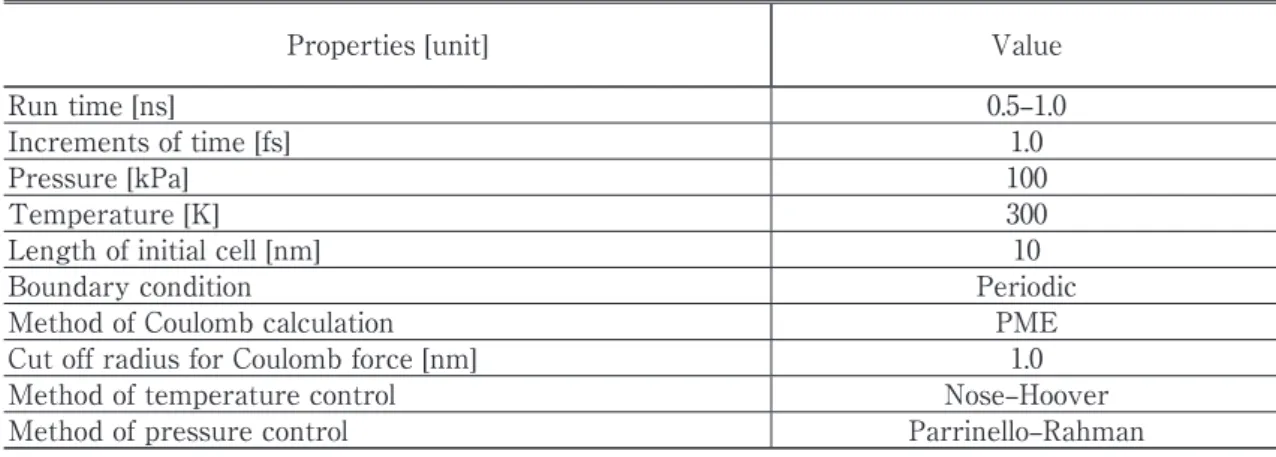
Tables 1 and 2 show the calculation conditions, and details of the simulation models.
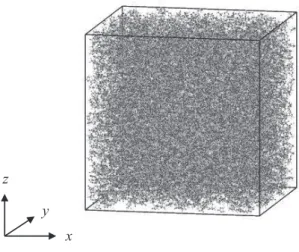
Figures 1 and 2 show the geometry of molecular models and an example of the molecular system that has been calculated here.
5 MOLECULAR DYNAMICS SIMULATION OF LI-ION COORDINATION STRUCTURE
AND TRANSPORT PROPERTIES IN LIB ELECTROLYTES:
INFLUENCE OF MOLECULAR SIZE Table 1. Computation conditions
Properties [unit] Value
Run time [ns] 0.5–1.0
Increments of time [fs] 1.0
Pressure [kPa] 100
Temperature [K] 300
Length of initial cell [nm] 10
Boundary condition Periodic
Method of Coulomb calculation PME
Cut off radius for Coulomb force [nm] 1.0
Method of temperature control Nose–Hoover
Method of pressure control Parrinello–Rahman
Table 2. Details of calculation models
Models Number of molecules Molecular size of solvent [nm]
Solvent LiPF6
EC+1M-LiPF6 7184 500 0.650
FEC+1M-LiPF6 6664 500 0.659
PC+1M-LiPF6 5572 500 0.698
BC+1M-LiPF6 4639 500 0.746
GBL+1M-LiPF6 6191 500 0.679
GVL+1M-LiPF6 4951 500 0.726
DMC+1M-LiPF6 5607 500 0.704
EMC+1M-LiPF6 4580 500 0.750
DEC+1M-LiPF6 3896 500 0.790
a) EC b) FEC c) PC d) BC
e) GBL f) GVL g) DMC h) EMC
i) DEC j) LiPF6 Colors of atomic species
● O ● C ● H ● F ● P ● Li
Fig. 1. Molecular models of solvents and lithium salt
x y z
Fig. 2. An example of an electrolyte model for MD simulation
4. Results and Discussion
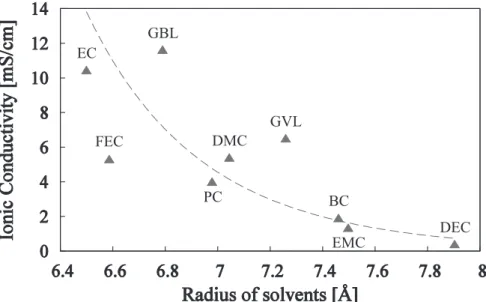
Fig. 3 shows the relationship between ionic conductivity and molecular size in the solvent.
Ionic conductivity shows a larger value for the smaller sized solvent molecules. In previous studies 1) - 3), ionic conductivity was shown to depend on the degree of salt dissociation, electrolyte viscosity, temperature, and diffusion coefficient of the ions. To date, there seems to be no correlation between ionic conductivity and the molecular size of the solvent. However, lithium ions in the electrolyte solution have a certain solvated structure, where each ion is sterically surrounded by solvent molecules (e.g., Fig. 4). The lithium ion diffusion coefficient is thought to be strongly influenced by that of surrounding solvents. When the solvent molecular size is relatively small, the solvated structure size becomes compact and consequently, the solvation diffuses easily through an electrolyte liquid. Thus, ionic conductivity becomes high.
7 MOLECULAR DYNAMICS SIMULATION OF LI-ION COORDINATION STRUCTURE
AND TRANSPORT PROPERTIES IN LIB ELECTROLYTES:
INFLUENCE OF MOLECULAR SIZE
GBL
FEC EC
DMC GVL
PC BC
EMC DEC
Fig. 3. Relationship between ionic conductivity and solvent molecule size DMC
EC
Li+ PF6-
Oc Oc
Oc Oc
P F
Fig. 4. An example of solvation structure
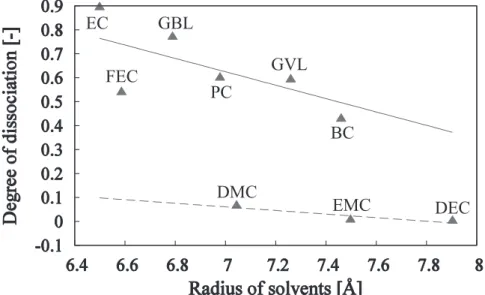
However, to effectively produce these effects, the lithium salt is required to be sufficiently dissociated. Additionally, to mostly dissociate lithium salts in an electrolyte liquid, lithium ions are required to obtain a solvated structure in which solvent molecules are coordinated to the ion. Fig. 5 shows the correlation between the molecular size and the degree of dissociation obtained for each solvent (a solid or dashed line represents the approximation for HPS or LVS, respectively). The smaller the molecular size of the solvent, the higher the degree of dissociation tends to be. When the molecular size is large, it is thought to be difficult for solvent molecules to compactly coordinate to a lithium ion, and it is possible that the energy barrier of dissociation increases. This tendency was especially remarkable with HPS molecules.
This means that the electrical properties of the solvent molecule are also strongly related to the dissociation of lithium salt. HPS molecules generally have a high dielectric constant and therefore promote dissociation of lithium salts, but because of their high viscosity, diffusivity of the ions decreases. However, the LVS molecules have a low dielectric constant, and thus, the degree of salt dissociation is low, but the viscosity is low and they easily diffuse. That is, smaller-sized HPS molecules, which promotes dissociation of lithium salt, and easily diffusible
LVS molecules contribute to the ionic conductivity.
EC FEC
GBL PC
GVL
BC
DMC EMC DEC
Fig. 5. Correlation between the molecular size and degree of dissociation for each solvent
To evaluate the coordination structure, the atom–atom pair radial distribution function (PRDF) is calculated and the average coordination number around lithium ions in the electrolyte solution was estimated. Fig. 6 shows the PRDF of solvent molecules around one lithium ion. The first peak appears near a distance 0.2 nm. This distance corresponds to that between a lithium ion and the nearest molecules. Previous studies 4), 5) showed that lithium ions come close to the carbonyl oxygen atoms (Oc) of the solvent molecules. Thus, we suggest that the first peak is for the Oc of the solvent molecules.
Fig. 6. Pair radial distribution functions of solvents around lithium ions
Each PRDF graph is integrated from a distance of 0–0.25 nm to evaluate the averaged coordination number of lithium ions. These results are shown in Fig. 7. The number of
9 MOLECULAR DYNAMICS SIMULATION OF LI-ION COORDINATION STRUCTURE
AND TRANSPORT PROPERTIES IN LIB ELECTROLYTES:
INFLUENCE OF MOLECULAR SIZE
solvents that are coordinated to one lithium ion was found to be between 2.8 and 4.4. Solvents with a small molecular size result in a large coordination number for the lithium ion. This suggests that a smaller solvent tends to be more coordinated to lithium ions. Previous studies also indicated that straight-chain molecules (e.g. DMC, EMC, DEC) are unsuited to coordination of four molecules around one lithium ion because of their high-aspect-ratio structure 4), 14). Conversely, ionic conductivity is high for solvents with a small molecular size. This is because they are likely to form many solvation structures and are able to promote dissociation of lithium salts in an electrolyte solution.
EC
FEC GBL
PC GVL BC
DMC
EMC DEC
Fig. 7. Coordination number for the lithium ion that was obtained for each solvent
5. Conclusion
In this study, we modeled electrolytes in which 1M-LiPF6 was mixed in a single high permittivity or low viscosity solvent, and we used MD analysis to evaluate the coordination status and transport properties of lithium ions. From the simulation results, we found that ionic conductivity is enhanced by smaller-sized solvent molecules. This was confirmed by the increase in the diffusion coefficient of solvent molecules that are coordinated to a lithium ion and also in that of the lithium ions. It is also observed that small molecules are easily and compactly coordinated to a lithium ion, and dissociation of lithium salt is effectively promoted.
Thus, ionic conductivity will be increased by increasing the amount of lithium ions that have a solvated structure in the electrolyte solution. We conclude that, because a smaller molecular size of the solvent improves the ionic conductivity of the electrolyte solution, the molecular size of the solvent is a key factor in choosing the combination of solvents, and it will be useful for the process of screening molecules and for the molecular design.
Acknowledgements
This study is supported by Daikin Industries, Ltd. and by the Kansai University Grant-in- Aid for progress of research in graduate course, 2017(Apr.)–2018(Mar.).
References
1) Y. Aihara, K. Sugimoto, W. S. Price and K. Hayamizu. Ionic conduction and self-diffusion near infinitesimal concentration in lithium salt-organic solvent electrolytes. J. Chem. Phys., 113, 1981- 1991 (2000).
2) Y. Saito, W. Morimura, R. Kuratani and S. Nishikawa. Factors controlling the ionic mobility of lithium electrolyte solutions in separator membranes. J. Phys. Chem. C, 120, 3619-3624(2015). 3) K. Hayamizu. Direct relations between ion diffusion constants and ionic conductivity for lithium
electrolyte solutions. Electrochim. Acta, 254, 101-111 (2017).
4) M. T. Ong, O. Verners, E. W. Draeger, A. C. T. van Duin, V. Lordi and J. E. Pask. Lithium Ion solvation and diffusion in bulk organic electrolytes from first-principles and classical reactive molecular dynamics. J. Phys. Chem. B, 119, 1535-1545(2015).
5) I. Skarmoutsos, V. Ponnuchamy, V. Vetere and S. Mossa. Li+ solvation in pure, binary, and ternary mixtures of organic carbonate electrolytes. J. Phys. Chem. C, 119, 4502-4515(2015).
6) D.A. Case, D.S. Cerutti, T.E. Cheatham, III, T.A. Darden, R.E. Duke, T.J. Giese, H. Gohlke, A.W.
Goetz, D. Greene, N. Homeyer, S. Izadi, A. Kovalenko, T.S. Lee, S. LeGrand, P. Li, C. Lin, J. Liu, T.
Luchko, R. Luo, D. Mermelstein, K.M. Merz, G. Monard, H. Nguyen, I. Omelyan, A. Onufriev, F.
Pan, R. Qi, D.R. Roe, A. Roitberg, C. Sagui, C.L. Simmerling, W.M. Botello-Smith, J. Swails, R.C.
Walker, J. Wang, R.M. Wolf, X. Wu, L. Xiao, D.M. York and P.A. Kollman. AMBER 2017, University of California, San Francisco, (2017).
7) M. J. Abraham, T. Murtola, R. Schulz, S Pall, J. C. Smith, B. Hess and E. Lindahl. GROMACS:
High performance molecular simulations through multi-level parallelism from laptops to supercomputers. Software X, 1-2, 19-25(2015).
8) L. Martinez, R. Andrade, E. G. Birgin and J. M. Martinez. Packmol: A package for building initial configurations for molecular dynamics simulations. J. Compt. Chem., 24, 819-825(2003).
9) S. Nose. Unified formulation of the constant temperature molecular-dynamics methods. J. Chem.
Phys., 81, 511-519(1984).
10) W. G. Hoover. Canonical dynamics: Equilibrium phase-space distributions. Phys. Rev. A, 31, 1695- 1697(1985).
11) M. Parrinello and A. Rahman. Crystal structure and pair potentials: A molecular-dynamics study.
Phys. Rev. Lett., 45, 1196-1199 (1980).
12) T. Darden, D. York and L. Pedersen. Particle mesh Ewald: An N-log(N) method for Ewald sums in large systems. J. Chem. Phys., 98, 10089-10092(1993).
13) C. Calero, J. Faraudo and M. Aguilella-Arzo. Molecular dynamics simulations of concentrated aqueous electrolyte solutions. Mol. Simul., 37, 1-12(2011).
14) K. D. Fulfer and D. G. Kuroda. A comparison of the solvation structure and dynamics of the lithium ion in linear organic carbonates with different alkyl chain lengths. J. Phys. Chem. Chem.
Phys., 19, 25140-25150(2017).