Instructions for use
Title Knowing How to Change Attitude : Persuasive Communication of Travel Information Engagement on Social Media in China
Author(s) 張, 俊嬌
Citation 北海道大学. 博士(国際広報メディア) 甲第13388号
Issue Date 2018-12-25
DOI 10.14943/doctoral.k13388
Doc URL http://hdl.handle.net/2115/72503
Type theses (doctoral)
File Information Junjiao̲Zhang.pdf
Knowing How to Change Attitude: Persuasive Communication of Travel Information Engagement on Social Media in China
A dissertation presented by
Junjiao Zhang
to
The Graduate School of International Media, Communication, and Tourism Studies
in partial fulfillment of the requirements for the degree of
Doctor of Philosophy
Hokkaido University Sapporo, Japan
August 2018
ACKNOWLEDGEMENTS
This dissertation has been an incredible journey throughout the four years in Hokkaido University. It is not only the compendium of my work throughout my doctorate years; it is one of the biggest milestones in my life. This dissertation represents the end of one chapter, and the opening of another in the next stage of my career as a researcher. This dissertation is also a result of many experiences that allowed me to persist in my dream.
First and foremost, I would like to thank my advisor, Professor Naoya Ito. Without his guidance and expertise, I would not have achieved something beyond as an average student. He had been very supportive and patient throughout these years. He encouraged me and pushed me further to greater heights in order to achieve what I have done. During the tough times when writing the dissertation, he gave me the moral support, guidance and motivation that I needed to move on.
Secondly, I would like to thank my vice-advisor, Professor Atsushi Tsujimoto. He had given me encouragement in completing my doctorate study, providing depth to my research argument to advance it to more implications. Also, I am very grateful to assistant Professor Juhyeok Jang, who devoted much time to review this dissertation very carefully.
I also thank Amy Hsueh who had helped me a lot in the language check of my first paper. She is heartwarming and sunshine; we just knew each other at a conference, but had impressive experiences together from then on. Meanwhile, I would like to thank associate Professor Chuck Brown (Renyuan Bai). He had given me much advice in improving my English level and also helped me check my paper writing. I also learned a lot from his self-discipline and optimistic attitude toward life. In addition, a big thank you to the researchers in Northeast Normal University, in particular to Professor Wenxi Wu, Lecturer Zaitong Li, and Lecturer Jihong Liu, who had supported me in data collections of the two surveys in this research. Without their help, this research could not have been completed.
A big thank you to all my fellow schoolmates, Yiwei Li, and especially Jia Song and Jing Qi, who has been guiding me throughout my doctorate years. They helped me, encouraged me, and comforted me at every step of my doctorate years. Not forgetting my fellow schoolmates in the Graduate School of International Media, Communications and Tourism Studies. Without their help, this research would not have seen the light of the tunnel. Thank you to all my friends and participants who took part in the surveys and provided opinions to make this research a success.
I would like to give my appreciation to my family in China. Despite being miles apart, they have provided me with strong emotional support and love every day which helped me pull through the toughest times of the process. Mom and Dad, I love you! Thank you so much for your concept of emphasizing on education. It has supported me from the small village to the big world.
Last but not least, I would like to thank my boyfriend, Jun Pan. Despite the geographical distance that we have right now, his love and support for me never lessened. The freedom that he gifted me to further my studies abroad has been a great motivation for me to push through the journey. As long as we are connected, nothing is impossible. Do you remember the code you sent me almost seven years ago? I say Yes!
TABLE OF CONTENTS
ACKNOWLEDGEMENTS ... I TABLE OF CONTENTS ...II LIST OF FIGURES ... V LIST OF TABLES ... VI
CHAPTER 1. INTRODUCTION ... 1
1.1 Background ... 1
1.2 Aims and Significance of the Research ... 4
1.3 Research Design ... 6
1.4 Organization of the Research ... 7
CHAPTER 2. LITERATURE REVIEW ... 10
2.1 Theoretical Framework ... 10
2.1.1 Consumer engagement ... 10
2.1.2 Engagement as persuasion ... 15
2.1.3 Elaboration likelihood model ... 18
2.1.4 ELM and travel information adoption ... 25
2.1.5 From “adoption” to “engagement” ... 29
2.1.6 Theory of planned behavior ... 29
2.2 Travel Information Adoption ... 31
2.2.1 Argument quality ... 31
2.2.2 Source credibility ... 34
2.2.3 Perceived information usefulness... 37
2.2.4 Technical adequacy... 38
2.2.5 Outcome: Travel information adoption ... 41
2.3 Bias Effects ... 42
2.3.1 Social presence ... 42
2.3.2 Self-disclosure ... 44
2.4 Developing a Travel Information Adoption Model... 46
2.5 Travel Information Engagement: Extension of Travel Information Adoption ... 46
2.5.1 Perceived self-efficacy... 46
2.5.2 Perceived online social capital ... 48
2.6 Developing an Integrated Model of Travel Information Engagement ... 52
CHAPTER 3. PILOT STUDY ON TRAVEL INFORMATION ADOPTION... 53
3.1 Research Model and Hypotheses ... 53
3.1.1 Structural model of travel information adoption ... 53
3.1.2 Dual-route effects ... 54
3.1.3 Technical adequacy as a trigger ... 57
3.1.4 Social presence and dual-route effects ... 59
3.1.5 Self-disclosure and dual-route effects ... 60
3.2 Methods ... 61
3.2.1 Measurement development in pilot study ... 61
3.2.2 Participants and data collection ... 64
3.3 Results ... 64
3.3.1 Descriptive statistics ... 65
3.3.2 Measurement model ... 68
3.3.3 Main effects... 72
3.3.4 Moderating effects ... 73
3.4 Discussion ... 76
CHAPTER 4. RESERACH MODEL AND HYPOTHESES ... 79
4.1 Development of Pilot Study ... 79
4.2 Research Model and Hypotheses ... 81
4.2.1 Structural model of travel information engagement... 81
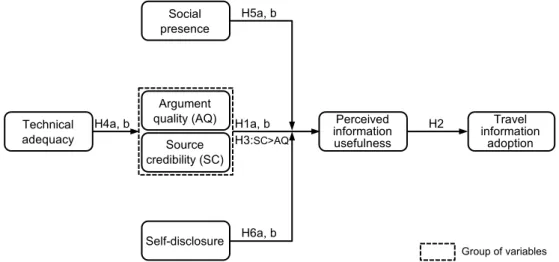
4.2.2 Hypotheses adapted from pilot study ... 83
4.2.3 Role of perceived self-efficacy ... 84
4.2.4 Role of perceived online social capital ... 87
4.2.5 Control variables ... 90
CHAPTER 5. METHODOLOGY ... 91
5.1 Measurement Development ... 91
5.1.1 Measurement scales adapted from pilot study ... 93
5.1.2 Measurement of perceived self-efficacy ... 93
5.1.3 Measurement of perceived online social capital ... 93
5.1.4 Measurement of travel information engagement ... 94
5.2 Participants and Data Collection ... 94
5.4 Data Analysis ... 96
CHAPTER 6. RESULTS... 97
6.1 Descriptive Statistics ... 97
6.1.1 Demographic profile ... 97
6.1.2 Experience of using travel-related social media ... 98
6.1.3 Sample representativeness ... 101
6.2 Exploratory Factor Analysis ... 103
6.3 Measurement Model ... 105
6.4 Hypotheses Testing ... 109
6.4.1 Main effects... 109
6.4.2 Moderating effects of social presence and self-disclosure ... 113
6.5 Post Hoc Analysis ... 117
CHAPTER 7. DISCUSSION ... 120
7.1 Review of the Findings... 120
7.1.1 Pilot study vs. formal study ... 120
7.1.2 ELM’s applicability to shape Chinese consumers’ behavior in travel ... 124
7.1.3 Bias effects for different consumers ... 126
7.1.4 Social cognitive process of travel information engagement ... 128
7.2 Theoretical and Practical Implications ... 131
7.2.1 Knowing attitude change in travel information engagement ... 131
7.2.2 Knowing how to persuade Chinese travelers via social media ... 136
7.3 Limitations and Future Research ... 141
REFERENCES ... 145
LIST OF FIGURES
Figure 1.1. Structure of the contents. ... 7
Figure 2.1. Elaboration likelihood model. ... 18
Figure 2.2. Technology acceptance model. ... 21
Figure 2.3. Information adoption model. ... 21
Figure 2.4. Theory of planned behavior... 30
Figure 2.5. Dimensions of technical adequacy... 40
Figure 2.6. Travel information adoption model. ... 46
Figure 2.7. Role of perceived self-efficacy in travel information engagement. ... 48
Figure 2.8. Role of perceived online social capital in travel information engagement. . 50
Figure 2.9. Travel information engagement model. ... 52
Figure 3.1. Research model in pilot study... 54
Figure 3.2. Results of structural equation model in pilot study. ... 72
Figure 3.3. Interaction effects of social presence with argument quality and source credibility in pilot study. ... 74
Figure 4.1. Research model... 82
Figure 6.1. Results of structural equation model. ... 110
Figure 6.2. Interaction effects of social presence with argument quality and source
credibility. ... 114
LIST OF TABLES
Table 2.1 Measurements of Consumer Engagement in Literature ... 14
Table 2.2 Internal Disposition in Attitude-behavior Relation ... 17
Table 2.3 Moderators Biasing the Cognitive Process of Travel Information Based on the ELM ... 28
Table 2.4 Dimensions of Argument Quality ... 34
Table 2.5 Dimensions of Source Credibility ... 36
Table 3.1 Variables and Literature Sources for Measurement Development in Pilot Study ... 62
Table 3.2 Measurement Items in Pilot Study ... 63
Table 3.3 Respondents’ Demographic Characteristics in Pilot Study... 66
Table 3.4 Respondents’ Experience of Using Travel-related Social Media in Pilot Study ... 67
Table 3.5 Results of Convergent Validity Testing in Pilot Study... 69
Table 3.6 Results of Discriminant Validity Testing in Pilot Study ... 70
Table 3.7 Chi-square Test of Argument Quality and Source Credibility in Pilot Study .. 71
Table 3.8 Results of Moderating Effects Testing of Social Presence in Pilot Study ... 74
Table 3.9 Multigroup Difference Analysis for Moderating Effects of Self-disclosure in Pilot Study ... 75
Table 5.1 Measurement Items ... 92
Table 6.1 Respondents’ Demographic Characteristics ... 98
Table 6.2 Respondents’ Experience of Using Travel-related Social Media ... 100
Table 6.3 Chi-square Test of Descriptive Statistics in Two Substudies ... 102
Table 6.4 Matrix of Exploratory Factor Analysis ... 104
Table 6.5 Results of Convergent Validity Testing ... 106
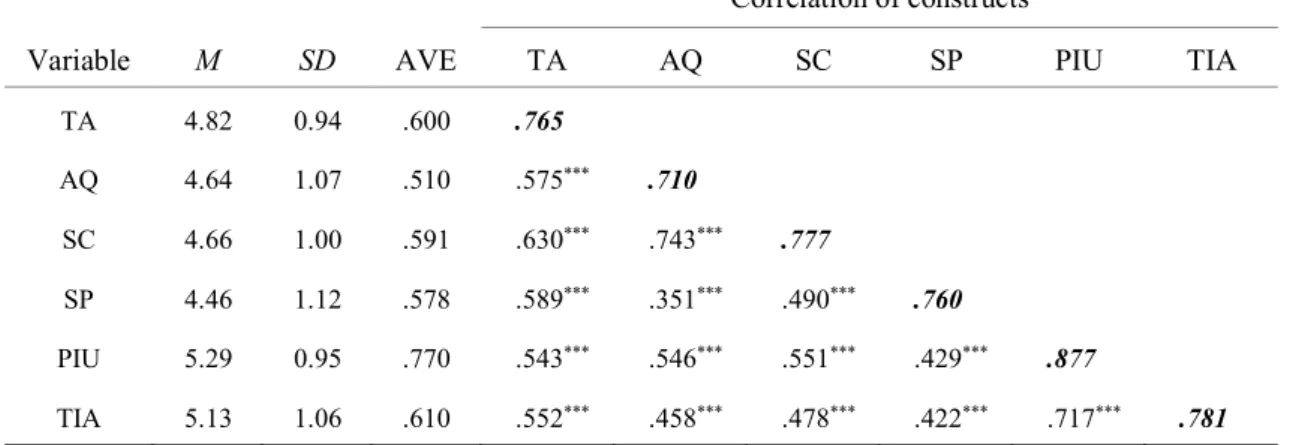
Table 6.6 Results of Discriminant Validity Testing ... 107
Table 6.7 Chi-square Test of Argument Quality and Source Credibility ... 108
Table 6.8 Results of Hypotheses Testing for Main Effects ... 112
Table 6.9 Results of Moderating Effects Testing of Social Presence ... 114
Table 6.10 Multigroup Difference Analysis for Moderating Effects of Self-disclosure 115
Table 6.11 Results of Hypotheses Testing ... 116
Table 6.12 Indirect Effects of Argument Quality and Source Credibility Through
Perceived Self-efficacy ... 118 Table 6.13 Indirect Effects of Argument Quality and Source Credibility Through
Perceived Information Usefulness ... 119
Table 7.1 Results of Comparison Between Pilot Study and Formal Study ... 121
CHAPTER 1. INTRODUCTION
1.1 Background
Social media has been transforming the way consumers communicate with each other and with companies (Minazzi, 2015). It is true especially in travel activities, because travel products are mostly considered as experience products, intangible, and difficult to be evaluated prior to consumption (Smith, 1994; Wilson, Zeithaml, Bitner, &
Gremler, 2012). These specific features generate high consumer involvement and high-risk perception in the travel information processing (Minazzi, 2015). Therefore, user-generated content (UGC) created and exchanged on social media has become a key information source for travelers (Pan, MacLaurin, & Crotts, 2007). In line with this, the first position of this research is particularly focused on impacts of social media on travel information engagement.
Social media encourages consumer empowerment and presents a golden opportunity for travel brands to engage with their consumers through two-way interactions beyond the purchase (Coşkun & Yılmaz, 2016; Harrigan, Evers, Miles, &
Daly, 2017; Minazzi, 2015; Thao, Wozniak, & Liebrich, 2017). Such two-way
interactions highlight that the ultimate goal and the value creation of social media
marketing in tourism lie in consumer engagement (Ge & Gretzel, 2017; Thao et al.,
2017). Meanwhile, consumer engagement through social media is becoming highly
interactive, social, and context specific (Dessart, Veloutsou, & Morgan-Thomas, 2016).
factors change their attitudes are core questions that need to be addressed.
From the social psychological perspective, travel information engagement could be viewed as a behavioral response predicted by persuasive communication, which is a cognitive-response approach on the basis of attitude-behavior theories. A successful persuasion includes three stages: information receiving, cognitive processing, and formation of attitude and conation (Tang, Jang, & Morrison, 2012). Although numerous theoretical and empirical studies have addressed the first and the third stages (e.g., Davis, 1989), the cognitive processing at the second stage, how consumers’ attitudes are formed and changed, still remains unclear like a black box (Bhattacherjee & Sanford, 2006; J. Zhang, Ito, Wu, & Li, 2017b). Therefore, the key to successful persuasion is to understand why and how consumers’ attitudes are changed.
This research adopts the elaboration likelihood model (ELM) (Petty & Cacioppo,
1986) as a fundamental theory to explore the cognitive mechanism contributing to a
successful persuasion. As one of the most feasible theories to interpret the travel
information processing (N. Chung, Han, & Koo, 2015), the ELM is a dual-process
theory with two thought routes of persuasive messages: a central route determined by
argument quality needing more effort and a peripheral route determined by source
credibility needing less effort (Briñol & Petty, 2009; Petty & Cacioppo, 1986). The
significance of the ELM is that it directly draws on the information cognitive process,
and also addresses the principle that the extent of effortful thinking an individual
engages in determines which route and outcome are responsible for persuasion (Wagner
& Petty, 2011).
Although the ELM has been used in a wide range of consumer behavior research, it has several limitations that needs to be addressed if adapt it into the research of travel information engagement. First, as external information primarily drives the information cognitive process (Bhattacherjee & Sanford, 2006), the role of technological features of social media should be expounded to shape the entire persuasive communication (J.
Zhang, Ito, Wu, & Li, 2017a). Second several terms of individual and situational
differences have been explored to have bias effects on consumers’ processing of
information. However, literature is rare from the relational perspective. In this research,
the social connection perceptions—users’ social presence and self-disclosure—are
considered as key factors in fostering bias effects. They are consumers’ subjective
perceptions rather than the two metrics for classifying different social media
applications in the media research (Kaplan & Haenlein, 2010). Third, because consumer
engagement values consumers’ active interactions between consumers and between
brands, it shapes travel information engagement as a social cognitive process. However,
the ELM focuses on the utilitarian motivations and their effects on the adoption side of
information (N. Chung et al., 2015). Considering the social aspects of consumer
engagement, this research invites the theory of planned behavior (TPB) (Ajzen, 1991) to
develop the ELM into engagement per se. Perceived self-efficacy and perceived online
social capital, as social motivations, are assumed to mediate the influence of the two
routes in the ELM. Fourth, consumer engagement merges adoption and generation sides
of the information together (Fang, Zhao, Wen, & Wang, 2017). Although the ELM has been widely applied, its power to predict consumer engagement is still expected to be explored in more empirical studies, since it focuses more on information adoption than information generation (e.g., N. Chung et al., 2015). Considering these gaps in literature, three basic research questions are therefore raised in this research:
RQ1: What cognitive processes shape travel information engagement in social media?
RQ2: Which paths are more effective in leading to persuasion?
RQ3: Does travel information engagement vary across users’ perceptions of social connection in social media? If so, how?
To address these questions, based on the review of literature, an integrated cognitive model was constructed by combining the ELM with the TPB. It draws on consumers’ cognitive processing of travel information through external stimulus, cognitive response, evaluation, and behavioral response. In the light of this, this research focuses on the causal and dynamic relationships between persuasive messages (argument quality, source credibility) in travel and recipient-oriented effects.
1.2 Aims and Significance of the Research
Focusing on the role of recipients’ perception, this research aims at exploring an
effective communication of consumer engagement in travel information to shape and
enhance the strategies of travel brands and tourism marketers in social media marketing.
With the purpose of knowing how to change attitude, this research is expected to make effort in drawing upon the causal and dynamic paths in the cognitive mechanism of travel information.
One of the most important contributions of this research is that it tries to develop an integrated cognitive model of persuasion to predict consumers’ engagement intention for travel information on social media. Drawing insights from the ELM, this research extends the model from adoption to engagement to explore consumers’ utilitarian motivations and social motivations to engage in travel information on social media. The utilitarian motivations shed light on the trigger role of technical adequacy of social media and the mediating effects of persuasive messages in increasing travelers’
perception of information usefulness. The social motivations shape the mediating effects of perceived self-efficacy and perceived social capital between persuasive messages and information usefulness. It is expected to add the productive and predictive power to the original ELM in elaborating travel information processing in the specific context of social media.
Another contribution lies in the explosion of the causal and dynamic relationships
between persuasive messages and recipient-oriented effects in consumers’ processing of
travel information. This research attempts to investigate how users’ perceptions of social
connection on social media interact and bias consumers’ thinking route to engaging in
travel information. Particularly, the moderating effects of users’ social presence and
self-disclosure are explored. It hopes to take more insights in consumers’ internal
disposition to adopt or generate travel information via social media.
In practice, this research also advances the knowledge of travel brands and tourism marketers in the question: What are the best ways to engage my audience with social media? It contributes an effective framework for them to evaluate and update their consumer engagement strategies in social media marketing. By working on investigating Chinese consumers’ engagement in travel information, this research is believed to help travel brands in how to design useful travel information, how to build social ties, and how to create a great space of online community. Moreover, the research on consumer engagement is rare and still in the initial phase in the field of social media marketing as well as in the research domain of travel information processing (Thao et al., 2017). Therefore, as an exploratory and empirical study, findings of this research might be more intriguing to the social media marketing in travel from a global perspective.
1.3 Research Design
Following the sequential approach, a multimethod design is used to transfer two
quantitative studies from the focus on adoption to the focus on engagement. That is, a
quantitatively-driven study—the pilot study—is conducted first, followed by a second
quantitative study: the formal study (Tashakkori & Teddlie, 2010, p. 198). In this
research, the pilot study indicated the cognitive process of travel information adoption,
results and implications of which informed the nature of the formal study. By the
of the persuasive communication in travel information engagement. The implemental framework is underlined in the following section.
1.4 Organization of the Research
This research is organized in seven chapters (Figure 1.1).
Figure 1.1. Structure of the contents.
• Travel information adoption
• Bias effects
• Travel information engagement Theoretical
Framework Introduction
• Background
• Aims and significance
• Research design
• Organization
• Research model and hypotheses
• Methods
• Results
• Discussion
• Developmentof the pilot study
• Research model and hypotheses
• Measurement development
• Participants and data collection
• Data screening and analysis
• Descriptive statistics
• EFA and CFA
• Hypotheses testing
• Post hoc analysis
• Review of the findings
• Theoretical and practical implications
• Limitations and future research Chapter 1
Literature Review
Pilot Study
Formal Study
Methodology
Results
Discussion Chapter 2
Chapter 3
Chapter 4
Chapter 5
Chapter 6
Chapter 7
Reference
Chapter 1 is the introduction of this research. It overviews the background, aims, significance of this research, and the basic research design. The rest of this research are organized in the following.
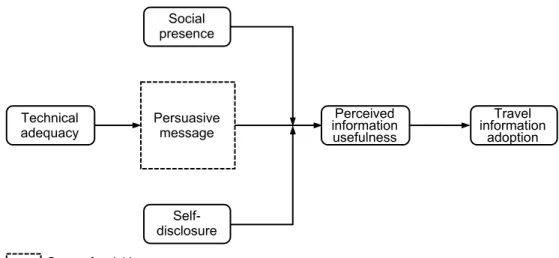
Chapter 2 is literature review. A stepwise approach is used to review the prior research on theoretical framework of consumer engagement, travel information adoption, bias effects, and travel information engagement. Based on the review of key variables, conceptual frameworks of travel information adoption model (TIAM) (Figure 2.6, p. 46) for the pilot study and travel information engagement model (TIEM) (Figure 2.9, p. 52) for the formal study are constructed.
Chapter 3 introduces the pilot study on the cognitive process of travel information adoption. A structural TIAM, as an extended ELM, is established with two routes, the central route (argument quality) and the peripheral route (source credibility). It assumes that the two routes are triggered by technical adequacy of social media and their effects on perceived information usefulness moderated by users’ social presence and self-disclosure. An online survey targeting Chinese young people was conducted to test the research model in the pilot study.
Based on the findings in Chapter 3, Chapter 4 focuses on developing hypotheses
and the structural TIEM for the formal study, in which travel information adoption is
advanced to travel information engagement. The structural TIAM in Chapter 3 is
extended by adding the mediating roles of perceived self-efficacy and perceived online
social capital. It proposes that self-efficacy and online social capital are predicted by the
two routes in the ELM and have direct impact on behavioral engagement intention.
Chapter 5 introduces the methodology of the formal study. The measurement is developed by modifying and expanding the instruments of the pilot study. The age span of target groups was enlarged to cover more respondents from the groups of less than 18 years of age and over 40 years of age. A web-based survey and a paper-and-pencil survey were conducted synchronously in mainland China.
Chapter 6 illustrates the results of each procedure in the data analysis for testing the structural TIEM in the formal study, including descriptive statistics, exploratory factor analysis (EFA), measurement model, hypotheses testing, and post hoc analysis.
Chapter 7 presents the discussion and implications of the research. A comparative discussion is used to review the findings in the two substudies, following which the theoretical and practical implications are interpreted with the endeavor to answer the three research questions raised in Chapter 1. Finally, limitations and future research are addressed.
Note. Part of the contents in this research has been published in Information and
Communication Technologies in Tourism 2017 (pp 639–653), Information and
Communication Technologies in Tourism 2018 (pp. 200–213), and International Journal
of Marketing and Social Policy, 2017, 1(1): 39–51. Publishers allow the author to use
the contents in the dissertation.
CHAPTER 2. LITERATURE REVIEW
2.1 Theoretical Framework
2.1.1 Consumer engagement
Engagement: Consumers’ behavioral response.
Despite the rapidly growing research on consumer engagement (CE) in marketing (Harmeling, Moffett, Arnold, & Carlson, 2017), effort regarding its conceptualization and measurement are still nascent, very restricted, and lack consensus due to its short history (Dessart et al., 2016; So, King, & Sparks, 2014; Thao et al., 2017). Broadly, extant studies have constructed CE with multiple dimensions or with one dimension (Dessart et al., 2016). The multidimensional concept of CE focuses on a psychological state of interactions between consumer and brand (Harmeling et al., 2017). It advocates a consumer’s positively valenced, brand-related cognitive, affective (emotional), and behavioral activities (Brodie, Hollebeek, Jurić, & Ilić, 2011; Hollebeek, Glynn, &
Brodie, 2014). In the one-dimension setting, CE presents a behavioral construct (So et
al., 2014) and is defined as a consumer’s behavioral manifestations toward a brand or
firm, which result from motivational drivers and go beyond purchase-related
transactions (van Doorn et al., 2010). Although construct differences exist in the two
perspectives, they share three fundamental points: (1) CE tends to be consumer-based
attitudinal and behavioral intensity toward an object (e.g., brand, firm) (Harmeling et al.,
2017); (2) CE occurs in a specific context supporting consumers’ activity with the
object (Dessart et al., 2016; J. Zhang, Ito, & Liu, 2018); and (3) CE captures consumer-brand interactive relationships beyond transactions (van Doorn et al., 2010).
Therefore, CE is naturally a consumers’ behavioral response.
This research prefers to understand and construct CE from a behavioral perspective.
First, a behavioral focus can build relatively independent constructs of CE to test the feasibility of its measurement due to its shortcomings in empirical study (Dessart et al., 2016; Harmeling et al., 2017). Second, psychological constructs of CE, including cognitive (attention, absorption) and affective (enthusiasm, enjoyment) dimensions (So et al., 2014), are highly memorable and emotional (Thao et al., 2017). As such, they may share so much association that it is difficult for respondents to distinguish them in an investigation. Third, CE in social media contexts is predominantly developed by quantitative measurement (Schivinski, Christodoulides, & Dabrowski, 2016; Thao et al., 2017). As an exploratory and empirical study, this research asserts that the narrow definition of CE is preferable and will help build further strong and direct implications in theory development.
Consumer engagement in social media marketing.
As mentioned previously, CE in this research will be measured as a behavioral construct. As such, CE tends to be behavioral focused, context specific, and dependent on active and continued interactions between a subject and an object in the circumstances (Fang et al., 2017; van Doorn et al., 2010; J. Zhang et al., 2018).
Therefore, social media environment has been considered one of the most excellent and
relevant settings for researching CE because they keep both highly interactive and social elements (Dessart et al., 2016; Schivinski et al., 2016; Thao et al., 2017).
Further, social media encourages consumer empowerment (J. Zhang et al., 2018) and presents a golden opportunity for tourism and hospitality brands to engage with their consumers through two-way interactions beyond the purchase (So et al., 2014;
Thao et al., 2017). Such two-way interactions, between consumers and between consumer and brand, highlight that the ultimate goal and the effectiveness of social media marketing in tourism lie in CE (Ge & Gretzel, 2017; Harrigan et al., 2017; So et al., 2014; Thao et al., 2017).
However, several key questions remain about the measurement of CE. Researchers
have tended to focus on conceptual and qualitative studies on CE (Dessart et al., 2016)
because the essence of CE is consumer experience (Thao et al., 2017). Shifting to social
media contexts, scholars have systematically explored and verified CE’s measurement
scales based on consumers’ quantitative data (Harrigan et al., 2017; Hollebeek et al.,
2014; Schivinski et al., 2016; So et al., 2014). In spite of these, few studies, so far, have
empirically and directly investigated the scales of CE. In addition, the construction of
the multidimensional scales was too complex with a large number of items, such as 42
items under 11 dimensions (e.g., Baldus, Voorhees, & Calantone, 2015). Such a setting
is unsatisfactory for an empirical study, which calls for a short form but powerful
measurement. An additional problem is that most of these measurement scales have
failed to address engagement with content or information on social media; instead, they
have documented the engagement with the brand or with the online brand community (Schivinski et al., 2016).
Considering the gaps discussed previously, this research tends to follow the calls for further effort in the empirical and quantitative study of CE, which is also scarce in the tourism research area. With a focus on the behavioral dimension of CE, researchers of consumer behavior in travel have mainly explored CE’s indicators from two angles:
social media metrics or affordance (e.g., Ge & Gretzel, 2017; Thao et al., 2017) and consumers’ behavioral intention (e.g., P. Wang, Zhang, Suomi, & Sun, 2017; J. Zhang et al., 2018). For instance, Ge and Gretzel (2017) calculated the number of likes, comments, and reposts under the Sina Weibo posts by a destination marketing organization to indicate CE. Schivinski et al. (2016) developed a behavioral scale of CE with brand-related content on social media, including three potential behavior intentions on Facebook, namely consumption, contribution, and creation. Despite different study approaches, as outlined by Fang et al. (2017), CE is particularly viewed as consumers’
active participation, namely behavioral engagement intention. Such engagement can be measured by personal engagement (i.e., adoption, use) and interactive engagement (i.e., sharing, generation). In the same way, CE on social media in travel could be determined by an integration of information/electronic Word-of-Mouth (eWOM) adoption and information/eWOM generation (P. Wang et al., 2017; J. Zhang et al., 2018). Table 2.1 (p.
14) presents a partial list of previous studies involving CE measurements on social
media and in particular on travel behavior topics.
Table 2.1
Measurements of Consumer Engagement in Literature
Authors Context Indicators Description
Schivinski et al.
(2016)
Brand-related social media content
• Consumption
• Contribution
• Creation
- Reading posts/fanpages;
- Watching pictures/graphics;
- Following blogs/brand.
- Commenting videos/posts/pictures/graphics;
- Sharing posts;
- "Like" pictures/graphics/posts.
- Initiating posts;
- Posting pictures/graphics/videos;
- Writing reviews/posts.
Dessart et al.
(2016)
Facebook brand community
• Learning
• Sharing
• Endorsing
- Seek ideas/information/ experiences/help;
- Share ideas/information/experiences;
- Provide help.
- Sanction, support, or refer resources shared.
P. Wang et al.
(2017)
eWOM on travel review website
• eWOM use/adoption
• eWOM generation
- Use eWOM;
- Motivate to take action;
- Agree with the eWOM.
- Share travel experiences;
- Provide travel experiences;
- Post comments.
Fang et al. (2017) Mobile travel applications
• Personal engagement
• Interactive engagement
- Continuance use;
- Referral;
- Word-of-mouth - Discussion;
- Sharing content;
- Solving problems.
Ge & Gretzel (2017)
Posts of a destination marketing organization (DMO) on Sina Weibo
• Liking
• Commenting
• Reposting
- Endorse posts
- Add information to posts - Spread posts
Thao et al. (2017) Facebook brand communities of airline industry
• Learning;
• Sharing;
• Co-developing;
• Advocating;
• Socializing.
- Number of members/active users/fans;
- Number of comments/views/user-generated photos or replies;
- Number of posts/reposts/shares;
- Number of responses to friend referral invites Note. eWOM = electronic word of mouth. This table is summarized by the author.
2.1.2 Engagement as persuasion
Gauging the sum of behavioral manifestations, the modes of CE are routes to persuasion (Phillips & Mcquarrie, 2010). That is, the CE process equals the process of persuasive communication, by which a brand develops and maintains the engaged consumers. As described in more detail, persuasion is an active attempt or strategy to change recipients’ actions or beliefs by persuasive messages (Y. Chang, Yu, & Lu, 2015).
Transforming such persuasion into social psychology, it draws upon the cognitive process of individuals’ attitude change (Myers, 2009; Petty & Cacioppo, 1986). In this line, engagement, as persuasion, can be well constructed through attitude-behavior theories.
In social psychology, persuasion refers to “the process by which a message induces change in beliefs, attitudes, or behaviors” (Myers, 2009, p. 230). Accordingly, a successful persuasion is typically possible when a recipient receives a persuasive message from another information source in a particular context or setting (Briñol &
Petty, 2009). In this mechanism persuasive communication commonly consists of three
stages: (1) information receiving, (2) cognitive processing, and (3) formation of attitude
and conation (Tang et al., 2012; J. Zhang et al., 2017b). Website characteristics enable
information to be transmitted from a sender to a recipient at the first stage (Gao, Dai,
Fan, & Kang, 2010; Tang et al., 2012). The third stage indicates a recipient’s evaluation
of a psychological object with some degree of favorable or unfavorable response, which
is expected to induce subsequent behavior toward the object (Ajzen, 2012; Briñol &
Petty, 2012).
However, cognitive processing at the second stage still remains unclear (Tang et al., 2012; J. Zhang et al., 2017b). In particular, the mode of information cognitive processing has been challenged in the two-way communication emerging with social media (J. Zhang et al., 2017b). Since the key to successful persuasion is to understand why and how consumers’ attitudes are changed (Briñol & Petty, 2009), it is essential for both academics and practitioners to endeavor to answer questions such as the following:
What types or routes of cognitive processing do consumers engage in? What factors activate cognitive processing? To address these questions, it is vital to trace attitude-behavior theories for establishing a persuasive communication that is well suited to predict CE.
For a number of reasons, this research tends to employ the elaboration likelihood model (ELM) (Petty & Cacioppo, 1986) and the theory of planned behavior (TPB) (Ajzen, 1991) to develop the cognitive process of travel information engagement on social media. First, they both capture the three categories of internal disposition in human behavior: cognitive response, evaluation, and behavioral response (Table 2.2, p.
17) (Ajzen, 2012). Second, they are well accepted to investigate particular behavior in
empirical studies because they content the principles of a high-quality theory with good
accessibility and compatibility (Ajzen & Fishbein, 1980). That is, dispositions in the
two theories can be measured and assessed by questionnaires with similar target, action,
context, and time elements (Ajzen, 2012). Third, in the marketing and social
psychology domains, these conceptual frameworks have been considered as the most popular, influential, and feasible for the study of persuasive communication in social media contexts (Teng, Khong, & Goh, 2015; Teng, Khong, & Goh, 2014). Teng et al.
(2015) conducted a systematic literature review of attitude-behavior theories used in social media contexts across almost nine years (January 2006–June 2014). They noted that research using the ELM increases steadily and becomes the most applicable model in predicting persuasive communication, followed by the TPB. The explanation power of the two theories was also dominant in the marketing, online communication, consumer behavior, and tourism research areas, among others. For these reasons, this research expects to make further efforts to expand the ELM and the TPB into the consumers’ particular engagement in travel information on social media. The following sections will outline more details of the two theories for building the conceptual framework of this research.
Table 2.2
Internal Disposition in Attitude-behavior Relation
Type of internal disposition Attitude-behavior theory Cognitive
response Evaluation Behavioral
response Elaboration likelihood model
(ELM)
• Argument quality
• Source credibility
• Elaboration likelihood
• Attitude • Behavior intention
Theory of planned behavior (TPB)
• Behavioral beliefs
• Normative beliefs
• Control beliefs
• Attitude toward the behavior
• Subjective norm
• Perceived behavioral control
• Behavior intention
• Behavior
Note. The table is compiled from Petty & Cacioppo (1986), Ajzen (1991), and Ajzen (2012).
2.1.3 Elaboration likelihood model
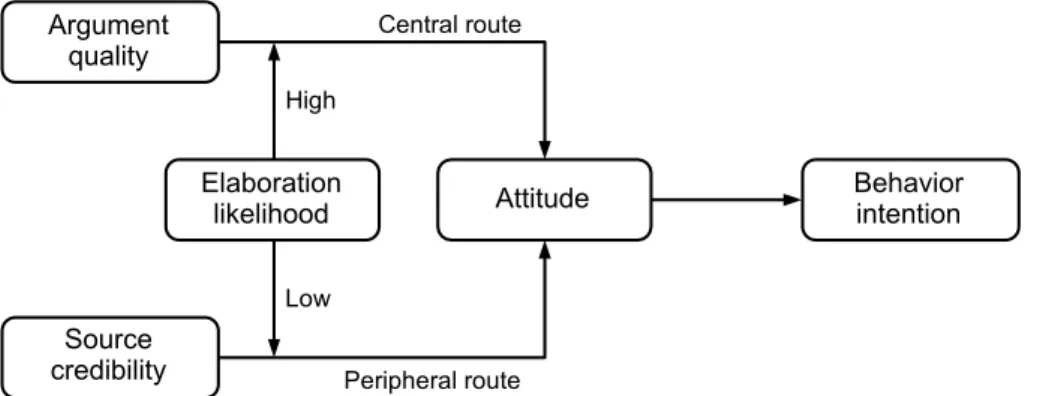
In social psychology, the elaboration likelihood model (ELM) (Petty & Cacioppo, 1981, 1986) is a dual-route process theory that articulates how individuals’ attitudes change in persuasive communication through a central route and a peripheral route, according to individuals’ motivations and abilities. As shown in Figure 2.1, the central route requires effortful thought from individuals to cognitively evaluate the argument quality embedded within messages (Bhattacherjee & Sanford, 2006; Petty, Cacioppo, &
Goldman, 1981). The peripheral route requires less effortful thought and serves as a result of some simple cues that trigger automatic acceptance such as source credibility (Myers, 2009; Petty & Cacioppo, 1984, 1986).
Figure 2.1. Elaboration likelihood model.
Adapted from Petty and Cacioppo (1986) (as cited in N. Chung et al., 2015, p. 906).
The ELM holds that the central route is more stable and enduring to predict long-term behaviors, whereas the peripheral route is relatively less persistent and less predictive of long-term behaviors (Bhattacherjee & Sanford, 2006; T. Zhou, Lu, &
Elaboration
likelihood Attitude Behavior
intention Argument
quality
Source credibility
Central route
Peripheral route High
Low
Wang, 2016). Moreover, individuals’ motivations and abilities to elaborate are viewed as the “elaboration likelihood,” which is guided by the principle that individuals “add something of their own to the specific information provided in the communication”
(Petty & Wegener, 1999, p. 46). In other words, elaboration likelihood accounts for the probability that an individual engages in the issue-relevant thinking necessary to identify the merits of the arguments (Cacioppo & Petty, 1984). The amount of elaboration is determined by individual and situational differences (R. E. Petty &
Cacioppo, 1984). Because of the bias variance, the most significant postulate of the ELM is that the extent of thinking (cognitive effort) an individual devotes to processing a message will determine which route is responsible for persuasion (Petty & Cacioppo, 1984; Wagner & Petty, 2011).
Apart from the consideration stated in subsection 2.1.2 (p. 15), there are more underlying reasons to select the ELM for interpreting persuasive communication. First, it holds that external information is the primary driver of attitude and behavior changes (Bhattacherjee & Sanford, 2006), and thus it could be used in different media contexts, including social media contexts (e.g., N. Chung et al., 2015; M. J. Kim, Chung, Lee, &
Preis, 2016; K. Z. K. Zhang, Zhao, Zhang, & Lee, 2014). Second, it directly draws upon the information cognitive processing with two distinct routes of persuasion, which could be employed to assess the information itself and its source, respectively (Ajzen, 2012).
Moreover, recognizing the route by which change occurs is crucial for understanding
the consequential attitudes (Briñol & Petty, 2012). Third, the ELM explains why and
how a given persuasion process may lead to different routes and outcomes according to the different cognitive effort of the recipients (Bhattacherjee & Sanford, 2006). It thus could be extended by developing the term of elaboration depending on recipient effects or situational effects (Wagner & Petty, 2011). In addition, a large body of empirical studies has suggested that the ELM is appropriate and pertinent in drawing upon persuasive messages advocated on social media, including travel information (N. Chung et al., 2015; Teng, Khong, & Goh, 2014).
The ELM in social media contexts has been modified or extended on its constructs, determinants, and moderators (J. Zhang et al., 2017a, 2017b). Contributions and limitations in these previous studies are outlined in the following subsections.
Constructs.
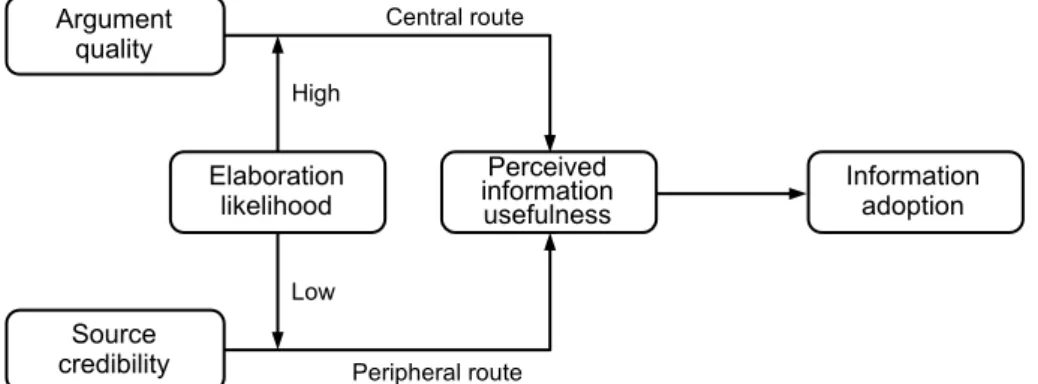
Sussman and Siegal (2003) proposed the information adoption model (IAM),
which introduced the term perceived information usefulness that is derived from the
technology acceptance model (TAM) (Figure 2.2, p. 21) (Davis, 1989) into the ELM,
instead of the attitude variable. They argued that information usefulness, as a key and
direct predictor of behavior intention, cannot be ignored and excluded when trying to
understand online information processing (e.g., e-mail). They expounded on and
clarified its crucial mediating effect among argument quality, source credibility, and
their outcome of information adoption (see Figure 2.3, p.21). The IAM simplifies and
improves the measurability of attitude change, which is considered difficult to scale
accurately. In addition, the IAM particularly expands the usage of the ELM in shaping
the information cognitive process in computer-mediated communication (C. M. K.
Cheung, Lee, & Rabjohn, 2008; N. Chung et al., 2015; M. J. Kim, Chung et al., 2016).
More importantly, it leads the scope of behavior intention to the direction of information adoption, which has become predominant in subsequent research on persuasive messages.
Figure 2.2. Technology acceptance model.
Adapted from Davis, Bagozzi, and Warshaw (1989).
Figure 2.3. Information adoption model.
Adapted from Sussman and Siegal (2003).
However, the IAM did not address the media environment and its features.
Because persuasive communication has an external information focus (Bhattacherjee &
Attitude
toward using Behavior intention Perceived
usefulness
Perceived ease of use External
variables Behavior
Elaboration likelihood
Perceived information usefulness
Information adoption Argument
quality
Source credibility
Central route
Peripheral route High
Low
Sanford, 2006), the role of external variables considered important in the TAM should also be expounded (J. Zhang et al., 2017a). Turning to social media, the context this research focuses on, unique technological features distinguish it from the traditional website system through the interactions between consumers and between consumers and the technology (C. Wang & Zhang, 2012; J. Zhang et al., 2017a). These interactions are evoking consumer empowerment and thus occur more frequently and are easier to observe (Animesh, Pinsonneault, Yang, & Oh, 2011). Therefore, the technological features of social media that serve as the external variables can heavily motivate consumers to actively participate in information processing via social media (Animesh et al., 2011; H. Zhang, Lu, Gupta & Zhao, 2014). Accordingly, this research intends to introduce the term “technical adequacy” into the ELM and the IAM as a trigger or input to stimulate consumers’ processing of travel information on social media (see subsection 2.2.4, p. 38, for more review).
Determinants.
In empirical studies, researchers have successfully explored fruitful factors that determine the two routes in the information process (C. M. K. Cheung & Thadani, 2012;
Teng, Khong, & Goh, 2014). In the central route, messages are measured for both quality and quantity. The former primarily includes information quality (Erkan & Evans, 2016), argument strength (C. M. K. Cheung & Thadani, 2012; M. Y. Cheung, Luo, Sia,
& Chen, 2009; K. Z. K. Zhang, Zhao, Cheung, & Lee, 2014), valence, extremity, and
type of information (e.g., Filieri, 2016; Yan et al., 2016). The latter, such as the volume,
length, and rating of the reviews, has been used to identify the usefulness of eWOM (C.
M. K. Cheung & Thadani, 2012; Yan et al., 2016). Involving the peripheral route, scholars have confirmed the significant impact of source metrics on information usefulness via social media, including source trustworthiness, expertise (C. M. K.
Cheung & Thadani, 2012; K. Kim, Cheong, & Kim, 2017), attractiveness, similarity, homophily, and tie strength (Steffes & Burgee, 2009; J. Zhang et al., 2017a, 2017b).
Derived from a social psychology perspective, one of the key aims of this research is to determine whether the ELM can predict Chinese consumers’ cognitive processing of travel information. Thus, this research traces back the initial operations of the ELM (Cacioppo & Petty, 1984), by which “argument quality” is expected to evaluate the central route, while “source credibility” is expected to examine the peripheral route.
Moderators.
Due to individual and situational differences, individual-oriented characteristics have been employed as recipient effects that strengthen the power of the central route but relatively weaken that of the peripheral route in information processing on social media. Several terms of individual differences have been explored, including, but not limited to, recipients’ prior knowledge, expertise, involvement level (Aghakhani &
Karimi, 2013; Gao, Tian, & Tu, 2015; R. Li & Suh, 2015; Martin & Lueg, 2013;
Sussman & Siegal, 2003; Tseng & Wang, 2016; Xue & Zhou, 2010; Yan et al., 2016;
Yang, Hung, Sung, & Farn, 2006), and perceived risk (Tseng & Wang, 2016; Tseng &
Kuo, 2014). Situational differences have also been indicated, such as personal relevance
(Alpar, Engler, & Schulz, 2015; Bhattacherjee & Sanford, 2006), product type (Hlee, Lee, Yang, & Koo, 2016), and media richness (N. Chung et al., 2015).
Although moderating effects have been taken seriously in academics, literature is rare from the relational perspective (J. Zhang et al., 2017a). However, the innovations social media bring are changing the social relationship or connection in information communication (Kaplan & Haenlein, 2010), making social aspects more important for consumers when making decisions than that in traditional media. Consequently, consumers’ differences in motivations and abilities depend more on the social aspects they perceive in social media. Such social influence is derived virtually from consumers’
sense of trust in social media. Thanks to the UGC, consumers are more aware of trust given by social media and, in turn, less effort and ability are required to access the information (Coşkun & Yılmaz, 2016; Robert & Dennis, 2005). Because of the sense of trust and ease in social media, consumers can immerse themselves in a sense of social presence as in real life (N. Chung et al., 2015). Further, because less effort is required in the information exchange, consumers are called upon to disclose themselves and become immersed in the interpersonal communication or social exchange (Coşkun &
Yılmaz, 2016). That is why factors related to social connections must be regarded when constructing recipients’ thinking effort to engage in information on social media.
Considering the important role of social connection in consumers’ decisions in
social media, this research intends to employ users’ social presence and self-disclosure
to appeal for in-depth insights on the bias effects and the dynamism in persuasive
communication on social media (J. Zhang et al., 2017a, 2017b).
2.1.4 ELM and travel information adoption
As overviewed in the prior subsection, interest in the ELM has grown in the travel information adoption research domain (Erkan & Evans, 2016; Petty, McMichael, &
Brannon, 1992; Salehi-Esfahani, Ravichandran, Israeli, & Bolden, 2016; Sparks, Perkins, & Buckley, 2013). Its predictive power has been confirmed in the issues of travel information processing, such as information searching on destination or travel websites (Tang et al., 2012; Tseng & Wang, 2016), travel information using via social media (N. Chung et al., 2015), online reviews of restaurants (Hlee et al., 2016;
Salehi-Esfahani et al., 2016), and shopping for mobile tourism products (M. J. Kim, Chung et al., 2016). However, tourism products are intangible, information-intensive, experienced, and synchronous, which makes them different from the alternatives (Smith, 1994). Travel information communication is thus closely related to a perceived high risk, which would produce high involvement situations faced by travelers. At this point, travelers are more likely to be extensively involved in the decision-making process (Kerstetter & Cho, 2004). Therefore, comparing to the original postulates in the ELM, previous studies regarding travel information have contributed some particular findings, which further advanced the extension of the ELM from three angles.
First, earlier studies implicitly considered message arguments as more important
than source cues for consumers with high involvement because the former was assumed
to be more complex, difficult, and effortful (Kitchen, Kerr, Schultz, McColl, & Pals,
2014), while the latter was subordinate in persuasive messages (Chaiken & Trope, 1999). However, it has been argued that travelers always combine both argument quality and source credibility in their thought modes regarding travel information assessment, noting a joint function of the two routes (N. Chung et al., 2015; M. J. Kim, Chung et al., 2016; SanJosé-Cabezudo, Gutiérrez-Arranz, & Gutiérrez-Cillán, 2009).
Another decision-making stream for travel products found that the effortless processing mode generates an offsetting effect on consumers’ attitudes and intention changes in the high-involvement situation when the information is insufficient with weak and untrustworthy arguments (Filieri, 2016; S. H. Jun & Vogt, 2013). Although there has been a lack of empirical studies to replicate or reinforce these findings, they do raise a question: Which route is more effective in the persuasive communication of travel information?
Second, the ELM has a trade-off postulate which posits that source credibility becomes less important when argument scrutiny increases, and vice versa (Petty &
Wegener, 1999). Despite that, researchers have demonstrated that causal relationships
exist between argument quality and source credibility when consumers evaluate online
reviews of restaurants and hotels (Shan, 2016; K. Z. K. Zhang, Zhao, Cheung et al.,
2014). Furthermore, Shan (2016) demonstrated that reviews of hotel products with
strong arguments are perceived as having greater source expertise and trustworthiness
than those with weaker arguments. The converse is also possible: reviews received from
credible sources are deemed more informative and persuasive ( K. Z. K. Zhang, Zhao,
Cheung et al., 2014). In short, the two routes in the ELM are likely to be interdependent with potential intimate associations in the cognitive processing of travel information (Crespo, Gutiérrez, & Mogollón, 2015; H. S. Jun & Vogt, 2013). Following these reasons, the trade-off postulate of the two routes in the ELM needs to be questioned in the information processing of experience products such as tourism products (SanJosé-Cabezudo et al., 2009; J. Zhang et al., 2017a, 2018).
Third, in terms of the biased processing, literature in tourism has also documented the moderating effects of recipient characteristics and situational factors derived from the ELM (Wagner & Petty, 2011), mainly including consumers’ prior knowledge (e.g., expertise, experience) (Filieri, 2016; Kerstetter & Cho, 2004; Tseng & Wang, 2016) and issue-involvement situations (e.g., H. S. Jun & Vogt, 2013; Tseng & Wang, 2016). In addition to these, as listed in Table 2.3 (p. 28), specific moderators related to perceived risk, product type, and context type have been developed particularly for travelers’
information adoption on the Internet and social media (Filieri, 2016b; Hlee et al., 2016;
Tseng & Wang, 2016). Although these extensions have advanced the application of the
ELM in tourism, similar to the core gap noted in the prior subsection 2.1.3 (p. 18), they
have failed to consider the social determinants of the “elaboration” from the perspective
of consumers’ social relationship in decision making. N. Chung et al. (2015) and Hlee et
al. (2016), respectively, captured the important roles played by social presence and
reviewers’ self-disclosure in biasing which path travelers are willing to engage in, but
these terms were not carried out from the consumer-oriented perspective. It thus sheds
light on a challenging question: How do the social aspects perceived by consumers affect how they process travel information? In doing so, this research tends to particularly focus on the potential moderating effects of users’ social presence and self-disclosure based on the consumer-oriented perspective.
Table 2.3
Moderators Biasing the Cognitive Process of Travel Information Based on the ELM
Moderator References
Recipient difference
Individual expertise Tseng & Wang (2016)
Consumer experience with consumer reviews Filieri (2016)
Prior knowledge Kerstetter & Cho (2004)
Perceived risk Tseng & Wang (2016)
Disconfirming information W. Zhang & Watts (2008)
Focused search W. Zhang & Watts (2008)
Situation difference
Issue involvement. Tseng & Wang (2016); H. S. Jun & Vogt (2013) Social network involvement M. J. Kim, Chung et al., (2016)
Consumer involvement Filieri (2016);
Rodríguez-Molina, Frías-Jamilena, & Castañeda-García (2015) Social presence (media richness) N. Chung et al. (2015)
Restaurant type Hlee et al. (2016)
Medium type Filieri (2016)
Reviewers’ self-image disclosure Hlee et al. (2016) Note. This table is summarized by the author.
2.1.5 From “adoption” to “engagement”
Although the ELM has been used in a wide range of social psychology and marketing science, its predictive power in consumer engagement is still expected to be explored in more empirical studies since it focuses more on information adoption (J.
Zhang et al., 2017b). In the specific contexts of social media, consumer empowerment is largely encouraged, driving two-way interactions between consumers and brands (Harrigan et al., 2017). As such, research of consumer engagement in travel information is encouraged to take more insights of social aspects. Accordingly, the outcomes of the persuasive communication would include both information adoption and information generation, expanding “adoption” to “engagement,” meeting both utilitarian motivations (M. J. Kim, Chung et al., 2016) and social or emotional motivations (N. Chung et al., 2015) to engage in travel information. This research argues that engagement is more effective in elaborating travel information processing than adoption.
2.1.6 Theory of planned behavior
Considering the limited application of the ELM in empirical studies on consumers’
engagement intention, theory of planned behavior (TPB) (Ajzen, 1991) is introduced.
Given that it is another feasible attitude-behavior theory in persuasion, it can be
employed to extend the cognitive processing of travel information from travel
information adoption to travel information engagement. In the TPB, social cognitive
factors are considered effective in driving consumers’ behavioral intention and actual
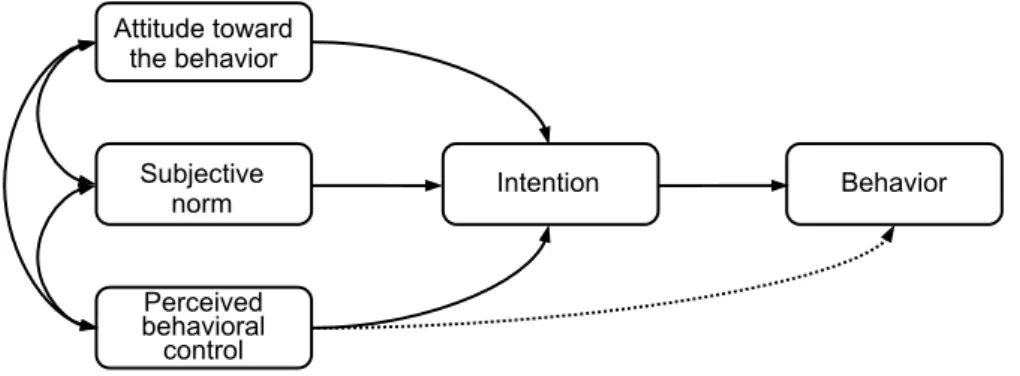
predicted by three inter-correlated independents of attitude toward behavior, subjective norms, and perceived behavioral control (Ajzen, 1991; P. Wang, 2014). Therefore, the focus of the TPB theory lies in the motivational influences on behavior (Teng et al., 2015), whereby it proposes that the stronger an individual is motivated to change behavior, the stronger the intention to engage in behavior (Ajzen, 1991).
Figure 2.4. Theory of planned behavior.
From “The Theory of Planned Behavior,” by I. Ajzen, 1991, Organizational Behavior and Human Decision Processes, 50, p. 182. Copyright 1991 by the Academic Press, Inc.
Integrating the TPB into this research, attitude toward behavior, defined as an individual’s favorable or unfavorable evaluations of a behavior, can be directly predicted by perceived information usefulness. In the IAM, perceived information usefulness instead of attitude serves as a mediator between persuasive messages and information adoption. In this perspective, the motivational influence of attitude toward behavior in the TPB can be transformed to the influence of perceived information usefulness. Subjective norms reflects the social influence from important reference individuals or groups (Ajzen, 2011), which closely link to the peers of importance. In
Subjective
norm Intention Behavior
Attitude toward the behavior
Perceived behavioral control