Instructions for use
Title Revisiting the relationship between resort companies and local communities focusing on personal communications : two case studies of Shimukappu Village in Hokkaido, Japan
Author(s) 神, 志穂
Citation 北海道大学. 博士(環境科学) 甲第14189号
Issue Date 2020-09-25
DOI 10.14943/doctoral.k14189
Doc URL http://hdl.handle.net/2115/79620
Type theses (doctoral)
File Information Shiho̲Jin.pdf
Revisiting the relationship between resort companies and local communities focusing on personal communications:
two case studies of Shimukappu Village in Hokkaido, Japan
(個人的コミュニケーションに注目した リゾート企業と地域の関係の再考:
北海道占冠村での
2
つの事例研究)北海道大学大学院環境科学院 神 志 穂
Shiho Jin
Graduate School of Environmental Science
Hokkaido University
Abstract
This doctoral dissertation revisited the role of the resort companies operating the resorts developed under the Law for Development of Comprehensive Resort Areas, “Resort Law” in local communities. Previous research regarded these resort developments did not contribute to community development because of serious damages to local communities in the developing process (e.g. Otsuka, 1992; Sato, 1998). There were some previous studies described employees who migrated during resort development (Yurugi et al., 1993; Takeda, 1994; Sato, 1998). However, there have been no recent studies on the topic, as a series of resort failures occurred before and after these studies.
Previous studies focusing on migrants as key persons in community development have examined those who work and live in the local community, such as farmers and guest house managers (e.g. Ohno, 2010; Tsutsui et al., 2015), and not resort employees. The migrants working in tourism often depend on employees’ communities formed with migrant colleagues rather than local communities (Tanigawa, 2004; Lundberg et al., 2009). Many studies pointed out a strong bond between employees of the tourism industry (e.g. Lee-ross, 2004; Junta et al., 2011), and no study clarified how the employees’ communities formed in the resorts have changed over the long term of decades.
This dissertation focused on short-term and long-term relationships between resort employees and residents. The analysis of resort employees’ consciousness and behaviors clarified that the employees connecting with the residents had a positive impact on the local community. This study also clarified processes and reasons for changing an employee-centered community to a player group of local community development over the decades to date.
A resort in Simukappu village, in Hokkaido, Japan was the site in this dissertation.
This resort development was a model project of developments under “Resort Low”
(Umekawa et al., 1997). The development began in 1982, the initial developers drew a magnificent blueprint for the domestically largest facility, which would cost 200 billion yen (Sato, 1998). The resort was applied to “Resort Low” in 1989, but after the burst of the bubble economy, its operating company went bankrupt, and the development was
ii
stopped in the middle of the plan. In 1998, the village purchased the resort facilities with a donation of 500 million yen from a tourism company in Hokkaido and entrusted the company to resort operation (Yamaji, 2006). Since 2005, only another company has been operating the resort through the history of recovering from failure as a typical exogenous resort development to its failure and renovation. The resort, Simukappu village, and Graduate School of Environmental Science, Hokkaido University signed a cooperative agreement with industry, government, and academia in 2012.
Chapter 2 investigated the current relationship between the resort company and the local community, through analyzing the factors for the employees to build cooperative relationship with producers in the resort event using local agricultural products. As an action research approach, while being involved in the event from planning to implementation, data were collected by participant observation and semi-structured interviews. This study revealed that their daily interactions and their trust with residents motivated employees to contribute to the local community, resulting in strengthening the cooperative relationship in the event. It was also suggested that the relationship could turn an exogenous company into a contributor to locally endogenous development.
Since the author has worked as a catalyst in changing this relationship, its impact on this relationship would be checked in further study.
Chapter 3 investigated the long-term relationship between the resort company and the local community, through analyzing the reasons for changing the resort migrant workers’
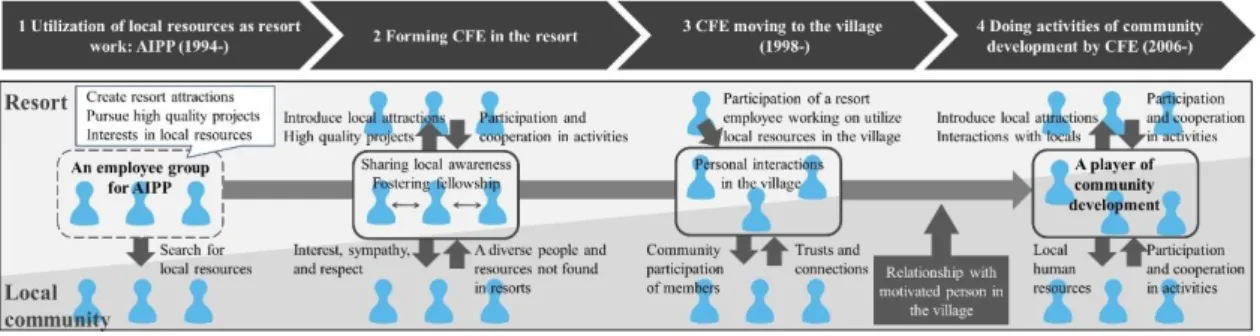
perspectives to become human resources contributing to community development in Shimukappu village. Focusing on the migrants’ community which was generated at the resort and engaging in community development, this study discussed the process of their changes over the decades since they had worked at the resort. Data were collected through participant observations and semi-structured interviews. This study clarified the processes in which resort employees had formed a community within the resort area that promoted them to become local human resources with some former employees’
support for their livings, which have not been pointed out in the previous studies. It was also found that the employees’ community itself has gradually changed from a group of employees to a player of local revitalization.
An important knowledge presented by this dissertation is that resort employees, who had been simply seen as the resort labor force of resort companies, play a role in formation of local communities. This dissertation also focused on the employees’ community and showed the possibility of organized, continuous relationships between employees and residents. The findings of this dissertation will help advance the academic knowledge about the migrants belonging to the relatively isolated organizations with many migrants.
iv
CHAPTER 1 GENERAL INTRODUCTION 1
1.1 Introduction 2
1.2 Background 2
1.3 Target 7
1.4 Research Question in this doctoral dissertation 10
CHAPTER 2 12
2.1 Introduction 13
2.2 Study area and methodology 14
2.3 The relationship between the resort and farmers in the process of launching C&M 17
2.4 Analysis and discussion 21
2.5 Conclusion and suggestions 25
Notes 26
CHAPTER 3 27
3.1 Introduction 28
3.2 Study methods 30
3.3 Study area and interviewees 30
3.4 Findings 33
3.5 Discussion 43
3.6 Conclusion 47
Notes 48
CHAPTER 4 GENERAL CONCLUSION 51
ACKNOWLEDGMENTS 56
REFERENCES 58
Chapter 1 General introduction
2
1.1 Introduction
From a long-term perspective, Japan and its region Hokkaido are shifting from the high economic growth period in the last century to sustainable societies in the 21st century.
One of the major symbols during this shift is resort development causing the bubble economy. From the viewpoint of sustainable society/community development toward the future, this study focused on two cases carried out in Shimukappu Village in Hokkaido and discussed that a large resort development had given the community not only a negative legacy but also good presents for sustainable community development.
In the 1980s and 1990s, many resorts were developed under “the Law for Development of Comprehensive Resort Areas,” to vitalize rural areas facing depopulation and aging, and then most of the resorts collapsed due to the bubble burst. Previous researches on the relationship between resorts and local communities mainly focused on the impact of resort development on local communities (e.g. Sato, 1990; Tsuchiya, 1990; Yurugi et al., 1993).
A few studies focused on the interaction of resort employees with the local community (e.g. Ooi et al., 2016). In the opening of resorts, most of the resort employees were migrants. However, at present, they may be regarded as members of the local community since it has been more than 30 years from the opening.
In Section 1.2, researches on resort development, resort employees as migrants, and migrants becoming local human resources in general cases except resort development are briefly reviewed. In Section 1.3, resort development in Shimukappu Village as a background for discussing Chapters 2 and 3 is described. In Section 1.4, the research question and structure of this dissertation are set.
1.2 Background
1.2.1 Rural development and resort development
Resort development under “the Law for Development of Comprehensive Resort Areas”
(hereafter “Resort Law”) enforced in 1987 was exogenous rural development, which was opposite to endogenous rural development, the current mainstream, led by residents and local capital. Many local governments facing depopulation and the decline of the local economy due to the outflow to the urban area since the 1960s got into resort development.
In 1997, the basic concept approved by the national government was implemented in 41 prefectures, and the total area of a specific area designated by the Resort Law was about 6.27 million ha, accounting for about 17% of the national land (Umekawa et al., 1997).
In the period of developing resorts, many researchers investigated the impact of the development on local communities in terms of local society, local economy, living environment, and natural environment (e.g. Mizoo, 1991; Yurugi et al., 1993). In rural areas, local government officials had persuaded farmers to acquire land for development, and many farmers had sold their farmland accordingly, and some of them got jobs at resorts for economic reasons (Sato, 1990; Sato, 1998). Resort development brought benefits such as employment, youth migrants, and good publicity to rural areas (Mizoo, 1991). Meanwhile, exogenous development companies lead the causes of various negative effects such as environmental destruction, loss of local identity, and leakage of economic ripple effects from the local areas, because of large-scale and nation-widely uniform development aimed at real-estate speculation (Yang, 2006; Osawa, 2018).
Most of the researches at that time were critical of resort development, because of issues such as lack of linkage with the local economy, destruction of living and natural environments, and developers’ indifference to residents (Sato, 1990; Tsuchiya, 1990; Sato, 1998). Many campaigns against resort development by residents, parliamentarians, bar associations also happened throughout the country (Sato, 1990; Goto, 1992; Otsuka, 1992).
After the collapse of the bubble economy in 1991, most of the resort development failed due to the bankruptcy or withdrawal of the resort developers (Oura, 2004; Okada, 2010), and many undeveloped sites were left around the country (Oura, 2004). The municipality that had invested in the resort suffered a huge amount of debt, causing deterioration of the living environment such as welfare and education of residents (Okada, 2010; Makidaira, 2013). Since the end of resort development, the number of researches on resorts has been declined. Some studies have examined the causes of the failure of resort development by analyzing the factors of the resort management crisis (Adachi, 2000) and the advantages and disadvantages of the joint public-private enterprises being responsible for the development (Matsui, 2002). There is no knowledge of how the
4
resort, which was regenerated by another company after its failure, was involved with the local community.
The adverse impacts of exogenous developers in resort development gave rise to an alternative idea, endogenous community development. Based on the criticism of exogenous development, Miyamoto (1989) advocated "endogenous development," which argued community development by local governments, local capital, and residents.
After the end of resort development, regional policies shifted from economic revitalization to support the endogenous development of residents (Matsumiya, 2007).
In terms of tourism, the local communities have taken the initiative in promoting
“community development tourism” that aims to create a sustainable community by using local resources (Morishige, 2015; Osawa, 2018).
It has been generally considered that resort development was not helpful for rural revitalization while having serious impacts on the local communities. Previous researches focused on the development period when the resorts were making the most visible changes to the rural communities. At present decades after the development period, there is no discussion about the impacts of the resorts on residents and their roles in community development.
1.2.2 Resort employees as migrants
The resort companies had employed many migrants, who were year-round or seasonal young single workers and transferring workers from affiliated companies (Tanno, 1986;
Mizoo, 1991; Takeda, 1994; Nozaki, 1995). Few studies have focused on the characteristics and experiences of the migrants. Regarding the employees of the resort, the target of this study, several studies have mentioned as follows: their daily lives were irregular hours due to seasonality of tourism and their work shift patterns including early morning and late-night (Takeda, 1993), many young employees moved in and out in a short period of several years (Takeda, 1993; Sato, 1998), and their mobility correlated with the limited social interaction with the residents and their attitudes of indifference to the local community (Takeda, 1993). There is no knowledge of employees regarding regenerated resorts, as many resorts closed their business before and after these studies.
Overseas resorts are different from Japanese resorts in t the way of having a law system like the Resort Law, but they have commons such as their employment depending on migrants. Employees’ work and lifestyle are associated with resorts’ features such as uncleared boundaries between leisure and work, seasonality in the business, many multinational migrant workers, and high mobility of employees (e.g. Adler et al., 1999;
Boon, 2006). Many employees work in seasonal or short-term employment for adventure, excitement, skill development, self-actualization, and career advancement and transfer in a few years at longest (Adler et al., 1999; Uriely, 2001). The employees as migrants tend to form communities with colleagues as migrants having the same lifestyle and mindset (Adler et al., 1999; Lee-ross, 1999; Lundberg et al., 2009).
Little is known about the relationship between migrant employees and the local community (e.g. Ooi et al., 2016). The existing studies have pointed out that seasonal employees spend a lot of time with members in the migrant employees’ community (Lundberg et al., 2009) and that some of them wish to join the local community (Ooi et al., 2016) or become a permanent resident over time (Perdue, 2004). Regarding tourism work, it is found that the interactions with residents as customers improve migrant workers’ linguistic and cultural understandings of the host communities and help them to adapt to their work environment and their host societies (Junta et al, 2011).
The interests of the previous studies focusing on resort employees are mostly in terms of workers in the tourism industry, with little attention to their impact on residents and local communities. There are no studies on how migrants staying long years since the opening of the resorts and the employees working in regenerated resorts currently interact with local communities.
1.2.3 Migrants as local human resources
Previous studies except resort studies clarified that migrants are helpful for the development of rural communities. Migrants bring new knowledge, skills, and connections to local communities and discover local resources and advantages from a different perspective from locals (Shikida, 2009; Ohno, 2010; Tsutsui et al., 2015). They also use local resources for entrepreneurship (Tsutsui et al., 2015), information dissemination (Tabata et al., 2018), interaction with urban residents (Oyama et al., 2015)
6
and regional regeneration (Shibata, 2006), resulting in invigorating local communities and attracting new migrants. That is, migrants became “local human resources” as those who carry out activities for the revitalization of local communities using local resources.
As for migrants’ settlement and becoming local human resources, the previous studies have examined those who work and live in the local community, such as farmers and guest house managers (e.g. Yoshikawa, 2005; Ohno, 2010; Tsutsui et al., 2015). They individually got into the local community and how they interact with locals affects their behaviors. The settlement of migrants is generally facilitated by friendships with locals in daily life (Kuwabara et al., 2014) and locals’ support of interactions with other residents and adaptation to their jobs and local society (Hara, 2001; Nakanishi, 2008). Most of the migrants who became local human resources had not originally had their willingness to contribute to community development and the personal connections helpful for their activities (Hagihara, 2014). They generally have the experiences, triggers of their changes, such as interactions with other residents and encounters with local resources and grow as key persons in community development with forming new networks and communities with other residents (Ohno, 2010; Hagihara, 2014).
Regarding migrants working in tourism, it was pointed out that they often connected deeply with the communities formed with migrant colleagues rather than local communities (Tanigawa, 2004; Lundberg et al., 2009). The employees’ communities help migrants to adapt to their jobs and new lives (Tanigawa, 2004; Junta et al., 2011;
Robinson et al., 2014). At that same time, their communities reduce opportunities for migrants to involve with local communities and make a boundary to feel cohesiveness with local people (Kato, 2014). The survey of hotel employees in tourist destinations (Lee-ross, 2004) found that employees belonging to their work communities tended to neglect other communities.
The previous studies focusing on the migrants as local human resources, but not specified as resort employees. In addition, many studies pointed out a strong bond between employees in the tourism industry, and no study clarified how the employees’
communities formed in the resorts have changed over several decades.
1.3 Target
Resort development in Shimukappu village, Hokkaido, was regarded as a model for the developments under the Resort Law. The original development plan, which spends a total of 200 billion yen over 20 years, is by far the most grandiose in Japan (Azumai, 1989), and the constructed resort boasts a national reputation as a luxury resort with urban facilities (Takeda, 1993). However, the resort management companies collapsed after the burst of the bubble economy, and the plan was halted in the middle of the development.
The history of the resort from its development to the present are described below.
In 1982, Shimukappu village started resort development with the third sector, the business entity established by the village and two private companies, to revitalize their community undergoing the decline of the agricultural and forestry industry and depopulation. Its capital is 98 million yen, with 50 million villages and 48 million private companies. The initial plan for the development had proposed that the third sector would involve in the business planning of the resort. However, in fact, the companies proposed a plan to manage and operate the resort without the third sector under the condition of paying the full cost of building facilities. The role of the village was limited to solving some difficulties for private companies, such as securing lands for the development and getting the permissions for road construction and cableway projects (Kannon, 1991; Takeda, 1993; Yamaji, 2006).
The resort was constructed geographically away from residential areas (Figure 1); it is about 6 km from the nearest residential area, the Tomamu district, and about 25 km from the Central district where the town hall and the roadside station are located. The road connecting the Tomamu area, which was used to be called “Isolated Island”, to the central area was paved at the time of the resort development. Even now, the road from both districts to the resort is surrounded by trees, and there are almost no houses or shops along the street.
Although, only a part of it was developed in the end, the initial development plan drew a magnificent blueprint including the largest facility in Japan, such as a 90-hole (553ha) golf course in a national forest, accommodation facilities with a total of 50,000 beds, a wave pool and an international conference hall (Sato, 1998). The private company that developed and managed the resort was a real estate agent and aimed to make a profit by
8
Figure 1. Locations of the resort and all districts in Shimukappu village, Hokkaido
selling the villa instead of the hotel accommodation fee. They enriched the leisure facilities to raise the value of the real estate (Azumai, 1989).
Land acquisition and development were carried out concurrently with resort operation (Kannon, 1991; Yamaji, 2006). The resort opened in 1983 as “Alpha Resort Tomamu”
at the stage of developing a ski site and an attached hotel. After that, facilities such as membership tower hotels, luxury condominiums, a golf course (18 holes), tennis courts (19 courts), a wave pool, a motocross bike course were added one after another. In 1989, this resort was designated as a priority area under the Resort Law.
The development changed the industrial structure of the village. In the Tomamu area, four out of five livestock farmers sold their farmland and left (Sato, 1998). Some farmers who left the farm got jobs in the resort (Yamaji, 2006). After the resort was open, seven guest houses and pensions were open in the Tomamu area, of which three
were run by locals (Mizoo, 1990). The population of the village increased from 1,463 (when the resort opened in 1983) to 2,124 (1993). Most of the migrants were young resort employees (Sato, 1998).
Initially, the local industries were linked to the resort by using the village's fuel, agricultural products, and milk at the resort. However, as the village products did not meet the resort standards of quality, quantity, and price, the resort became to use the suppliers in Sapporo, the largest city in Hokkaido. The locals hoped that the resort development would lead to the revitalization of local industries, but that was not realized (Takeda, 1993).
After the bubble burst, due to the worsening of cash flow, the private company responsible for development and operation went bankrupt in 1998 (Sato 1998). The village purchased a resort facility with a donation of 500 million yen from Kamori Kanko, a tourism company in Hokkaido, and entrusted Kamori Kanko to the operation (Yamaji, 2006). Since 2005, Hoshino Resort Co., Ltd., a resort management company outside Hokkaido, has been managing the resort.
After its regeneration, the resort changed their business to a large resort which attracted many tourists with local resources such as a summer landscape of “the sea of clouds”
made by surrounding mountains and Ice Shells (the dome made of ice) taking an advantage of the extremely cold and snowy conditions. In Chapter 2, the resort built a new cooperative relationship with farmers in 2012, which was not the one-sided relationship such as biased towards resort-side efficiency and economic benefits when its initial development. In the same year, the village, the resort, and the Graduate School of Environmental Science at Hokkaido University signed a partnership agreement. The significance of this collaboration for industry-academia collaboration was explained in Higuchi and Yamanaka (2017).
It is an interesting point in the current working situations of the resort employees that some people are continuously living in the village even after resigning the job at the resort, although, in a few years, many people move to the affiliated resorts in Japan and overseas owned by the operating company.
10
1.4 Research Question in this doctoral dissertation
As described in Section 1.2, previous research on the impact of resorts on the local community focused on the resort development period. The knowledge of the relationship between migrant employees and local communities is also limited to young employees migrated in the period of resort development and seasonal employees. As described in Subsection 1.2.3, previous studies except resort studies have pointed out that migrants often discovered buried regional resources and produced the vitality for local communities. However, there are no studies investigating resort employees as local human resources.
Currently, more than 30 years after the resort development, there is a possibility that the relationship between resort employees and residents changed due to changes in working positions or tasks at the regenerated resort and their lifestyle such as marriage and retirement of employees migrating when the development of the resort. In particular, the employees who have lived for many years may be rediscovering the advantage of being local. Furthermore, if some members of the employees’ communities mentioned in Subsection 1.2.3 became the main players in local community development, they would provide the opportunity to work together for the other members.
This dissertation reconsiders the role of the resort in the local community analyzing short-term and long-term relationships between resort employees and residents. The resort in Shimukappu Village built new relationships with local farmers and villages after regenerated by a different exogenous company. In addition, since there are no other resort companies in the village and most of the migrants in the village are resort employees, this resort is suitable measuring the impact of the employees on the local community.
From a short-term perspective, Chapter 2 analyzed the factors that helped employees build cooperative relationships with producers at the event that used local produce from the resort. This chapter will show that daily interactions and trust with residents motivate employees to contribute to the local community and that such motivated employees connect local communities and resorts.
From a long-term perspective, Chapter 3 clarified how the former employees after leaving the resort settled down in the local community area and became involved in
community development. In particular, this chapter will focus on how the employees’
community which the key persons who migrated at the resort developing involved in has changed over the decades to date. In addition, from the viewpoint of migrants’
becoming local human resources, this Chapter will clarify the process of how the migrant employees became into local human resources via the resort.
Based on Chapters 2 and 3, Chapter 4 will make the conclusion, and mention how the two studies contributed to the academic knowledge and what is still unanswered from the standpoint of the role of resorts in the local community, with prospects for future research, as remarks.
Chapter 2
Case study one: A new relationship between a resort company and local farmers for the creative local
resource use in the rural area: A case study of collaboration between Hoshino resort Tomamu and
farmers in Shimukappu, Hokkaido
2.1 Introduction
Since the late 1960s, rural areas have suffered from depopulation, aging, and a decline of key industries such as agriculture and forestry (Tsutsui, 2008; Hobo, 2013). In order to revitalize rural economy and community, tourism has been promoted nationally since the 1970s.
However, in the process of large-scale tourism development, exogenous companies caused some adverse effects on rural areas. In the 1980s, under the Resort Law, many exogenous developers destroyed natural environment of the rural areas and brought a great loss to the rural economies due to their bankrupt associated with the burst of the bubble economy in the 1990s. The developers neither took a consideration of intentions among residents nor had partnerships with them about the developments. They put a priority on the recovery of their investments and wasted local resources without taking responsibility for their conservation (Okata, 2012; Otsuka, 1992; Sato, 1998).
When exogenous actors which are not limited to resort companies used local resources, they often gave a disadvantage to the community due to a lack of understandings and considerations (Morishige, 2012). Using local resources without consensus with local community, as resort development in the 1980s, was tended to conflict with local community and not sustainable.
“The theory of endogenous development”, an alternative community development theory based on the autonomous activity by rural residents, was advocated from criticism to exogenous development. In this theory, it was desirable that local actors as local companies and organizations should lead community development. Miyamoto (1989) argued with the theory and indicated that it was difficult to sustain community development without collaboration and partnership with exogenous actors. Therefore, it was unnecessary to refuse all of exogenous capitals and techniques. If we consider the current situation of rural community, it is impossible to maintain rural community isolated from others (Shikida, 2005). Nakamura (2000) pointed out the necessity to bring exogenous development close to endogenous development and organize a rural collaboration system for the prosperous coexistence of local people and exogenous company.
14
These arguments focused on the relationship with exogenous actors in rural development. It is needed to analyze specific case studies about processes and factors that exogenous actors close to endogenous development and build collaboration with rural actors. Particularly, it is important to reveal the collaboration process built between exogenous actors and rural actors and analyze the factor of the collaboration, because autonomous activities by actors are important in the theory of endogenous development.
Research on relationships between local communities and resorts, which were developed during the resort development boom, have focused on mainly the negative impacts of exogenous development on community, such as issues of the resort law as regional policy (Okada, 2010), lack of consensus among residents on resort development (Takizawa, 1997), and impacts on the local natural environment (Adachi, 2000). Few researchers have examined roles of resort developers in the community and changes their relationships with residents.
Therefore, this paper examined the relationship between exogenous and local actors in
“Kumonoshita Café & Marché”, planned by “Hoshino Resort Tomamu Co., Ltd.”
(hereafter, “H Tomamu”) that was an exogenous resort in Shimukappu Village, Hokkaido.
H Tomamu collaborated with farmers in Shimukappu Village in order to use local produce in the event. The relationship between H Tomamu and the farmers was considered as a mutualistic relationship with a community built by exogenous actor. The purpose of this research was to clarify the factors of changes in H Tomamu actors’ perspective and behavior to the farmers associated with the interaction with the farmers and locals.
2.2 Study area and methodology
2.2.1 Shimukappu Village
As already introduced in Chapter 1, this chapter also give a brief description of Shimukappu Village. Shimukappu Village is a mountain village surrounded by mountains on all its sides, the total area 571.31 km2 and population 1,191(at the end of May 2013).
The population of this village has decreased from 4,705 since 1960. This area has an inland climate and the temperature changes drastically in a day and seasons. It is extremely cold in winter, and the snow accumulation is over 100cm. There are 6
districts in the village. The main village office is located at Chuou district that has the largest population. H Tomamu is located at Tomamu district which is 25km away from Chuou district (Figure 1, in Section 1.3).
Mountains and forests cover 94% of the total area of the village. Since its settlement in 1902, the village has developed agriculture and forestry as its core industries. The number of farm household decreased to 18 on April 2013 from 46 in 2008. The household living on cultivating crops is 5 including the part-time farmer. The village addressed agriculture decline owing to aging and a lack of successors by supporting for newly farmer.
In the working population of Shimukappu Village (as of 2010), the ratio of the tertiary industry (63%) is higher than primary industry (9%) and secondary industry (28%).
This largely depends on the existence of H Tomamu, but in Tomamu district, there are also 5 small accommodations such as pension other than H Tomamu, and most residents engage in tourism. Tourism has been a key industry of the village. An important tourism facility of the village is a roadside station “Shizen-Taikan Shimukappu” in Chuou district, where local products such as farm produce are sold by the local tourism association.
2.2.2 Hoshino Resort Tomamu
In 2006, H Tomamu opened “Unkai Terrace” to show tourists the sea of clouds from halfway up Mt.Tomamu. At the end of 2012, the number of hotel guests was about 306,000, and the number of “Unkai Terrace” visitors was about 97,000 including one-day tourists. The number of customers in H Tomamu has been increasing year after year.
H Tomamu in Shimukappu Village and Graduate School of Environmental Science at Hokkaido University signed a cooperative agreement with industry, government, and academia on September 21, 2012. The purpose of this cooperation is mutual efforts of such as education and research and the interactions of people with the aim of environmental conservation, tourism promotion, and development of the local community1).
16
2.2.3 Kumo-no-shita Café & Marché
This study focused on “Kumo-no-shita Café & Marché” (hereafter, “C&M”) held in H Tomamu from July 14 to September 2, 2012. At C&M, there was a café offering breakfast made with locally grown produce in the area. The farm produce from Shimukappu Village and nearby Shimukappu are used in the café and sold in a marché.
Staff A, a corporate communication officer of H Tomamu (at the time), mainly made the C&M concepts and contents. Staff A also made a leaflet and display panels for introducing the farmers’ effort of caring produce to visitors. The details will be described below. Staff B, who is responsible for the marché, and Staff C, who is responsible for the café, negotiated with farmers for the purchase volume, arranged their staffs, and managed. The number of visitors at C&M was about 12,000.
The café got the highest customer satisfaction among the restaurants in the event2). The marché was attempt as a pilot small shop, sales were not sufficient affected by the smallness of items and its unattended service.
2.2.4 study method
Data were collected through participant observation and semi-structured interviews conducted from March to October 2012, mainly in Shimukappu Village and H Tomamu.
An action research approach was used to collect data. The interviewees were actors for C&M (H Tomamu employees, farmers in Shimukappu Village) including people who did not participated in C&M. In addition, the farmers around Shimukappu (Minami- FuranoTown, Furano City) who provided their farm products for C&M were interviewed in this study.
The interviews with producers were conducted before and after C&M (survey one, two).
To grasp their current state, issues, and interest level for the marché, survey one was conducted to four producers in Shimukappu Village on May 16 and17, 2012, before C&M.
Three produccers engaged in farming in the village and one engaged in processing and selling of forest resources in the village. The district details were Two Sosyubetsu District, one Tomamu District, and one Shimukappu District. Three interviewees have had contact with H Tomamu in the past such as having worked as year- round employees,
traded of their produce with the resort, and helped with the resort's events. One is a current employee of H Tomamu.
In order to grasp the influence of changes of H Tomamu actors’ behavior for farmers on farmers’ perception of H Tomamu and on motivation to participate in C&M, survey two was conducted to five farms participating in C&M on September 11 and12, 2012, after C&M. Three farmers engaged in farming, one engaged in fruit growing and a café business, and one engaged in growing and selling flowering plants. The district details were two Sosyubetsu District, one Tomamu District, and producers in outside the village were one Minami-Furano Town, and one Furano City. Four interviewees have had contact with H Tomamu such as having worked as year- round or seasonal employees and traded of their produce with the resort, including interviewee in survey one. The other is an acquaintance of Staff B.
The author pointed out merits and demerits of C&M based on survey one and two to H Tomamu. Participant observations and interviews were conducted to investigate the impact of her suggestions on H Tomamu actors’ perspectives and behaviors to the farmers.
Analysis of the public relations leaflets, Simukappu Village homepage and documents recorded by H Tomamu also accompanied these observations and interviews.
2.3 The relationship between the resort and farmers in the process of launching C&M
2.3.1 Planning in the resort
Staff A who was a corporate communication officer in H Tomamu planned C&M and the project had started since 2012. In H Tomamu, Staff A has been leading a project to create a new attraction with the Sea of Clouds since 2010. In this discussion, C&M was planned as a place to introduce crops growing under the sea of clouds and attractions of the land where the sea of clouds occurred. Staff A had another task of showing a vision of the company in and out of the company. She had handled many projects in the past and played a central role in C&M.
At the planning stage of C&M, Staff A considered that using the amenity of the local area was necessary for providing visitors with “real experience”. She also considered that “making the place with local people” was especially important in C&M.
18
Consequently, C&M was planned as a place where local producers contact directly with consumers selling at the store.
Though the main purpose of C&M was to improve the satisfaction of visitors to H Tomamu, Staff A also hoped that C&M would lead to regional vitalization as well as remind producers of the goodness of their products and region through the communication with consumers. Staff A shared those purposes with H Tomamu actors in a project meeting (March, 2012), and with Staff B who was responsible for the marché and Staff C who was responsible for the café (April-May, 2012). However, H Tomamu did not exchange their opinions with producers and know producers’ states and issues.
Survey one was conducted in this situation.
2.3.2 The gaps between the plan and the local producers’ states
According to survey one, producers tended to show a negative attitude to contact with H Tomamu, because of the following reasons; producers had met employees at H Tomamu only few times and have only transient business dealings with H Tomamu and the poor sales of village products at the past events in H Tomamu. Producers, except a current employee, rarely went to H Tomamu. A producer has never gone to H Tomamu even though he had supplied his farm products to there. That was caused not only by the fact that H Tomamu was a tourism facility but also there was long distance between Tomamu district and other districts. The way from Tomamu district to Chuou or Sosyubetsu district took about 30 to 40 minutes by car. Therefore all interviewees had a difficulty of the transition frequently.
All farms in Shimukappu village were small family-run. Beside a H Tomamu employee, all the farmers mentioned that they did not have an extra worker for selling in marché because C&M was held on July and August that were busiest seasons for farmers in a year.
Some producers had experiences of selling farm products at stores and were vitalized by exchanging with customers – “I was glad to hear that my produce was delicious form customers”. A few issues of producers were found due to the aging of village people –
“The sales have been down because of increasing the number of people who cannot come to buy in my market”.
2.3.3 Behavior changes in Resort actors
The author pointed out issues of C&M based on survey one to Staffs A and B (May 17, 2012). Subsequently, they changed their behaviors after confirming the facts pointed out by her and consulting with local acquaintances.
First, Staff A reconfigured the plan of C&M and proposed it again. To avoid giving producers the impression that “I am being taken advantage of H Tomamu”, the following details clearly shown on new proposal: “we must express respect to producers for creating things together”. Based on this proposal, H Tomamu actors shared the idea that they should build a positive relationship with producers in the medium and long-term (June 4, 2012). The theme of this proposal was that they create C&M together with producers who understood their attitudes to the local community.
Second, in order to inform producers’ information to C&M visitors and lead them to the farm where they can buy farm products directly, Staff A made a leaflet and display panels both of which described producers’ characteristics and passion with their product.
The purpose of leading C&M visitors to farms was not only increasing producers’ income from selling farm products but also vitalizing producers through communication with tourists. Staff A with the author interviewed with each producer to make a leaflet and display panels. The leaflet was delivered to producers by Staff A or the author and distributed to C&M visitors. The display panels were put up in the C&M place. Staffs B and C were invited by Staff A to accompany the interviews with producers. These interviews were opportunities for communication between H Tomamu and producers.
Staff C sometimes visited producers of farm products used in café after the interviews.
Third, Staff B also changed the way to contact with producers, because he gave top priority on building a continuous relationship with them. Staff B initially planned a briefing of marché for producers in H Tomamu, but he finally visited producers who had traded their products with H Tomamu in order to ask for their cooperation. In addition, to build trust relationships with producers, Staff B decided to have many opportunities to communicate with them. He often bought products directly from the producers, and he visited the farm as much as possible for other than purchasing the products. These awareness and actions had never been in H Tomamu’s dealing with producers.
20
2.3.4 The influence of resort actors’ changes on producers
According to survey two, the producers to whom H Tomamu actors had visited frequently tended to be impressed by substantial communication with H Tomamu. H Tomamu’s behaviors also gave an impression as “different from others as before C&M”
to producers who had known H Tomamu in the past. Producers felt that H Tomamu had given consideration to them and showed sincere attitude to make a place of C&M because of the operation suited their working conditions and the leaflet and display panels for introducing their minds to guests. However, a producer thought “no different from the usual” because his idea with marché was not reflected as much as he expected.
In terms of the economic effects, producers gained profit from café, however there was not much profit from marché due to the poor sales. On the other hand, one of the producers who participate in marché did not expect the high sales. He was impressed by H Tomamu to build a good relationship with the local community and satisfied with contributing his effort to the local revaitalization. Producers also pointed out issues.
For examples, they had to learn new ordiering system for marché and there was no full- time salesperson in marché. Nevertheless, four producers would like to participate in the event next year. One producer who was not willing to participate in it felt that he did not see any changes in realstionships with H tomamu and also had a big burden of new system with a small deal and less profit.
2.3.5 The awareness shared by resort actors
For reviewing of C&M, six staffs (A, B, C, food and beverage unit manager, a café staff and a facility staff) in H Tomamu participated in the meeting held after C&M finished (October 4, 2012), in which the author presented C&M’s positive and negative results described in subsection 2.3.4. By their discussion based on her presentation, all C&M actors understood that they should maintain goodrelationships with producers.
Moreover, they discussed the relationship with producers from the aspect of economic benefit. Staff B in charge of the marché, which generated a small profit, hold a negative view on the deals with local producers. With his consideration on the merit and demerit for them and producers, he intended to purchase farm products from not only local producers but also other regions’ farmers dealing with H Tomamu. On the other hand,
Staff C in charge of the café, which provided good profits for producers, pointed out the beneficial impact on customer satisfaction by using local farm products. After discussing how they could contribute to local producers thorough this event, they eventually shared an goal to construct a mutualistic place with producers in next year.
2.4 Analysis and discussion
After the survey one, H Tomamu actors changed their behaviors to build a trust relationship with producers. For example, they chose the way to puarchase not through distributors as usual but directly with producers. Based on their experiences of building a relationship with producers and our presentation about survey two, H Tomamu actors recognized the necessity to reconsider the way to get economic profit from C&M for H tomamu and producesrs. The way corresponds to “the company which consider the development area’s natural and social conditions due to taking social responsibility”
pointed out by Hurutani et.al. (2012) as a feature of sustainable developments. To reveal the process of exogenous actors to build “mutualistic relationship” with local actors, the author analyzed the causes of H Tomamu‘s way to change their actions in this case.
2.4.1 The factors of resort actors’ change of behavior after survey I
In the planning stage of C&M, staff A and B assumed that producers might hesitate to contact with H Tomamu, as the resort had not met residents’ expectations by the past bankruptcy and the resort had not maintained a relationship with producers but made only temporary deals with producers in the past. They had worried that producers still had
“a negative impression” to H Tomamu. Their anxieties had become a psychological barrier for H Tomamu actors to build relationships with producers at the planning stage of C&M.
There were three factors that eliminated their barrier.
First of all, they were willig to contribute to their local community: building local identity or pride as residents and revitalizing of the local community through C&M. All H Tomamu actors who were interviewed also felt the attraction of the natural environment in this village, relationships with local residents, and village lives. They also wanted to let visitors know the attraction.
22
Uno and Tsurumi(1994) presented the concept of “key person” who was a main person to realize the potential endogenous development; they defined the ideal “key person” as
“persons who value the benefits and potentials of other people as well as oneself” and
“persons who feel an attachment with people and environment of their hometown and care about environmental conservation of the town”. H Tomamu actors were “key person” as follows: they hoped to contribute to the local community that they were attracted by residents and their lives and sought to realize mutualism with producers at C&M by respecting producers’ opinions. Especially, the intendment to contribute to the local community is important to understand the behavior change of H Tomamu actors.
In the next section, I discuss the reasons why they had the mind before C&M.
Second, staff A and B understood the importance of cooperation with producers in order to provide “a real experience” for visitors in C&M. This common understanding was shared among H Tomamu actors when they build relationships with producers before C&M opening.
Third, staff A and B have local producers and acquaintances that they knew well long time before the event. After the survey I, they went to discuss about their concerns and issues of C&M immediately with the locals. Listening to their opinions and advice directly, the staff deeply understood producers’ thoughs of H Tomamu and issues of C&M and reflected their new perspectives to their actions. If they had not buit personal trust relationships already, they would not have a chance to change their actitions.
2.4.2 The background for resort actors to build their mind to contribute to local community
There were three backgrounds in common on the development of H Tomamu actors’
mind to contribute to the local community.
The first background was the policy of Hoshino Resort, “producing local attraction”.
The policy intended to improve customer satisfaction by providing customer services using local resources with value added based on their knowledge. The CEO of Hoshino Resort and the general manager of H Tomamu stated this policy at general employee meetings of Hoshino Resort and H Tomamu, respectively, and all H Tomamu actors who told us that they recognized the policy. Moreover, the general manager of H Tomamu
made a hotel which had been bankrupted move in to black by using local attractions, and strongly recommended employees using local resources as attractions of H tomamu.
The second background is the promotion for H Tomamu actors to build relationships with locals. The local person, who personally had trust relationships with staffs A and B, informed H Tomamu staff including spokespersons announcements of meetings and events in which residents would participate, toward the interactions between H Tomamu and residents. H Tomamu actors who participated in the meetings or events not only understood the local community but also built new personal connections with residents.
They strongly wished to contribute to the local community as increased opportunities for interactiosn with the locals, although all H Tomamu actors did not always participate.
The third background is that some H Tomamu actors are residents, who had daily interactions with other residents in the village. Staff B and C, coming from outside Hokkaido, lived in Tomamu district for working in H Tomamu. Living in a residential quarter, they could easily interact with other residents compared to other employees living in corporate dormitory far from the quarter. They enjoyed interactions with their neighbors such as participations to festivals or events at the district. Even though they were migrants, living in the local community allowed them to interact naturally with the locals and to understand about the local community. The interactions were caused by residents’ positive attitudes to accept migrants as well as the locality of Tomamu district where many tourism employees lived.
2.4.3 Positioning of H Tomamu in endogenous development
The author considered whether C&M corresponded or not to endogenous development by referring to definition and principles noted by Miyamoto (1989). Miyamoto (1989) defined “endogenous development” as that “local development should be planned by local individuals, companies, and associattions and required their own development in technology to achieve conserving and using local natural resources. The development associated with economic development rooted in the local culture should be implemented by the local government and lead the improvement of the local welfare”. He also indicated the following principles of endogenous development: based on local technology,
24
industry, and culture; regional inter-industry relations in which additional values belong to the local area in every stage.
The features of H Tomamu actors’ behaviors and consciousness correspond to Miyamoto’s definition and principles. First of all, they built the inter-industry relations with local industry toward sustainably economic development of their company and the local area. H Tomamu actors maintained comfortable relationships with producers to develop sustainable C&M. Second, they used local resources reasonably while they conserved local environment. They implemented producers’ opinions respectively in a their plan which was earned high customer satisfaction. Third, they produced an economic effect on the local area. They organized C&M strongly seeking economic profit for producers as well as H Tomamu. These are important to consider endogenous development.
H Tomamu is, of course, an exogenous company, and they had used local resources to create their benefits by improving customer satisfaction. Therefore, this resort development did not imply to endogenous development. However, C&M can be considered as an endogenous development, as their behavior and awareness were also matched with the definition and principles of endogenous development presented by Miyamoto (1989). H Tomamu actors hoped C&M contribute to community development, and they have been challenging to develop C&M as a sustainable and succefful event. If they evolves C&M in the future, local community might be vitalized by increasing profit and empowerment of local producers.
Furthermore, it was significant that the contribution of H Tomamu (not actors) to endogenous development of the local community. H Tomamu actors built positive relationships with producers toward the sustainable development of C&M. To build one-to-one trust relationships with producers, H Tomamu actors took actions such as visiting producers frequently, making a simply framework for producers, and telling H Tomamu’s new way to contribute to the local community through C&M. Good relationships with producers made H Tomamu actors strongly be aware of producers’
profit from C&M. On the other hand, producers had their good impressions of H Tomamu, because they could feel felt the new way to contribute to the local community through communications with H Tomamu actors. These positive impressions motivated
the producers to participate in C&M continuously. Therefore, in conducting C&M, H Tomamu was regarded as a contributor to endogenous development through the interaction between H Tomamu actors and producers, in spite of a mere exogenous actor originally.
2.5 Conclusion and suggestions
In this case, a resort company, exogenous developer, built trust relationships with producers to lead mutualism that both of producers and the company could make a profit.
The reason that H Tomamu built a sustainable relationship with the local community was not only the company’s policy, providing “real experience” for visitors to improve customer satisfaction, but also individual staff at H Tomamu actors changed their own perspectives to contribute to the local community. Personal trust relationships with residents in public and private motivated the staff to change their ways to contribute to the locals.
H Tomamu actors had various relationships with residents: interaction for the purpose of making interests of exogenous company, interaction along with personal mind, daily interaction as an inhabitant, indirect interaction through the third persons. The company’s approach toward the local community was changed by developing interpersonal trust relationships based on the various relationships. The relationships between employees and residents restrained the one-sided use of local resources and helped exogenous developer to develop a mutualistic relationship with local community.
Thus, this study suggested that a relationship between a company and a local community is changed by enriched relationships between employees and residents. The relationship building between the resort company and the local community was influenced by the local actors. Local people changed their perception of the resort as an isolated place, because of sweeping away their image of the resort as one-side development and realizing café and marché as a business advantageous to both resort and local community. Through an ordinary relationship building with an exogenous company, local community can easily collaborate with exogenous companies for local development.
26
It should be remarked that the author’s actions might play a catalyst in this changing as a third party. That is, there is a possibility that the third action which is not related to tourism or agricultural income promoted H Tomamu actors’ actions.
The activity has been limited to join for only some actors. In the near future, the activity would become sustainable regional vitalization based on having trust relationships and the empowerment of local producers. As suggested in this study, the local community should provide more face to face meetings for residents and employees of exogenous companies to lead the companies to the endogenous development of the local community.
Acknowledgements
The author would like to special thanks to Hoshino Resort Tomamu Co., Ltd., Shimukappu Village, and producers for their cooperation.
Notes
1. It includes natural scientific researches as a prediction of a sea of clouds and education programs for children in Simukappu village. In this cooperation, Hokkaido university did not receive any support from H Tomamu except accommodation.
2. This finding was based on customer satisfaction surveys of their guests by H Tomamu (conducted from July 13 to September 4, 2012).
Chapter 3
Case study two: A Study on the transformation process of community from migrant workers in the resort to
development actors in the rural area
28
3.1 Introduction
Tourism has promoted the migration of urban residents to rural areas as well as the revitalization of rural economy contracted by a decline of local industries (Nagatomo, 2004). Previous studies, which focused on the relationship between tourism and migration, suggested a connection between tourism experiences and decision-making processes to the tourism destinations (Yamashita,1999; Gosnell et.al., 2012) and the increase of migration for jobs relevant to the development of tourism industry (Tanikawa, 2004; Yoshikawa, 2005). However, the previous studies have hardly attended to the process how migrant workers in the tourism industry from urban areas became long- termed residents in rural areas and local resource.
Our purpose of this research focused on migrants who worked at a resort enterprise was explained as follows. Under the Resort Law, resorts, which were developed in rural areas around Japan in the 1980s, had employed many workers moved from urban areas.
Despite this situation, the previous studies have not paid attention to workers’ capabilities and roles as residents in rural areas1). Compared to migrants who had jobs deeply related to their local community as farmers or Community-Reactivating Cooperator Squad, workers at the resorts have different roles and perspectives about the local community because of their motivations for migration. They migrated not for living in the local area but for working at resorts. Most of them transferred or changed their jobs within a few years (Sato, 1998), and local community did also not expect to interact with them (Sato, 1990).
Even if workers had various reasons for migration, getting new residents would be beneficial for local communities where extreme depopulation had been ongoing. If local communities could expect workers to participate in community development and to play roles in their communities, building relationships between workers and local communities would be meaningful for the community.
In fact, the involvement in the local community is relevant to the consciousness to local community such as love of local including natural environment and local lives (Hobo, 1996) and as confidence and pride in local place and community (Yoshimoto, 2008).
Moreover, Sakamoto et al. (2009) pointed that positive awareness of societies and resources motivated people to show understandings about local resources and participate
in community activities. Interactions with residents could be a motivation for resort workers to become local human resources.
This study focused on how migrants who employed by the resort became local human resources engaging in their community development. The resort in Shimukappu Village, Hokkaido, was selected as our case study because people migrated from urban areas actively engaged in the community development. Chapter 2 examined an event which was organized by the resort’s employees for using local resources and found the reasons for their behavior changes. The changes occurred during planning and implementation of the event and the resort employees showed care for local farmers through the event.
During the examination, the author noticed that most of the people playing central roles in the village’s community development were migrants who had been employed by the resort. Therefore, this study focused on the long-term process of their participations in the community development since they had worked at the resort. Also, this study focused on the relationships between migrants, other local residents, and local resources in the resort and the village, as it was found that there were enriched personal relationships between migrants and local residents. The relationships should be a main cause of behavioral changes and as was explained in the previous chapter. The purpose of this research was to explain the cause of their changes becoming local human resources, based on the growth of their understandings of the local community and resources and their relationships with others formed through the experiences.
Based on the interviews inquiring their consciousness and experience, this study analyzed how they were affected by circumstance in the community surrounding them and relationships with others. This study focused on the community which was formed through working collaboratively at the resort and engaging in the community development.
In this study, the terms are defined as follows: the community of former employees (CFE) is a community of six former employees (including five interviewees) who are currently engaging in the community development, and local society is social relationship with cooperativeness and uniformity between people who involved in their community such as local governors and residents living in a certain area of land2).
30
3.2 Study methods
In this study, former employees were interviewed to analyze their consciousness and attitudes behind their actions, which was using local resources since they worked at the resort, the changes of their relationships with local residents, and the process how they had gradually engaged in the community development. Five interviewees were migrants who worked at an endogenous resort, Alpha Resort Tomamu, a predecessor of Hoshino Resort Tomamu. Co., Ltd. (hereafter, “Resort”) in Shimukappu Village, Hokkaido, and engaged in community development of this village voluntarily after they had left Resort. Interviews were conducted in the village in November 2013 and January 2014. Data were collected by semi-structured interviews, and unstructured interviews were conducted to complement and to ensure the data.
To assess consciousness of villagers3) toward community development by migrants and circumstances of the village, the following research was conducted: semi-structured interviews with members of the village council (five except interviewee D) in November 2013, participant observation and unstructured interviews with villagers in an event planned by migrants on March 21-22, 2014. Analysis of the official book of village history, public relations leaflets of the village and the village council, the documents relevant to migrants’ activities (meeting materials, participant lists, a date of income and expenses)also accompanied these interviews and observations.
3.3 Study area and interviewees
3.3.1 Study area
As already introduced in Chapter 1, this chapter also give a brief description of Shimukappu Village. Shimukappu Village, Hokkaido, is a mountain village surrounded by mountains on all of its sides, total area 571.31 km2, and population 1,248 (at the end of January 2016). Mountains and forests cover 94% of the total area, and there are the headwaters of the Mukawa River that is one of the rivers with good water quality in Japan4). The weather is severe in winter, and -35.8 degrees Celsius, the lowest temperature ever observed in Japan in the 21st century, was recorded in 2001. The snow accumulation is heavy, usually around 100 cm. There are six districts in the village.