Instructions for use
Title Studies on molecular determinants for susceptibilities of bats to filoviruses
Author(s) 高舘, 佳弘
Citation 北海道大学. 博士(獣医学) 甲第14110号
Issue Date 2020-03-25
DOI 10.14943/doctoral.k14110
Doc URL http://hdl.handle.net/2115/79672
Type theses (doctoral)
File Information Yoshihiro̲TAKADATE.pdf
Hokkaido University Collection of Scholarly and Academic Papers : HUSCAP
Studies on molecular determinants for susceptibilities of bats to filoviruses
(フィロウイルスに対するコウモリの感受性を 決定する分子基盤に関する研究)
Yoshihiro TAKADATE
i
Contents
Abbreviations --- 1 Preface --- 4
Chapter I: Different tropisms between Ebola and Marburg viruses controlled by heterogeneity of bat Niemann-Pick C1 orthologues
Introduction --- 7 Materials and Methods --- 9
Cells Viruses Biosafety
Sequencing of NPC1 genes and plasmid construction Stable cell lines expressing NPC1 proteins
Solid-phase NPC1-GP binding assay Molecular modeling
Statistical analysis
Results --- 19 Differential susceptibility to EBOV and MARV between bat-derived cell lines FBKT1 and ZFBK13-76E
Rescued susceptibility of FBKT1 and ZFBK13-76E cells expressing exogenous human NPC1
Unique aa sequences found in NPC1 of FBKT1 and ZFBK13-76E cells
Importance of aa residues in NPC1-C loop regions in the cell susceptibility to
EBOV and MARV infection
ii
Comparison and identification of aa residues at the GP RBD and NPC1- binding interface
Discussion --- 37 Summary --- 47
Chapter II: Niemann-Pick C1-mediated distinctive host cell preference of a bat-derived filovirus, Lloviu virus
Introduction --- 48 Materials and Methods --- 53
Cells Viruses
Cloning of bat NPC1 genes and generation of stable cell lines expressing chimeric HEK293T/SuBK12-08 NPC1 proteins
Statistical analysis
Results --- 51 Susceptibility of bat-derived cell lines to VSV-EBOV, -MARV, and -LLOV Amino acid sequences of the domain C of bat NPC1 orthologues and
susceptibilities of Vero E6 cell lines expressing exogenous NPC1 proteins to VSV-EBOV, -MARV, and -LLOV
Comparison of amino acid sequences at the NPC1-binding interface of
filovirus GP and the infectivity of VSV pseudotyped with EBOV, LLOV, and their mutant GPs in SuBK12-08 cells
Discussion --- 62
Summary --- 65
iii
Conclusion --- 66
Acknowledgments --- 68
Abstract in Japanese --- 71
References --- 75
1 Abbreviations
A Alanine
BDBV Bundibugyo virus
BOMV Bombali virus
BSA Bovine serum albumin
BSL-4 Biosafety level-4
C Cysteine
CHAPS 3-([3-Cholamidopropyl] dimethylammonio) propanesulfonate
D Aspartic acid
DAPI 4’,6-diamidino-2-phenylindole, dihydrochloride
dGP Digested GP
DMEM Dulbecco’s modified Eagle’s medium
E Glutamic acid
E. helvum Eidolon helvum
EBOV Ebola virus
EDTA Ethylenediaminetetraacetic acid ELISA Enzyme-linked immune sorbent assay
F Phenylalanine
FCS Fetal calf serum
FITC Fluorescein isothiocyanate
G Glycoprotein of VSV
G Glycine
GFP Green fluorescent protein GP Glycoprotein of filovirus
H Histidine
HEK293T Human embryo kidney 293T HRP Horseradish peroxidase
IFN Interferon
IgG Immunoglobulin
IU Infectious unit
K Lysine
2
L Leucine
LAMP1 Lysosomal-associated membrane protein 1
LLOV Lloviu virus
MARV Marburg virus
MLAV Mengla virus
NIH National Institutes of Health
NP Nucleoprotein
NPC1 Niemann-Pick C1
NPC1-C The domain C of Niemann-Pick C1
NPC2 Niemann-Pick C2
OD Optical density
P Proline
PBS Phosphate-buffered saline P. alecto Pteropus alecto
PBST Phosphate-buffered saline with Tween 20 PCR Polymerase chain reaction
PDB Protein Data Bank
P. vampyrus Pteropus vampyrus
Q Glutamine
R. aegyptiacus Rousettus aegyptiacus
RAVV Ravn virus
RBD Receptor binding domain
RESTV Reston virus
RPMI Roswell Park Memorial Institute
S Serine
SDS Sodium dodecyl sulfate
sp. species
SUDV Sudan virus
T Threonine
TAFV Taï Forest virus
TCID
5050% tissue culture infectious dose
3
TMB 3,3’,5,5’-Tetramethyl benzidine
V Valine
VLP Virus-like particle
VP Virus protein
VSV Vesicular stomatitis virus
4 Preface
Viruses in the family Filoviridae are divided into five genera: Marburgvirus, Ebolavirus, Cuevavirus, Striavirus, and Thamnovirus. There is one known species in the genus Marburgvirus, Marburg marburgvirus, consisting of two viruses, Marburg virus (MARV), and Ravn virus (RAVV). There are five distinct species in the genus Ebolavirus:
Zaire ebolavirus, Sudan ebolavirus, Taï Forest ebolavirus, Bundibugyo ebolavirus, and Reston ebolavirus, represented by Ebola virus (EBOV), Sudan virus (SUDV), Taï Forest virus (TAFV), Bundibugyo virus (BDBV), and Reston virus (RESTV), respectively
2). A novel ebolavirus species, Bombali ebolavirus, represented by Bombali virus (BOMV), has been proposed recently
23). The genus Cuevavirus is made up of a single species, Lloviu virus (LLOV), whose RNA genome was detected in insectivorous bats in Europe
34,57). The other two genera, Striavirus and Thamnovirus, have a single species respectively with viruses whose genomes were detected in fishes in China. Recently, a novel filovirus, Měnglà virus (MLAV), was found in China and a new genus (Dianlovirus) has been proposed for this virus
87). EBOV, SUDV, TAFV, BDBV, MARV, and RAVV cause severe hemorrhagic fever in humans and nonhuman primates
20). Since infectious LLOV, BOMV, and MLAV have never been isolated, nothing is known about the pathogenicity of these viruses in humans and nonhuman primates. Although filovirus diseases in humans have only been reported from central and west African countries
13), ecological and epidemiological studies strongly suggest the occurrence of unrecognized filovirus infections in humans and animals in nonendemic areas in Africa, and even in Asian and European countries
4,12,22,23,34,52,53,57,61,69,82,87).
It has been shown that a variety of animal species (e.g., domestic pigs, duikers,
dogs, fishes, and bats) were infected with filoviruses. Of these animals, some species of
5
bats are suspected to be the natural reservoir of filoviruses, which is the species that maintain the infectious virus in nature
65). Numerous epidemiological studies have suggested that filoviruses infect many bat species, including frugivorous and insectivorous bats, both of which are widely distributed in African, European, and Asian countries
66). Viral RNA genomes of EBOV, RESTV, BOMV, LLOV, MLAV, MARV, and RAVV have been detected in bats
3,23,29,34,41,57,69,78,83,84,87). However, infectious ebolaviruses (EBOV, SUDV, TAFV, BDBV, RESTV, and BOMV), LLOV, and MLAV have never been isolated from any species of bats
23,34,41,57,87), while infectious MARV and RAVV were both isolated from a particular fruit bat species (i.e., Rousettus aegyptiacus [R. aegyptiacus])
3,83). Interestingly, it has been experimentally demonstrated that MARV, but not ebolaviruses, efficiently infects R. aegyptiacus bats and replicates in multiple organs
31), suggesting a difference in host preference between marburgviruses and ebolaviruses. Previous in vitro studies also indicate that some bat-derived cell lines have differential susceptibility to each filovirus
28,38,45,60).
The envelope glycoprotein (GP) is the only viral surface protein of filoviruses,
and thus mediates both receptor binding and membrane fusion in the process of viral entry
into cells
80). During the entry step, GP interacts with multiple host molecules. Infection is
initiated by the binding of the virus to attachment factors such as C-type lectins
1), and
virus particles are then internalized into the host cells via micropinocytosis
55,75). Viral
particles are delivered to the late endosome. The low pH environment of the late-
endosome leads to the cysteine protease-mediated proteolysis of GP
11). Then, the digested
GP (dGP) interacts with the host endosomal fusion receptor Niemann-Pick C1
(NPC1)
9,15,58), which is a lysosomal cholesterol transporter ubiquitously expressed in
many cell types
10,16,17,27). Loss of NPC1 function is known to cause a fatal
6
neurodegenerative disorder (i.e., Niemann-Pick disease type C)
10). The interaction between dGP and NPC1 allows for fusion of the viral envelope and the host endosomal membrane and is hypothesized to be a major determinant in the host range of various filoviruses
35,56,60).
Although bat-derived cell lines have been reported to have different
susceptibilities to filoviruses, the underlying molecular mechanisms which determine
viral host range remains unclear. I postulated that each viral species has a preferred bat
species and sought to identify the biological factors that determine susceptibility of
specific bat cells to different filoviruses. In this thesis, I investigated the molecular basis
underlying the host range of filoviruses by focusing on the interaction between filovirus
GPs and NPC1. In chapter I, I show the molecular determinants for the differential
susceptibilities of two cell lines derived from a Yaeyama flying fox (Pteropus dasymallus
yayeyamae) and a straw-colored fruit bat (Eidolon helvum [E. helvum]) (i.e., FBKT1 and
ZFBK13-76E cells, respectively) to MARV and EBOV, respectively. In chapter II, I
demonstrate the mechanisms for the preferential susceptibility of a Miniopterus bat
(Miniopterus sp.)-derived cell line (i.e, SuBK12-08 cells) to LLOV.
7 Chapter I:
Different tropisms between Ebola and Marburg viruses controlled by heterogeneity of bat Niemann-Pick C1 orthologues
Introduction
It has been suggested that filoviruses have different tropism depending on bat species. Previous studies using vesicular stomatitis virus (VSV) pseudotyped with filovirus GPs demonstrated that FBKT1 cells might be susceptible to EBOV, but not MARV
45), and a straw-colored fruit bat-derived cell line might be susceptible to MARV, but not EBOV
58). However, the molecular determinants for this differential susceptibility of these bat-derived cell lines to EBOV and MARV remain poorly understood
28,38,45,60). Thus, in chapter I, I compared the susceptibilities of several bat cell lines derived from various bat species using VSV pseudotyped with filovirus GPs and infectious EBOV and MARV, and found that while most bat-derived cell lines showed some susceptibility to both viruses, FBKT1 was not susceptible to MARV and ZFBK13-76E showed remarkably low susceptibility to EBOV.
The interaction between dGP and NPC1 is thought to be important for filovirus
entry into cells. The published co-crystal structures of EBOV dGP and the domain C of
human NPC1 (NPC1-C), which is the key region facilitating their interaction
demonstrated that there are two surface-exposed loops on NPC1 (i.e., amino acid
positions 420-428 and 501-508) which mediate its interactions with dGP
86). Interestingly,
it has been shown that sequence variations in the NPC1-C loops influence the
susceptibility of cell lines derived from humans and snakes to filoviruses
35,56), suggesting
that the interaction between NPC1 and GP is important for host-range restriction of
8 filoviruses.
In chapter I, I determined the molecular basis for different susceptibilities of
FBKT1 and ZFBK13-76E cells to MARV and EBOV by focusing on the interaction
between filovirus GPs and NPC1.
9 Materials and Methods
Cells
Vero E6 and human embryonic kidney (HEK) 293T cells were grown in Dulbecco’s modified Eagle’s medium (DMEM) (Sigma) supplemented with 10% fetal calf serum (FCS) (Cell Culture Bioscience), 100 U/ml penicillin, and 0.1 mg/ml streptomycin (Gibco). Bat-derived cell lines were established as described previously
44,45,46,63,77). All of the bat cell lines were grown in Roswell Park Memorial Institute (RPMI) 1640 medium (Sigma) supplemented with 10% FCS, 100 U/ml penicillin, and 0.1 mg/ml streptomycin. Origins of these cell lines are shown in Table 1.
Viruses
Using VSV containing the green fluorescent protein (GFP) gene instead of the
receptor binding VSV glycoprotein (G) gene, pseudotyped viruses with GPs of EBOV
(Mayinga), SUDV (Boniface), TAFV (Pauléoula), BDBV (Butalya), RESTV
(Pennsylvania), and MARV (Angola) were generated as described previously
14,80). The
amounts of GPs incorporated into VSV particles were measured by western blotting with
a mixture of a rabbit anti-BDBV GP antiserum (FS0510), which is produced by
immunization with a synthetic peptide corresponding to amino acid residues 83–97
(TKRWGFRAGVPPKVV) of BDBV GP, and a mouse anti-MARV GP monoclonal
antibody (AGP127-8)
32)and confirmed to be similar among virus species (data not
shown). Mutant GP genes were constructed by site-directed mutagenesis and were cloned
into the protein expression vector pCAGGS
62). VSVs pseudotyped with filovirus GPs
(VSV-EBOV, -SUDV, -TAFV, -BDBV, -RESTV, and -MARV) were preincubated with
10 Table 1. Origins of cell lines used in this study
a
Scientific names of the species are shown in italic.
bTemporarily identified by habitat and nucleotide sequence of cytochrome b genes (97% in BLAST search). The East African epauletted fruit bat (Epomophorus minimus), Ansell's epauletted fruit bat (Epomophorus anselli), Peter's dwarf epauletted fruit bat (Micropteropus pusillus) and Gambian epauletted fruit bat (Epomophorus gambianus) are also genetically similar (97%).
c
Temporarily identified by habitat and nucleotide sequence of cytochrome b genes (99%
in BLAST search).
Cell line Common name Scientific name
aOrgan
Vero E6 African green monkey Chlorocebus sp. Kidney
HEK293T Human Homo sapiens Kidney
FBKT1 Yaeyama flying fox Pteropus dasymallus yayeyamae Kidney
ZFBK13-76E Straw-colored fruit bat Eidolon helvum Kidney
ZFBK11-97 Peter's epauletted fruit bat
bEpomophorus crypturus Kidney
ZFBK15-137RA Egyptian fruit bat Rousettus aegyptiacus Kidney
DemKT1 Leschenault’s rousettes Rousettus leschenaultii Kidney
SuBK12-08 The long-fingered bat
cMiniopterus sp. Kidney
YubFKT1 Eastern bent-winged bat Miniopterus fuliginosus Kidney
BKT1 Greater horseshoe bat Rhinolophus ferrumequinum Kidney
11
the anti-VSV G monoclonal antibody VSV-G [N] 1-9
54)to abolish the background infectivity of parental VSV. Tenfold diluted pseudotyped VSVs were inoculated onto confluent cell monolayers cultured on 96-well plates, and the infectious unit (IU) in each cell line was determined twenty hours later by counting the number of GFP-expressing cells under a fluorescent microscope. Relative infectivity of pseudotyped VSVs in an NPC1-knockout Vero E6 cell line (Vero E6/NPC1-KO cl.19) expressing exogenous NPC1 was determined by setting the GFP-positive cell number of wildtype HEK293T- NPC1-expressing cells infected with each virus to 100%.
Infectious EBOV (Mayinga) and MARV (Musoke) were used for titration in Vero E6, FBKT1, ZFBK13-76E, and DemKT1 cells. Tenfold diluted stock viruses were inoculated onto cell lines in 96-well plates. Cells were fixed with 10% formalin 3 days postinfection and stained with a mixture of a mouse anti-EBOV GP monoclonal antibody (ZGP42/3.7)
21)and a mouse anti-EBOV nucleoprotein (NP) monoclonal antibody (ZNP74-7)
14)or a mixture of a rabbit anti-MARV GP and NP antisera (FS0505 and FS0608, respectively)
21)as primary antibodies, and anti-mouse immunoglobulin G (IgG) (Jackson ImmunoResearch, 115-095-003) or anti-rabbit IgG (Jackson ImmunoResearch, 711-096-152) conjugated with fluorescein isothiocyanate (FITC) as secondary antibodies.
Infected cells were observed under a fluorescent microscope. 50% tissue culture infectious dose (TCID
50) values were calculated by the Reed and Muench method.
Infectious EBOV-GFP (Mayinga)
18)and MARV (Angola) were used for focus- forming assays as described previously
32,35). These infectious filoviruses were inoculated onto confluent cell monolayers cultured in 96-well plates. After adsorption for 1 hour, the inoculum was replaced with Eagle’s minimal essential medium containing 1.2%
carboxymethyl cellulose. After incubation for 3 days, cells were fixed. MARV-infected
12
cells were immunostained with a mixture of rabbit anti-MARV GP and NP (FS0505 and FS0609, respectively)
21)as primary antibodies followed by anti-rabbit IgG conjugated with Alexa Fluor 488 (A11034, Invitrogen) as a secondary antibody. Focus-forming units of filoviruses were quantified by counting the number of fluorescent foci. Relative infectivity was determined by setting focus forming unit values given by Vero E6 cells expressing wildtype HEK293T-NPC1 to 100%.
Biosafety
Infectious work with wildtype EBOV and MARV was performed in the Galveston National Laboratory biosafety level 4 (BSL-4) laboratory at the University of Texas Medical Branch and in the BSL-4 laboratory at the Integrated Research Facility of the Rocky Mountain Laboratories, Division of Intramural Research, National Institute of Allergy and Infectious Diseases, National Institutes of Health (NIH; Hamilton, MT).
Experiments were performed following the standard operating procedures approved by the Institutional Biosafety Committees.
Sequencing of NPC1 genes and plasmid construction
Total RNA was extracted from FBKT1, ZFBK13-76E, ZFBK11-97, ZFBK15-
137RA, DemKT1, SuBK12-08, YubFKT1, and BKT1 cells using ISOGEN (Nippongene)
and mRNAs were reverse transcribed with Superscript IV (Invitrogen). To amplify NPC1
genes of FBKT1 and ZFBK13-76E, polymerase chain reaction (PCR) was performed
with KOD-Plus Neo (TOYOBO) using primer sets designed based on the sequences of
Pteropus vampyrus (P. vampyrus) (GenBank accession number; XM_023530841.1) and
Miniopterus natalensis bats (GenBank accession number; XM_016211523.1). PCR
13
products were directly sequenced or cloned into TOPO (Invitrogen) or pSP72 (Promega) plasmid vectors followed by sequencing. After sequence confirmation, wildtype and mutant NPC1 genes of HEK293T, FBKT1, and ZFBK13-76E were inserted into the pMXs-puro retroviral vector (Cell Biolabs). The plasmids of mutant NPC1 genes were constructed by site-directed mutagenesis with KOD-Plus Neo. After sequence confirmation, these mutant genes were inserted into the retroviral vector. An In-Fusion cloning kit (BD Clontech) was used for constructing the retroviral vectors carrying NPC1 genes. All NPC1 sequences of FBKT1, ZFBK13-76E, ZFBK11-97, ZFBK15-137RA, DemKT1, SuBK12-08, YubFKT1, and BKT1 have been deposited in GenBank under ID codes LC462999, LC462993, LC462994, LC462995, LC462996, LC462997, LC462271, and LC462998, respectively.
Establishment of Vero E6/NPC1-KO cell line
Vero E6/NPC1-KO cells were previously generated in this laboratory
35). Briefly,
guide RNA (gRNA) sequences were designed by using CRISPRdirect web tool
(https://crispr.dbcls.jp/). Synthesis of the gRNA template, in vitro transcription of g RNA,
and purification of gRNA were performed by using GeneArt precision gRNA synthesis
kit (Invitrogen). Vero E6 cells were transfected with the mixture of gRNA products and
Platinum Cas9 nuclease (Invitrogen), using Lipofectamine CRISPRMAX Cas9
Transfection Reagent (Invitrogen). Three days post transfection, the presence of genomic
cleavage was confirmed by using a GeneArt Genomic Cleavage Detection Kit
(Invitrogen) (data not shown). After the clonal expression of these cell for three weeks,
deletion of NPC1 protein expression was confirmed by Western blotting (data not shown).
14 Stable cell lines expressing NPC1 proteins
To generate retroviruses carrying NPC1 genes, HEK293T-derived Platinum-GP cells (Cell Biolabs) were co-transfected with pMXs-puro encoding NPC1 genes and the expression plasmid pCAGGS encoding the VSV G using Lipofectamine 2000 (Invitrogen). Empty pMXs-puro was used for vector control cells. Forty-eight hours later, the culture supernatants containing retroviruses were collected, filtered through 0.45-μm filters, and used to infect FBKT1, ZFBK13-76E, and Vero E6/NPC1-KO cl.19.
Transduced cells stably expressing exogenous NPC1 were selected with a growth medium,
containing 6.0 μg/ml (FBKT1), 1.0 μg/ml (ZFBK13-76E), or 10.0 μg/ml (Vero E6/NPC1-
KO cl.19) puromycin (Sigma-Aldrich). I examined expression levels and intracellular
localization of exogenous NPC1 molecules in western blotting and confocal microscopy
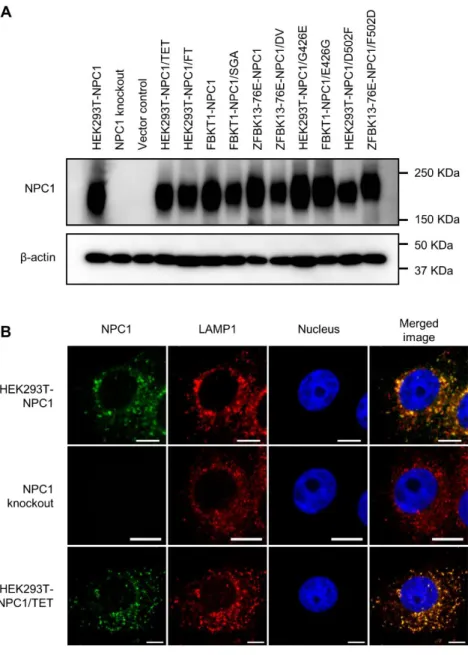
and confirmed that similar band intensities and lysosomal localization were uniformly
observed in each cell line (Figure 1). I also confirmed the expression of human NPC1
protein in HEK293T NPC1 transduced bat cell lines (data not shown).
15
Figure 1. Expression of exogenous NPC1 in Vero E6/NPC1-KO cl.19 cells
(A) Western blotting for wildtype and mutant NPC1 expression. Each cell lysate was subjected to sodium dodecyl sulfate (SDS)-polyacrylamide gel electrophoresis followed by western blotting with rabbit anti-NPC1 monoclonal antibody (ab134113, Abcam), mouse anti-β actin monoclonal antibody (ab6276, Abcam), HRP-conjugated goat anti- rabbit IgG (074-1506, KPL), and HRP-conjugated goat anti-mouse IgG (115-035-062, Jackson ImmunoResearch). The bound antibodies were visualized with Immobilon Western (Millipore). (B) Co-localization of NPC1 and a lysosome marker, Lysosomal- associated membrane protein 1 (LAMP1). Representative cell images are shown here.
Cells were grown in Millicell EZ SLIDE 8-well glass (Millipore). NPC1 was stained with
16
rabbit anti-NPC1 monoclonal antibody (ab134113, Abcam) and donkey anti-rabbit IgG
(H+L) antibodies conjugated with Alexa Fluor 488 (A21206, Invitrogen). Anti-LAMP1
antibodies (SAB3500285, Sigma-Aldrich) were conjugated with Alexa Fluor 594 using
APEX Alexa Fluor 594 Antibody Labelling (ab134113, Abcam) and donkey anti-rabbit
IgG (H+L) antibodies conjugated with Alexa Fluor 488 (A21206, Invitrogen). Anti-
LAMP1 antibodies (SAB3500285, Sigma-Aldrich) were conjugated with Alexa Fluor
594 using APEX Alexa Fluor 594 Antibody Labelling Kit (Invitrogen) and then used. The
nucleus was stained using 4’,6-diamidino-2-phenylindole, dihydrochloride (DAPI)
(Molecular Probes). Images were taken with 63x oil immersion objective on a Zeiss LSM
780 confocal laser microscope and analyzed with ZEN 2.3 Lite software. The expression
of NPC1 (green), LAMP1 (red), and nucleus (blue) are shown separately or as merged
images. The scale bars represent 10 μm.
17 Solid-phase NPC1-GP binding assay
Vero E6/NPC1-KO cells and Vero E6/NPC1-KO cells expressing HA-tagged NPC1 and its mutants
35)were lysed with CHAPS-NTE buffer (0.5% wt/vol CHAPS [3- [[3-Cholamidopropyl]dimethylammonio]propanesulfonate], 140 mM NaC1, 10 mM Tris-HC1, 1 mM EDTA [Ethylenediaminetetraacetic acid]; pH7.5) (10
7cells/ml). Then, EDTA-free Complete Protease Inhibitor Cocktail (Roche) was added. The cells were sedimented at 10,000 × g for 10 min at 4˚C, and the supernatant was harvested. Virus-like particles (VLPs) (4-6 mg/ml in phosphate-buffered saline [PBS]) were treated with thermolysin (Sigma) at 37˚C for 90 min. The VLP solution was diluted at 1:10 with 0.05 M carbonate buffer (pH9.6). Enzyme-linked immune sorbent assay (ELISA) plates (Maxisorp, Nunc) were coated with the diluted VLPs, and incubated at 4˚C overnight.
The VLPs were removed and the plates were blocked with bovine serum albumin (BSA)
(10 mg/ml in PBS) and incubated at room temperature for 2 hours. After washing the
plates once with 0.05% Tween 20 in PBS (PBST), the cell lysate was added to each well
and incubated at 4˚C overnight. After removal of the lysate, the plates were washed with
PBST 3 times, and rat anti-HA antibody 3F10 (Sigma) diluted with PBST containing BSA
(5 mg/ml) was added, and then incubated at room temperature for 1 hour. After washing
3 times with PBST, horseradish peroxidase (HRP)-conjugated anti-rat IgG (H+L)
(Jackson ImmunoResearch) was added to each well. After incubation at room temperature
for 1 hour, the plates were washed 4 times with PBST and the 3,3',5,5'-Tetramethyl-
benzidine (TMB) substrate (Sigma) was added and incubated in the dark at room
temperature for 60 min. The optical density (OD) value at 450 nm was measured after
stopping the reaction with 1M phosphoric acid.
18 Molecular modeling
Three-dimensional models of the NPC1-C and EBOV GP complex were prepared based on a previous study
86)(Protein Data Bank [PDB] code 5F1B). Three- dimensional structures shown in the figures of this study were prepared using PyMOL (Schrödinger LLC).
Quantification and statistical analysis
All statistical analyses were performed using R software (version 3.5.2)
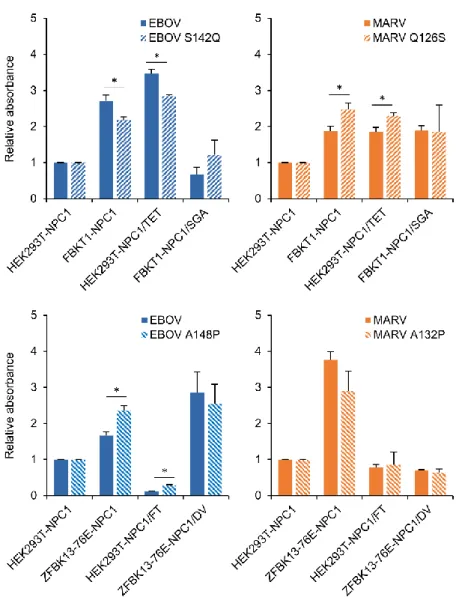
71). For comparison of viral infectivity between NPC1-transduced cell lines, reported in Figure 5 and Figure 10, one-way analysis of variance, was performed, followed by Dunnett’s test.
Student t-test was used in Figure 8. P-values of less than 0.05 were considered to be
significant.
19 Results
Differential susceptibility to EBOV and MARV between bat-derived cell lines FBKT1 and ZFBK13-76E
Using non-replicating VSVs pseudotyped with GPs of EBOV, SUDV, TAFV,
BDBV, RESTV, and MARV (VSV-EBOV, -SUDV, -TAFV, -BDBV, -RESTV, and -MARV,
respectively), I investigated GP-dependent tropism, which appears to be the principal
determinant for the host range-restriction of filoviruses. Vero E6 cells, which are
commonly used for filovirus studies, HEK293T cells, and eight bat-derived cell lines of
different origins were used to compare their susceptibilities (Table 1 and Figure
2)
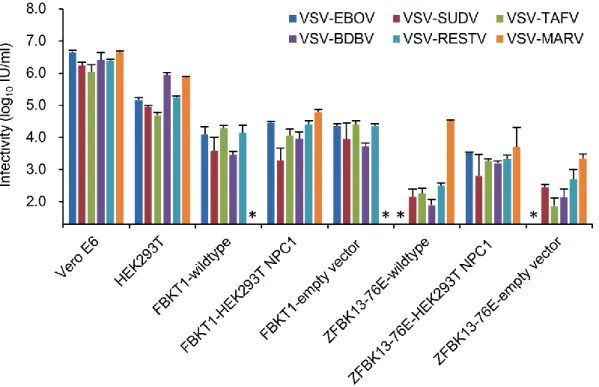
44,45,46,63,77). I found that Vero E6, HEK293T, and the bat-derived cell lines, except
FBKT1 and ZFBK13-76E, were susceptible to all pseudotyped VSVs tested. Consistent
with a previous study
45), FBKT1 was susceptible to VSV-EBOV, -SUDV, -TAFV, -BDBV,
and -RESTV, but not to VSV-MARV. In contrast, ZFBK13-76E was susceptible to VSV-
SUDV, -TAFV, -BDBV, -RESTV, and -MARV, but not to VSV-EBOV, indicating that cell
lines derived from this bat species might be less susceptible to EBOV
60). Next, the
impaired GP-dependent susceptibilities of FBKT1 and ZFBK13-76E were confirmed
using infectious filoviruses (Table 2). Consistent with the results for pseudotyped VSVs,
FBKT1 cells showed susceptibility to infectious EBOV but not to MARV. Although
ZFBK13-76E cells were susceptible to both EBOV and MARV, the infectivity of EBOV
in ZFBK13-76E cells was significantly lower than in Vero E6, FBKT1, and DemKT1
cells.
20
Figure 2. Susceptibility of cell lines to VSVs pseudotyped with filovirus GPs Vero E6, HEK293T, and bat-derived cells were infected with VSVs pseudotyped with filovirus GPs (VSV-EBOV, -SUDV, -TAFV, -BDBV, -RESTV, and -MARV). Viral IUs in each cell line were determined by counting the number of GFP-expressing cells as described in Materials and Methods. Each experiment was conducted three times, and average and standard deviations are shown. Asterisks represent IUs under the limit of detection (20 IU/ml).
Table 2. Susceptibility of bat-derived cell lines to Ebola (EBOV) and Marburg virus (MARV) infection
Cell lines Infectivity (TCID
50/100 μl)
aRelative infectivity to Vero E6
EBOV MARV EBOV MARV
Vero E6 3.16 × 10
45.01 × 10
51.00 1.00
FBKT1 5.01 × 10
3Not detected
b0.16 -
ZFBK13-76E 3.16 × 10
22.00 × 10
50.01 0.40
DemKT1 3.16 × 10
43.16 × 10
51.00 0.63
a
Viral titers in Vero E6 and bat-derived cell lines were determined as the 50% tissue culture infectious dose (TCID
50).
b