324
IEICE TRANS. FUNDAMENTALS, VOL.E104–A, NO.1 JANUARY 2021
LETTER
Sum Rate Maximization of Dense Small Cell Network with Load Balance and Power Transfer among SBSs
Xuefei PENG†a),Nonmember andXiao XUE††b),Student Member
SUMMARY This letter proposes a load balance and power transfer scheme among small cell base stations (SBSs) to maximize the sum rate of small cell network. In the proposed scheme, small cell users (SUEs) are firstly associated with their nearest SBSs, then the overloaded SBSs can be determined. Further, the methods, i.e., Case 1: SUEs of overloaded SBSs are offloaded to their neighbor underloaded SBSs or Case 2: SUEs of overloaded SBSs are served by their original associated SBSs through obtaining power from their nearby SBSs that can provide higher data rate is selected. Finally, numerical simulations demonstrate that the proposed scheme has better performance.
key words: load balance, power transfer, data rate
1. Introduction
Improving the quality of service for load, i.e., users through resource allocation method is a hot topic in wireless network [1]–[3]. Recently, some works have focused on the study of power allocation and load balance. To minimize the total power drawn by the base stations (BSs) from smart grid, the authors in [4], [5] analyzed the energy losses while guar- anteeing safety and balancing out the power of the hybrid battery management system. Nevertheless, the application of this system in real wireless network is not discussed. The problem of load balance was considered in [6]–[11]. [6]
discussed a central load balancing selection algorithm to save the resource. Different load balancing and interference management methods while considering cell association in cellular networks was studied in[7]. Authors in[8]consid- ered cell zooming to achieve load balance of hyper cellular network. Moreover, sleeping strategy for BSs with light load was adopted to reduce power consumption and improve en- ergy efficiency of the network. Authors in[9]proposed an optimal load balancing association method between remote radio heads and mobile devices to minimizes handovers. A novel energy-efficient ant-based routing algorithm was pro- posed in [10] to achieve load balancing and prolong the
Manuscript received February 8, 2020.
Manuscript revised April 26, 2020.
Manuscript publicized July 17, 2020.
†The author is with Electronics and Information Engineering, Changchun University of Science and Technology, No.7089 WeiX- ing Road, Changchun, Jilin, 130022, P.R.China.
††The author is with the State Key Laboratory of Integrated Service Networks (ISN), School of Telecommunications Engineer- ing, Xidian University, No.2 South Taibai Road, Xi’an, Shaanxi, 710071, P.R.China.
a) E-mail: [email protected] (Corresponding au- thor)
b) E-mail: [email protected]
DOI: 10.1587/transfun.2020EAL2011
lifetime of wireless sensor network. Energy group buying with load sharing was proposed in[11]to reduce the energy costs of mobile network operators by utilizing their collab- oration benefit. However, power transfer among small cell base stations (SBSs) is not considered in[6]–[11].
Different from existing literature, this letter adopts load balance and power transfer scheme among SBSs to maximize the sum rate of small cell network. The main contributions of this letter are summarized as follows.
• The network model with load balance and power trans- fer is established.
• The scheme with load balance and power transfer is proposed to maximize the sum rate of the small cell network.
• A number of results are given to illustrate the better performance of our proposed scheme.
2. System Model
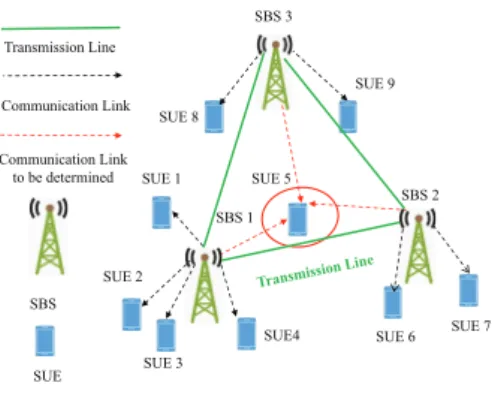
As shown in Fig. 1, consider downlink communication of small cell network, whereS={1,2, . . . ,s. . . ,S}SBSs with low transmit power are randomly and uniformly deployed in a circle area, and N = {1,2, . . . ,n. . . ,N} orthogonal fre- quency division multiple access (OFDMA) resource blocks (RBs) are equally allocated to SBSs. Assume small cell users (SUEs) are randomly and uniformly distributed in the cov- erage area of SBSs. LetU ={1,2, . . . ,u. . . ,U}denote the set of SUEs. For the resource allocation, assume different RBs are allocated to SUEs in the same small cell. Addition- ally, we assume fixed charing equipment, i.e., smart grid and charging pile provide limited energyPto the deployed SBSs
Fig. 1 Network model.
Copyright © 2021 The Institute of Electronics, Information and Communication Engineers
LETTER
325
Algorithm 1Load Balance and Power Transfer Algorithm
Initialization:Ls=∅(∀s∈ S), and sets=1,n=1,u=1.
foru=1 : Udo s∗=min
P Ls,u|∀s∈ S Ls∗=s∗∪ Ls∗
fors=1 : Sdo
CalculatekSBSs−SBSu k end for
end for fork=1 : Sdo
if Lk>Lm a xthen
Sort the SUEs associated with SBSkby decreasing distance, and denote the formerLm a x SUEs associated with SBSk asLok, yk,u=1(u∈Lok),Ruk=log(1+pkRBN·g0k u)(u∈Lok)andzk,u = 0(u∈Lok). Besides, denote the lastLk−Lm a xSUEs associated with SBSkasLk0, andyk,u=0(u∈Lk0).
foru=1 :(Lk−Lm a x)andu∈Lk0do ifRukv >Ru
d∗kthen
Rkvu =log(1+pkvN·g0k u), andzk,u=1(u∈Lk0).
else
d∗ = minP Ls,u|∀s∈(D/{ys,u=1}), Rud∗k = log(1+pd
∗ RB·gd∗u
N0 ), andzd∗,u=1(u∈Lk0).
end if end for end if end for
during a period of time, and pRBs (∀s ∈ S) is the transmit power of SBSson one RB that equals toLP
m a x, whereLmax denotes the maximal number of traffic load, i.e., users that each SBS can support.
3. Load Balance and Power Transfer Scheme
Following, we will give the detail description about the process of load balance and power transfer, which is described in Algorithm 1. Firstly, we assume each SUE is associated with the SBS that has the smallest path loss, which means that SUEuwill be associated with SBSs∗satisfying the following formula
s∗=minPLs,u|∀s∈ S . (1) Further, we can determine the number of users associated with SBSsasLs(s∈ S). We specify the maximum traffic load that each SBS can support (the maximum number of users is allowed to associate with each SBS) isLmax. There- fore, ifLs >Lmax,Ls−LmaxSUEs will not associate with SBSs(∀s ∈ S)in the first process of user association. Let binary vectoryrepresents whether SUEs are associated with SBSs, whose element is an association indicator decision variable ys,u ∈ {0,1} denoting whether SUEu associated with SBSs,ys,u=1 if SUEuassociated with SBSs, other- wise ys,u =0. Then, we can obtain the data rate of SUEu associated with SBSsasRus=log(1+pRBsN·g0s u), wheregsuis the channel gain from SBSsto SUEu,pRBs is the transmit power of SBSson one RB, and N0 is the power of white gaussian noise.
There are still some SBSs overloaded after the afore-
mentioned minimum path loss association method. To fur- ther save energy of the small cell network, we will decide the SUE of overloaded SBS is served by its original SBS through transferring power from the nearest underloaded SBS or of- floaded to its nearest underloaded neighbor SBSs. For ex- ample, as shown in Fig. 1, SUE 5 is the the overloaded load of SBS 1, we will determine SUE 5 is served by its original associated SBS 1 through obtaining power from the nearest neighboured SBS 2 of SBS 1, or directly offloaded to its nearest underloaded SBS 2.
Case 1: The SUEs of overloaded SBSkis served by its original SBS through transferring power from the nearest underloaded SBSvof SBSk.
Assume optical transmission line is used to connect different SBSs, then the received power of SBS k obtain from its nearest underloaded SBSvcan be denoted as follow
pkv=pRBv · fkv, (2)
where fkv is the power loss in the transmission line from SBSvto SBSk, andpRBv is the transmit power of SBSvon one RB. As the power loss model given in[4],[5], the power loss fkvcan be calculated as follows
fkv=C· k SBSv−SBSk k, (3) whereCis the power loss of per unit length, and k SBSv− SBSk k is the Euclidean distance between SBSv and SBS k, i.e., the length of transmission line between SBSv and SBSk. Assume one RB of SBSvis also occupied by SBS kin the process of power transfer. Therefore, the data rate of SUEucan be denoted asRukv=log(1+pkvN·g0k u), where gkuis the channel gain from SBSkto SUEu, andN0is the power of white gaussian noise.
Case 2: The SUEs of overloaded SBS is offloaded to their nearest underloaded neighbor SBSs.
We adopt expanded cell user association method to of- fload cell-edge SUEs in the overloaded small cells to their nearest underloaded neighbor SBSs, here, we denote the set of underloaded SBSs asD, so the new associated SBSd∗of SUEucan be denoted as follows
d∗=minPLs,u|∀s∈(D/{ys,u =1}) . (4) In this case, the maximal number of SUEs offloaded to SBS d∗(∀d∗ ∈ S)should be no larger thanLmax−Ld∗. Rud∗k = log(1+pRBd∗N·g0d∗u), wheregd∗uis the channel gain from SBS d∗to SUEu.
Then, we will decide to use the methods in Case 1 or Case 2 to serve the SUEs in the overloaded SBSs by the following criterion. IfRukv >Rud∗k, we will choose the method described in Case 1 to serve SUEuin the overloaded SBS k, i.e., SUEu in the overloaded SBS is served by its original SBS through transferring power from the nearest underloaded SBSs of its original associated SBS. Otherwise Rukv≤Ru
d∗k, we will choose the method described in Case 2 to offload SUEu in the overloaded SBS kto SBS d∗, i.e., the SUE of overloaded SBS k is offloaded to their nearest
326
IEICE TRANS. FUNDAMENTALS, VOL.E104–A, NO.1 JANUARY 2021
underloaded neighbor SBSd∗
After the aforementioned process of load balance and power transfer described in Algorithm 1, we use vector z to represent the new association relationship between SBSs and SUEs for the SUEs belong to overloaded SBSs in the first process of user association, wherezs,u =1 if SUE u is associated with SBS s, otherwise zs,u = 0. Thus, the sum data rate of SUEs deployed in small cell network can be expressed as follows
Rsum= X
u∈U
X
s∈S
Rus ·ys,u+X
u∈U
X
s∈S,d∈S
Rusd·zs,u. (5)
4. Complexity Analysis
The calculation of the distances among SBSs, and SBSs and SUEs has a complexityO(S2)andO(SU), respectively.
Moreover, SUEs are associated with the SBSs nearest to them, which has a computing complexity ofO(SU). Fol- lowing, the SBSs have overloaded loads will be offloaded according to the criteria given in Case 1 or Case 2, which has a computing complexity not larger thanO(2SU). Therefore, the total computing complexity of the proposed algorithm is not larger thanO(SU*S2*SU*2SU)=O(2S5U3).
5. Simulation Results
In our simulation, all the SUEs and SBSs are randomly and uniformly distributed in a circle region, and the radius of R is given in meters. We consider the channel model includes path loss, rayleigh and shadowing fading, where the path loss from SBS s to SUE u is given by PLsu = 38.46+20∗log10(dsu), in whichdsudenotes the distance between SBSsand useru, with the unitm. The shadowing standard deviations is 8 dB for the link between SBS and the SUE[12], andCis equal to 0.05 W/m. In addition,Lmaxis set as the maximum integer not larger than the ratio of the number of users and the number of SBSs. Next, we compare the proposed scheme with the load balance scheme that does not consider power transfer among SBSs as studied in[11], and power transfer scheme.
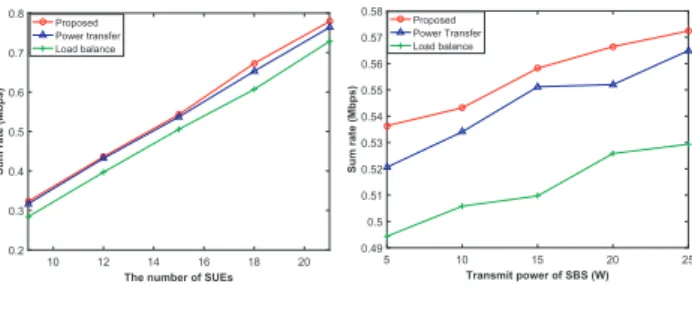
Figure 2 shows the sum rate with respect to the number of users, where S = 3, R = 15 m, and pRB = 10 W. The number of deployed SUEs varies from 9 to 21. Moreover, Lmax varies from 3 to 7 corresponding with the number of deployed SUEs varies from 9 to 21. We can observe the sum rate of the proposed scheme increases with the increasing of the number of deploying SUEs. Moreover, the sum rate of the proposed scheme is better than the load balance scheme and power transfer scheme used independently. The reason is that the proposed scheme choose either load balance or power transfer method that can achieve a higher rate to serve the overloaded SUEs.
Figure 3 shows the sum rate varies with the transmit power of SBSs, where S=3, R=15 m, U=15,Lmax=5, and the transmit power pRBof each SBS varies from 5 W to 25 W. We can observe the sum rate of the three schemes
Fig. 2 Sum rate varies with the number of SUEs
Fig. 3 Sum rate varies with transmit power of SBSs
increase with pRB. The reason is that the higher transmit power can provide better quality of service. Besides, the sum rate of the proposed scheme is better than the other two schemes because the proposed scheme jointly consider load balance and power transfer factors.
6. Conclusion
A scheme with both load balance and power transfer among SBSs has been proposed in this letter to maximize the sum rate of small cell network. Firstly, SUEs have been asso- ciated with their nearest SBSs. There are still some SBSs overloaded since the limited load supporting ability of SBSs.
Therefore, the proposed scheme considering both load bal- ance or power transfer has been adopted to serve the over- loaded SUES in a higher sum rate secondly. Finally, numer- ical simulations have been given to demonstrate the better performance of the proposed scheme.
References
[1] J.G. Andrews, S. Singh, Q. Ye, X. Lin, and H.S. Dhillon, “An overview of load balancing in HetNets: Old myths and open prob- lems,” IEEE Wireless Commun., vol.21, no.2, pp.18–25, 2014.
[2] R. Khan, M. Haroon, and M.S. Husain, “Different technique of load balancing in distributed system: A review paper,” Proc. IEEE Global Conference on Communication Technologies (GCCT), IEEE, pp.371–375, 2015.
[3] J.G. Andrews, S. Singh, Q. Ye, X. Lin, and H.S. Dhillon, “An overview of load balancing in HetNets: Old myths and open prob- lems,” IEEE Wireless Commun., vol.21, no.2, pp.18–25, April 2014.
[4] D. Benda, X. Chu, S. Sun, T.Q.S. Quek, and A. Buckley, “Renew- able energy sharing among base stations as a min-cost-max-flow optimization problem,” IEEE Trans. Green Commun. Netw., vol.3, no.1, pp.67–78, March 2019.
[5] D. Benda, X. Chu, S. Sun, T.Q.S. Quek, and A. Buckley, “Modeling and optimization of renewable-energy sharing among base stations as a minimum-cost-maximum-flow problem,” Proc. IEEE Vehicular Technology Conference (VTC), pp.1–5, June 2018.
[6] S. Kaur and T. Sharma, “Efficient load balancing using improved cen- tral load balancing technique,” Proc. IEEE International Conference on Inventive Systems and Control (ICISC), IEEE, pp.1–5, 2018.
[7] M. Chinipardaz, M. Rasti, and M. Nourhosseini, “An overview of cell association in heterogeneous network: Load balancing and in- terference management perspective,” Proc. IEEE International Sym- posium on Telecommunications (IST), IEEE, pp.1250–1256, 2014.
[8] D. Zhang, “A cell zooming strategy with cooperative transmission and load balancing in hyper cellular network,” Proc. IEEE Interna- tional Conference on Telecommunications (ICT), IEEE, pp.26–30,
LETTER
327
2019.
[9] T. Kim and W. Choi, “Optimal load-balancing association scheme for C-RANs with mobile IoT devices,” Proc. IEEE International Symposium on Real-Time Distributed Computing (ISORC), IEEE, pp.89–90, 2019.
[10] X. Li, B. Keegan, F. Mtenzi, T. Weise, and M. Tan, “Energy-efficient load balancing ant based routing algorithm for wireless sensor net- works,” IEEE Access, vol.7, pp.113 182–113 196, 2019.
[11] J. Xu, L. Duan, and R. Zhang, “Energy group buying with loading sharing for green cellular networks,” IEEE J. Sel. Areas Commun., vol.34, no.4, pp.786–799, 2016.
[12] E.U. T.R. Access, “Further advancements for E-UTRA physical layer aspects,” 3GPP TR 36.814, Technical Report, 2010.