INVITED PAPER
Special Section on Josephson Junctions — Past 50 years and Future —Recent Developments of High-T c Electronic Devices with Multilayer Structures and Ramp-Edge Josephson Junctions ∗
Seiji ADACHI†a), Akira TSUKAMOTO†, Tsunehiro HATO†, Joji KAWANO†,Nonmembers, andKeiichi TANABE†,Member
SUMMARY Recent developments of electronic devices containing Josephson junctions (JJ) with high-Tcsuperconductors (HTS) are reported.
In particular, the fabrication process and the properties of superconduct- ing quantum interference devices (SQUIDs) with a multilayer structure and ramp-edge-type JJs are described. The JJs were fabricated by re- crystallization of an artificially deposited Cu-poor precursory layer. The formation mechanism of the junction barrier is discussed. We have fabri- cated various types of gradiometers and magnetometers. They have been actually utilized for several application systems, such as a non-destructive evaluation (NDE) system for deep-lying defects in a metallic plate and a reel-to-reel testing system for striated HTS-coated conductors.
key words: high-Tc superconductor, Josephson junction, ramp-edge, SQUID
1. Introduction
Josephson effect is a unique characteristic of superconduc- tivity [1]. Soon after the discovery of high-Tc supercon- ductors (HTSs) in 1986 [2], one had expected realization of electronic devices utilizing the effect at high tempera- tures above a few tens of Kelvin or more. That was one of the great impacts of the discovery. Simultaneously, it was pointed out that superconducting connection was quite weak at the grain boundaries of polycrystalline HTS sam- ples [3]. It was also revealed that HTSs intrinsically had a large anisotropy [4], [5]. These facts mean that HTSs with highly-controlled crystal orientation are needed to fabricate electronic devices. Preparation technique of superconduct- ing thin films with high quality is a key for reproducible fabrication of JJs applicable to actual devices. Enormous efforts have been paid to establish the technique. For ex- ample, the relationship between oxygen partial pressure and temperature for successful deposition of high-quality super- conducting films was clarified [6], [7]. Presently, HTS films suitable to device fabrication are prepared by various de- position techniques, such as pulsed laser deposition (PLD),
Manuscript received July 26, 2011.
Manuscript revised October 18, 2011.
†The authors are with Superconductivity Research Laboratory/
International Superconductivity Technology Center, Tokyo, 135- 0062 Japan.
∗This work was partly supported by New Energy and Indus- trial Technology Development Organization (NEDO) for Super- conductors Network Device Project and the Materials and Power Applications of Coated Conductors Project, and Japan Science and Technology Agency (JST) under Strategic Promotion of Innovative Research and Development Program.
a) E-mail: [email protected] DOI: 10.1587/transele.E95.C.337
sputtering, reactive coevaporation or molecular beam epi- taxy (MBE), chemical vapor deposition (CVD) and so on.
Various types of JJs were developed with the aim of appli- cation to electronic devices in 1990s. Successful prepara- tion of JJs led to fabrication of superconducting quantum interference devices (SQUIDs). Since then, the fabrication technology of HTS-SQUIDs has been gradually improved.
Presently we can find commercial SQUID magnetometers and gradiometers in actual market places [8]. Single flux quantum (SFQ) devices containing many JJs were designed and fabrication of HTS-SFQ digital circuits was also tried [9].
In the recent decade, our research group has investi- gated fabrication of HTS-SFQ circuits and HTS-SQUIDs.
For the first several years, we had concentrated on construct- ing a stable fabrication process of JJs [10] and demonstrat- ing proper logic operation of the HTS-SFQ circuits [11].
Then recent years, we have been developing various systems using HTS-SQUIDs utilizing the JJ-preparation technology improved in the former HTS-SFQ studies [12]. We devel- oped the technology including superconducting wiring with multilayer structures and ramp-edge type JJs. In this pa- per, we mainly describe our JJ-preparation technology and recent activities on HTS-SQUID systems. Our results on HTS-SFQ are also described only briefly. Prior to the re- ports on our research activities, a general introduction on a variety of HTS-JJ types is briefly given.
2. Types of HTS Josephson Junctions
Observation of Josephson effect is one of indispensable con- ditions for establishment of superconductivity in a particu- lar material. Following the discovery of HTSs, fabrication of JJs in forms of break junction [13] and point contact [14], as illustrated in Fig. 1, has been tried and physical properties of HTSs such as Josephson coupling and energy gaps were investigated. In these techniques, the surface plays an im- portant role. The unknown altered layer at the surface has chances to form moderate junction barriers, when it is sand- wiched by two superconductors. They are good techniques to try observing the particular phenomena.
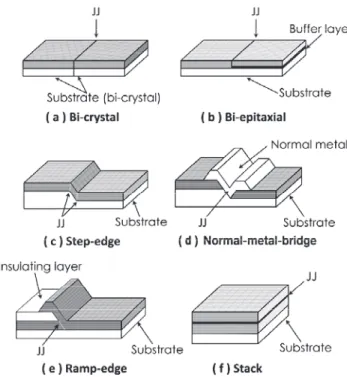
Various types of JJs using superconducting thin films are illustrated in Fig. 2. Bi-crystal junctions [15], [16]
(Fig. 2(a)) have been widely used, because of the easy fab- rication process and moderately good reproducibility. How- ever, the long grain boundary in a substrate gives restric- Copyright c2012 The Institute of Electronics, Information and Communication Engineers
Fig. 1 Josephson junctions using polycrystalline HTS samples.
(a) Break junction and (b) point contact.
Fig. 2 Josephson junctions using HTS thin films. Superconducting films arec-axis oriented, i.e. the CuO2planes are parallel to the substrate surface.
tions to superconducting wiring design in a chip. The other types illustrated in Figs. 2(b)–2(f) do not have such dis- advantage. One can prepare JJs at desired positions in a chip. Char et al. [17] developed a bi-epitaxial technique in which partially modifiedin-planeorientation by inserting a buffer layer is effectively utilized, as illustrated in Fig. 2(b).
Steps artificially formed on a substrate surface are also ef- fectively utilized to make JJs. Daly et al. [18] succeeded in demonstrating proper JJ operation at YBa2Cu3Oy (YBCO) grain boundaries at steps artificially formed on a substrate (Fig. 2(c)). This type of JJ is also widely used in actual de- vices as well as bi-crystal JJs. Another type of JJ using a step on a substrate was developed by DiIorio et al. [19] and Ono et al. [20] Separated superconducting portions at a step are mediated by normal metal, as drawn in Fig. 2(d). This type of JJ is called as normal-metal-bridge JJ.
Two types of JJs having oxide multilayer structures were fabricated, as illustrated in Figs. 2(e) and 2(f). These
[25]–[27]. Barrier layers in both the types are artificially prepared by interface engineering techniques such as surface modification of the lower superconducting layer, namely base electrode (BE) [24], or by deposition of some non- superconducting materials [21]–[23]. In the ramp-edge JJs (Fig. 2(e)), ramp surface at which edges of CuO2planes ap- pear is exposed and then the upper superconducting layer, namely counter electrode (CE), is deposited after proper in- terface engineering of the ramp. Usually, c-axis oriented films are used for superconducting electrodes. Josephson current in the direction being parallel to the CuO2 plane passes through a barrier. The ramp-edge JJ has an over- hang structure of CE. In the structure, the JJ barrier is cov- ered with CE. We can expect that the superconducting CE works as a magnetic shield for the barrier. It is favorable from viewpoint of durability against the entry of flux vor- tices. Also, the tilted barrier seems to be tough against the vertically applied magnetic field [28]. In the stack type (Fig. 2(f)), a BE surface being parallel to the substrate is ex- posed before interface engineering. It means that Joseph- son current must pass in the direction vertical to the CuO2
plane. It is technically difficult to fabricate an appropriate barrier for Josephson tunneling current along the direction with short coherence length. However, Kimura et al. [27] re- ported an encouragingly highIcRn value in their stack-type JJ. Development of reproducible fabrication technique is de- sired.
3. Preparation of Ramp-Egde Type JJs
Moeckly and Char [24] prepared YBCO ramp-edge JJs by modifying the edge surface through an ion bombardment and/or vacuum annealing process prior to CE deposition.
This type of JJ has been called an “interface-engineered junction (IEJ)”. Satoh et al. [29] demonstrated fabrication of JJs with a smallIcspread (1σ=8% at 4.2 K for a 100- JJ series-array) utilizing a similar technique without an in- tentional ion bombardment. They called it as “interface- modified junction (IMJ)”. The reported smallIcspread im- plied that this kind of method is promising to prepare well- controlled JJs with high reproducibility.
Wen et al. [30] studied the IMJ barrier prepared by Satoh et al. [29] in terms of structure and composition by means of a transmission electron microscope (TEM) and en- ergy dispersive X-ray (EDX) spectroscopy. They revealed that an amorphous layer with a significantly Cu-poor or nearly Cu-free composition was formed on the surface of an ion-bombarded YBCO BE ramp edge before YBCO CE deposition. After the CE deposition, a thin barrier layer with a Cu-poor composition as compared with the stoichiometric YBCO was formed. They reported Ba:Y:Cu=43:30:27 for the barrier layer, indicating that 27% Cu was supplied from
Fig. 3 Schematic illustration of cross-section of an HTS-SFQ circuit.
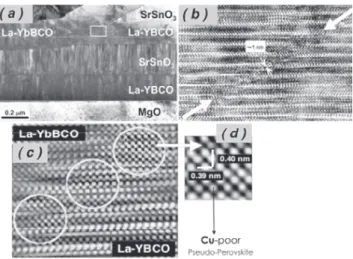
Fig. 4 TEM images of the barrier region of ramp-edge JJ prepared by the IMJ method. (a) Low magnified image, (b) high resolution one, (c) Fourier transformed one, and (d) atomic image at the barrier region.
electrodes during CE deposition and significant diffusion of Cu took place.
We also investigated the fabrication process of ramp- edge type JJs for HTS-SFQ circuits [31]. Schematic il- lustration of cross-sectional view of an HTS-SFQ circuit is drawn in Fig. 3. The thickest portion consists of five oxide layers with a total thickness of more than 1μm. We used Y0.9Ba1.9La0.2Cu3Oy (La-YBCO) for the BE and ground plane layers, and Yb0.9Ba1.9La0.2Cu3Oy (La-YbBCO) for the CE. SrSnO3 (SSO) was used for insulating layers. The oxide films except La-YbBCO were deposited by off-axis magnetron sputtering. The CE layer was prepared by pulsed laser deposition (PLD). Junction barriers were prepared by using the IMJ method.
We investigated the obtained barrier in terms of struc- ture and composition [32]. TEM images of the junction interface are shown in Fig. 4. A low magnified image (Fig. 4(a)) indicates that an oxide multilayer structure with sharp interfaces is successfully constructed. A successive line with a different crystal symmetry and a thickness of ap- proximately 1 nm, which is indicated by arrows, can be seen at the interface between BE and CE in a high resolution im- age of Fig. 4(b). In both images, no appreciable segregated phase is found. A Fourier transformed image and the en- larged one of the barrier region are shown in Figs. 4(c) and 4(d), respectively. In the barrier region, the ordered structure
Fig. 5 Schematic illustration of Cu-poor precursor method.
Fig. 6 Compositional changes at the interface or the barrier region of ramp-edge JJ prepared by the Cu-poor precursor method.
along thec-axis of triple perovskite disappears and a cubic- like unit with lattice parameters of 0.39×0.40 nm2is seen.
EDX analysis revealed that the atomic ratio of Cu/(other cations) was less than unity, suggesting Cu and some other cations occupy the atomic site for small cation of the per- ovskite oxide. We speculated that small Yb ions enter the site [10]. The EDX analysis also revealed that the barrier region had a slightly La-rich composition comparing with those of electrodes, implying that La ions stabilized a cubic- like perovskite phase at the barrier.
It was likely that significant Cu diffusion from elec- trodes to the barrier region took place during CE deposi- tion, because the applied technique was similar to Satoh et al.’s [29]. It seems possible that such significant change in composition may promote impurity segregation, although the appreciable precipitate is not observed in our samples of Fig. 4 fortunately. To reduce such possibility, we have de- veloped a new method for JJ preparation [33], namely Cu- poor precursory method, as illustrated in Fig. 5. Between the ramp formation and CE deposition, a deposition step for a Yb-Ba-La-Cu-O thin layer with a thickness of a few nm is inserted. The same target was used for the following CE deposition. To obtain a Cu-poor composition, PLD condi- tion was altered from that for the CE. In this method, the composition at the ramp surface is artificially controlled, as described in Fig. 6.
Before deposition of the Cu-poor thin layer, the com- position at the ramp surface seemed to be significantly Cu- poor by preferential sputtering of Cu during ion milling [30].
That region is indicated by “A” in Fig. 6. Then, the Cu-poor precursory layer having a composition indicated by “B” is deposited. During the sequential CE deposition, the com- position at the interface gradually changes to the region “C”
by Cu diffusion form electrodes. This thin layer with the composition “C” is expected to be a junction barrier. It is expected that moderately Cu-poor composition of “C” can
suppress local segregation of impurity phase at a barrier re- gion, since no significant Cu diffusion is required to form the barrier with the composition “C”. Formation of a clear bar- rier having sharp interfaces between electrodes was also ex- pected. Enhancement inIcRnvalues was actually observed for JJs prepared in this method [33].
4. HTS-SFQ Circuits
We had fabricated elementary HTS-SFQ circuits using the multilayer structure as schematically shown in Fig. 3. The fabrication technology for many JJs with homogeneous characteristics in a chip is required. A small spread of sigma
=7.3% inIc’s for 1000 JJs was reported by our group [34].
We found that the JJ properties are affected by local layout design around individual JJ, and devised a method to over- come the problem, namely a “separated base layout (SBL)”
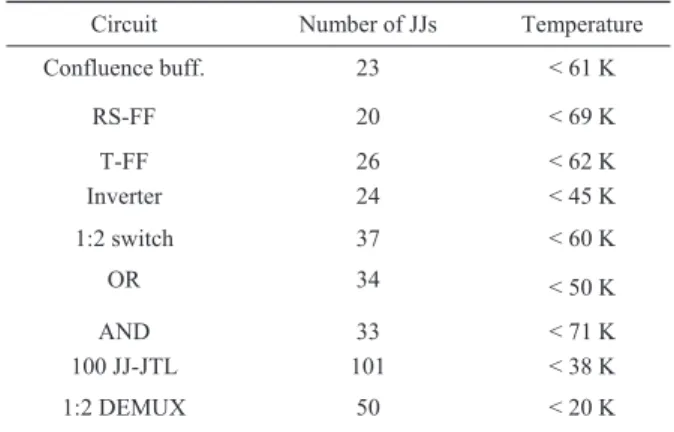
method [35]. Our activities on HTS-SFQ were previously reported in this journal [11]. Here, HTS-SFQ circuits in which successful logic operation was demonstrated by our group are listed in Table 1.
5. HTS-SQUIDs
5.1 Fabrication of Gradiometers and Magnetometers We have fabricated HTS-SQUIDs by applying the above- mentioned process developed for HTS-SFQ. Our fabrica- tion process was previously described [36]. In the process, some modifications have been made in thin film materials for HTS-SQUIDs. La-YBCO ground plane was replaced by non-superconducting Pr1.4Ba1.6Cu2.6Ga0.4Oy (P4G4) [37].
It is expected that this black-colored P4G4 works as a tem- perature homogenizer during deposition of the upper lay- ers. SmBa2Cu3Oy (SmBCO) and Er0.95La0.1Ba1.95Cu3Oy (L1ErBCO) are used for the BE and CE, respectively. A cross-sectional view of our HTS-SQUID taken by a scan- ning electron microscope (SEM) is shown in Fig. 7. A thin buffer layer of BaZrO3 (BZO) was inserted between MgO substrate and P4G4 to improve the quality of P4G4. The sur- face of BE was covered by a thin SSO layer, called 1st SSO.
This works as a protective layer for BE during the patterning
Fig. 7 An SEM photo of cross-sectional view of multilayer for HTS- SQUID.
Fig. 8 Schematic illustration of HTS-SQUID gradiometer with integrated feedback coil.
procedure by photolithography and ion-milling. Sharp inter- faces and no columnar growth suggest that oxide multilayer structure was successfully constructed.
We fabricated directly-coupled HTS-SQUID gra- diometers. Figure 8 is a schematic illustration of the gra- diometer. A feedback coil was integrated on the pickup loop using the multilayer technology. Gradiometers with different sizes (x×y) of the pickup loop were fabricated.
Typical inductance of a SQUID inductor and JJ width were 40∼60 pH and 2∼3μm, respectively. For instance, an opti- cal micrograph (OM) image for a gradiometer with (x×y= (0.5×1.0) in mm is shown in Fig. 9.
Figure 10 shows typical properties measured at 77 K for a gradiometer with a size of (1.0×1.0) in mm. 2Icand Rn/2 were measured to be approximately 12μA and 7.8Ω, respectively. Relatively largeIcRnproduct of 93μV was ob- served. Assuming the occurrence of thermal noise round- ing in theI-Vcurve shape, the actual Icvalue might be ap- proximately 20μA. Then, IcRn product is estimated to be 156μV. Peak-to-peak modulation voltageVmodof 60μV was obtained. This gradiometer showed a rather low flux noise
Fig. 9 OM images of a gradiometer with (x×y)=(0.5×1.0) in mm.
Fig. 10 Properties of an HTS-SQUID gradiometer with (x×y)=(1.0× 1.0) in mm. (a)I-V, (b)V-Φcurves and (c) flux noise measured in AC bias mode at 77 K.
Fig. 11 A directly-coupled HTS-SQUID magnetometer.
evaluated in AC bias mode of 3.8μΦ0/Hz1/2 in the white noise region. The 1/f corner was about several tens Hz for this gradiometer.
We fabricated two types of HTS-SQUID magnetome- ters on MgO substrate with a size of 15×15 mm2 [38].
These are directly coupled and inductively coupled ones.
Figure 11 shows a photo of a directly-coupled magnetome-
Fig. 12 Field noise characteristics for a directly-coupled HTS-SQUID magnetometer. Data were collected in AC bias mode at 77 K.
Fig. 13 An inductively-coupled HTS-SQUID magnetometer.
ter chip and an optical micrograph (OM) image of SQUID inductors. This layout has 4 SQUIDs with different designs in JJ width (WJJ) and inductance (LS) in order to improve production yield of the chip. We can choose a SQUID suit- able to particular application. The obtained result of field noise measurement in AC bias mode at 77 K for a chip is shown in Fig. 12. A SQUID inductor with LS = 40 pH andWJJ =2.0μm was used. The effective area (Aeff) was 0.3 mm2. Quite low noise characteristics were observed. A white noise level was measured to be 30 fT/Hz1/2. With de- creasing frequency, the noise increases appreciably below a few tens Hz. However, the chip exhibits a rather low noise of 200 fT/Hz1/2even at 1 Hz.
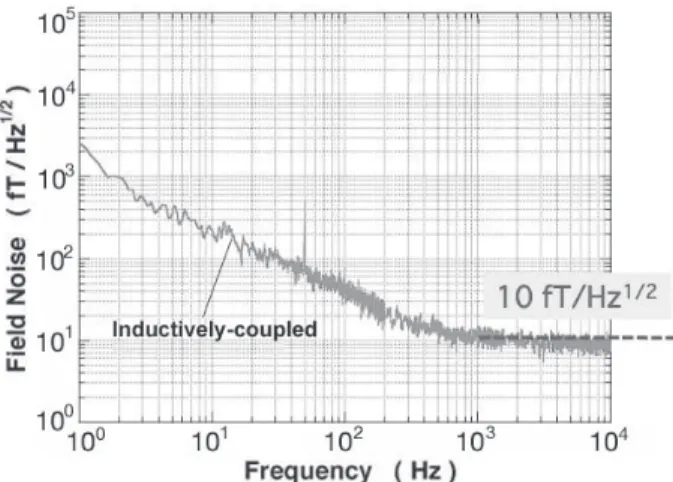
Figure 13 shows a photo of an inductively-coupled magnetometer chip and OM images around SQUIDs [38].
That is so-called Ketchen-type. Design of the pickup coil is almost identical with that of the abovementioned directly- coupled one. A 20-turn input coil was prepared on a washer with a size of 200×200μm2. Both widths of the line and the space for the input coil are 2μm. WJJ andLS are 2μm and 30 pH, respectively. Aeff was 2.0 mm2. Field noise spec- trum taken in AC bias mode at 77 K is shown in Fig. 14.
Noise level lower than the directly-coupled magnetometer was recorded above 200 Hz. White noise level was mea- sured to be 10 fT/Hz1/2. However, the noise increases appre- ciably below 400 Hz with decreasing frequency. Presently the origin is not clear.
Fig. 14 Field noise characteristics for an inductively-coupled HTS- SQUID magnetometer. Data were collected in AC bias mode at 77 K.
Fig. 15 Principle of the NDE system for striated CCs with five filaments using a 5-ch HTS-SQUID gradiometer array.
5.2 Non-Destructive Evaluation (NDE) System for Stri- ated HTS Coated Conductors (CC)
Recently, the research and development for HTS-CC have been intensively carried out. Successful fabrication of several-hundred-meter long CCs with high critical currents over a few hundreds amperes has been achieved [39]. Stri- ating techniques of the CCs have been also developed for application to AC power devices such as transformers and motors [40]. However, there was no NDE system that en- abled us to examine striated CCs in reasonably high resolu- tion, high sensitivity and high speed. We proposed a new NDE system using HTS-SQUIDs [41].
In the system, an HTS-SQUID gradiometer array was used. Eddy currents are induced in superconducting layer of CCs by using an induction coil, and the variation of mag- netic field gradient generated by the eddy currents is mon- itored by the gradiometers. Figure 15 is an illustration de- scribing the principle of our NDE system. We fabricated the system for 5-mm-wide CCs divided to 5 filaments, and con- sequently the width of each filament was nealy 1 mm. OM images of the array are shown in Fig. 16. Each gradiometer has a design of the abovementioned (1.0×1.0)-gradiometer shown in Fig. 8 [42]. To reduce effects of cross-talk between adjacent feedback coils, five gradiometers were arranged in two lines forming a “W” character.
Fig. 16 OM photos of 5-ch HTS-SQUID gradiometer array.
Fig. 17 Photograph of the RTR-NDE system for striated CC using HTS- SQUID gradiometer array.
Figure 17 shows the whole NDE system for reel-to- reel (RTR) examination of striated HTS-CCs. In a vacuum chamber, a cooling system for CC is installed. CC under the gradiometer array is cooled belowTcby thermal conduction to a cold stage and pre-cold stages. To achieve sufficient contact between CC and the stage, a back tension of 2 N/m was applied to CC by controlling torque power of reel shafts.
After some additional improvement in the system, we suc- ceeded in achieving the maximum testing speed of 80 m/h.
An example of test results is shown in Fig. 18. The upper image in the figure was taken by a scanning laser mi- croscope. It enables us to examine the height of the sample.
The bright area suggested the occurrence of delamination in Lanes 1 and 5. The lower two graphs shows the SQUID signals for Lanes 1 and 5. Anomalies in the signals at po- sitions corresponding to the bright portions in the laser mi- croscope image are seen. It suggested that delamination in the filaments was detected by the SQUID-NDE system. We confirmed that the system could detect other types of defects such as shorts between adjacent filaments, regions with sig- nificantly reduced critical current and so on. This system is very convenient to check striated HTS-CCs before utilizing
Fig. 18 An example of NDE test results for a striated HTS-CC. The up- per image was taken by a scanning laser microscope. The lower two graphs are signals for the gradiometers of channels 1 and 5, positioned above Lanes 1 and 5, respectively.
them for fabrication of various power devices. Moreover, it is also useful to check CCs before the striation process. The system can detect inhomogeneity in superconducting prop- erties such as some precipitates and scratches introduced by handling mistakes and so on. We can thus choose CCs ap- propriate to execute striation procedure.
5.3 Non-Destructive Evaluation (NDE) System for Deep- Lying Defects
NDE using SQUIDs has advantages over conventional NDE techniques. Since SQUID has high sensitivity even at low frequencies which enable penetration of eddy current into deep regions of a conducting sample, weak magnetic sig- nals generated from deep regions can be detected, even when the sample is covered with some materials. We fabri- cated a 2-axis planar-type HTS-SQUID gradiometer chip- shown in Fig. 19 [43], [44]. Two gradiometers having a baseline of 8.5 mm were orthogonally prepared on a chip.
(see Fig. 19(a)). Figure 19(b) is a layout design of the center area. Superconducting cross-over wiring and superconduct- ing contacts between BE and CE were prepared. Each gra- diometer has four SQUID inductors withWJJ=2.0–3.0μm.
We can choose suitable one among them.
We constructed an NDE system consisting of a liquid- nitrogen cryostat, a double-D type induction coil, an X-Y stage and electronic equipments including flux-locked loop (FLL) circuits. Figure 20(a) is a photographic view of the cryostat and induction coil. There is a sapphire window at the bottom of the cryostat. Inside the window, the gradiome- ter is located in an evacuated space. We examined an alu- minum plate having a slit hole as a defect. Measurement of the distribution of magnetic signals from the plate was carried out. The configuration of the gradiometer and the sample in the present experiment is illustrated in Fig. 20(b).
Distorted eddy current around the slit hole is detected. One gradiometer in a chip was used. By inserting aluminum
Fig. 19 2-axis planar-type HTS-SQUID gradiometer chip. (a) Photo- graphic view of a chip mounted on a sapphire rod, and (b) the layout design of center area of the chip.
Fig. 20 (a) Photographic view of the cryostat and double-D type induc- tion coil. Inside the window, the gradiometer was set in an evacuated space.
(b) Schematic illustration of configuration of the gradiometer and the sam- ple in the present experiment.
Fig. 21 Contour map of the magnitude signal around a slit defect in the sample. 9-layer aluminum plates (total thickness of 18 mm) without a slit was inserted between the sample and the cryostat. The position of the deep- lying slit is indicated. Numbers in the map are signal intensities in arbitrary unit.
plates without a slit between the sample and the cryostat, the distance between the gradiometer and the slit or the slit depth was changed.
Figure 21 shows an example of the obtained results.
A 2-mm thick aluminum plate having a 30 mm long slit
existing at 20 mm deep position, even though 9-layer alu- minum plate was inserted. It was estimated that our system possibly could detect the slit at 50 mm deep position [44].
6. Conclusion
Various types of JJs using HTSs were briefly explained. Bi- crystal junction and step-edge one have been widely used.
Ramp-edge junctions enable us to realize devices having rel- atively complicated layout designs. We have studied the fabrication process of the ramp-edge JJs, and fabricated HTS-SFQ circuits and HTS-SQUIDs. We have developed a method to prepare JJ barriers reproducibly, namely “Cu- poor precursor” method. In this method, an appropriate JJ barrier is obtained by re-crystallization of the artificially de- posited Cu-poor precursory layer. It is speculated that com- position of the precursory layer, being Cu-poor and con- taining small rare earth elements, is important. Recently, we fabricated NDE systems using HTS-SQUIDs with ramp- edge JJs and multilayer structures. By using a 5 ch HTS- SQUID gradiometer array, a RTR testing system for striated HTS-CCs was developed. It has been actually utilized for research & development of HTS power devices. We also fabricated a chip of 2-axis planar-type HTS-SQUID gra- diometer having a rather long baseline of 8.5 mm. An NDE system with this chip was fabricated to search for deep-lying defects in a metallic plate.
Acknowledgments
The authors thank to Dr. Y. Ishimaru for fruitful discussion, Mr. Y. Oshikubo and Mr. Y.-S. Moon for technical assis- tances.
References
[1] B.D. Josephson, “Possible new effects in superconductive tunnel- ing,” Phys. Lett., vol.1, pp.251–253, March 1962.
[2] J.G. Bednorz and K.A. M¨uller, “Possible highTcsuperconductiv- ity in the Ba-La-Cu-O system,” Z. Phys. B – Cond. Mat., vol.64, pp.189–193, Aug. 1986.
[3] K.A. M¨uller, M. Takashige, and J.G. Bednorz, “Flux trapping and superconducting glass state in La2CuO4−y: Ba,” Phys. Rev. Lett., vol.58, no.11, pp.1143–1146, 1987.
[4] Y. Iye, T. Tamegai, H. Takeya, and H. Takei, “The anisotropy up- per critical field of single crystal YBa2Cu3Ox,” Jpn. J. Appl. Phys., vol.26, pp.L1057–L1059, 1987.
[5] T.K. Worthington, W.J. Gallagher, and T.R. Dinger, “Anisotropic nature of high-temperature superconductivity in single-crystal YBa2Cu3O7−x,” Phys. Rev. Lett., vol.59, no.10, pp.1160–1163, 1987.
[6] R.H. Hammond and R. Bormann, “Correlation between the in-situ growth conditions of YBCO thin films and the thermodynamic sta- bility criteria,” Physica C, vol.162-164, pp.703–704, 1989.
[7] R. W¨ordenweber, “Growth of high-Tcthin films,” Supercond. Sci.
[10] S. Adachi, H. Wakana, Y. Wu, Y. Ishimaru, Y. Tarutani, and K.
Tanabe, “Structure and formation mechanism of interface-modified layer in ramp-edge Josephson junctions with La-doped 123-type su- perconducting electrodes,” IEEE Trans. Appl. Supercond., vol.13, no.2, pp.877–880, June 2003.
[11] K. Tanabe, H. Wakana, K. Tsubone, Y. Tarutani, S. Adachi, Y.
Ishimaru, M. Maruyama, T. Hato, A. Yoshida, and H. Suzuki, “Ad- vances in high-Tcsingle flux quantum device technologies,” IEICE Trans. Electron., vol.E91-C, no.3, pp.280–292, March 2008.
[12] H. Wakana, S. Adachi, K. Hata, T. Hato, Y. Tarutani, and K. Tanabe,
“Development of integrated HTS SQUIDs with a multilayer struc- ture and ramp-edge Josephson junctions,” IEEE Trans. Appl. Super- cond., vol.19, no.3, pp.782–785, 2009.
[13] J. Moreland, L.F. Goodrich, J.W. Ekin, T.E. Capobianco, A.F. Clark, A.I. Braginski, and A.J. Panson, “Josephson effect above 77 K in a YBaCuO break junction,” Appl. Phys. Lett., vol.51, no.7, pp.540–
541, Aug. 1987.
[14] J.S. Tsai, Y. Kubo, and J. Tabuchi, “Josephson effects in the Ba-Y- Cu-O compounds,” Phys. Rev. Lett., vol.58, no.19, pp.1979–1981, May 1987.
[15] P. Chaudhari, J. Mannhart, D. Dimos, C.C. Tsuei, J. Chi, M.M.
Oprysko, and M. Scheuermann, “Superconducting transport proper- ties of grain boundaries in YBa2Cu3O7−δ,” Phys. Rev. Lett., vol.60, no.16, pp.1653–1656, April 1988.
[16] D. Dimos, P. Chaudhari, and J. Mannhart, “Direct measurement of the superconducting properties of single grain boundaries in YBa2Cu3O7bicrystals,” Phys. Rev. B, vol.41, no.7, pp.4038–4049, March 1990.
[17] K. Char, M.S. Colclough, M.S. Garrison, N. Newman, and G.
Zaharchuk, “Bi-epitaxial grain boundary junctions in YBa2Cu3O7,”
Appl. Phys. Lett., vol.59, no.6, pp.733–735, Aug. 1991.
[18] K.P. Daly, W.D. Dozier, J.F. Burch, S.B. Coons, R. Hu, C.E. Platt, and R.W. Simon, “Substrate step-edge YBa2Cu3O7 rf SQUIDs,”
Appl. Phys. Lett., vol.58, no.5, pp.543–545, Feb. 1991.
[19] M.S. DiIorio, S. Yoshizumi, K.-Y. Yang, J. Zhang, and M. Maung,
“Practical highTc Josephson junctions and dc SQUIDs operating above 85 K,” Appl. Phys. Lett., vol.58, no.22, pp.2552–2554, June 1991.
[20] R.H. Ono, J.A. Beall, M.W. Cromar, T.E. Harvey, M.E. Johansson, C.D. Reintsema, and D.A. Rudman, “High-Tc superconductor- normal metal-superconductor Josephson micro bridges with high- resistance normal metal links,” Appl. Phys. Lett., vol.59, no.9, pp.1126–1128, Aug. 1991.
[21] J. Gao, W.A.M. Aarnink, G.J. Gerritsma, and H. Rogalla, “Con- trolled preparation of all high-TcSNS-type edge junctions and DC SQUIDs,” Physica C, vol.171, pp.126–130, 1990.
[22] M.I. Faley, U. Poppe, H. Soltner, C.L. Jia, M. Siegel, and K. Urban,
“Josephson junctions, interconnects, and crossovers on chemically etched edges of YBa2Cu3O7−x,” Appl. Phys. Lett., vol.63, no.15, pp.2138–2140, Oct. 1993.
[23] J.B. Barner, B.D. Hunt, M.C. Foote, W.T. Pike, and R.P. Vasquez,
“YBa2Cu3O7−δ -based, edge-geometry SNS Josephson junctions with low-resistivity PrBa2Cu3O7−δ barriers,” Physica C, vol.207, pp.381–390, 1993.
[24] B.H. Moeckly and K. Char, “Properties of interface-engineered high TcJosephson junctions,” Appl. Phys. Lett., vol.71, no.17, pp.2526–
2528, Oct. 1997.
[25] C.T. Rogers, A. Inam, M.S. Hedge, B. Dutta, X.D. Wu, and T. Venkatesan, “Fabrication of heteroepitaxial YBa2Cu3O7−x- PrBa2Cu3O7−x-YBa2Cu3O7−x Josephson devices grown by laser deposition,” Appl. Phys. Lett., vol.55, no.19, pp.2032–2034, Nov.
1989.
[26] B.H. Moeckly, “All Ya–Ba–Cu–O c-axis trilayer interface- engineered Josephson junctions,” Appl. Phys. Lett., vol.78, no.6, pp.790–792. Feb. 2001.
[27] T. Kimura, K. Wakita, Y. Yoshinaga, K. Taniike, T. Nishitani, M.
Inoue, A. Fujimaki, and H. Hayakawa, “Vertically-stacked Joseph- son junctions using YbBaCuO as a counter electrode for improving uniformity,” IEEE Trans. Appl. Supercond., vol.15, no.2, pp.145–
148, June 2005.
[28] Y. Hatsukade, K. Hayashi, Y. Shinyama, Y. Kobayashi, S. Adachi, K. Tanabe, and S. Tanaka, “Characteristics of an HTS-SQUID gra- diometer with ramp-edge Josephson junctions and its application on robot-based 3D-mobile compact SQUID NDE system,” Physica C, vol.471, pp.1228–1233, 2011.
[29] T. Satoh, J.G. Wen, M. Hidaka, S. Tahara, N. Koshizuka, and S. Tanaka, “High-temperature superconducting edge junction with modified interface barriers,” Supercond. Sci. Technol., vol.13, pp.88–92, 2000.
[30] J.G. Wen, N. Koshizuka, S. Tanaka, T. Satoh, M. Hidaka, and S.
Tahara, “Atomic structure and composition of the barrier in the mod- ified interface high-TcJosephson junction studied by transmission electron microscopy,” Appl. Phys. Lett., vol.75, no.16, pp.2470–
2472, Oct. 1999.
[31] H. Wakana, S. Adachi, Ai Kamitani, N. Nakayama, Y. Ishimaru, Y. Oshikubo, Y. Tarutani, and K. Tanabe, “Improvement in repro- ducibility of multilayer and junction process for HTS SFQ circuits,”
IEEE Trans. Appl. Supercond., vol.15, no.2, pp.153–156, June 2005.
[32] Y. Wu, Y. Ishimaru, H. Wakana, S. Adachi, Y. Tarutani, and K.
Tanabe, “Identification of different phases in barriers of interface- engineered ramp-edge Josephson junctions: Formation mechanisms and influence on electrical properties,” J. Appl. Phys., vol.92, no.8, pp.4571–4577, Oct. 2002.
[33] H. Wakana, S. Adachi, N. Nakayama, K. Tsubone, Y. Tarutani, and K. Tanabe, “Fabrication of ramp-edge junctions with highIcRnprod- ucts by using Cu-poor precursor,” IEEE Trans. Appl. Supercond., vol.17, no.2, pp.233–236, June 2007.
[34] T. Suzuki, Y. Ishimaru, M. Horibe, O. Horibe, H. Wakana, S.
Adachi, Y. Oshikubo, Y. Tarutani, U. Kawabe, and K. Tanabe, “Eval- uation of fabrication process for interface-modified ramp-edge junc- tions,” Physica C, vol.392-396, pp.1378–1381, 2003.
[35] K. Tsubone, H. Wakana, Y. Tarutani, S. Adachi, Y. Ishimaru, K.
Nakayama, and K. Tanabe, “Operation of HTS toggle-flip-flop cir- cuit with improved layout design,” IEEE Trans. Appl. Supercond., vol.16, no.4, pp.2011–2017, Dec. 2006.
[36] S. Adachi, K. Hata, T. Sugano, H. Wakana, T. Hato, Y. Tarutani, and K. Tanabe, “Preparation of multilayer films for integrated high-Tc
SQUIDs with ramp-edge Josephson junctions,” Physica C, vol.468, pp.1936–1941, 2008.
[37] S. Adachi, N. Suzuki, H. Wakana, T. Sugano, N. Iwata, H.
Yamamoto, and K. Tanabe, “Preparation of non-superconducting Pr1.4Ba1.6Cu2.6Ga0.4Oyfilm for HTS devices,” Physica C, vol.463–
465, pp.952–955, 2007.
[38] S. Adachi, A. Tsukamoto, Y. Oshikubo, T. Hato, Y. Ishimaru, and K. Tanabe, “Fabrication of low-noise HTS SQUID gradiometers and magnetometers with ramp-edge Josephson junctions,” IEEE Trans.
Appl. Supercond., vol.21, no.3, pp.367–370, June 2011.
[39] T. Izumi and Y. Shiohara, “R&D of coated conductors for applica- tions in Japan,” Physica C, vol.470, pp.967–970, 2010.
[40] K. Suzuki, J. Matsuda, M. Yoshizumi, T. Izumi, Y. Shiohara, M.
Iwakuma, A. Ibi, S. Miyata, and Y. Yamada, “Development of a laser scribing process of coated conductors for the reduction of AC losses,” Supercond. Sci. Technol., vol.20, pp.822–826, 2007.
[41] T. Hato, S. Adachi, Y. Sutoh, K. Hata, Y. Oshikubo, T. Machi, and K. Tanabe, “NDE of coated-conductor using HTS SQUID array,”
Physica C, vol.469, pp.1630–1633, 2009.
[42] S. Adachi, Y. Oshikubo, A. Tsukamoto, Y. Ishimaru, T. Hato, J.
Kawano, and K. Tanabe, “Improved reproducible fabrication pro-
cess of HTS-SQUIDs with ramp-edge Josephson junctions and mul- tilayer structures,” Physica C, vol.470, pp.1515–1519, 2010.
[43] A. Tsukamoto, S. Adachi, Y. Oshikubo, J. Kawano, T. Hato, and K. Tanabe, “Fabrication of integrated two-axis high-Tcplanar gra- diometer,” IEEE Trans. Appl. Supercond., vol.21, no.3, pp.363–366, June 2011.
[44] J. Kawano, T. Hato, S. Adachi, Y. Oshikubo, A. Tsukamoto, and K.
Tanabe, “Non-destructive evaluation of deep-lying defects in mul- tilayer conductors using HTS SQUID gradiometer,” IEEE Trans.
Appl. Supercond., vol.21, no.3, pp.428–431, June 2011.
Seiji Adachi received a B.S. degree in 1983 and M.S. in 1985, from Hokkaido University, Japan. He joined the Central Research Labo- ratory, Matsushita Electric Industrial Co. Ltd. in 1985, and engaged in the research of synthesis and characterization of fine ceramics. In 1991, he moved to Superconductivity Research Labo- ratory, International Superconductivity Technol- ogy Center (SRL-ISTEC) and has engaged in the research of superconducting materials and their thin film growth for electronic devices. He received Dr. degree from Hokkaido University in 1993. Dr. Adachi is a member of the Physical Society of Japan, the Japan Society of Applied Physics and the Ceramics Society of Japan.
Akira Tsukamoto received the B.S. de- gree from Kyushu University, in 1987 and the Ph. D degree from Tokyo Institute of Technol- ogy, in 2000. In 1987, he joined Central Re- search Laboratory, Hitachi Ltd., Tokyo, Japan, and engaged in thin film growth of oxide super- conductors. He was temporary moved to SRL- ISTEC from 1994 to 1997. He returned to Hi- tachi Ltd in 1997. Since 2009, he has been temporary moved to SRL-ISTEC again, where he has been engaged in the research of high Tc superconducting quantum interference devices and their applications.
Dr. Tsukamoto is a member of the Japan Society of Applied Physics.
Tsunehiro Hato was born in Nagoya, Japan, in 1963. He received the B.S., M.S., and Ph.D. degrees in electronic engineering from Nagoya University in 1987, 1989, and 1992, respectively. In 1992, he joined Fujitsu Laboratory Limited, Kanagawa, Japan, where he worked on the research and development of high-temperature oxide superconducting de- vices and circuits. He is currently work- ing on the research and development of high- temperature oxide superconducting SQUID and systems, including NDE system for coated conductors and SQUID-TEM system. Since 2003, he has worked in SRL-ISTEC. Dr. Hato received the Inose science award from the Association for Promotion of Electric Elec- tronics and Information Engineering in 1988. He is a member of the Japan Society of Applied Physics.
tion. From 2009, he stays in SRL-ISTEC, where he engaged in the research of Non-destructive evaluation using HTS-SQUIDs. From 2011, he entered Tokyo Institute of Technology for work- ing adults program. He is a member of the Japan Society of Applied Physics.
Keiichi Tanabe received his B.E., M.E., and Ph.D. degrees in applied physics from the University of Tokyo in 1977, 1979, and 1988, respectively. In 1979, he joined the Elec- trical Communication Laboratories of Nippon Telegraph and Telephone Corporation, Ibaraki, Japan, where he worked on the research of su- perconducting thin films and Josephson junc- tions for electronic applications. From 1987 to 1988, he was with the School of Applied and Engineering Physics, Cornell University, as a visiting scientist. In 1995, he joined the SRL-ISTEC, Tokyo, Japan, where he has been working on the research and development of high-temperature oxide superconducting materials, thin films, and electronic devices. He is currently Deputy Director General of SRL and Director of Division of Electronic Devices. Dr. Tanabe is a member of the Japan Society of Ap- plied Physics, the Physical Society of Japan, and the American Physical Society.