Title
[原著]Helminth fauna of the Ryukyu Archipelago, Japan. 2.
Four Kalicephalus species parasitic to snakes in Okinawa
Island (Nematoda: Diaphamocephalidae)
Author(s)
Hasegawa, Hideo; Otsuru, Masamitsu
Citation
琉球大学保健学医学雑誌=Ryukyu University Journal of
Health Sciences and Medicine, 5(1): 1-10
Issue Date
1982
URL
http://hdl.handle.net/20.500.12001/4105
琉大保医誌5 1 : 1-10, 1982.
Helminth fauna of the Ryukyu Archipelago, Japan.
2. FourKalicephalusspecies parasitic to snakes in
Okinawa Island (Nematoda: Diaphamocephalidae)
Hideo Hasegawa and Masamitsu Otsuru
(Department of Parasitology, School of Medicine, University of the Ryukyus)
Kalicephalus nematodes are the hookworm-like parasites of reptiles and very characteristic in the cephalic structure. From Japan proper, Yamaguti (1935) described K. natricis from Natrix tigrina
and Elaphe quadriγirgata, and later, Fukui (1963) recorded this species from the same host species.
However, the validity of K. natricis was doubted by Schad (1962). Kamegai el al. (1962) detected Kalicephalus sp. from Agkistrodon halys in Honshu and Kyushu.
From the Ryukyu Archipelago, Yamaguti (1935) described K. laticaudae from a sea snake, Laiicauda laticaudata, in Ishigaki Isl. This species was also collected from L. semifasciata in Amami-oshima Isl. by Telford (1967). Hori and Kaneko (1969) and Kagei (1973) detected Kalicephalus sp.
from Trimeresurus flaγoγiridis in Amami-oshima Isl. Schad (1962) reported some morphological characteristics of K.γiperae chungkingensis collected from an unidentified snake in Okinawa Isl.
Since 1980, surveys on zoonotic parasites in the Ryukyu Archipelago have been carried out, and various animals have been examined for parasites. During those surveys, the authors detected four Kalicephalus species from the snakes in Okinawa Isl., recently. This paper deals with the morphology and taxonomy of these nematodes.
Materials and Methods
Most of the specimens were collected from the viscera of snakes killed with chloroform, fixed in hot 70 % ethanol. Worms from opheodrys semicarinatus were recovered from the host viscera preserved in 10 % formalin solution. For microscopic observation, the parasites were cleared in glycerin-alcohol solution and mounted with 50 % glycerin jelly. Figures of worms were made with the aid of a drawing tube, Olympus BH-DA-LB. All specimens were deposited in the Department of Parasitology, School of Medicine, University of the Ryukyus.
Description and Discussion 1. Kalicephalus Viperae chungkingensis Hsu, 1934
(Fig. 1)
Materials studied: 5 males and 4 females.
Host: Trimeresurus okinaγensis
Habitat: Esophagus.
Locality: Ada, Kunigami Village, Okinawa Prefecture. Date: July, 1981
I CP
Fig. 1. Kalicephalus Viperae chungkingensis Hsu, 1934
A. Male, general view; B. Anterior extremity of male, lateral view; C. Anterior extremity of male, ventral view; D. Bursa copulatrix, lateral view; E. Bursa copulatrix, ventral view; F. Female, general view; G. Posterior extremity of female, lateral view; H・ Vulval region.
Kalicephalus from Okinawan snakes
Body slim, almost straight in fixed condition. Face rounded, with cuticule expanded medially and dorsoventrally. Anterior chitinoid ridge also rounded. Posterior ventral and doral pieces almost triangular and with smooth posterior edges. Dorsal gutter developed and beaded. Esophagus with long neck and elongated bulb. Excretory pore positioned posterior to middle of esophageal bulb or posterior to esophagus. Cervical papillae present at level of posterior end of esophagus. Excretory glands not overlapping base of esophageal bulb.
Male: Body tapered to both extremities. Posterior margin of bursa copulatrix oblique in lateral view Ventral rays thin, run parallel close together in their total length. Lateral rays derived from a common trunk. Antero-lateral shortest and more divergent than postero-lateral from medio-lateral ray. Externo-dorsal ray derived from the dorsal ray near its base and has thin distal end. Dorsal ray divided into two inner and two outer branches at same level, former branches are redivided into inner longer and outer shorter offshoots. Spicules equal, having short strongly shouldered tips. Gubernaculum present. Genital cone prominent. Dorsal lip of genital cone has two papillae.
Female: Body tapered to both extremities. Reproductive system didelphic. Vulva not protruded. Tail conical, slightly bent ventrad, and lacking terminal spike.
Measurements of the worms are shown in Table 1.
K, γ chungkingensis is parasitic to various snakes including Trimeresurus spp. in the Southeast
Asia. Schad (1962) examined specimens of this species collected from an unidentified snake in Okinawa Isl. and noticed that they had shorter stouter tails than did the Chinese and Formosan
specimens. The same feature is also observed in the present worms. Trimeresurus okinaγensis IS
first recorded as a host of K- γ'・chungkingensis.
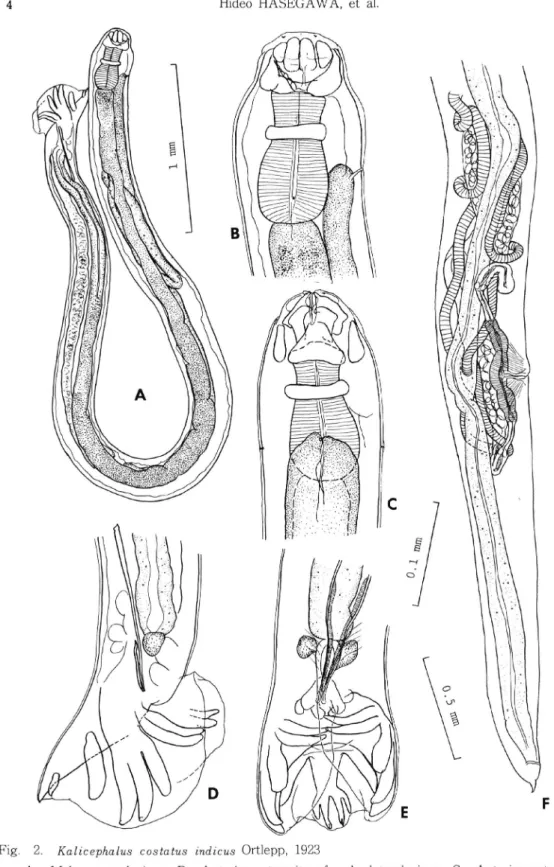
2. Kalicephalus costatus indicus Ortlepp, 1923 (Fig. 2)
Materials studied: 6 males and 7 females. Host: Opheodrys semicarinatus
Habitat: Small intestine.
Locality: Yona, Kumgami Village, Okinawa Prefecture. Date: July, 1981.
Body relatively stout, somewhat contracted probably due to inadequate fixation. Cervical region expanded. Face rounded, with inflated cuticle, directing almost anteriorly. Anterior chitinoid ridge wide. Posterior ventral and dorsal pieces large and a thick superficial welt connects them. Esophagus short, thick and with bulb. Excretory pore positioned anterior to middle of esophageal bulb. Cervical papillae located behind level of excretory
pore-Male: Ventral rays of bursa copulatrix almost same in length, run together with each other. Antero-lateral ray shortest among laterals. Medio-lateral and postero-laterals almost equal, diverging distally. Externo-dorsal ray originated near base of dorsal ray. Dorsal ray divided into two branches which immediately redivided into outer and inner offshoots. Inner offshoots divided distally. Spicules equal, alate, with spatulated tips. Gubernaculum prominent. Genital cone contracted in present specimens. Female: Body tapered to posterior end. Uteri prodelphic. Vulva slightly elevated. Tail conical,
Fig. 2. Kalicevhalus costatus indicus Ortlepp, 1923
A. Male, general view; B. Anterior extremity of male, lateral view; C. Anterior extremity of male, ventral view; D. Bursa copulatrix, lateral view; E. Bursa copulatrix, ventral view; F・ Posterior part of female, lateral view.
Kalicephalus from Okinawan snakes
with terminal spike.
Morphometric data are stated in Table 1.
K. c. indicus is widely distributed in Oriental and Australian areas. This species has been found not only from the snakes, but also from the lizards and even from a wild cat. The present worms have deeper buccal capsule and longer distance between the cephalic apex and the excretory pore than do the specimens from other countries (Hsu, 1934; Baylis, 1936; Schad, 1962). The inadequate fixation might cause these discrepancies but it may not be denied that these are due to the host or geographical variations. The snake, Opheodrys semicarinatus, is recorded as a new host of K. c. indicus. Although there has been no reliable report on K. c. indicus from Japan, Schad (1962) suspected that K. natricis Yamaguti, 1935 was this species in part.
3. Kalicephalus posteroγulvus Schad, 1962
(Fig. 3)
Materials studied: 10 males and ll females. Host: Nalri∬ pryen pryeri
Habitat: Esophagus.
Locality: Ada, Kunigami Village, Okinawa Prefecture. Date: July, 1981.
Body slim, almost straight in fixed condition. Face rounded, directing anteriorly or slightly tilted dorsally, with cuticle expanded medially and strongly inflated in corners. Anterior chitinoid ridge rounded. Posterior ventral chitinoid piece almost triangular, External edge of the posterior ventral piece rounded, without protrusions. Posterior dorsal piece narrow. Dorsal gutter long and with prominent internal ridge beaded weakly. Esophagus composed of relatively long neck and elongated bulb・ Excretory pore positioned anterior to middle of esophageal bulb. Cervical papillae present behind level of excretory pore. Excretory glands large and overlapping base of esophageal bulb.
Male: Body slender, tapered to anterior and posterior extremities. Antero-ventral and ventro-ventral rays of bursa copulatrix fused basally but separated distinctly through distal two-thirds. Lateral rays sharing a common base, divergent at same level, forming almost equal angles. Antero-lateral ray slightly shorter than other Antero-laterals. Externo-dorsal ray stout basally, curved and pointed distally. Dorsal ray branched two times: inner termination slightly distal to outer termination. Spicules equal, alate and pointed, Gubernaculum present. Genital cone short and thick. A pair of papillae on distal end of dorsal lip of cloaca.
Female: Body tapered to posterior end, Uteri prodelphic. Vulva far to posterior. Postvulval body lacks ovarian coils. Tail conical, simple and without terminal spike.
Measurements of worms are presented in Table 1.
K. posteroγulγus was first described on the materials mainly from Formosan snakes (Schad,
1962). The morphological and morphometrical features of the present worms are identical with those
桃欄朋冊
^
^
a
^
l
A_
ぼ
閥
欄
附
則
Fig. 3. Klicephalus posterovulvus Schad, 1962
A. Male, general view; B. Anterior extremity of male, lateral view; C. Anterior extremity of male, ventral view; D. Bursa copulatrix, lateral view; E. Bursa copulatnx, ventral view; F. Female, general view; G. Posterior part of female, lateral view.
Kalicephalus from Okinawan snakes s r o -寸 T . 0 Z E ' 0 -6 Z ' O s r o -z r o r;.寸t()-820 T 寸 0 -s e o Z ﹂ " 0 -O Z ' 0 8 S 0 -9 T O 6 2 0 -9 1 0 8 Z ' 0 -Z Z ' 0 8"5- ト.c c O f -E S x S 9 -8 S 9 I O -T I O I : 9 0 " ∞ -Z I " 9 zro-∞O.0 Z E 0 -6 Z O I S O -寸 N . 0 I S 0 -8 1 0 e r o -i r o 9 T " 0 -E T ' 0 9 N . 0 -9 1 0 2 9 - L Z 〓 s r o -e r o Z 寸 0 -S S ' O o r 0 -8 0 0 0 ﹂ " 0 -卜 Z . 0 ∞ z o -寸 Z . 0 6 T " 0 -i T ' O z r o -i r o e r o -z r o O Z ' 0 -s r 0 8 . 寸 -﹂ ・ ﹂ OT l J , d J l d f x a ご d x -i i j v h j s n i v y d a j -X y o v u q -v u , 3 ﹂ j , d i i a K j i d x i i j v f j s n / i i n d -0 1 3 J り o d -v T : x -m 3 u 9 ] i t p o q { B A j n A 一 s o d : q ; S u 3 ] A p o q ] E A [ r i A 3 j d s e p a s s a j d x a s i o i } b j p A │ n ^ 蝣 p a ; B ; s s s i A u s q 一 o s s a i u n u i u i u i s ; u 3 u r a i n s E a w 0 寸 -﹂ ﹂ x g ∞ I 6 9 6 r o -z . r o T ︰ C e t の -7 7 ' 7 G O O ∞ r o -s i o 2 S 0 -6 2 0 6 Z O -z z o L N . 0 -I Z ' O O Z " 0 -9 T ' 0 寸 N . 0 -6 1 0 6 E " 0 -I Z " O トト9-ト'寸 ト s r 0 -o r o ∞﹂'0-寸C.0 9I"0-寸TeO ∞ S 0 -9 S O 6 Z O -ト N e O s z 0 -o z o Z I " O -9 T " 0 i z -0 -6 r o L Z 0 -9 Z O 卜 蝣 f J - ト 、 t 7 ∽ 99-e寸X g∞Iのト OS0-Z20
i
^
o
s
-e
s
i
g r 0 -m T . 0 寸 C ' 0 -﹂ ﹂ " 0 6 S O -ト ﹂ O s s o -s z o 9 1 0 -寸 1 . 0 w サ : 6 Z 0 -9 Z O ト 7 , -Z L 寸 ZT0-600 ∞ Z 0 -9 S O s r 0 -o r o O の " 0 -6 Z O ∞ ﹂ 0 -9 ﹂ O E Z ' 0 -I Z ' O 寸 r o -z r o 9 I " 0 -E T O 9 2 0 -0 2 0 9 ' 9 - Z 9 ( j . u l r f ' s u O T S U 9 U I I P 軸 B 凹 q も u a i l i e i O T } E J I B A T n AsngEudosa 10 u;dim uintuixe∑
q;Su9i snSBudos凹
ajod Ajoisioxa o一
3 u u 9 A J 9 U O 一 x 3 d B o i r e u d a o u i o j t 3 o u e ; s i q e i n s d e o r e o a n q 1 0 m d a n J 9 ; 3 U I B i p D B 3 J 4 A p o q i o q ; p i M u i n ∈ ! X q M m 3 u 9 T A p o g p a j n s B 9 t u s u i j o m -蝣 0 m ︰ a r e u i a j ql叫U3T uinmoBujaqnf) t 1 品 u a i a m o i d c
snSBudoss 10 mpiM tununxF∑
m 3 u 9 i s n g B u d o s g 9 j o d A m 一 9 1 D X 9 0 } 曹 I U 3 A J 9 U O 一 x 9 d E o i r e u d s o E o j j 9 0 u b ; s ] q a m s c t e o p o o n q j o q ; d 3 Q l a i a u i e i p P B 3 H A p o q 1 0 m p i M . u i n u i p r e ] / ¥ j i n S u a i A p o 田 p a j r i s E a u j s u i j o m ' o j ^ 一 3 I B M り n f V U I X V 3 1 1 U 3 S s i C j p o d y d n s n o i p m s n j v j s o j -y s i s u a A v m u o s n i n s a j a d w i j b i s i s u a S u -i y S u n y s a v i a d i n -y D U E T S T B M B U I ﹄ O U I S 9 5 f B U S E O j i p g j a A o o s j d d s s n ] v y d 3 。 i ] v } ; j o j E } F p o p ; a u i o q d j o p ¥ [ x 8 W B ト
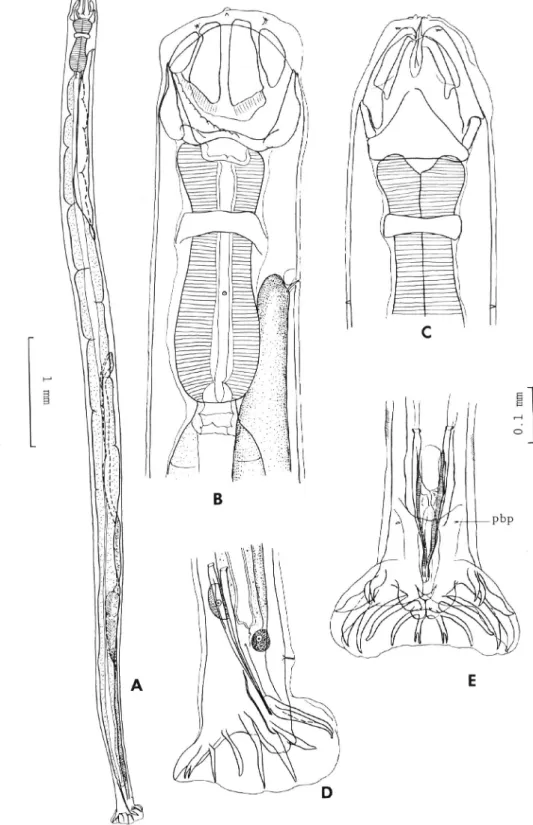
4. Kalicephalus brachycephalus Maplestone, 1931 Fig.4)
Materials studied: 3 males. Host: Natri.∬ pryen pryeri Habitat: Rectum (?)
Locality: Ada, Kunigami Village, Okinawa Prefecture. Date: July, 1981.
Body slim. Head very large. Face tilted slightly dorsally. Anterior ridge curved, narrow in width. Posterior dorsal piece crescent in shape. Posterior ventral piece elongated longitudinally. Weakly-developed superficial welt present between both posterior pieces. Dorsal gutter beaded. Anterior part of head strongly compressed laterally. Esophagus with long neck and elongated bulb. Excretory pore present in areas between nerve ring and middle of esophageal bulb. Cervical papillae present at level of esophageal bulb.
Male: Posterior margin of bursa copulatrix almost transverse. Bursal rays thin and fine. Ventral rays diverging distally. Lateral rays arising from a common trunk. Antero-lateral ray shortest among laterals. Dorsal ray relatively short. Dorsal ray divided into two inner and two outer branches at same level. Inner branches shorter than outer ones, redivided distally. Spicules almost equal, with spatulat-ed tips. Gubernaculum relatively large. Genital cone protrudspatulat-ed. A pair of small papillae present on dorsal lip of cloaca and one papilla on the ventral lip of it.
Morphological data are shown in Table
K. brachycephalus is characterized by a very large buccal capsule. The morphological appear-ances of the present materials are identical with the previous descriptions (Hsu, 1934; Schad, 1962), although the distance from the cephalic apex to the nerve ring and the excretory pore are slightly shorter. There has been no record of K. brachycephalus from Japan but Schad (1962) suspected that K. natricis Yamaguti, 1935 was this species in part.
Summary
Four Kalicephalus species (Nematoda: Diaphanocephalidae), i. e., K. γiperae chungkingensis Hsu, 1934 from Trimeresurus okinaγensis, K. costatus indicus Ortlepp, 1923, from opheodrys
semi-carinatus, K. posterovulvus Schad, 1962 and K. brachycephalus Maplestone, 1931 from Natrix pryeri
pryeri, were collected in Okinawa Island, Japan. K. c. indicus, K. posterovulγus and K-
brachy-cephalus were first recorded from Japan. T. okinaV 0. semicarinatus and N. p. pryeri were
recorded as the new hosts for K. γ. chugkingensis,K. c・ indicus, and K.posteroVulvus and K-
brachy-cephalus, respectively. The morphological characteristics of the worms were described and figured. Acknowledgements
The authors wish to express their gratitude to Prof. I. Miyagi, University of the Ryukyus, for his kindness in giving the snakes. They also thank Dr. A. Ichihara, the Meguro Parasitological Museum for his kindness in sending copies of papers on the subject.
Kalicephalus from Okinawan snakes
Fig- 4. Kalicephalus brachycephalus Maplestone, 1931
A. Male, general view; B. Anterior extremity of male, lateral view; C. Anterior extremity of male, ventral view; D. Bursa copulatrix, lateral view; E. Bursa copulatnx, ventral view.
References
1) Yamaguti, S∴ Studies on the helminth fauna of Japan. Part ll. Reptilian nematodes. Jap. J. Zool.
6, 393-402, 1935.
2) Fukui, T.: Parasites of Japanese reptiles. J. Yokohama Municip. Umv. 14(2), 123-140, 1963.
(In Japanese.)
3) Schad, G. A.: Studies on the genus Kalicephalus (Nematoda: Diaphanocephalidae). II. A tax-onomic revision of the genus Kalicephalus Molin, 1861. Can. J. Zool. 40, 1035-1165, 1962.
4) Kagei, N∴ The endoparasites of snakes in Japan. Snake 5, 141-150, 1973. (In Japanese.) 5) Telford, S. R∴ Studies on the parasites of oriental reptiles. I. Parasitology of the seasnake,
Laticauda semifasciata, in the vicinity of Amami Island, Japan. Jap. J. Exp・ Med. 37(3),
245-256, 1967.
6) Hori, E., Kaneko, K.: On the parasites of Habu, Trimeresurus flavoV蝣idis. Jap. J. Parasit.
18 (6, suppl.), 667, 1969. (In Japanese.)
7) Kamegai, SH H., Nonobe,汁, Kato, K.‥ On the parasites of Agkistrodon blomh占ffi (Boie) in Japan. Jap. J. Parasit. ll (4, suppl.), 39, 1962. (In Japanese.)
' Hsu, H. F.: On some Klaicephalus species from China with a discussion of certain systematic characters of the genus. Peking Nat. Hist. Bull. 8, 375-389, 1934・
9) Ortlepp, R. J.: Observations on the nematode genera Kalicephalus, Diaphanocephalus and Occi-。itod。ntus. g. n. and on the larval development of Kalicephalus philodryadus sp. n. J. Helminth. 1, 165-189, 1923.
10) Baylis, H. A∴ Fauna of British India, including Ceylon and Burma. Nematoda, Vole 1. (Ascandea
and Strongyloidea). Secretary of State for India in Council, London, 1936.
ll) Maplestone, P. A∴ Parasitic nematodes obtained from animals dying in the Culcutta zoological
gardens. Pts. 4-8. Rec. Ind. Mus. 33, 71-171, 1931.
Abbreviations used in figures: a. anus; al. antero-lateral ray; ap. anterior plates; ar° anterior chitmoid
ridge; av. antero-ventral ray; b. bursa copulatrix; c. cloaca; cp. cephalic papillae; d. dorsal ray; dei. deirid; dg. dorsal gutter; e. esophagus; eb. esophageal bulb; ed. externo-dorsal ray; ag. excretory glands; ep. excretory pore; f. face; gub, gubernaculum; i. intestine; ml. medio-lateral ray; nr, nerve ring; O. ovary; oj. ovijector; pbp. prebursal papillae; pdp. posterior dorsal piece; pi. postero-lateral ray; pvp. posterior ventral piece; r. rectum; sp. spicule(s); t. testis; u. uterus; va. vagina; vl. vulva; vv. ventro-ventral ray.