2014 Year (Heisei 26 Year) Doctoral Dissertation
A Study toward Community Involvement in Local Flood Risk Reduction Activities: Case Study Flood Situation in 2011,
Thailand
Ritsumeikan University Graduate Schools Graduate School of Policy Science RAUNGRATANAAMPORN I-soon
5831110011-2
Contents
Table of contents i
List of figures iii
List of tables v
List of abbreviations viii
Acknowledgement ix
Abstract x
Preface xiii
1. Introduction 1
1.1 Research questions and research objectives 1
1.2 Flood management policy in Thailand 6
1.3 Flood incidence in Thailand in 2011 24
2. Integrating the theory of planned behavior and flood risk 40 acceptability to determine willingness to involve in
CBDRR
2.1 The importance of communities-municipality collaborating 40 in Community Based Disaster Risk Reduction
2.2 Roles of community in supporting the building of disaster resilience 42 2.3 Community becoming key stakeholders in minimizing losses 51
in disaster situation
2.4 Integrating the theory of planned behavior and flood risk acceptability 63 for speculating on motivation of community action through CBDRR
2.5 Social pressure, personal attitude, and self-evaluation affecting 68 community willingness to involve in CBDRR activities
3. Community involvement in CBDRR activities 73 during flood incident
3.1 Community performance in responding to flood incident 73 3.2 The title role of community in providing information and manpower 75
during disaster at the municipality level
3.3 Community members were not ready for flood response 93
3.4 Indicators influencing community to respond during flood incident 103 3.5 Community temporal collaborate with municipality during flood 110
4. Factors motivating community involvement in CBDRR 114 During the normalcy
4.1 Introduction of possible factors motivating community to involve in 114
CBDRR during the normalcy
4.2 Community answered they unwanted to involve in CBDRR 116 4.3 Summary efficient factors motivating community to involve in 119
CBDRR during normalcy
4.4 Effect of social pressure, self-evaluation and attitude toward risk on 131 CBDRR
4.5 Robust effect of public opinions and anxiety on CBDRR 168
5. Conclusion 172
5.1 Summary of conclusion and findings 172 5.2 Policy implications: Recommendation for community-municipality 180 collaboration in disaster risk reduction
5.3 Research limitations and further study 183
References 186
Appendix 1 Information relevant to public perception of flood incident 194 In the 2011 Thai flood
Appendix 2 Questionnaire Survey Roles of municipality 201 in flood response activities Appendix 3 Questionnaire Survey A Study towards Public Involvement 205
in Comprehensive Flood Disaster Management:
Perception of Risk Acceptability in Urban Flood Risk Area
Lists of figure
Fig. 1.1 Research framework 4
Fig. 1.2 Economic loss due to flood incident during 1989 to 2011 7 Fig. 1.3 Amount of relief allocation provided by department of Disaster 11 Fig. 1.4 Classification of Duty in National Headquarter of Disaster 13
Management in Thailand
Fig. 1.5 Command system in disaster response of Thailand 15 Fig. 1.6 Executive organization in Bangkok Metropolitan Administration 19 Fig. 1.7 Incident Command System (ICS) and on-site single command 21 Fig. 1.8 Executive units under the single command system 23 Fig. 1.9 Track map of five tropical storms in 2011 25 Fig. 1.10 Comparison in average household income before and after 27
case of Flood incident in 2011
Fig. 1.11 Comparison between damage cost in housing, vehicle and 28
furniture classified by region
Fig. 1.12 Comparison between unemployment rate before 28 and after flood incident in 2011
Fig. 2.1 Study diagram in Chapter 2 41
Fig. 2.2 Theoretical framework in analysis of intention to take action 70 in disaster risk reduction at the level of self-help and mutual-help
Fig. 3.1 Study diagram in Chapter 3 74
Fig. 3.2 Relationship between SNAP and National Preparation plan 76 Fig. 3.3 Operation procedures and plan revision under SNAP 77 Fig. 3.4 Linkage between government and external organs in disaster 82
collaboration under SNAP plan
Fig. 3.5 Location of Pak Kret Municipality, Nonthaburi Province 84 Fig. 3.6 Flood history in Pak Kret Municipality between 2006-2011 85 Fig. 3.7 Histogram and normal Q-Q plot of time to starting response 97
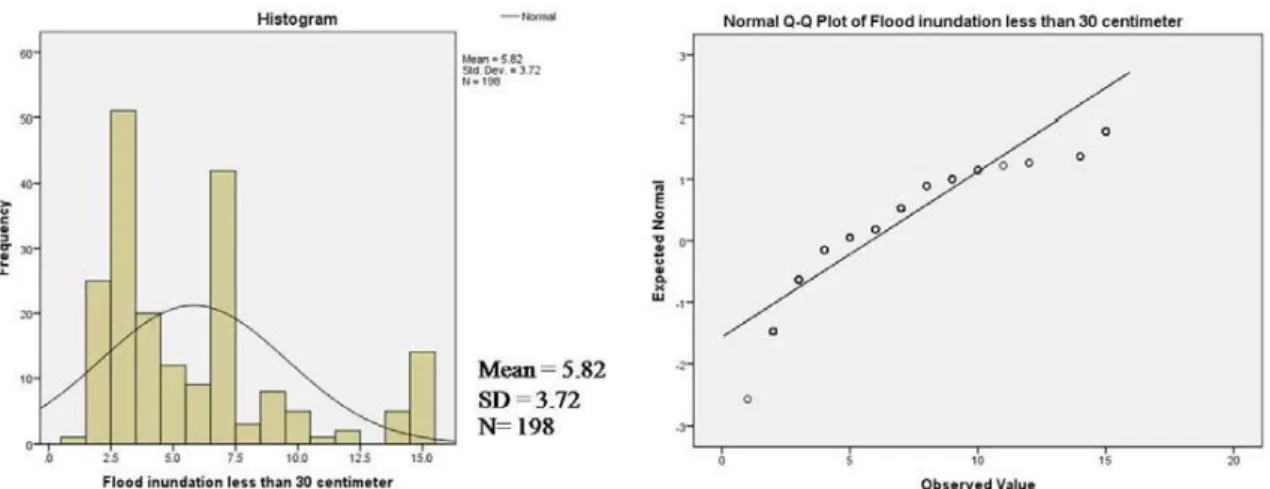
after flood had inundated at 0-30 CM
Fig. 3.8 Histogram and normal Q-Q plot of time to starting response 97 after flood had inundated at 31-60 CM
Fig. 3.9 Histogram and normal Q-Q plot of time to starting response 97 after flood had inundated at 61-90 CM
Fig. 3.10 Perception of flood preparation activates of respondents in 101
Pak Kret Municipality
Fig. 3.11 Perception of flood response activities of respondents in 102
Pak Kret Municipality
Fig 4.1 Study diagram of chapter 4 115
Fig. 4.2 Histogram and normal distribution plot of leadership 128 and performance of government and supporters (X1)
Fig. 4.3 Histogram and normal distribution plot of reliability 128 and transparency of information (X2)
Fig. 4.4 Histogram and normal distribution plot of fear 128 and anxiety toward flood disaster (X3)
Fig. 4.5 Histogram and normal distribution plot of Expectation 129 of relief and damage (X4)
Fig. 4.6 Histogram and normal distribution plot of 129 Effect from other people (X5)
Fig. 4.7 Histogram and normal distribution plot of Characteristics 129 of flood risks (X6)
Fig. 4.8 Histogram and normal distribution plot of Source of 130 information (X7)
Fig. 4.9 Histogram and normal distribution plot of Personal 130 understanding and flood experience (X8)
Lists of Table
Table 1.1 Summary of research questions and research objectives 2 Table 1.2 Level of severity, vulnerability, management, risk 6
and weight score classify by types of hazard
Table 1.3 Chronology of legal basis relevant to flood-related issue 9 during 1900 2012
Table 1.4 Content of Disaster Department and Mitigation Plan 12 Table 1.5 Actors in Incident Command System 23 Table 1.6 Percentage of flood affected household categorized by illness and 26 causalities
Table 2.1 component of resilience 43
Table 2.2 Variables, assumptions and operationalization in social resilience 47 Table 2.3 Assumption and implication/conclusion in disaster response 49
based on traditional model
Table 2.4 Assumption and implication/conclusion in disaster response 50 based on professional model
Table 2.5 Comparison between strength and weakness of traditional model 51 and professional model
Table 2.6 Broad typology of institutions identified with disaster 53 and development strategy
Table 2.7 Three faceted of self-help, mutual help and public help 56 in emergency and recovery
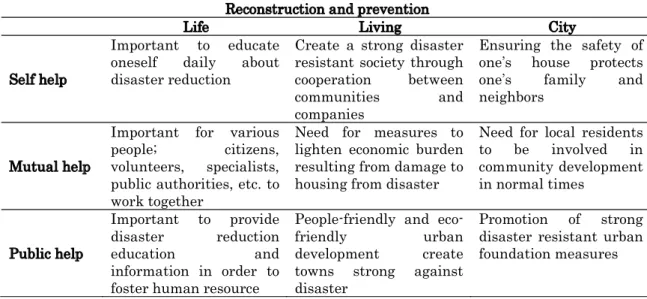
Table 2.8 Three faceted of self-help, mutual help and public help 57 in reconstruction and prevention
Table 2.9 Level and application of three-level of disaster risk reduction 57 Table 2.10 Examples of community involvement in disaster risk reduction 58 Table 2.11 Characteristic of participation toward ladder of participation 59 Table 2.12 Comparison between applications of disaster management 61
based on ladder of participation
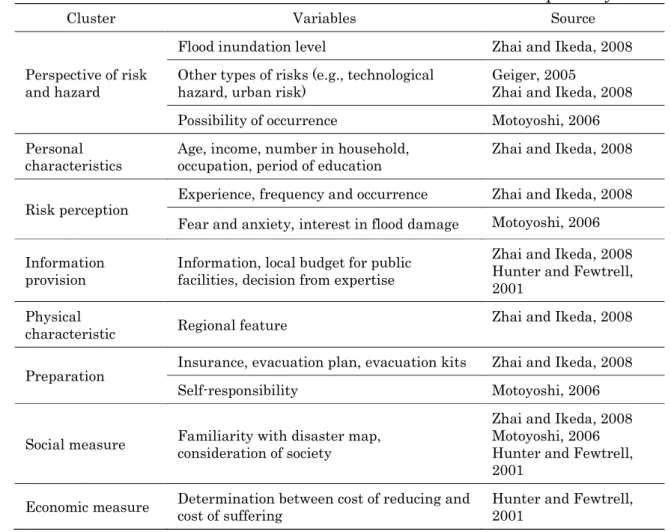
Table 2.13 Classification of variables in relevance to flood risk acceptability 67 Table 3.1 Activities stated in Strategic National Action Plan (SNAP) 78
in 2010-2019
Table 3.2 Investigation into the collaboration between government and 82 community in disaster management policy in Thailand Table 3.3 Usual tasks in each organ under municipality 86 Table 3.4 Activities in divisions toward tasks in Pak Kret model 89 Table 3.5 Basic information of respondent 94 Table 3.6 Starting date to take response during flood incident classify 96
by level of flood inundation
Table 3.7 Comparison between stakeholders in flood management activity 99 Table 3.8 Comparison between influencing factors toward decision of 100
involvement Table 3.9 Correlation between dates of starting to respond 106
and personal characteristic in Pak Kret municipality classify by level of flood inundation
Table 3.10 Correlation between influencing factors 109 and flood inundation level in Pak Kret municiality
Table 4.1 Data of respondents in Pak Kret Municipality, 117
Nonthaburi Province
Table 4.2 Intention of respondent to take action for flood risk reduction 119 Table 4.3 Average score and standard deviation of attitude in relevance to 121
Flood preparation
Table 4.4 Kaiser-Meyer-Olkin Measure of Sampling Adequacy 122 Table 4.5 Classification of variables into factors 123 Table 4.6 Factors, component variables, average score and 126
standard deviation of grouped factors
Table 4.7 Result of normality test for each group factor 127 Table 4.8 Classification of variables in this analysis 131 Table 4.9 Cross tabulation between predicted and observed data for the 134
decision to share information in relevance to flood situation between the constant model and predictor model
Table 4.10Coefficients of the model predicting toward decision to 136 sharing information in relevance to flood situation
Table 4.11Cross tabulation between predicted and observed data for the 138 decision to Donate stuff to flood victims in relevance to
flood situations
Table 4.12 Coefficients of the model predicting toward decision to 139 donate stuffs to flood victims
Table 4.13Cross tabulation between predicted and observed data for the 141 decision to be volunteer to help community
Table 4.14Coefficients of the model predicting toward decision to 142 be volunteer to help community
Table 4.15Cross tabulation between predicted and observed data regarding 144 the decision to check survival kits
Table 4.16 Coefficients of the model predicting the decision to 145
check survival kits
Table 4.17 Cross tabulation between predicted and observed data regarding 148 the decision to plan evacuations
Table 4.18 Coefficients of the model prediction for decision to 149 plan evacuations 194
Table 4.19 Cross tabulation between predicted and observed data regarding 151 the decision to apply insurance
Table 4.20 Coefficients of the model predicting the decision to 152 apply insurance 197
Table 4.21 Cross tabulation between predicted and observed data regarding 155 the decision to apply sandbags for flood protection
Table 4.22 Coefficients of the model predicting the decision to 156
apply sandbags for flood protection
Table 4.23 Cross tabulation between predicted and observed data regarding 158 the decision to participate in evacuation drills
Table 4.24 Coefficients of the model predicting the decision to participate 159 in evacuation drills
Table 4.25 Cross tabulation between predicted and observed data 162 regarding the decision to participate in Community-Based
Disaster Risk Reduction (CBDRR) activities
Table 4.26 Coefficients of the model predicting the decision to participate 163 in Community-Based Disaster Risk Reduction (CBDRR) activities Table 4.27 Cross tabulation between predicted and observed data 165 regarding the decision to volunteer for cleaning or recovery after
flood incident
Table 4.28 Coefficients of the model predicting the decision to 167 volunteer for cleaning or recovery after flood incidents
Table 4.29 Summarize relevant factors which influence the intention to 171 participate in flood risk reduction
Abbreviations
ADPC - Asian Disaster Preparedness Center
ANCHOR - Academic Network for Community Happiness Observation and Research
BMA - Bangkok Metropolitan Administration CBDRR - Community-Based Disaster Risk Reduction
DDPM - Department of Disaster Protection and Mitigation FEMA - Federal Emergency Management Agency
FROC - Flood Relief Operation Center
GFDRR - Global Facility for Disaster Reduction and Recovery
GISTDA - Geo-Informatics and Space Technology Development Agency HFA - Hyogo Framework for Action
ICS - Incident Command System
IFRC - International Federation of Red Cross and Red Crescent Societies IGR - Inter-Governmental Relation
IHDP - International Human Dimensions Programme on Global Environmental Change
IPCC - Intergovernmental Panel on Climate Change MAC - Multi-Agency Coordination Centre
MoE - Ministry of Education
NESDB - Office of the National Economic and Social Development NSO - National Statistic Office
OTOS - One Tambon One Service
PAO - Public Administration Organization RAST - Radio Amateur Society of Thailand
SC - Single Command
SCWRM - The Strategic Committee for Water Resource Management SNAP - Strategic National Action Plan for Disaster Risk Reduction SOP - Standard Operating Procedure
TMD - Thailand Metrological Department
UNDP - United Nations Development Programme
UNFCCC - United Nations Framework Convention on Climate Change UNISDR - The United Nations Office for Disaster Risk Reduction
Acknowledgement
This research did not finish unless valuable effort and support from many people. First of all, I would like to gives my appreciation to my two supervisors, Prof. KAMIKO Akio and Prof. Hidehiko KANEGAE from Graduate School of Policy Science, Ritsumeikan University. Their experience and knowledge are motivating and open my perspectives toward public administration and disaster management and I will adapt and continue for further study in the future
I would like to gives my appreciate to Prof. MURAYAMA Hiroshi, Prof.
MATSUOKA Kyungmi, Prof. ODA Hisaya, Prof. NISHIMURA Yozo, Prof. Salem Kim HICKS, Prof. Masato KAMIKUBO, Prof. Yoko OTSUKA, Prof. Katsuki TAKAO, Prof. Monte CASSIM, Prof. SHIBATA Akira, Prof. Kenichi NAKAGAMI, Prof. Kmiko SHIKI, and Prof. Yusuke TOYODA for encouragement, inspiration, give valuables comment and suggestion in this research.
I appreciate to Assoc. Prof. Dr. Chaweewan DENPAIBOON and Dr.
Thongchai ROACHANAKANAN for supporting me since I study in Bachelor Degree. I also would like to show appreciation to key informants, Ms. Petchda Vejsri, Head Office of Plan division and Ms. Kanchana Vilairat, Head Office of Social Welfare, Pak Kret Municipality and respondents who contribute data and information for fulfill in this research. Also I appreciate to Japanese Government to provide Monbukagakusho: MEXT scholarship to me during study in Japan. I also appreciate to staffs of Disaster Mitigation of Urban Cultural Heritge (Rits- DMUCH), Project room 2 staffs, and staffs of graduate School of Policy Science, Ritusmeikan University for pleasant support.
I am thankful to my family, Thai, Japan and foreign friends, and juniors for giving good encouragement and support for me to complete my research. All of yours efforts are helping me to pass and overcome to those difficulties, barrier, and challenges during study abroad. I got memorable moments in my life while I stay in Japan. Thank you very much
A Study Toward Community Involvement in Local Flood Risk Reduction Activities:
Case Study Flood Situation in 2011, Thailand
RAUNGRATANAAMPORN I-soon Student ID: 5831110011-2
Abstract
Public participation in disaster management was stated as a crucial aspect toward current issue in comprehensive disaster risk reduction activities.
It became more crucial component since response and recovery provided by government and authorities were reaching the limit. There were some difficulties and conflicts happened during flood incident in 2011 Thailand. Community members who lived in flood affected area, tried to cope and collaborate with municipality to respond during flood incident. The study aims to confirm factors which many previous studies pointed out motivating community members to be involved in flood risk reduction activities at community level.
This study focused on the post period of flood incident between 2013 - 2014 as not recovering but normal period. The study is based on two theories: 1) TPB based on Ajzen and Fishbein (1985), and 2) Flood Risk Acceptability (Slovic, 1974; Hunter and Fewtrell; 2001, Geiger; 2005). In the concept of TPB; there are three components: 1) Attitude toward risk: It covers characteristic of flood risk, expectation on damage, and fear and anxiety; 2) Self-estimation: It contains experience, interest toward risk reduction, understanding toward flood risk; and 3) Social pressure: It means effect from other people, reliability of information, and leadership of service provider. In the concept of Flood Risk Acceptability, the case study applied relevance factors to Flood Risk Acceptability which Zhai and
Ikeda (2008) mentioned: It treats flood risk perception, personal characteristic, and flood disaster experience. Also, the case study considered factors that Motoyoshi (2005) pointed out as follows: fear, consideration of society, risk perception, trust in administrative organization, cost and benefit, and subjective norm.
The study applied 22 variables related with Flood Risk Acceptability to identify factors that influenced community members to respond during flood incident. The study distributed questionnaires randomly to 200 respondents during August-September in 2013. Based on the concept of Flood Risk Acceptability, the study had adopted variables to analyze the correlation between influence factors that are personal characteristic (7 variables), flood risk perception (4 variables), flood disaster experience (1 variables), effects from other people or information sources (4 variables), fear, and uncertainties and expectation (3 variables), and the number of starting dates to respond. The analysis was classified by level of flood inundation (3 variables). The results confirmed that personal characteristic and flood disaster experience have significantly negative correlation to the starting dates to respond since flood started to inundate.
The study applied 10 kinds of flood risk reduction activities. The factors that could predict taking the activities were fear and anxiety toward flood situation and effect from other people (4/10 of flood risk reduction activities were significantly predicted). Second was understanding and experience toward flood situation (3/10 of flood risk reduction activities were significantly predicted) and third was Reliability and transparency of information (2/10 of flood risk
reduction activities were significantly predicted). Among flood risk reduction activities that community members tend to act, the factors significantly predictable were "Using sandbags or water pumping for flood protection" (4/8 of factors predicted with significant level at 0.05). "Sharing information", "Apply insurance" and "Participating in evacuation drill" (2/8 of factors predicted with significant level at 0.05) Based on TPB, some components could be applied for predicting intention of community member towards decision to take flood risk reduction activities.
This dissertation contributed to confirm that TPB and Flood Risk Acceptability are applicable for a Thai case. The dissertation also achieved to establish the conceptual framework to identify intention of community members to be involved in flood risk reduction activities based on TPB and Flood Risk Acceptability. The dissertation also identified types of flood risk reduction activities that community members are able to collaborate with municipality officer based on SNAP for Disaster Risk Reduction. The dissertation confirmed that both of personal characteristic and flood disaster experience significantly correlated to Flood Risk Acceptability. Finally, the dissertation confirmed three components in TPB were able to predict intention of community members to take flood risk reduction activities in Thailand for responding to the next flood incident.
Preface Rationale of Studies
Disaster management has become a hot issue in urban development and human security since threats from hazards and vulnerability are increasing, and have caused the damage from natural disasters to become more severe, and it has become crucial to lower the socio-economic loss. Disaster, is defined as a serious disruption to the functioning of a community or a society involving widespread human, material, economic or environmental losses and having an impact which exceeds the ability of the affected community or society to cope using its own resources (UNISDR, 2009). Hazards, are defined as a dangerous phenomenon, substance, human activity or condition that may cause loss of life, injury or other health impacts, property damage, loss of livelihood and services, social and economic disruption, or environmental damage (UNISDR, 2009). In 2005, the United Nations Office for Disaster Risk Reduction (UNISDR) established a model for disaster management called the Hyogo Framework for Action (HFA). This framework was determined to be the baseline of disaster management, and community involvement towards disaster management, thus it became a crucial aspect of tackling threats from disasters and hazards in the peaceful time of the non-disaster phase. The Hyogo Framework for Action stated that approaches such as increasing capacities of community members in disaster preparedness, adaptive behaviors to reducing risks, knowledge transfer from disaster stakeholders, and concern from the next generations are primary tasks to apply on the community level as Community-Based Disaster Risk Management (CBDRM). To achieve successful disaster management on the local
level, external organizations such as the government, non-profit organizations (NPOs), the academic sector and the private sector are encouraged to cooperate with the community and municipality in order to increase the capability of the community to reduce the risk and handle the damages and losses caused by disaster. Thailand adopted the Hyogo Framework of Action to be implemented in the case of disaster management as a Strategic National Action Plan (SNAP) for the period from 2010-2019.
Thailand has experienced flooding since ancient times, with the annual monsoons as the crucial factor. This circumstance happened in case of flooding in 2011; there were five tropical monsoons during 25th July 2011 16th January 2012 which originated from the northern region in August and became severe in September which caused floods throughout the central region of Thailand of approximately 14,241 Square Kilometers in November 2011. The affected area of flooding covered 65 provinces and killed 657 persons at that time. The case of Thailand flooding in 2011 drew attention among scholars and communities towards finding improvements in regional watershed management in the future.
Basically, the perception towards water management in Thailand was more concerned with the water scarcity issue in drought period rather than the issue of excessive water in the monsoon period, and the perception in flood disaster relief was addressed as the social welfare relief activity. As a result, the flood disaster management was concerned with a defensive approach rather than an offensive approach. The aspect of multi-boundary management was stated as one necessary factor in large-scale disaster management; there was no organization that could deal with flood situation as a cross-jurisdiction organ in a professional
way, although each governmental organ and division had data and information related to the flood situation the linkage between those organs was not found.
Moreover, the non-clarity of information, belated information and miscommunication among media and people occurred often which led to misunderstanding towards the real situation of disaster.
Due to the political unrest in Thailand caused by different political perspectives, the political conflicts in Thailand had emerged in 2004, seven years before the flood incident started in 2011. These political conflicts had widespread consequences through other policies in Thailand after 2004 in relevance to the seeking for political advantage in political interest groups and continuity of policies implementation. The political unrest also affected the management of the flood in 2011. Although Thailand had adopted disaster management policies at an international level and tries to applying them at a local level, failure in terms of policy implementation, precisely in case of political conflicts, are undermining the effectiveness in policy implementation. Moreover, considering the disaster situation itself, there has been political failure in terms of the implementation and this has affected the ability of the response by remaining resources.
The effort of local community and municipality toward disaster risk reduction was found during the flood incident in 2011. Municipalities tried to cope during the flood incident by their own resources and encourage local community to participate in disaster response plan. Collaboration among stakeholders in municipalities happened since it was stated as an important component in comprehensive disaster risk reduction and management. Thus, study toward public involvement in disaster risk reduction is necessary to realize
how people react towards threats of forthcoming hazard, what kind of decision that they made to minimize damage caused by floods and consequential hazards, and how do they decide to take action. These are also important to realize the current situation of disaster risk reduction effort in the community as well.
Concept of Study
This research discusses the circumstances of the Thai flood in 2011 and Flood policy in Thailand before flooding in 2011, discussion of policy and practice, precisely in case of policy failure in terms of implementation in disaster response is discussed. Moreover, the intention of local people to take action in flood situations after the 2011 flood is reviewed. The originality of this research is the discussion between policy and practice in the case of the flooding in Thailand in 2011, and the intention to take action in relevance to flood response and flood risk reduction activities in flood prone communities. This research tries to debate the circumstance of community involvement toward flood risk reduction and response. There are four research questions as follows (1) How important is community collaboration in disaster risk reduction activity (2) How far can a community members could be involved in disaster management plans at the community level (3) What kinds of factors influence people to respond during flood incidents and (4) What kinds of intention motivate people to take action in flood preparation activities in comprehensive flood disaster risk reduction There are five chapters in this research as follows:
Chapter I will describe research questions, research objectives, research framework, and definition of key concepts. Also the basic ideas of flood disaster policy in Thailand and the situation of flooding in Thailand in 2011 is reviewed in this chapter.
Chapter II will describes various concepts in relevance concepts of flood risk acceptability and Theory of Planned Behavior (TPB) and establish tries to link between these major concepts to establish theoretical framework in this research.
Chapter III will examine between Strategic National Action Plan and flood disaster response in local level. This chapter also compares the different intentions of local people to taking preparation in flood situations and the relationship between personal characteristics and influencing factors that affect the decision to respond during flood incident.
Chapter IV will discuss intention of local people to take flood risk preparation in urban flood prone areas. This chapter applies the concept of decision analysis and flood risk acceptability to analyze the intention of local people to decide to prepare or be involved in Community-Based Disaster Risk Reduction activities.
Chapter V will summarize the research output in chapter II to Chapter IV in relevance to community involvement toward disaster risk reduction
plan at the municipal level, intention to respond and intention to take action toward flood risk reduction activities and intention of Community- Based Disaster Risk Reduction (CBDRR). This section also gives suggestions for future studies in regards to the disaster resilience concept and flood risk acceptability.
1. Introduction
1.1 Research questions and research objectives 1.1.1 Research questions
The aim of this research is to figure out the motivation of community members in flood prone area deciding to involve in flood risk reduction activities.
This study had select case of flood incident in 2011 in Thailand to explain what happened during the flood situation in Thailand in 2011 and the consequences due to the constraints of flood management provided by the government in 2011 flooding case, there are four research questions which can be stated as follows
(1) How to integrate Theory of Planned Behavior (TPB) and Flood Risk Acceptability to identify willingness of community members to involve in flood risk reduction activities
(2) How can community members involve in flood risk reduction activities during flood incident
(3) What factors influence community members to respond during flood incident based on Flood Risk Acceptability
(4) What factors do motivate communities members to involve in flood risk reduction activities in normal period based on TPB
1.1.2 Research objectives
This research was divided into five chapters; Chapter 1 to Chapter 5, but the evidences to answer research questions are contained in Chapter 2 to Chapter 4. There are six objectives in this research which could be described in table 1.1
Table 1.1 Summary of research questions and research objectives
Research question Research objectives Chapter
To establish the conceptual
framework based on TPB and Flood Risk Acceptability for investigating intention of community members to involve in flood risk reduction activity
Chapter 2
To identify types of flood risk reduction activities that
communities be able to involve in current disaster management plan.
Chapter 3 To find out how early the
community members starting to respond during flood incidents.
To analyze the relationship between personal characteristics, influence factors, and the starting dates to respond since flood incident start based on Flood Risk Acceptability
To identify factors that motivates community members to involve in flood risk reduction activities based
on TPB Chapter
To predicting the intention of 4 community members to involve in flood risk reduction activities based on TPB
Source: Author, 2014
1.1.3 Research hypotheses
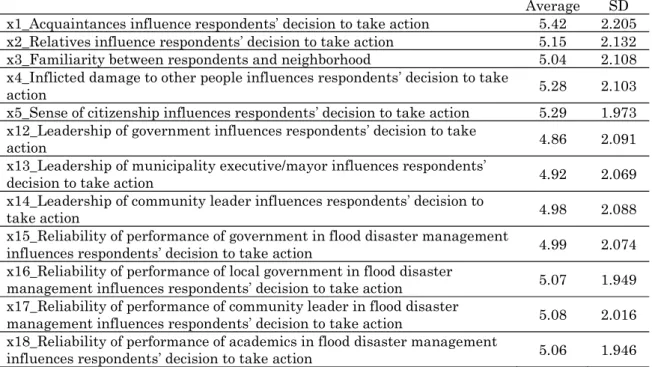
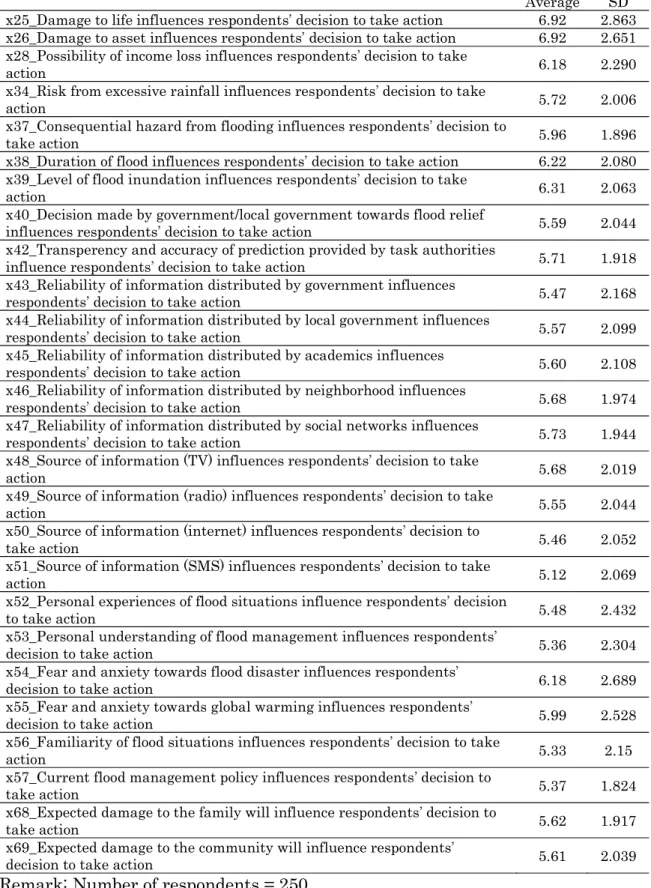
The research hypothesis in this study had being mentioned in research question 4; What factors do motivate communities members to involve in flood risk reduction activities in normal period based on TPB In research question no 4: To identify factors that motivate community members to involve in flood risk reduction activities based on TPB. These eight types of influencing factors are 1) Leadership and performance of government and supporters, (2) reliability and transparency of information, (3) fear and anxiety toward flood disaster, (4)
expectation on relief and expected damage, (5) effects from other people, (6) characteristic of flood risk, (7) source of information, and (8) experience and understanding of respondent toward flood disaster. All factors have being test in this research. The hypothesis has set and could described as follows;
Leadership and performance of government and supporters Reliability and transparency of information Fear and anxiety toward flood disaster Expectation on relief and expected damage Effect from other people Characteristic of flood risk Source of information Experience and understanding
Leadership and performance of government and supporters Reliability and transparency of information Fear and anxiety toward flood disaster Expectation on relief and expected damage Effect from other people Characteristic of flood risk Source of information Experience and understanding
This research had adopt and applied Theory of Planned Behavior (TPB) and Flood Risk Acceptability to identifying factors that influence community members to involve in flood risk reduction activities.
4
1.ra1.orewmk fhrceaes3 R k orch Framew Resear 1.1Fig. Source: Author, 2014
1.1.4 Published papers
To achieve this research, the following research papers were published as supplementary to this research
(1) I-soon RAUNGRATANAAMPORN, (2014), An Investigation of the Circumstances of Flood Response in Thailand-Case Study of the Flooding Situation in 2011, Journal of Policy Science, Vol.21 No.2, February 2014, pp. 43-66 In Chapter 1 and 3
(2) I-soon RAUNGRATANAAMPORN, Penpathu Pakdeeburee, Akio Kamiko,, Chaweewan Denpaiboon (2014), Government-Communities Collaboration in Disaster Management Activity: Investigation in the Current Flood Disaster Management Policy in Thailand. Procedia of Environmental Science (2014), pp. 622-631 In Chapter 2 and 3
(3) I-soon RAUNGRATANAAMPORN, (2014), Determination towards Decision of Public Response in Flood Situation: Case Study in Urban Flood Prone Area in Central Region in Thailand. Applied Environmental
Research, ( ) In Chapter 3
1.2 Flood management policy in Thailand
Thailand is located in low land area and had often affected by tropical storms and flash flood annually. Flood had been considering as a severe threat of natural disaster compared to other kinds of hazards (UNDP, 1994). According to table 1.1 shows that the weight score of risk in hydrological hazards such as flooding (W Flooding=2.39), typhoons (W Typhoon=2.31) and tropical storms are having higher weight score compared to other kinds of risk (i.e., W Accident=2.37; W
Drought=2.24; W Earthquake=1.97) Moreover, the level of severity and risk are high while the level of hydrological management are at a moderate level.
Consequential hazards such as mudslide, landslide and river floods can happen when torrential rainfall occurs.
Table 1.2 Level of severity, vulnerability, management, risk and weight score classify by types of hazard
Types of risk Level Overall Weight
score Severity Vulnerability Management Risk
Flooding High Moderate Moderate High High 2.39
Typhoon and
tropical storm High High Moderate Moderate Moderate 2.31
Earthquake Low Low Bad Moderate Moderate 1.97
Mudslide Moderate Low Bad Moderate Moderate 2.15
Drought High Moderate Moderate Moderate Moderate 2.24 Conflagration High Moderate Moderate Moderate Moderate 2.2
Explosions High Moderate Bad High High 2.34
Accidents High Moderate Bad High High 2.37
Human
disease Low Low Moderate Low Low 1.63
Plant disease Moderate Low Low Moderate Moderate 1.77 Civil unrest Low Low Low Moderate Moderate 1.87
Refugee Moderate Low Moderate Moderate - -
Source: Strategic National Action Plan (Thailand), 2010
Threats from flood risk also affecting to human security and economic development. According to data of economic loss stated by the Office of the
National Economic and Social Development (NESDB) shown that the trends of economic loss due to flood incident during year 1989 to year 2011 (national level) has increased (Fig. 1.2) Economic loss due to flood incident dramatically increased during the year 2009 to year 2011
Fig. 1.2 Economic loss due to flood incident during 1989 to 2011 Source: Office of the National Economic and Social Development, 2013
1.2.1 Flood policy in Thailand had change since 1990 (1) Legal basis
The legal basis relevant to floods in Thailand has changed from an irrigation-oriented approach to flood protection system and then has changed to comprehensive disaster management approach since 1990. The contents and intention of the legal basis of Thai regulation since the year of 1960 to 2012 could be split into three periods as follows:
First period (During 1960-1970) the intention of the legal basis in relevance to flood management policy is related to irrigation-based management.
Precisely, water discharge for irrigation and flood safety are stated in those acts.
- 5,000.00 10,000.00 15,000.00 20,000.00 25,000.00 30,000.00
1989 1990 1991 1992 1993 1994 1995 1996 1997 1998 1999 2000 2001 2002 2003 2004 2005 2006 2007 2008 2009 2010 2011
Value (Million THB)
Year
Economic loss due to flood incident during 1989 to 2011
Economic cost (milion THB)
Linear (Economic cost (milion THB)) Year of severe flood incident (Bangkok and vicinity)
For example, the Canal Treatment Act (1902), Irrigation Act (1939), Royal Irrigation Act (1942), Municipality Act 1953 (Revised 2010), Bank for Agriculture and Agricultural Cooperatives Act (1966), Electricity Generating Authority of Thailand Act (1968).
Second period (1970-1990) the flood management issues had changed and become more specific in flood control. Contents and intention in regulations are not only concerning water discharge and water management but the contents that relevance to mitigation in urban planning and flood relief, has been considering in flood management issue. For example, the Town Planning Act (1975), Groundwater Act (1977), The Civil Defense Act (1979), Canal Treatment Act (1983), and Bangkok Metropolitan Administration Act (1985). Moreover, some regulations are assigning tasks to municipalities and Bangkok Metropolitan Administration to prepare and respond during flood incidents within its jurisdiction.
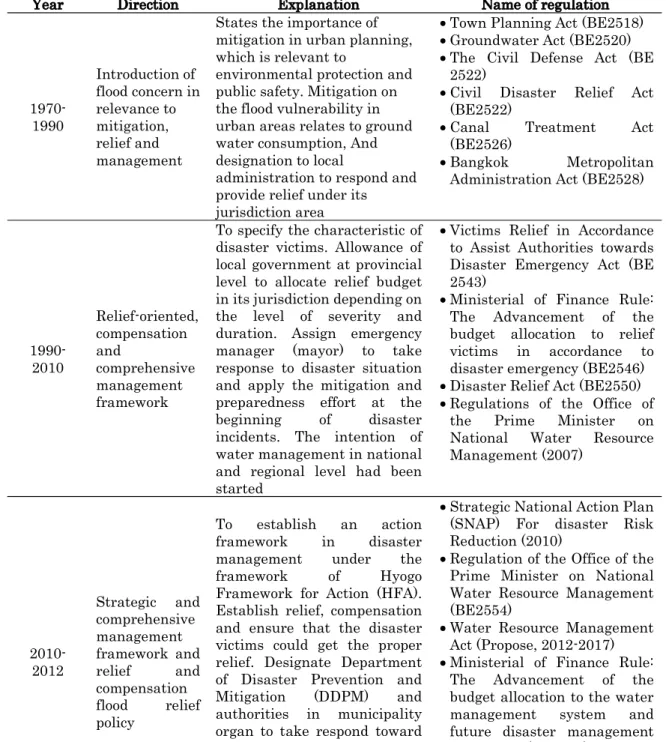
Third period (1990-2000) the intention of flood regulation in Thailand had been changed to a more relief-driven approach. Especially focusing on providing relief and subsidize efforts to people who are affected by disaster. For example, the Victims Relief in Accordance to Assist Authorities towards Disaster Emergency Act (2000), Ministerial of Finance Rule: The Advancement of The Budget Allocation to Relief Victims in Accordance to Disaster Emergency (2003), Disaster Relief Act (2007), and the Regulations of the Office of the Prime Minister on National Water Resource Management (2007). The government had enacted other four regulations in 2010, which relates to budget allocation and subsidizes the affected people. For example, Ministerial of Finance Rule: The
Advancement of the Budget Allocation to the Water Management System and Future Disaster Management Framework (2012), Ordinance of Promotion of Disaster Insurance (2012), and the Ordinance of Subsidize to Victims from Flood (2012). Moreover, the Thai government is implementing Strategic National Action Plan (SNAP) for Disaster Risk Reduction as the operation framework for comprehensive disaster management. (i.e., Strategic National Action Plan (SNAP) for Disaster Risk Reduction (2010), Regulation of the Office of the Prime Minister on National Water Resource Management (2011), Water Resource Management Act (Propose, 2012-2017). Legal basis had changed from the irrigation-related issue to comprehensive disaster management plan. Table 1.1 shows the chronology of the legal basis that relates to flood issue during 1990 2012
Table 1.3 Chronology of legal basis relevant to flood-related issue during 1900 2012
Year Direction Explanation Name of regulation
1900- 1970
Irrigation- related issue and general management
Flood related issues had been enacted in terms of water discharge. At municipal level the intention of water control is related to maintaining quality of life, which is relevant to the task of administrators.
Canal Treatment Act (1902), Irrigation Act (1939),
Royal Irrigation Act (BE2485), Municipality Act 1953 (Revised 2010)
Bank for Agriculture and Agricultural Cooperatives Act (BE 2509)
Electricity Generating Authority of Thailand Act
(BE2511)
Source: Office of the council of State, 2014
Table 1.3 Chronology of legal basis relevant to flood-related issue during 1900 2012 (Cont )
Year Direction Explanation Name of regulation
1970- 1990
Introduction of flood concern in relevance to mitigation, relief and management
States the importance of mitigation in urban planning, which is relevant to
environmental protection and public safety. Mitigation on the flood vulnerability in urban areas relates to ground water consumption, And designation to local
administration to respond and provide relief under its jurisdiction area
Town Planning Act (BE2518) Groundwater Act (BE2520) The Civil Defense Act (BE 2522)
Civil Disaster Relief Act (BE2522)
Canal Treatment Act (BE2526)
Bangkok Metropolitan Administration Act (BE2528)
1990- 2010
Relief-oriented, compensation and
comprehensive management framework
To specify the characteristic of disaster victims. Allowance of local government at provincial level to allocate relief budget in its jurisdiction depending on the level of severity and duration. Assign emergency manager (mayor) to take response to disaster situation and apply the mitigation and preparedness effort at the beginning of disaster incidents. The intention of water management in national and regional level had been started
Victims Relief in Accordance to Assist Authorities towards Disaster Emergency Act (BE 2543)
Ministerial of Finance Rule:
The Advancement of the budget allocation to relief victims in accordance to disaster emergency (BE2546) Disaster Relief Act (BE2550) Regulations of the Office of the Prime Minister on National Water Resource Management (2007)
2010- 2012
Strategic and comprehensive management framework and relief and compensation
flood relief policy
To establish an action framework in disaster management under the framework of Hyogo Framework for Action (HFA).
Establish relief, compensation and ensure that the disaster victims could get the proper relief. Designate Department of Disaster Prevention and Mitigation (DDPM) and authorities in municipality organ to take respond toward water management. To foster the relief budget procedure during the process of compensation.
Strategic National Action Plan (SNAP) For disaster Risk Reduction (2010)
Regulation of the Office of the Prime Minister on National Water Resource Management (BE2554)
Water Resource Management Act (Propose, 2012-2017) Ministerial of Finance Rule:
The Advancement of the budget allocation to the water management system and future disaster management framework (BE2555)
Ordinance of Promotion of Disaster Insurance (BE2554) Ordinance of Subsidize to Victims from Flood (BE2555)
Source: Office of the council of State, 2014
Since economic loss due to flood incident had slightly risen since 1989 until 2011, the amounts of budget allocation in disaster response are increasing as well. Fig. 1.3 shows that the amount of advance budget toward flood response rose slightly during the years of 2001 2005. Due to flood incident in 2011, it shown that Department of Disaster Prevention and Mitigation (DDPM) Thailand had applied a large amount of budget advancement compared to the previous year.
Fig. 1.3 Amount of relief allocation provided by department of Disaster Prevention and Mitigation in official budget advancement during 2001-2011 Source: Office of the National Economic and Social Development, 2013
(2) Emergency operation in disaster management under management framework
The Disaster Relief Act (2007) established the Department of Disaster Prevention and Mitigation (DDPM) as an agency to respond to all circumstances
- 2,000.00 4,000.00 6,000.00 8,000.00 10,000.00 12,000.00
2001 2002 2003 2004 2005 2006 2007 2008 2009 2010 2011
Amount (Million THB)
Year
Relief by DDPM Official
advances (Million THB) Expon. (Relief by DDPM Official advances (Million THB)) Year of severe flood incident (Bangkok and vicinity)
of a disaster situation. The DDPM s tasks and duties comprise a system of responding to disaster management in a comprehensive way (mitigation, preparedness, response and recovery) by coordinating with governmental sectors, divisions and departments, local authorities, private organizations, and civic society within an integrative approach. The disaster policy in Thailand gained greater importance following the tsunami incident which devastated the southern region of Thailand in 2004. It drew the attention of the Thai government had implement various kinds of projects that relevance to recovery and mitigation efforts, for enhancing a sense of safety cultureon the local level.
According to the disaster management policy established by the Department of Disaster Management and Prevention in the year 2013, there are seven aspects and four strategies, which are described in table 1.4
Table 1.4 Content of Disaster Department and Mitigation Plan
Core Strategy Approaches
(1) To apply the Incident Command System (ICS) as an operational framework
(2) To minimize the number of traffic accidents under the governmental policy as national policy
(3) To prepare the suitable operation plan of disaster management in accordance to the ASEAN Economic Community (AEC) policy in 2015
(4) Increasing the idea of safety culture to young generation
(5) To increase the preparation in local level by applying Community-Based Disaster Risk Management (CBDRM) (6) To increase capabilities and accuracy in disaster-related information and data
(7) To increase the capabilities of volunteer activities ready to be dispatched for disaster response
(1) Increase capacities of organizations with relevance to disaster management activities toward disaster prevention and relief
(2) To increase the effective integration among disaster response units on national level
(3) To encourage the collaboration through networking of disaster response units for increasing the effectiveness of disaster management on local level
(4) To improve the system of victim relief to become more standardized
Source: Department of Disaster Protection and Management, 2013
Fig.1.4 Classification of Duty in National Headquarter of Disaster Management in Thailand
Source: Division of Disaster Protection and Mitigation, 2012
(3) Strategic National Action Plan (SNAP) for Disaster Risk Reduction had implementing in various countries
The Ministry of Interior had established a plan called Strategic National Action Plan (SNAP) on Disaster Risk Reduction (SNAP) in 2010 to apply an operational plan to respond to disaster situations during 2010 2019. This plan was established in accordance with the Hyogo Framework for Action (HFA) for reducing vulnerability by applying various kinds of projects and approaches in relevance to comprehensive disaster management under five objectives are (1) to increase the safety standard in terms of life and assets of people and tourists to become a practical safety standard at the international level, (2) To establish the strategic plan of disaster management to reduce threats caused by disaster in
the long-term period, (3) To declare the willingness of the Thai government towards efforts to reduce damage and loss under the concept of Disaster Risk Reduction (DRR), (4) To develop and establish a disaster reduction plan in long- term period under the Hyogo Framework of Action, and (5) To increase capabilities of divisions, departments and government at all level towards disaster management issues, and encourage them to establish disaster risk reduction plan and operate an integrative approach according to SNAP plans.
There are four aspects that are specified into the plan as core strategies, these are (1) Prevention and Mitigation [i.e. Information management, Risk assessment, and Community-Based Disaster Risk Management Programs (CBDRM), and Risk awareness projects]; (2) Preparation [i.e. improvement of early warning system, disaster training drill, disaster preparedness plan, machine preparation, basic needs preparation, budget allocation, and infrastructure preparation]; (3) Emergency response [i.e. monitoring, Incident Command System (ICS), evacuation planning, provision of relief aid, search and rescue]; and (4) Rehabilitation and Reconstruction plan [i.e. disaster damage assessment, measurements in relief efforts, urban infrastructure restoration, disaster relief goods allocation and management, mental relief, and recovery plan establishment]. The SNAP plan also designs the main actors and supporters to coordinate for each strategy.
Fig.1.5 Command system in disaster response of Thailand Source: ADPC, 2014
1.2.2 Disaster management framework in regional level
According to the Strategic National Action Plan (SNAP), the contents of each strategy regarding disaster management activities are stated as an operation plan in terms of a year plan. Evaluation on the successful toward non- structural mitigation measurement such as Community-Based Disaster Risk Reduction, establishing a risk map, implementing disaster drills, and sharing information relevant to the disaster situation, are evaluated annually. All are
applied as a baseline of this plan and operation. Moreover, the specifications of the disaster emergency response operation plan are varying according to the characteristic of the hazards.
The provincial and district level (Amphoe) have responsibility regards to tasks stated in Strategic National Action Plan (SNAP) by supervising, monitoring, and evaluating municipal activities of disaster management at the local level and ensuring that those subordinate organs (municipalities) are establishing proper methods of disaster management. The provincial and district level (Amphoe) will supervise municipalities to see their capacity for handling disaster situations and when their limits have been reached and also for those disaster situations which afflict multi-jurisdictions of municipalities.
1.3.3 Disaster management in local level (1) Municipality
Public Administration Organizations (PAO) were authorized as the main organizations to support, provide, monitor and implement necessary services under its jurisdiction (Article 1) and have to respond to disaster or emergency situations as a first-hand respondent, and support provincial governor as a deputation (Article 20 of Disaster Relief Law, 2007). As they are closely related to communities, municipalities are considered a local government in Thailand (Section 1 Article 4 and Section 3 Article 69-71 in accordance with the Public Administration Act, 1991). Bangkok Metropolitan Administration and Pattaya City are being considered as special type of local governments. The reasons are that both of these two local governments have their own legal identity, their mayor serve as city managers, and these two local governments are established
in order to serve the rapid growth of urban development. (Bangkok as a capital city, and Pattaya due to its rapid development as a tourist destination) Those two areas are considered as special local governments and obtained the legal right to enact and implement services and regulations in accordance with the provision of basic services, specific demands and other tasks in its jurisdiction for serving the local demand. Moreover, as stated in the single-command approach in the framework of disaster response, Local Administrative Organizations (municipalities, Pattaya City and Bangkok Metropolitan Administration) are enabled to become first-hand respondents towards disaster management issues.
However, the changing of decision-makers or emergency managers is dependent on the severity of the disaster and the size of the affected area.
Municipalities and other agencies such as police, military, foundations and private sector are coordinating together in the event of a disaster. The Division of Disaster Prevention in municipalities implemented the regulation that the two major responders diagnose the damage caused by the disaster and provide basic relief. On a legal basis, municipalities are concerned with the relief and mitigation of disaster threats, but in the case of flood incident in 2011, the disaster proved larger than the municipalities capacity to handle and respond to it. Thus, municipality response and relief methods were focused on flood budget relief in accordance with the Thai Cabinet in two ways: one was the ordinary flood relief budget, which provided for households that were affected by flooding for more than seven days; the second was a subsidy budget based on flood damage which is not to exceed 30,000 THB per household. Providing budget relief became the main strategy to gives relief to victims for recovering their
conditions after the flood. However, the reason that budget relief seems to be such a big problem in municipality response is a misunderstanding from local communities, namely that the expectations for relief per household are larger than the limitation offered per household. This conflict of interest stems from the difference in cost estimation between that arrived at in self-evaluation by affected household and that determined by the evaluation of municipal officers.
(2) Bangkok Metropolitan Administration (BMA)
The Bangkok Metropolitan Administration is considered a special local government system, which can divided into three parts as follows: (1) Executive organs, which generally coming from elections; (2) Department and divisions, which are classified as sixteen departments governed by the Permanent Secretariat of the Bangkok Metropolitan Administration; and (3) Sub-district office, which derived command and policy initiated by superior organs and was implemented as an actor. Primary objectives of the Bangkok Metropolitan Administration are maintaining public safety, disaster mitigation and provide basic relief aid, city planning, traffic management, provision of infrastructures, social welfare, and environmental policies. All the tasks are stated as tasks of the Bangkok Metropolitan Administration (Bangkok Metropolitan Administration act, 1985)
Fig. 1.6 Executive organization in Bangkok Metropolitan Administration Source: Bangkok Metropolitan Administration, 2013
The primary flood response in the Bangkok Metropolitan Administration is under the purview of the Department of Drainage and Sewerage. The two threats that relates to flood risk in the BMA are, (1) intensive rainfall, and (2) tidal flood risk. There are two types of flood measurement in the Bangkok Metropolitan Area: structural measurement and non-structural measurement.
The implementations under these two approaches depend on the area of density.
Structural measurement, such as the polder system and embankment projects are applied in urban areas (high density of population area) While non-structural measurement such as urban planning or canal cleaning, are applied in urban areas (medium or low density of population area). As an autonomous organization, the Bangkok Metropolitan Area had to respond to flood protection
Executive organ
Division
Local level
by itself under its legal basis, and the BMA governor became an emergency manager in the case of flood situation as an executive organ. There are two kinds of subordinate organs which are considered operational organs: in-charge organs and supportive organs. The authority which is in charge of flood management in the Bangkok Metropolitan Area are the Department of Drainage and Sewerage and District office in relevance to Department of Drainage and Sewerage organs (50 Districts in BMA), and the supportive organization are other division in district level and Bangkok Metropolitan Authority (Department of Drainage and Sewerage; 2014)
Current situation of disaster management framework in Thailand in relevance to the inter-governmental relationship towards disaster management is top-down, and structure-oriented approach. Tasks of local government towards disaster management are to implement disaster mitigation and preparation projects in their jurisdiction. In case of disaster situation, municipalities could respond towards disaster situation based on its resources and capacities. Since the situation become more severe and cover larger than one jurisdiction, superior organs such as provincial office and central government, have to command and become the emergency manager towards that situation
21
Fig.1.7 Incident Command System (ICS) and on-site single command Source: Department of Disaster Prevention and Mitigation, 2012
The government had applied Incident Command System (ICS) to respond to disasters situation. The person in the role of emergency manager would change depending on the severity of situation. Generally, municipalities, the Bangkok Metropolitan Administration, and Pattaya City will take responsibility as primary organs towards disaster situation and use their own resources and capability. (Article 50 of Municipality Act 2000; Section 5 Article 89 of Bangkok Administration Act, 1985; and Section 4 Article 62 of Pattaya City Administration Act, 1999). In cases where the situation becomes more severe and municipalities are unable to handle them, the supervisory organization (e.g., on the provincial and central government levels) will supervise and command the response to that situation. In the case of wide-scale disaster situations, the Prime Minister will become the emergency manager. The structure of single command is shown in table 1.5 and figure 1.8.
Table 1.5 Actors in Incident Command System
Level Description Emergency
manager Operator
1 (Low level of severity)
Local public administrations (e.g., municipality, and Pattaya City) could handle and take response by their own capability
Disaster Protection (Amphoe, District level) Execute by Sheriff
Disaster Protection (Municipality, Tambon Administration Organization, and Pattaya city)
2 (Moderate
severe)
Local public administrations and sub-districts in Bangkok Metropolitan Area could not handle to the situation by their own capability
Flood Disaster Command Headquarter (Provincial level)
Disaster Protection (Amphoe, District level) Execute by Sheriff Disaster Protection (Municipality, Tambon Administration Organization, and Pattaya city)
3 (High severe)
Flood disaster becomes more widespread and cause damages and loss, which is larger than provincial level could handle it
National Disaster Protection Headquarter, Execute by Minister of Interior
Disaster Protection (Amphoe, District level) Execute by Sheriff Disaster Protection (Municipality, Tambon Administration Organization, and Pattaya city) Flood Disaster Command
Headquarter (Provincial level) 4
(Extremely severe)
Flood disaster becomes extremely severe. According to Disaster Relief Act in 2007, Prime Minister will command and make decision toward emergency response issues
Prime Minister All subordinate organs
Source: Office of the National Water and Flood Management Policy, 2013
Fig. 1.8 Executive units under the single command system Source: Office of the National Water and Flood Management Policy, 2013
1.3 Flood incidence in 2011 Thailand 1.3.1 Flood incidence
Thailand has always experienced flooding due to annual monsoons.
However, the flood incident in 2011 had occurred by tropical monsoon and the effect from storms that tracked in 2010 (AON), there are five tropical monsoons that struck during the period from 25th July 2011 to 16th January 2012. The flooding originally began in the northern region of Thailand in August of 2011 and become severe in September in the northern part of the Chao Phraya Basin.
Then it expanded to impact a wide swath of the central region in October. The affected area of flooding covered 65 provinces with an estimated area of 90,652.43 square kilometers and claimed the lives of 815 people to that point in time. The flood inundation from the northern region caused flooding in the central region from the end of July to the end of August, 2011, but the situation became more severe from September 1st to November 27th. There are two reasons for the severity of the flooding in 2011: natural causes and man-made factors. A natural characteristic of the affected regions and the effects from global warming caused an unexpected intensity of rainfall, which in turn caused flood inundation in the regions. Due to the small volume of rainfall intensity in flood season in 2010 the authority decided to increase the amount of water for irrigation collected. However, due to the effect from five depressions that cause excessive rainfall in the Northern region, which also caused the inflow of water to dams and reservoirs reached their limit. To avoid dam failure, the decision to discharge water had been made. The other cause was man-made, namely self defense in flood-prone areas, which caused isolation in flood protection, and the
existing flood-management measures could handle only the average annual flooding (Kongchan, 2012). These four factors that caused the flood in Thailand to become severe are (1) Highest amount of rainfall with five tropical storms1, (2) water runoff from the major river, (3) unsuitable land use in flood plains, and (4) flood mismanagement (Poapongsakorn and Meethom, 2012: 251-255)
Fig.1.9 Track map of five tropical storms in 2011 Source: Aon Benfield Analytics, impact on demand, 2011
1.3.2 Damages and loss
According to data collected by the National Statistic Office (NSO) during 10th February to 21st March 2012 toward the flood situation in 2011. Results of the survey showed that there are 16.9 million households that were affected by flooding (80.4% of total households in 2010) and most of the affected households were impacted by the flood both inside and outside buildings. There are 17.6 million people who were affected by flooding (82.2% of the total population in
1Five tropical storms which traced and cause flood incident in 2011 are:
Haima Depression (from 23th – 27th June, 2011): rainfall 5 days > 150 mm.
Nok Ten Depression (from 30th July – 1st August, 2011): rainfall 3 days > 150 mm.
Hai Tang Storm (from 26th – 28th September, 2011): rainfall 3 days > 180 mm.
Nesard Storm (from 2nd – 3rd October, 2011): rainfall 2 days > 120 mm.
Nalkae Storm (from 6th – 7th October, 2011): rainfall 2 days > 100 mm.