O R I G I N A L A R T I C L E
Nosocomial infection caused by vancomycin-susceptible multidrug-resistant Enterococcus faecalis over a long period in a university hospital in Japan
Michiaki Kudo1,2, Takahiro Nomura2, Sachie Yomoda3, Koichi Tanimoto4and Haruyoshi Tomita2,4
1Department of General Surgical Science (Surgery I),2Department of Bacteriology,3Department of Laboratory Medicine and Clinical Laboratory Center and4Laboratory of Bacterial Drug Resistance, Gunma University Graduate School of Medicine, Maebashi, Gunma, Japan
ABSTRACT
Compared with other developed countries, vancomycin-resistant enterococci (VRE) are not widespread in clinical environments in Japan. There have been no VRE outbreaks and only a few VRE strains have sporadically been isolated in our university hospital in Gunma, Japan. To examine the drug susceptibility ofEnterococcus faecalisand nosocomial infection caused by non-VRE strains, a retrospective surveillance was conducted in our university hospital. Molecular epidemiological analyses were performed on 1711E. faecalisclinical isolates collected in our hospital over a 6-year period [1998–2003].Of these isolates, 1241 (72.5%) were antibiotic resistant and 881 (51.5%) were resistant to two or more drugs. The incidence of multidrug resistantE. faecalis(MDR-Ef) isolates in the intensive care unit increased after enlargement and restructuring of the hospital. The major group of MDR-Ef strains consisted of 209 isolates (12.2%) resistant to the five drug combination tetracycline/erythromycin/kanamycin/streptomycin/gentamicin. Pulsed-field gel electrophoresis analysis of the major MDR-Ef isolates showed that nosocomial infections have been caused by MDR-Ef over a long period (more than 3 years). Multilocus sequence typing showed that these strains were mainly grouped into ST16 (CC58) or ST64 (CC8). Mating experiments suggested that the drug resistances were encoded on two conjugative transposons (integrative conjugative elements), one encoded tetracycline-resistance and the other erythromycin/kanamycin/streptomycin/gentamicin- resistance. To our knowledge, this is thefirst report of nosocomial infection caused by vancomycin- susceptible MDR-Ef strains over a long period in Japan.
Key words Enterococcus faecalis, multidrug resistance, non-vancomycin-resistant enterococci, nosocomial infection.
The incidence ofEnterococcus infections is increasing and this organism has become a significant cause of nosocomial infections worldwide (1). Enterococcus faecalis and Enterococcus faecium, commonly isolated from humans, account for 85–95% and 5–10%, respectively, of the enterococcal strains isolated from clinical infections (2). Many clinical enterococcal isolates
exhibit multidrug resistance, providing these organisms with a selective advantage in the hospital environment.
Outbreaks of nosocomial infections caused by entero- cocci resistant to various drugs have been reported in Europe and the USA (3, 4). Since thefirst isolation of VRE in Europe, they have spread and been found more frequently both in environments (e.g. food animals) and
Correspondence
Haruyoshi Tomita, Department of Bacteriology, Gunma University Graduate School of Medicine, 3-39-22 Showa-machi, Maebashi, Gunma 371-8511, Japan. Tel:þ81 27 220 7990; fax:þ81 27 220 7996; email: [email protected]
Received 1 May 2014; revised 4 August 2014; accepted 15 August 2014.
List of Abbreviations:ABPC, ampicillin; CC, clonal complex; CP, chloramphenicol; Ef,Enterococcus faecalis; EM, erythromycin; GM, gentamicin;
ICE, integrative conjugative element; ICU, intensive care unit; KM, kanamycin; MDR, multidrug resistance; MIC, minimal inhibitory concentration;
MLST, multiple locus sequence typing; PFGE, pulsedfield gel electrophoresis; SM, streptomycin; ST, sequence type; TC, tetracycline; VRE, vancomycin resistant enterococci.
in hospitals throughout the world (5, 6). Outbreaks and nosocomial infection caused by VRE pose a serious clinical problem in many developed countries (1, 6).
In Japan, we have reported nosocomial infections caused by high-level gentamicin-resistant E. faecalis (MIC>500 mg/L) in Gunma University Hospital (7). In 1996, we also reported thefirst isolation of VRE from a patient in Japan (8). The incidence of isolation of VRE is increasing in Japan; however, according to the Japan Nosocomial Infections Surveillance (9), VRE are not widespread in the hospital environment compared with other developed countries. There are still few reports of VRE or nosocomial infections caused by multidrug resistant enterococcal strains in Japan (10).
In this study, we report a retrospective surveillance of E. faecalisinfections over 6 years [1998–2003] in Gunma University Hospital, Japan and provide evidence of occurrence over a long period (more than 3 years) of nosocomial infection caused by vancomycin-susceptible, MDR-Ef clones. We also demonstrate the roles of conjugative transposons (ICE) and pheromone-respon- sive plasmids in the spread of enterococcal drug resistance.
MATERIALS AND METHODS Bacteria, media and reagents
Clinical isolates (n¼1711) ofE. faecaliswere obtained from inpatients at Gunma University Hospital between 1998 and 2003 and kept frozen. API Strep 20 (bioMerieux, Durham, NC, USA) was used for the identification of E. faecalis. Media used were Todd– Hewitt broth (Difco Laboratories, Detroit, MI, USA) and Mueller–Hinton broth (Nissui, Tokyo, Japan). The MICs to the antibiotics were determined by an agar dilution method using Mueller–Hinton agar plates. Overnight cultures of the stains were diluted 100fold with fresh broth. One loopful of each dilution (around 104CFU) was plated on agar plates containing drugs. The plates were incubated for 18 hr at 37°C. For quality control, strainE. faecalisATCC 29212 was used in this study, as recommended by the Clinical Laboratory Standard Institute performance standards (M100-S17). Through- out this study, the breakpoints of MICs for“resistance” to antibiotics were defined as follows (mg/L): TC,>12.5;
EM, >12.5; KM, >500; SM, >500; GM, >500; CP,
>12.5; ABPC,>12.5; and VCM,>3 (Table 1).
Detection of drug resistance genes
The geneserm(B),tet(M),lin(B),aph(3’)-IIIa,ant(4”)-Ia, ant(6’)-Ia, aac(6’)-Ie-aph(2”)-Ia, aph(2”)-Ib, aph(2”)-Ic, aph(2”)-Id, acc(6’)-Ii and ant(9)-Ia were examined by
PCR using specific primer sets as described else- where (11). The amplified PCR products were confirmed by DNA sequence analysis.
Isolation and manipulation of plasmid DNA
Plasmid DNA was isolated by an alkaline lysis method (12). Plasmid DNA was treated with restriction endonucleases and analyzed by agarose gel electrophoresis (13).
Mating procedures
Broth and filter matings were performed as described previously with a donor/recipient ratio of 1:10 (7). The concentrations of the antibiotic drugs in the selective agar plates were as follows (mg/L): TC, 12.5; EM, 12.5;
KM, 500; SM, 500; and GM, 500.
PFGE of chromosomal DNA
Slices of agarose plugs containing chromosomal DNA were placed into 300mL of reaction buffer with 50 U of SmaI (New England BioLabs, Ipswich, MA, USA), and incubated at 25°C overnight. After digestion, the slices were placed in wells of a 1.2% SeaPlaque GTG agarose gel (FMC, Rockland, ME, USA) and electrophoresed within a clamped homogeneous electric field (CHEF-DR II;
Bio-Rad Laboratories, Hercules, CA, USA).
MLST
MLST analysis was performed as previously de- scribed (14). The housekeeping genes gdh, gyd, pstS, gki,aroE,xptandyqiLwere analyzed using data from the MLST web site (15).
Clumping assay
Detection of mating aggregation (clumping) was performed as described previously (7). The synthetic pheromones (100 ng/mL) cAD1, cPD1, cCF10, cAM373 and cOB1 were used to determine the specificity of pheromone responses (16).
Reorganization of the tertiary university hospital of this study
In January 2002, our hospital was remodelled and new wards constructed. The renovated hospital consists of large clinical care specialty departments, which results in concentration of patients with similar conditions in the same ward. Three traditional internal medicine depart- ments (Internal Medicine I–III), which each had their own ward, were reorganized into seven new wards
(Endocrine/Diabetes, Gastrointestinal, Hepatic Metabo- lism, Cardiovascular, Respiratory/Allergy, Renal/Rheu- matism and Hematology). Two traditional surgical departments (Surgery I and II), each of which had its own ward, were reorganized into six new wards (Breast/
Endocrine Surgery, Gastrointestinal Surgery, Respirato- ry Surgery, Pediatric Surgery, Cardiovascular Surgery and Transplantation). The old ICU ward, which had eight beds and before the reorganization mainly served as a post-operative recovery room for cardiovascular surgery, was expanded: the modern centralized ICU ward now has 30 beds. The inpatients are moved between the ICU and general wards depending on the severity of their illness and other needs.
Statistical analysis
Data were processed using the SPSS scientific package SPSS 12.0 (SPSS, Chicago, IL, USA). The statistical significance offindings was evaluated byX2and Fisher exact tests. Results were considered to be statistically significant atPvalues<0.05.
RESULTS
Drug resistances ofE. faecalisclinical isolates
During the 6 year study period [1998–2003], 1711 E.
faecalis clinical isolates were obtained and examined using eight antibiotics (Table 1). The sources of specimens and numbers of isolates were as follows:
urine, 714 (41.7%); sputum, 309 (18.1%); vaginal swab, 166 (9.7%); exudates, 160 (9.4%); pus, 153 (8.9%);
decubitus, 75 (4.4%); blood, 51 (3.0%); bile, 37 (2.2%);
and others or unknown, 46 (2.7%). Most E. faecalis strains were isolated from immunocompromised pa- tients such as those undergoing chemotherapy for malignant tumors, post-operative inpatients, or those
with diabetics. In most cases, theE. faecalisisolates were considered to have caused infection; however, limited clinical data were available for this retrospective bacteriological study.
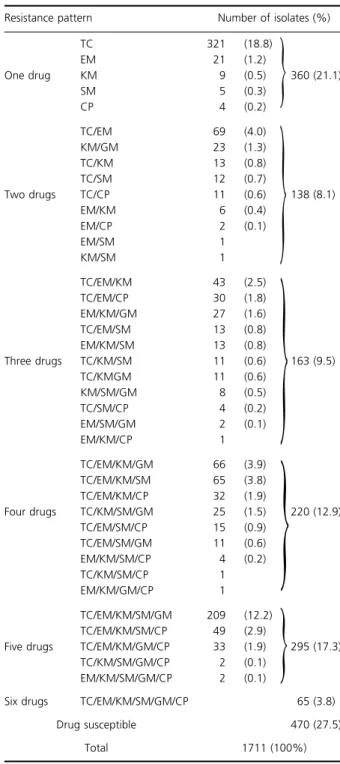
Only 470 strains (27.5%) were susceptible to all antimicrobials tested in this study (Table 1). The remaining 1241 isolates (72.5%) were drug resistant, the resistances and numbers of isolates being as follows:
TC, 1111 (64.9%); EM, 769 (44.9%); KM, 731 (42.7%);
SM, 518 (30.3%); GM, 485 (28.3%); and CP, 256 (15.0%).
Neither ampicillin nor vancomycin resistant strains were isolated. The annual incidences of strains resistant to each drug did not change significantly during the 6 year surveillance period.
The drug resistance patterns are listed in Table 2.
Multiple resistance (to two or more antibiotics) was shown by 881 strains (51.5%). A five-drug resistance pattern (TC/EM/KM/SM/GM), shown by 209 isolates (12.2%), accounted for the largest category of MDR-Ef isolates.
In January 2002, the hospital underwent reconstruc- tion and reorganization. With an increase in bed numbers in the ICU ward from eight to 30,E. faecalis isolation from patients in the ICU increased dramatically from 82 to 210 isolates (Table 3). The incidences of MDR-Ef (resistance to three or more drugs) in the ICU ward were always much higher than in the rest of the hospital (P<0.05). The incidences in the ICU ward increased significantly after the reorganization, as shown in Table 3 (P<0.05).
PFGE analysis of TC/EM/KM/SM/GM- resistant MDR-Ef isolates
We wanted to investigate the spread of MDR-Ef strains in our hospital and nosocomial infections caused by vancomycin-susceptibleE. faecalisstrains. We therefore focused on the major group of MDR-Ef isolates that were
Table 1.Frequencies of isolation of drug resistantE. faecalisclinical strains
Drug (MIC, mg/L)
Number of isolates (%) in each year
1998 1999 2000 2001 2002 2003 Total
TC (>12.5) 133 (77.3) 184 (70.0) 212 (68.6) 166 (56.3) 237 (59.3) 179 (64.9) 1,111 (64.9) EM (>12.5) 79 (45.9) 132 (51.0) 146 (47.2) 120 (40.7) 188 (47.0) 104 (37.7) 769 (44.9) KM (>500) 83 (48.3) 114 (44.0) 128 (41.4) 115 (39.0) 158 (39.5) 133 (48.2) 731 (42.7) SM (>500) 58 (33.7) 109 (42.1) 92 (29.8) 73 (24.7) 101 (25.3) 85 (30.8) 518 (30.3)
GM (>500) 59 (34.3) 93 (35.9) 94 (30.4) 62 (20.0) 103 (25.8) 74 (26.8) 485 (28.3)
CP (>12.5) 18 (10.5) 55 (21.2) 60 (19.4) 28 (9.5) 53 (13.3) 42 (15.2) 256 (15.0)
ABPC (>12.5) 0 0 0 0 0 0 0
VCM (>3) 0 0 0 0 0 0 0
Susceptible 36 (20.9) 64 (24.7) 70 (22.7) 98 (33.2) 135 (33.8) 67 (24.3) 470 (27.4)
Total 172 259 309 295 400 276 1,711
resistant tofive drugs (TC/EM/KM/SM/GM). Of the 209 TC/EM/KM/SM/GM resistant MDR-Ef isolates, 105 strains isolated during certain periods representing both before and after hospital restructuring were chosen and further examined at the molecular level (Fig. 1). Of the 105 strains examined, 51 isolates were obtained during the 11 months between October 1999 and August 2000 (before the restructure) and 54 during the 20 months
between August 2001 and May 2003 (after the restruc- ture). Of the 105 isolates, 100 strains were isolated from inpatients more than 3 days after their admission (mostly more than 1 month after admission). The remainingfive strains (strain numbers 9, 13, 20, 49, and 52, shown in Fig. 1) were isolated from outpatients who had been inpatients of our university hospital. Chromosomal DNA was examined by PFGE (Fig. 1) and plasmid DNA was also examined (data not shown). The PFGE profiles were classified into several groups, using combinations of letters and numbers. The same letter indicates a similar pattern, suggesting an identical origin or closely related strains. The same letter with a different number shows a small change (one to three bands shift), suggesting that the strains are genetically related. Capital letters indicate multiple isolations from different inpatients, and lower-case letters indicate a single isolation. Isolates showing unique profiles were not grouped and are non-typed (blank), suggesting they are unrelated to the others. Based on PFGE profiles, five groups were identified and designated with letters (A through E) followed by numbers (1 through 9) (Fig. 1).
Identical or very similar MDR-Ef strains were isolated from different inpatients and from a variety of wards during this period covered by the study. For example, 28
“A1-type” strains were isolated from 16 patients in 11 different wards (ICU, neonatal intensive care unit,first internal medicine ward, southfloors 4, 6 and 8, eastfloor 4, westfloors 4–7) from October 1999 to February 2003.
Other types were also multiply isolated from different inpatients (Fig. 1). These findings suggest that several MDR-Ef clones have repeatedly caused nosocomial infections in the hospital over a long period.
MLST analysis of the MDR-Ef isolates
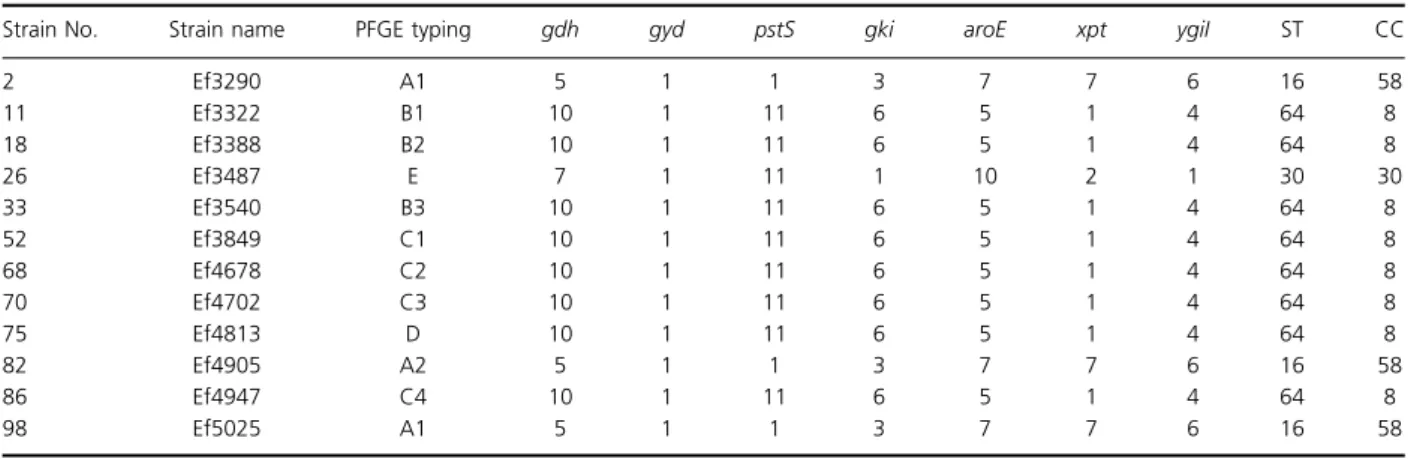
The isolates persistently causing nosocomial infections were further analyzed by MLST (Table 4). The“A-types” (A1, A2) were categorized as ST16 (CC58). The “B- types”(B1–B3),“C-types”(C1–C4) and“D-type”were all categorized as ST64 (CC8). The remaining“E-type” was categorized as ST30. The MLST data also confirmed that nosocomial infections persistently isolated over the long-term were caused by two major MDR-Ef clones, ST16 (CC58) and ST64 (CC8). ST16 strains, including two main types (A1, A2) and eight subtypes (a1–a8), were isolated from 26 patients in 17 different wards, whereas ST64 strains, including eight main types (B1–3, C1–4 and D) and 17 subtypes (b1–b8, c1–c9) were isolated from 39 patients in 14 different wards. These results suggest that both clones have become established in the hospital environment and have repeatedly caused nosocomial infections during the period analyzed.
} }
} }
}
Table 2.Drug resistance patterns ofE. faecalis
Resistance pattern Number of isolates (%)
One drug
TC 321 (18.8)
360 (21.1)
EM 21 (1.2)
KM 9 (0.5)
SM 5 (0.3)
CP 4 (0.2)
Two drugs
TC/EM 69 (4.0)
138 (8.1)
KM/GM 23 (1.3)
TC/KM 13 (0.8)
TC/SM 12 (0.7)
TC/CP 11 (0.6)
EM/KM 6 (0.4)
EM/CP 2 (0.1)
EM/SM 1
KM/SM 1
Three drugs
TC/EM/KM 43 (2.5)
163 (9.5)
TC/EM/CP 30 (1.8)
EM/KM/GM 27 (1.6)
TC/EM/SM 13 (0.8)
EM/KM/SM 13 (0.8)
TC/KM/SM 11 (0.6)
TC/KMGM 11 (0.6)
KM/SM/GM 8 (0.5)
TC/SM/CP 4 (0.2)
EM/SM/GM 2 (0.1)
EM/KM/CP 1
Four drugs
TC/EM/KM/GM 66 (3.9)
220 (12.9)
TC/EM/KM/SM 65 (3.8)
TC/EM/KM/CP 32 (1.9)
TC/KM/SM/GM 25 (1.5)
TC/EM/SM/CP 15 (0.9)
TC/EM/SM/GM 11 (0.6)
EM/KM/SM/CP 4 (0.2)
TC/KM/SM/CP 1
EM/KM/GM/CP 1
Five drugs
TC/EM/KM/SM/GM 209 (12.2)
295 (17.3) TC/EM/KM/SM/CP 49 (2.9)
TC/EM/KM/GM/CP 33 (1.9)
TC/KM/SM/GM/CP 2 (0.1)
EM/KM/SM/GM/CP 2 (0.1)
Six drugs TC/EM/KM/SM/GM/CP 65 (3.8)
Drug susceptible 470 (27.5)
Total 1711 (100%)
Experimental conjugation study of MDR-Ef clones
To examine the localization of resistance genes and investigate the roles of plasmids, experimentalin vitro conjugation studies were performed usingfive represen- tative MDR-Ef clones (strains No. 2, 8, 84, 85 and 98 [grouped as ST16 and A-types in this study]) (17). All these strains displayed induced mating aggregation in response to synthetic peptide cCF10, indicating that they carried pCF10-type pheromone-responsive plasmids (7, 13). No drug-resistant transconjugants were obtained by broth mating, suggesting either that thefive resistance genes are not linked to (encoded on) the pheromone- responsive plasmid, or that the plasmid has lost the ability to transfer. Filter mating experiments resulted in transconjugants on all of the selective plates: representa- tive data for two strains (strains No. 82 and 98) are shown in Table 5. The data from the mating experiments and plasmid profiles indicated that four resistances (EM/
KM/SM/GM) were transferred together and that TC- resistance transferred independently. These findings suggest that the MDR-Ef strains carry two conjugative transposons (ICEs, one conferring EM/KM/SM/GM- resistance and the other TC-resistance (18, 19).
Detection of drug resistance genes in a MDR-Ef clone
One of the clonal MDR-Ef strains (strain No. 98) was examined for drug resistance genes by PCR. The drug resistance genes tet(M), erm(B),lin(B),aac(6')-Ie-aph- (2”)-Ia,ant(6')-Ia,sat(4)andaph(3')-IIIawere detected (data not shown). Combining these findings with the conjugation data, four aminoglycoside resistance genes and an erythromycin resistance gene could be encoded on an ICE, and a tetracycline resistance gene could be encoded on another ICE. The presence of resistance genes on the chromosome was confirmed by Southern hybridization analysis using specific probes (data not shown).
DISCUSSION
In this survey, VRE were not isolated in our hospital between 1998 and 2003; however, most of the isolates were MDR-Ef strains. Although the first VRE were isolated in Japan in 1998, isolation of VRE from clinical sources still rarely occurs compared with other coun- tries (8, 10). Since November 1991, vancomycin has mostly been used to treat methicillin-resistantStaphylo- coccus aureus infections in Japan. The amount of vancomycin used in Japan remains fairly low compared with Europe and the USA (10), which may be one reason for the infrequent isolation of VRE in Japan. However, there have been reports of VRE isolation from imported chicken meat samples in Japan (20). In our nationwide surveillance, VRE strains were isolated from healthy people, suggesting that such strains may have already spread throughout the general community in Japan (20, unpublished data). If this is the case, more frequent VRE clinical isolates may be inevitable in the near future.
Glycopeptide agents, including vancomycin and teico- planin, must be used judiciously, especially when treating patients with a risk of VRE colonization. Once a patient colonized with VRE is admitted to a hospital and handled improperly, nosocomial VRE infections could occur, causing a serious problem in that hospital.
Our group has reported nosocomial infections caused by high-level gentamicin-resistantE. faecalis strains in our hospital in 1998 (7). We described inter-ward transmission of enterococcal strains and found that pheromone-responsive plasmids played a role in dissemination (13). After notification of the risk of nosocomial infection caused by non-VRE strains, standard precautions must be followed more strictly;
the staff in our university hospital have therefore been thoroughly educated concerning infection control.
However, because most people pay little attention to non-VRE isolates, strict contact precautions against enterococcal infection caused by MDR-Ef strains are rarely practiced in hospitals in Japan.
Table 3.Incidence of MDR-Ef in the ICU
1998–2001 (before reconstruction) 2002–2003 (after reconstruction)
MDR-Ef
Entire hospital (600 beds)
Incidence (/bedyear)
Old ICU (eight beds)
Incidence (/bedyear)
Entire hospital (650 beds)
Incidence (/bedyear)
New ICU (30 beds)
Incidence (/bedyear)
three drugs2 453 (43.8%) 0.189 33 (40.2%) 1.03† 290 (42.9%) 0.223 94 (44.8%) 1.57†,‡
four drugs2 368 (35.6%) 0.153 27 (32.9%) 0.84† 212 (31.4%) 0.163 75 (35.7%) 1.25†,‡
five drugs2 224 (21.6%) 0.102 15 (18.3%) 0.46† 136 (20.1%) 0.105 45 (21.4%) 0.75†,‡
Total isolates 1035 (100%) 0.431 82 (100.0%) 2.56† 676 (100%) 0.52 210 (100%) 3.5†,‡
†, the incidences in ICU were higher than those in the rest of the hospital (P<0.05);‡, the incidences in the new ICU were significantly higher than those in the old ICU (P<0.05).
In the present study, we retrospectively investigated MDR-Ef isolates (non-VRE) and showed that the major category had a five-drug (TC/EM/SM/KM/GM) resis- tance pattern. The results of PFGE analysis suggest that TC/EM/SM/KM/GM resistant MDR-Ef strains have repeatedly caused nosocomial infections in our hospital over a long period. However, we cannot completely rule out the possibility of carry-in infections caused by similar independent MDR-Ef strains in this retrospective study. The PFGE patterns of E. faecalisin the general population are quite heterogeneous, especially regarding drug sensitive strains, and maybe also for highly resistant strains (21, 22), which supports our conclusion that nosocomial infections and/or nosocomial transmissions
are caused by the same MDR-Ef strains within our hospital.
Isolates in this majority group were mainly classified as ST16 (CC58) or ST64 (CC8) strains by MLST. VRE isolates grouped as ST16 (CC58) have been reported in some European countries, including Spain, Poland and the Netherlands (14, 23), and VRE isolates grouped as ST64 (CC8) have been detected in the USA (6, 23). Our data suggest that these twoE. faecalis clones, indepen- dent of drug resistances, might be adapted to colonizing the human intestine globally. The human-adapted clones may have acquired drug resistance genes from other organisms. Drug resistances, including vancomycin resistance, could subsequently be acquired through
Fig. 1. PFGE analysis (SmaI) of the major multidrug (TC/EM/SM/KM/GM) resistance inE. faecalisisolates.The upper column shows the 51 isolates obtained during the 11 months between October 1999 and August 2000. The lower column shows the 54 isolates obtained during the 20 months between August 2001 and May 2003. Dates on arrowheads are representative isolation dates, shown as a time series. A gray arrow shows the time of hospital reconstruction in January 2002. M indicates a lambda DNA molecular size marker. PFGE profiles are classified into several groups using combinations of letters and numbers, the significance of which is described in the text. Wards/patients indicate the inpatient wards. The abbreviations are as follows: Each horizontal line with symbols indicates repeated isolations from the same patient during hospitalization. Some inpatients changed wards. 1I,first internal medicine ward; D, dermatology ward; E2, east 2ndfloor; E4, east 4thfloor; G, gynecology ward; HCU, high care unit; ICU, intensive care unit; N4, north 4thfloor; N5, north 5thfloor; N7, north 7thfloor; NICU, neonatal intensive care unit; S4, south 4thfloor; S5, south 5thfloor; S6, south 6thfloor; S7, south 7thfloor; S8, south 8thfloor; U, urology ward; W3, west 3rdfloor; W4, west 4thfloor; W5, west 5thfloor; W6, west 6thfloor; W7, west 7thfloor.
horizontal gene transfer. Many drug resistances are encoded on transposons and frequently inserted into plasmids or conjugative transposons, resulting in large composite conjugative transposons (ICEs) (18, 19). The five drug resistances of the major MDR-Ef strains are likely to be encoded on conjugative transposons. Four of thefive resistances, including gentamicin resistance, are linked and encoded on a composite conjugative transposon on the chromosome.
In January 2002, our hospital was remodeled. The ICU was expanded to serve critically ill patients hospital- wide, about 60% of these patients being post-operative, 20% from hospital wards and 20% from the emergency room. In the restructured ICU, doctors, nurses and clinical engineers treat critically ill patients using life support devices such as ventilators, extracorporeal membrane oxygenation, intra-aortic balloon pumping, ventricular assist devices and plasmapheresis. Contrary to expectations, over the 2 years after the clean modern
hospital had been established, the incidence of MDR-Ef strains from the ICU increased (Table 3). The frequency of isolation (incidence per bed and year) of MDR-Ef strains resistant to three or more antibiotics, four or more antibiotics, orfive or more antibiotics, rose around 1.5-fold (1.57/1.03, 1.25/0.84 and 0.75/0.46, respective- ly), and these were statistically significant increases (P<0.05). Thus, the ICU was an important area to target with anti-infection measures. The renovated hospital consists of large clinical care specialty departments that concentrate patients with similar conditions in the same ward, attended to by the same staff, and medicated according to similar guidelines, including with antibiotic therapies. This may facilitate the increase, transmission and spread of drug resistant strains. In particular, because it functions as a hub ward in the hospital, the modern centralized ICU could be a high-risk environ- ment for the rapid and extensive spread of nosocomial infections. Strict infection control measures, including
Table 4.MLST of the representative multidrug (TC/EM/SM/KM/GM) resistantE. faecalisisolates
Strain No. Strain name PFGE typing gdh gyd pstS gki aroE xpt ygiI ST CC
2 Ef3290 A1 5 1 1 3 7 7 6 16 58
11 Ef3322 B1 10 1 11 6 5 1 4 64 8
18 Ef3388 B2 10 1 11 6 5 1 4 64 8
26 Ef3487 E 7 1 11 1 10 2 1 30 30
33 Ef3540 B3 10 1 11 6 5 1 4 64 8
52 Ef3849 C1 10 1 11 6 5 1 4 64 8
68 Ef4678 C2 10 1 11 6 5 1 4 64 8
70 Ef4702 C3 10 1 11 6 5 1 4 64 8
75 Ef4813 D 10 1 11 6 5 1 4 64 8
82 Ef4905 A2 5 1 1 3 7 7 6 16 58
86 Ef4947 C4 10 1 11 6 5 1 4 64 8
98 Ef5025 A1 5 1 1 3 7 7 6 16 58
The numbers in the gene categories indicate the allele numbers registered on the MLST web site (15).
Table 5.Experimental conjugation study byfilter mating and transfer frequency of drug resistances Strain
No.
Strain name
PFGE pattern/
MLST typing
Pheromone- responsive plasmid
Selective Drug
Transfer frequency (transconjugant/donor)
Drug resistance patterns of the ten trans- conjugants examined (number of strains)† 98 Ef5025 A1-type/ST16
(CC8)
pCF10 type (cCF10) TC 4.0108 TC (10)
EM 2.2107 EM/KM/SM/GM (10)
KM 2.6106 EM/KM/SM/GM (9), TC/EM/KM/SM/GM (1) SM 4.4107 EM/KM/SM/GM (9), TC/EM/KM/SM/GM (1) GM 4.0107 EM/KM/SM/GM (7), TC/EM/KM/SM/GM (3) 82 Ef4905 A2-type/ST16
(CC8)
pCF10 type (cCF10) TC 2.6107 TC (10)
EM 2.8106 EM/KM/SM/GM (6), TC/EM/KM/SM/GM (4) KM 9.6106 EM/KM/SM/GM (4), TC/EM/KM/SM/GM (6) SM 5.4106 EM/KM/SM/GM (6), TC/EM/KM/SM/GM (4) GM 1.2106 EM/KM/SM/GM (8), TC/EM/KM/SM/GM (2)
†, each transconjugant was randomly chosen from one selective plate. Concentrations of the selected drugs (mg/L): TC, 12.5; EM, 12.5; KM, 500; SM, 500; GM, 500.
contact precautions, may be needed to prevent and control nosocomial infections and transmissions caused by the ignored persistent MDR bacteria identified by this study.
ACKNOWLEDGMENTS
We thank SE Flannagan (University of Michigan, Ann Arbor, MI, USA) for helpful advice on the manuscript.
This study was supported by grants from the Japanese Ministry of Education, Culture, Sport, Science and Technology (Gunma University Operation Grants) and the Japanese Ministry of Health, Labour and Welfare (Grants H24-Shinkou-Ippan-010 and H24-Shokuhin- Ippan-008).
DISCLOSURE
The authors declare that they have no conflict of interest.
REFERENCES
1. Arias C.A., Contreras G.A., Murray B.E. (2010) Management of multi-drug resistant enterococcal infections.Clin Microbiol Infect16: 555–62.
2. Malani P.N., Kauffman C.A., Zervos, MJ (2002) Enterococcal disease, epidemiology, and treatment. The Enterococci. In:
Gilmore M.S. ed. Washington, DC: American Society for Microbiology, pp. 385–408.
3. Gordon S., Swenson J.M., Hill B.C., Piqott N.E., Facklam R.R., Cooksey R.C., Thornsberry C., Jarvis W.R., Tenover F.C. (1992) Antimicrobial susceptibility patterns of common and unusual species of enterococci causing infections in the United States.
Enterococcal Study Group.J Clin Microbiol30: 2373–8.
4. Moellering R.C., Jr. (1992) Emergence ofEnterococcusas a significant pathogen.Clin Infect Dis14: 1173–8.
5. Uttley A.H., Collins C.H., Naidoo J., George R.C. (1988) Vancomycin-resistant enterococci.Lancet1: 57–8.
6. Werner G., Coque T.M., Hammerum A.M., Hammerum A.M., Hope R., Hryniewicz W., Johnson A., Klare I., Kristinsson K., et al. (2008) Emergence and spread of vancomycin resistance among enterococci in Europe.Euro Surveill.doi: pii: 19046.
7. Ma X., Kudo M., Takahashi A., Tanimoto K., Ike Y. (1998) Evidence of nosocomial infection in Japan caused by high-level gentamicin-resistantEnterococcus faecalis and identification of the pheromone-responsive conjugative plasmid encoding gentamicin resistance.J Clin Microbiol36: 2460–4.
8. Fujita N., Yoshimura M., Komori T., Tanimoto K., Ike Y.
(1998) First report of the isolation of high-level vancomycin- resistantEnterococcus faecium from a patient in Japan.
Antimicrob Agents Chemother42: 2150.
9. Japan Nosocomial Infections Surveillance Releases and announcements. [Cited in March 2014] Available from URL:
www.nih-janis.jp/english.
10. Arakawa Y., Ike Y., Nagasawa M., Shibata N., Doi Y., Shibayama K., Yagi T., Kurata T. (2000) Trends in Antimicrobial-drug resistance in Japan.Emerg Infect Dis6:
572–5.
11. Chow J.W. (2000) Aminoglycoside resistance in enterococci.
Clin Infect Dis31: 586–9.
12. Sambrook J., Fritsch E.F., Maniatis T.(1989) Molecular cloning:
a laboratory manual. 2nd ed. Cold Spring Harbor, NY: Cold Spring Harbor Laboratory Press.
13. Shiojima M, Tomita H, Tanimoto K, Fujimoto S, Ike Y. (1997) High-level plasmid-mediated gentamicin resistance and pheromone response of plasmids present in clinical isolates ofEnterococcus faecalis.Antimicrob Agents Chemother41:
702–5.
14. Leavis H.L., Bonten M.J., Willems R.J. (2006) Identification of high-risk enterococcal clonal complexes: global dispersion and antibiotic resistance.Curr Opin Microbiol9: 454–60.
15. Multi Locus Sequence Typing Enterococcus faecalis [Cited in December 2013] Available from URL: http://efaecalis.mlst.net.
16. Fujimoto S., Clewell D.B. (1998) Regulation of the pAD1 sex pheromone response ofEnterococcus faecalisby direct interaction between the cAD1 peptide mating signal and the negatively regulating, DNA-binding TraA protein.Proc Natl Acad Sci USA95: 6430–5.
17. Clewell D.B. (2011) Tales of conjugation and sex pheromones: a plasmid and enterococcal odyssey.Mob Genet Elements1: 38– 54.
18. Clewell D.B., Flannagan S.E., Jaworski D.D. (1995)
Unconstrained bacterial promiscuity: the Tn916-Tn1545family of conjugative transposons.Trends Microbiol3: 229–6.
19. Wozniak R.A., Waldor M.K. (2010) Integrative and conjugative elements: mosaic mobile genetic elements enabling dynamic lateral geneflow.Nat Rev Microbiol8: 552–63.
20. Ozawa Y., Tanimoto K., Nomura T., Yoshinaga M., Arakawa Y., Ike Y. (2002) Vancomycin-resistant enterococci in humans and imported chickens in Japan.Appl Environ Microbiol68: 6457– 61.
21. del Campo R., Ruiz-Garbajosa P., Sanchez-Moreno M.P., Baquero F., Torres C., Canton R., Coque T.M. (2003)
Antimicrobial resistance in recent fecal enterococci from healthy volunteers and food handlers in Spain: genes and phenotypes.
Microb Drug Resist9: 47–60.
22. Castill-Rojas G., Mazari-Hiriart M., Ponce de Leon, Amieva- Fernandez S., Agis-Juarez R.I., Huebner R.A., Lopez-Vidal J.
(2013) Comparison ofEnterococcus faeciumandEnterococcus faecalisstrains isolated from water and clinical samples:
antimicrobial susceptibility and genetic relationship.PLoS ONE 8: e59491.
23. Quinones D., Kobayashi N., Nagashima S. (2009) Molecular epidemiologic analysis ofEnterococcus faecalisisolated in Cuba by multilocus sequence typing.Microb Drug Resist15:
287–93.