ニ価白金イオンからなる三角形型三核クラスター錯
体
著者
伊藤 翼
二価白金イオンからなる三角形型三核クラスター錯体
研究課是番号 08454207
平成8-9年度科学研究費補助金
(基盤研究(B)(2))
成 果 報 告 書
平成9年3月
研究代表者 伊藤 翼
(東北大学大学院理学研究科教授)
はしがき
本研究は,平成8年度から平成9年度にわたって文部省科学研究費補助金(基盤研究
(ち)(2),課題番号0 8 4 5 4 2 0 7)の交付を受けて,主に東北大学大学院理学研究科錯
体化学研究室で行ったものである.
本研究を実施するに当たっては,本研究室の大学院生ならびに学部生諸君の多大な協
力が合ったことに感謝する.また,本研究のご理解を勝った文部省関係者各位に感謝す
る.
研究組織
研究代表者 伊藤 翼(東北大学大学院・理学研究科・教授)
研究分担者 山口 正(東北大学大学院・理学研究科・助手)
研究経費
平成8年度
平成9年度
計
円
円
円
千
千
千
0 0 0 0 0 0 7 2 9 ' ● ′ ● 3 4 7研究の背景と目的
分子内に金属一金属間結合をもつ金属クラスター錯体は,金属問結合がもた
らす特異的電子構造や,近接する複数の金属原子(あるいはイオン)が分子内
において占める立体化学に由来する興味深い化学特性をしばしば示す.この種
の新親化合物の合成,構造,反応性に関する研究は,基礎学問として重要であ
るだけでなく,触媒など有用な物質の開発につながる.筆者らは,ここ7-客年
にわたって二価白金イオンがつくる正方形型クラスター骨格を含む4核白金
(Ⅱ)クラスター錯体について,新患化合物の合成・構造・反応性・電子構造な
ど基礎化学的観点から研究を行い,末尾に記載した成果をあげてきた. 1-7)筆者
らがこの研究を開始する以前に知られていた白金(ⅠⅠ)のクラスター錯体は,
酢酸イオン架橋の四核錯体【pt4(CH3COO)8】が唯一の例であった・8110)この
化合物が2価の白金イオン問に結合をもつ珍しい物質であること,また,
この日金閣結合がどのような化学特性を発現させるかという点に着目し,
電子構造・反応性に関する研究を行い,四角形型クラスター骨格面内の配
位座が置換活性であるのに対して面外配位座は置換不活性であり,極めて
顕著な位置選択的反応性をもつことを理論・実験両面から明らかにした.
また, NMR飽和移動法を活用して【Pt4(CH3COO)81の面内酢酸イオン交
換速度を決定し,白金間結合が2価白金イオンサイトの反応性を異常に高
めていることを克量的に明らかにした.この知見に基づき種々の二座配位
子をクラスター面内に導入した多数の新親四核錯体を合成し,この2価白
金イオンの四角形型クラスター骨格が普遍的な骨格構造であることを実験
的に証明した・更に, 【pt4(CH3COO)81は極めて置換活性である面内配位サ
イトが隣接していることに着日し,この錯体がアセトニトリルの水和反応
等の触媒として機能することも明らかとなった.6)
上記研究の過程において・ 【Pt4(CH3COO)81の面内配位座にジメチルグリ
オキシム,シクロヘキサンジオンジオキシム等 配位原子周りが立体的に
込み入った配位子を導入すると,クラスター骨格変換反応が誘発され,四
角形型骨格が三角形型へ変換されることを初めて見出した.この白金ⅠⅠ価
の三角形型クラスター骨格は,これまで知られていない全く新しいタイプ
のものであり,その成果を速報論文として報告した.3)本研究は,この三
角形型クラスター骨格を含む白金ⅠⅠ価クラスター錯体について,新親化合
物の合成・構造・反応性・電子構造などその化学を給合的に研究することを
目的とする.
白金を含む三角形型クラスター錯体については, Puddephatt (カナダ)ll)や
山本(東邦大)ら12)が低原子価の白金を含む系について報告しているが,
い.本研究は,筆者の研究室における独自の研究の過程で見出された全く新し
いタイプの化合物に関するものである.
参考文献
1) T. Yamaguchi, Y. Sasaki, A. Nagasawa, T. Ito, N. Koga,and K. Morokuma,
InoT・8. ChenL, 28, 4311-4312 (1989).
2) T. Yamaguchi, Y. Sasaki,and T. Ito, J. AmL Che肌Soc., 112, 403814040 (1990).
3) T. Yamaguchi, N. Nishimura.and T. Ito, ). AtTL Chem. Soc., 115, 1612-1613
(1993).
4) T. Yamaguchi, T. Ueno,and T. Ilo, InoT・g. Chem., 32, 4996-4997 (1993).
5) T. Yamaguchi, K. Abe,and T. Ito, Inol・8. Chem., 33, 2689-2691 (1994).
6) T. Yamaguchi, H. Adachi, T. Ito,and Y. Sasaki, Bull. Chem. Soc. Jpn., 67,
3116-3118 (1994).
7) Tadashi Yamaguchi, Akira Shibataand Tasuku lto, ). Chem. Soc. Dalton 7TllanS.,
403 1-4032 (1996)8) de C. T. M. A. A. F. Carrondoand A. C. Skapski, J. Chem. Soc.., ChenL
Commun., 4101411 (1976)
9) de C. T. M. A. A. F. Carrondoand A. C. Skapski,AcぬClyStallogr., Sect. B , 34,
1857-1862 (1987)
10) de C. T. M. A. A. F. CaLrOndoand A. C. Skapski, ibid 34, 3576-3578 (1978)
ll) R. Ramachandran, D. S. Yang, N. C. Payneand R. J. Puddephatt, Inol・8. Chem.,
31, 4236・4240 (1992)
12) Y Yamamoto, H. Yamazakiand T. Sakumi, ). Atn. Chem. Soc., 104, 2329-2330
本研究の成果
この2年間にわたる研究により,本報告に記述したさまざまな新しい成果が
得られた.ごく近い将来,これらの成果を学会誌へ論文として投稿予定であり,
現在,合成法の再現性の確認など若干残されている実験を行いつつ,投稿原稿
のとり纏めの作業を行っている状況である.諸般の事情で,本科学研究費の助
成期間内に論文として成果を公表出来なかったが,本報告書に記載した内容を
基に数カ月の期間内に成果の公表を行う予定である.
本研究において合成された新規目的化合物とその化合物番号,
ならびに,クラスター面内配位子の構造とその略号
lPt4(CH3COO)8]
lPt3 (CH3COO)4(dmgH2) (dmgH)2]
lPt3 (CH3COO)4(C doH2) (cdoH)2]
lPt3 (CH3COO)4(dpgH2) (dpgH)2]
lPt3 (CH3COO)4(bqdH2) (叫dH)2]lPt3 (CH3COO)4(dagH2) (dagH)d
lpt3 (CH,COO)4(Me2en),]2'
lpt, (cH3COO).(en)3】 2'lPb(CH3COO)4(L) (dmgH2) (dmgH)d
)J
HO-N N-OH
diEE蛤thylglyoxime(dmgH2)
G_?
HO-N N-OH
HO-N N一〇日 1 ,21CyClohexanedione dioxiⅡ蛤 diphenylglyoxiⅡ近 (cdH2) (dpgH2)質
HO-N N-OH
benz叩10批dioxim (叫dH2)〔
Me-HN NH-Me
NJV'-dimethylethylenediamine
(Me2en)
H2NmN H2
日0-N N-OH dia血oglyoxime (血gH2)Eid
2HN NH2
ethylenediamine (en)糾・13 6 ㈹ 脚 仰 の ㈱ S
Introducti on
Pla血um cluster complexeswithPt-Pt bonds are known for various oxid如ion states.
Many ofthemare low-Valent plahum clusters・1-3 Tervalent plahumalSo foms dineric
cluster complexes4 0r compotmds such as platintm blue in a PtP)仲tOII) mixed valence state.5
Divalent pla血um clusters, however, had ban岨mited tothe octaBtCetatO COmPlex
PII(p-CH3COO)81 (1),6untn we reported its derivatives. rbviously we reportedthatthe acetate
ligandsin1 which are inthe plane of the square-planar Pt cluster core are labne, whereasthe
out-of-plane hgands are inert to subsdtution, aJldthat many derivadves of 1 canbe p托paredvia
the substitution reaction・7 we foundalsothat 1 acts as an effective catalyst for hydrolysis of
aatmitrne.8 It has been shownthatthe regiosel∝dve subsdtution reacdvityandthe catalydc
activity characterisdc of 1 result fromthe Pt一m bonds inthe cluster kleton which labni2X:
coordination sits trams totheintemetanic bonds・7・S hthe course of the study onthe
reactivides of 1, wefoundthat upon reaction withsome oxime ligands, 1undergoes a cluster
core traJISfoimadon to afford new PtP) cluster complexes having a novel triangularcore.
preliminary results have been published.9 Inthis paper, we report chemistry of novel Pt(Ⅱ)
tdangularcluster complexes amdthe mechanism of the cluster core transforma丘on fromthe
squaLe-planartothe血gulartype. ReBLCtivides ass∝iated withthe trams effect of Pt-Pt bonds
Experimental
Materials.
lpt4(CH3COO)8] (1) was prepared bytheliterature method・10 orgmic solvents were
d血d on molecularsieve 4A before tm. Deuterated solvents, CDC13, D20・and other reagents
were used as reccivedwithout負∬血er purificadon.
Appratus・
lH, 13C, 195pt NMR spectra were record on a JEOL GSX-270 FT-NMR spectrometer at
270, 67.9,and 58.0 MHz, respeCtively・ Elementalanalysesand measurements of FAB一mass
spectra (JEOL JMS-HⅩ100) am carried out at hstrumentalAnalysis Center for Chemistry at
Tohoku University.
synthesis of lPt3(CH3COO)4(dmgH2)(dmgH)2] (2)・ Method A・
Toanacetone solution (30 mL) of 1 (100mg) was added all aCetOne SOhdon (30 mL)
of H2dmg (hereahr abbreviated as H2dmg) (500mg)andthe solution was Fefluxed for 4 h・
Blue black precipitate fomed was丘1-d offandthe mtrate was evaporated to dryness・ The
residue was dissolved in dichloromethane (2 mL) andthe mtered solution was charged onto
snica-gel colt- Ⅳakogel C-200)・ On eludon of dichloromethane/methanol (97 :3)the flrSt
brown fracdon was conected. ne efAuent was evaporated and purified by gel-filtra丘on
column (Sephadex LH-20, dichloromethane/acetomitrile (2/1 ) as eluent) togive broⅥm powder
(yield 27 mg, 30%)・
Meth.d B. T。anacetone solution (20 mL) of少(see below) (50 mg) was added an
acetone solution (20 mL) of H2dmg (50 mg) andthe solution was refltRed for 4 h・ Blue black
precipitate formed was fltered offandthefiltrate was evaporated to dryness・ The residue was
dissolved in dichloromethane (2 mL)andthefilteFed soludon was charged onto silica-gel
column (Wakogel C-200)・ On elution of dichloromethane/methanol (97:3)the fTlrSt brown
fraction was conected. The emuent was evaporated togive brownpowder (yield 15 mg,
Data for 2: lH NMR (CDC13, Ppm) 8 1.79 (S, 6H, OAc-CH3), 1.85 (S, 6H, OAc-CH3),
2・35 (S, 6H, dmg-CH3), 2.40 (S, 6H, dmg-CH3), 2.44 (S, 6H, dmg-CH3), 12.22 (S, 2H,
dmg10H); 13c NMR (CDC13 , PPm) 8 12・77 CH3), 12・94 CH3), 13・16
(dmg-CH3), 21・25 (OAc-'cH3), 21・62 (OAc-(dmg-CH3), 149.31 (dmg-C=N), 150.33 (dmg-C=N),
155.59 (dmg-C=N), 179.58 (OAc-CO), 192.07 (OAc-CO);Anal. Calcd for
Pt3C20H34N6014: C, 20.57; H, 2.94; N, 7.20. Found: C, 21.47; H, 3.13; N, 6.93;
FAB-Mass m/z l167 lcalcd M+= 1167.6]
Dark brown crystals of 2・CHC13 Suitablefor X-ray analysis were grownby slow
diffusion of hexaneinto a chloroform soludon of 2.
Synthesis of lPt3(CII3COO)4(cdoH2)(cdoH)2] (3).
Toanacetomide solu丘on (30 mL) of 1 (200 mg) was addedanacetomide solution
(130 mL) of cyclohexanedione dioxime Olerea飴r abbreviated as H2Cdo) (430 mg)and sdrred
for 12 h・ Brownneedle crystals formed were removed by futradonandthe mtrate was
evaporated to dryness. The residue was dissolved in dichloromethane (5 mL)andthe futeped
soludon wa畠charged onto a snica-gel column (Wakogel Cl200). On eludon of
dichloromethane/methanol (98:2)the mainbrownhction was comected. ne efnuent was
evaporatedand purified by gel-futradon column (Sephadex LH-20,
dichloromethane/acetomide (2/1) as eluent) togive brownpowder Wield 150 mg, 70%).
Data fわr 3: lH NMR (CDC13, ppm) 8 1.81 (S, 6H, OAc-CH3), 1.86 (S, 6H, OAc-CH3),
1.73 (m, 12H, cdo-CH2), 2.97 (m, 12H, cdo-CH2), 12.08 (S, 2H, cd0-OH); 13c NMR
(CDC13 , ppm) 8 21.29 (cdoICH2), 21.34 (cdo-CH2), 21.42 (cdo-CH2), 21.68 (OAc-CH3),
25・69 CH2), 25.77 CH2), 25.84 CH2), 149.94 C=N), 151.22
(cdo-C=N), 156.03 (cdo-(cdo-C=N), 179.55 (OAc-CO), 192.06 (OAc-CO);Anal. Calcd for
Pt3C26H40N6014: C 25.07; H, 3.24; N, 6.75. Found: C, 25.33; H, 3.28; N, 6.59;
FAB-Mass m/z l246 lcalcd M+ = 1245.7]
Red Crystals of 3・2CH3CN suitable for X-rayanalysis were obtained by
recrystanizadon LTrom acetomibile solution of 3.
To an acetomitrile solution (15 mL) of 1 (100 mg) was addedanacetomidle solution (80
mL) of diphenylglyoxime (hereafter abbreviated as H2dpg) (1 g)andthemixture was stind
for 12 h・ Blueand white solids fomed were removed by filtradon andthe futrate was
evaporated to dryness. The residue was dissolvedindichloromethane (3 mL)andthefiltered
solution was charged onto a suca-gel column (Wakogel C-2(氾). On eludon of
dichloromethandmethanol (99: 1 )the main dark brownBaction (R.4) was collectedand
evaporated togive broⅥm powder (yield 55 mg, 45%).
Data for 4: lH NMR (CDC13, PPm) 8 1.92 (S, 6H, OAc-CH3), I.97 (S, 6H, OAc-CH3),
7.24-8.04 (m, 30H, dpg-0), 12.79 (S, 2H, dpg-OH); 13c NMR (CDC13 , PPm) 8 21.34
(OAc-CH3), 21・90 (OAc-CH3), 126.281130.63 (dpg一〇), 151.17 C=N), 151.58
(dpg-C=N), 155.52 (dpg-(dpg-C=N), 179.64 (OAc-CO), 192.51 (OAc-CO);Anal. Calcd for
Pt3C50W6014: C, 38.99; H, 2.99; N, 5.46. Found C, 39.44; H, 3.15; N, 5.42;
FAB-Mass m/z 1540 【Calcd M+ = 1539.2].
Synthesis of lPt3(CE3COO)4(bqdE2)(tlqdII)2] (5).
To an acetomitrile sohtion (15 mL) of 1 (1(氾mg) was addedanacetomitri1e solution (30
mL) of benzoquinone dioxime (here曲r abbreviated as H2bqd) (55 mg)andthemixture was
stirred for lOmin. Black sohds formed were removed byfiltrationandthe filtrate was
evaporated to dryness. The residue was dissolved in dichloromedlane (5 mL)andthe soludon
氏ltered was charged onto a silica-gel coltmn (Wakogel C-200). On eldon of
dichloromethandmethanol (97:3)the main dark brown fraction (Fr.4) was couectedand
evaporated to give brownpowder (yield 25 mg, 25%).
Data for 5: 1H NMR (CDC13, PPm) 8 1.79 (S, 6H, OAc-CH3), 1.85 (S, 6H, OAcICH3),
6.53-6.74 (m, 6H, bqd-0), 7.26-7.41 (m, 6H, bqd-0), 12.49 (S, 2H, bqd-OH); 13c NMR
(CDC13 , pPm) 8 21.20 (OAc-CH3), 21.66 (OAc-CH3), 1 18.1 1 (bqd10), 1 18.54 (bqd一〇),
1 18・79 (bqd一〇), 127.95 (bqd一〇), 130.46 (bqd一〇), 133.30 (bqd一〇), 147.97 (bqd-C=N),
149・61 (bqd-C=N), 151.29 (bqd-C=N), 179.76 (OAc-CO), 192.30 (OAc-CO);Anal. Calcd
Toanacetomitri1e solution (50 niL) of 1 (100 mg) was added 190 mg of
diaminoglyoxime (hereafter abbreviated as H2dag)andthemixture was stirred for 24 h.
Brownsolid was p托CIPltatedandfiltered off. The solid was dissolvedinwaterandthe
soludon was slowly evaporated togive redmicro crystals. Red Crystals of 6・ 10H20 suitable
for X-rayanalysis were obtained by recrystanizationfrom aqueous soluBon of 6.
Synthesis of lPt3(CII3COO)4(Me2en)3]2+ (7).
Method A To a dichloromethane solmion (5 mL) of 1 (100 mg) was added 0.1 mL of
NJV',dimethylethylenediamine (Me2en). The color of the soludon changed from red to dark
brownand white powder was precipitated・ After 24 h,the precipitate was filtered offandthe
filtrate was evaporated to give a brownoil・ To this o止was added 3 mL of waterand 200 mg of
soditmperchlorate・ The solution was very slowly evaporated for several days togive dark red
crystals.
Data for 7(CIO4)2:Anal. Calcdfor Pt3C20H48N6016C12: C, 18.70; H, 3.77; N, 6.54;
Cl, 5.52. Found: C, 18.90; H, 3.65; N, 6.51; Cl, 5.85.
Medtd B To a dichloromethane solution (5 mL) of3 (loo mg) was added 0.17 mL of
NN',dimethylethylenediamine (Me2en)・ ne color of the solution changed from red to dark
brownand white powder was precipitated・ A触r 24 h,the precipitate was mtered offandthe
filtrate was evaporated togive a brownon. 195pt NMR of D20 solution of this oily material
showsthe same spectrum of 7.
Dark red crystals of 7(CIO4)2・2NaCIO4・ 10H20 suitable for X-ray work were Obtained
by recrystallization血om aqueous solution of 7 containinganexcess of NaC104.
Caution! The peTIChわrate salts we potenh'ally eqk)sive・ Shzall q〟のtZ'des only shouhi be
pllePWed andprecautz'onぬken LhLTing hanLning
Synthesis of lPt3(CII3COO)4(en)3]2+ (S).
To a dichloromethane solution (5 mL) of 3 (100 mg) was added 0.17 mL of
ethylenediamine (en)・ The color of the solution changed from red to dark brownand white
powder was precipitated. After 24 h,the precipitate was Entered offandthe filtrate was
synthesis of lPt4(CH3COO)4L(dmgH2)(dmgH)2] (9) = -'Pt3.1''・
To an acetone soludon (I阜o mL) of 1 (500mg) was addedanacetone solution (150
mL) of H2dmg (2.5 g)and s血陀d for 20 h・ Brovm needle crystals formed were removed by
filtrationandthe fntrate was evaporated to drymess・ The residue was dissolved in
dichloromethane (20 mL)andthe mtered soludon was charged onto snica-gel colum
叩akogel C-200)・ On elution of dichloromethane/medlanOl (97 :3)the third brown fraction was
collected. ne emuent was evaporated togive brown pワwder (yield 250 mg・ 45%)・ Dark
browncrystals of 9・CHC13・0・5C6H14 Suitable for X-ray work were grownby slow diffusion
of hexane into a CHC13 SOlution of p.
Ⅹ・ray Data Collection aTld Structure DetemitLation・
hthis study'five structures have been dete-ined・ Data couecdonsand structure
analyses were made commonly in afollowing way・unless otherwise stated below・ b each
data conection, a suitable crystalcoated withepoxy due was attached to a glass fiberand
mounted on a Rigaku AFC 7S or Rigaku AFC 5S four circle difhctometer・ Themit cell
parameters were obtained by a least-squares血ment oftheangularsethgs of 20 high-angle
(22.5。 < 20 < 30.00) reflecdons・ Intensity datainthe range 3 < 20 < 550 were measured by
use of a 20-a scanat a scamg rate Of4・00min・1・ Lorentz・ polarization,and absorpdon
correction (DIFABSll) were applied tothe intensity data・ ne structure was solved by
automadc Pattersonanalysis (DmDIF PATTY12) and successive difference Fomier,and
refined bythefun matrix least-squares method・ A血OtFOPic temperattlre factors were applied
to an non-hydrogen atom ・
crystallographicand structural detemhadon data amlistedinTable l・ ju calculadons
were perfo-edwithuse of the teXsaJI CryStallographic softwaJe PaCkage13・ Atmic positional
parametersare glVen in Table 2 I 6・
Tables ofthemisotropicthemalparameters (Table Sl - S5) are available as supplementary
material. Specialcomments are : extincdon corI∝don has been apphed totheintensity data of
simulation of 195pt NMR Spectra・
Calculation of peak posi血nsand reladve intensities in second order 195pt NMR spectrum
for each isotopomer was performedwiththe program LAOCN514 The chemiCalshifts used in
the calculation were obtained dirEX;dy丘omthe posidon of two mainpeaks in observed
spectrum・ The coupling constants Jpt-pt were obtained direcdy丘om a difference between outer
and inner peak positions of AB pattem when outerpeak of AB pattem was clearly observed・
Whenthe outer peak of AB pattem was too weak to read out the position,the coupling constant
was calculated from chemiCalshiR difR:zence tx:tween A and B path:m (Av)and difference
beth,een inner peaks of AB pattem (Ⅹ) by use offollowing equadon・
∫ ≡ (Av2一Ⅹ2) / 2Ⅹ
In simulated spectmm, each signalwas dmwn at calculated posltlOnwithCalculated
relativeintensityinwhichthe naturalabtmdaJICe Ofthe isotopomer was taken into accounLAn
appropriate linewiddl Was assumed for Lorentziancurve・
EHMO Calculation.
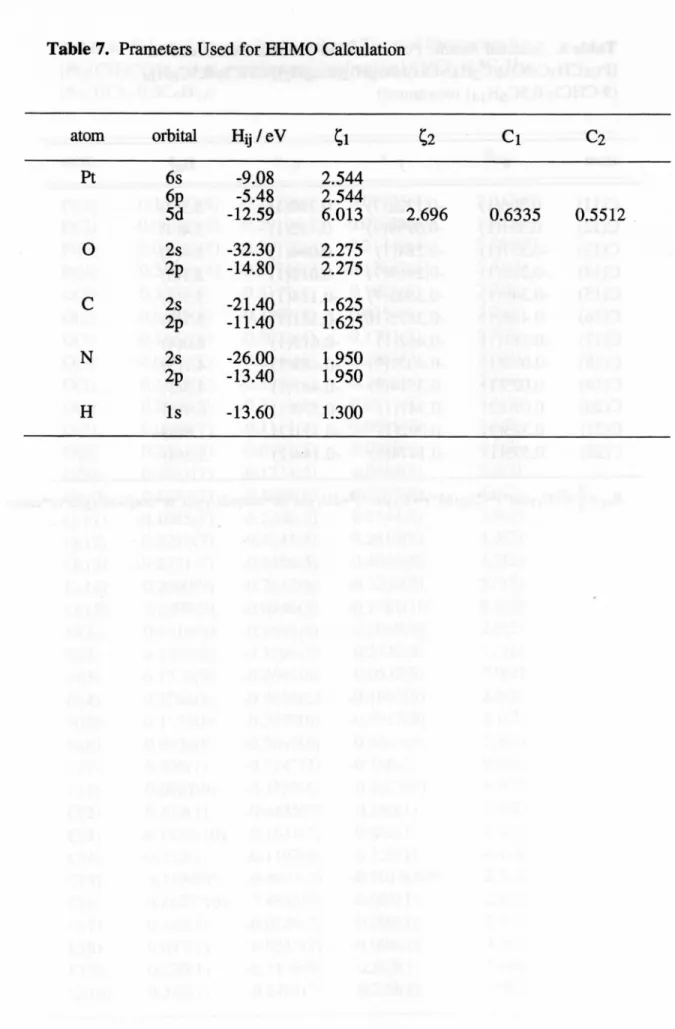
Extended HGckel molecularorbitalCalcdations wereperfomedwiththe convemional
program・15 The pammeters used are listed in Table 7・
Table 7
The geom甜y of the model complex, 【Pt3PCOO)4(glyH)2(glyH2)] (H2gly = glyoxime), was
taken as follows. Pt-Pt bondsina Pt3 isoscelesmiLngleare two Pt-Pt bonds of 2.5 Land one
pt-pt of 2.6 A. Following distancesandangles were usedinthe modeling of glyoximato
hgands: C-N = I.32 A, C-C = 1.57 A, N-0 = I.28 A, C-H = 1.08 A, 0-H = 0.97 A; N-C-C =
1150; N-C-H ≡ 1210; N-0-H = 1090. Glyoxinatoligands were located inthe Pt3 Cluster plane
withpt-N distance of 2.15 A. Fonowing distances and angles were usedinthe modeling of
formato ligaJlds: C-0 ≡ 1.26 A, C-H = 1.08 A; 0-C-0 ≡ 0-C-H ≡ 1200. Fomatoligands were
located perpendicularly tothe Pt3 plane withPt-0 distance of 2.00 A. The posidonal
parameters for EHMO calcdadon am listedinthe supplementary materids・Crable S6) ¶le
energy level of onethird血gment was calculated for mononuclearcomplex
【m(HCOO)2(glyH2)] whose geometry is assumed to bethe same asthat of
Experiments on Substitution Reactivity・
(a) Reaction of glyoximato clusterwith other free glyoxjJneLigands.
To an acetomitde solution (25 mL) of Pt3(CH3COO)4(CdoH2)(CdoH)2] (3) (50 mg) was
added excess dpgH2 (175 mg)andthemixture was refluxed for 24 h. The solution was
evaporated to drynessandthe solid residue was purified by gel-filtra血n colm
chromatography (Sephadex LH-20, dichloromethandacetomitri1e (2/1) as duent) togive brovm
powder・ Simi1arreactions by combinadons of 4 aJld cdoH2 (Feflux for 24 h), Sand bqdH2
(Feflux for 4 h),and land bqdH2 (Stirred at room temperature for 48 h) were caJTied out. h
allthe reacdons, product was amixture of血uclearclusters (see text).
(b) Reaction of dimethylethylenediamine cluster (7(CIO4)2)with free
ethylenediamine・ Toanaqueous soludon (4 mL) of 【n3(CH3COO)4(Me2en)3](CIO4)2
((10 mg) was added ethylenediamineandthe mixttwe was shed for 24 h. ne solution was
evaporated togiveanoil which was purified by gel-mtradon column (Sephadex LH-20,
dichloromethane/acetomitrile (2/1) as eluent) togive brown on. 1H-and 195pt-NMR of the
Results aJId Discussion
Syntheses of TrinuclearPIatiJIum(II) Clusters.
When 1 wasallowed to reactwithexcess ofglyoxime derivadves such as
dinethylglyoxime (dmgH2), CyClohexanedione dioxime (cdoH2), diphenylglyoxime (dpgH2),
and benzoquinone dioxime (bqdH2), Or diaminoglyoxime (dagH2), 1underwent not only
subsdtution of the in-plane acetate for glyoxime ligand butalso cluster core transformation from
the square-planar tothe triangulartype.
lPt4(CH3COO)i] + 5 dmgH2 >
lPt3(CH3COO)4(dmgH)2(dmgH2)] + lPt(dmgH)2] + 4 CH3COOH
The reactionwithdmgH2 needed to reflux the reacdonmixture for severalhours, whereas
that withbqdH2 COmPletedinseveralminutes at room temperature. Condidons needed for
completion Eofthe托aCdon depended onthe incoming ligandand was harder inthe order of
dmgH2 > dagH2壬≠ CdoH2年dpgH2 > bqdH2. It appearsthatthe trend corresponds tothe
dgidity oftheglyoximeligand.
The reactionwithdmgH2under ndder conditions (room temperature, for 1 day) gave
tetranuclearComplex 【Pt4(L)(CH3COO)4(dmgH)2(dmgH2)] (9 = ''Pb+I " ) (See Experimental
section)・Asdescdbed later,this tetraner consists of two umits, a tdangularcluster core very
sin止artothatinP3(CH3COO)4(dmgH)2(dmgH2)] (2) aJld mononuclearmit withsquare
planargeomeq・Andthein-plane coordination sites of the triangularcore areall occupied by
the dimethylglyoximatoligands・ The駈StruCturalfeatu托S Showthe partialremovalof one Pt
fromthe tetranuclearcluster core of 1, suggestingthat 9 isanintermediateinthe cluster core
transfomadon・ In actual fact, hr血er reaction of lPt4(L)(CH3COO)4(dmgH)2(dmgH2)] (9)
withanexcess of dmgH2 gave 【Pり(CH3COO)4(dmgH)2(dmgH2)]. The reaction scheme is
_ ____ ___ ____- - -- --- --- -- - --- --- - -- --- ---I-
-I--Figure I
__ I_ _ __I __ II IIII lI
-When 1 is anowed to reactwithdmgH2 (Or Other glyoximes), in-planeligand subsdmion takes
place imi血ny'as evidenced bythe factthatthein-plane coordinadon sites in 2 areall ∝cupied
bythe glyoximeligands・ TheinComng glyoxime hgands take a chelate coordination mode
ratherthanthe bddge coordinadon of acetates in l・ Because of the steric demands of the buky
glyoximeligands atthe in-plane sites・ one Pt inthe square planarcluster of 1 is pushed out
血omthe core to yieldthe tdangularcluster・
The same cluster core transfomadon血omthe tetranucleamothe triJluCleartype wasalso
observed when bulky bidentate chelateligands othertha・1glyoxine derivadve such as
N,N'-dimethylethylenediamine (Me2en) was used・
【Pt4(CH3COO)81 + 5 Me2en >
lpt3(CH3COO)4(Me2en)3]2'+ lpt即e2en)2]2'+ 4
CH3COO-Since Me2en has no extra coordina血g atom such as oxygen atoms of glyoxime which
cancoordinate tothefourthpla血um of ・・Pt3+lM intermediate species・the ddving force of
cluster core transfomation would bethe steric repulsion of bulky chelateligands・Anattempt
by use of more b叫tetramethylethylenediamine wasunsuccessfu1・ It seemsthat
tetramethylethylenediamine is too bulky to maintain not onlythe tetraJluClear but ahothe
血uclear cluster core structure.
Another route to synthesize neW血uclearpl血mqI) clusters is in-planeligand
substitution for trinuclearcluster complexes which have been madevia cluster core
transf.rmadon. ne reaction of t血uclearplahumOI) cdo cluster 3withan excess of
dimethylethylenediamine (Me2en) gave a trinuclearplatinumm) Me2en Cluster 7・ which was
exacdythe same as obtained hmthe cluster core transformation・
lPt3(CH3COO)4(CdoH)2(CdoH2)] + 3 Me2en + 2 H20 >
lpt3(CH3COO)4(Me2en)3]2+ + 3 cdoH2 + 2
0H-ne advantage of the use of the subs血don托aCdon isthatincorningligand, which
occupiesthe in-plane site of resul血g product, is not limited to bunyligand・ Indeed, reaction
of 3 or 7 withethylenediamine gave 【n3(CH3COO)4(en)3]2+ (8). It should be notedthat
reaction of lwithethylenediaminegives Pt4(CH3COO)4(en)4]4'exclusively and does not
Description of Crystal Structure.
For structurally characterized five compounds, ORmP drawings are showninFigtms
2-6and selected bond lengths aJldangles am glVen Tables 8-12
Figures 2 - 6
Tables 8 - 12
(a) lpt3(CH3COO)4(dmgH)2(dmgH2)]・CIICI3 (2・CHCI3)・ Three
pla血um am arranged in isosceles血gle, in whichmique edge (Pt(1)-Pt(3)=2・605(1) A) is
somewhat longerthanisosceles sides P(1)-Pt(2)=2・522(1) A, Pt(2)-Pt(3)=2・516(1) A)・ The
Pt-Pt distances strongly suggestthe presence of metal-metalSingle bond・ ne labr distances
a陀SOmeWhat shorn:rthanthose in tetranuclear pl血num(町complexeswithN-donor ligands at
the in-plane site, whereasthe fomer is slightly longerthan Pt-Pt bondsinany tetraJluClear
plahumP) complexesthus farstructurally characterized.6,7・16-19
Each pla血um atom has distorted ∝tahedralcoordin血on geometry if pl血m-plahtm
bonds areincluded・ Each pla血tm atom is coordinated by chelahg dimethylglyoximato hgand
atthein-plane site. Tbethree dinethylglyoximatoligandsinteract together by two hydrogen
bonds between adjacent dimethylglyoximatoligands (0(2)-0(3) = 2.49(2) A and 0(4)I--0(5)
= 2.45(2) A). TYLe Out-Of-plane coordinadon sitesare occupied by four acetates・ Two of these
bridge two pla血um at each isosceles side (between Pt(l)and Pt(2)and between Pt(2)and
pt(3))and aLe disposed oppositely tothe cluster plane. ne other two acetates are coordinated
atthe remaining sites, Pt(1)and Pt(3),ina monodentate fashion・ The amgement of the
out-of-plane acetates withrespect tothe Pt3 Plane is up-down-up-down・ which is simi1artothat in
1. Thereare no direct bridge by acetate止gand onthe longer edge O)etween Pt(1) and Pt(3))・
There exist, however, two hydrogen bonds between dimethylglyoximatoand monodentate
acetate (o(1)--10(14)=2.66(2) Åand 0(6)一一一0(7)=2.55(2) A). There is a pseudo C2 axis
which are somewhat longerthanthoseina mononuclear pla血umglyoximato complex (ca.
2.00 A).20 The dongadon arises from trams influence of plahum-pla血um bond, which has
been observedintetranucleaq pla血umOD cluster complexes.6・7,16119
(b) 【Pt3(CII3COO)4(cdoH)2(cdoH2)]・2CH3CN (3・2CH3CN). The
cluster core structure is again an isosceles triangleand is very similartothat of 2withlonger
edge of Pt(1)-Pt(3)=2.605(I) A)and shorter edges of Pt(1)-Pt(2)=2.542(I) Land
Pt(2)-pt(3)=2.529(1) A. There amalSo two hydrogen bonds between adjacent cdoligands (0(10)一一一
o(ll) = 2.47(2) Land 0(12)-I-0(13) = 2.51(2) A),and two hydrogen bonds between cdoand
monodentate acetate (0(7)-I-0(9) = 2.66(2) Åand 0(8)---0(14) ≡ 2.65(2) A). The
pla血tm-mitrogen distances (2. 12(1) - 2.20(1) A) lengthen as compaJed withnomaln-N distance due
to traJIS influence of Pt-Pt bonds.
(C) lPt3(CH3COO)4(dagH)2(dagH2)】・10H20 (6・10H20). There exists
crystallographic c2 axis throughPt(1)and amid point of Pt(2)and Pt(2.). The cluster core
structure is again similartothose of land 3 withlonger (Pt(2)-Pt(2')=2.594(1) A)and two
shorter Pt-Pt bonds (Pt(1)-Pt(2)=2.526(1) A). There aJealso hydrogen bonds between
adjacent dagligands (0(1)---0(2) ≡ 2.45(2) A)and between dagand monodentate acetate
(o(3)---0(7) = 2.74(2) A ). Plahum-mitrogen distances ( Pt-N = 2.10(1) - 2.21(I) A) are
again elongated to some extent丘om nomalPt-N distance.
(d) lPt3(CH3COO)4(Me2en)3](CIO4)2・2NaCIO4 (7(CIO4)2・2NaC104).
The crystalis double salts comprised of the cluster complex perchlorateand sodium
perchlorate. There exists crystanographic C2 aXisthroughPt(1)and mid point of Pt(2)and
Pt(21). The cluster core structure isanisosceles tdangle similartothose in glyoximato
pla血umOI) trinuclearclusters.AsCompared withglyoximato clusters,themique edge of the
isosceles dangle (Pt( 1)-Pt(2)) ≡ 2.564(1) A) is somewhat shorter, whereasthe isosceles edges
are longer (Pt(2)-Pt(2.) = 2.592(1) A). The elongation of the isosceles edges may be caused
bythe absence of hydrogen bond betweenthe in-plane ligaJlds (viLh inPa). Thereforethe
plane acetates is agam up-down-up-downwithrespect tothe cltlSter Plane, butthefeattm of
hydrogen bonds ass∝iatedwiththe out10f-plane acetates is different from glyoximato clusters・
hthis complexthe hydrogen bond is observed between acetate oxygenand Me2enmitrogen
attached tothe same pla血tm atom (0(4)---N(2) = 2.77(2) A), whereas inthe glyoximato
clusters intramolecularhydrogen bonds operate between acetate oxygenandglyoximato oxygen
attached tothe adjacent pla血um atom, Thereforthere is no bddging interaction tx:tween
pla血ums attheunIque edge.
pt-N distances are 2. 19(2), 2.20(2), 2.22(2) A, which are somewhat longerthanother
pla血um diamine complex (ca. 2.05 A).21 nis elongadon of platinum 一oin-planeligand
distance arisfrom trams influence of platinum-pla血um bond, which is observedinglyoxime
cluster. DifferenceinPt-N between glyoximato cluster and Me2en Cluster is sim止ar tothat
betw飴n mOnOnuClearglyoximato and diamine pla血um complexes・2021
(e) 【Pt4(CH3COO)4(C2Ⅱ4NOH)(dmgH)2(dmgH2)】・CHC13・0.5C6H14
(9・CIIC13・0.5C6H14). Cluster 9 is a tetranucl飽r Pla血um(Ⅱ) complex comprised of two
mits, a tdangularcluster coreand mononuclearmit withsquare planargeom甜y・ The
t血uclearcluster core forms isosceles tdanglewith somewhat longermique side (n( 1)-Pt(3) =
2.6752(6) A)and shorb!r isosceles sides (Pt(1)-Pt(2) = 2.5301(7) A, Pt(2)-Pt(3) = 2.5437(5)
A). Each pla血um is coordinated by dimethylglyoximatoligand atthe in-phe siteandfour
acetates are coordinated atthe outl0f-plane site including, two acetates ac血g as bridgingligand
withinthe cluster. ne structural features of the trinuclearpordon is very similartothat in 2・
ne fourdl platinum is coordinated by two dimethylglyoximato oxygensand one bddging
acetate血om t血uclearcore,and remalnmg COOrdinating site is occupied by methyloximewith
T12 mode. nere are no Pt-Pt bonds betweenthemits (Pt(1)-Pt(4) = 3・2833(6) A, Pt(3)-Pt(4)
= 3.21 16(8) A). The bridging acetate between Pt(3)and Pt(4) corresponds to one of the
monodentate acetatesintrinuclearcluster 2. These structuralfeahres suggest strOnglythat 9 is
anintemediateinthe cluster core transfomadon,and showsthe pardalremovalof one Ptfrom
the tetranuclearcluster core of 1.
0(14) of dimethylglyoxlmatoligands. TYIe oxygen-oxygen SePaJdon 0(9)-0( 14) is elongated
to 3.98 A as comparedwithcorresponding separadoninbinuclearclusters land 3 (3.85 and
3.89 A, respectively). The hydrogen bonds between adjacent dimethylglyoximatoligands
(o(10)-0(1 1) = 2.39(l) A and 0(12)---0(13) = 2.37(I) A)are shorterthanthosein2 aJld 3.
The origin of the shortening would be again due to distordon ariSingfromthe inserdon of
fourthplatinum・ The methyloxime止gand isthought to be decomposition product of
195pt NMR spectra
195pt NMR spectra for pla血uncluster complexeswithPt-Pt bond(S)areingeneral
complicated tNmuSe Ofthe presemα of isotopomers (naturalabundance of 195pt = 33・8%)and
large Pt-Pt coupling constants・ Fdemore, when a coupling constant is large reladve tothe
chemiCalshift difference, a second order patcem is observed.
Figure 7 shows asanexample observedand simuladon spectra for
Fig. 7
lpt3(CH3COO)4(CdoH)2(CdoH2)] (3). The observed spectrum was not simple, but was
successfdlyanalyZX5d by assumingthatthe Pt3 tdangle is isosceles,that is, two kinds of Pt
exist inthe cluster core skeleton,andthat, becatlSe Ofthe nattwalabundance of 195pt , spectra
of the A, A2, B, AB,and A2B types corresponding to various isotopomersare superposed・
Figure 8 shows eight possible isotopomers,their classi丘cation into six types,
Fig. 8
andtheir naturalabundaJICe for a triangular clusterwithC2 Symmetry・ Isotopomer (a) has no
195pt nucleusand shows no 195pt NMR resonaJICe. Bothof type (b)and type (C) isotopomer
show a singlet peak at the same posidon. Isotopomer of type (d)also shows a singlet at
different position fromthe singlet due to types仲)and (C)・ The type (e) isotopomer has direcdy
bonded 195pt nucleiandthe coupling constants IJpt-pt would be large relative to a chemical
shiftdifference. Thereforethe type (e) isotopomers should show an AB pattem・ Isotopomer
of type (i) hasthree mutually coupled 195pt nucleiand should show many signals of A2B
pattem withweak intensity because of the spread of the totalintensityand of low abtndaJICe・
Assumingthe above discussion, itfollowsthat 195pt NMR spectrum of compotmd 3 should
type signals. h actual fact, such a spectralpattem has been seen in Figure 7a. The simulated
spectrum (Fig・7b) reproduces fully the observed spectnm.
ChemiCalshiRsand couphg constant of binuclearpl血tm(q cluster ale Stmadzedin
Table 13.
Table. 13
ChemiCalshi触of glyoximato clusters are around at l㈱ ppm (vs. K2PtC14 / D20)and simnar
tothose of tetranuclearpla血tnP) clusters withoxygen ormitrogen donors atthein-plane
position. h Pt3 isosceles tdangularcluster core, coordination environmentsaround two kinds
of pla血umare almostthe same, bothhaving one chela血gglyoximatoligand, two acetatesand
two pla血tm-pla血um bonds・ Differencesinchemicalshi鮎for two sites depend onthe kind
of glyoximatoligands. The differences for dmg, cdo, dpg,and bqd cltlSterare 3.6, 28.0,
20・8, 117・7 ppm, respectively,andthe trend is simnar tothe order of rigidity oftheligand,
which might affect'a distordon of the cluster core structure.
Onthe other hand, chemiCalshift differences betweenthe two sites in diamine clusters are
largerthanthose in glyoximato clusters (272.9 ppm for 7and 224.7 ppm for 8). The reason
for large chemiCalshift differencesindiamine clusters may be hydrogen bonds opera血g within
the cluster. mamine mgand atthemique apex of isoscdes dangle d聡s not pardcipatein
hydrogen bonding. Onthe other hand, diamineligands atthe two equivalent Pt sites are
involvedinintracluster hydrogen bonding, which operates between NH group of dianineand
carboxylate oxygen of monodentate acetate.
AsgiveninTable 13, coup止ng constants JAB Ofthe present血uclearclusters are very
large (ca. 8(X氾Hz). The valuesare similar tothose of tetranuclear platinum町) cluster,18・22
EHMO cdculations
EHMO calCulations have been cazried out for a dangularmodel compound,
PtⅡ3(HCOO)4(glyH)2(glyH2)] (glyH2 =glyoxime) aJld its I/3fragment.
Figure 9 shows calculated energy levels associatedwithPt 5d orbitals for
PtTI3田COO)4(glyH)2(如H2)and its 1/3fragnent, aJldtheir corFeladon.
Fig. 9
The reladvely large HOMOILUMO gap (1.67 eV) suggeststhe stabnity of the triangular
cluster core・ Molecularorbitals de血ved from d7t (''dxy", -'dxz'', ''dyz一一) orbitals ofthefragment
are not consideredinthefollowing discussion, becalm anthese molecularorbitals are hIly
occupiedand bondingandantibonding effects are COmpenSated. Therefore we w山discuss
only molecularorbitals derived from d6 0rbitalS (l'dx2-y2''and ''dz2-I) of the fragment, which
a陀Shown inthick血es inthe diagram. Three一一dz2-- orbitals of the fragments makethree
molecularorbitalS , One bondingand two amibonding orbitalS,the lath:r of which are nearly
degenerate・ Three -ldx2-y21. of the fragmentsalso form oneandbondingand two closely
separated bonding orbitalS・ Each血gment has two do electronsandthenthe cluster has six dcF
electrons. These six electrons occupythe low lyingthree bonding orbitalS. nis meanSthe
presence of three Pt-Pt single bonds between neighbo血g Pt atoms inthe dangular
framework. Moreover, reduced overlap populations between adjacent pl血umatoms of O・355
Solution Behavior
Species in Solution lH and 13c NMR spectra ofalltheglyoximato clusters 2-5 in
CDC13 Showthat each compound has C2 Symmetry,that is,the cluster core isanisosceles
triangle. Ths is consistentwithⅩ-ray structures found for land 3 and showsthatthe solid
state structtm is maintainedina soludon state.
Onethe other hand, Me2en Cluster 7 Showed complicated lH NMR spectrum in D20
which is not corLSistent withthe solid state structure.Although7also showed complicated
195pt NMR spectrum in D20, plain spectrtm typicalof binuclearpla血umOI) cluster (vidk
inPa) has been obtained when an excess of free Me2enligaJld was added tothe solution. These
suggestthatthe Me2enligand(S) dissociate pardally togiveanequilib血皿mixturewithaqua
complexes in aqueous solution. Ethylenediamine cluster 8 shows sim血behavior to 7 in
D20,althoughthe rate of the ethylenediaHhe diss∝iadon was much slowerthan7.
h・plane Substitution Reactivity Previously we investigated subsdtution
reactivity of tetranuclearcluster 【Pt4(CH3COO)8】 (1),and reportedthatthe acetateligands
which a托in`the plane of the square-planarcluster coreare labile, whereasthe out-of-plane
ligandsareinert to subsdtuion.7 It has been concludedthat trams effect of Pt-Pt bondgivesrise
tothe differenceinthe substitdon reactivity in 1. Similarregioselecdve subsdtution reacdvity
canbe expected forthe present血uclearclusterswithPt-Pt bonds,and relevant expe血ents
were camied out (see experimentalsection f♭r reacdon conditions).
When [h3(CH3COO)4(CdoH)2(CdoH2)] (3) wasallowed to react withanexcess of
dpgH2 under refluxing for 24 h, amixtu托Of some trinuclear platinum(Ⅱ) clusters was
obtained・ lH NMR of the product suggeststhat it containSunreacted cluster Sand partially
subsdtuted derivadves, 【Pt3(CH3COO)4(dpgH)tl(cdoH)2_tI(CdoH2)] (n = land/or 2), but does
not contain fdly substituted cluster 【n3(CH3COO)4(dpgH)2(dpgH2)] (4). Prolonged
refluxing of the reaction mixture did not afford 4, but resulted in decomposition of cluster 3.
Reaction of a contrary pair,that is, reaction of 4 withfTree cdoH2ligand, gave very simnar
results. Severe reaction conditions required forthe in-plane ligand substitutionand slowne$
andtherefore would be difficult to subsdtute. Because of this, Rdly subs丘tuted products were
not ob血ed.
Onthe other hand, reaction of 【Pt3(CH3COO)4(CdoH)2(CdoH2)] (3)withexcess di血es
(Me2en Or en) at ambient temperature gave a fdly substituted cluster 6 or 7 easily. ne
out-of-plane acetateligaJlds remainedintactinthe products. It appears dlat highcoordina血g ability of
diaminemitrogens causes breaking of intramolecularhydrogen bonds to resultincomplete
substitution. In fact, reacdon byaltemateligand combinadon, reaction of
dimethylethylenediamine cluster (7) withglyoximes, did not prKeCd atal1, sugges血g poor
dona血g abnity of glyoximes.
195pt NMR of lPt3(CH3COO)4(Me2en)3]2+ (6)inD20inthe presence of excess of
ethylenediamine was exacdythe same asthat of lPt3(CH3COO)4(en)3]2+ (7). nis factalso
References
(1) (a) Calabrese, J・ C・; Dahl, L F・; Chimi, P.;Lengomi, G.; Martinengo, S. ). Am. ChenL
Soc・ 1974, 96, 2614-2616・ (b) Teo, B・ K.; Disalvo, F. J.; Waszczak, J. V.; Longomi,
G.; Ceriotti, A. Inorg. Chem. 1986, 25, 2262-2265.
(2) (a) Render, R・; Braunstein, P・; Tiripicchio, A.; Cameumi, M. T. A乃geW. ChenL Int.
Ed Engl・ 1985, 24, 861-862・仲)Ferguson, G.; Lloyd, B. R.; Puddephatt, R. J.
OrganometaLlics 19%, 5, 334-348. (C) Yamamoto, Y.; Yamazaki, H.; Sakumi, T. J.
Am・ Chem・ Soc・ 1982, 104, 2329-2330・ (d)Albinati, A.; Moor, A.; Pregosin, P. S.;
Venanzi, L M・ J・ A札Chem. Soc. 1982, 104, 7672-7673. (e) Hal1am, M. F.;
Mingos, M・ P.; Adatia, T.; McPadin, M. ). Chem. Soc. Dalton TllanS. 1988, 335-340.
(i) Ramachandran, R・; Yang, D・ S・; Payne, N・ C.; Puddephatt, R. J. tlWg. Chem.
1992, 31, 4236-4240.
(3) (a) Puddephatt, R・ J. Che"i Soc. Rev. 1983, 12, 99-127. (b) KFeVOr, J. V.; Simonis,
U・ Karson, A・; Castro, C・; Akakbar, M・ Inorg・ Chem. 1992, 31, 312-317and
references citedtherein.
(4) (a) Woouins, J・ D・; Kelly, P. F. Coord. Chetn. Rev. 1985, 65, 115-140. (b)
0'Halloran, T・ V・; Lippard, S. J. Isr. ). Chem. 1985, 25, 130-137. (C) Cotton, F. A.;
Walton, R・ A・ Stl.uCt. Bonding (Berlin) 1985, 62, 1-49. (d) Cotton, F. A.; Falvello, L
R・; Ham, S・ Inorg・ Chem・ 1982, 21, 1709-1710. (e) Yamaguchi, T. Sasaki, Y. Ito, T.
J・ Am・ Chetn・ Soc・ 1990, 112, 4038-4040. (i) Appleton, T. G. Byriel, K. A.; Hall, J.
R・; Kennard, C. H. L.; Mathieson, M. T. ). Am. Chem. Soc. 1992, 114, 730517307.
(5) (a) 0'Halloran, T・ V・; Mascharak, P・ K・; WilliamS, I. D.; Roberts, M. M.; Lippard, S.
・ J・ Inorg. ChetlL 1987, 26, 1261-1270. (b) Matsumoto, K.; Sakai, K.; Nisio, K.;
Tokisue, Y.; Ito, R.; Nishide, T.; Shichi, Y. ). Ant Chetn. Soc. 1992, 114,
8110-81 18and references citedtherein.
(6) (a) Carrondo, M・ A・ A・ F. de C. T.; Skapski, A. C. ). Chem. Soc., Chem. Commun.
1976, 410-41 1・ (b) idem., AcEa CTySlallogr., Sect. B 1978, B34, 1857-1862. (C)
(8) Yamaguchi, T・; Adachii, H・; Sasaki, Y.: Ito, T. Bull. Chem. Soc. Jpn., 1994, 67,
3116.
(9) T・ Yamaguchi, N. Nishimura, and T. Ito, J. Ant Chem. Soc., 1993, 115 1612.
(10) Yamaguchi, T・ Ph・ D lmesis, Tohoku Umiversity (1990).
(ll) Walker, N; Stuart, D. Acta ClySE. A39, 158-166.
(12) Beuzskens, P・ T.; Admiraal, G.; Bosman,W. P.; Garcia-Granda, S.; Gould, R. 0. ;
Smits, J・ M・ M・; Smykalla, C. The DmDIF programsystem (1992).
(13) teXsan, single crystalstructureanalysis so氏ware, version 1. 7, MolecularStructure
Corporation, The Woodlands, TX, (1995).
(14) Vassidei, L.; Sciacovelli, Q. QCPE No. 458.
(15) Nishimoto, K・ Imamura, A・ ed "Bunshisekkei noぬmeno Ryoushikigaku" (Quantum
Chemistry for Moleculardesign,inJapanese), 1989, Kohdansha.
(16) Yanaguchi, T.; Ueno, T.; Ito, T. Inorg. Chem., 1993, 32 , 996.
(17) Yamaguchi, T.; Sasaki, Y.; Ito, T. ). Atn. Cheln. Soc., 1990, 112 , 4038.
(18) Yamaguchi, T.; Shibata, A.; Ito, T. ). Chem. Soc., Dalton Trams., 1996, 4031.
(19) Shibata・ A・; Yamaguchi・ T・; Ito, T・ Inorg・Chim・ Acta, 1997, 265, 197-204・
(20) Frasson, E・; Panattomi, C・; Zhnnetti, R. Acta ClyStallogr., 1959, 12, 1027.
(21) Freeman, W. A. Inorg.Chetn.,1976, 15, 2235.
Table 1 Crystallographic data for 2・CHC13, 3・2CH3CN, 6・ 10H20, 7(CIO4)・2Na(C104), 9・CHC13・0.5C6H14.
2・CHC13 3・ 2CH3CN 6・ 1 0H20 6(CIO4)2・2NaCIO4 9・ CHC13・0. 5C6H 14EmpiriCalFormula Pt3C21H34014N6C12
Formula Weight 1 250.7 1Space Group P 7 (#2)
α/Å 12.334(2) b / A 16.053(3) C / A 9.809(2) α / deg 94.86(I) β/ deg 111.29(1) γ/ deg 89.59(1) Ⅴ/ Å3 1802.5(5) Z 2 Dtak / g cm-3 2・304 p即oKa)/cm-1 117.80Diffractometer Rigaku AFC7 S
九(MoKα) / Å 0.71069 T/.K 233 Crystalsi28/mm3 0・20 × 0・20× 0・10
Umique ReLTrecdon
Observed
Variables
Pt3014N8C30H46 Pt3C14H38019N14 Pt3C20H42N6024C14Na2 Pt4C24H39016N6C12 1328.01 1291.8 1 P I (#2) C2/C (#15) 12.376(3) 8.951 (6) 16.898(4) 2 1. 136(6) 1 1.782(4) 1 8.036(6)1 09.08(2)
1 12.68(2) 103.68(4)102. 12(2)
1982(1) 3315(2) A 22 4 2.224 2.588 105.88 126.751523.64
C2/C (#15)
21.458(8)
12.501 (7)
1 7.244(2)
105.07 (2)
4466 (2) 4 2.266 96.791518.87
PT (#2)
1 2. 102(2)
1 6.030(4) 1 1.739(2)95.76(2)
1 15.65(1)
97.34(2)
2004. 9( 8) 22.516
140.59
Rigaku AFC5R Rigaku AFC7S Rigaku AFC5R 鮎gaku AFC7 S
0.71069 0.7 1069 0.7 1069 0.7 1069 r.t. r.t. r.t. 23 0.10×0.10×0.15 0.10×0.10×0.30 0.10×0.10×0.05 0.10×0.15×0.30
2
6
7
6
。
6
3
8 4 4 08
4
1
3
1
6
3
2
2
0
0
糾
7
5
2
の
.
0
-7
4
1
2
0
0
Table 2. Selected Atomic Positionaland ThermalPamneters for
Pta(CH3COO)4(dmgH)2(dmgH2)] ・CHC13 (2・CHC13)
atom x y z Bq 舵 Pt(I) -0.05124(6) 0.25987(5) 0.00894(8) Pt(2) 0.03649(6) 0.19802(5) -0.17131(8) 仇(3) -0.17776(7) 0.22666(5) -0.26794(8) 0(1) -0.234(1) 0.365(1) 0. 107(2) 0(2) 0.188(1) 0.2429(10) 0.254(1) 0(3) 0.276(1) 0.1921(10) 0.073(2) 0(4) 0.018(1) 0.1342(10) -0.484(1) 0(5) -0. 175(1) 0.193(1) 0(6) -0.426( 1 ) 0.238( 1 ) 0(7) -0.294(1) 0. 1852(9) 0(8) -0.101(1) 0.1521(8) 0(9) 0.01 1(1) 0.3697(8) 0(10) 0.086(1) 0.3 146(8) 0(ll) -0.006(1) 0.0805(8) 0(12) -0.198(1) 0.1041(8) 0(13) -0.167(1) 0.3479(9)-0.585(1)
一0.250(2)-0.008(1)
0.061(1)
10.022( 1 )
-0.185(1)
-0.162(1)
-0.251(1)
-0.303(1)
0(14) -0.272(1) 0.3954(10) -0.168(2) N(1) -0.127(1) 0.327(1) N(2) 0.08 1 (2) 0.274( 1 ) N(3) 0.216(1) 0.173(1) N(4) 0.084(1) 0.1 5 1(1) N(5) -0.244(2) 0.207( I ) N(6) -0.363(1) 0.237(1) C(1) -0. 106(2) 0.388(2) C(2) -0.069(2) 0.340( 1 ) C(3) 0.055(2) 0.307( 1 ) C(4) 0. 136(2) 0.3 19(2) C(5) 0.398(2) 0.129(1) C(6) 0.272(2) 0. 144(1) C(7) 0.195(2) 0.125(1) C(8) 0.236(2) 0.081(2) C(9) -0.408(2) 0.239(2) C(10) -0.355(2) 0.227(1) C(ll) -0.423(2) 0.240(2) C(12) -0.554(2) 0.245(2) C(13) -0.207(2) 0.139(1) C(14) -0.225(2) 0.059(1) 3 nrJU nLuC C C
0. 146(2)
0.228(2)
-0.070(2)
-0.346(2)
-0.504(2)
-0.336(2)
0.398(2)
0.288(2)
0.330(2)
0.483(2)
-0.096(2)
-0. 146(2)
-0.309(2)
-0.420(3)
-0.737(2)
-0.576(2)
-0.48 1(2)
-0.555(3)0.052(2)
0.118(3)
1.61(2) 1.0(X氾 1.70(2) 1.0㈱ 1.79(2) 1.0(X氾 3.5(4) 1.0∝氾 3. 1 (4) 1.0(糊) 3.4(4) 1.0000 3.4(4) 1.0(X氾 3. 8(4) 1.0000 3.9(4) 1.0∝氾 2.9(3) 1.0㈱ 2.0(3) 1.0∝氾 2.0(3) 1.00∝) 2.0(3) 1.0∝X) 1.9(3) 1.00W 2.4(3) 1.0(X氾 2.6(3) 1.0000 3.3(4) 1.0000 2.5(4) 1.000 2.5(4) 1.0㈱ 2. 8(4) 1.0(X氾 2.4(4) 1.0000 2.6(4) 1.0000 3.0(4) 1.000 3.5(6) 1.0000 2.8(5) 1.0000 2.0(4) 1.00W 3.9(6) 1.0(X氾 3.0(5) 1.0(X氾 2.7(5) 1.0(X氾 3.4(6) 1.0(X氾 6.5(9) 1.0000 6.5(8) 1.0000 3.0(5) 1.0(X氾 3.4(6) 1.0000 6.7(9) 1.0000 3.0(5) 1.0000 4.2(6) 1.0(X氾Table 2. Selected Atomic Positionaland ThermalPaJmeterS for
P3(CH3COO)4(dmgH)2(dmgH2)] ・CHC13 (2・CHC13) (COn血ued)atom I y z Beg uc
C(16) 0.1 13(2) C(17) -0.112(2) C(18) -0.137(2) C(19) -0.218(2) C(20) -0.208(2) 0.462( 1 ) -0. 1 22(3) 4.0(6) 1.0(X氾 0.058( 1) -0.204(2) -0.037(1) -0. 192(3) 0.404( 1 ) -0.253(2) 0.49 1 ( 1 ) -0.306(2) 2.4(5) 1.0000 3.5(6) 1.000 2.7(5) 1.0(X氾 4.2(7) 1.0000Table 3. Selected Atomic Positionaland ThermalParameters for
Pt3(CH3COO)4(CdoH)2(CdoH2)] ・2CH3CN (3・2CH3CN)
atom i y z B..
軌(1) 1.04256(6) 0.26157(4) Pt(2) 0.84185(5) 0.28588(4) Pt(3) 0.83131(6) 0.17918(4) 0(1) 0.9914(10) 0.1709(7) 0(2) 1.1090(9) 0.3587(6) 0(3) 0.817(1) 0. 1955(7) 0(4) 0.8570(10) 0.3800(6) 0(5) 0.792( 1 ) 0.0660(7) 0(6) 0.8553(10) 0.2881(6) 0(7) 0.954( 1 ) 0.0339(7) 0(8) 1. 127(1 ) 0.2668(8) 0(9) 1. 198(1 ) 0. 1430(7) 0(10) I.183(I) 0.41 14(8) 0(ll) 0.9907(10) 0.4355(8) 0(12) 0.5550(10) 0.2305(8) 0(13) 0.530(1) 0. 1 154(9) 0(14) 0.944(1) 0. 1 141(8) N(1) 1.196(1) 0.2157(8) N(2) 1. 195(1) 0.3484(8) N(3) 0.877(1 ) 0.3854(8) N(4) 0.662(1) 0.2837(8) N(5) 0.633(1) 0. 1 123(8) N(6) 0.841(1) 0.1091(8) C(1) 1.145(1) 0.342(1) C(2) 1.212(2) 0.429(1) C(3) 0.898(2) 0. 159( 1) C(4) 0.873(2) 0.09 1( 1) C(5) 0.862( 1 ) 0.3622(10) C(6) 0.873(2) 0.438( 1) C(7) 0.859(2) 0.017(1) C(8) 0.799(2) -0.073( 1) C(9) 1.303(2) 0.261( 1) C(10) 1.422(2) 0.236( 1) C(1 1) 1.526(2) 0.293(2) C(12) 1.524(2) 0.364(2) C(13) 1.417(2) 0.395(1) C( 14) 1.304(2) 0.336( 1) 0.27632(6) 2.67(1) 0. 15460(6) 2.59(1) 0.26215(6) 2.70(1) 0.084(I) 3.4(3) 0.4662(9) 3.0(2) -0.024( 1 ) 3.6(3) 0.323(1) 3.2(2) 0. 102(1) 3.5(3) 0.4245(9) 3.2(2) 0.221(1) 4.2(3) 0.569(1) 4.4(3) 0.372(1) 4.7(3) 0.236(1) 4.7(3) 0.1 ll(1) 4.2(3) 0.025(1) 4.8(3) 0.1 14(1) 4.7(3) 0.490(1) 4.7(3) 0.344(1) 3.2(3) 0.275(1) 3.2(3) 0.086(1) 3.3(3) 0.041(1) 3.1(3) 0.209(1) 3.4(3) 0.388(1) 3.6(3) 0.574(2) 3.4(4) 0.7 13(2) 4.9(5) -0.02 1(2) 3.5(4) -0. 165(2) 5.0(5) 0.422(1) 2.9(3) 0.543(2) 4. 1 (4) 0.1 17(2) 3.8(4) -0.022(2) 5.3 (5) 0.353(1) 4.1(4)0.394(2)
0.387(3)
0.361(5)
0.3 16(2)
0.317(2)
4.7(5) 8.7(9)15(1)
4.8(5)
4.0(4)
Table 3. Selected Atomic Posidonaland TllemalParaJneterS for
Pt3(CH3COO)4(CdoH)2(CdoH2)] ・2CH3CN (3・2CH3CN) (cominued)
I y z B..
C(16) 0.782(1) 0.459(1) -0.057(2) C(17) 0.650(2) 0.431(2) -0.178(2) C(1 8) 0.546(2) 0.415(2) -0. 153(3) C(19) 0.526(1) 0.339(1) -0.107(2) C(20) 0.654(1) 0.338(1) -0.016(2) C(21) 0.613(2) 0.055(1) 0.258(2) C(22) 0.480(2) -0.009( 1 ) 0.2 1 1 (2) C(23) 0.486(3) -0.053(2) 0.303(3) C(24) 0.59 I (3) -0.063(2) 0.384(4) C(25) 0.726(2) 0.008( 1) 0.45 1(2) C(26) 0.732(2) 0.0581(9) 0.368(1) 4. 0(4) 7.6(7) 7.9(8) 5.2(5)3.2(4)
3.6(4)
5.0(5)
1 1.9(9)
10(1)
4.9(5)
3.0(3)
Table 4. Selected Atomic Posidonaland ThermalP皿eterS for 【m3(CH3COO)4(dagH)2(dagH2)]・ 10H20 (6・ 10H20) x y z Beg Pt( 1 ) 0.0000 0.06477(4) Pt(2) -0.06337(8) -0.03778(3) 0(1) -0.1 1 1(2) 0・1399(5) 0(2) -0. 1 53 ( I ) 0.0425(4) 0(3) -0.165(2) -0・1866(5) 0(4) -0.22 1 ( 1 ) 0・0674(4) 0(5) -0.281(1) -0.0222(4) 0(6) 0.144(1) -0.0533(4) 0(7) 0.180(1) 10・1504(5) N( 1 ) -0.054(2) 0・2533(5) N(2) -0.050(2) 0・ 1435(5) N(3) -0.156(I) 10.0169(5) N(4) -0. 151 (2) -0. 1264(5) N(5) -0.223(3) -0.0545(9) N(6) -0.245(2) -0・1776(5) C(1) -0.030(2) 0・ 1991(6) C(2) -0.182(2) 一0・0621(7) C(3) -0. 1 94(2) -0・ 1254(7) C(4) -0.3 1 2(2) 0・0245(7) C(5) -0.474(2) 0・0308(8) C(6) 0.215(2) -0・1064(7) C(7) 0.357(2) -0・1112(9) 0.2500 1.59(2) 0.30766(4) 1.49( 1 ) 0. 3740(7 ) 4. 3 (4) 0.439 8 (6)
0.3 108(7)
0. 1906(6)0.241 3(6)
0. 3799 (6)0.3367(6)
0.3203(8)
0.3 128(7)
0.4029(8 ) 0.345 8(8)0.513(1)
0. 4396(9)0.284(1)
0.4465(8)
0.4065( 10)
0. 199(1)
0.153(1)
0.38 15(10)
0.448(1)
2.5(3)
3.4(3)
2.2(3)2.1(3)
2.3(3) 3.3(3)3.8(4)
2.0(3)
2.3(3) 2.5(3)3.1(5)
3.7(4)
2.9 (4) 1.8(3)2.6(4)
2.7(4)4.4(5)
2.6(4)5.0(6)
Be. -雪n2( Ul. (aa ・)2・ U22(bb・如33(cc*)2・2 U1 2aa*bb*cosy・2U12LW*cc*cosβ+2 U1 2bb*cc*cosa)
認
州
側
脚
州
側
州
側
州
側
i
.
州
側
豊
洲
洲
叩
i
.
i
.
洲
o 1 1 1 1 1 1 1 1 1 1 1 1 1 1 I 1 1 1 1 1 1Table 5. Selected Atomic Positionaland nlermalParameters for
【Pり(CH3COO)4(Me2en)3] (CIO4)2・ 2Na(CIO4) (7(CIO4)2・ 2Na(Clog))
atom x y z Bq
Pt(l) 0.榊 0. 1449(I) Pt(2) -0.06123(4) 0.32189(8) 0(1) -0.0030(7) 0. 136(1) 0(2) -0.0499(6) 0.295( 1) 0(3) -0.0737 (6) 0.369( 1) 0(4) -0. 1 639(8) 0.290( 1) N( 1 ) 0.0698(9) 0.0 10( 1) N(2) -0. 1 640(8) 0.290( 1) N(3) -0.0952(8) 0.483( 1 ) C( 1 ) -0.024( 1 ) 0.207(2) C(2) -0.023( 1 ) 0. 1 93(2) C(3) -0. 1 19(1) 0.35 1(2) C(4) -0. 1 13(1) 0.408(2) C(5) 0.0301(10) -0.088(2) C(6) 0.1258(10) 0.026(2) C(7) -0. 1 80(1 ) 0.2 14(2) C(8) -0. 1 983(9) 0.395(2) C(9) -0.1558(10) 0.475(2) C(10) -0.0452(10) 0.549(2) ー0.2500 3.85(4) -0.285 12(5) 3.58(2) -0.3653(8) 5.0(4) -0. 395 5 (7 ) 4. 4(4) -0. 1801(8) 4. 1(4) -0. 1770(9) 6.0(5) -0.2354( 1 0) 5.0(5) -0.3375( 1 0) 4.7(5) -0.3276( 1 0) 4.7(5) -0.4 14(2) 5.4(8) -0.504( 1 ) 8.0(8) -0. 147(1 ) 5.9(8) -0.069( 1 ) 7.4(8) -0.266(2) 6.5(8) -0.272( 1 ) 6.0(7) -0.409(1) 6.3(7) -0.358( 1 ) 4.9(6) -0.39 1(1) 5.6(7) -0.358(1) 5.3(7)a.q -雪n2( Ul 1 (aa・)2・ U22(bb・)2・ U33(cc・)2・2U1 2aaWcosy・2 U1 2aa・cc・cosβ・2 U1 2bb・cc・cosa)
認
州
側
州
側
洲
州
側
0
0
洲
0
0
0
0
州
側
州
側
0
0
0
0
o 1 1 1 1 1 1 1 1 L 1 L L 1 1 1 1 L LTable 6. Selected Atomic Positionaland ThemalPameters for
pta(CH3C 00)4(C2WOH)(dmgH)2(dmgH2)] ・ CHC13 I 0・ 5C6H 14
(9・CHC13・0. 5C6H 14)
atom x y z Bq
pt(1) 0.13597(4) -0.21326(3) 0.02225(4) 2・012(8) pt(2) -0.08809(4) -0.29104(3) 10.07028(4) 1・903(8) pt(3) 0.01926(4) -0.30720(3) 10.21349(4) 2・085(9) pt(4) 0.30039(4) -0.21766(3) -0.13842(5) 3・31(1) 0(1) 0.1797(6) -0.3177(4) 0(2) -0.0195(6) -0.3802(4) 0(3) -0.1651(6) -0.2025(4) 0(4) -0.0699(7) -0.2146(5) 0(5) 0.1015(6) -0.4050(4) 0(6) 0.2999(7) -0.3416(5) 0(7) 0.0889(7) -0.1114(4) 0(8) 0.2361(8) -0.0107(5) 0(9) 0.4051(7) -0.1734(5) 0(10) 0.1044(7) -0.1503(6) 0(ll) 10.1085(8) -0.2206(5) 0(12) -0.3289(7) -0.4143(6) 0(13) -0.2221(7) -0.4156(5) 0(14) 0.2060(9) -0.2612(6) 0(15) 0.2999(9) -0.0946(5) N(1) 0.3316(8) -0.1688(6) N(2) 0.1871(8) -0.1569(5) N(3) -0.1716(9) 10.2641(6) N(4) -0.2768(8) -0.3656(6) N(5) -0.1173(8) -0.3970(6) N(6) 0.0938(9) -0.3095(6) N(7) 0.398(1) 一0. 1247(7) C(1) 0.0967(9) -0.3755(6) C(2) 0. 139(1) -0.4435(7) C(3) -0.1423(10) -0.1841(7) C(4) -0.2 12(1) -0. 1 197(8) C(5) 0.2194(9) -0.4023(7) C(6) 0.2627(10) -0.4832(7) C(7) 0. 148( 1) -0.0326(7) C(8) 0.093(1 ) 0.03 15(7) C(9) 0.530(1) -0. 1 108(9) C(10) 0.388(1) -0. 1401 (7)0. 102 1(6)
0.03 5 6(6)-0. 1703(7)
-0.2952(7)
-0. 1466(6)
-0.091 1(7)
-0.0595(7) 0.0983(9) 0.0484( 8)0.2587(8)
0. 1744(8)
-0.28 19(8)
-0.4046( 8 )-0.3260(8)
-0.1781(10)
0. 1069(9)0.2142(8)
0.0532(9)
-0. 1665(9)
-0.3912(9)
-0.3503(9)-0. 196(2)
0. 1012(9)
0.180(1)
-0.262(1)-0.333(1)
-0.1014(10)
-0.052(1)
-0.008(1)
-0.094( 1 )0.305(1)
0.229(1)
2.2(2) 2.2(2) 2.7(2) 3.0(2)2.1(1)
3.1(2)
3.0(2)
4.5(2)
3.8(2)4.3(2)
3.9(2)
4. 3 (2)4. 1(2)
5.0(3)
8.8(3) 2.9 (2) 2.7(2)3.0(2)
2.6(2)3.1(2)
3.5(3)9.6(4)
1.9(2)
2.8(2) 2.9(3) 4. 4(4) 2.5(2) 2.8(3) 3.3(3)4.5(4)
5.6(4)
3.5(3)Table 6. Selected Atomic Positionaland ThemalPaLameterS for
【n3 (CH3COO)4(C2H4NOH) (dmgH)2(dmgH2)] ・ CHC13 ・ 0. 5C6H 14 (少・CHC13・0.5C6H14) (COn血ued)atom x y z Beg
C( 1 1) 0.306(1 ) -0. 1322(7) 0.290(1) C(12) 0.35 1(1) -9.0959(9) 0.432(1) C(13) -0.357(1) -0.284(1) 0.094(1) C(14) -0.288(1) -0.2969(7) 0.012(1) C(15) -0.349(1) -0.3503(7) -0.114(1) C(16) -0.488(1) -0.3875(10) -0.181(1) C(17) -0.181(1) -0.462(1) -0.613(1) C(18) -0.092(1) -0.4037(9) -0.489(1) C(19) 0.025(1) -0.3514(9) -0.467(1) C(20) 0.070(2) -0.347( 1 ) -0.570( 1 ) C(21) 0.523(2) -0.092( 1) -0. 12 1(2) C(22) 0.593(1) -0.1474(8) -0.144(2) 3.5(3)5.4(4)
5.4(4)
3.1(3)
3.5(3)5.7(4)
6.0(4)4.1(3)
4.3(3)
6.4(5)
ll.8(8)
5.3(4)
Table 7. PraJneterS Used for EtmO Calculation
atom od)ital Hij/eV ;1 62 CI C2 Pt 6S 6p 5d -9.08 2. 544 -5.48 2.544 12.59 6.013 2.696 0.6335 0.55 120
C
Table 8・ Selected Bond DistanceandAngles for lPt3(CH3COO)4(dmgH)2(dmgH2)]
(2)
BondLengths(A)
distance atom atom distancc
Pt(1) Pt(2) 2,522(1) Pt(2) Pt(3) 2.516(1) Pt(1) 0(9) 2.02(1) Pt(I) N(2) 2.17(1) Pt(2) 0(ll) 1.98(1) Pt(2) N(4) 2.09(2) Pt(3) 0(13) 2.02(1) Pt(3) N(6) 2.15(2) Pt(1) Pt(3) Pt(1) 0(8) Pt(1) N(1) (2) 0(10) (2) N(3) (3) 0(12) (3) N(5)
2.605(1)
2.00(1)
2. 12(2)2.00(1)
2.12(2)
2.01(1)
2.15(2)
Bond Angles(o)
angle atom abm atom angle
58.76(3)
58.98(3)
84.5(3)
1 10.0(5)
93.8(3)168.6(5)
89.7(6) 88.5(6)72.9(7)
95.4(4)
1 70.9(5)
87.4(3)
108.8(5)
86.9(6)91.1(6)
76.3(7)
90.4(4) 1 18.5(5)98.1(4)
172.4(5)
91.2(6)
Pt(l) Pt(2) Pt(2) Pt(1) Pt(2) Pt(1) Pt(3) Pt(1) Pt(3) Pt(1) 0(8) Pt(1) 0(8) Pt(1) 0(9) Pt(1) Pt(1) Pt(2) Pt(1) Pt(2) Pt(3) Pt(2) Pt(3) Pt(2)0(10) Pt(2)
0(10) Pt(2)
0(ll) Pt(2)
Pt(1) Pt(3) Pt(1) Pt(3) Pt(2) Pt(3) Pt(2) Pt(3)0(12) Pt(3)
0(12) Pt(3)
(2) 86.3(5) ( 10) 87.2(4) (3) 1 12.7(5) ( 10) 94.7(4) (3) 174.6(5) (1 1) 177.2(5) (4) 9 1.9(6) (4) 85. 6(6) 1 2) 94.4(4) 5) 166.0(5) 12) 84.7(4) 5) 109.0(5) m加
mぬ
a
:
a
:
n
a
:
m船
舶
m加
n ■ . ■ ■ i Z t H H u n r J t M ■ ー ■ い り叩
認
諾
W
z
S
芯
q
1
l
叫
叫
榊
器
g
o
S
器
㈹
器
岬
) ー ー ヽ ■ ′ ー ) ) ) ー ) ) ー ) ) ー ) ) ) ー ) ) 1 3 1 1 1 1 1 1 1 2 2 2 2 2 2 2 3 3 3 3 3 ( ー ( ( ー ( ( ー ( ( ( ー ( ( ー ( ( ( ー ( (a
:
a
p
t
a
:
a
:
E
a
:
E
E
n
E
a
:
a
:
p
t
a
:
h
p
t
a
:
n
p
t
p
:
p
t
a
、 . ■ L u ∩ -. h l . 1 日 1 1 山 一 1恥
恥
附
∫
附
恥
附
.
i
.
脚
W
i
.
恥
恥
.
i
.
M
g
・
・
3
.
,
㌫
附
.
附
即
i
:
o
T
z
y
o
T
z
v
o
T
z
v
N
v
O
T
z
v
q
z
v
o
T
T
N
N
o
T
N
o
T
N
o
T
N
L ( 3 ) 6 2 . 2 7 ( 3 ) - ( 8 ) 9 7 . 6 ( 4 ) ■ ( 1 ) 1 7 2 . 3 ( 4 ) ■ ( 8 ) 9 1 . 8 ( 3 ) ■ ( 1 ) 1 1 8 . 5 ( 5 ) ・ ( 9 ) 1 7 4 . 3 ( 5 ) I ( 2 ) 8 8 . 0 ( 5 )0 ( 1 3 ) 1 7 5 . 2 ( 5 )
N ( 6 ) 8 8 . 5 ( 6)Table 9. Selected Bond Distance andAngles for Pta(CH3COO)4(CdoH)2(CdoH2)】 (3)

![Table 2. Selected Atomic Positionaland ThermalPamneters for Pta(CH3COO)4(dmgH)2(dmgH2)] ・CHC13 (2・CHC13) atom x y z Bq 舵 Pt(I) ‑0.05124(6) 0.25987(5) 0.00894(8) Pt(2) 0.03649(6) 0.19802(5) ‑0.17131(8) 仇(3) ‑0.17776(7) 0.22666(5) ‑0.26794(8) 0(1) ‑0.234(1)](https://thumb-ap.123doks.com/thumbv2/123deta/5889849.1047847/33.819.91.754.65.1225/table-selected-atomic-positionaland-thermalpamneters-pta-coo-dmgh.webp)
![Table 2. Selected Atomic Positionaland ThermalPaJmeterS for P3(CH3COO)4(dmgH)2(dmgH2)] ・CHC13 (2・CHC13) (COn血ued) atom I y z Beg uc C(16) 0.1 13(2) C(17) ‑0.112(2) C(18) ‑0.137(2) C(19) ‑0.218(2) C(20) ‑0.208(2) 0.462( 1 ) ‑0. 1 22(3) 4.0(6) 1.0(X氾0.058(](https://thumb-ap.123doks.com/thumbv2/123deta/5889849.1047847/34.819.39.753.136.1232/table-selected-atomic-positionaland-thermalpajmeters-coo-con血ued-x氾.webp)
![Table 3. Selected Atomic Positionaland ThermalParameters for Pt3(CH3COO)4(CdoH)2(CdoH2)] ・2CH3CN (3・2CH3CN) atom i y z B.](https://thumb-ap.123doks.com/thumbv2/123deta/5889849.1047847/35.819.111.753.74.1188/table-selected-atomic-positionaland-thermalparameters-coo-cdoh-cdoh.webp)
![Table 3. Selected Atomic Posidonaland TllemalParaJneterS for Pt3(CH3COO)4(CdoH)2(CdoH2)] ・2CH3CN (3・2CH3CN) (cominued) I y z B.](https://thumb-ap.123doks.com/thumbv2/123deta/5889849.1047847/36.819.74.716.111.998/table-selected-atomic-posidonaland-tllemalparajneters-cdoh-cdoh-cominued.webp)
![Table 4. Selected Atomic Posidonaland ThermalP皿eterS for 【m3(CH3COO)4(dagH)2(dagH2)]・ 10H20 (6・ 10H20) x y z Beg Pt( 1 ) 0.0000 0.06477(4) Pt(2) ‑0.06337(8) ‑0.03778(3) 0(1) ‑0.1 1 1(2) 0・1399(5) 0(2) ‑0. 1 53 ( I ) 0.0425(4) 0(3) ‑0.165(2) ‑0・1866(5) 0(4](https://thumb-ap.123doks.com/thumbv2/123deta/5889849.1047847/37.819.120.765.38.1193/table-selected-atomic-posidonaland-thermalp皿eters-coo-dagh-dagh.webp)
![Table 5. Selected Atomic Positionaland nlermalParameters for 【Pり(CH3COO)4(Me2en)3] (CIO4)2・ 2Na(CIO4) (7(CIO4)2・ 2Na(Clog)) atom x y z Bq Pt(l) 0.榊 0. 1449(I) Pt(2) ‑0.06123(4) 0.32189(8) 0(1) ‑0.0030(7) 0. 136(1) 0(2) ‑0.0499(6) 0.295( 1) 0(3) ‑0.0737 (](https://thumb-ap.123doks.com/thumbv2/123deta/5889849.1047847/38.819.27.725.31.1217/table-selected-atomic-positionaland-nlermalparameters-pり-coo-clog.webp)
![Table 6. Selected Atomic Positionaland ThemalPameters for pta(CH3C 00)4(C2WOH)(dmgH)2(dmgH2)] ・ CHC13 I 0・ 5C6H 14 (9・CHC13・0. 5C6H 14) atom x y z Bq pt(1) 0.13597(4) ‑0.21326(3) 0.02225(4) 2・012(8) pt(2) ‑0.08809(4) ‑0.29104(3) 10.07028(4) 1・903(8) pt(3)](https://thumb-ap.123doks.com/thumbv2/123deta/5889849.1047847/39.819.76.780.43.1228/table-selected-atomic-positionaland-themalpameters-woh-dmgh-dmgh.webp)
![Table 6. Selected Atomic Positionaland ThemalPaLameterS for 【n3 (CH3COO)4(C2H4NOH) (dmgH)2(dmgH2)] ・ CHC13 ・ 0. 5C6H 14 (少・CHC13・0.5C6H14) (COn血ued) atom x y z Beg C( 1 1) 0.306(1 ) ‑0. 1322(7) 0.290(1) C(12) 0.35 1(1) ‑9.0959(9) 0.432(1) C(13) ‑0.357(1) ‑](https://thumb-ap.123doks.com/thumbv2/123deta/5889849.1047847/40.819.58.732.96.1206/table-selected-atomic-positionaland-themalpalameters-coo-noh-con血ued.webp)