Introducing Constructive Alignment into a Curriculum:
Some Preliminary Results from a Pilot Study.
*)Correspondence: [email protected]
Abstract ─ A common theme in the many challenges currently facing universities is the need for
transparency and comparability within and between curricula. Emerging evidence from University College Dublin is starting to suggest that a constructively aligned curriculum can promote both of these features. In so doing, it can help students to study more efficiently, teachers to manage the learning of a diverse student population more effectively, facilitate better international comparison of courses, prompt innovative teaching and enable responsive management. However, these benefits only manifest fully when, and if, each of these groups deliberately acts to take advantage of the oppor-tunities provided by the structure. In the case of students, it is important that they are kept fully in-formed and constantly reminded of how the intended outcomes will determine how they are assessed.
Tim McMahon* & Dolores O’Riordan
(Received on February 24, 2006)
UCD, Dublin
Introduction
The scale and speed of the technological changes made possible by the scientific advances of the last century have produced many challenges to universities (World Bank 2002, Wagner 1999, Knowles 1988). In terms of curriculum design and instructional method, the most obvious are
• correspondingly significant, rapid and continuing changes in the knowledge base of many subjects – in turn prompting the need to ensure that students become lifelong learners rather than masters of a stable body of knowledge or set of skills.
• the development of new ways of communicating knowledge.
Indirectly, however, through the profound economic and social change it produces, the rapid rate of technological change is also a contributory factor in many of the other challenges now facing higher education providers.
At a local and national level, these challenges include • changes in the composition of the student body.
As a result of increasing participation rates, the accessibility agenda, changing expectations of students and increasing international movements of students for all or part of their course, student cohorts are now much more diverse and demanding than hitherto. (In terms of both the demands they make and the demands that this diversity puts on teachers and managers.)
• changes in the relationship between universities and the state, in particular the trend towards a demand-led market in Higher Education and the introduction of ‘The Managerial University” (Teichler 2005). (Usually, this means transferring power away from the collective academic community towards an executive President or small strategic management team.)
At an international level these challenges include • a need for greater standardisation of content and
modes of delivery, including the defining of curricula in terms of comparable learning outcomes.
• a need to embed “international competences” within courses.
• increasing opportunities for collaborative activity such as student and teacher exchanges, joint degrees or enrolment and shared research programmes.
• a tendency for increased international co-ordination and harmonisation of regulatory procedures. (For the 45 countries within the European Education Area, this means adhering to the Bologna agenda.)
At the same time, an emerging body of knowledge concerning effective learning is both challenging and enabling universities to produce better teaching and better designed curricula (Biggs 2003, Toohey 1999). The one thing that all these challenges have in common is that the appropriate responses all require increased transparency within the curriculum and greater comparability between similar curricula in different institutions. At course level, the need for comparability, inter-institution collaboration and the results of research into teaching and learning all require that a common and easily understood language be used to describe the curriculum. At the local and national level, accountability, whether to funding agencies or quality assurance regimes, requires clear statements of goals, standards, actions and results. Internationally, the increasing volume of movement of students, graduates and teachers makes the harmonisation of the way the curriculum is structured and described imperative.
Reforming the Curriculum to Increase
Transparency and International Comparability
One model that can help provide the needed transparency and comparability is that suggested by Biggs (2003). In this model, the most important principle of curriculum design and delivery is seen as “constructive alignment” between the three key components of a learning programme, namely, intended learning outcomes, instructional methods and the assessment regime. One of the key purposes of this “constructive alignment” model is to prompt the kind of deep learning identified by the World Bank as necessary to deal with what they describe as the “short shelf life” of knowledge and skills and the “acceleration of scientific and technological progress” (World Bank 2002).
UCD Dublin is currently restructuring of its entire undergraduate programmes in line with this model. The new curriculum for the first year of all undergraduate programmes was implemented for students incoming in September 2005. Before embarking on the revision of all programmes, however, a pilot project spanning the academic years 2002 – 2003 and 2003 – 2004 introduced a form of “constructive alignment” into the Faculty of Agriculture a year ahead of the rest of the university. This Faculty was chosen because the results of both an internal Quality Assurance / Quality Improvement (UCD 2001) and an international study of Agriculture Education (EVA 2002), of which UCD was a part, had highlighted the need for greater international comparability and for structures that supported an increasingly diverse student population. The same studies had indicated that implementing an outcomes-based curriculum (of which Biggs’ model is a form), would be an essential first step in fulfilling these needs. One key difference between the pilot and the university-wide restructuring was that with university-wide restructuring it was decided to change the curriculum for the incoming first year and follow this through in subsequent years; in contrast the Faculty of Agriculture changed all four years of its undergraduate curriculum at the same time.
The process of the reform introduced into the Faculty of Agriculture was firstly to identify intended outcomes for all courses, secondly to decide how best these outcomes should be assessed and make this the basis of the assessment regime, and finally to decide upon teaching methods appropriate to both assessment and
outcomes. This was the complete reverse of the traditional UCD way of designing curricula which usually started with deciding what was to be taught. This would then lead to decisions on how best to assess the selected content. If there were any outcome statements at all (which, often, there were not), these tended to be in the form of descriptive summaries of the main knowledge requirements.
Thus the idea of using the type of outcomes proposed by Biggs as drivers of curriculum and instructional design was new to most of the teachers involved in the pilot. Problems caused by this unfamiliarity with the Biggs model, were compounded by confusion in much of the literature over the precise meaning not only of the term “outcomes” but also the related term “objectives”. The need to facilitate a common
understanding within the Faculty led to the adoption of the model proposed by D’Andrea (Fry et al, 2003), which makes a distinction between learning outcomes and learning objectives - outcomes being larger statements appropriate to describing courses or modules, objectives being small statements appropriate for designing individual learning sessions. This particular model was deemed attractive because it defined outcomes in a way that enabled avoidance of the over-prescription and reductionism of some extant outcomes-based curricula (Leatherwood 2005, Hussey & Smith 2002, Ecclestone 1999).
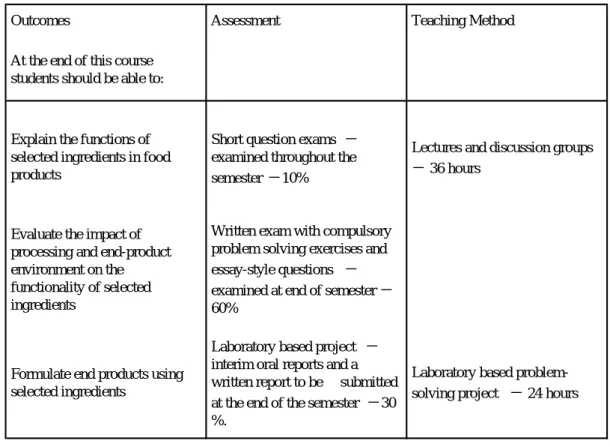
An example of alignment in the curriculum is given in Table 1.
Table 1: An example of an aligned curriculum (Courtesy of Dr Dolores O’Riordan, UCD)
Outcomes Assessment Teaching Method
At the end of this course students should be able to:
Explain the functions of selected ingredients in food products
Short question exams − examined throughout the semester −10%
Lectures and discussion groups
− 36 hours
Evaluate the impact of processing and end-product environment on the functionality of selected ingredients
Written exam with compulsory problem solving exercises and essay-style questions − examined at end of semester − 60%
Formulate end products using selected ingredients
Laboratory based project − interim oral reports and a written report to be submitted at the end of the semester −30 %.
Laboratory based problem-solving project − 24 hours
Preliminary Findings from the UCD Faculty
of Agriculture Pilot Project.
Initial findings from this project, informed by preliminary observations of the current full-scale restructuring (which, of course, includes the Faculty of Agriculture) enable some useful hypotheses to be drawn concerning both the utility and effectiveness of the model itself and on how it can best be introduced where the traditional subject-based curriculum has been in place for several generations. It must be stressed, however, that the findings reported in this paper are the result of early-stage observations and evaluations. Continuing evaluation of the reform process at UCD will be necessary to test and, if appropriate, validate these interpretations.
Evaluative data on the pilot was gathered by:
• Semi-structured interviews with 100% of the academic staff of the Faculty of Agriculture who actively employed in teaching during the final semester of the project. It was important to note that most of the data from this source was gathered at the late planning and early implementation stages. It will be necessary to conduct further evaluations as the new curriculum rolls out. • Consultative group meetings with student members
of the Faculty Staff / Student Liaison Committee. The group consisted of ten students: four 4th year students, three 3rd year students and three 2nd year students. This was followed by a questionnaire to the same group seeking, among other things, specific comments on the new documentation. The data presented, therefore, represents the views of those students chosen by their peers to represent them on official liaison and consultative committees. All of these students were in the position of having taken some of the courses to which the documents they were reviewing related and currently undertaking others. Five of the nine would also be taking further courses in the following semester.
Additional data, relating to the university-wide restructuring, comes from the direction observation of the authors as a result of their subsequent (separate and different) leadership and co-ordination work in
the university-wide restructuring.
The preliminary findings can be categorised into process and product – i.e. those which relate to the effective implementation of an outcomes-based curriculum and those that relate to the utility or otherwise of such a curriculum itself.
Process Finding 1: Teachers who were familiar with the curriculum being defined by content often had trouble, at first, with setting outcomes that were measurable.
The first, and arguably the biggest, problem with implementing the new structure was persuading academics to adopt or create statements of learning outcomes that were behavioural – i.e. capable of being observed and, therefore, assessed. Those academics used to regarding the curriculum as transmission of knowledge often found it difficult to specify in writing the behaviour of students that would demonstrate possession of this knowledge. There was a particular reluctance to replace (or even amplify) the word “understand” with descriptions of behaviour that could be observed such as the ability to be able to “explain”, “select”, “judge” or “justify”. The provision of supporting educational development seminars explaining the rationale of using behavioural language including a full discussion of the possible pitfalls -was crucial at this stage, as were workshops in developing outcomes-writing skills. Both the seminars and workshops proved essential to meeting (or coming close to meeting) the target dates for the production of curriculum documents and to ensuring that all three key components of the curriculum (i.e. outcomes, assessment and teaching methods) were included. It was not just a question of developing new skills but also one of adopting a whole new outlook on the nature, structures and even purpose of curriculum documents – in essence, a paradigm shift. Once, however, the skills of outcome-writing had been mastered, and the necessity for alignment with teaching and assessment internalised, teachers were quick, usually, to recognise the value and utility of describing the curriculum in this way.
Process Finding 2: It was necessary to limit the number of outcomes in order to ensure a reasonable workload for both students and staff.
When the academic staff first started to write outcomes for courses, there was a tendency to produce far more
outcomes than could be addressed within the timeframe of the course. The need to align all three elements of the curriculum led to a greater awareness of what constitutes a reasonable student (and staff) workload.
Process Finding 3: There was a need to be aware, at all times, of the dangers of over-prescription. Although the centrality of learning outcomes in constructing curricula that encourage effective learning is well established (Rust et al 2005, Biggs 2003, Spady 1998 & 1994), there is still much debate over the issue of to what extent defining learning outcomes in advance limits both teacher and student creativity and, hence, the potential depth and breadth of learning (Rees 2004, Harden 2002, Hussey & Smith 2002, Ecclestone 1999, Stenhouse 1986). None of the criticisms of using outcomes to define the curriculum, however, seriously seek to challenge the idea that students perform better when they are clear in their own minds about what is required of them by the assessment system. Properly written outcomes are one of the best ways of clarifying this information for students and an aligned curriculum is one of the best ways of helping teachers ensure that assessment tasks do actually address the intended outcomes. As even the most ardent critics of outcomes concede:
Learning outcomes have their value when properly conceived and used in ways that respect their limitations and exploit their virtues…
(Hussey & Smith 2002: 222).
Hussey and Smiths’ criticism is not of learning outcomes as an organising principle of curriculum design but of those who ascribe to them the attribute of being able to specify precisely and in advance, all the transactions that should take place within a given learning situation and the concomitant function of providing a checklist which, if met, indicates conclusively that learning is complete. It is in order to avoid such a limiting misuse of learning outcomes that the D’Andrea (2003) model of learning outcomes was adopted. In this model outcomes avoid the over-specificity of objectives and criteria as used, for example, within much of the UK system and which have been described as having little or no relationship to learning (Leatherwood 2005 p 309).
Process Finding 4: Redefining courses in terms of
behavioural outcomes both required and facilitated an audit of the appropriateness of content, teaching strategies and assessment methods.
Once teachers had mastered both the philosophy and skills required to design an outcomes-based curriculum, many found that the process both demanded and facilitated a fuller audit of the curriculum. The process of having to complete documentation that asked for courses to be defined in terms of behavioural outcomes and then to plan teaching and assessment methods appropriate to these outcomes became, in effect, a series of sequential audits of content, assessment and teaching. Although time-consuming, all but one of the teachers agreed that this was a more effective approach to curriculum reform than the more traditional approach of “tinkering” with existing structures to see if they can be improved. Of some concern is that this prompting of a re-appraisal of assessment and teaching is proving rare in the university-wide restructuring of first-year curricula. Initial observations suggest that the much smaller reach and breadth of supporting educational development workshops, as compared to the pilot, has been a key factor in this.
Process Finding 5: Involving students in the reform process helped ensure that the new curriculum documents were student-friendly.
The students of the Faculty of Agriculture were involved in the reform process from the beginning of the project through a number of mechanisms including established liaison and representative committees and, also, specially-convened focus groups. The students were highly supportive of the change process and overwhelmingly approved the outcomes-based model. Their support of the change process included structured scrutiny of proposed curriculum documents. This helped ensure that final drafts of new Faculty of Agriculture curriculum documents were written in student-friendly language. Unfortunately, this was not always the case in the subsequent university-wide restructuring. In those cases where students were not involved in the very early review of outcomes statements, there was a tendency to over-complex or jargon-ridden language.
Process Finding 6: The involvement of educational developers had a positive effect.
The idea of an aligned curriculum is simple in theory but hard to achieve in practice. The sheer logistical
complexity of completely altering all course documentation and ensuring that these are in a standard format was a major managerial problem only partly overcome by having an overall steering committee and naming people responsible for collating documentation in each subject. The biggest problem, however, was persuading academics to adopt or create learning outcomes that were behavioural – i.e. capable of being observed and, therefore, assessed. One of the biggest lessons from the UCD experience, therefore, is the very positive effect a carefully planned professional development and training strategy can have on curriculum change. In the case of the Faculty of Agriculture pilot, two members of the University’s Centre for Teaching and Learning were attached to the project throughout (on a 0.5 and 0.1 basis respectively) and worked in close collaboration with the Faculty Steering Group. When the pilot was complete, there was general agreement that this professional development dimension had been crucial to the successful implementation of change (only one member of the Faculty’s teaching staff dissenting from this view). Again, teachers involved in both the pilot project and the later university-wide restructuring reported that, in general, the outcomes statements and module descriptors of the latter lacked the quality and rigor of the former. As the other conditions were similar (if anything the pressure on Faculty of Agriculture staff had been greater than on staff in the rest of the university because of the competing requirements of several major changes taking place at the same time and the decision to change all four years of the undergraduate curriculum in one go), it seems reasonable to infer that the comparative lack of training contributed to this difference. The reasonableness of this inference is supported by the traceable difference in quality between the outputs of those staff in other Faculties who had been given training (usually by the same team from the Centre for Teaching and Learning as serviced the pilot) and those who had not. Although written guidelines were available to all staff, these do not seem to have been as effective as the workshops, inputs and personal consultations that took place during the Agricultural Faculty pilot. Further evidence of the beneficial effect of the involvement of education developers comes from the incompleteness of many of the curriculum documents produced by many of the staff not involved in the pilot or the recipients of similar training. In the documents produced by this group, assessments were not always matched to
outcomes. Indeed, in some cases, the assessment section of the documentation had not been even been completed. While this suggests that the message of a need for alignment might not have been promulgated with sufficient vigour, it also seems clear that the detailed one-day workshops conducted for all staff involved in the pilot paid significant benefits. Process Finding 7: When it came to implementing the new curriculum, the most beneficial impacts on student learning were obtained when teachers ensured that students were fully informed about what the intended outcomes were and how they related to the assessment. Where teachers did not so inform students, many of the benefits of constructive alignment were lost. It also proved highly desirable to continually remind students of the link between outcomes and assessment in order to ensure that they remained focused.
Product Finding 1: A constructively aligned curriculum produced opportunities for more effective monitoring and evaluation.
In theory, once written, outcomes serve as a base line for evaluating a course. With outcomes in place, an evaluator can estimate how well the teaching and learning strategies, content, materials & resources, and assessment procedures are designed to support students in achieving them. In terms of monitoring, outcomes enable co-ordination of courses in related areas. For example, knowing the outcomes for the earlier modules in a programme enables teachers on later modules to have a much more realistic idea of the entry knowledge and skills level of students. It also enables the easy identification of where essential content is addressed in the learning programme, whether anything is unnecessarily repeated and whether there are any gaps in either content or process. Even in the planning stage, teachers in the Faculty of Agriculture found that the new curriculum model could help avoid overlap, allow for better co-ordination between modules and identify potential gaps and repetitions. This only happened, however, when a conscious choice was made, by individual or teams of teachers, to search for such dysfunctions – what the constructive alignment structure did, was make this process much easier than hitherto.
Product Finding 2: The new curriculum documents, based on Biggs’ alignment model, helped students know what was expected of them. This enabled more
effective learning.
The student representatives on committees and the focus groups reported that the new documentation greatly helped them know what was expected in the courses. They felt that the new structure enabled a much more focused and effective approach to study. It also facilitated peer support for study. The supposition that this is particularly useful when there is an increasingly diverse student population is supported in the literature (Yorke & Longden 2004). Product Finding 3: The new curriculum structure enabled students to make better informed curriculum choices.
The student representatives and focus groups also reported that knowing the intended outcomes for each course enabled better choices to be made between optional elements of the curriculum.
Product Finding 4: The new curriculum documents enabled teachers at UCD to compare their courses with those in similar institutions in the European Education Area.
The teachers in the Faculty of Agriculture reported that with the new curriculum documents they were better able to compare their courses with similar ones in other institutions (UCD has the only Agricultural Faculty in Ireland, so all equivalent courses and institutions are abroad).
Product Finding 5: The new curriculum documents enabled feedback and guidance to be focused on individual need.
Where both the teacher and the student were fully aware of the intended outcomes, it became possible for them to engage in a dialogue on how well, or otherwise, the student was progressing towards them. For example, international exchange students could discuss how their curriculum choices would fit in with the requirements of their home institution.
Product Finding 6: Having to write descriptions of the curriculum promoted innovation in teaching and assessment.
Using Biggs’ format to structure the curriculum encouraged some teachers to introduce new teaching and / or assessment strategies where these would be a better match for the outcomes. As noted above (Process finding 4), there has not been a widespread reproduction of this phenomena in the university-wide
restructuring of first-year undergraduate courses. It would seem that the teaching innovations were as much a result of the educational development activities that were integral to the pilot programme as of the curriculum structure. Nonetheless, teachers in the Faculty of Agriculture did report that having to describe the curriculum in the new way prompted rethinking and reform of teaching and assessment methods.
Product Finding 7: The benefits of the new curriculum structure were most profound when (a) teachers remained aware of the need to maintain constructive alignment in practice and (b) students were constantly reminded how their leaning experiences were related to the outcomes and, most importantly, how these outcomes determined the method and content of the summative assessments they would face.
Perhaps the most important of the preliminary findings from the pilot project was that alignment in the curriculum is not achieved through a one-off restructuring process even when completely new curriculum documentation is successfully put in place. Rather, alignment must be realised through a continuing process wherein academics ensure that their teaching is always focused on the intended outcomes and that students are guided, both individually and collectively, to focus on achieving these outcomes in the knowledge that this will be rewarded by the assessment system. In the UCD pilot, benefits to student learning were most manifest in those instances where teachers kept reminding students of what the intended outcomes where and how they would be assessed. Where this was done, students tended to report considerable satisfaction with the new curriculum. Where this was not done, many of the benefits of constructive alignment were lost. There is considerable evidence that it is their perception of what will be rewarded by the assessment system that is the prime determinant of what and how students study (Biggs 2003, Scouller 2000, Brown et al 1997, Attkins et al 1993, Ramsden 1992, Gibbs 1992). Consequently, the key to a successful and beneficial implementation of the aligned curriculum model is for teachers to seek to ensure that their students focus their studies on the stated outcomes by making explicit not only how their own teaching relates to these outcomes but also how the marking scheme will be used to test and reward achievement of them. There is also considerable evidence in the literature on assessment to support the
contention that effective strategies for this require students to be actively engaged in examining, discussing and applying the criteria, rather than merely receiving information about them (Rust et al 2005 & 2003, Rust 2002, Cohen et al 2001, Hughes 1995, Forbes & Spence 1991). It should go without saying that desired outcomes should, where possible, be couched in terms that require demonstration of higher order learning (i.e. synthesis and evaluation). In this way, the aligned curriculum can be used to facilitate the prompting of critical thinking.
Product Finding 8: A constructively aligned curriculum can enable more responsive management.
This is, perhaps, not so much a finding as an observational supposition based on the opportunities for more active monitoring and evaluation provided by a set of curriculum documents which, at least, specify intended outcomes for all components of a course or programme and, at best, also indicate teaching methods and assessment schedules. On-the-face-of-it, this ought to enable managers to identify and respond to imperatives the require curriculum redesign e.g. changes in the level of knowledge or skills of students on entrance (as a result, say, of changes in the second-level curriculum), technological or scientific advances, new regulatory requirements or the results of evaluations and audits. The one management benefit that was directly observed was that some curriculum leaders identified overlaps and gaps moved to eliminate them.
Conclusion
The results so far obtained from the UCD pilot must be treated with a certain amount of caution. They are inferences from a preliminary evaluation which are best seen as working hypotheses drawn from close observation. As such, they merit further investigation and testing. It is intended that evaluations of the full-scale restructuring currently underway at UCD provide such tests.
Nonetheless, preliminary data from the UCD restructuring is robust enough to suggest the implementation of Biggs’ curriculum model has the potential to benefit students, teachers and managers alike.
• For students, opportunities for effective learning can be enhanced when the structure makes explicit what will be rewarded in assessment, illuminates feedback and helps focus study. It can also facilitate mobility within and between programmes. • For teachers, the structure can prompt revision of
methods at the planning and evaluation stages. It can also provide a focus for feedback and guidance that the students can understand and to which they can respond.
• For managers, the structure can increase the amount of useful information received and make internal and external comparison easier.
In each case, however, it is, deliberate secondary actions that provide the benefits not the structure itself. If teachers take the time and trouble to focus their own work on ensuring continual alignment and, further, make this obvious to students, then the students, in turn, can be guided into more focused and effective modes of study. They must, however, choose to take advantage of this guidance. Similarly, managers can take advantage of the information made explicit by the structure to be more responsive to the needs of teachers, students and other stakeholders. Biggs’ model, then, can be seen as having an inherent facilitating potential for enhancing teaching, learning and educational management. There is, however, no inevitability about actualizing this potential. Rather, t h e c u r r i c u l u m s t r u c t u r e t h a t r e s u l t s f r o m implementing the model provides teachers and managers with the opportunity to provide a better learning environment for students. The deliberate actions required to realize the potential benefits of the model can be seen as analogous to those needed to achieve the “active engagement” that can create a “common understanding” and “better standardization” of assessment criteria (Rust 2005 p 233). This, in turn, suggests that the benefits of a constructively aligned curriculum can best be achieved within a social constructivist framework (Rust 2005) wherein managers, teachers and students form a “community of practice” (Price 2005, Wenger 1998) where tacit understandings are exchanged through examination, discussion and application of the principle of aligning outcomes, assessment, teaching and studying.
References:
Attkins M J, Beattie J & Dockrell W B (1993) Assessment Issues in Higher Education UK Employment Department, London.
Biggs J (2003) Teaching for Quality Learning at University (2nd Edition) SHRE / Open University Press, Maidenhead, UK.
Brown G, Bull J & Pendleberry M (1997) Assessing Student Learning in Higher Education Routledge, London.
D’Andrea V (2003) “Organising Teaching and Learning: Outcomes-based Planning” in Fry H, Ketteridge S & Marshall S (eds) Teaching and Learning in Higher Education (2nd Edition) Kogan Page, London.
Ecclestone K (1999) Empowering or Ensnaring? The Implications of Outcome-based Assessment Higher Education Quarterly 53.1, 29 – 48. EVA (2002) International Comparative Evaluation of
Agricultural Science Related BSc Programmes, EVA / Vester Kopi, Copenhagen.
Forbes D A & Spence J (1991) An Experiment in Assessment for a Large Class in Innovations in Engineering Education Ellis Horwood, London. Gibbs G (1992) Improving the Quality of Student Learning Technical and Educational Services, Bristol.
Cohen R, Boud D & Sampson J (2001) Dealing with Problems Encountered in Assessment of Peer Learning in Falchikov N Learning Together: Peer Tutoring in Higher Education Routledge, London.
Harden R M (2002) Developments in Outcome-based Education Medical Teacher, 24:117–20.
Hughes I E (1995) Peer Assessment Capability 1.3 39 – 43.
Hussey T and Smith P (2002) The Trouble with Learning Outcomes Active Learning in Higher Education, 3:220–233.
Knowles M (1988) “Preface” in Boud D, Developing Student Autonomy in Learning Kogan Page, London.
Leatherwood C (2005) Assessment Policy and Practice in Higher Education: Purpose, Standards and Equity Assessment and Evaluation in Higher Education 30.3, 307 – 324.
Price M (2005) Assessment Standards: The Role of Communities of Practice and the Scholarship of
Assessment Assessment and Evaluation in Higher Education 30.3, 215 – 230.
Ramsden P (1992) Learning to Teach in Higher Education London, Routledge.
Rees C E (2004) The Problem with Outcomes-based Curricula in Medical Education: Insights from Educational Theory Medical Education, 38: 593– 598
Rust C, O’Donovan B & Price M A (2005) Social Constructivist Assessment Process Model: How the Research Literature Show us this could be Best Practice Assessment and Evaluation in Higher Education 30.3, 231 – 240.
Rust C, Price M A & O’Donovan B (2003) Improving Students’ Learning by Developing their Understanding of Assessment Criteria and Processes Assessment and Evaluation in Higher Education 28.2, 147 – 164.
Rust C (2002) The Impact of Assessment on Student Learning – How Can the Research Literature Practically Help to Inform the Development of Departmental Assessment Strategies and Learner Centered Assessment Practices Active Learning in Higher Education 3.2, 145 – 158.
Scouller K (2000) The Influence of Assessment on Student Learning Australian Association for Research in Education, available at http:// www.aare.edu.au/00pap/sco00195.htm
Spady W G (1994) An Appeal to Objective Dialogue: A Response to Schlafly and LaHaye. School Administrator, 51:30–1.
Spady W G (1988) Organising for Results: The Basis of Authentic Restructuring and Reform. Educational Leadership, 46:4–8.
Stenhouse L (1986) An Introduction to Curriculum Research and Development. Heinemann, London.
Teichler U (200) Recent Higher Education Reforms and the Changing Role of Micro-Planning Report of the International Workshop on Higher Education Reform in Japan and Germany Centre for Research and Development of Higher Education, March 2005, The University of Tokyo. UCD (2001) Peer Review Report for the Faculty of Agriculture April 2001, Unpublished UCD Paper, Dublin.
Wagner A (1999) “Lifelong Learning in the University: A New Imperative?” in Hirsch & Weber (eds) Challenges Facing Higher Education at the Millennium, American Council on Education,
Oryx Press, Phoenix, USA pp 134 – 152. Wenger E (1998) Communities of Practice: Learning,
Meaning and Identity Cambridge University Press, Cambridge.
World Bank (2002) Structuring Knowledge Societies:
new ch all eng es f o r t er ti ar y ed uca tio n, Washington, DC.
Yorke M and Longden B (2004) Retention and Student Success in Higher Education SHRE / Open University Press, Buckingham, UK.