INTRODUCTION
The caridean shrimp genus, Alpheus, is a taxonomically diverse group with approximately 320 described species (WoRMS2020). Most Alpheus species inhabit soft sediments, in which they construct burrows or live under rocks, while some species have symbiotic relationships with other invertebrates (Banner and Banner 1982; Anker et al. 2006; Hurt et al. 2013). According to a recent review by Henmi et al. (2017), the burrow morphology of Alpheus shrimps has been studied in only 16 species, which is approximately 5% of the known species in the genus. The present study reports the burrow morphology of Alpheus sp., which was formerly identified as A. euphrosyne richardsoni (sensu Miya 1995), at muddy tidal flats in Shikoku Island and Kii Peninsula, western Japan. Given that Alpheus sp. is
assigned “Near Threatened” status in the Red List of Marine Crustacea issued by the Ministry of the Environment, Government of Japan (2017), the ecological notes, such as burrow structure, of this species may contribute to its conservation.
MATERIALS AND METHODS
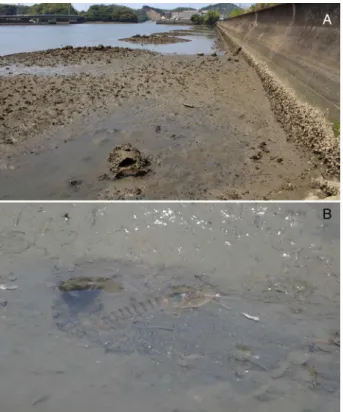
An in situ study of the morphology of Alpheus sp. burrows was conducted at a tidal flat in Sukumo City (32° 55’ 42” N, 132° 41’ 45” E), Kochi Prefecture in Shikoku Island, western Japan. The study site (Figure 1) is a muddy tidal flat, which was to be reclaimed to build a high breakwater. Casts of animal burrows were made at low tide on April 20, 2019 (spring tide) using a polyester resin (Den-nest, Midori Chemical Laboratory Inc., Chiba, Japan), which was mixed with a peroxide catalyst (2% by
99
Research Note
Burrow morphology of an alpheid shrimp at muddy tidal flats
in western Japan
Sota Kirihara
1, Gyo Itani
1, 2*, Jun-ichi Nunobe
3, Akihito Nomoto
3,
Kristian Q. Aldea
1, Runa Murakami
2, Hiroshi Sakata
4, andYumi Henmi
51Graduate School of Kuroshio Science, Kochi University, 2-5-1 Akebono, Kochi 780-8520, Japan 2Graduate School of Education, Kochi University, 2-5-1 Akebono, Kochi 780-8520, Japan 3IDEA Consultants, Inc. 1-14-22 Nanko-Kita, Suminoe, Osaka, Osaka 559-8519, Japan 4Museum of Nature and Human Activities, 6 Yayoigaoka, Sanda, Hyogo 669-1546, Japan
5Maizuru Fisheries Research Station, Field Science Education and Research Center, Kyoto University,
Nagahama, Maizuru, Kyoto 625-0086, Japan
Abstract
Although well over 300 species are known from the caridean shrimp genus, Alpheus, only less than 20 species have had their burrow morphology studied thus far. Therefore, we investigated the burrow morphology of
Alpheus sp., which was formerly identified as A. euphrosyne richardsoni (sensu Miya 1995), at muddy tidal flats
in Shikoku Island and Kii Peninsula, western Japan. In doing so, two burrow casts were obtained in situ using a polyester resin. The burrows were highly complicated and stratified, with many short cul-de-sac branches and looped structures.
Key words: resin casting, shrimp burrow, Alpheus, looped structure
Received 14 October 2020; Accepted 2 November 2020. *Correspondence. E-mail: [email protected]
volume). After one day, the hardened casts were carefully removed from the sediment by hand and transported to the laboratory. Among the six burrow casts obtained, only one represented the burrow of Alpheus sp.; the other five casts represented the burrows of the eel goby, Taenioides sp. C (sensu Kurita and Yoshino 2012). The horizontal extension and total depth of the burrows were measured to the nearest 0. 5 cm. Meanwhile, the total length of each burrow, including every branch and segment, was measured (to the nearest 0. 1 cm) by following the contour of the cast with a tapeline. The diameter of the burrow was defined as the height and width of the elliptical cross-section, averaged from three points along the tunnel. The resin cast of Alpheus sp. burrow will be deposited in the Museum of Nature and Human Activities in Hyogo Prefecture.
We also examined a burrow cast of Alpheus sp. from the Museum of Nature and Human Activities in Hyogo Prefecture. The cast was obtained, using a polyester resin (U-PiCA, Japan U-PiCA Company, Ltd.), 20 years ago by GI and HSat a tidal flat in the Uchinoura Inlet (33°41’ 34” N, 135° 23’ 12” E), Wakayama Prefecture, Kii Peninsula in western Japan.
RESULTS
The burrow cast from Kochi was shallow (9 cm in depth), but wide horizontally (53 cm × 45 cm), with 2 openings and 18 short cul-de-sac branches (measuring 6. 5 cm in length on average) (Figure 2). These two openings were situated very close to one another (paired opening); one was funnel shaped (see also Figure 1B) and the other was circular. The main tunnel was smooth on the floor, but rough on the roof, with an elliptical cross-section (1.4 cm width × 1.2 cm height). The total burrow length (including branches) was 329 cm. Moreover, the tunnels were stratified and had three looped structures. The total length of the embedded shrimp was 2.5 cm.
The burrow cast from Wakayama was 16 cm deep, with a horizontal extension measuring 38 cm × 35 cm, with 3 openings and 17 short cul-de-sac branches Burrow morphology of an alpheid shrimp
100
Fig. 1. A. Study site at Sukumo City in Kochi Prefecture,
Japan. B. Alpheus sp. near the funnel-shaped burrow opening.
Fig. 2. The burrow cast of Alpheus sp. from Kochi Prefecture.
A. Plan view. B. Side view. C. Oblique view. The arrow indicates burrow opening.
(measuring 3.1 cm in length on average) (Figure 3). The total burrow length (including branches) was 337 cm, with an elliptical cross-section (1.3 cm width × 1.2 cm height). The tunnels were stratified and had two looped structures. The embedded shrimp specimen was lost (no data).
DISCUSSION
The burrow morphology of Alpheus sp. from two study sites (Kochi and Wakayama Prefecture) was similar in the way the burrow extended over a wide area with stratified tunnels, many side branches, and looped structures. However, there was a difference between them in the depth of the burrows, which was shallower in the sample from Kochi. Dôtu (1961) has shown a brief sketch of the burrow morphology of this species (as A. bisincisus); the resin casts in this study were much more complicated, but similar in that the burrow has many side branches. In contrast, A. brevicristatus, which inhabits sandy-mud tidal flats in Japan, had a simple burrow with fewer side branches (Henmi et al. 2017; 2020). The presence of stratified tunnels and many side branches may be indicative of the efficient use of deposits from the sediment (Nickel and Atkinson 1995). The looped structure has been found in two highly complicated burrow casts of A. heterochaelis in an estuary in Georgia, USA (Howard and Frey 1975; Basan and Frey 1977). Shinn (1968) also recorded the presence of complicated A. floridanus burrows in the Atlantic, but by looking at the figure, we could not ascertain the presence or absence
of a loop. Conversely, a more simplified morphology without stratified structure of A. floridanus burrow, found in the Caribbean Sea, was recorded by Dworschak and Ott (1993).
Our study showed that the individuals of Alpheus sp. require a wide space to create their burrows, which comprise a highly complex underground structure. Future studies in aquaria should elucidate the development of the looped structure as well as its function. Owing to the limited number of casts obtained, the symbiotic animals in the burrow was not detected. However, it should be noted that several studies (Suzuki and Wada 1999; Koyama et al. 2017) have suggested the occurrence of an estuarine goby, Apocryptodon punctatus with Alpheus sp. (as A. richardsoni). In light of these findings, further studies on the symbiotic relationship between the shrimp and goby will be worthwhile.
ACKNOWLEDGEMENTS
We would like to thank Dr. T. Yorisue (Museum of Nature and Human Activities, Hyogo) for hosting a visit to search the museum collections. We would also like to thank the editor and two anonymous referees for helpful comments and suggestions. Additionally, this work was partly supported by the Asahi Glass Foundation. We acknowledge Editage (www. editage. jp) for English language editing.
REFERENCES
Anker A., Ahyong S.T., Noël P.Y. and Palmer A.R. 2006. Morphological phylogeny of alpheid shrimps: parallel preadaptation and the origin of a key morphological innovation, the snapping claw. Evolution 60: 2507-2528.
Banner D.M. and Banner A.H. 1982. The alpheid shrimp of Australia Part III: The remaining alpheids, principally the genus Alpheus, and the family Ogyrididae. Records of the Australian Museum 34: 1-357.
Basan P.B. and Frey R.W. 1977. Actual-paleontology and neoichnology of salt marshes near Sapelo Island, Georgia. In: Trace fossils 2. (eds T.P. Crimes Kirihara et al.
101
Fig. 3. Oblique view of the burrow cast of Alpheus sp. from
and J.C. Harper). Seel House Press, Liverpool, pp. 41-70.
Dôtu Y. 1961. The bionimics and life history of the gobioid fish, Apocryptodon bleekeri (Day). Bulletin of the Faculty of Fisheries Nagasaki University 10: 133-139.
Dworschak P.C. and Ott J.A. 1993. Decapod burrows in mangrove-channel and back-reef environments at the Atlantic Barrier Reef, Belize. Ichnos 2: 277-290. Henmi Y., Fujiwara C. and Itani G. 2020. Mesocosm experiments revealed a possible negative effect exerted by the facultatively symbiotic goby on the host alpheid shrimp burrow. Journal of Experimental Marine Biology and Ecology 527: 151379.
Henmi Y., Fujiwara C., Kirihara S., Okada Y. and Itani G. 2017. Burrow morphology of alpheid shrimps: case study of Alpheus brevicristatus and a review of the genus. Zoological Science 34: 498-504. Howard J. D. and Frey R. W. 1975. Estuaries of the
Georgia Coast, U.S.A.: Sedimentology and biology. II. Regional animal-sediment characteristics of Georgia estuaries. Senckenbergiana maritima 7: 33-103.
Hurt C., Silliman K., Anker A. and Knowlton N. 2013. Ecological speciation in anemone-associated snapping shrimps (Alpheus armatus species complex). Molecular ecology 22: 4532-4548. Koyama A., Inui R., Sawa K. and Onikura N. 2017.
Symbiotic partner specificity and dependency of two gobies (Apocryptodon punctatus and Acentrogobius sp. A) and four alpheid shrimps inhabiting the
temperate estuary of southern Japan. Ichthyological Research 64: 131-138.
Kurita T. and Yoshino T. 2012. Cryptic diversity of the eel goby, genus Taenioides (Gobiidae: Amblyopinae) in Japan. Zoological Science 29: 538-545.
Ministry of the Environment, Government of Japan. 2017. Red List of Marine Crustacea. Accessed at: https://www.env.go.jp/press/files/jp/106405.pdf on 2020-10-10.
Miya Y. 1995. Four species of Alpheus from intertidal and shallow water mudflats in the Sea of Ariake, Kyushu, Japan (Crustacea, Decapoda, Alpheidae). Bulletin of the Faculty of Liberal Arts, Nagasaki University, Natural Science 35 (Special Issue): 271-288.
Nickell L. A. and Atkinson R. J. A. 1995. Functional morphology of burrows and trophic modes of three thalassinidean shrimp species, and a new approach to the classification of thalassinidean burrow morphology. Marine Ecology Progress Series 128: 181-197.
Shinn E.A. 1968. Burrowing in recent lime sediments of Florida and the Bahamas. Journal of Paleontology 42: 879-894.
Suzuki T. and Wada K. 1999. Record of a gobiid fish, Apocryptodon punctatus from the Uchinoura Inlet in Wakayama Prefecture, Japan. Nankiseibutu 41: 61-63.
WoRMS. 2020. Alpheus Fabricius, 1798. Accessed at: http://www.marinespecies.org/aphia.php?p=taxdeta ils&id=106978 on 2020-10-10.
Burrow morphology of an alpheid shrimp