辺の容量が–定のネットワークにおける動的なフローを 用いた避難計画問題に対する効率的なアルゴリズム An EMcient Algorithm for the Evacuation Problem
in
DynamicNetwork
Flows withUniform
Arc Capacity andits Extension
神山直之, 加藤直樹, 瀧澤重志
Naoyuki Kamiyama, Naoki Katoh, Atsushi Takizawa 京都大学大学院工学研究科建築学専攻
Department of Architecture and Architectural $\mathrm{E}\mathrm{n}\mathrm{g}_{\dot{\mathrm{i}}}$eering, Kyoto University
Abstract
In our previous paper [9], we proposed an $O(n\log n)$ time algorithm for the
evacuation problem for a$\sqrt{n}\mathrm{x}\sqrt{n}$ gridnetwork with uniform arc capacity. In this
paper,weextendtheclasses of networks to whichwe canapply the algorithmof[9].
1
Introduction
Recently,diversedisasters occurred and caused serious damagesinmanycountries. There-fore it is very importantto establish crisis management systems against $1\mathrm{a}r\mathrm{g}\triangleright$-scaledis& ters such as big earthquakes, conflagrations and tsunamis to secure evacuation pathways and
to
effectively guideresidents
to a safe
place. Inour
work,we
adopt dynamic nctworkflowsi
as
a
model for evacuation. A
dynamicnetwork flow is defined
on a
network
whichconsists
of
a
directed
graph $D=(V, A)$with
capacity $c(e)$ andtransit time
$\tau(e)$on
every
arc
$e\in A$.
Forexample, ifwe
consider
urbanevacuation, vertices modelbuildings, rooms,exits and
so
on, andan
arc
modelsa
pathwayor a
road connocting vertices. Foran
arc
$e$,capacity $c(e)$ represents the number ofpeople which
can traverse
thearc
$e$ per unit time,and transit time $\tau(e)$ denotes the time required to traverse $e$.
Since
Ford and Fulkerson[3],dynamic networkflowshave been studiedextensively (see thesurveybyKotnyek [10]). Given a network with
a
single sink and initial supplies at vertices, the evacuation problemwhichwe
considerin this paper asks tofindthe minimum time horizonsuchthat we cansend all the initial supplies toasink. This problem can besolved by the algorithm of Hoppe and Tardos [7] in polynomial time. However their running time is high-order polynomial, and hence isnot
practical in general.Therefore
it isnecessary
to devisea
faster
algorithmfor
a
tractable and
practicaJlyuseful subclass of
this problem.In
our
previous
paper
[9],we
proposedan
$O(n\log n)$ time algorithmfor
the evacuation problemfor
a
$\sqrt{n}\mathrm{x}\sqrt{n}$ grid network with uniformarc
capacity where $n$ is number of vertices ingiven network. In this paper,
we
extend the classes of networks to whichwe can
apply the algorithm of [9].$\overline{1\mathrm{A}}$
fewauthors(e.g.,Fleister in[2])argue that the word “dynamic” ismoreconsistently used foraproblemwith input that changes over time. Thereforethese authors preferto use theterms
flow
over1.1
Problem Formulation and
notation
Let $\mathbb{R}_{+}$ and$\mathbb{Z}_{+}$ denote the set ofnonnegativereals and nonnegative integers, respectively.
We
mayrepresent a set $\{x\}$ ofa
single element by $x$.
For any finite set $X$, we define $|X|$as
the number of elcments belong to $X$.We denote by $D=(V, A)$ a directed graph $D$ which consists ofavertex set $V$ and an
arc set $A$. Moreover we denote by $e=(u, v)$ an arc $e$ whose tail is $u$ and head is $v$
.
Inthe
case
wherean
arc
$e=(u, v)$ hasno
parallel arc,we
mayrepresent $e$ by $(u, v)$. A path$p=(e_{1}, e_{2}, \ldots, e_{1})$from
a vertex
$u\in V$to
a
vertex
$v\in V$ in$D$isa sequencc
ofarcs
belongto
an
arc
set
$A$which satisfies the followingtwo
conditions: (1) the headof$e$:
andthetailof$e:+1$
are
thesame
vertexfor any$i\in\{1,2, \ldots, l-1\},$ (2) thetail of$e_{1}$ is$u$and the head of$e_{\iota}$ is $v$
.
Forany pair of subsets$X,$$\mathrm{Y}\subseteq V$,we
define6(X,$\mathrm{Y}$) $=\{e=(x,y):x\in X, y\in \mathrm{Y}\}$,
and
we
write$\delta^{+}(W)$ and $\delta^{-}(W)$ instead of $\delta(W, V-W)$ and $\delta(V-W, W)$, respectively.For any vertex $v\in V$,
we
define $P_{v}=\{w\in V:e=(w, v)\in A\}$.
Moreover, forany
pairofvertices$u,$$v\in V$,
we
denote by $\lambda(u,v)$ the localarc
connectivity from$u$to $v$ in $D$, i.e.,the maximumnumber ofthe arc-disjoint paths from $u$ to $v$ in $D$
.
Here
we
definea
dynamic network. We denote by $N=(D=(V, A),$$c,\tau,$$b,$$s)$a
dy-namic network
Al
which consistsofthe underlying directed graph$D=(V, A)$, a capacity function $c:Aarrow \mathrm{R}_{+}$ whii represents the upper bound for therate
offlow
thatentersan
arc
per unit time,a
transit timefunction
$\tau:Aarrow \mathbb{Z}_{+}$ which represents thetime requiredto traverse
an
arc,a
supplyfunction
$b:Varrow \mathbb{R}_{+}$ which represents the supply ofeach
vertex, andasink $s\in V$. Notice that for any
arc
$e$ thetransittime $\tau(e)$ isa
nonnegativeinteger. Since
we
consider evacuationtoa
sink $s$,we assume
thata
sink $s$ hasno
leavingarcs
and no supply, and anyvertex $v\in V$ is reachable to a sink $s$.
For any vertex$v\in V$,we
define $R_{v}=${
$w\in P_{\delta}$: $w$ is reachable from $v$ in $D$}.
Finallywe
definea
length ofa
path$p$in the underlying directed graph $D$ of$N$
as
thesum
of transit times ofarcs on
$p$,
i.e., $\sum_{\epsilon\in \mathrm{p}}\tau(e)$
.
Here
we
define a dynamic networkflow
$f:A\cross \mathbb{Z}_{+}arrow \mathbb{R}_{+}$ in a dynamic network$N=(D=(V, A),$$c,$$\tau,$$b,$$s)$
.
For anyarc
$e\in A$ and time step $\theta\in \mathbb{Z}_{+}$, we denote by$f(e, \theta)$ the flow rate entering the
arc
$e$ at the time step $\theta$which aarrives at the head of$e$at the time step $\theta+\tau(e)$. Notice that any time step is
a
nonnegative integer.We
call $f$a
feasible
dynamic networkflow
in$N$ ifit satisfies thc following three conditions, i.e.,capacity constraint,
flow
conservation, and demand constraint [11]. Capacityconstraint:
$\mathrm{F}\mathrm{o}\mathrm{r}\mathrm{r}\mathrm{y}\mathrm{a}\mathrm{r}\mathrm{c}e\in A\mathrm{t}\mathrm{d}\mathrm{t}\mathrm{i}\mathrm{m}\mathrm{e}\mathrm{s}\mathrm{t}\mathrm{e}\mathrm{p}\theta\in \mathbb{Z}_{+}$,$0\leq f(e, \theta)\leq c(e)$
.
(1)Flow conservation: For
any
vertex$v\in V$ and time step $\Theta\in \mathrm{Z}_{+}$,$\sum_{\epsilon\in\delta(v)}\sum_{\theta+=0}^{\Theta}f(e, \theta)-\sum_{\epsilon\in\delta-(v)}\sum_{\theta=0}^{\Theta-\tau(\epsilon)}f(e, \theta)\leq b(v)$
.
(2)Demand
constraint:
There existsa
time step $\Theta\in \mathbb{Z}_{+}$ such thatHere we give the intuitive understanding ofthe above three conditions. Capacity
con-straintensures
that the flow rate entering into anyarc
$e$ at any time step $\theta$ is boundedby thecapacity of$e$. Flow conservation
ensures
that the flow rate entering into anyarc
$e$at any time step $\theta$is bounded bythe
sum
ofthe flowrate arriving at the tailof$e$ andthestorage of the tail of$e$ at the time step $\theta$. Demand constraint ensures that all ofsupply
flow
intoa
sink $s$.
For
a
feasible dynamicnetwork
flow $f$ in$N$, let $\Theta(f)$ denote the completion time for$f$
,
i.e., the minimum time step $\Theta$ satisfying (3). The evacuation problem asksto find the minimum value of$\Theta(f)$among
all feasibledynamicnetwork flowsin$N$.Given
a
dynamicnetwork
$N$,the
evacuation
problem$\mathrm{E}\mathrm{P}(N)$is
formallydefined
as
follows:
$\mathrm{E}\mathrm{P}(N):\ovalbox{\tt\small REJECT} \mathrm{e}${
$\Theta(f):f$ isa
feasible dynamic network flow in$N$}.
Throughout this paper, $n$ and $m$
denote
respectively the number ofthe vertices and thearcs
in given network $N$for the evacuation problem $\mathrm{E}\mathrm{P}(N)$.
1.2
Related works
Burkard, Dlaska, and Klinz [1] presented
a
strongly polynomial time algorithm for the evacuation problem in thecase
where onlyone
vertex hasa
supply in given network. Unlike in the static networkflow2
problem, the evacuation problemcan
not bereduced
tothe
case
where
onlyone vertex has
a
supplyby usingsuper-source
which
is
connected
with allvertex
in givennetwork.
This isbecause
the capacity of thearc
connecting thesuper-source
toa vertex
$v$can
not
be setso
that thetotal amount
offlow
that passthroughthis
arc
during the timehorizon equalto the supply of$v$.
The capacities ofarcs
in
a
dynamicnetwork
limit theflow rate at
each time step. Hoppeand
Tardos [7]gave
the only known polynomial time algorithm for the evacuation problem. The algorithm of [7]solves
theevacuation
problem $\mathrm{E}\mathrm{P}(N)$ by using $O(S^{2}\log^{2}(nCM\mathcal{T}))$ minimumcost
static network flow computations where$S,$ $C,$ $M$, and $\mathcal{T}$respectively denotethe number of verticeswith positive supplies, the maximum capacity ofarcs, the
sum
ofallsupplies of vertices and the maximum transit time in $N$.
Their running timecan
be made stronglypolynomial by using the parametric
search
technique of Megiddo [12].As a
specialcase,
Hall, Hippler, andSkutella
[6] consider the evacuation problemfor
a
dynamic networksuch that foreachvertex
$v$ alengthof anypathfrom$v$ toa sink is thesame
value. Mamada, Uno, Makino, and Fujishige [11] consider the evacuation problem$\mathrm{E}\mathrm{P}(N)$ for
a
dynamicnetwork
$N$with tree structure and presentedan
$O(n\log^{2}n)$ timealgorithm. For other special class, the algorithm of [9] solves the evacuation problem
$\mathrm{E}\mathrm{P}(N7$ for
a
dynamicnetwork$N$witha
$\sqrt{n}\mathrm{x}\sqrt{n}$girdstructureand uniformarc
capacityin time $O(n\log n)$
.
2
The
Evacuation
Problem for
Grid
Networks
First
we define
a
grid graph.For
simplicity,we
assume a
grid graph ison
$N^{2}$ grid points$\underline{\{1,2,\ldots,N\}\mathrm{x}\{1,2,\ldots,N\}}$inthe plane, and let$n=N^{2}$
.
Herea
vertex isidentified
with$2\mathrm{i}$ orderto distinguish $\mathrm{C}\mathrm{l}\mathfrak{B}8\mathrm{i}\mathrm{C}\mathrm{u}$ network flows from dynamic network flows, wecall classic network
$(i,j)$ with $i\in\{1,2, \ldots , N\}$ and $j\in\{1,2, \ldots, N\}$. The distance between two vertices
$(i,j)$ and $(i’,j’)$ is defined as $|i-i’|+|j-j’|$
.
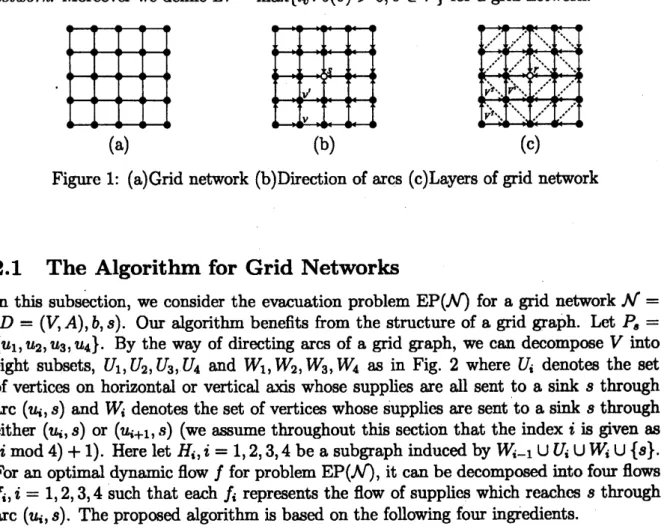
Twovertices $(i,j)$ and $(i’,j’)$ areconnectedby an edge ifand only if $|i-i’|+|j-j’|=1$ holds (Fig. 1$(\mathrm{a})$). The edgewhich connects
$v$ and $v’$ is directed $\mathrm{h}\mathrm{o}\mathrm{m}v$ to $v’$ if and only if the distance from $v’$
to
$s$ is smaller thanthat
from$v$to
$s$ (Fig. $1(\mathrm{b})$). A dynamic network definedon a
grid graph is calleda
gridnetwork. We
assume
throughout this paper that, in dynamic networkswe are
concerned with, the capacities of allarcs
take thesame
value $c\in \mathrm{R}_{+}$ and the transit times of allarcs
take thesame
value $\tau\in \mathbb{Z}_{+}$.
Notice
thatwe
define $c$ and $\tau$as
nota
function butan
integer here.From
this assumption,we
use
the notation $N=(D=(V, A),$$b,$$s)$ forsimplicity by omitting the capacity function and the transit time function. Moreover
we
assume
a sinkisan
inner vertex, i.e. thein-degree ofa
sink is four (the othercase can
be similarly treated).In
a
grid network $N=(D=(V, A),$$b,$$s)$, for anyvertex
$v\in V$, we define $l_{v}$as
thelength
of a
path from $v$to
a
sink $s$.
Notice that for any $v\in Vl_{v}$ is unique ina
$g\mathrm{i}\mathrm{d}$network $N$
.
Vertex set $V$ is partitioned into layers according to the distancefrom
$s$.
Thus,
a
directed graph $D$can
be viewedas a
layered graph. A layered graph $D=(V,A)$with a
sink $s\in V$is
a
directed
graph consistingof several
layerswhich
partition $V$into
subsets $V^{0}(=\{s\}),$$V^{1},$ $V^{2},$
$\ldots$ such that vertices $v\in V^{:}$ and
$w\in V^{\mathrm{j}}$
are
connected bya
directed
arc
$e=(v,w)$ onlyif$i-j=1$, and $V^{p}$ denotes the set of all of verticessatisfying$l_{v}=p\tau$ (Fig. $1(\mathrm{c})$). A dynamic network defined
on
a layered graph is calleda
layerednetwork. Moreover
we define
$L \tau=\max\{l_{v} : b(v)>0, v\in V\}$ fora
grid network.$(\mathrm{a}]$ $(0]$ $(\mathrm{C}l$
Figure
1:
(a)Grid network (b)Directionof
arcs
(c)Layersof
gridnetwork
2.1
The
Algorithm for Grid
Networks
In this $8\mathrm{u}\mathrm{b}\mathrm{s}\mathrm{e}\mathrm{c}\mathrm{t}\mathrm{i}\mathrm{o}\mathrm{n}$, we consider the evacuation problem $\mathrm{E}\mathrm{P}(N)$ for
a
grid network $N=$$(D=(V, A),$$b,$$s)$
.
Our algorithm benefits from the structure ofa
grid graph. Let $P_{\epsilon}=$$\{u_{1}, u_{2}, u_{3}, u_{4}\}$
.
By the way of directingarcs
ofa
grid graph,we can
decompose $V$ intoeight subsets, $U_{1},$ $U_{2},$ $U_{3},$ $U_{4}$ and $W_{1},$ $W_{2},$ $W_{3},$ $W_{4}$
as
in Fig.2
where $U_{*}$ denotes theset
of verticcs
on
horizontalor
vertical axis whose suppliesare
allsent to
a
sink $s$ througharc
$(\mathrm{u}_{i}, s)$ and $W_{1}$ denotes theset
of verticeswhose suppliesare
sent toa
sink $s$ througheither $(u_{1}, s)$
or
$(u:+1, s)$ (weassume
throughout this section that the index $i$ is givenas
($i$mod$4$) $+1)$
.
Here let $H_{i},i=1,2,3,4$ bea
subgraph induced by $W_{i-1}\cup U_{1}\cup W_{i}\cup\{s\}$.
For
an
optimal dynamicflow $f$ for problem $\mathrm{E}\mathrm{P}(N)$, itcan
be decomposed into four flows$f_{1},$$i=1,2,3,4$ such that each $f_{1}$ represents the flow ofsupplies which reaches $s$ through
Theorem 2.1 There exists a subgraph $H_{1}’$. of$H_{1}$ which spans $W_{i-1}\mathrm{U}U_{1}\cup W_{i}\cup\{s\}$ for
$i=1,2,3,4$ suchthat $H_{\dot{\iota}}’$
are arc
disjoint for$i\neq j$.
It is easy to see that the above theorem holds from Fig
3.
Notice that that arc-disjoint subgraph $H_{i}’$are
not uniquely determined.Figure
2:
Decomposition of$N$ Figure3:
$H_{1}’,$ $H_{2}’,$ $H_{3}’,$ $H_{4}’$Now
suppose
that forevery
$v\in W_{1}$ with$i=1,2,3,4$, theamounts
of supply (denotedby $b_{:}(v)$ and $b_{i+1}(v)$ respectively) which reach $r$ via
arcs
$(\mathrm{k}, s)$ and $(\mathrm{k}+1, s)$ respectivelyare
fixed.
Moreoverwe
define$N_{1}=(H_{*}, b:, s)$wherefor every$v\in U_{1}$we
define$b_{:}(v)=b(v)$.Theorem 2.2 Theoptimal objectivevalue for $\mathrm{E}\mathrm{P}(N_{i})$ for every $i\in\{1,2,3,4\}$ does not
depend
on
the choice ofarc-disjoint subgraphs $H_{i}’$, but remains thesame.
Theorem 2.3 There existsanoptimaldynamicflow $f$such that $f_{1}$ and$f_{j}$ doesnot share
any
arc
forevery
$i\neq j$.
From thesefacts, when$b_{1}$ and$b_{i+1}$ are fixedfor
every
$v\in W_{1}$ andevery
$i$with$i=1,2,3,4$,
an
optimalflow
of
$\mathrm{E}\mathrm{P}(N)$can
be
found
byindependently obtaining
an
optimalflow
$f_{1}^{*}$ for $\mathrm{E}\mathrm{P}(N_{i})$ for each $i\in\{1,2,3,4\}$.
Since
thesubgraph
$H_{1}’$. isa
rooted tree, the solutionof
$\mathrm{E}\mathrm{P}(N_{1})$can
be given by simply specifying the supply at each $v\in W_{i-1}\cup U_{*}$. $\cup W_{1}$.
Thus, the problem $\mathrm{E}\mathrm{P}(N)$ reduces to finding
an
optimal allocation of$b(v)$ to $b_{j}(v)$ and$b_{*+1}(v)$ for each $v\in W_{i}$ with $i=1,2,3,4$, and
we
call thisproblem the optimal allocationproblem
for
supplies. Moreover,we
prove the following theorem. Consequently, we can solve the evacuation problem for grid networks with uoiformarc
capacity efficientlyas
will be shown in Theorem 2.5.Theorem 2.4 $\mathrm{T}\mathrm{h}\mathrm{e}^{\mathfrak{l}}$optimal allocation problem for supplies
can
betransformed into themin-max
resource
allocation problem under networkconstraints [8, 5, 4].The min-max
resource
alloeation problem under network eonstraints isa
kind ofmin-max
flow
problem with multiplesources
and sinks
ina
staticnetwork
[8, 5, 4]which
isdefined as follows.
Supposewe are
given a network with multiplesources
and sinks such thata
fixed amount ofsupply is associated with eachsource,
and the cost function$\gamma_{t}(x_{t})$ which is nondecreasing in $x_{t}$ is associated with each sink $t$ where $x_{t}$ denotes the
amount of flow entering $t$
.
Then theproblem asksto
finda
(static)flow
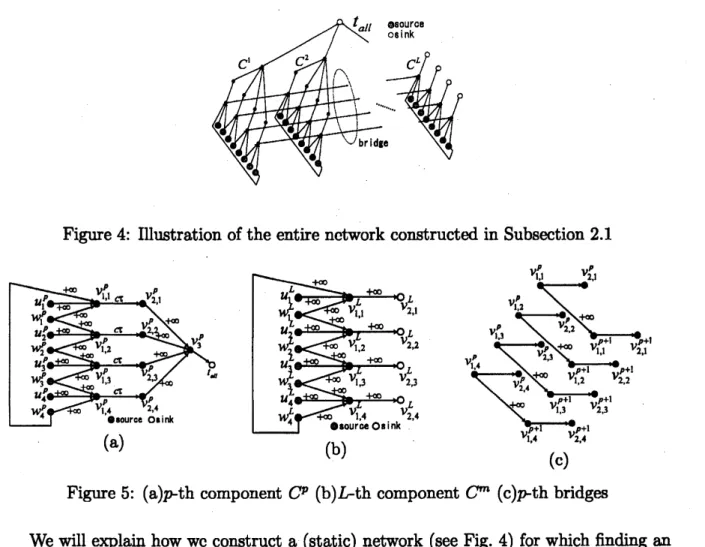
that minimizesFigure4:
nlustration
of the entirenetwork constructedinSubsection 2.1
$(\mathrm{a}j$
$(\mathrm{D}]$
(C)
Figure
5:
$(\mathrm{a})p$-th component $C^{\mathrm{p}}$ $(\mathrm{b})L$-th component $C^{m}(\mathrm{c})\gamma \mathrm{t}\mathrm{h}$bridgesWewill explain how
we construct
a
(static) network (see Fig. 4) for which $\mathrm{f}\mathrm{i}\mathrm{n}\mathrm{d}_{\dot{\mathrm{i}}}\mathrm{g}$an
optimalsolution for themin-max
resource
allocation problem producesan
optimalsolution for the evacuation problem. The network to be constructed consists of $L$ components$C^{1},$ $C^{2},$ $\ldots,$
$C^{L}$. Eachcomponent $C^{p}$ except $C^{L}$ hasfour layerswhile $C^{L}$ has threelayers.
The first layer of each component $\alpha$ has eight
sources.
The second and third layersconsists of four vertices denoted by $v_{1,i}^{\mathrm{p}},$$v_{2,:}^{p},i=1,2,3,4$. The fourth layer consists of
a
single vertex$v_{3}^{\mathrm{p}}$
.
The connection between the layersare as
shown in Fig. 5(a). Only thearcs
from thesecond to third layer havefinite capacity$c\tau$ in $C^{P}$with $1\leq p\leq L-1$ whilethe
arcs
in $C^{L}$ have infinite capacity. Thecapacity of the otherarcs
is $\infty$.
All vertices $v_{3}^{p}$ with $1\leq p\leq L-1$are
connectedto
$t_{d1}$.
Thevertices $v_{2,i}^{L},i=1,2,3,4$ of$C^{L}$
as
wellas
$t_{d1}$are
sinksof
this network whichare
associated with
a
cost function. The actual costfunction for
each $v_{2,1}^{L},i=$ 1,2,3,4 isequalto the amount theflowenteringit. Thecost function associated with$t_{all}$ takes
zero
irrespective of the flow value entering it.
In addition tothis,
we prepare
arcs
between consecutivecomponents.More
precisely,as
shown inFig. 5(c), thereisan
arc
from $v_{1,:}^{\mathrm{p}}$ to $v_{1,:}^{\mathrm{p}+1}$ for each$p$with $1\leq p\leq L-1$ and$i$ with $1\leq i\leq 4$
.
The capacityof thisarc
is defined tobe $\infty$.
Thisarc
is calleda
bridge.It is known that the min-max
resource
allocation problem for the network with $|V|$vertices, $|A|$
arcs
and $|T|$ sinkscan
be solved in $O(|T|(|V||A| \log|V|+|T|\log\frac{M}{|T|}))$ timewhere
$M$ denotes thesum
ofsupplies [8, 5, 4].The second
term in the parenthesis, i.e.,network constraints.
Since
our
cost function associated with $v_{2,:}^{L},$$i=1,2,3,4$ islinear,we
can
reducethe
timeto
$O(1)$ (the detailsare
omitted).In
our
case, $|T|$ isconstant
and $|V|=O(\sqrt{n}),$ $|A|=O(\sqrt{n})$, thus the running time becomev $O(n\log n)$. This proves the followingtheorem.Theorem 2.5 The evacuation problemfor
a
grid networkwithuniformarc
capacitycan
besolved
in $O(n\log n)$ time.3
Extension of the
Algorithm of [9]
It is easy
to
see
that the algorithm of [9]can
be extendedto a
general layered network$N$ such
that
(1)the
length ofany
path froma vertex
$v$to
a
sink $s$ take thesame
value, and (2) the underlying layered graph $D=(V, A)$ (we allow $D$ to have multiple
arcs) contain$\mathrm{s}$ arc-disjoint layered subgraphs $H_{1},$ $H_{2},$
$\ldots,$$H_{k}$ which spans $U_{1},$ $U_{2},$$\ldots,$$U_{k}$
and includes $e_{1},$ $e_{2},$$\ldots,$$e_{\mathrm{k}}$ respectively, where
we
define $\delta^{-}(s)=\{e_{1}, e_{2}, \ldots,e_{k}\}$ and$U_{*}$.
is the set of vertices from which the tail of $e_{1}$ is reaehable in $D$
.
Thus, the resultcan
also begenerahized to the
case
where thearc
capacity isa
multipleof$c$by regarding thearc
as
multipleones as
longas
the resulting layered graph satisfies the requirementjust mentioned above. In this sectionwe
consider
the conditions under which layered graphs contain such arc-disjoint layered subgraphs.Here
we
considera
layered graph $D=(V, A)$ with asink $s\in V$.
We denotea
layer whose distance from$s$is$i$as
$V^{:}$.
Notice that $V^{0}=\{s\}$.
We define$\delta^{-}(s)=\{e_{1}, e_{2}, \ldots, e_{k}\}$and $U_{1}$ be the set of vertices form which the tail
of
$e_{1}$ is reachable in $D$.
We
prove thefollowing
lemma.
Lemma
3.1 Given
a layered network $D=(V,A)$ witha
sink
$s\in V$,
there
exist $k$aborescences $T_{i}=(U_{1}, A_{*}.)$ for each $i\in\{1,2, \ldots, k\}$ such that
every
$T_{1}$ is rooted at $s$,$e_{i}\in A_{:},$ $A_{:}\subseteq A$ and $A_{i}\cap A_{j}=\emptyset(i\neq j)$ hold if and only if for
any
$v\in V$we
have$\lambda(v, s)=|\delta(R_{v}, s)|$
.
Proof: If there exist $k$ aborescences satisfying the lemma statement, it is easy to
see
that for any $v\in V$
we
have $\lambda(v, s)=|\delta(R_{v}, s)|$.
Wethen prove the “if-part”.Assume
that for any $v\in V$ we have $\lambda(v, s)=|\delta(R_{v}, s)|$.
We prove there exist $k$aborescences satisfying thelemma statement by inductionon the number oflayers $i$.
Inthe
case
for$i=1$,
it is easy to see that the lemma holds.Next
we
assume
for
$i=j$the
lemma holds.Notice
thatsince
$D$ isa
layered graphtheparents
of
a
vertex of
$V^{j+1}$ belongto
$V^{j}$from
thedefinition of
a
layeredgraph.Since
$\lambda(v, s)=|\delta(R_{v}, s)|$ holds, the number of the
arcs
whose tail is $v$ is at least $|\delta(R, s)|$.
Wehave
$R_{v}= \bigcup_{w:\epsilon=(v.w)\in A}R_{w}$
.
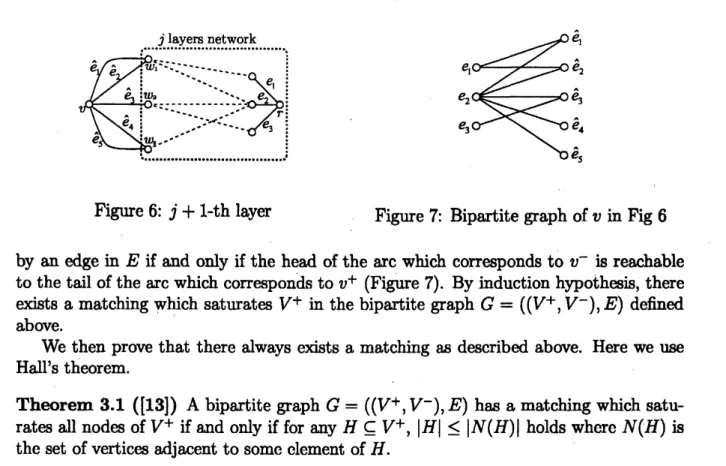
For convenience, let the
arcs
whose tail is $v$ be $\hat{e}_{1},\hat{e}_{2},$$\ldots$ (Figure 6).
Here
we
define the bipartite graph $G=((V^{+}, V^{-}),$$E)$ as follows. An element of$V^{+}$corresponds to
an
element of $R(v)$ andan
element of $V^{-}$ corroeponds toan
element inFigure 6:
$j+1$-th layer$\mathrm{P}^{\cdot}\mathrm{l}\mathrm{g}\mathrm{u}\mathrm{r}\mathrm{e}\mathrm{o}:\gamma+\perp-\tau \mathrm{n}\mathrm{l}\mathrm{a}\mathrm{y}\mathrm{e}\mathrm{r}$
Figure
7:
Bipartite graphof
$v$ in Fig6
by
an
edge in $E$ if and only if the head of thearc
which correspondsto
$v^{-}$ is reachableto the tail ofthe
arc
which correspondsto $v^{+}$ (Figure 7). By induction hypothesis,thereexists
a
matching which saturates $V^{+}$ in the bipartite graph $G=((V^{+}, V^{-}),$$E)$ definedabove.
We then prove that there always exists
a
matchingas
described above. Herewe use
Hall’s theorem.Theorem
3.1
([13])A
bipartite graph $G=((V^{+}, V^{-}),$$E)$ has a matching whichsatu-rates
all nodes of$V^{+}$ if and only if for any $H\subseteq V^{+},$ $|H|\leq|N(H)|$ holds where $N(H)$ isthe
set
ofvertices adjacent tosome
elcment of$H$.
We prove the existence of such matching
as
described above by contradiction.Assume
that thereexists $H\subseteq V^{+}$ with $|H|>|N(H)|$.
This contradicts the fact that thereare
atleast $|\delta(R_{v}, s)|$ arc-disjoint paths. This completes the proof. $\mathrm{g}$
From Lemma 3.1,
we can
easilyprove the following theorem.Theorem 3.2 Theevacuation problemfor alayerednetwork$N=(D=(V, A),$$b,$$s)$with
loiform
arc
capacity which satisfies $\lambda(v, s)=|\delta(R_{v}, s)|$ for any $v\in V$can
be solved in $O(m+k^{3}n^{2}\log n)$ time wherewe
define $k=|P_{\epsilon}|$.
Proof: To finish the proof of the theorem,
we
have to prove thecorrectness
of the time complexity. Thefirst
term, i.e., $O(m)$ is the time required to $\mathrm{o}\mathrm{b}\mathrm{t}\mathrm{a}\dot{\mathrm{i}}R_{v}$ for any$v\in V$by depth-first search.
The second
term
is the time requiredto
solve the
min-maxresource
allocation problem producesan
optimalsolution for the
evacuation problem.Since thetime complexity depends
on
thesizeof the network for whichfindingan
optimal solutionforthemin-maxresource
allocationproblem producesan
optimalsolutionforthe evacuation problem. Note that the example of the network for the evacuation problem for grid networks is shownas
in Figure 4. Though we omit the details, the number of vertices is $O(kn)$, the number ofarcs
is $O(kn)$, and the number ofsinks is $O(k)$.
Thus,the runningtime of the algorithm is $O(k^{3}n^{2}\log n)$ by Theorem
2.5.
$\mathrm{g}$Acknowledgements
This
research
issupported byJSPS Grrt-in-Aid
for
Scientific Research
on
priorityareas
References
[1] R.E. Burkard, K. Dlaska, and B. Klinz. The quickest flow problem. ZOR-Methods and Models
of
Operations Research, 37:31-58,1993.
[2] L. Fleischer. Faster algorithm for the quiekest transshipment problem.
SIAM
J.on
Optimization, $12(1):18-35$,2001.
[3]
L.R. Ford and
D.R. Fulkerson. Flows in Networks.Princeton
University Press, Princeton, NJ,1962.
[4]
S.
Fujishige. Lexicographicaillyoptimalbaseof
a
polymatroidwithrespectto
a
weight vector. Mathematicsof
Operations Research, $5(2):186-196$, May1980.
[5] S. Fujishige. Nonlinear optimization with submodular constraints. In Submodular Functions and Optimization, volume 58, pages
223-250.
Elsevier Science, North-Holland, 2nd edition,2005.
[6] A. Hall,
S.
Hippler, and M. Skutella. Multicommodity flowsover
time: Efficient algorithms and complexity. In Automata, Languages and Programming, 30th Inter-national Colloquium (ICALP 2003), volume2719
ofLNCS, pages397-409.
Springer,2003.
[7] B. Hoppe and
\’E.
Tardos. The quickest transshipment problem.Mathematics
of
Operations Research, $25(1):36-62$, February2000.
[8] T. Ibaraki and N. Katoh.
Resource allocation
problems under submodularcon-straints. In Resource Allocation Problems : Algorithmic Approaches,
pagoe 144-176.
MIT Press, Cambridge, MA,1988.
[9] N. Kamiyama, N. Katoh, and A. Takizawa. An effieient algorithm for evacuation problems in dynamic
network
flows with uniformarc
capacity.IEICE
hansactionon
Fundamentals,E8&D(8):2372-2379,
August2006.
[10] B. Kotnyek.
An
annotated overviewof
dynamicnetwork
flows.
Technical
Report RR-4936, Inria SophiaAntipolis, September2003.
[11]
S.
Mamada, T. Uno, K. Makino, andS.
Fujishige. An $O(n\log^{2}n)$ algorithm fora
sink location problem in dynamic tree networks. Discrete Applied Mathematics,
to
appear.
[12] N. Megiddo. Combinatorial optimization with rational objective functions. Mathe-matics
of
Operation Research, 4:414-424,1979.
[13] W.R. Pulleybland. Matchings and extensions. In R.L. Graham, M. Gr\"otschel, and L.