
SPRINGER
THEORY FOR COMPLEX REFLECTION GROUPSPRAMODN.ACHAR
ABSTRACT. Many complexreflectiongroupsbehaveasthoughtheyweretheWeylgroupsof “nonexis-tent algebraicgroups”: onecan associatetothem variousrepresentation-theoreticstructuresandcarry outcalculationsthat appear todescribethe geometry andrepresentationtheoryofanunknownobject. Thispaper isasurveyofaprojecttounderstandthe geometry ofthe”unipotentvariety” ofacomplex
reflectiongroup (enumeration ofunipotent classes, Springer correspondence, Greenfunctions), based onthe author’s joint workwithA.-M.Aubert.
Acomplex
reflection
group is afinite groupof automorphisms ofafinite-dimensionalcomplex vector$spa\iota eV$that isgenerated by reflections, $i.e.$, lineartransformationsthat fixsomehyperplane pointwise.
Some complex reflectiongroups can actually berealized on areal vector space, and afamous theorem of Coxeter statesthat $th\infty e$
are
preciselythe finite Coxetergroups.Among those, the reflection groups that can be realized on a$\mathbb{Q}$-vector space
are
particularly important:these are thegroups that
occur
$ss$Weylgroups ofreductive algebraicgroups.
Since the early $1990’ s$, there has been agrowing
awareness
that many complex reflection groupsthat cannot be realized over $\mathbb{Q}$ nevertheless behave as though they were
the Weyl groups of certain “nonexistent” algebraic groups. The first important step
was
the discovery [4, 5, 13] that their group algebras admitdeformationsresemblingIwahori-Hecke algebras of Coxetergroups. Those deformationsare now
knownas
cylcotomic Hecke algebms. Subsequent work by anumber of authors showed that complex reflection groups admit analogues ofCoxeterpresentations [13], rootsystems [17,33]and root lattices [33], length functions [8, 9],generic degrees [28, 30], and Green functions [36, 37].Atheme in these developments is that statements that are regarded as theorems in the setting of Weylgroups are often adopted as definitionsin the settingofcomplex reflection groups. For instance, families ofrepresentations for Weyl groups are defined in terms of the $Kazhdanarrow Lusztig$ basis for the
Hecke algebra, but atheorem of Rouquier[34]$gives^{\backslash }$analternatedescription offamilies intermsofblocks
over asuitable coefficient ring. ForcyclotomicHecke algebras, Kazhdan-Lusztig bases
are
unavailable, but “Bouquierblocks” still make sense, and have been adopted asadefinition [10,23,32].Thepresentpaperis anexpositionofhow this philosophy may beapplied to the theory of unipotent classes and the Springer correspondence. Many features of the geometry ofthe unipotent variety of
an algebraic group–including the number ofconjugacy claeses, their dimensions and closure relations, and their local intersection cohomology–can be computed from elementary knowledge of the Weyl group. Remarkably, analogous calculations for complex reflection groups often yield sensible results, with surprisingly “geometric” integrality and positivity properties, even though there is not (yet?) an actual “unipotentvariety” attached to ageneral complexreflectiongroup.
The ideas and results $d\infty cribed$ here come from aseries of joint papers by the author and
A.-M. Aubert [1, 2, 3]. There are no new theorems in this paper. However, the last two sections give the resultsofvarious calculationsin the exceptionalgroups thathave not previouslybeen published. Acknowledgements. The author is grateful to Syu Kato and Susumu Ariki for having madeit possible for himtovisitKyotoinOctober 2008, and toHyohe Miyachi and Tatsuhiro Nakajima for the invitation toparticipate inthe RIMSworkshop ”Expansionof CombinatorialRepresentationTheory.” The author also receivedsupport from NSF grant DMS-0500873.
1. OVERVIEW OF COMPLEX REFLECTION GROUPS
1.1. Examples and classiflcation. The easiest example of a complex reflection group is the cyclic group $\mathfrak{C}_{d}$ oforder $d$, actingon $\mathbb{C}$by multiplication by d-th
roots of unity. Simiarly, the n-fold product
$(C_{d})^{n}$ acts on $\mathbb{C}^{n}$ as a
(reducible) complex reflection group. The symmetric group $6_{n}$ acts on $\mathbb{C}^{n}$ by
permuting coordinate axes, and this action isgenerated byreflections and normalizes the action of$(\mathfrak{C}_{d})^{n}$
.
The semidirectproduct
is an irreduciblecomplex reflection group. If$d=2$, this is the Weyl groupof type $B_{n}$ or $C_{n}$.
Next,replace$d$ byaproduct of positive integers $de$, andconsider the group$G(de, 1, n)$
.
Define amap $\phi_{e}$ : $G(de, 1, n)arrow C_{e}$ by$\phi_{e}=p\circ f$, where $f$: $G(de, 1, n)arrow \mathfrak{C}_{de}$ assignsto anelementof$(\mathfrak{C}_{de})^{n}\rangle\triangleleft \mathfrak{S}_{n}$theproduct ofthe componentsin the $(\mathfrak{C}_{de})^{n}$ part, and$p:\mathfrak{C}_{de}arrow \mathfrak{C}_{e}$ is theobvious quotient map. Then let
$G(de, e, n)=ker\phi_{e}$
.
This isalso an irreduciblecomplex reflection group, andit is obviously anormal subgroup of index$e$ in
$G(de, 1, n)$
.
The Weyl groups oftype $D_{n}$ are of this form; they are thegroups $G(2,2, n)$. Thedihedralgroups also occur in this series: thegroup $I_{2}(m)$ of order $2m$is $G(m, m, 2)$.
According to the classffication theorem due to Shephard and Todd [35], there are, in addition to the infinite family $G(de, e, n)$ (called impremitive groups), exactly thirty-four other irreduciblecomplex reflection groups (called primitive
or
exceptional groups). In their notation, which hasnow
become standard, these aredenoted$G_{4},$
$\ldots,$$G_{37}$
.
The exceptional finiteCoxeter groups occur inthislist asfollows:
$H_{3}\simeq G_{23}$, $F_{4}\simeq G_{28}$, $H_{4}\simeq G_{30}$, $E_{6}\simeq G_{35}$, $E_{7}\simeq G_{36}$, $E_{8}\simeq G_{37}$.
1.2. Cyclotomic Hecke algebras. All complex reflection groups are known to have ”Coxeter-like” presentations [13]. Suchpresentationsinvolve two kinds of relations: (i) ”braid-likerelations,” which are homogeneousrelations of certain form involving two
or
more
generators, and (ii) ”order relations,” which simply specify the order ofeach generator. (Inthe Coxeter case, allgenerators have order 2.) Suppose$W$ has such apresentationwith generators$t_{1},$
$\ldots,$$t_{r}$ and orderrelations$t_{1}^{e_{1}}=\cdots=t_{r^{r}}^{e}=1$.
Let $\mathcal{H}(W)$ be the algebra over the Laurent polynomial ring $\mathbb{Z}[u, u^{arrow 1}]$ with generators $T_{1},$
$\ldots$,$T_{r}$,
subjecttothesamebraid-like relations
as
thegeneratorsof$W$, and to thefollowingadditional relations:$(T_{i}-u)(T_{i}^{e:-1}+T^{e_{i}-1}+\cdots+1)=0$ for each $i\in\{1, \ldots, r\}$
.
Clearly, under the specialization$u\mapsto 1$, the latter relations become the order relations for $W$, and$\mathcal{H}(W)$
becomes thegroup ring$\mathbb{Z}W$
.
$\mathcal{H}(W)$ is known asthe spetsial cyclotomic Hecke algebm for W. (For thegeneric cyclotomic Hecke algebra and its other specializations,see [13].$)$ Incase $W$ is a Coxeter group, $\mathcal{H}(W)$ is simply its usualsingleparameter Iwahori-Hecke algebra.
Assumption 1.1. The spetsial cyclotomic Hecke algebra$\mathcal{H}(W)$ is a
free
$\mathbb{Z}[u, u^{-1}]$-moduleof
rank $|W|$.This assumption is known to hold for all imprimitive complex reflection groups [4, 5] and many exceptional
ones
[11]. Theimportanceof thisassumptioncomes ffomthe fact that it allowsusto invoke the machinery of Tits’ deformation theorem (see [21, Chap. 7]). In particular, over asufficiently large field $\mathcal{K}$containing $\mathbb{Z}[u,u^{-1}]$, the algebra$\mathcal{K}\mathcal{H}(W)=\mathcal{K}\otimes_{Z[u,u^{-1}]}\mathcal{H}(W)$
is isomorphic to the group algebra $\mathcal{K}W$, so the set of irreducible representations of$\mathcal{K}\mathcal{H}(W)$ may be
identified with those of$W$. The field $\mathcal{K}$ will be called a splitting
field
for $\mathcal{H}(W)$.
According to [29], $\mathcal{K}$may betaken to be the field of rational functionsinsome rootofthe indeterminate$u$
.
The group algebra$\mathbb{Z}W$admits acanonical symmetnzing trace, i.e.,alinear function$t:\mathbb{Z}Warrow \mathbb{Z}$such
that the bilinear form $(h_{1}, h_{2})\mapsto t(h_{1}h_{2})$ is symmetric and nondegenerate. It is given by the formula
$t(w)=\delta_{w,1}$ for$w\in W$
.
Similarly,$\mathcal{K}\mathcal{H}(W)\simeq \mathcal{K}W$ admitsasymmetrizing trace $\tau_{\mathcal{K}}$ :$\mathcal{K}\mathcal{H}(W)arrow \mathcal{K}$. Sucha trace is necessarily a class function on $W$, so we can write it as a linear combination of irreducible
characters:
$\tau\kappa=\sum_{\chi\in Irr(W)}\frac{1}{c_{\chi}}\chi$.
Theelements$c_{\chi}\in \mathcal{K}$arecalledSchurelements. In theimprimitivegroups,itis known [31] thatthe trace
$\tau\kappa$ arises byextension of scalars from a trace $\tau$ : $\mathcal{H}(W)arrow \mathbb{Z}[u, u^{-1}]$, and that is conjectured (see [12])
to holdingeneral.
Relatedto Schur elements arethe $gener\tau c$degoees, given by the formula
$D_{\chi}(u)=P(W)/c_{\chi}$
.
Here, $P(W)$denotes the Poincar\’epolynomid of$W$, given by
where $d_{1},$
$\ldots,$$d_{r}$ are the exponents of W. (The terminology comes from the fact that if $W$ is a Weyl
group, then when $u$ is specializedto aprime power $q$, thegeneric degrees $D_{\chi}(q)$ give the dimensions of
acertain irreduciblerepresentationsofareductivegroup over the field of$q$ elements.)
1.3. Spetsial complex reflection groups. In general, generic degrees are elements of the splitting field$\mathcal{K}$, butfor certain
class ofgroups, includingallCoxeter groups, theytum out tobe polynomials in
$u$. These groups, known
as
spetsial groups, have a number of equivalent characterizations [30,Proposi-tion8.1],and
are
incertainwaysbetter-behavedthan general complexreflection groups. Theirreducibleimprimitive spetsial complex reflectiongroups arethose of theform
$G(d, 1, n)$ or $G(d, d, n)$.
There areeighteen irreducibleprimitivespetsial complexreflection groups:
$G_{4},$ $G_{6},$ $G_{8},$$G_{14},$ $G_{23},$ $G_{24},$ $G_{25},$ $G_{26},$$G_{27},G_{28},$ $G_{29}.G_{30},$$G_{32},$ $G_{33},$ $G_{34},$ $G_{35},$ $G_{36},$ $G_{37}$
.
For a spetsial complexreflection group $W$, we attach an integerto each irreducible representation$\chi\in$
Irr$(W)$ bythe formula
$a( \chi)=\min$
{
$i|u^{i}$ appearswithnonzero
coefficient in $D_{\chi}$}.
This quantity is knownsimply
as
the a-invareantof$\chi$.1.4. The coinvariant algebra and j-induction. For any character$\chi$of$W$, we define the
fake
degreeof$\chi$to be thepolynomial
$R( \chi)=\frac{(u-1)^{r}}{|W|}P(W)\prod_{w\in W}\frac{\det_{V}(w)\chi(w)}{\det(u\cdot id_{V}-w)}$
.
If$\chi$ is an irreducible character of$W$, this polynomialmay be interpreted as the graded multiplicity of $\chi$ in the coinvariantalgebra $C(W)$, which is the quotient of the symmetric algebra $S(V)$ by the ideal
generated by the ring $S(V)_{+}^{W}$ of W-invariants ofstrictly positive degree. The latter is a homogeneous
ideal, so $C(W)$ inherits a grading$C(W)=\oplus_{i}C^{i}(W)homS(V)$. Wethen have
$R( \chi)=\sum_{i}[C^{*}(W):\chi]u^{i}$
.
Theb-invamant ofanirreducible character $\chi$ is given by
$b( \chi)=\min\{i|[C^{i}(W) : \chi]\neq 0\}=\min$
{
$i|u^{i}$ appearswithnonzero
coefficient in$R(\chi)$}.
Sinoe$C^{i}(W)$ is aquotient of$S^{i}(W)$, any character$\chi$ appears with nonzeromultiplicity in$S^{b(\chi)}(W)$.
Theorem 1.2 (see [21, Section 5.2]). Let $W’\subset W$ be a
reflection
subgroup, and let $\chi’\in$ Irr$(W’)$ bean irreducible representation. Assume that$\chi’$ occurs with multiplicity 1 in $S^{b(\chi’)}(V)$
.
Thenthe smallestW-stable subspace
of
$S^{b(\chi)}(V)$ containing$\chi’$affords
an imeducible W-representation$\chi$ with the property
that$b(\chi)=b(\chi’)$. Moreover, $\chi$
occurs
with multiplicity 1 in $S^{b(\chi)}(V)$.
The representation $\chi$ is said to be obtained by $MacDonald$-Lusztig-Spaltenstein induction or
j-induction from$\chi_{1}’$. wewrite
$\chi=j_{W}^{W},\chi’$.
The last statementInthe theoremabove enables
us
torepeat thej-induction operationwhenwe havea chain of reflection subgroups $W”\subset W\subset W$. It is clearfrom the definition of thisoperation that$j_{W’}^{W},\simeq j_{W}^{W},$ $oj_{W^{2}}^{W’},$
.
1.5. Rouquier blocks and special representations. Let $O$ be the ringobtained from $\mathbb{Z}[u, u^{-1}]$ by
inverting all elements of $1+u\mathbb{Z}[u]$, i.e., all polynomials with constant term 1. The ring $O\mathcal{H}(W)=$ $\mathcal{O}\otimes_{Z[u,u^{-1}]}\mathcal{H}(W)$ is notsemisimple in general. Givenablock of$O\mathcal{H}(W)$, onecan furtherextendscalars
to $\mathcal{K}$ and then ask which irreducible
representationsof$\mathcal{K}\mathcal{H}(W)$ occur inthat block. For Weyl groups,
this questionhas been answeredby Rouquieras follows,
Theorem 1.3 ([34]). Assume that$W$ is Weyl group. Then two representationsinIrr$(W)$ belong to the
same two-sided cell
if
and onlyif
the corresponding$\mathcal{K}\mathcal{H}(W)$-representationsbelong to the same blockof
$O\mathcal{H}(W)$
.
For general complexreflectiongroups, thereis currentlyno analogue ofKazhdan-Lusztigtheory, and hence noway to define two-sided cells. Instead, we adopt the abovetheoremas adefinition ofacertain way ofpartitioning Irr$(W)$
.
Deflnition1.4. The
families
inIrr$(W)$are thesubsets characterized by the following property: tworep-resentations in Irr$(W)$belong to thesamefamilyif andonlyif the corresponding$\mathcal{K}\mathcal{H}(W)$-representations
belong to the same block of$O\mathcal{H}(W)$.
Families of characters have been studiedby Brou\’e-Kim [10], Kim [23], and Malle-Rouquier [32], and mostrecently by Chlouveraki [15, 16].
Definition 1.5. Arepresentation $\chi\in$ Irr$(W)$ is special if$a(\chi)=b(\chi)$
.
Special representations ofWeyl groups play
an
important role in many aspects ofgeometric repre-sentation theory, appearing, for instance, in Lusztig’s parametrizationof unipotent characters offinite reductivegroups [25], and in connection with specialconjugacy classesin the unipotent variety [39]. A well-known propertyof the set ofall special representations ofa Weylgroup is thatexactlyoneoccursin each two-sided cell. Ananalogousstatement holdsforspetsial complexreflection groups in general: Theorem 1.6 ([32, Thbor\‘eme 5.3]). Assume that$W$ is spetsial. Then eachfamily
of
Irr$(W)$ containsa
unique special representation.
This statement can fail in nonspetsial groups: see [32, Exemple 5.5] for a family in the nonspetsial group $G_{5}$ containingno specialrepresentation.
2. SPRINGER THEORY FOR ALGEBRAIC GROUPS
2.1. Overview. Let$G$beasemisimplealgebraicgroupover $\mathbb{C}$ (orany algebraically closed field of good
characteristic), and let $T\subset G$be amaximaltorus. Let $W$ denote theWeyl groupof$G$, and $L$ theroot
lattice, both with respect to $T$
.
Then $W$ is naturally a reflection group acting on the complexvectorspace$V=\mathbb{C}\otimes_{Z}L$
.
Let$\mathcal{U}$ denote the variety ofunipotent elements in $G$, and let $f$ denote the set ofpairs $(C, E)$, where $C\subset \mathcal{U}$ is a conjugacy class, and $E$ is a G-equivariant local system on $C$
.
Recall that the Springercorrespondence is acertain injectivemap
$\nu$: Irr$(W)arrow T$.
Onewayof$defining\sim$theSpringercorrespondenoeis
as
follows: let$\mathcal{B}$denotethe variety ofBorelsubgroupsof$G$, andlet $\mathcal{U}=\{(x, B)\in \mathcal{U}x\mathcal{B}|x\in B\}$
.
This isa
smoothvariety, and theobvious map$\pi$:$\overline{\mathcal{U}}arrow \mathcal{U}$is aresolution of singularities, knownasthe Springer resolution. Thederived push-forward of the constant sheaf$R\pi_{*}\underline{\mathbb{C}}$is asemisimpleperverse sheafon$\mathcal{U}$,
so
it has the generalform(2.1) $R\pi_{*}\underline{\mathbb{C}}=$ $\oplus$ IC$(C, E)\otimes V_{C,E}$, $(C,E)\in 1$
where the $V_{C,E}$ are various finite-dimensional vector spaces. Following Borho-MacPherson[6], the $V_{C,E}$
carry actions of $W$. Moreover, the
nonzero
$V_{C,E}$ carry irreducible representations of $W$, and everyirreducible representation occurs
as
exactlyone
$V_{C,E}$.
The Springer correspondence $\nu$ is defined bymatching each element ofIrr$(W)$ with the vector spaoe$V_{C,E}$onwhich itisrealized. (Becausesome $V_{C,E}$
mayvanish, the Springercorrespondence is not, in general, surjective.)
2.2. Enumerating unipotentclasses. Let$T_{0}\subset T$bethesetofpairs$(C, E)$with$E$trivial. Ofcourse, $\prime r_{0}$ may be thought ofsimply asthe set of unipotent classes. It tums out that
$rr_{0}$ is always contained
in the image of the Springercorrespondence. Moreover, therepresentationsappearing in$\nu^{arrow 1}(\prime r_{0})$ admit
an elementarydescription in terms of certain subgroups of$W$.
A subgroup $W’\subset W$ is called pseudoparabolic if it is generated by reflections corresponding to a
proper subset of the extended Dynkin diagram of type dual to $G$. Equivalently, one may consider the
Langlands dual group $G^{\vee}$, together with the dual maximal torus $T^{\vee}\subset G^{\vee}$
.
A subgroup $H^{\vee}\subset G^{\vee}$ iscalledan endoscopic group (for $G$) if it is the identity component of the centralizer ofsome element of
$T^{\vee}$
.
Endoscopicsubgroups are automatically reductive. A subgroup $W’\subset W$is pseudoparabolic ifand
only ifit is theWeyl group ofsomeendoscopic group.
The following theorem describes the relationshipbetween pseudoparabolic subgroups and unipotent classes.
Theorem 2.1 (see [14]). The following two conditions on a representation$\chi\in$ Irr$(W)$ are equivalent:
(1) $\nu(\chi)\in l_{0}$
.
(2) $\chi\simeq j_{W}^{W},\chi’$, where $W’\subset W$ is some pseudopambolic subgroup, and $\chi’\in$ Irr$(W’)$ is a special
Definition 2.2. A representation $\chi\in$ Irr$(W)$ satisfying the equivalent conditions of Theorem 2.1 is
called a Springerrepresentation.
By taking $W’=W$in the second part ofthe theorem above, weobtain the following. Corollary 2.3. Everyspecial representation
of
$W$ is a $Spr\dot{v}nger$representation.2.3. Green functions and the Lusztig-Shoji algorithm. In considering the perverse sheaf (2.1), a natural problem is the determination of the stalks of the various simple perverse sheaves IC$(C, E)$
.
Wewilldescribe these stalks in thefollowing way. Given another pair $(C’, E’)\in\prime r$, consider the object
IC$(C, E)|c’$
.
This isacertaincomplex ofsheaves whose cohomology sheavesarelocalsystemson
$C’$. Wemay then ask what the multiplicity of the irreducible localsystem$E$‘in thelocalsystem$\mathcal{H}^{i}(IC(C, E)|_{C’})$
is. Finding all such multiplicitiesis equivalent to determining thepolynomials (2.2) $\Pi_{(C,E),(C’,E^{r})}(u)=\sum_{i}[\mathcal{H}^{i}(IC(C, E)|c/) : E’]u^{i/2}$
.
(Itis known that $\mathcal{H}^{i}(IC(C,$$E))=0$forodd$i$, so these areindeed polynomials in
$u.$) Thesepolynomials
are called Green
functions.
Most of them can be computed using only elementary linear algebra, by amethod which we now describe. Let
$\prime r’=$the image of
$\nu\subset$T.
Accordingto [26, Theorem $24.8(c)$]$\rangle$
$\Pi_{(C,E),(C’,E’)}=0$ if$(C, E)\in\prime r’$ but $(C’, E’)\not\in\prime r^{J}$.
We henceforth restrict our attention to those $\Pi_{(C,E),(C’,E’)}$ with $(C, E),$$(C‘, E’)\inr’$. The next two
theorems togetherenableus to effectively computethese polynomials.
Theorem 2.4 (see [20, Section 2]). Let $W$ be a complex
reflection
group acting on a vector space $V$,andsuppose Irr$(W)$ is equipped witha
fixed
partition into an ordered collectionof
disjoint subsets:Irr$(W)=C_{1}u\cdots C_{n}$
.
Let$b(C_{i})= \min\{b(\chi)|\chi\in C_{i}\}$.
Define
amatrrx$\Omega=(\omega_{\chi,\chi})_{\chi,\chi’\in Irr(W)}$ by$\omega_{\chi,\chi^{l=u^{N}R(\chi\otimes\chi’\otimes\overline{\det})}}.$,
where $N^{*}$ is the number
of refiections
in $W$, and$\overline{\det}$ denotes the complex conjugateof
the determinant chamcterof
W. Then there is a unique pairof
matrices $P=(P_{\chi,\chi’})_{\chi,\chi’\in Irr(W)},$ $\Lambda=(\Lambda_{\chi,\chi’})_{\chi,\chi’\in Irr(W)}$with entrees in$\mathbb{Q}(u)$ satisfying the matrixequation
PA$P^{t}=\Omega$
and subject to following additional conditions:
(2.3) $P_{\chi,\chi’}=\{\begin{array}{ll}0 if \chi\in C_{i}, \chi’\in C_{j} with i<j,u^{b(C_{*})} if \chi,\chi^{l}\in C_{i},\end{array}$
$\Lambda_{\chi,\chi’}=0$
if
$\chi\in C_{i},$ $\chi’\in C_{j}$ with$i\neq j$.
The proof of this theorem is elementary and consists mostly of a description of a procedure for producingthe matrices $P$ and$\Lambda$
.
That procedure is knownas the Lusztig-Shoji algorithm.When $W$ is theWeyl group of a reductivealgebraicgroup, a particularclass of orderedpartitionsof
Irr$(W)$ arises naturally in connection with the Springercorrespondence. Let us say that apartition
Irr$(W)=c_{1}u\cdots uC_{n}$
is
of
Springer type ifthe following two conditions hold:(1) Tworepresentations$\chi$ and $\chi’$ belong to thesame $C_{i}$ if and only ifthe Springercorrespondence
attaches them both to local systems on the
same
unipotent class. (Thus, there is a bijection between the collection ofsubsets $\{C_{i}\}$ andthe setof unipotent classes.)(2) Suppose that $C_{i}$ corresponds to$C\subset \mathcal{U}$ and $C_{j}$ to$C’\subset \mathcal{U}$
.
If$C’\subset\overline{C}$, then $j\leq i$.
The second condition simply says that the total order on the $C_{t}$ refines the closure partial order on
unipotentclasses.
Theorem 2.5 ([26,Theorem24.8]). Let$W$ bethe Weylgroup
of
a reductive algebraicgroup, andassumethat Irr$(W)$ is equipped with an orderedpartition into disjoint subsets
of
Springer type. Let$P$ and$\Lambda$ be(1) We have$P_{\chi,\chi’}(u)=\Pi_{\nu(\chi),\nu(\chi’)}(u)$. Inparticular, the entnes
of
$P$ lie in$\mathbb{Z}[u]$ and havenonnega-tive
coefficients.
(2) The entries
of
$\Lambda$ also lie in$\mathbb{Z}[u]$.Notethat the conditions(2.3) in Theorem2.4 say that the matrix $P$is upper-triangular (nocondition
is imposed if $\chi\in C_{i},$ $\chi’\in C_{j}$ with $i>j$ ) and that $\Lambda$ is block-diagonal. The former corresponds to the
fact that the stalks of IC$(C\rangle E)$ vanish outside$\overline{C}$, and the latter is related to an interpretation in [26,
Theorem24.8]oftheentries of$\Lambda$in termsofinner productsofcertaincharacteristic functions supported
on a
single unipotent class.3. PSEUDOPARABOLIC SUBGROUPS OF COMPLEX REFLECTION GROUPS
In the precedingsection, wesaw how to reduoe the determination of unipotent classes and the cal-culation ofGreen functions into elementary calculations in termsofthe Weyl group, via Theorems 2.1 and 2.5. Our aim is to carry out analogous calculations for complex reflection groups, in the hope that the results describesome as-yet unknown “unipotent variety” in thatcase as well. However, those calculationsrequire someauxiliarydata
(1) A suitable notion of ”pseudoparabolic subgroup,” allowing us to adopt part ofTheorem 2.1 to define Springer representations (cf. Definition 2.2) of complex reflection groups.
(2) A way ofpartitioningIrr$(W)$ into
an
ordered collection of disjoint subsets satisfyingappropriateaxioms, enabling
us
to carry out the algorithm of Theorem 2.4.The former
was
studied in [3]; this is thesubject ofthe present section. The latter, which is much less well understood, will be treated in the next section.3.1. Root lattices and stabilizers. Many ideasinthis section andthefollowingonedepend notonly on a complex reflection group $W$, but also on the choice of a root lattice $L$ in the sense of Nebe [33].
This phenomenon is to be expected, as it already occurs in the realm ofalgebraic groups: groups of types $B_{n}$ and $C_{n}$ have isomorphic Weyl groups but inequivalent root lattices and different Springer
correspondences.
Nebe’sdefinition dependson the fact that every reflectiongroup over $\mathbb{C}$can actually berealizedover
a much smaller field $K\subset \mathbb{C}$; in fact, $K$ canbetaken to be afiniteabelian extension of$\mathbb{Q}$. (For a table
of the minimal fields over which various complex reflection groups can be realized, see [13].$)$ Inside$K$,
wehave the ring of integers $\mathbb{Z}_{K}$, andwe may consider $\mathbb{Z}_{K}$-latticesinside K-vector spaces.
Deflnition 3.1. Let $W$ be acomplex reflection group, actingon the vector spaoe $V$
.
Assume that $W$can be realized
over
the abelian number field $K$.
A rootlattice isa W-stable$\mathbb{Z}_{K}$-submodule$L\subset V$suchthat $V\simeq C\otimes z_{K}L$, and such that $L$ is spanned by the W-orbit ofone element.
(InNebe’sterminology,these
were
calledprimitiverootlattices; generalrootlatticeswerenot required tobespannedby the W-orbit ofasingleelement. Here, however, all root lattices will be assumed tobeprimitive.) The root lattices for all irreducible complex reflection groups have been classified by Nebe. Eachirreducibleprimitive spetsial complex reflectiongroup other than$G_{6},$ $G_{26}$, and$G_{28}$ admitsaunique
root lattice. Byanabuse ofnotation andlanguage, wewill usually write, for instance, $G_{14}$” instead of
“the pair $(G_{14}, L)$ where $L$ is the unique root lattice.” Thegroup $G_{28}=F_{4}$ admits two root lattices;
they
are
exchangedby theautomorphism of$F_{4}$ which swaps long and short roots.The groups $G_{6}$ and $G_{26}$ also admit two isomorphism classes of root lattices each. In each case,
Nebe [33] has denotedone ofthe root lattices$L_{1}$ and the other $L_{2}$. Continuingthe abuse ofnotation,
we will simply write $G_{6}$” and $G_{26}$” to refer to the pairs $(G_{6}, L_{1})$ and $(G_{26}, L_{1})$
.
The pairs $(G_{6}, L_{2})$and $(G_{26}, L_{2})$ will be abbreviated $G_{6}’$ and $G_{26}’$,respectively.
Thus, $hom$ the viewpoint of Springer theory, there are 21 cases to study among the irreducible
primitive spetsial complex reflection groups. In the sequel, wewill omit the Weyl groups $E_{6},$ $E_{7},$ $E_{8}$,
and $F_{4}$ (with its two root lattices) from the discussion, since there is nothing new to say about their
Springertheory, andwe willfocus onthe remaining 16cases:
$G_{4},$ $G_{6},$ $G_{6}’,$ $G_{8},$$G_{14},$ $G_{23},$ $G_{24},$ $G_{25},$ $G_{26},$$G_{26}’,$$G_{27},$$G_{29}.G_{30},$$G_{32},$ $G_{33},$ $G_{34}$
.
3.2. Stabilizers oftorus points. Recall that if$W$is the Weylgroup of
an
algebraicgroup $G$, then asubgroup $W’\subset W$ is pseudoparabolic if and only if it is the Weyl groupof the centralizer in the dual
group$G^{\vee}$ ofapointofthe dual torus $T^{\vee}$
.
Ofcourse, $W$itself actson$T^{\vee}$.
Wecanbypass thenotions ofWeyl groups and centralizersin$G^{\vee}$ andobserve simply that $W’\subset W$is pseudoparabolic if and only ifit
W-equivariant waywith $V/L$, where $L$ is the root latticeof$W$ and $V=\mathbb{C}\otimes_{Z}L$. That last observation
is a statementthat makes sense forgeneralcomplex reflection groups, and it
seems
reasonable to adopt it as a definition.Approximate Definition 3.2. Roughly, a subgroup $W’$ ofa complex reflection group $W$ should be
called pseudoparabolic with respect totheroot lattice $L$ ifit is thestabilizer ofsome point of$V/L$
.
Unfortunately,many things
can
go wrongifthis is takenas
a literal definition: pseudoparabolic sub-groups may fail to be reflection subsub-groups (so the Hecke algebra and special representations may be undefined), andeven when they are reflectiongroups, theymay fail to be spetsial (so special represen-tations may not behave asexpected). However, theseproblems tum out not to be veryserious: instead of taking the $fuIl$ stabilizerofa point of$V/L$,one
constructs $hom$ it a certain large spetsial reflectionsubgroup, and calls that group “pseudoparabolic.” For the full definition, the reader is referred to [3, Section 8].
3.3. Finding pseudoparabolic subgroups. The determination of allpseudoparabolic subgroups (with respecttoanyrootlattice) inall imprimitivespetsial complexreflectiongroups
was
carried out in[3],and the results appearthereas
Th\’eor\‘emes8.11 and 8.15. A typical pseudoparabolic subgroup of$G(d, 1, n)$is aproductof various subgroupsofthe form$G(d, 1, m),$ $G(d, d, m)$, and $G(1,1, m)$ with$m\leq n$, subject
to various constraints dependingon $d$ and on the choioe of root lattice. Pseudoparabolic subgroups of
$G(d, d, n)$ with $n\geq 3$ aresimilar, althoughno factors oftype$G(d, 1,n)$ may appearinthat
case.
The dihedral groups $G(d, d, 2)$ behave somewhat differently from the other imprimitive complex
re-flection groups, mainly because they can be defined
over
fields of the form $K=\mathbb{Q}(\zeta_{d}+\zeta_{d}^{-1})$ (where $\zeta_{d}$ is aprimitive d-throot ofunity) rather than over$\mathbb{Q}(\zeta_{d})$
.
The rank-2pseudoparabolic subgroups of$G(d, d, 2)$
are
precisely thesmaller dihedral groups $G(p^{k},p^{k},2)$where $p$is aprime and$p^{k}$ divides $d$.
Finally, for theprimitive spetsial complexreflectiongroups,the determination ofpseudoparabolic sub-groups has beendone by computer, using theCHEVIEpackagefor theGAPcomputeralgebra system [18]. Given a point in $V/L$, it is straightforward to identify the associated pseudoparabolic subgroup of$W$
.
However, to find all pseudoparabolic subgroups in this way, we must show how toreduoe the problem ofchecking all points of $V/L$ to that of checking a finite number of points. The next two subsections
describe this reduction. The results ofthe calculations will be givenin Section 3.6.
3.4. Maximal-rank pseudoparabolic subgroups. We begin by observing that anypseudoparabolic subgroupiscontained in someparabolic subgroupof thesamerank. Inother words, the listof all pseu-doparabolicsubgroups of$W$is simplythe unionof the listsofmaximal-rank pseudoparabolicsubgroups
of all parabolic subgroups of $W$. The parabolic subgroups ofall complex reflection groups are known
(see [13], forinstance),so we have reduced theproblemof finding allpseudoparabolic subgroupsto that offinding all those ofmaximal rank. In the remainder of this subsection, we show that there exists a
finite set of points $P\subset V/L$ such that any maximal-rank pseudoparabolic subgroup arises ffom some
point of$P$
.
Following Nebe [33], we can associate to $W$ a root system $R\subset L$
.
Such a root system consists ofa W-stable finite set of$\mathbb{Z}_{K}^{*}$-orbits ofvectors (called roots), with onesuch orbit for each cylic reflection
subgroup in $W$, subject toacertain integralitycondition. (Since $\mathbb{Z}_{K}^{*}$ maybe infinite, $R$may be infinite
as well.) Specifically,if$\alpha$is aroot forthereflection $s$, let$\alpha^{\vee}\in V^{*}$ be the element suchthat $s(x)=x-\langle\alpha^{\vee},$$x\rangle\alpha$
.
The integrality condition states that $\langle\alpha^{\vee},$$\beta\rangle\in \mathbb{Z}_{K}$ for all$\beta\in R$, and hence for all$\beta\in L$
.
Now, let $x\in V$ be a point whose image in $V/L$ gives rise to a pseudoparabolic subgroup $W’$ of
maximal rank in $W$
.
For anyreflection $s\in W’$,we must have$x-s(x)=\langle\alpha^{\vee},x\rangle\alpha\in L$,
andhence
$\langle\beta^{\vee},x-s(x)\rangle=\langle\alpha^{\vee},$$x\rangle\langle\beta^{\vee},\alpha\rangle\in \mathbb{Z}_{K}$.
Let $\mathfrak{p}_{\alpha}\subset \mathbb{Z}_{K}$ be the ideal generated by the elements $\langle\beta^{v},$$\alpha\rangle$ as $\beta$ ranges over all roots. Then $(\alpha^{\vee}\rangle x\rangle$
belongs to the fractional ideal $\mathfrak{p}_{\alpha}^{-1}\subset K$. Next, let $q_{\alpha}\subset \mathbb{Z}_{K}$ be the ideal that is the image of $(\alpha^{\vee},$$\cdot\rangle$ : $Larrow \mathbb{Z}_{K}$
.
We clearly have$q_{\alpha}\subset \mathfrak{p}_{\alpha}^{-1}$.
Choose a set ofcoset representatives$a_{1},$
$\ldots,$$a_{t}$ in$p_{\alpha}^{-1}$ for the finite
group $\mathfrak{p}_{\alpha}^{-1}/q_{\alpha}$. By replacing
$x$ bya suitable element of$x+L$, we mayassume that $x$ lies on
one
of thefinitely manyaffine hyperplanesdefined byequationsofthe form
We could repeat this process beginning with any other reflection preserving $x+L$, and thereby achieve that $x$simultaneously liesin on various hyperplanes ofthe form (3.1) corresponding to different roots.
Because $W$ ‘ is assumed to have maximal rank, there exists a set ofreflections in $W’$ whose associated
roots span $V$, so we may insist that$x$ belong to the following set:
(3.2) $\overline{P}=\{x|forall\alpha insomesetofrootsspanningVxsatisfiesequationsoftheform(3l)\}\cdot$
It is clear that $\tilde{P}$
is finite. Taking $P$to be the image of$\tilde{P}$
in $V/L$, we have established the following.
Proposition3.3. There $tS$a
finite
set$P\subset V/L$ suchthat every mazzmal-rankpseudopambolic subgroupof
$W$ is associated to somepointof
$P$.
3.5. Cartan integers for complex reflection groups. As noted earlier, it is straightforward to identify explicitly the pseudoparabolic subgroup $W’\subset W$ associated to apoint of$V/L$
.
The precedingpropositiontells
us
that it sufficestocheckpointsinafiniteset $P$, but to do thecalculationby computer,we first need an algorithmic meansoflisting the pointsof$P$. Onesees from the definition of$P$that it
suffices to know all possible values of $\langle\alpha^{\vee})\beta\rangle$, and up to multiplication by a unit in $\mathbb{Z}_{K}$, thereare only
finitely many such values for afixed reflection group and rootsystem. By analogy with the Weyl group
case, wecall thequantities $\langle\alpha^{\vee},$$\beta\rangle$ Cartanintegers (ofcourse, theyaoe nowalgebraic integersingeneral,
and notnecessarily elementsof$\mathbb{Z}$).
Let $s$ and$t$ bereflections, with correspondingroots $\alpha$ and $\beta$in someroot system. To determine the
possible Cartan integers, we first consider the following related elements of$\mathbb{Z}_{K}$: $N_{s,t}=\langle\alpha^{\vee},$$\beta\rangle\langle\beta^{\vee},$$\alpha\rangle$.
As thenotation suggests, $N_{\epsilon.t}$ depends onlyon the reflections $s$ and $t$, and noton thechoice ofroots
$\alpha$
and$\beta$, oreven on thechoice of root system. (Toseethis, notethat ifwe replace, say,$\alpha$by another root
$ca$ with$c\in K^{\cdot}$, then we must alsoreplace$\alpha^{\vee}$ by $(c\alpha)^{\vee}=\overline{c}1\alpha^{\vee}.)$
Ofcourse,$N_{\iota,t}$ alsoremains unchangedifwereplace$s$ by another reflectionwith the sameroot. We
may thus assumethat $s$and $t$ have the eigenvalue property appearing inthe followingdefinition.
Deflnition 3.4. Atriple ofpositive integers $(a, b, l)$ is called admissible ifthereexist reflections $s$ and
$t$ of
some
complex vector space $V$ whose nontrivialeigenvalues are $e^{2\pi i/a}$ and $e^{2\pi i/b}$, respectively, andwhich satisfy the “braid relation”
$\vee sts\cdots=\vee tst\cdots$,
$l$fSctors $l$factors
but do not satisfy any shorter braid relation.
Theusefulness of this notion liesin the fact that [1, Proposition 3.9] gives us aformula for$N_{s,t}$ just
in terms of the admissibletriple determined by $s$ and $t$
.
The paper [1] also gives a classification of alladmissibletriples(seealso [22]), and from [1, Table 1]and [13], it iseasyto readoff the list ofadmissible triples occurring in primitive spetsial complexreflection groups. (Thereareother admissibletriples that
occur only in imprimitiveornonspetsial groups.)
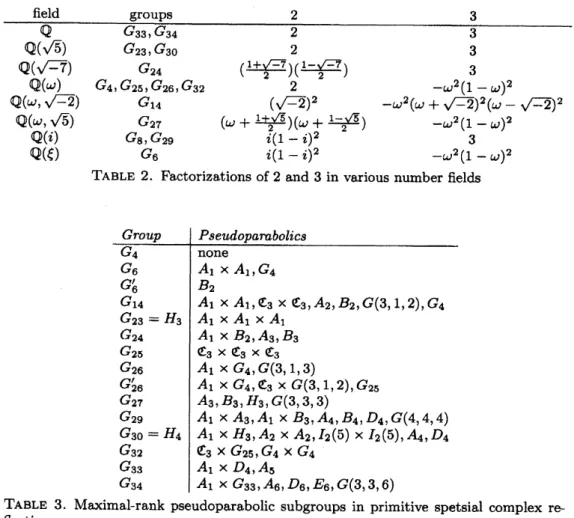
This list is given Table 1, together with the corresponding values of$N_{s,t}$
.
The third column recordsthenormof$N_{s,t}$ over$\mathbb{Q}$: weseethat in thesecases, $N_{s,t}$ iseither aunitorelse thegenerator ofapower
ofaprime idealover (2) or (3) $\subset \mathbb{Z}$. The lastcolumn of the table givesthe smallest
extension of$\mathbb{Q}$over
whichagiven admissible triplemay be realized.
Wenowretum to the problem ofdeterminingthe possibleCartanintegers. AnyCartan integer $\langle\alpha^{\vee},$$\beta\rangle$
is a divisor (in $\mathbb{Z}_{K}$) ofsome $N_{s,t}$, and from the list in Table 1, we seethat everysuch $N_{s,t}$ is a divisor
of either 2 or 3. The list of all possible Cartan integers (up to multiplication by a unit) can then be obtained simply by writingdown the factorizations ofthe numbers 2 and 3 in the ring $\mathbb{Z}_{K}\cdot$. (As noted
in the proofof [33,Corollary 13], these rings
are
all uniquefactorizationdomains.) These factorizations aregiven in Table 2,3.6. Determination ofpseudoparabolic subgroups of primitive spetsial groups. We are now
ready to put everything together into an algorithm. For a fixed spetsial complex reflection group $W$
defined over the number field $K$, together with a fixed Nebe root lattioe $L$
over
$\mathbb{Z}_{K}$, we look up thefactorizationsof2and3in $\mathbb{Z}_{K}$in Table2. Thatlist of factors isequivalenttothe listofideals appearing
in the union below:
$\overline{P}=$ $\cup$ $\mathfrak{p}^{-1}L/L\subset V/L$.
$\frac{AdmissibletriplesN_{s,t}Norm(N_{\epsilon,t})Field}{(2,2,3)11\mathbb{Q}}$
(2,2, 4) 2 2 $\mathbb{Q}$
$\frac{(2,2,5)\frac{3+\sqrt{5}}{1-\omega 2}1\mathbb{Q}(\sqrt{5})}{(2,3,4)3\mathbb{Q}(\omega)}$
$\frac{(2,3,8)+\xi\sqrt{2}1\mathbb{Q}(\omega,\sqrt{-2})(2,3,6)\frac{\omega(1-i)}{1^{1-\xi}-\omega},\neg 4\mathbb{Q}(\xi)}{(3_{l}3_{j}3)-\omega 1\mathbb{Q}(\omega)}$
$\frac{(3,3,4)-2\omega 4\mathbb{Q}(tv)}{(4,4,3)-i1\mathbb{Q}(i)}$
TABLE 1. Admissible triples in primitive spetsial complexreflection groups. Notation:
$\omega=e^{2\pi i/3},$ $\xi=e^{2\pi i/12}$
.
$f_{\mathbb{Q}G_{33},G_{34}23}^{ieldgroups23}$
$\mathbb{Q}(\sqrt{5})$ $G_{23},$ $G_{30}$ 2 3$\mathbb{Q}(\sqrt{-7})$ $G_{24}$ $( \frac{1+\sqrt{-7}}{2})(\frac{1-\backslash ^{\Gamma-7}}{2})$ 3
$\mathbb{Q}(\omega)$ $G_{4},$$G_{25},$$G_{26},G_{32}$ 2 $-\omega^{2}(1-\omega)^{2}$
$\mathbb{Q}(\omega, \sqrt{-2})$ $G_{14}$ $(\sqrt{-2})^{2}$ $-\omega^{2}(\omega+\sqrt{-2})^{2}(\omega-\sqrt{-2})^{2}$
$\mathbb{Q}(\omega, \sqrt{5})$ $G_{27}$ $( \omega+\frac{1+\sqrt{5}}{2})(\omega+\frac{1-\sqrt{5}}{2})$ $-\omega^{2}(1-\omega)^{2}$
$\mathbb{Q}(i)$ $G_{8},$$G_{29}$ $i(1-i)^{2}$ 3
$\mathbb{Q}(\xi)$ $G_{6}$ $i(1-i)^{2}$ $-\omega^{2}(1-\omega)^{2}$
TABLE 2. Factorizations of2 and 3invarious number fields
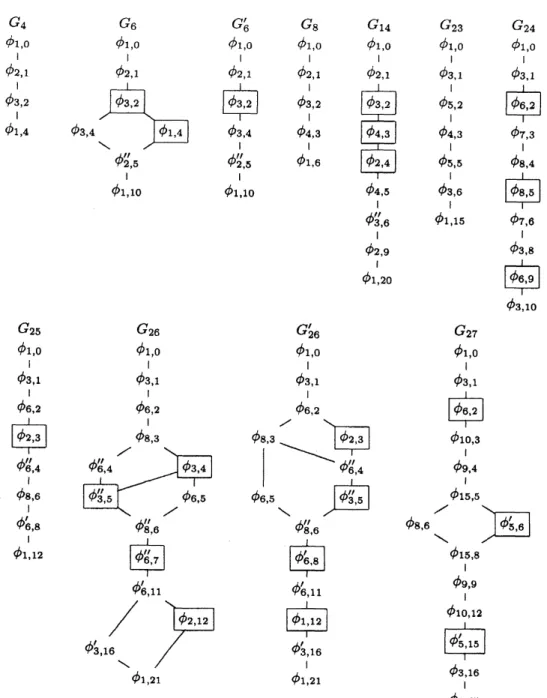
TABLE 3. Maximal-rank pseudoparabolic subgroups in primitive spetsial complex re-flection groups
$\overline{P}$ is a finite set
containing the set $P$ defined following (3.2). For each pointof$\overline{P}$, we can
then find the associatedpseudoparabolic subgroup bydirect computation. Weknow from Proposition 3.3 that every maximal-rank pseudoparabolic subgroup arises inthis way. The results ofthis calculation aregiven in Table 3. (Note the converse is not true: some points of$\overline{P}$ may give
rise to pseudoparabolic subgroups that are not ofmaximal rank. Those groups have been omitted from Table 3.) In this table,
as
in Section 1, $\mathfrak{C}_{d}$ denotes the cyclic group of order $d$, and any direct factor that happens to be a Coxeter4. SPRINGER CORRESPONDENCES FOR COMPLEX REFLECTION GROUPS
4.1. Springer representations. Following the usual philosophy for generalizing concepts $hom$ Weyl
groups toother complexreflection groups, we adoptthe second part of Theorem 2.1 as a definition: Definition4.1. Givenaspetsial complexreflection group$W$andarootlattioe$L$,we saythat$\chi\in$Irr$(W)$
is a Springer representation ifit is ofthe form $\chi\simeq j_{W}^{W},\chi’$ for somepseudoparabolic subgroup $W’\subset W$
and
some
special representation $\chi’\in$Irr$(W‘)$.
The list of special representations has been determined by $Brou6-Kim[10]$ in the imprimitive
case
and by Malle-Rouquier [32] inthe primitivecase.
Using those results, it is easy tocomputethe list of all Springer representations. The results inthesmall examplesof$G_{4},$ $G_{6}$, and $G_{6}’$ aregiven in Table 4.In each table, the list ofall pseudoparabolic subgroups (notjustthe maximal-rankones) appearsonthe left-hand side, and the list ofall Springer representations appears along the top. The interior of the table encodes j-induction: aspecial representation $\chi’$ appears in the row labelled by the subgroup $W$‘
and the column labelledby therepresentation$\chi$ exactly when $\chi\simeq j_{W}^{W},\chi’$.
Thehorizontal dividing line in thetablesfor$G_{6}$and$G_{6}’$ separates parabolicsubgroups (abovethe line)
from pseudoparabolicsubgroups thatare not parabolic (below). (Recall that$G_{4}$ has no pseudoparabolic
subgroupsof latterkind.) The vertical linesseparatethe Springerrepresentations byfamilies. In$G_{4}$ and
$G_{6}’$, every Springer representation is special, sothey all lie in distinct families. In contrast, in$G_{6}$, there
are two nonspecialSpringer representations, both inthesame family as thespecial representation $\phi_{2,1}$
.
The notation for representations of primitive complex reflection groups follows that of [32]. The general principle is that $\phi_{r,s}$ is an irreducible representation of dimension $r$ and b-invariant $s$
.
Whenthese twoproperties fail touniquely characterize arepresentation, the various representations withthe samedimension and b.invariant may bedenoted, for instance,$\phi_{r}’,$, and$\phi_{r}’’$
,,.
When aclassical-type Weylgroupoccurs, itsrepresentations arelabelledby partitionsor bipartitions as in [14].
Unfortunately,itwould be impracticaltoreproducesuch tables ofj-inductiondatahere formostlarger
primitivespetsial complex reflection groups: $G_{34}$, for instance, has fifty-three Springer representations.
However, the list ofSpringerrepresentations themselves will appearin Section 4.3.
Finally, we remark briefly on what happens in the imprimitive case. Recall that in classical-type Weylgroups,the Springer correspondencecanbe describedwith the aid ofcombinatorial objects called symbols and u-symbols. (These are certain arrays of nonnegative integers related to partitions.) The set of all symbols and the set ofall u-symbols are both in bijection with Irr$(W)$, and a representation
$\chi\in$ Irr$(W)$ is a Springer representation if and only if its corresponding u-symbol is distinguished (an
elementary combinatorialproperty).
There is a generalization of the notion of u-symbols, due to Malle [27], that is adaptedtodiscussing the irreducible representations of$G(d, 1, n)$ or $G(d, d, n)$
.
This notion was used by Shoji [36, 37] in hisstudyofGreen functions for these groups, and implicit in that workwasthe idea that the representations corresponding to distinguished generalized symbolsshould be thoughtofas “Springer representations.”
However, the combinatorial set-up of [36, 37] has no obvious generalization to primitive complex
re-flection groups. One of the aims of the paper [3]
was
to give ”intrinsic” descriptions ofsome of the combinatorial notions in [36, 37], with a view to generalizing Shoji)$s$ work to all spetsial groups. ForSpringerrepresentations, this is achieved with the followingresult.
Theorem 4.2 ([3, Th\’eor\‘eme 8.11]). The Spmnger representations
of
$G(d, 1, n)$ orof
$G(d, d, n)$ areprecisely those corresponding to distinguishedgeneralizedsymbols.
4.2. Springercorrespondencesand Green functions. In the work of Shoji[36, 37]mentionedabove, his main aim
was
thestudy of Greenfunctions. The essential idea here is simply to runthe algorithm fromTheorem 2.4 andsee
how the outputbehaves. That algorithm requiressome
inputdata: namely, an ordered partitioningofIrr$(W)$ intodisjointsubsets. Recall that in the Weylgroup case, this datacomesfrom the Springercorrespondence, which for classical groups can be encoded with the combinatorics of u-symbols. Specifically,two Weylgroup representationsare attached to the sameunipotent classby the Springercorrespondenoe ifandonly if their u-symbolsare similar. By analogy, in his studyof$G(d, 1, n)$
and $G(d, d, n)$, ShojipartitionedIrr$(W)$ by similarityclassesof generalized symbols.
The natural question to ask is:
can one
give an “intrinsic,” noncombinatorial description of this partitionof Irr$(W)$ that could then be appliedtoprimitive complex reflection groupsas
well7 In otherwords, we areseeking to do for similarity classesofsymbolswhat Definition 4.1 and Theorem 4.2 do for distinguished symbols. Such awayof partitioning Irr$(W)$ should be regarded as ageneralizationof the
Springer correspondenoefor algebraicgroups.
Thisquestionremains largelyopen. In this section,wediscuss desideratafora solution tothequestion,
as
wellas
computational examples amongprimitive groups.We begin by making a few observations about the Springer correspondenoe for an algebraic group. It is known [14] that among the representations attached to a given unipotent class, the
one
attached to the trivial local system (i.e., the Springerrepresentation) is theuniqueonewith minimal b-invariant. Moreover, the b-invariant of that representation is exactly half thecodimension of that unipotent class in the full unipotent variety. We have previously noted that everyspecial representation is a Springerrepresentation. It turns out that everynonspecial representation must be attachedto a unipotentclass in the closure ofthe one corresponding to the unique special representation in the same family. As we
saw
inTheorem 2.5, theentries of thematrices $P$ and$\Lambda$ producedby theLusztig-Shoji algorithm, a priori only rational functions of$u$,
are
actually polynomials. Furthermore, because the entries of$P$describe stalks ofsimpleperversesheaves, theyhave nonnegative coefficients,and they obey aboundon the degrees oftermsthat may appear, coming from cohomological degree boundson perverse sheaves.
We now removethe underlying algebraic group from the precedingparagraph, and adopt thelist of observationsasa definition.
Deflnition 4.3 (cf. [2, Definition 3]). Given an ordered partition
(4.1) Irr$(W)=C_{1}u\cdots uC_{n}$,
let $P$ and $\Lambda$denote
the output of the Lusztig-Shoji algorithm. Thepartition (4.1) is called
an
abstra$ct$Springer correspondence for $W$ if the followingproperties hold:
(1) Each$C_{i}$contains aunique Springerrepresentation
$\chi_{i}$
.
Moreover,for any$\chi\in C_{i},$ $\chi\neq\chi_{i}$, wehave$b(\chi)>b(\chi_{i})$.
(2) If$i<j$, then $b(C_{i})\geq b(C_{j})$.
(3) Suppose$\chi\in C_{i}$ isaspecial representation. If$\chi’\in C_{j}$ belongstothe
same
familyas
$\chi$, then$j\leq i$
.
(4) $P$and $\Lambda$have entries in
$\mathbb{Z}[u])$ and in addition, all coefficients ofentries of$P$are nonnegative.
(5) If$\chi\in C_{i}$, then $P_{\chi,\chi’}(u)$ is divisible by $u^{b(C_{i})}$ for all$\chi’\in$Irr$(W)$
.
This definition should perhaps be regarded
as
preliminary. It is certainly satisfied by the actual Springercorrespondences for algebraic groups, but it has somewhat of an ad hoc flavor. It istoo weak toimplyageneral uniqueness statement,but it isalso too restrictive:as
wewillseebelow, condition(5) may be unreasonable forgeneral complexreflection groups. Thebest result so faris for dihedral groups. Theorem 4.4 ([2, Theorem 2]). Let $W$ be adihedml group $G(d, d, 2)$.If
$d$ is odd, $W$ admitsa
uniqueabstract Springer correspondence.
If
$d$ is even, $W$ admits a unique abstmct Spmnger correspondencesatisfying thefollowing additional property:
(5) Each $non- Sp\dot{n}nger$ representation belongs to the set $C_{i}$ with $i$ as large as possible, subject to
To understand the last condition, note that even before choosing a partition of the form (4.1), the numberof subsets isdetermined (they are inbijectionwith the Springer representations), and they are
already endowed with at least apartialorder, by condition (2).
Given
an
abstract Springercorrespondenoe,we can
try to develop the analogy with unipotent classes ofanalgebraic group further, by extracting ”geometric” information from thematrix $P$.
Definition 4.5. Suppose$W$ is equippedwith anabstract Springer correspondence. The closurepartial
order on Springerrepresentations isdefinedby declaring$\chi_{i}\leq\chi_{j}$ if$P_{\chi_{f}.\chi}$
.
$\neq 0$.
It follows from Theorem 2.5and basic properties ofperverse sheaves that inthe
case
ofanalgebraic group, the partial orderdefined abovecoincides withthe usual closurepartialorderon
unipotentclasses. Definition 4.6. Inan
algebraic group, a special piece is the union ofa special unipotent class $C$ andall nonspecial classes in $\overline{C}$
that are not contained in the closure of any smaller special unipotent class
$C’\subset\overline{C}$
.
Inan abstractSpringercorrespondence, aspecialpieceis a set consisting ofonespecialrepresentation
$\chi$ and all nonspecial Springerrepresentations $\chi’\leq\chi$ such that there is no other special representation $\chi_{1}$ with $\chi’\leq\chi_{1}<\chi$.
It is clear that thesetwodefinitions
are
compatible in the settingofalgebraicgroups.Next, recall thatavariety $X$ is mtionally smooth ifthesimple perverse sheaf IC$(X, \underline{\mathbb{C}})$ is simply the
constant sheaf$\underline{\mathbb{C}}$. (Anotherwayof sayingthisisthat$X$ is rationallysmooth if
it obeysPoincar\’e duality.) A number ofimportantvarieties inrepresentationtheory tumoutto berationally smooth, includingthe fullunipotent varietyof an algebraic group [7] andall its special pieces [24].
TYanslating rationalsmoothness into thesettingof theLusztig-Shoji algorithm,we obtain the follow-ing notion.
Deflnition 4.7. Let$X\in$ Irr$(W)$ be asetofSpringerrepresentationswith auniquemaximal element$\chi$
with respectto the closurepartialorder. $X$ is said tobe mtionallysmooth if$P_{\chi,\chi’}=u^{b(\chi)}$ for all$l\in X$
.
$G_{4}$ $G_{6}$ $\phi_{1,0}$ $1$ $\phi_{2,1}$ $1$ $\phi_{3,2}$ $1$ $\phi_{1,4}$ $G_{8}$ $G_{14}$ $G_{23}$ $\phi_{1,0}$ $\phi_{1,0}$ $1$ $1$ $\phi_{2,1}$ $\phi_{3,1}$ $1$ $1$ $\phi_{3,2}$ $\phi_{5,2}$ $1$ $1$ $\phi_{4,3}$ $\phi_{4,3}$ $1$ $1$ $\phi_{1,6}$ $\phi_{5,5}$ $1$ $\phi_{3,6,|}$ $\phi_{1,15}$
TABLE 6. Partial orders on Springer representationsfor primitive spetsial complex re-flection groups
Theorem 4.8 ([2,Theorem3]). Inthe dihedmlgmups, each special pieceis rationallysmooth, as is the whole unipotent variety.
Here, the ”whole unipotentvariety) simply means the set ofall Springer representations. Of course, there is no knownactual varietywhose intersection cohomologyisobtainedby runningtheLusztig-Shoji algorithm for a dihedral group, but this kind ofresult leads one to hopethat perhaps one day, such
a
variety might be found.4.3. Calculations inthe primitivegroups. Weconcludeby considering abstractSpringer correspon-dences for the primitive spetsial complex reflection groups. We will treat $G_{4}$ and $G_{6}$ in detail, and the
$G_{29}$ $\phi_{1,0}$ $1$ $\phi_{4,1,|}$ $\phi_{10,2}$ $G_{30}$ $G_{32}$ $\phi_{1,0}$ $\phi_{1,0}$ $1$ $1$ $\phi_{4.1,|}$ $\phi_{4,1,|}$ $\phi_{9,2,|}$ $\phi_{10,2}$ $\phi_{16,3}$ $1$ $\phi_{25,4}$ 1 $\phi_{36.5}$ $1$ $\phi_{24,6}$ $1$ $\phi_{4_{1},31}$ $\phi_{1,60}$ $\phi_{1,40}$ TABLE 6. (continued)
Recall from Section 4.1 that the only Springer representations in$G_{4}$ are the special representations.
To produoe an abstract Springer correspondence, we must decide how to group the three non-Springer representations, denoted (following [32]) $\phi_{2,3},$ $\phi_{2,5}$, and $\phi_{2,8}$
.
It is readilyseenthat conditions (1)$-(3)$ ofDefinition 4.3 imply that $\phi_{2,5}$ and $\phi_{2,8}$ must belong to thesame subset asthe Springer representation $\phi_{1,4}$. The position of$\phi_{2,3}$ is not determined bythese axioms, but when the Lusztig-Shoji algorithm is
run, condition (4) fails unlaes $\phi_{2,3}$ is placed with$\phi_{2,1}$
.
The resulting matrix $P$isshownin Table 5. Thevertical and horizontal lines show thepartitionofIrr$(W)$ intosubsetsas in (4.1).
In this example, the subsets of that partitiontumed out to be precisely thefamilies ofcharactersof
$G_{4}$, as determined by Malle-Rouquier [32]. The idea of carrying out the Lusztig-Shoji algorithm with
Irr$(W)$ partitioned by families, rather thanby an actual or abstract Springer correspondence, has been
investigated by Geck-Malle [20]. The Lusztig-Shoji algorithm in this case isnot well understood, even
for Weyl groups. In the Weyl group case, the output is undoubtedly related to the geometry of the unipotent variety, and Geck and Malle formulate
some
preciseconjectures on thistopic. Someprogressinthis direction has been made by Shoji [38], but an analogueofTheorem 2.5 is still lacking.
Next, we turn to $G_{6}$
.
In this case, there are seven Springer representations. There tum out to besix partitions ofIrr$(W)$ satisfying conditions (1)$-(4)$ ofDefinition 4.3, but unfortunately, all of them
violate condition (5). Nevertheless, there is a unique partition satis$\mathfrak{h}^{r}ing$ the additional condition (5)
appearing in Theorem 4.4. The matrix $P$ obtained by running the Lusztig-Shoji algorithm with this partition is shown in Table 5. Notethat the failureof condition (5) is quite mild: it occurs only in the entry $P_{\phi_{1d},\phi_{2,7}}$. It also has
a
feature thatnever
occurs
in Weyl groups: the representation$\phi_{2,7}$ is notaSpringerrepresentation, but itscomplex conjugate $\phi_{2,5}’’$ is. (In Weylgroups, all representationsare
self-conjugate.) Condition (5) should probably bereplaced byaslightlydifferent condition to accommodate this kindofoccurrence, but it is not known at this time what the correct formulationof suchacondition shouldbe.
The Lusztig-Shoji algorithm
can
similarly be carried out for the remaining primitive groups, using the list ofSpringer representations from Table 4, and using condition (5) of Theorem 4.4as a
guide for partitioning Irr$(W)$.
Condition (5) often fails in the way seen in $G_{6}$, so these partitions are notquiteabstract Springercorrespondences, but the other conditionshold, and thedefinitions of the closure partial order andofrationalsmoothness from Section 4.2 makesense.
The closurepartialorder on Springer representationsineach of theprimitive groups (otherthan the Coxetergroups) is shown in Table 6. By examination of the results of the Lusztig-Shoji algorithm for each of these groups, weobtain the following analogue of Theorem4.8.
Theorem 4.9. In the pnmitive spetsialcomplex
reflection
groups, each specid pieceis mtionallysmooth, as is the wholeunipotent variety.REFERENCES
[1] P.AcharandA.-M. Aubert, On$mnk2$complexreflectiongrvups, Comm. Algebra 36 (2008),2092-2132.
[2] P.Achar and A.-M. Aubert,Spnnger correspondencesfordthedralgroups, Transform. Groups 13(2008), 1-24.
[3] P. Achar and A.-M. Aubert, Repr\’esentations de Sprenger pour les groupes de rdflexions complexes impremitifs,
arXiv$:0707.0836v1$.
[4] S. Arikl and K.Koikc,AHecke algebraof$(Z/rZ)t6_{n}$ and constructionofitsirreduciblerepresentations,Adv. Math. 106 (1994),$21\triangleright 243$.
[5] S.Ariki, Representation theory ofaHecke algebmof$G(r,p, n)$, J.Algebra 177 (1995), 164-185.
[6] W. Borho and R. MacPherson, $Repr\ell sentations$ des groupes de Weylet homologse $d$‘intersection pour les vare\’etis
$n:lpotentes,$$C$R.Acad.Sci. Paris292 (1981),707-710.
$[7|$ W.BorhoandR.MacPherson, Partialresolutionsofnilpotentvareeties,in Analysu and topologyonsingularspaces,
II, $JII$(Luminy, 1981), $Ast6risque101-102$ (1983),23-74.
[8] K. Bremke and G.Malle, Reduced$wo\dagger ds$ andalengthfunction for$G(e, 1, n)$, Indag. Math. 8 (1997),453-469.
[9] K. Bremke and G. Malle,Root systems andlength$func\alpha ons$,Geom. Dedicata 72 (1998),83-97.
[10] M.Brou\’eandS. Kim, Famtlles de camct\‘eres des$alg\delta bres$deHecke cyclotomiques, Adv.Math. 172 (2002),5$S-136$.
[11] M.Brou6andG. Malle, Zyklotomtsche Heckealgebren, Ast\’erisque212 (1993), 119-189.
[12] M. Brou\’e,G. Malle, andJ.Michel, Towardsspetses$I$,Transform. Groups4 (1999), 157-218.
[13] M. Brou\’e, G. $MaUe$, and R. Rouquier, Complex reflection groups, braid groups, Hecke algebras, J. Reine
Angew.Math.500(1998), 127-190.
[14] R.W.Carter, Finite groups ofLie type; Conjugacy classes andcomplex chamcters,John Wiley,New-York, 1985.
[15] M. Chlouveraki, Rouquierblocksofthe cyclotomtc Hecke algebms,C. R.Math.Acad.Scl.Paris344(2007),$615\triangleleft 20$
.
[16] M.Chlouverakl,Rouquier blocksofthe cyclotomic$Ank$-Kotkealgebms,AlgebraNumberTheory 2(2008), 68$-720.
[17] A.M.Cohen, Finite complexreflectiongroups, Ann. Sci.\’EcoleNorm. Sup. (4)9(1976), $379arrow 436$.
[18] M. Geck, G. Hiss, F. Lubeck, G. Malle, et G. Pfeiffer. CHEVIE$-A$ systemfor computing and processing gener$c$
chamcter tables forfinite groups ofLie type, Weyl groups, and Hecke algebras, Appl. Algebra Engrg. Comm.
Comput.7 (1996), 175-210.
[19] M. Geck and G. Malle, On the exestence ofaunipotent supportfor the irreducible charactersofafinue group of
Lie type, Trans. Amer.Math.Soc. 352(1999), $42\triangleright A56$.
[20] M.Geckand G. Malle, Onspecialpieces inthe umpotent$var\tau e\ell y$,J.Experiment. Math8 (1999),281-290.
[21] M. Geck and G. Pfeiffer, Chamcters of finite Coxeter groups and Iwahon-Hecke algebms, London Mathematical Society Monographs, New Seriesno.21,Oxford UniversityPress,NewYork,2000.
[22] M. Hughesand A. Morris, Root systemsfor two dimensionalcomplexrefiectiongroups,$\Re m$
.
Lothar. Combin.45(2000/01), Art.$B45e,$ $18$pp.
[23] S. Kim, Famtliesofthechanxctersofthe cyclotomicHecke algebrasof$G(de, \epsilon, r)$, J.Algebra289(2005),$34\triangleright 364$
.
[24] H. Kraft andC. Procesi, A specwl decomposition ofthe nilpotent coneofa classicalLie algebra, in Orbites
unipo-tentes et repr\’esentations, III, Ast\’erisque$17\succ 174$(1989),271-279.
[25] G. Lusztig, Characters ofreductive groupsover afinuefield, Annals of Mathematics Studies, vol. 107, Princeton
University Press, Princeton, NJ, 1984.
[26] G. Lusztig, CharacterSheaves, $V$, Adv. Math.61 (1986), 103-155.
[27] G. Malle, Unipotente Gmde impnmitiver komplexer Spiegelungsgruppen, J.Algebra177(1995), $768 26$.
[28] G. Malle, Degr\’es relatifs des $alg\delta bres$ cyclotomiques associ\’ees auxgroupes de r\’efiexions complexes de dimension
deux, FiniteReductive Groups: $B\epsilon lated$Structures andRepresentations (M. Cabanes,ed.), Progress in Mathematics,
vol. 141, Birkhauser, 1997,pp. 311-332.
[29] G. Malle, On the rationality andfake degrees ofcharacters of cyclotomic algebras, J. Math. Sci. Univ. Tokyo 6
(1999),647-677.
[30] G.Malle, On the genenc degreesofcyclotomicalgebras, Represent. Theory4(2000), 342-369.
[31] G. Malle and A. Mathas,Symmetriccydotomic Heckealgebras,J. Algebra205 (1998),275-293.
[32] G. Malle and R. Rouquier, Familles decaract\‘eresdegroupes der\’eflexionscomplexes, Represent.Theory 7(2003),
$61k640$.
[33] G.Nebe, The rootlattices ofthe complexreflectiongroups,J.Group Theory 2(1999), 15-38.
[34] R. Rouquier, Fanilles et blocs d’alg\‘ebres deHecke, C. R.Acad.Scl. ParisS\’er. I Math. 329(1999), 1037-1042.
[35] G.C. Shephard and J.A.Todd, Finite unitaryreflectiongroups,Canadian J. Math6(1954), 274-304.
[36] T. Shojl, Greenfunctions associated to complexreflectiongroups,J.Algebra245 (2001), $650t94$.
[37] T. Shoji, Greenfunctions $ass$ociatedto complexreflectiongroups. II, J. Algebra258 (2002), 563-598.
[38] T. Shoji, Greenfunctionsandaconjecture ofGeck and Malle, Beitr\"age AlgebraGeom.41 (2000), 115-140.
$[39|$ N. Spaltenstein, Classesunipotentes etsous-groupesde$Bon\iota$LectureNotes inMath. 946,Springer, Berlin
![Introduction Forβ >1 a Parry number, Boyd [9] introduced the notion of the beta-conjugates of β in the context of the R´enyi - Parry numeration system](data:image/gif;base64,R0lGODlhAQABAIAAAP///wAAACH5BAEAAAAALAAAAAABAAEAAAICRAEAOw==)