2成分
Camassa‐Holm方程式の多重ソリ
トン解とその簡約
Multisoliton solutions of thetwo‐component Camassa‐Holm
equation
and their reductions山口大学大学院創成科学研究科
松野
好雅(Yoshimasa
Matsuno)
Division of
Applied
Mathematical ScienceGraduate School of Sciences and
Technology
for InnovationYamaguchi
University\mathrm{E}‐mail address:
matsuno@yamaguchi‐u.ac.jp
Abstract: The twxcomponent Camassa‐Holm
(CH2)
equationmodels thepropagation
of nonlinearsurface
gravity
waves onshallowwater. It has several remarkable features.Among
them,
it isacompletely
integrable
system.By
employing
adirect methodinsolitontheory,
wedevelop
asystematic procedure
for
constructing
multisoliton solutions of the CH2equation,
andexplore
theirproperties.
Then,
weshow that the two
integrable
reductions arepossible
for the CH2equation
by
means ofappropriate
scaling
limits, leading
to the CH andtwo component Hunter‐Saxtonequations.
The reduced form ofmultisoliton solutionsis
presented
for bothequations.
1. Introduction
We consider the
following
two‐componentgeneralization
of the Camassa‐Holm(CH)
equation(CH2
equation
hereafter)
n $\eta$+um_{x}+2mu_{x}+ $\rho \rho$_{x}=0, p_{t}+( $\rho$ u)_{x}=0
.(1.1)
Here,
u=u(x, t), $\rho$= $\rho$(x, t)
andm=m(x, t)\equiv u-u_{xx}+$\kappa$^{2}
arereal‐valued functions oftime tand aspatial
variablex, and thesubscripts
xandtappended
touand $\rho$denotepartial
differentiation. Theparameter $\kappa$inthe
expression
of misassumedtobeanon‐negative
real number. In thephysical
context,the CH2 systemarisesas amodelequationfor shallow‐waterwaves.
Actually,
itwasderived from theGreen‐Naghdi equations by using
anasymptotic
analysis,
whereuistheleading
orderapproximation
ofthe horizontal
velocity
whereas $\rho$isrelatedtothedepth
of the fluidat theleading
order[1],
Thesamesystemwasalso derived from the basic Eulersystemforan
incompressible
fluid withaconstantvorticity
[2].
One remarkable feature of the CH2equationisthatit isa
completely integrable
system.Indeed,
ithas the Lax
representation given
by
[1, 2]
$\Psi$_{xx}= (-$\lambda$^{2}$\rho$^{2}+ $\lambda$ m+\displaystyle \frac{1}{4}) $\Psi,\ \Psi$_{t}=(\frac{1}{2 $\lambda$}-u)$\Psi$_{x}+\frac{u_{x}}{2} $\Psi$
.(1.2)
Various reductionsare
possible
for the CH2equationwhilepreserving
itsintegrability. Specifically,
ifoneputs
$\rho$=0
,then thesystemreducestothe CHequation
[3]
u_{t}+2$\kappa$^{2}u_{x}-u_{xxt}+3uu_{x}=2u_{x}u_{xx}+uu_{xxx}
.(1.3)
Another reductionis thetwo‐component Hunter‐Saxton
(HS2)
equation
which canbe derivedby
theshort‐wave hmit of the CH2
equation
[1].
It has thesameformasEq.
(1.1)
with the variablemreplaced
by
-u_{xx}+\mathrm{K}^{2}.
In thispaper,we
develop
asystematic procedure
forconstructing
the multisoliton solutions of the CH2equation,
andexplore
theirproperties.
The reductionprocedure
isperformed
for the soliton solutions ofthe CH2
equation
toobtain thecorresponding
solutions of the CH and HS2equations.
Here,
wedescribeonly
themainresults,
and the details will bereported
elsewhere.2. Exact method of solution
There exist severalexactmethods of solution for
solving
nonlinear evolutionequations.
Among them,
usefulin
obtaining
solitonsolutions. The method workseffectively
ifonereduces the CH2equationtoamoretractaule form
by
areciprocal
transformation.Following
the standardprocedure,
theparametric
representationof theNsoliton solution will be
constructed,
whereN isanarbitrary
positive integer.
2.1.
Reciprocal transformation
First of
all,
weintroduce thereciprocal
transformation(x, t)\rightarrow(y, $\tau$)
according
tody= $\rho$ d $\alpha$- $\rho$ udt, d $\tau$=dt. (2.1a)
Then,
thexandtderivatives transformas\displaystyle \frac{\partial}{\partial x}= $\rho$\frac{\partial}{\partial y}, \frac{\partial}{\partial t}=\frac{\partial}{\partial $\tau$}-pu\frac{\partial}{\partial y}. (2.1b)
Applying
the transformation(2.1)
toEq.
(1.1),
weobtain thesystemof PDEs foruand $\rho$(\displaystyle \frac{m}{$\rho$^{2}})_{ $\tau$}+$\rho$_{y}=0, $\rho$_{r}+$\rho$^{2}u_{y}=0. (2.2a,b)
It then follows from
(2.1b)
that the variablex=x(y_{{}_{\rangle}T})
obeys
asystemof hnear PDEsx忽
=\displaystyle \frac{1}{ $\rho$},
x_{ $\tau$}=u.(2.3a, b)
Thesystemofequations
(2.3)
isintegrable
since itscompatibility
condition x_{ $\tau$ y}=x_{y $\tau$}isassuredby
virtueof
(2.2b)
.Now,
thequantity
m=u-u_{xx}+$\kappa$^{2}
in(1.1)
canbe rewritteninthenewcoordinatesystemasm=u+ $\rho$(\ln $\rho$)_{ $\tau$ y}+$\kappa$^{2}
,(2.4)
wherewehave used
(2.2b)
toreplace
u_{y}by
-$\rho$_{ $\tau$}/$\rho$^{2}.
Letusintroduce thenew
dependent
variable\mathrm{Y}=\mathrm{Y}(y, $\tau$)
by
the relation\displaystyle \frac{m}{$\rho$^{2}}-\frac{$\kappa$^{2}}{$\rho$_{0}^{2}}=Y_{y}
.(2.5)
Subsituting
(2.5)
into(2.2a)
and thenintegrating
the resultantexpression
by
y under theboundary
conditionsY_{ $\tau$}\rightarrow 0and
$\rho$\rightarrow$\rho$_{0}(>0)
as|y|\rightarrow\infty
,weobtain$\rho$= $\rho$ 0-Y_{ $\tau$}
.(2.6)
The
following proposition
isthestarting point
inthepresentanalysis.
Proposition
2.1. The variablesxand Ysatisfy
the systemof
PDEsx_{y}($\rho$_{0}-Y_{ $\tau$})=1
,(2.7)
($\rho$_{0}-\displaystyle \mathrm{Y}_{ $\tau$})(\frac{$\kappa$^{2}}{$\rho$_{0}^{2}}+Y_{?J}) =x_{ $\tau$}x_{y}-[($\rho$_{0}-Y_{ $\tau$})x_{ $\tau$ y}]_{y}+$\kappa$^{2}x_{y}
.(2.8)
2.2. Bilinearization
In
applying
the direct method tothegiven
nonlinearequations,
the first stepis to transform theequations
into the bilinearequations,
whichweshallnowdemonstrate. To thisend,
weintroduce thedependent
variable transformationswhere
f,
\tilde{f},
gand\tilde{g}
aretau‐functions and d is anarbitrary
constant.Then,
weestablish thefollowing
proposition.
Proposition
2.2. Consider thefollowing
systemof
bilinearequations
for f,
\tilde{f},g
and\tilde{g}
:D_{y}\displaystyle \tilde{f}\cdot f+\frac{1}{ $\rho$ 0}(\tilde{f}f-\tilde{g}g)=0
,(2.10)
\mathrm{i}D_{ $\tau$}\tilde{g}\cdot g+$\rho$_{0}(\tilde{f}f-\tilde{g}g)=0
,(2.11)
D_{ $\tau$}D_{y}\displaystyle \overline{f}\cdot f+\frac{1}{$\rho$_{0}}D_{ $\tau$}\tilde{f}\cdot f+$\kappa$^{2}D_{y}\tilde{f}\cdot f=0
,(2.12)
D_{ $\tau$}D_{y}\displaystyle \tilde{g}\cdot g-\mathrm{i}\frac{$\kappa$^{2}}{$\rho$_{0}^{2}}D_{ $\tau$}\tilde{g}\cdot g+\mathrm{i}$\rho$_{0}D_{y}\tilde{g}\cdot g=0
,(2.13)
where the bilinearoperatorsare
defined by
D_{y}^{m}D_{ $\tau$}^{n}f\cdot g=(\partial_{y}-\partial_{y'})^{m}(\partial_{ $\tau$}-\partial_{7'})^{n}f(y, $\tau$)g(y',$\tau$')|_{y'=y,$\tau$'=}
ア,(m,n=0,1,2
,(2.14)
Then,
the solutionsof
thissystemof equations
solve theequations
(2.7)
and(2.8).
2.3. Parametric
representations
of
the solutionsTheorem 2.1. The two‐component CH
equation
(1.1)
admits the parametricrepresentations
of
thesolutions
u(y, $\tau$)= (\displaystyle \ln\frac{\tilde{f}}{f})_{ $\tau$} $\rho$(y, $\tau$)=$\rho$_{0}-\mathrm{i}(\ln\frac{\tilde{9}}{g})_{ $\tau$} , (2.15a)
x(y, $\tau$)=\displaystyle \frac{y}{$\rho$_{0}}+1_{\mathrm{J}\mathrm{J}}\frac{\tilde{f}}{f}+d. (2.15b)
Remark 2.1. The parametric representationsof
1/ $\rho$
andm/$\rho$^{2}
in termsof the tau‐functionsare alsoavailable from
(2.3a)
,(2.5)
and(2.9).
Explicitly, they
read\displaystyle \frac{1}{p}=\frac{1}{$\rho$_{0}}+(\mathrm{h}\frac{\tilde{f}}{f})_{y} \frac{m}{$\rho$^{2}}=\frac{$\kappa$^{2}}{$\rho$_{0}^{2}}+\mathrm{i}(\mathrm{U}\mathrm{n}\frac{\tilde{g}}{g})_{y}
(2.16)
2.4.
N‐soliton solutionTheorem 2.2. The
tau‐functions f,
\overline{f},g
and\tilde{g} constituting
the N ‐soliton solutionof
thesystemof
bilinearequations
(2.10)-(2.13)
aregiven
by
theexpressions
f=\displaystyle \sum_{ $\mu$=0,1}\exp [,\sum_{J^{=1}}^{N}$\mu$_{j}($\xi$_{j}+$\phi$_{j})+\sum_{1\leq j<t\leq N}$\mu$_{j}$\mu$_{l}$\gamma$_{ji]} , (2.17a)
\displaystyle \tilde{f}=\sum_{ $\mu$=0,1}\exp [\sum_{j=1}^{N}$\mu$_{j}($\xi$_{j}-$\phi$_{j})+\sum_{1\leq j< $\iota$\leq N}$\mu$_{j}$\mu$_{l}$\gamma$_{ji]} , (2.17b)
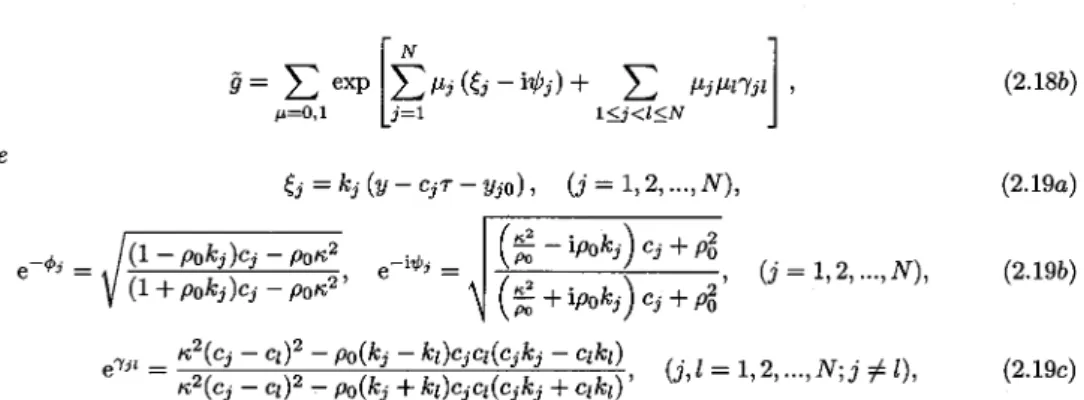
\displaystyle \tilde{g}=\sum_{ $\mu$=0,1}\exp[\sum_{j=1}^{N}$\mu$_{j}($\xi$_{\mathrm{j}}-\mathrm{i}$\psi$_{j})+\sum_{1\leq j<l\leq N}$\mu$_{j} $\mu \iota \gamma$_{jl}] , (2.18b)
where
$\xi$_{j}=k_{j}(y-c_{j} $\tau$-y_{j0}) , (j=1,2, \ldots, N) , (2.19a)
\mathrm{e}^{-$\phi$_{j}}=\sqrt{\frac{(1-p_{0}k_{j})\mathrm{c}_{j}-p_{0}$\kappa$^{2}}{(1+$\rho$_{0}k_{j})c_{j}-$\rho$_{0}$\kappa$^{2}}},
\mathrm{e}^{-\mathrm{i}$\psi$_{j}}=\sqrt{\frac{(\frac{$\kappa$^{2}}{$\rho$_{0}}-\mathrm{i}$\rho$_{0}k_{j})c_{j}+$\rho$_{0}^{2}}{(\frac{$\kappa$^{2}}{ $\rho$ 0}+\mathrm{i}$\rho$_{0}k_{j})c_{j}+$\rho$_{0}^{2}}}, (j=1,2, \ldots,N)
,(2.19b)
\displaystyle \mathrm{e}^{$\gamma$_{jl}}=\frac{$\kappa$^{2}(c_{j}-c_{l})^{2}-$\rho$_{0}(k_{j}-k_{l})c_{j}c_{l}(c_{j}k_{j}-c_{l}k_{t})}{$\kappa$^{2}(c_{j}-c_{l})^{2}-$\rho$_{0}(k_{j}+k_{l})c_{\hat{J}}c_{l}(c_{j}k_{j}+c_{l}k_{l})}, (j, l=1,2, \ldots,N;j\neq l) , (2.19c)
and c_{j} is the
velocity of jth
soliton inthe(y, $\tau$)
coordinatesystemwhichisgiven
by
the solutionof
thequadratic equation
(1-p_{0}^{2}k_{j}^{2})c_{\mathrm{j}}^{2}-2p_{0}$\kappa$^{2}c_{j}-$\rho$_{0}^{4}=0\backslash , (j=1,2, \ldots, N)
.(2.20)
Here,
k_{j}
and y_{\mathrm{j}0} arearbitrary complex
parameterssatisfying
the conditionsk_{j}\neq k_{l}
forj\neq l
. Thenotation\displaystyle \sum_{ $\mu$=0,1}
implies
thesummationoverallpossible
combinationsof $\mu$_{1}=0
,1, $\mu$_{2}=0
,1,$\mu$_{N}=0
,1.Theparametric representationof the N‐soliton solution
given
by
(2.15)
with the tau‐functions(2.17)
and(2.18)
ischaracterizedby
the 2Ncomplex
parametersk_{j}
and y_{j0}(j=1,2\ldots., N)
. Theparametersk_{j}
determine theamplitude
and thevelocity
of thesohtons,
whereas theparameters y_{j0} determinethe
position
(or phase)
of the sohtons. Ifwe impose the conditions\tilde{f}
=f^{*}
and\tilde{g}
=g^{*}
where theasterisk denotes
complex conjugate,
then the solutions become real functions ofx andt.Note,
howeverthat
they
wouldyield
multi‐valued functions unless certain conditions areimposed
onthe parametersk_{\mathrm{j}}(j=1,2, ..,N)
. Thesamesituationhas been encounteredininvestigating
thestructureof the sohtonsolutions of the CH and modified CH
equations
[6‐8].
We will address thispoint
inthenestsectionwherethe detailed
analysis
of the soliton solutions will be done.Before
proceeding,
weinvestigate
the characteristics of thevelocity
of the sohton. Thequadratic
equation
(2.20)
hastwo rootsc_{j}=\displaystyle \frac{$\rho$_{0}}{1-($\rho$_{0}k_{\mathrm{j}})^{2}}($\kappa$^{2}+d_{j})=\frac{$\rho$_{0}^{3}}{d_{j}-$\kappa$^{2}}, (j=1,2, N) , (2.21a)
where
d_{j}=$\epsilon$_{j}\sqrt{$\kappa$^{4}+$\rho$_{0}^{2}-$\rho$_{0}^{4}k_{j}^{2}},
($\epsilon$_{j}=\pm 1, j=1,2, \ldots, N)
.(2.21b)
To assure the
reality
of c_{j}, one mustimpose the condition for theparameter$\rho$_{0}k_{j}
, wherek_{j}(j
=1,2,
N)
areassumedtobepositive
real numbers.Actually,
Itmustlieinthe interval0<$\rho$_{0}k_{j}<\displaystyle \frac{\sqrt{$\kappa$^{4}+$\rho$_{0}^{2}}}{p_{0}}, (j=1,2, \ldots, N)
.(2.22)
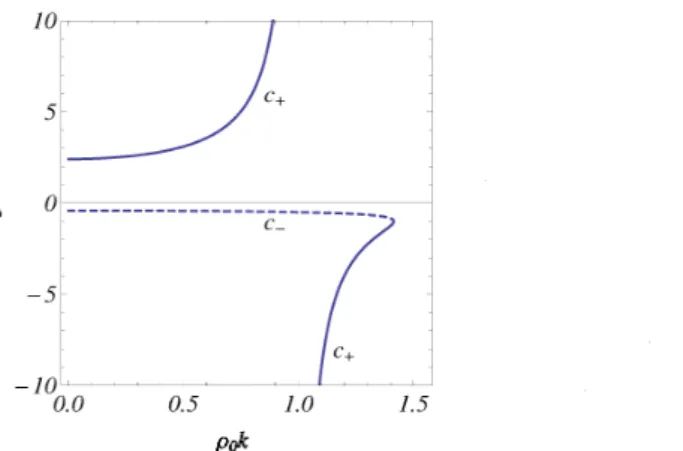
Figure
1plots
the velocities c+ \equiv c_{j}($\epsilon$_{j} = +1)
and c_{-} \equivc_{j}($\epsilon$_{j} = -1)
as afunction of$\rho$_{0}k
\equiv$\rho$_{0}k_{j}.
The
velocity
\mathrm{c}_{+} ispositive
for 0 <$\rho$_{0}k
< 1 andnegative
for 1<$\rho$_{0}k
<\sqrt{$\kappa$^{4}+p_{0}^{2}}/$\rho$_{0}
. Itexhibits thesingularity
at$\rho$_{\mathrm{O}}k=1
.Specifically,
$\rho$_{0}($\kappa$^{2}+\sqrt{$\kappa$^{4}+$\rho$_{0}^{2}}<c+<\infty, (0<$\rho$_{0}k<1) , (2.23a)
$\rho$_{0}k
Figure
1.Thevelocity c=c\pm \mathrm{o}\mathrm{f}
the solitonas afunction of$\rho$_{0}k
for$\rho$_{0}=1
and $\kappa$=1: c_{+}(solid curve),
c_{-}
(dashed curve).
On the other
hand,
thevelocity
c_{-}isacontinuousfunction of$\rho$_{0}k
and takesnegative
valuesinthe interval(2.23),
asindicatedby
theinequality
‐
\displaystyle \frac{$\rho$_{0}^{3}}{$\kappa$^{2}}<c_{-}<-$\rho$_{0}(\sqrt{$\kappa$^{4}+$\rho$_{0}^{2}}-$\kappa$^{2})
,(0<$\rho$_{0}k<\sqrt{$\kappa$^{4}+$\rho$_{0}^{2}}/ $\rho$ 0)
.(2.24)
In
particular,
c_{-} =-$\rho$_{0}^{3}/(2$\kappa$^{3})
at$\rho$_{0}k=
1. It turns outthat the soliton with thevelocity
c_{-}always
propagatestothe left whereas the soliton with the
velocity
c+propagatestotheright
and leftdepending
onthe value of
p_{0}k
.Thus,
the two‐soliton solution exhibits both theovertaking
and head‐on collisions.Using
(2.21),
theexpressions(2.19b)
become\displaystyle \mathrm{e}^{-$\phi$_{j}}=\frac{|(1-$\rho$_{0}k_{j})c_{j}-$\rho$_{0}$\kappa$^{2}|}{ $\rho$ 0\sqrt{$\kappa$^{4}+$\rho$_{0}^{2}}}=\frac{\{(1-$\rho$_{0}k_{j})c_{j}-p_{0}$\kappa$^{2}\}\mathrm{s}\mathrm{g}\mathrm{n}c_{j}}{ $\rho$ 0\sqrt{$\kappa$^{4}+$\rho$_{0}^{2}}}
,\displaystyle \mathrm{e}^{-\mathrm{i}$\psi$_{j}}=\frac{$\kappa$^{2}c_{j}+$\rho$_{0}^{3}-\mathrm{i}$\rho$_{0}^{2}k_{\mathrm{j}}c_{j}}{\sqrt{$\kappa$^{4}+$\rho$_{0}^{2}}|c_{j}|}
,(2.25)
wherethe
symbol
sgn denotes thesign
function. Inview of the relationd_{j}^{2}-d_{l}^{2}=$\rho$_{0}^{4}(-k_{\mathrm{j}}^{2}+k_{l}^{2})
whichfollows from
(2.21b)
,theexpression(2.19c)
becomes\displaystyle \mathrm{e}^{$\gamma$_{jl}}=\frac{(d_{j}-d_{l})^{2}+$\rho$_{0}^{4}(k_{j}-k_{l})^{2}}{(d_{j}-d_{l})^{2}+$\rho$_{0}^{4}(k_{j}+k_{l})^{2}}
.(2.26)
3.
Properties
of soliton solutionsIn this section,wefirst
explore
theproperties
of the one‐soliton solutionindetail and thenperform
an
asymptotic
analysis
of thegeneral
N‐soliton solution.Consequently,
the formula for thephase
shiftof each sohton will be derived. The {wo‐solitoncaseisdiscussed
shortly.
3.1. One‐soliton solution
The tau‐functions
corresponding
tothe one‐soliton solutionaregiven by
(2.17)
and(2.18)
with N=1f=1+\mathrm{e}^{ $\xi$+ $\phi$}, \tilde{f}=1+\mathrm{e}^{ $\xi$- $\phi$}
,(3.1)
with
$\xi$=k(y-c $\tau$-y_{0}) , c=c\displaystyle \pm=\frac{p_{0}^{3}}{\pm\sqrt{$\kappa$^{4}+$\rho$_{0}^{2}-$\rho$_{0}^{4}k^{2}}-$\kappa$^{2}}, (3.3a)
\displaystyle \mathrm{e}^{- $\phi$}=\frac{|(1-$\rho$_{0}^{ $\iota$}k)c-$\rho$_{0}$\kappa$^{2}|}{$\rho$_{0}\sqrt{$\kappa$^{4}+$\rho$_{0}^{2}}}, \mathrm{e}^{-\mathrm{i} $\psi$}=\frac{$\kappa$^{2}c+$\rho$_{0}^{3}-\mathrm{i}$\rho$_{0}^{2}kc}{\sqrt{$\kappa$^{4}+$\rho$_{0}^{2}}|c|}, (3.3b)
wherewehaveput
$\xi$=$\xi$_{1}, k=k_{1},
c=c_{1},$\phi$=$\phi$_{1}, $\psi$=$\psi$_{1}
andy_{0}=y_{10}forsimplicity.
The
parametric representation
of the one‐soliton solution is obtainedby introducing
(3.1)
and(3.2)
with
(3.3)
into(2.15).
Itcanbewritten inthe formu=\displaystyle \frac{kc\sinh $\phi$}{\cosh $\xi$+\cosh $\phi$}, p=$\rho$_{0}+\frac{kc\sin $\psi$}{\cosh $\xi$+\cos $\psi$}, (3.4a)
X\displaystyle \equiv x-\tilde{c}t-x_{0}=\frac{ $\xi$}{$\rho$_{0}k}+\ln\frac{1-\mathrm{t}\Re \mathrm{A}_{2}^{4}\mathrm{t}\Re \mathrm{A}_{2}^{ $\xi$}}{1+\mathrm{t}_{\partial \mathrm{J}}\mathrm{A}_{2}^{4}\mathrm{t}\Re \mathrm{A}_{2}^{ $\xi$}}, (3.4b)
with
\displaystyle \sinh $\phi$=\frac{k|c|}{\sqrt{$\kappa$^{4}+$\rho$_{0}^{2}}}
,\cosh $\phi$=\sqrt{1+\frac{k^{2}c^{2}}{$\kappa$^{4}+$\rho$_{0}^{2}}},
\displaystyle \sin $\psi$=\frac{$\rho$_{0}^{2}kc}{\sqrt{$\kappa$^{4}+$\rho$_{0}^{2}}|c|}
,\displaystyle \cos $\psi$=\frac{$\kappa$^{2}c+$\rho$_{0}^{3}}{\sqrt{$\kappa$^{4}+$\rho$_{0}^{2}}|c|}
,(3.4c)
where
\tilde{c}=c/p_{0}
is thevelocity
of the solitoninthe(x, t)
coordinatesystem,x_{0}=y_{0}/ $\kappa$
and theconstantdin
(2.15b)
has been chosen such that$\xi$=0 corresponds
toX=0. Letus nowdescribesomeimportant
propertiesof the solution.(a)
Smoothnessof
the solutionWecomputetheyderivative ofxfrom
(3.4b)
toobtainx_{y}=\displaystyle \frac{1}{$\rho$_{0}}-\frac{k\sinh $\phi$}{\cosh $\xi$+\cosh $\phi$}
.(3.5)
Since k>0 and
$\phi$>0,
x_{y}\geq x_{y}|_{ $\xi$=0}
.Using
(3.3b)
for$\phi$ gives
x_{y}|_{ $\xi$=0}=\displaystyle \frac{1}{$\rho$_{0}}(1-$\rho$_{0}k\mathrm{t}\mathrm{u}\mathrm{A}\frac{ $\phi$}{2}) =\frac{1}{|c|}(\sqrt{$\rho$_{0}^{2}+$\kappa$^{4}}-$\kappa$^{2})
.(3.6)
Thus,
ifcisfinite,
then x_{y} >0 , and themap(2.1)
becomesone‐to‐one,assuring
that the solutionissmooth and
nonsingular. Actually,
one canshow that the derivativesdu/dX
andd $\rho$/dX
arefinite forarbitrary
X\in \mathbb{R}.(b)
Amplitude‐velocity
relationThe
amplitude‐velocity
relation of the solitonis animportant characteristic of thewave. Itcanbederived
simply
from theexplicit
form of the solution. To thisend,
letA_{ $\rho$}
be theamplitude
of thewavemeasured from the constant levelp =
$\rho$_{0} and
A_{u}
be that of the fluidvelocity, namely
A_{ $\rho$}
=$\rho$(X
=0)-$\rho$_{0}, A_{u}=|u(X=0
It follows from(3.3)
and(3.4)
thatA_{ $\rho$}=(\sqrt{$\kappa$^{4}+$\rho$_{0}^{2}}|\tilde{c}|-$\kappa$^{2}\tilde{c}-$\rho$_{0}^{2})/$\rho$_{0}\rangle A_{u}=||\tilde{c}-$\kappa$^{2}|-\sqrt{$\kappa$^{4}+$\rho$_{0}^{2}}|
,(3.7)
where
\tilde{c}=c/p_{0}
. Notefrom(3.3b)
and(3.4a)
that2 1.5 1 0.5
0-10
-5 0 5 10 X 3 2 1 0-1-10 -5 0 5 10
X -10 -5 0 5 10 XFigure
2.One‐soliton solution. u: thin solidcurve, $\rho$: bold solidcurve. a:$\kappa$=1, $\rho$_{0}=1, k=0.4,
\tilde{c}=\tilde{c}+=2.81,
\mathrm{b}: $\kappa$=1,$\rho$_{0}=1, k=1.0, \tilde{c}=\tilde{\mathrm{c}}+=-1.25.
\mathrm{c}:$\kappa$=1, $\rho$_{0}=1, k=1.4,
\tilde{c}=\tilde{c}_{-}=-0.83.Invoking
theexpressionof thevelocity
cfrom(3.3a)
, we can seethatA_{ $\rho$}
>0forarbitrary
c=c\pmwhereas
u(X=0)>0
for c>0 andu(X=0)<0
for c<0. These results show that theprofile
of $\rho$isalways
ofbright
type,but that of udepends
onthepropagation
direction of the soliton.Actually,
ifcispositive
(negative),
thenuiscurvedupward
(downward).
Figure
2depicts
thetypical profile
ofuand $\rho$for theright‐going
soliton(a),
and theleft‐going
soliton(b)
and(c),
respectively.
3.2. N‐soliton solution
Here,
weinvestigate
theasymptotic
behavior of the N‐soliton solution forlarge
time. Let\tilde{c}_{n}(=
c_{n}/$\rho$_{0} (n=1,2, \ldots, N)
Ue thevelocity
of the nthe solitoninthe(x, t)
coordinatesystem,and order theminaccordance with the relation\tilde{c}_{N}<\tilde{c}_{N-1}< <\tilde{c}_{1}. We take the hmit t\rightarrow-\inftywith the
phase
variable$\xi$_{n}
of the nth solitonbeing
fixed.Then,
the otherphase
variables behave hke$\xi$_{1}, $\xi$_{2},
$\xi$_{n-1}\rightarrow+\infty
,and$\xi$_{n+1},$\xi$_{n+2},
$\xi$_{N}\rightarrow-\infty
.Performing
anasymptotic
analysis
for the tau‐functions(2.17)
and(2.18)
andsubstituting
theleading‐order approximations
for them into(2.15),
weobtain theasymptotic
form of u,$\rho$and x
u\displaystyle \sim\frac{k_{n}\mathrm{c}_{n}\sinh$\phi$_{n}}{\cosh($\xi$_{n}+$\delta$_{n}^{(-)})+\cosh$\phi$_{n}}, p\sim p_{0}+\frac{k_{n}c_{n}\mathrm{s}\dot{\mathrm{m}}$\psi$_{n}}{\cosh($\xi$_{n}+$\delta$_{n}^{(-)})+\cos$\psi$_{n}}
,(3.8)
x-\displaystyle \tilde{c}_{n}t-x_{n0}\sim\frac{$\xi$_{n}}{$\rho$_{0}k_{n}}+\ln\frac{1-\mathrm{t}\mathrm{a}\mathrm{M}_{2}^{\mathrm{g}_{n}}\tanh\frac{($\xi$_{n}+$\delta$_{n}^{\text{(-})})}{2}}{1+\mathrm{t}\mathrm{a}\mathrm{J}\mathrm{A}_{2}^{4}\underline{n}\mathrm{t}\mathrm{a}\mathrm{J}\mathrm{A}\frac{($\xi$_{n}+$\delta$_{n}^{\text{(-})})}{2}}-2\sum_{j=1}^{n-1}$\phi$_{j}
,(3.9)
where
$\delta$_{n} =\displaystyle \sum_{j=1}^{n-1}$\gamma$_{nj}=\sum_{j=1}^{n-1}\ln[\frac{(\acute{d}_{n}-d_{j})^{2}+$\rho$_{0}^{4}(k_{n}-k_{j})^{2}}{(d_{n}-d_{j})^{2}+$\rho$_{0}^{4}(k_{n}+k_{j})^{2}}]
.(3.10)
+\infty.
Applying
the similaranalysis yields
theasymptotic
formscorresponding
to(3.8)
and(3.9)
u\displaystyle \sim\frac{k_{n}c_{n}\sinh$\phi$_{n}}{\cosh($\xi$_{n}+$\delta$_{n}^{(+)})+\cosh$\phi$_{n}}, $\rho$\sim$\rho$_{0}+\frac{k_{n}c_{n}\sin$\psi$_{n}}{\cosh($\xi$_{n}+$\delta$_{n}^{(+)})+\cos$\psi$_{n}}
,(3.11)
x-\displaystyle \tilde{c}_{ $\eta$}t-x_{n0}\sim\frac{$\xi$_{n}}{$\rho$_{0}k_{n}}+\ln\frac{1-\tanh_{2}^{$\mu$_{n}}\tanh\frac{($\xi$_{n}+$\delta$_{n}^{\text{(}+)})}{2}}{1+\mathrm{t}\mathrm{m}\mathrm{h}_{2}^{\mathrm{A}}n-\mathrm{t}\Re \mathrm{A}\frac{($\xi$_{n}+$\delta$_{n}^{(+)})}{2}}-2\sum_{j=1}^{n-1}$\phi$_{\hat{J}\rangle}
(3.12)
where
$\delta$_{n}^{(+)}=\displaystyle \sum_{j=n+1}^{N}$\gamma$_{nj}=\sum_{j=n+1}^{N}\ln[\frac{(d_{n}-d_{j})^{2}+$\rho$_{0}^{4}(k_{n}-k_{j})^{2}}{(d_{n}-d_{j})^{2}+$\rho$_{0}^{4}(k_{n}+k_{\mathrm{j}})^{2}}]
.(3.13)
These results show that as t \rightarrow \pm\infty, the N‐soliton solution is a
superposition
of Nindependent
solitons each of which has the form
given
by
(3.4).
Theneteffect of the collision of solitonsappearsas aphase
shift. Toseethis,
letx_{nc}Ue thecenterposition
of the nth soliton. It then follows from(3.9)
and(3.12)
that thetrajectory
ofx_{nc}isgiven by
x_{n\mathrm{c}}\displaystyle \sim\tilde{\mathrm{c}}_{n}t-\frac{$\delta$_{n}^{(-)}}{$\rho$_{0}k_{n}}-2\sum_{j=1}^{n-1}$\phi$_{j},
(t\rightarrow-\infty)
,x_{n\mathrm{c}}\displaystyle \sim\tilde{c}_{n}t-\frac{$\delta$_{n}^{\mathrm{t}+)}}{$\rho$_{0}k_{n}}-2\sum_{j=n+1}^{N}$\phi$_{j},
(t\rightarrow+\infty)
.(3.14)
We define the
phase
shift of the nth soliton whichpropagatestotheright by
$\Delta$_{n}^{R}=x_{n\mathrm{c}}(t\rightarrow+\infty)-x_{nc}(t\rightarrow
-\infty)
, and thatpropagatestothe leftby
$\Delta$_{n}^{L} =x_{nc}(t\rightarrow -\infty)-x_{nc}(t\rightarrow+\infty)
.Using
(2.19b)
,(3.10),
(3.13)
and(3.14),
wefind that$\Delta$_{n}^{R}=\displaystyle \frac{1}{$\rho$_{0}k_{n}} [\sum_{j=1}^{n-1}\ln[\frac{(d_{n}-d_{j}\rangle^{2}+p_{0}^{4}(k_{n}-k_{j})^{2}}{(d_{n}-d_{j})^{2}+$\rho$_{0}^{4}(k_{n}+k_{j})^{2}}] -\sum_{j=n+1}^{N}\ln[\frac{(d_{n}-d_{j})^{2}+$\rho$_{0}^{4}(k_{n}-k_{j})^{2}}{(d_{n}-d_{j})^{2}+$\rho$_{0}^{4}(k_{n}+k_{j})^{2}}]]
+\displaystyle \sum_{j=n+1}^{N}
\mathrm{I}\mathrm{n}[\displaystyle \frac{(1-$\rho$_{0}k_{j})\tilde{c}_{j}-$\kappa$^{2}}{(1+$\rho$_{0}k_{j})\tilde{c}_{j}-$\kappa$^{2}}]
-\displaystyle \sum_{j=1}^{n-1}]_{\mathrm{J}\mathrm{J}}[\frac{(1-$\rho$_{0}k_{j})\tilde{c}_{j}-\dot{ $\kappa$}^{2}}{(1+$\rho$_{0}k_{j})\tilde{c}_{j}-$\kappa$^{2}}]
.(3.15)
Theexpressionof
$\Delta$_{n}^{L}
isequal
to-$\Delta$_{n}^{R}.
3.3. Two‐soliton solution
The twesoliton solutionisthemostfundamental elementin
understanding
thedynamics
of solitonssince each soliton exhibits pair‐wise interactions with every other soliton. There exist two types of
interactionsfor the CH2
equation,
i.e.,theovertaking
and head‐on collisions.The tau‐functions for the two‐soliton solutionare
given by
(2.17), (2.18)
and(2.19)
with N=2.They
read
f=1+\mathrm{e}^{$\xi$_{1}+$\phi$_{1}}+\mathrm{e}^{$\xi$_{2}+$\phi$_{2}}+ $\delta$ \mathrm{e}^{$\xi$_{1}+$\xi$_{2}+$\phi$_{1}+$\phi$_{2}}, \tilde{f}=1+\mathrm{e}^{$\xi$_{1}-$\phi$_{1}}+\mathrm{e}^{$\xi$_{2}-$\phi$_{2}}+ $\delta$ \mathrm{e}^{$\xi$_{1}+$\xi$_{2}-$\phi$_{1}-$\phi$_{2}}
,(3.16)
g=1+\mathrm{e}^{$\xi$_{1}+\mathrm{i}$\psi$_{1}}+\mathrm{e}^{$\xi$_{2}+\mathrm{i}$\psi$_{2}}+ $\delta$ \mathrm{e}^{$\xi$_{1}+$\xi$_{2}+\mathrm{i}$\psi$_{1}+\mathrm{i}$\psi$_{2}}, \tilde{g}=1+\mathrm{e}^{$\xi$_{1}-\mathrm{i}$\psi$_{1}}+\mathrm{e}^{$\xi$_{2}-\mathrm{i}$\psi$_{2}}+ $\delta$ \mathrm{e}^{$\xi$_{1}+$\xi$_{2}-\mathrm{i}$\psi$_{1}-\mathrm{i}$\psi$_{2}}
,(3.17)
where
$\xi$_{j}=k_{j}(y-c_{j} $\tau$-y_{j0}) , (j=1,2) , (3.18a)
$\delta$=\displaystyle \mathrm{e}^{$\gamma$_{12}}=\frac{(d_{1}-d_{2})^{2}+$\rho$_{0}^{4}(k_{1}-k_{2})^{2}}{(d_{1}-d_{2})^{2}+$\rho$_{0}^{4}(k_{1}+k_{2})^{2}}, (3.18b)
4 3 2 1
0‐{
4 3 2 \uparrow\underline{0}.
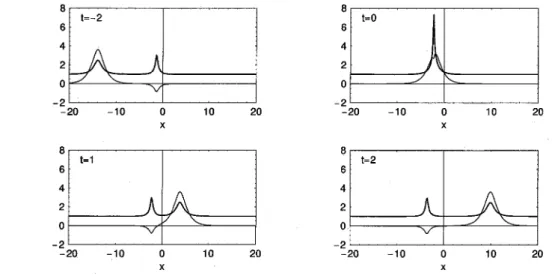
Figure
3. Theovertaking
collision oftwosolitons. u: thin solidcurve, $\rho$: bold solidcurve.$\kappa$=1,
$\rho$_{0}=1,
k_{1}=0.8, k_{2}=0.7, \tilde{c}_{1+}=6.02, \tilde{\mathrm{c}}_{2+}=4.37.
\mathrm{e}^{-$\phi$_{j}}=\sqrt{\frac{(1-$\rho$_{0}k_{j})c_{j}-$\rho$_{0}$\kappa$^{2}}{(1+$\rho$_{0}k_{j})c_{j}-$\rho$_{0}$\kappa$^{2}}},
\mathrm{e}^{-\mathrm{i}$\psi$_{j}}=\sqrt{\frac{(\frac{$\kappa$^{2}}{ $\rho$ 0}-\mathrm{i}$\rho$_{0}k_{j})c_{j}+$\rho$_{0}^{2}}{(\frac{$\kappa$^{2}}{ $\rho$ 0}+\mathrm{i}$\rho$_{0}k_{j})c_{j}+$\rho$_{0}^{2}}},
(j=1,2)
.(3.18c)
Recall from
(2.21)
that thevelocity
ofjth
sohtonin(x_{\rangle}t)
coodinatesystemisgiven
by
\displaystyle \tilde{c}_{j}=c_{j}/$\rho$_{0}=\frac{p_{0}^{2}}{d_{j}-$\kappa$^{2}}, d_{j}=$\epsilon$_{j}\sqrt{$\kappa$^{4}+$\rho$_{0}^{2}-$\rho$_{0}^{4}k_{j}^{2}}, (j=1,2)
.(3.19)
Substituting
(3.16)
and(3.17)
into(2.15),
we obtain the parametric representationof the twQsolitonsolution. Asseenfrom
Figure 1,
this solution describes both theovertaking
and headoncollisions,
whicharetreated
separately.
(a)
Overtaking
collisionWe consider thecasec_{j}=c_{j+},
0<$\rho$_{0}k_{j}<1
sothat0<\tilde{c}_{2+}<\tilde{c}_{1+}
.Figure
3illustrates theovertaking
collision oftwosolution for four distinct values oft. The solitonic feature of the solutionisobvious from
the
figure
which confirmsanasymptotic
analysis presented
in§3.1.
Thephase
shift of each solitonisgiven
by
(3.15).
Explicitly,
$\Delta$_{1}^{R}=-\displaystyle \frac{1}{$\rho$_{0}k_{1}}\ln [\frac{(d_{1}-d_{2})^{2}+$\rho$_{0}^{4}(k_{1}-k_{2})^{2}}{(d_{1}-d_{2})^{2}+$\rho$_{0}^{4}(k_{1}+k_{2})^{2}}] +\ln [\frac{(1-$\rho$_{0}k_{2})\tilde{c}_{2}-$\kappa$^{2}}{(1+$\rho$_{0}k_{2})\tilde{\mathrm{c}}_{2}-$\kappa$^{2}}] (3.20a)
$\Delta$_{2}^{R}=\displaystyle \frac{1}{$\rho$_{0}k_{2}}\ln [\frac{(d_{1}-d_{2})^{2}+$\rho$_{0}^{4}(k_{1}-k_{2})^{2}}{(d_{1}-d_{2})^{2}+$\rho$_{0}^{4}(k_{1}+k_{2})^{2}}] -\ln [\frac{(1-$\rho$_{0}k_{1})\tilde{c}_{1}-$\kappa$^{2}}{(1+p_{0}k_{1})\tilde{c}_{1}-$\kappa$^{2}}] , (3.20b)
with
8 6 4 2 0
-\underline{2}_{\mathrm{J}, $\iota$}
X 8 6 4 2 0 -2 X X XFigure
4. The head‐on collision oftwosolitons. u: thin solidcurve, $\rho$: bold solidcurve. $\kappa$= 1,p_{0}=1,
k_{1}=0.8, k_{2}=0.7, \tilde{c}_{1+}=6.02, \tilde{c}_{2+}=-1.25
(b)
Head‐on collisionAn
example
of the head‐on colhsionisshowninFigure
4,
where thevelocity
of each soliton is chosenasc_{2+} < 0 < c_{1+}. The formula of the
phase
shift for theright‐running
soliton is the same as(3.20a)
whereas that of the
left‐running
solitonisgiven
by
$\Delta$_{2}^{L}=-$\Delta$_{2}^{R}.
4. Reductionstothe Camassa‐Holm and
two‐component
Hunter‐Saxtonequations
Inthissection,wefirst show that the CH2
equation
anditsN‐soliton solution reducetothose of the CHequationby
meansofanappropriate
limiting procedure. Then,
wedemonstrate that the short‐wavelimit of the CH2equation
yields
thetwo‐componentHunter‐Saxtonequation.
4.1.
Reductiontothe Camassa‐Holmequation
The CH
equation
(1.3)
isderivedsimply
from the CH2equation
by putting $\rho$=0
. In thissetting,
onemust
impose
theboundary
condition$\rho$_{0}=0
. TheN‐sohton solution of the CHequation
isreduced fromthat of the CH2equation
by taking
the limit$\rho$_{0}\rightarrow 0
. Toshowthis,
weintroduce thafollowing scaling
variables
u=\displaystyle \overline{u}, $\rho$= $\rho$ 0\overline{ $\rho$}, m=\overline{m}, x=\overline{x}, y=\frac{p_{0}}{ $\kappa$}\overline{y}, t=\overline{t}, $\tau$=\overline{ $\tau$}, d=\overline{d},
k_{j}=\displaystyle \frac{ $\kappa$}{$\rho$_{0}}\overline{k}_{j}, \mathrm{c}_{j}=\frac{$\rho$_{0}}{ $\kappa$}\overline{c}_{j}, y_{j0}=\frac{$\rho$_{0}}{ $\kappa$}\overline{y}_{j0}, (j=1,2, \ldots, N)
.(4.1)
Then,
theleading‐order asymptotics
of c_{j} from(2.21)
and$\phi$_{\mathrm{j}}, $\psi$_{j}
and $\gamma$_{\mathrm{j}l} from(2.19b, c)
arefoundtobec_{j}\displaystyle \sim\frac{2$\rho$_{0}$\kappa$^{2}}{1-( $\kappa$\overline{k}_{j})^{2}}, (j=1,2, \ldots, N) , (4.2a)
\displaystyle \mathrm{e}^{-$\phi$_{j}}\sim\frac{1- $\kappa$\overline{k}_{j}}{1+ $\kappa$\overline{k}_{\mathrm{j}}}\equiv \mathrm{e}^{-\overline{ $\phi$}_{j}}, \mathrm{e}^{-\mathrm{i}$\psi$_{j}}\sim 1-\frac{$\rho$_{0}}{ $\kappa$}\overline{k}_{j}, (j=1,2, \ldots,N) , (4.2b)
\mathrm{e}^{$\gamma$_{j1}}=
(\displaystyle \frac{\overline{k}_{j}-\overline{k}_{l}}{\overline{k}_{\hat{J}}+\overline{k}_{l}})^{2}\equiv \mathrm{e}^{\overline{ $\gamma$}_{j1}}, (j, l=1,2, \ldots, N;j\neq l)
.(4.2c)
We notethat a
limiting
form\overline{\mathrm{c}}_{j}
\sim-$\rho$_{0}^{2}/(2 $\kappa$)
whicharises from(2.21)
with $\epsilon$_{\mathrm{j}} =-1(j = 1,2)
isnotrelevantsincethisexpression
degenerates
tozero asp_{0}\rightarrow 0.
The
asymptotics
of the tau‐functionsf
and\tilde{f}
from(2.17)
andgand\tilde{g}
from(2.18)
becomef\displaystyle \sim\sum_{ $\mu$=0,1}\exp [\sum_{j=1}^{N}$\mu$_{j}(\overline{ $\xi$}_{j}+\overline{ $\phi$}_{j})+\sum_{1\leq j<l\leq N}$\mu$_{j}$\mu$_{l}\overline{ $\gamma$}_{j} $\iota$] \equiv\overline{f}, (4.3a)
\displaystyle \tilde{f}\sim\sum_{ $\mu$=0,1}\exp [\sum_{j=1}^{N}$\mu$_{\mathrm{j}}(\overline{ $\xi$}_{j}-\overline{ $\phi$}_{j})+\sum_{1\leq j<l\leq N}$\mu$_{j}$\mu$_{l}\overline{ $\gamma$}_{j}i] \equiv f (4.3b)
g=\displaystyle \overline{f}_{0}+\mathrm{i}\frac{$\rho$_{0}}{ $\kappa$}\overline{f}_{0,\overline{y}}+O($\rho$_{0}^{2}) , \tilde{g}=\overline{f}_{0}-\mathrm{i}\frac{$\rho$_{0}}{ $\kappa$}\overline{f}_{0,\overline{y}}+O($\rho$_{0}^{2})
,(4.4)
where
\displaystyle \overline{f}_{0}=\sum_{ $\mu$=0,1}\exp [\sum_{j=1}^{N}$\mu$_{j}\overline{ $\xi$}_{j}+\sum_{1\leq j< $\iota$\leq N}$\mu$_{j}$\mu$_{l}\overline{ $\gamma$}_{jt}] , (4.5a)
\overline{ $\xi$}_{j}=\overline{k}_{\mathrm{j}}(\overline{y}-\overline{c}_{j}\overline{ $\tau$}-\overline{y}_{j0})
,\displaystyle \overline{c}_{j}=\frac{2$\kappa$^{3}}{1-( $\kappa$\overline{k}_{j})^{2}}, (j=1,2, \ldots, N)
.(4.5b)
Introducing
(4.3)
and(4.4)
into(2.15),
weobtain thelimiting
forms ofu, $\rho$and x\displaystyle \overline{u}= (\ln\frac{\overline{\tilde{f}}}{\overline{f}})_{\overline{ $\tau$}} $\rho$\sim$\rho$_{0}(1-\frac{2}{ $\kappa$}(\ln\overline{f}_{0})_{\overline{y} $\tau$}) \equiv p_{0}\overline{ $\rho$}, (4.6a)
あ
=\displaystyle \frac{\overline{y}}{ $\kappa$}+1_{\mathrm{J}\mathrm{J}}\frac{\sim_{f}^{\sim}}{\overline{f}}+\overline{d}.
(4.6b)
Theparametric representationof the N‐sohton solutiongiven
by
(4.6)
with the tau‐functions(4.3)
coincides
perfectly
with that of the CHequationpresentedin[6].
Inparticular,
the one‐soliton solution(3.4)
reducesto\displaystyle \overline{u}=\frac{2 $\kappa$\overline{c}\overline{k}^{2}}{1+$\kappa$^{2}\overline{k}^{2}+(1-$\kappa$^{2}\overline{k}^{2})\cosh\overline{ $\xi$}}, (4.7a)
\displaystyle \overline{X}=\overline{x}-c \overline{x}_{0}= \frac{\overline{ $\xi$}}{ $\kappa$\overline{k}}+\mathfrak{l}\mathrm{n}\frac{(1- $\kappa$\overline{k})\mathrm{e}^{\overline{ $\xi$}}+1+ $\kappa$\overline{k}}{(1+ $\kappa$\overline{k})\mathrm{e}^{\overline{ $\xi$}}+1- $\kappa$\overline{k}}, (4.7b)
with
\overline{ $\xi$}=\overline{k}
(
\overline{y}-③テー90)
\displaystyle \overline{c}=\frac{2$\kappa$^{3}}{1-( $\kappa$\overline{k})^{2}},
\overline{\tilde{c}}=\overline{c}/ $\kappa$,
(4.7c)
reproducing
the one‐sohton solution of the CHequation.Thelimitingform of thephaseshift which is denoted
by
\overline{ $\Delta$}_{n}^{R}
canbe obtainedbyapplying
thescalings
(4.1)
to(3.15)
andusing(4.1)
and(4.2a),
resultingin+\displaystyle \sum_{j=n+1}^{N}\ln(\frac{1- $\kappa$ k_{\mathrm{j}}}{1+ $\kappa$ k_{j}})^{2}-\sum_{j=1}^{n-1}\mathrm{I}_{\mathrm{J}1}(\frac{1- $\kappa$ k_{j}}{1+ $\kappa$ k_{j}})^{2} (n=1,2, \ldots,N)
.(4.8)
This coincides with the formula for the
phase
shift of the nth soliton which has been derive for theN‐soliton solution of the CH
equation
[6].
Remark 4.1.
Ifweput
\overline{r}=\mathrm{K}-2(\ln\overline{f}_{0})_{\overline{y} $\tau$}
,then\overline{m}=\overline{r}^{2}, \overline{ $\rho$}=\overline{r}/ $\kappa$
.(4.9)
The
reciprocal
transformation(2.1a)
reproduces
thecorresponding
onefor the CHequationd\overline{y}=\overline{r}d\overline{x}-\overline{r}\overline{u}d\overline{t}
, dテ=d\overline{t}.(4.10)
The bilinear
equations
(2.10)‐(2.12)
reduce,
inthescaling limit,
tothe bilinearequations
$\kappa$ D_{\overline{y}}\overline{\tilde{f}}\cdot\overline{f}+\overline{\tilde{f}}\overline{f}-f_{0}^{2}=0
,(4.11)
Dテ
D_{\overline{y}}\overline{f}_{0}\cdot\overline{f}_{0}+ $\kappa$(\overline{\tilde{f}}\overline{f}-\overline{f}_{0}^{2})=0
,(4.12)
$\kappa$ D_{\overline{ $\tau$}}Dす
\overline{\tilde{f}}\cdot\overline{f}+D_{\overline{ $\tau$}}\overline{\tilde{f}}\cdot\overline{f}+$\kappa$^{3}D_{\overline{y}}\sim_{f}^{\sim}\cdot\overline{f}=0
,(4.13)
whereas the
scaling
limit of(2.13)
isshowntocoincide with(4.11).
Onecanshow that the tau‐functions\overline{f}
and\overline{\tilde{f}}
from(4.3)
and\overline{f}_{0}
from(4.5)
solve the above bilinearequations.
4.2.
Reductiontothetwo‐componentHunter‐Scwtonequation
Thetwo‐componentHunter‐Saxton
(HS2)
equationstemsfrom the short‐wave limit of the CH2equa‐tion. To show
this,
weintroduce thescaling
variablesu=$\epsilon$^{2}\displaystyle \hat{u}, $\rho$= $\epsilon$\hat{p}, m=\hat{m}, x= $\epsilon$\hat{x}, y=$\epsilon$^{2}\hat{y}, t=\frac{\hat{t}}{ $\epsilon$}, $\tau$=\frac{\hat{ $\tau$}}{ $\epsilon$}
.(4.14)
Rescaling
the CH2equation(1.1)
by
(4.14)
andtaking
the limit $\epsilon$\rightarrow 0,weobtain the HS2equation
\hat{m}t+ûm免\hat{x}+2\hat{m}û£十
\hat{ $\rho$}\hat{p}_{\hat{x}}=0,
\hat{ $\rho$}_{\hat{t}}+(\hat{p}\hat{u})
¢ =0,(4.15)
where \hat{m}=
−ûx
\hat{}x\hat{}+ $\kappa$2. The N‐sohton solution of the HS2equationcanbe reduced from that of the CH2
equation
by
meansofalimiting procedure.
Thappropriatescaling
variablearefoundtobek_{j}=\displaystyle \frac{\hat{k}_{j}}{$\epsilon$^{2}} , c_{j}=$\epsilon$^{3}\hat{c}_{j}, y_{j0}=$\epsilon$^{2}\overline{y}_{j0}, (j=1,2, \ldots, N) , $\rho$_{0}= $\epsilon$\hat{ $\rho$}_{0}, d= $\epsilon$\hat{d}
.(4.16)
Inthe limit $\epsilon$\rightarrow 0, the solitonparameters
corresponding
tothosegiven by
(4.2)
have theleading‐order
asymptotics
c_{j}\displaystyle \sim-\frac{$\epsilon$^{3}}{\hat{ $\rho$}_{0}\hat{k}_{j}^{2}}($\kappa$^{2}+\hat{d}_{j}) , \hat{d}_{j}= $\epsilon$ j\sqrt{$\kappa$^{4}-\hat{ $\rho$}_{0}^{4}\hat{k}_{j}^{2}}, (j=1,2, \ldots, N) , (4.17a)
\displaystyle \mathrm{e}^{-$\phi$_{j}} \sim 1+ $\epsilon$\frac{\hat{k}_{j}\hat{c}_{j}}{$\kappa$^{2}}, \mathrm{e}^{-\mathrm{i}$\psi$_{j}}\sim\sqrt{\frac{(\frac{$\kappa$^{2}}{\hat{ $\rho$}0}-\mathrm{i}\hat{ $\rho$}_{0}\hat{k}_{j})\hat{c}_{j}+\hat{p}_{0}^{2}}{(\frac{$\kappa$^{2}}{\hat{ $\rho$}0}+\mathrm{i}\hat{ $\rho$}_{0}\hat{k}_{j})\hat{c}_{j}+\hat{ $\rho$}_{0}^{2}}}\equiv \mathrm{e}^{-\mathrm{i}\hat{ $\psi$}_{j}}, (j=1,2, \ldots, N) , (4.17b)
The tau‐functions
(2.17)
and(2.18)
have theleading‐order asymptotics
f\displaystyle \sim\hat{f}+\frac{ $\epsilon$}{$\kappa$^{2}}\hat{f}_{\hat{ $\tau$}}, \tilde{f}\sim\hat{f}-\frac{ $\epsilon$}{$\kappa$^{2}}\hat{f}_{\hat{ $\tau$}}
,(4.18)
g\displaystyle \sim\sum_{ $\mu$=0,1}\exp[\sum_{j=1}^{N}$\mu$_{j}(\hat{ $\xi$}_{\mathrm{j}}+\mathrm{i}\hat{ $\psi$}_{j})+\sum_{1\leq j<l\leq N}$\mu$_{\mathrm{j}}$\mu$_{l}\hat{ $\gamma$}_{ji}] \equiv\hat{g}, (4.19a)
\displaystyle \tilde{g}\sim\sum_{ $\mu$=0,1}\exp[
\equiv g
(4.19b)
where
\displaystyle \hat{f}=\sum_{ $\mu$=0,1}\exp [\sum_{j=1}^{N}$\mu$_{j}\hat{ $\xi$}_{j}+\sum_{1\leq j<l\leq N}$\mu$_{j}$\mu$_{l}\hat{ $\gamma$}_{jl}] , (4.20a)
\displaystyle \hat{ $\xi$}_{j}=\hat{k}_{j}(\hat{y}-\hat{c}_{j}\hat{ $\tau$}-\hat{y}_{j0}) , \hat{c}_{j}=-\frac{1}{\hat{ $\rho$}_{0}\hat{k}_{j}^{2}}($\kappa$^{2}+$\epsilon$_{j}\sqrt{$\kappa$^{4}-\hat{ $\rho$}_{0}^{4}\hat{k}_{j}^{2}}) , (j=1,2, \ldots,N) , (4.20b)
The
parametric representation
for the N‐soliton solution of the HS2equationfollowsby introducing
(4.18)
and(4.19)
into(2.15)
andtaking
the limit $\epsilon$\rightarrow 0.Explicitly,
it isgiven
by
\displaystyle \hat{u}=-\frac{2}{$\kappa$^{2}}(\ln\hat{f})_{\hat{ $\tau$}\hat{ $\tau$}}, \hat{ $\rho$}=\hat{ $\rho$}_{0}-\frac{2}{$\kappa$^{2}}\mathrm{i}(\frac{\hat{\tilde{g}}}{\hat{g}})_{\hat{ $\tau$}} (4.21a)
\displaystyle \hat{x}=\frac{\hat{y}}{\hat{ $\rho$}0}-\frac{2}{$\kappa$^{2}}
(
In\hat{f})_{\hat{ $\tau$}}+\hat{d}.
(4.21b)
The
hmiting
forms of1/ $\rho$
andm/$\rho$^{2}
from(2.16)
read\displaystyle \frac{1}{\hat{ $\rho$}}=\frac{1}{\hat{ $\rho$}_{0}}-\frac{2}{$\kappa$^{2}}(\ln\hat{f})_{\hat{ $\tau$}\hat{y}},
We write theone‐soliton solution for reference:
\displaystyle \frac{\hat{m}}{\hat{ $\rho$}^{2}}=\frac{$\kappa$^{2}}{\hat{ $\rho$}_{\mathrm{O}}^{2}}+\mathrm{i}(\frac{\hat{\tilde{g}}}{\hat{g}}\mathrm{I}_{\hat{y}}
(4.22)
\displaystyle \^{u}=-\frac{1}{2$\kappa$^{2}}\frac{(\hat{k}\hat{c})^{2}}{\cosh_{2}^{2\hat{ $\xi$}}}, \hat{ $\rho$}=\frac{1}{\frac{1}{\hat{ $\rho$}0}+_{2}\hat{k}_{ $\kappa$}^{2}=\hat{c}\frac{1}{\cosh_{2}^{2 $\xi$}}}, (4.23a)
\displaystyle \hat{X}=\hat{x}-\hat{\tilde{c}}\hat{t}-\hat{x}_{0}=\frac{\hat{ $\xi$}}{\hat{ $\rho$}_{0}}+\frac{\hat{k}\hat{\mathrm{c}}}{$\kappa$^{2}}\tanh\frac{\hat{ $\xi$}}{2}, (4.23b)
with
\hat{ $\xi$}=\hat{k}
(
\hat{y}-\hat{c}
テー\hat{y}0
),
\displaystyle \hat{\mathrm{c}}=-\frac{1}{\hat{ $\rho$}_{0}\hat{k}^{2}}($\kappa$^{2}\pm\sqrt{$\kappa$^{4}-\hat{ $\rho$}_{0}^{4}\hat{k}^{2}})
,\tilde{c}\wedge=\hat{c}/\hat{ $\rho$}0.
(4.23c)
Note that the
velovity
\hat{\tilde{c}}
from(4.23c)
isalways negative
sothat the sohton propagatesto the left asRemark 4.2.
Under the
scaling
(4.14),
thereciprocal
transformation(2.1)
and equations(2.2)-(2.5)
remainthesameform. The bilinear
equations
(2.10), (2.11)
and(2.13)
reducerespectively
toD_{\hat{ $\tau$}}D_{\hat{y}}\displaystyle \hat{f}\cdot f \frac{$\kappa$^{2}}{\hat{ $\rho$}_{0}^{2}}(\hat{f}^{2}-\hat{\tilde{g}}\hat{9})=0
,(4.24)
\mathrm{i}D_{\hat{ $\tau$}}\hat{\tilde{g}}\cdot\hat{g}+\hat{ $\rho$}_{0}(\hat{f}^{2}-\hat{\tilde{g}}\hat{g})=0
,(4.25)
D_{\hat{ $\tau$}}D_{\hat{y}}\displaystyle \hat{\tilde{g}}\cdot\hat{g}-\mathrm{i}\frac{$\kappa$^{2}}{\hat{ $\rho$}_{0}^{2}}D_{\overline{ $\tau$}}\hat{\tilde{g}}\cdot\hat{g}+\mathrm{i}\hat{ $\rho$}_{0}D_{\hat{y}\tilde{9^{\wedge}}}\cdot\hat{g}=0
,(4.26)
whereas the bihnear
equation
(2.12)
rducesto(4.24)
whencoupled
with(2.10).
5. Discussion
We have constructed the multisoliton solutions of the CH2 equation
by
adirect method combinedwith the
reciprocal
transformation.Subsequently,
wehave shown that the mulitisoliton solutions of theCH and HS2
equations
are reduced from those of the CH2equation
by
means ofappropriatescaling
limits. Wenote thatthe CH2
equation
doesnotexhibitpeakons
asopposed
tothe CHequation.
Thisfactcanbe confirmed
by taking
the zerodispersion
limit $\kappa$\rightarrow 0for the one‐soliton solution(3.4).
Onthe
other‐hand,
the one‐soliton solution(4.7)
of the CHequation yields
thepeakon
solutioninthe hmit$\kappa$\rightarrow 0
[9
,10]
. It has also beenpointed
outthat the HS2equation
(4.15)
doesnotsupportpeakons
when$\kappa$=0and
$\rho$_{0}\neq 0
.Nevertheless,
ifoneimposes
theboundary
condition$\rho$\rightarrow 0
as|x|\rightarrow\infty
,then the HS2
eqaution
hasmultipeakon
solutions[1].
It isaninteresting
problem
for the HS2equation
torecoverthepeakon
solutions from the smooth soliton solutions.Acknowledgement
This researchwas
partially supported by
Yamaguchi
University
Foundation.References
[1]
A. Constantin and R. I.Ivanov,
Onanintegrable
two‐component
Camassa‐Holm shallowwatersystem,
Phys.
Lewtt. A 372(2009)
7129‐7132.[2]
R.I.Ivanov, Two‐component
integrable
systemsmodelling
shallowwaterwaves: Theconstantvorticity
case,Wave Motion46
(2009)
389−396[3]
R. Camassa and D.D.Holm,
Anintegrable
shallow waterequatĩonwithpeaked solitons, Phys.
Rev.Lett. 71
(1993)
1661‐1664.[4]
Y.Matsuno,
Bihnear TransformationMetbod, 1884,
AcademicPress,
New York.[5]
R.Hirota,
The Direct Method in SolitonTheory, Cambridge University Press, Cambridge,
2004.[6]
Y.Matsuno,
Parametricrepresentation
for
the multisoliton solutionof
the Camassa‐Holmequation,
J.
Phys.
Soc.Jpn.
74(2005)
1983‐1987.[7]
Y.Matsuno,
Bäcklundtransformation
and smooth multisoliton solutionsfor
amodified
Camassa‐Holmequation
with cubicnonlinearity,
J. Math.Phys.
54(2013)
051504.[8]
Y.Matsuno,
Smooth andsingular
multisoliton solutionsof
amodified
Camassa‐Holmequation
withcubic