最大値過程について
九州大学大学院経済学研究院 岩本 誠一
九州大学大学院経済学研究科 津留崎 和義
Graduate School ofEconomics,
Kyushu Univ.
1
Introduction
In this paper we
are
concerned with amaximum process generated through independentand identically distributed random variables via its summation process. Both the i.i.d.
process and the summation process
are
Markov chains. Theprobabilisticbehavior of bothis well known [12]. However, the maximum process is not Markov. We
are
interestedin how to make it Markov on suitable state spaces. Further we focus our attention on
arecursive computation ofexpected value, variance and probability distribution of the
maximum random variable.
We present anewmethod “Markovization”, which is astochastic realization of
invari-ant imbedding approach $[2-7, 9, 11]-” \mathrm{d}\mathrm{y}\mathrm{n}\mathrm{a}\mathrm{m}\mathrm{i}\mathrm{c}$ programming without optimization” [1,
p. 115], [2, p.72], [4, p.203], [8, p.23], $[9, 10]$, [13, Chap.14]. We show that the computation
is based upon the Markovization.
2
Profit Process
2.1
Random Walk
Let $X_{1}$, $X_{2}$,
$\ldots$ , $X_{i}$,$\ldots$ be independent and identicallydistributed with $P(X_{i}=1)=p$, $P(X_{i}=-1)=q$ $(0\leq p\leq 1, p+q=1)$.
In agame of flippingacoin–probability of head is$p$ –infinitely, $X_{i}=1(-1)$ denotes
awin (loss) at $i$-th flipping. When aplayer wins (loses), he get (loses) one-unit.
Then we define the sum-tO-date as follows :
$\mathrm{Y}_{0}=0$, $\mathrm{Y}_{i}=\sum_{j=1}^{i}X_{j}$. (1)
The additive process $\{\mathrm{Y}_{i}, i\geq 0\}$ is arandom walk [12, p.143]. It is also called aprofit
process. In the game of coin flipping, $\mathrm{Y}_{i}$ denotes anet profit, which is equal to “the
number
of
wins –the numberof
losses” up to$i$ flippings. It is adifference between winsand losses.
Further we define the maximum-tO-date :
$Z_{i}= \max_{1\leq j\leq i}\mathrm{Y}_{j}$.
数理解析研究所講究録 1207 巻 2001 年 101-113
The maximum process $\{Z_{i}, i\geq 1\}$ is called amaximum profit process. In the game, $Z_{i}$
denotes the maximum value of differences between wins and losses up to $i$ flippings.
Let $N$ be any positive integer. We
are
concerned with the maximum profit randomvariable
over
the $N$-stage $Z_{N}$. Our problem is to find its expected value, variance andprobability distribution :
$E[Z_{N}]$, $V[Z_{N}]$, $P(Z_{N}=k)$.
2.2
Profit Process
Let
us
takean
integer $n(\geq 2)$.
We consider arandom variable $U$, which follows theBinomial distribution $Bi(n;p)$ :
$P(U=k)$ $={}_{n}C_{k}p^{k}q^{n-k}$ $k=0,1$,
$\ldots$ ,$n$.
It is easily shown that
$E[U]=np$, $V[U]=npq$.
We return to the random variable $\mathrm{Y}_{n}$ defined in (1). Let
us
consider the events$\mathrm{Y}_{n}=1\cdot$ $k$$+(-1)\cdot$ $(n-k)$, $k$ $=0,1$,
$\ldots$ ,$n$
.
Thenwe
have$P(\mathrm{Y}_{n}=2k-n)={}_{n}C_{k}p^{k}q^{n-k}$.
Thus
we see
that $\mathrm{Y}_{n}=2U-n$holds almost surely.As asummary
we
obtainLemma 2.1.
(i) $\mathrm{Y}_{n}=2U-na.s$
.
(ii) $P(\mathrm{Y}_{n}=2k-n)={}_{n}C_{k}p^{k}q^{n-k}$ $k=0,1$,
$\ldots$ ,$n$ (iii) $E[\mathrm{Y}_{n}]=n(p-q)$, $V[\mathrm{Y}_{n}]=4npq$.
Thus $\mathrm{Y}_{n}$ takes $\mathrm{v}\mathrm{a}\mathrm{l}\mathrm{u}\mathrm{e}\mathrm{s}-n$, $-n+2$,
$-n+4$, $\ldots$ , $n-2$, $n$
.
Letus
define state spaces$\{S_{n}\}$
as
follows :$S_{n}:=\{-n, -n+2, -n+4, \ldots, n-2, n\}$ $n=0,1$,$\ldots$ (2)
where
$S_{0}=\{0\}$.
Therefore, the profit process $\{\mathrm{Y}_{n}, n=0,1, \ldots\}$ is aMarkov chain
on
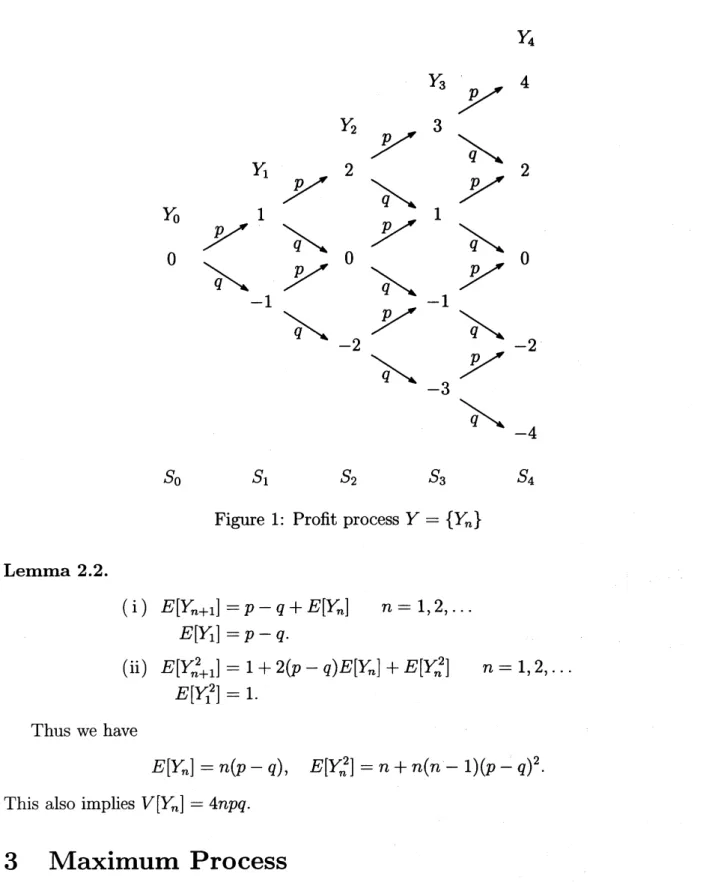
the state spaces$\{S_{n}\}$ with the transition probability $p=\{p_{n}(j|i)\}$ (Figure 1) :
$p_{n}(j|i)=\{$
$p$ if $j=i+1$
$q$ if
$j=i-1$
0otherwise
$n=0,1$, $\ldots$ . (3)
Then the recursion $\mathrm{Y}_{n+1}=X_{n+1}+\mathrm{Y}_{n}$, $n=1,2$, $\ldots$ together with i.i.d. property in $\{X_{n}\}$
$\mathrm{Y}_{4}$ $\mathrm{Y}_{3}\nearrow^{p}$ 4 $\mathrm{Y}_{2}\nearrow p$ 3 $\backslash _{q}$ $\mathrm{Y}_{1}\nearrow p$ 2 $\backslash _{q}$ $\nearrow p$ 2 $\mathrm{Y}_{0}$ 1 1
$\nearrow p$ $\backslash _{q}$ $\nearrow^{p}$ $\backslash _{q}$
000
$\backslash _{q}$ $\nearrow^{p}$
$\backslash _{q}$ $\nearrow^{p}$
-1 -1
$\backslash _{q}$ $\nearrow p$ $\backslash _{q}$
-2 -2 $\backslash _{q}$ $\nearrow p$ -3 $\backslash _{q}$ -4 $S_{0}$ $S_{1}$ $S_{2}$ $S_{3}$ $S_{4}$
Figure 1: Profit process $\mathrm{Y}=\{\mathrm{Y}_{n}\}$ Lemma 2.2.
(i) $E[\mathrm{Y}_{n+1}]=p-q+E[\mathrm{Y}_{n}]$ $n=1,2$,$\ldots$
$E[\mathrm{Y}_{1}]=p-q$. (i) $E[\mathrm{Y}_{n+1}^{2}]=1+2(p-q)E[\mathrm{Y}_{n}]+E[\mathrm{Y}_{n}^{2}]$ $n=1,2$, $\ldots$ $E[\mathrm{Y}_{1}^{2}]=1$. Thus we have $E[\mathrm{Y}_{n}]=n(p-q)$, $E[\mathrm{Y}_{n}^{2}]=n+n(n-1)(p-q)^{2}$.
This also implies $V[\mathrm{Y}_{n}]=Anpq$.
3Maximum Process
It is shown that expected value and variance of profit $\mathrm{Y}_{n}$ has been calculated through
the Binomial distribution. In this section we consider expected value and variance of
maximum profit $Z_{n}$.
Lemma 3.1. (i) For$n=1,2$,$\ldots$,
$\mathrm{Y}_{2n+1}>Z_{2n}$
is equivalent to $X_{2}+X_{3}+X_{4}+X_{5}+\cdots+X_{2n-4}+X_{2n-3}+X_{2n-2}+X_{2n-1}\geq 0$ $X_{4}+X_{5}+\cdots+X_{2n-4}+X_{2n-3}+X_{2n-2}+X_{2n-1}\geq 0$ . $\cdot$ . $X_{2n-4}+X_{2n-3}+X_{2n-2}+X_{2n-1}\geq 0$ $X_{2n-2}+X_{2n-1}\geq 0$ $X_{2n}=X_{2n+1}=1$.
(ii) For$n=1,2$,$\ldots$ ,
$\mathrm{Y}_{2n+2}>Z_{2n+1}$ is equivalent to $X_{3}+X_{4}+X_{5}+X_{6}+\cdots+X_{2n-3}+X_{2n-2}+X_{2n-1}+X_{2n}\geq 0$ $X_{5}+X_{6}+\cdots+X_{2n-3}+X_{2n-2}+X_{2n-1}+X_{2n}\geq 0$ . $\cdot$ . (4) $X_{2n-3}+X_{2n-2}+X_{2n-1}+X_{2n}\geq 0$ $X_{2n-1}+X_{2n}\geq 0$ $X_{2n+1}=X_{2n+2}=1$. In particular, $\mathrm{Y}_{2}>Z_{1}$ is equivalent to $X_{2}=1$
.
(iii) In either case we have
$\mathrm{Y}_{n+1}-Z_{n}=1$ (5)
$\mathrm{Y}_{n+1}^{2}-Z_{n}^{2}=2\mathrm{Y}_{n}+1$ $n=0,1$,
$\ldots$ . (6)
$Pro\mathrm{o}/$
.
Since (i) is shown,we
first show (ii). We note that the inequality$\mathrm{Y}_{2n+2}>Z_{2n+1}$
$=\mathrm{Y}_{1}\vee \mathrm{Y}_{2}\vee\cdots\vee \mathrm{Y}_{2n-1}\vee \mathrm{Y}_{2n}\vee \mathrm{Y}_{2n+1}$
is equivalent to the system ofinequalities
$\mathrm{Y}_{2n+2}>\mathrm{Y}_{2n+1}$ $\Rightarrow X_{2n+2}>0$ $\mathrm{Y}_{2n+2}>\mathrm{Y}_{2n}$ $\Rightarrow X_{2n+2}+X_{2n+1}>0$ $\mathrm{Y}_{2n+2}>\mathrm{Y}_{2n-1}$ $\Rightarrow X_{2n+2}+X_{2n+1}+X_{2n}>0$ $\mathrm{Y}_{2n+2}>\mathrm{Y}_{2n-2}$ $\Rightarrow X_{2n+2}+X_{2n+1}+X_{2n}+X_{2n-1}>0$
.
$\cdot$.
$\mathrm{Y}_{2n+2}>\mathrm{Y}_{2}$ $\Rightarrow X_{2n+2}+X_{2n+1}+\cdots+X_{3}>0$ $\mathrm{Y}_{2n+2}>\mathrm{Y}_{1}$ $\Rightarrow X_{2n+2}+X_{2n+1}+\cdots+X_{3}+X_{2}>0$.
$X_{2n+2}=1$ $X_{2n+1}=1$ $X_{2n}>-2$ $X_{2n-1}+X_{2n}>-2$ $X_{2n-2}+X_{2n-1}+X_{2n}>-2$ (7) . $\cdot$
.
$X_{3}+X_{4}+\cdots+X_{2n-1}+X_{2n}>-2$ $X_{2}+X_{3}+X_{4}+\cdots+X_{2n-1}+X_{2n}>-2$.Since each $X_{m}$ takes only two values -1, 1,
we see
that (7) is equivalent to (4). (iii) isshown as follows. First
we assume
that $\mathrm{Y}_{n+1}>Z_{n}$. Here$\mathrm{Y}_{n}=\mathrm{Y}_{n-1}+X_{n}$
$>\mathrm{Y}_{n-1}$ (since $X_{n}=1$)
$\mathrm{Y}_{n}=\mathrm{Y}_{n-2}+X_{n-1}+X_{n}$
$\geq \mathrm{Y}_{n-2}$
$\mathrm{Y}_{n}=\mathrm{Y}_{n-3}+X_{n-2}+X_{n-1}+X_{n}$
$>\mathrm{Y}_{n-3}$ (since $X_{n-2}+X_{n-1}\geq 0$)
$\mathrm{Y}_{n}=\mathrm{Y}_{n-4}+X_{n-3}+X_{n-2}+X_{n-1}+X_{n}$
$\geq \mathrm{Y}_{n-4}$
.
$\cdot$
.
Then we have $Y_{n}\geq \mathrm{Y}_{m}$, $m=1,2$,
$\ldots$ ,$n$, which implies
$\mathrm{Y}_{n+1}-Z_{n}=\mathrm{Y}_{n+1}-\mathrm{Y}_{n}=X_{n+1}=1$.
Furthermore, this implies
$\mathrm{Y}_{n+1}^{2}-Z_{n}^{2}=(\mathrm{Y}_{n+1}+Z_{n})(Y_{n+1}-Z_{n})$
$=Y_{n+1}+Z_{n}$
$=2\mathrm{Y}_{n+1}-1$ $=2\mathrm{Y}_{n}+1$.
$\square$
Then we have the following recursion formulae :
Lemma 3.2.
(i) $E[Z_{n+1}]=P(\mathrm{Y}_{n+1}>Z_{n})+E[Z_{n}]$ $n=1,2$, $\ldots$ $E[Z_{1}]=p-q$.
(ii) $E[Z_{n+1}^{2}]=E[(2\mathrm{Y}_{n}+1)\cdot 1_{\{\mathrm{Y}_{n+1}>Z_{n}\}}]+E[Z_{n}^{2}]$ $n=1,2$,
$\ldots$
$E[Z_{1}^{2}]=1$.
Proof.
Firstwe
note the equality$1_{\{\mathrm{Y}_{n+1}>Z_{n}\}}+1_{\{\mathrm{Y}_{n+1}\leq Z_{n}\}}=1$
where $1_{A}$ is the characteristic function of set $A$ :
$1_{A}(\omega)=\{$ 1if $\omega$ $\in A$ 0otherwise. It holds that $Z_{n+1}=Z_{n}\vee \mathrm{Y}_{n+1}$ $=(Z_{n}\vee \mathrm{Y}_{n+1})\cdot(1_{\{\mathrm{Y}_{n+1}>Z_{n}\}}+1_{\{\mathrm{Y}_{n+1}\leq Z_{n}\}})$
$=\mathrm{Y}_{n+1}\cdot 1_{\{\mathrm{Y}_{n+1}>Z_{n}\}}+Z_{n}\cdot 1_{\{\mathrm{Y}_{n+1}\leq Z_{n}\}})$
$=(Y_{n+1}-Z_{n})\cdot 1_{\{\mathrm{Y}_{n+1}>Z_{n}\}}+Z_{n}$ (8)
$Z_{n+1}^{2}=(Z_{n}\vee \mathrm{Y}_{n+1})^{2}$
$=(Z_{n}\vee \mathrm{Y}_{n+1})^{2}\cdot(1_{\{\mathrm{Y}_{n+1}>Z_{n}\}}+1_{\{\mathrm{Y}_{n+1}\leq Z_{n}\}})$
$=\mathrm{Y}_{n+1}^{2}\cdot 1_{\{\mathrm{Y}_{n+1}>Z_{n}\}}+Z_{n}^{2}\cdot 1_{\{\mathrm{Y}_{n+1}\leq Z_{n}\}})$
$=(\mathrm{Y}_{n+1}^{2}-Z_{n}^{2})\cdot 1_{\{\mathrm{Y}_{n+1}>Z_{n}\}}+Z_{n}^{2}$. (9)
Prom (5)
we see
that$E[(\mathrm{Y}_{n+1}-Z_{n})\cdot 1_{\{\mathrm{Y}_{n+1}>Z_{n}\}}]=E[1_{\{\mathrm{Y}_{n+1}>Z_{n}\}}]$
$=P(\mathrm{Y}_{n+1}>Z_{n})$.
Taking the expectation of both sides in (8),
we
have$E[Z_{n+1}]=E[(\mathrm{Y}_{n+1}-Z_{n})\cdot 1_{\{\mathrm{Y}_{n+1}>Z_{n}\}}]+E[Z_{n}]$ $=P(\mathrm{Y}_{n+1}>Z_{n})+E[Z_{n}]$.
Similarly, acombination of (6) and (9) yields
$E[Z_{n+1}^{2}]=E[(\mathrm{Y}_{n+1}^{2}-Z_{n}^{2})\cdot 1_{\{\mathrm{Y}_{n+1}>Z_{\mathfrak{n}}\}}]+E[Z_{n}^{2}]$
$=E[(2\mathrm{Y}_{n}+1)\cdot 1_{\{\mathrm{Y}_{n+1}>Z_{n}\}}]+E[Z_{n}^{2}]$.
$\square$
4Markovization
The profit process $\{\mathrm{Y}_{n}, n\geq 0\}$ is aMarkov chain, where the state spaces $\{S_{n}\}$ and the
transition probability $p=\{p_{n}(j|i)\}$
are
defined by (2) and (3), respectively. Now weconsider the maximum profitprocess $\{Z_{n}, n\geq 1\}$, which is not necessarily Markov. We
are
interestedinsome
approachwhich makes the maximum process Markovon
asuitablestate spaces. In the case, the statespaces
are
meaningfulas
faras
it is small We call thisproblemaMarkovization of process $\{Z_{n}\}$
.
In this section the Markovization is performedthrough
an
invariant imbedding method [1, p.82], [13, Chap.
Let us define the past-value sets $\{\Omega_{n}\}$
as
follows :$\Omega_{n}:=\{\lambda_{n}|\lambda_{n}=(-1)\vee y_{1}\vee y_{2}\vee\cdots\vee y_{n-1}, y_{i}\in S_{i}, 1\leq i\leq n-1\}$
$n=2,3$,$\ldots$ .
In particular, we call $\Omega_{n}$ the maximum-value-set to date $n$. Then the past-value sets
satisfy the forward recursive formula :
Lemma 4.1.
$\Omega_{2}=\{-1,1\}$
$\Omega_{n+1}=$
{A
$\vee y|\lambda\in\Omega_{n}$, $y\in S_{n}$}
$n=2,3$, $\ldots$ .In fact, we have
$\Omega_{2}=\{-1,1\}$
$\Omega_{n}=\{-1,0,1, \ldots, n-2, n-1\}$ $n=3,4$,$\ldots$ .
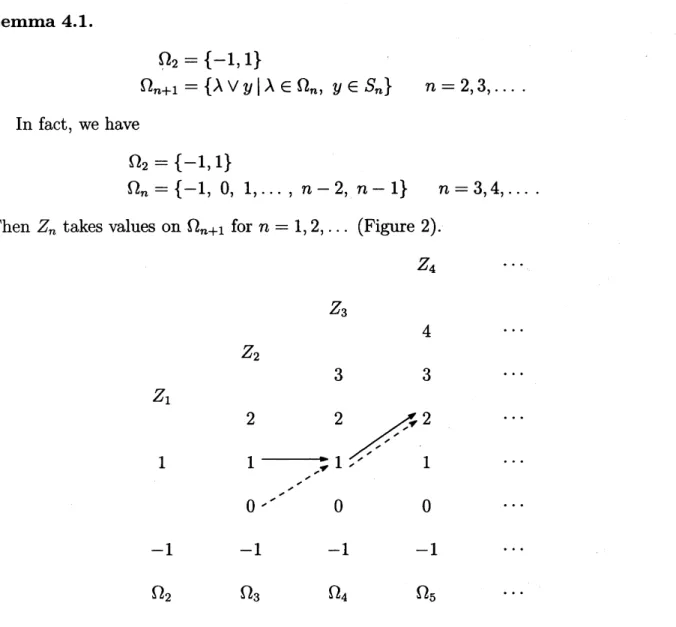
Then $Z_{n}$ takesvalues
on
$\Omega_{n+1}$ for $n=1,2$,$\ldots$ (Figure 2). $Z_{4}$ $Z_{3}$ $Z_{2}$ 33 $Z_{1}$ 22 3 1 1 \prime\prime\prime $1$
0\prime\prime\prime’
0 0 -1 -1 -1 -1$\Omega_{2}$ $\Omega_{3}$ $\Omega_{4}$ $\Omega_{5}$
Figure 2: Maximum profit process $Z=\{Z_{n}\}_{n\geq 1}$
Lemma 4.2. However the maximum profit process $Z=\{Z_{n}, n\geq 1\}$ is not Markov on
the state spaces $\{\Omega_{n+1}\}$. Infact, both transition probabilities
$P(Z_{4}=2|Z_{2}=0, Z_{3}=1)=p$
and
$P(Z_{4}=2|Z_{2}=1, Z_{3}=1)=p^{2}$
depend on the yesterday’s state and are not equal
for
$0<p<1$.Proof.
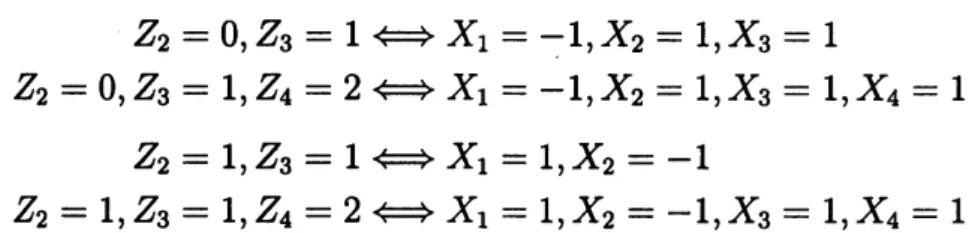
The following four equivalencesaxe
easily shown.$Z_{2}=0$,$Z_{3}=1\Leftrightarrow X_{1}=-1$,$X_{2}=1$,$X_{3}=1$
$Z_{2}=0$,$Z_{3}=1$,$Z_{4}=2\Leftrightarrow X_{1}=-1$,$X_{2}=1,X_{3}=1$,$X_{4}=1$
$Z_{2}=1$,$Z_{3}=1\Leftrightarrow X_{1}=1$,$X_{2}=-1$
$Z_{2}=1$,$Z_{3}=1$,$Z_{4}=2\Leftrightarrow X_{1}=1$,$X_{2}=-1$,$X_{3}=1$,$X_{4}=1$.
The first two and the last two yield the former transition probability and the latter,
respectively. This completes the proof. $\square$
$(\mathrm{Y}_{4;}\lambda_{4})$ $\mathrm{Y}_{1}$ 1 $\mathrm{Y}_{0}$ 0 -1 (4; 3) (2; 3) (2; 2) (0; 2) (2; 1) (0; 1) (-2; 1) (0; 0) (-2; 0) (0;-1) (-2;-1) (-4;-1)
$\tilde{S}_{0}$ $\tilde{S}_{1}$ $\tilde{S}_{2}$ $\tilde{S}_{3}$ $\tilde{S}_{4}$
Figure 3: Expanded profit process $\tilde{\mathrm{Y}}=\{\tilde{\mathrm{Y}}_{n}, n\geq 0\}$
First, by attaching $\Omega_{n}$,
we
expand the state space $S_{n}$ to augmented state spaces $\{\tilde{S}_{n}\}$as
foUows :$\tilde{S}_{n}:=S_{n}$, $n=0,1$
$\tilde{S}_{n}:=\{(y_{n};\lambda_{n})|yi_{\dot{l}}^{=x_{1}+x_{2}+\cdots+x_{\dot{l}}}\lambda_{n}=y_{1}\vee y_{2}\vee\cdots\vee y_{n-1}\in\{-1,1\},1\leq i\leq n$ $\}\subset S_{n}\cross\Omega_{n}$ $n=2,3$,
$\ldots$ ,$N$.
Then the expanded state spaces $\{\tilde{S}_{n}\}$
are
forwardly generatedas
followsLemma 4.3.
$\tilde{S}_{2}=\{(2;1), (0;1), (0;-1), (-2;-1)\}$
$\tilde{S}_{n+1}=$
{
$(y+x$;A$\vee y$) $|(y;\lambda)\in\tilde{S}_{n},$ $x\in\{-1,1\}$}
$n=2,3$,$\ldots$ ,$N$.
Second we define
anew
transition law $q=\{q_{n}\}$ there by$q_{0}(j|0):=\{$ $p$ if $j=1$ $q$ if $j=-1$ $q_{1}((j;i)|i):=\{$ $p$ if $j=i+1$ $q$ if
$j=i-1$
$q_{n}((j;\mu)|(i;\lambda)):=\{$$p_{n}(j|i)$ if A$\vee i=\mu$
0otherwise $n=2,3$, $\ldots$ .
Finally we define asequence of random variables $\{\tilde{Y}_{n};n=0,1, \ldots\}$ by
$\tilde{\mathrm{Y}}_{n}:=\mathrm{Y}_{n}$ $n=0,1$; $\tilde{\mathrm{Y}}_{n}:=(Y_{n};\lambda_{n})$
$n=2,3$, $\ldots$ .
We call $\tilde{Y}=\{\tilde{Y}_{n}\}$ an expanded profit process. Thus $Y_{n}$ represents today’s profit, which
behaves stochastically. And $\lambda_{n}=( 1)\vee y_{1}\vee y_{2}\vee\cdots\vee y_{n-1}=z_{n-1}$denotes the
mcvximum-tO-yesterday, which has beenalready determined. Thus $\{\lambda_{n}\}$ is deterministic. Everytime
$Y_{n}$ realizes avalue $y_{n}$, the resulting pair $(y_{n};\lambda_{n})$ yields the today’s maximum-value
$\lambda_{n}\vee y_{n}=y_{1}\vee\cdots\vee y_{n-1}\vee y_{n}=z_{n}$
under maximum operation V. In other words, the expanded profit process $\tilde{\mathrm{Y}}=\{\tilde{\mathrm{Y}}_{n}\}$
generates the maximum process $Z=\{Z_{n}\}$ under the binary operation. Furthermore, we
have the following desired property.
Lemma 4.4. The expanded profit process $\{\tilde{\mathrm{Y}}_{n}, n\geq 0\}$ is a Markov chain on the state
spaces $\{\tilde{S}_{n}\}$ $with$ the transition probability $q=\{q_{n}\}$ (Figure 3).
We define amapping $T_{n}$ : $\tilde{S}_{n}arrow R^{1}$ by
$T_{n}(\tilde{y}_{n}):=\lambda_{n}\vee y_{n}$ $n=2,3$,
–
Then the sequence ofmappings $\{T_{n}\}$ transforms process $\{\tilde{\mathrm{Y}}_{n}\}$ into $\{Z_{n}\}$ in the following
sense :
$T_{n}(\tilde{Y}_{n})=Z_{n-1}\vee Y_{n}=Z_{n}$ $n=2,3$,
$\ldots$ .
Thustheprocess $\{\tilde{\mathrm{Y}}_{n}\}$ is aMarkovization of$\{Z_{n}\}$. Thus the Markovization is astochastic
version ofthe final state model [1, p.82], [13, p.71]
4.1
Recursion for
$E[Z_{N}]$Now let
us
take apositiveinteger $N(\geq 2)$. We derive arecursive formula for the expectedvalue of the maximum random variable$Z_{N}$. We define
a
$te$ minalfunction
$T:\tilde{S}_{N}arrow R^{1}$by
$T(\tilde{y}_{N}):=\lambda_{N}\vee y_{N}$.
Lemma 4.5. $Jt$ holds that
$E[Z_{N}]=\tilde{E}_{\tilde{y}0}[T(\tilde{\mathrm{Y}}_{N})]$
where $\tilde{E}_{\tilde{y}0}$ is the expectation operator induced
from
the transition law $q$ and the initialstate $\tilde{y}_{0}=y_{0}=0$.
Let
us
define the sequence ofexpected value functions $\{u_{n}\}$as
follows :$u_{n}(\tilde{y}_{n}):=\tilde{E}_{\tilde{y}_{n}}[T(\tilde{Y}_{N})]$ $n=0,1$,
$\ldots$ ,$N-1$
$u_{N}(\tilde{y}_{N}):=\lambda_{N}\vee y_{N}$
where$\tilde{E}_{\tilde{y}_{n}}$ is theexpectationoperator induced from thetransition law $\{q_{n}, q_{n+1}, \ldots, q_{N}\}$
and
an
initial state $\tilde{y}_{n}\in\tilde{S}_{n}$.
We remark that $\tilde{y}_{n}$ takes the following values :$\tilde{y}_{0}=y_{0}=0$, $\tilde{y}_{1}=y_{1}=-1$
or
1, $y\sim n=(y_{n};\lambda_{n})$ $n=2,3$,$\ldots$ ,$N$.
Then
we
have the backward recursive formula :Theorem 4.1.
$u_{0}(0)= \sum_{j\in S_{1}}u_{1}(j)q_{0}(j|0)$
$u_{1}(i)= \sum_{j\in S_{2}}u_{2}(j;i)q_{1}(j|i)$ $i\in S_{1}$
$u_{n}(i; \lambda)=\sum_{j\in S_{n+1}}u_{n+1}$(
$j$;A$\vee i$)$q_{n}(j|i)$ $(i;\lambda)\in\tilde{S}_{n}$, $n=2,3$,
$\ldots$ ,$N-1$ (10)
$u_{N}(i;\lambda)=\lambda\vee i$ $(i;\lambda)\in\tilde{S}_{N}$.
Thus, successively solving (10),
we
have the desired expected value of the maximumprofit $Z_{N}$
over
$N$-stage problem :$u_{0}(0)=E[Z_{N}]$
.
Actually the recursive formula reduces
as
follows :Corollary 4.1.
$u_{0}(0)=pu_{1}(1)+qu_{1}(-1)$
$u_{1}(i)=pu_{2}(i+1;i)+qu_{2}(i-1;i)$ $i=-1,1$ $u_{n}(i;\lambda)=pu_{n+1}$($i+1$;A$\vee i$) $+qu_{n+1}(i-1;\lambda\vee i)$
$(i;\lambda)\in\tilde{S}_{n}$, $n=2,3$,
$\ldots$ ,$N-1$
$u_{N}(i;\lambda)=\lambda\vee i$ $(i;\lambda)\in\tilde{S}_{N}$.
4.2
Recursion for
$E[Z_{N}^{2}]$Now let us consider the expectedvalue of the squared random variable$Z_{N}^{2}$
.
Here in placeof the terminal function $T$
we
introduce the squared terminalfunction
$T^{2}$ : $\tilde{S}_{N}arrow R^{1}$ by$T^{2}(\tilde{y}_{N}):=(\lambda_{N}\vee y_{N})^{2}$.
Then we have
Lemma 4.6. It holds that
$E[Z_{N}^{2}]=\tilde{E}_{\tilde{y}0}[T^{2}(\tilde{\mathrm{Y}}_{N})]$.
Let us define $\{v_{n}\}$
as
follows :$v_{n}(\tilde{y}_{n}):=\tilde{E}_{\tilde{y}_{n}}[T^{2}(\tilde{\mathrm{Y}}_{N})]$ $n=0,1$, $\ldots$ ,$N-1$ $v_{N}(\tilde{y}_{N}):=(\lambda_{N}\vee y_{N})^{2}$. Then we have Theorem 4.2. $v_{0}(0)=pv_{1}(1)+qv_{1}(-1)$ $v_{1}(i)=pv_{2}(i+1;i)+qv_{2}(i-1;i)$ $i=-1,1$
$v_{n}(i;\lambda)=pv_{n+1}$($i+1$;A$\vee i$) $+qv_{n+1}$($i-1$;A$\vee i$) (11)
$(i;\lambda)\in\tilde{S}_{n}$, $n=2,3$,
$\ldots$ ,$N-1$
$v_{N}(i;\lambda)=(\lambda\vee i)^{2}$ $(i;\lambda)\in\tilde{S}_{N}$.
Thus, the recursive computation of (11) yields the desired expected value:
$v_{0}(0)=E[Z_{N}^{2}]$.
4.3
Recursion
for
$P(Z_{N}=k)$Now let us consider the probability distribution of $Z_{N}$. For each fixed $k\in\Omega_{n\dagger 1}$ the
probability it takes value $k$ is calculated through invariant imbedding. We define the
terminal function $T:\tilde{S}_{N}arrow R^{1}$ by
$T(\tilde{y}_{N}):=\psi(\lambda_{N}\vee y_{N})$
where $\psi(\cdot)$ is the indicator function ofaone-point set $\{k\}$ :
$\psi(z):=1_{\{k\}}(z):=\{$ 1if $z=k$
0otherwise Then
Lemma 4.7. It holds that
$P(Z_{N}=k)=\tilde{E}_{\tilde{y}0}[T(\tilde{Y}_{N})]$.
Further we define $\{w_{n}\}$
as
follows : $w_{n}(\tilde{y}_{n}):=\tilde{E}_{\tilde{y}_{n}}[T(\tilde{Y}_{N})]$ $n=0,1$, $\ldots$ , $N-1$ $w_{N}(\tilde{y}_{N}):=\psi(\lambda_{N}\vee y_{N})$. Then Theorem 4.3. $w_{0}(0)=pw_{1}(1)+qw_{1}(-1)$ $1;\mathrm{i})=pw_{2}(i+1;i)+qw_{2}(i-1;i)$ $i=-1,1$$Wn(i;\lambda)=pw_{n+1}$($i+1$;A$\vee i$)$+qw_{n+1}$($i-1$;A$\vee i$) (12)
$(i;\lambda)\in\tilde{S}_{n}$, $n=2,3$,
$\ldots$ ,$N-1$
$w_{N}(i;\lambda)=\psi(\lambda\vee i)$ $(i;\lambda)\in\tilde{S}_{N}$.
Thus, the recursion (12) yields the desired probability :
$w_{0}(0)=P(Z_{N}=k)$
.
References
[1] R.E. Belman, Dynamic Programming, Princeton Univ. Press, NJ, 1957.
[2] R.E. Bellman, Some Vistas
of
Moderm Mathematics, University ofKentucky Press,Lexington, KY,
1968.
[3] List of Publications :Richard Bellman, IEEE Transactions
on
Automatic Control,AC-26(1981), No. $5(\mathrm{O}\mathrm{c}\mathrm{t}.)$,
1213-1223.
[4] R.E. Bellman, Eye
of
the Hurricane:an
Autobiography, WorldScientific, Singapore,1984.
[5] R.E. Bellman(Ed. R.S. Roth), The Bellman Continuum :A Collection
of
the Worksof
Richard Bellman, World Scientific, Singapore, 1986.[6] R.E. Bellman and E.D. Denman, Invariant Imbedding, Lect. Notes in Operation
Research and Mathematical Systems, Vol. 52, Springer-Verlag, Berlin, 1971.
[7] R.E. Bellman and E.D. Denman, Invariant Imbedding :Proceedings
of
the SummerWorkshop
on
Invariant Imbedding Held at the Universityof
Southerm California,June -August 1970, Lect. Notes in Operation Research and Mathematical Systems,
Vol. 52, Springer-Verlag, Berlin, 1971.
[8] S. Iwamoto, Theory
of
Dynamic Program :Japanese, KyushuUniv. Press, Fukuoka,1987.
[9] S. Iwamoto, Maximizing threshold probability through invariant imbedding, Eds.
HF. Wang and U.P. Wen, Proceedings
of
The Eighth BELLMAN CONTINUUM,Hsinchu, ROC, Dec.2000, pp.17-22
[10] S. Iwamoto, Fuzzy decision-making through three dynamic programming
proaches, Eds. H.F. Wang and U.P. Wen, Proceedings
of
The Eighth $BEL\ovalbox{\tt\small REJECT}$CONTINUUM, Hsinchu, ROC, Dec.2000, pp.23-27.
[11] E.S. Lee, Quasilinearization and Invariant Imbedding, Academic Press, New $\urcorner$
1968.
[12] S. Ross, Stochastic Processes :second edition, Wiley&Sons, New York, 1996.
[13] M. Sniedovich, Dynamic Programming, Marcel Dekker, Inc. NY, 1992