
トップページ - 横浜国立大学学術情報リポジトリ
35
0
0
全文
(2) Introduction East Asia contains the world's largest region of extra-tropical evergreen broad-leaved forests, often known as "laurel forests" because of the importance and often the dominance of trees from the laurel family, Lauraceae. Such trees generally have intermediate-sized, dark green (shadetolerant), thin-coriaceous but mesomorphic leaves which are especially characteristic of evergreen Lauraceae and were thus called 'Lorbeerblatter' (e. g. Rube1 1930) or laurophylls (e. g. Klotzli 1988; Box 1996, 1997). Since these leaves are somewhat glossy, they have also been called lucidophylls (Kira 1969, 1977, 1991). Forests dominated by laurophyll trees are rather dark and somber, with low light levels below the canopy, and are typically evergreen from top to bottom. The term laurophyll forest is used in this paper because laurophyll forests are generally of two main types, those dominated by Lauraceae (i. e. true "laurel forests") and those dominated by laurophyll Fagaceae, mainly the genus Castanopsis but also Lithocarpus (Pasania) and evergreen Quercus (Cyclobalanopsis). Both types occur throughout the warm-temperate and humid subtropical zones of East Asia, from coastal areas of northern Japan, through southern Japan and the south tip of Korea, to Taiwan and large areas of southeastern and southwestern China (e. g. Suzuki 1952, 1953; Liu and Yang 1961; Wang 1961; Wu 1980; Fujiwara 1981-86). Similar laurophyll forests also occur in montane belts in subtropical and tropical mountains a s far south as Indonesia and Malaysia (e. g. Whitmore 1975, Klotzli 1984, Chen et al. 1986, Fujiwara 1986). Comparable laurophyll forests also occur in equivalent climatic situations on other continents, including southern Brazil, scattered areas of eastern Australia and southeastern Africa (mainly montane belts), topogenically moist patches in the southeastern USA, and in cool-maritime New Zealand, Tasmania, and Southern Chile (e. g. Ovington 1983, Hub1 1988, Klotzli 1988, Box 1997, Tagawa 1997). At the time our releves were made in Taiwan and China (1985-88), laurophyll forests were not widely recognized outside East Asia a s a basic biome type, nor had symposia on laurophyll forests been held or detailed studies been published. Basic description was an important objective. Although some descriptions were published (Box et al. 1989, 1991a, 1991b1, other commitments conspired to prevent earlier publication of the material from Taiwan (as well as from the Yunnan Plateau and from Korea). The Taiwan releves are thus used now to examine some remaining questions and to compare with results and hypotheses from some recent, more detailed research programs on laurophyll forests /(Hara. and Yonebayashi. 1997, Tagawa and Hotta. 1997).. Laurophyll forests, especially in East Asia, are known for their taxonomic richness. Since our material is insufficient for phytosociological analysis, the focus of this paper is on the structure, richness and biogeographic relations of some especially well developed laurophyll forest examples in Taiwan and adjacent southern China, as well a s the climatic position and regeneration potential of East Asian laurophyll forests in general.. Field Data The data used herein include two good examples of mature, natural laurophyll forest from less accessible, rugged mountain areas of central Taiwan, a s illustrated in Photos 1 and 2. Slopes can be quite steep, 20" or more, and may also harbor stands of the endemic conifer Taiwania cryptomerioides (Photo 3). The Taiwanese and Chinese laurophyll forests were described by standard Braun-Blanquet relevgs, as documented by Fujiwara (1987). Each relev6 represents an area of about 400-600 square meters. The particular stands studied include the following:.
(3) Photo 1. General appearance of natural Laurophyll forest (Central Taiwan).. Photo 2. Extensive Laurophyll forest on steep slopes in Central Taiwan (Yu-Shan 3CI Mountains, near Yi-Nu Pu-Bu 2&@7%, Yu-Shan National Park 3d1l3lTLG-B)..
(4) Photo 3. Taiwania cryptomerioides stand in Central Taiwan (Yu-Shan National Park ELLIH~~H). , 1 ) a very tall (34m) laurel forest co-dominated by four Lauraceae species, a t 1690m elevation, just below the Guan-Gao hut in the Yu-Shan Mountains of central Taiwan; 2 ) a tall (30m) evergreen Fagaceae forest dominated by Castanopsis carlesii (albeit with a somewhat disturbed understorey), at 1810m elevation just above Yi-Nu Pu-Bu, in the same part of the Yu-Shan Mountains; and 3 ) a much shorter (16m) Castanopsis-Elaeocarpus forest, frequently disturbed by cattle and man a s well as by typhoons, at 380m elevation in the Nan-Jen Shan (Mandarin: Nan-Ren Shan), in the Kenting National Park of southern Taiwan. The locations are shown in Figure 1. Relev6s and photographs are shown below. Except where local experts provided other taxonomic names, nomenclature in the relev6s and tables generally follows that of the "Flora of Taiwan" (Flora of Taiwan Editorial Committee 197579), which will be subsequently referred to without author citation. The Taiwanese and Chinese usages of Machilus (=Persea) and Cyclobalanopsis (=evergreen Quercus) are preserved in the releves and tables, and generally in the text, except when referring to Japanese contexts for the same species. The "Flora of Taiwan" (1975-79) still uses Cyclobalanopsis but has adopted Persea in place of Machilus. Data collection resulted in the following numbers of taxa recognized: 1 ) 26 species of pteridophytes (18 fully identified, 8 a s genus only), in 14 genera and seven families (sensu Mabberley 1987, in which the Aspleniaceae are treated a s including the Athyriaceae, Aspidiaceae and Dryopteridaceae) ; 2 ) two conifers, Podocarpus formosensis (Podocarpaceae) and Cephalotaxus wilsoniana (Cephalotaxaceae), the latter endemic to Taiwan; 3 ) 24 species of monocotyledons (11 fully identified, 13 a s genus only), in 14 genera and eight.
(5) Fig. 1. Locations of the relev6 sites in Taiwan (left) and of Taiwan relative to the Ryukyu Islands, China, and southern Japan (right).. ,. families (including Smilacaceae as separate from Liliaceae); 4 ) 128 species of dicotyledons (117 fully identified, 9 a s genus only, and two totally unidentified), in 88 genera (as in the "Flora of Taiwan" and the Appendix, some classified differently in Japan and elsewhere) and 48 families; and 5 ) one variety, Schima superba var. kankoensis, a s separate from its main species which also is represented (if main species not present, varieties were counted a s species). The full list of species found in the relev6s is given in the Appendix, classified by genus and family and with indications of relev6 occurrence and general biogeographic distribution.. Composition and Structure of a Mature Laurel Forest The composition and three-dimensional structure of mature laurophyll forests in Taiwan is illustrated by two samples from the Yu-Shan Mountains in Central Taiwan, both of which are clearly analogous to laurophyll forests in Japan. The first stand represents a true "laurel forest" in which Lauraceae are quite dominant and is illustrated by a relev6 at 1690m elevation on a 25" slope to the northeast just above the mountain hut a t Guan-Gao (Relev6 I). The general sub-canopy structure of this stand, in the fog, is shown in Photo 4.. In the laurel forest stand a t Guan-Gao, the canopy layer (TI layer) is composed entirely of laurophyll species. The four species with the greatest cover are all from the family Lauraceae: Beilschmidia erythrophloia, Litsea acuminata, Machilus (=Persea) thunbergii and M. kusanoi. Persea thunbergii is a major laurel forest dominant in Japan, while P . kusanoi was separated from P . thunbergii by Hayata (1911) and is now considered by the "Flora of Taiwan" to be the same a s P. japonica. Litsea species, in Taiwan a s well a s Japan, occur more commonly as understorey trees, but some, including L . acuminata, can reach over 20m in height. Two other canopy species are the laurophyll Fagaceae Lithocarpus lepidocarpus, a fairly common and.
(6) Relev6 1. Tall Mature Laurel Forest a t Guan-Gao, Yu-Shan Mountains, Central Taiwan. 1690 m, 25" slope to NE 30 x 25 m Personnel: KF, CCH, EB. TI: 3.3 Beilschmidia erythrophloia 2.2 Machilus tlzulzbergii 1.2 Lithocarpus lepidocarpus 1.1 Schima superba. 2.3 Litsea acuminata 2.1 Machilus kusanoi 1.1 Pasania kawakamii. Liana: 2.2 Mucuna macrocarpa 3.3 Eurya strigilosa 2.2 Turpinia formosana 1.2 Machilus japonica 1.1 Cinnamomum randaiense + Michelia conlpressa. T,:. Vines:. +.2 Ficus sarmentosa var. henryi + Schisandra arisanensis. Epiphyte:. +.2 Asplenium antiquum. S:. 3.3 Eurya glaberrima 1.2 Beilschmidia erythrophloia 1.1 Ardisia crenata +.2 Machilus japonica + Cinnamomum randaiense. Vines:. 1.1 Piper kadsura + Schisandra arisanensis + Itea parvifirora + Bauhinia championii + Trachelospermum asiaticum + Tetrastigma formosana. Epiphyte:. 1.1 Trichomanes auriculatum + Procris laevigata. H:. 4.4 Pellionia radicans +.2 Gopdyera sp, + Alpinia sp.. Vines:. Ferns:. + + +. Piper kudsura Bauhinia championii Ficus tannoensis. 2.3 Diplazium dilatatum 1.2 Pteris tokioi + Arachniodes aristata + Polystichum lzancockii + Microsorium buergerianum + Dryopteris sp.. 1.2 Litsea acuminata 1.1Lithocarpus lepidocarpus 1.2 Eurya glaberrima 1.1 Tricalysia dubia. 2.2 Turpinia forntosana 1.2 Litsea acuminata 1.1 Ilex formosana +.2 Eurya leptophylla + Ficus erecta. + + + + +. Ficus sarmentosa var. henryi Mucuna macrocarpa Parthenocissus himalayana Smilax bracteata ssp. verruculosa Stauntonia hexaphylla. +.2 Alpinia sp. + Microsoriunz buergerianum 2.2 Beilschmidia erythrophloia + Peperomia reflexa. +. +. Parthenocissus himalayana Smilax bracteata ssp. verruculosa. 2.2 Diplazium donianum +.2 Arachniodes pseudaristata + Arachniodes amabilis + Microlepia marginata' + Microlepia sp..
(7) Photo 4. Interior of tall mature laurel forest a t Guan-Gao, documented in Relev6 1. The forest stand is a t 1690m, in an often foggy area just below the Guan-Gao hut, Yu-Shan National Park. The canopy is composed entirely of laurophyll species: four Lauraceae with higher cover (Beilschmidia, Machilus and Litsea), plus two species of evergreen Fagaceae (Lithocarpus and Pasania) and Schima superba (Theaceae) . All three understorey layers are also composed overwhelmingly of laurophyll species. abundant but endemic canopy tree, and Pasania kawakamii, usually a medium-sized tree but very common and also endemic to Taiwan. The other canopy component is Schima superba, a widespread canopy component of East Asian evergreen broad-leaved forests, from another important laurophyll family, Theaceae, often more widely represented by trees and arborescents of laurel forest understoreys. The tree understorey (Tz layer) and shrub layer of this laurel forest are also largely composed of species from these three families, including Eurya (Theaceae, three species) and Cinnamomum randaiense (Lauraceae).. Also included, however, are woody. species from other largely. laurophyll families: Michelia compressa (Magnoliaceae), which also occurs fairly commonly in southern Japan and the Ryukyu Islands; Tricalysia dubia (Rubiaceae), which occurs throughout Taiwan and also in China; and in the shrub layer the widespread Ardisia crenata (Myrsinaceae, also in Japan) and Ilex formosana (Aquifoliaceae, Taiwan and southern China, not to be confused with the Taiwan endemic I. formosae). The only remaining arborescent understorey component is Turpinia formosana ( S t a ~ h ~ l e a c e a e )a, small, endemic, but very common essentially laurophyll tree. This genus has some tropical members (Indomalaysia and tropical America), although other genera in the small family (Euscaphis, Staphylea, Tapiscia) are temperate except for Huertia (tropical America). One frutescent individual of deciduous Ficus erecta (Moraceae) also occurred in the shrub layer. An elegant theory of canopy and tree-understorey composition of East Asian evergreen broad-.
(8) leaved forests and their relations with tropical montane forests has recently been proposed by Ohsawa (1991, 1995), who divides the laurophyll component of these forests into two "guilds" (actually synusiae) : 1 ) lauro-fagaceous notophyll trees, characteristic of the forest canopy and of lower-montane tropical evergreen forests, and delimited by growing-season warmth and by low temperatures; and 2 ) symploco-myrsinaceous microphyll trees, characteristic of the tree and shrub understoreys. and of higher-montane tropical cloud forests, with lower warmth requirements but still delimited also by low temperatures. These two synusiae form separate forests on tropical mountains but gradually merge into a single forest type, but with vertical separation, a s the temperature ranges for the two types merge in the warm-temperate zone. The sample in Relev6 1 supports this idea, showing canopy dominance by the lauro-fagaceous element and occurrence of such smaller-leaved laurophylls a s. Ardisia crenata (Myrsinaceae) , Eurya leptophylla (Theaceae), and Ilex formosana (Aquifoliaceae) only in the shrub layer. Of the three Eurya species in the relev6, E. strigilosa (Tz) is described by the "Flora of Taiwan" a s a small tree, E. glaberrima (Tz and S) a s a small tree o r shrub, and E. leptophylla (S) a s a shrub. Leaf size of the three species is also given a s descending in that order. Of course saplings of some canopy and sub-canopy species also occur in the shrub layer, but the other shrub-layer species generally have leaves shorter than 8cm and are not Lauraceae o r Fagaceae. The herb layer, vine/liana synusia, and epiphyte synusia represent quite different families. The subcoriaceous but not really laurophyll tropical liana Mucuna macrocarpa (Leguminosae, Malaysia and Polynesia), which is common throughout Taiwan a t lower and middle elevations, reached the canopy with significant cover. Piper kadsura (Piperaceae), a scandent common also in southern Japan and Korea, was significant and was one of very few species to occur in all 9. three relev&. The relatively rich vine synusia also included Ficus sarmentosa var. henryi, F.. tannoensis, Bauhinia championii (Leguminosae) , and the laurophyll Trachelospermum asiaticum (Apocynaceae) with tropical affinities, a s well as more temperate elements such as evergreen Smi-. lax bracteata ssp. verruculosa (Smilacaceae) and Stauntonia hexaphylla (Lardizabalaceae) , and deciduous Schisandra arisanensis (Schisandraceae) and a Parthenocissus species identified a s P.. himalayana (Vitaceae, but incompletely known in Taiwan). The herb layer had a cover of 90% and was dominated by Pellionia radicans (Urticaceae) , along with seedlings of canopy co-dominant. Beilschmidia erythrophloia and several ferns, especially Diplazium dilatatum, D. donianum, Pteris tokioi, and three species of Arachniodes. The only herbs were unidentified species of Goodyera (Orchiaceae) and Alpinia (Zingiberaceae) , plus Peperomia reflexa (Piperaceae) . Trichomanes. auriculatum (Hymenophyllaceae, Japan to Thailand and Indonesia, now called Vandenboschia auriculata in the "Flora of Taiwan") was the most common epiphyte, along with Asplenium antiquum and Microsorium buergerianum (both also widespread outside Taiwan).. Composition and Structure of a Mature Laurophyll Fagaceae Forest The second relev6 represents the evergreen Fagaceae type of laurophyll forest (Castanopsis dominant) which occurs over perhaps even wider areas of East Asia, including much of more inland southern Japan. The relev6 was made at 1810m, on a 20-30" slope to the southwest, near the observation point at Yi-Nu Pu-Bu (Relev6 2). The interior of this stand is shown in Photo 5. This forest is dominated more completely by a single species, Castanopsis carlesii (Fagaceae,.
(9) Relev6 2. Tall Mature Castanopsis forest a t Yi-Nu Pu-Bu, Yu-Shan Mountains, Central Taiwan.. 1810 rn, 20-30" slope to SW 30 x 25 m Personnel: KF, CCH, El3. T,:. 5.4 Castanopsis carlesii 1.1 Beilschmidia erythrophloia 1.1 Machilus japonica + Cyclobalanopsis longinux + Lithocarpus lepidocarpus (+.2) Iaesia polycarpa. 2.3 Schinza superba 1.1 Eriobotrya deflexa 1.1 Elaeocarpus sylvestris + Pasania kawakamii + unknown tree (not Itea). T,:. 1.2 Beilschmidia erythrophloia 1.2 Pasania kawakamii + Lithocarpus lepidocarpus + Cinnamomum insularimontanum + Actinodaphne nantoensis. 1.1 Machilus japonica +.2 Turpinia formosana + Castanopsis carlesii + Machilus thunbergii + Evodia roxburghiana. S:. 2.2 Turpinia formosana 2.2 Hydrangea chinensis 1.2 Beilschmidia erythrophloia +.2 Michelia compressa +.2 Elaeagnus sp. + Castanopsis carlesii + Machilus japonica + Pasania kawakamii + Quercus stenophylloides -t Ternstroemia gymnanthera + Daphniphyllunz himalaense + Damnacanthus indicus + Morus australis + Salh sp. + Callicarpa formosana + Mussaenda pamiflora + Desmodium sp. + unknown shrub (not Itea or Paederia). 2.2 Litsea acuminata 1.2 Eurya leptophylla 1.2 Ardisia crenata +.2 Osmanthus matsumuranus +.2 Boehmeria sp. + Eriobotrya deflexa + Elaeocarpus sylvestris + Lithocarpus lepidocarpus + Symplocos cochinchinensis + Ilex formosana + Gordonia axillaris + Viburnum parvifolium + Zanthoxylon scandens + Maesa formosana + Cephalotaxus wilsoniana + Embelia lenticellata + Itea pamiflora. Vines:. Epiphyte:. +.2 Smilax sp, + Parthenocissus himalayana + Ficus nipponica + Clematis sp. + Schisandra arisanensis + Stauntonia sp. +.2 Microsorium buergerianum. + + + + +. Smilax sp, Jasminum hemsleyi Clematis alsornitrifolia Lonicera acuminata Trachelospermum gracilipes.
(10) H:. 1.2 Damnacanthus indicus + Machilus japonica + Idesia polycarpa + Embelia lenticellata. Vines:. 2.2 Tetrastigma formosana +.2 Hedera rhombea +.2 Ficus nipponica + Smilax sp.. Forbs:. +.2 Atpinia sp. + Cymbidium sp. + Ophiopogon sp.. Ferns:. 2.3 Arachniodes pseudaristata 1.2 Dryopteris sp, + Dryopteris sp, +.2 Pteris cretica + Acrophorus stipellatus + Coniogramme sp.. Graminoids:. +.2 Oplismenus cornpositus + Carex sp.. +.2 Rubus swinhoei + Pasania kawakamii + Ardisia crenata + Acanthopana. trifoliatus 1.2 Piper kadsura +.2 Parthenocissus himalayana +.2 Trachelospermum gracile. + +. Calanthe arisanensis Polygonzun sp.. 2.2 Arachniodes amabilis +.2 Dryopteris sp, +.2 Microlepia sp. + Polystichum sp. + Pteris fauriei. +. Carex lenta. Photo 5. Tall mature castanopsis forest a t Yi-Nu Pu-Bu, documented in Relev6 2. The canopy i s dominated by Castanopsis carlesii, with some Schima superba and individuals of Beilschmidia, Machilus, Elaeocarpus, and Eriobotrya. TAis stand is a t 1810m, above YiNu Pu-Bu ZkB7%,in Yu-Shan National P a r k ~ L L I ~ ~ ~ L ~ B ..
(11) Taiwan and adjacent southeastern China), a s is common in the evergreen Fagaceae forests of East Asia. The other canopy components are also mainly laurophylls: Schima superba (Theaceae), plus Lauraceae and evergreen Fagaceae, a s well a s laurophyll Elaeocarpus syluestris (Elaeocarpaceae, =. E. ellipticus in Japan). In addition, however, there was also a large individual of evergreen but not really laurophyll Eriobotrya deflexa (Rosaceae), a Taiwan endemic; a tall evergreen tree which could not be identified at all; and, on the edge of the plot, individuals of the deciduous invasive Idesia polycarpa (Fl~courtiaceae,monospecific genus), which occurs in China and Japan but comes from a family with mainly tropical affinities. The tree understorey involved mainly the canopy and other species of Lauraceae and evergreen Fagaceae (very little C. carlesii), a s well as laurophyll Turpinia formosana (as in the laurel forest relev61 and quasi-laurophyll Euodia. roxburghiana (Rutaceae, evergreen), considered the same a s E. merrillii by the "Flora of Taiwan." The shrub understorey showed definite signs of disturbance, including a larger number of species (47 versus 25) and higher total cover (45% versus 30%) than in the laurel-forest relev6, despite a canopy cover of 90%. Nevertheless, the shrub layer included 10 species from the main laurophyll families (Lauraceae, evergreen Fagaceae, Theaceae) and 14 other laurophyll species (including fairly abundant Hydrangea chinensis), and the same number (11) of vine species a s in the laurel-forest shrub layer. The remaining 12 species include single or few individuals of such non-laurophyll components a s evergreen Eriobotrya deflexa; shrubs Elaeagnus sp., Viburnum. paruifolium, Callicarpa formosana, and Zanthoxylon scandens; coniferous Cephalotaxus wilsoniana; unidentified species of Salix, Boehmeria, and Desmodium; and one completely unidentified shrub. The vine synusia was similar to that of the laurel forest, but there was only one epiphyte, Microsorium buergerianum. The herb layer was a bit less dense at 70% (versus 90% for the laurel forest) and was composed of a more even mix of ferns (especially two Arachniodes species), small vines, and some seedlings and herbs.. A Disturbed "Typhoon Forest" In contrast to the mature forests of Relev6s 1 and 2, the third stand studied represents a much shorter forest, a t 380m elevation on a 15" slope to the south, in the Nan-Jen Mountains of the Kenting National Park, Hengchun Peninsula, southern Taiwan. This forest seemed to have been disturbed frequently, both by animals and by typhoons. Being further south, it also contains more species with tropical affinities. The structure and composition of this typical "typhoon forest" is illustrated by Relev6 3. (See also vegetation descriptions by Chen 1984, 1985, and data from a study in the same area by Hara et al. 1997.) The shorter stature of this stand is shown in Photo 6. The short (16m) but moderately dense (80%) canopy was dominated by Castanopsis indica, along with Elaeocarpus syluestris, and with significant cover also by Schima superba var.. kankoensis, plus evergreen but not really laurophyll Schefflera octophylla (Araliaceae, southeast Asia and southern China to the Ryukyu Islands) and deciduous Engelhardtia roxburghiana ( J ~ ~ l a n d a c e a India e, to Malaysia and southern China). There were also a very few or single individuals of laurophyll Beilschmidia, Machilus, Castanopsis, Cyclobalanopsis, Gordonia, Michelia,. Eurya and Ilex species, plus more typically understorey laurophyll Symplocos, Syzygium, and Daphniphyllum species. In addition, though, there were also a few canopy individuals of the usually shrubby, non-laurophyll Glochidion rubrum (common in thickets) and Sapium discolor (both Euphorbiaceae, with ranges extending to Malaysia); usually shrubby Pithecellobium. lucidum (Leguminosae, moderately large compound leaves; from Hainan to the Ryukyu Islands);.
(12) Relev6 3. Frequently Disturbed Castanopsis-Elaeocarpus Typhoon Forest in the Nen-Jen Shan % ! I . LLI, Kenting National Park %JECGGSl, southern Taiwan.. 380 m, 15" slope to S 25 x 25 m Personnel: KF, CCH, Chiou W.-L., EB T,:. S:. 4.4 Castanopsis indica 2.3 Scheflera octophylla 2.2 Engelhardtia roxburghiana +.2 Glochidion rubrum +.2 Daphniphyllum glaucescens + Ilex formosae + Eurya hayatai + Pithecellobium lucidum + Beilschmidia tsangii + Ilex cochinchinensis + Symplocos wikstroemifolia. 3.3 Elaeocarpus sylvestris 2.2 Schima superba var. kankoensis +.2 Cyclobalanopsis longinux +.2 Michelia compressa +.2 Gordonia axillaris + Astronia ferruginea + Machilus zuihoensis + Castanopsis stellato-spina + Prunus phaeostica + Syzygium euphlebium + Sapium discolor. 3.3 Illicium arborescens 1.1 Ilex matsudai +.2 Ilex formosae + Schima superba var. kankoensis + Cyclobalanopsis longinux + Daphniphyllum glaucescens + Neolitsea buisanensis + Ardisia sieboldii + Helicia forrnosana. 1.2 Ilex cochinchinensis +.2 Litsea nakai + Beilschmidia erythrophloia + Engelhardtia roxburghiana + Michelia compressa + Pasania brevicaudata + Adinandra formosana vhypochl. + Glochidion lanceolatum + Gardenia jasminoides. 1.2 Engelhardtia roxburghiana 1.2 Eurya hayatai 1.2 Helicia formosana 1.1Diospyros eriantha 1.1 Symplocos glomerata +.2 Illicium arborescens +.2 Pasania brevicaudata +.2 Castanopsis carlesii +.2 Castanopsis indica +.2 Psychotria rubra +.2 Ilex cochinchinensis + Gardenia jasminoides + Michelia compressa + Astronia ferruginea + Beilschmidia tsangii + Elaeocarpus sylvestris + Schima superba var. kankoensis + Cryptocarya chinensis + Lithocarpus amygdalifolius + Ficus formosana + Zanthoxylon nitidum + Ficus erecta. 1.2 Ilex forrnosae 1.2 Microtropis japonica 1.1 Cyclobalanopsis longinux 1.1 Ardisia quinquegona 1.1 Ardisia cornudentata +.2 Litsea nakai +.2 Neolitsea buisanensis +.2 Ehretia 1ongifZora +.2 Daphniphyllum glaucescens +.2 Sarcandra glabra +.2 Pithecellobium lucidum + Glochidion rubrum + Gordonia axillaris + Machilus zuihoensis + Symplocos wikstroemifolia + Scheflera octophylla + Garcinia multiflora + Machilus thunbergii + Podocarpus formosensis + Meliosma rigida + Osmanthus marginatus + '~asianthusplagiophyllus.
(13) + + + + Palm:. 1.1 Daemonorops nzargaritae. Bamboo:. 1.1 Schizostachyum di@sum. Vines:. 1.1Smilax sp. + Stauntonia hexaplzylla + Psychotria serpens + Epipremnum pinnatum. H:. B. Lasianthus sp. Wikstroemia taiwanensis Litosanthes biflora St~ychnoslzenryi. +.2 Castanopsis indica + Pithecellobiurn lucidum. + + + +. Viburnum odoratissimum Callicarpa remotiflora Tarenna gracilipes Ilex asprelta. + + +. Piper kadsura Snzilax lanceifolia Fissistigma glaucescens. + + +. Daphniphyllum glaucescens Ficus sp. (apocynoid) Stauntonia hexaphylla. Vines:. +.2 Trachelospermunz gracilipes + Psychotria serpens. Herbs:. 2.2 Ophiopogon sp, +.2 Aspidistra daibuensis + Semnostaclzya longespicatus + Ophiopogon sp,. +.2 Zingiber kawagoii +.2 Codonacanthus pauciflorus + Calanthe sp. + Lophatherum gracile. Ferns:. 3.3 Pronephrium triphyllum 1.2 Diplazium donianum +.2 Diplazium ntettenianum. 1.2 Pleocnemia rufinewis +.2 Diplazium dilatatum + Blechnurn orientale. Photo 6. Frequently disturbed "Typhoon Forest" in the Nan-Jen Shan i%iILLI (Kenting National T ~southern ~ Taiwan), ~ ~ documented , in Relev6 3. The shorter stature of the Park % forest and somewhat broken canopy are apparent in the photograph. The canopy is composed (in descending order of cover) by Castanopsis indica, followed by Elaeocarpus syluestris and then Schefflera octophylla, Schima superba var. kankoensis, and Engelhardtia roxburghiana..
(14) mid-size coriaceous-leaved tree Astronia ferruginea (Melastomataceae, northern Philippines to southernmost Taiwan); and subcoriaceous Prunus phaeostica (Rosaceae, Assam to southern China; also common in thickets). The 8 m arborescent (Td layer and 4 m shrub layer showed similar diversity, with laurophylls most numerous but not predominant, a s they were in the mature forests in the central mountains. The herb layer and the vine synusia were generally similar to those of other stands but also had some species with more tropical affinities. Other than overall stature, the typhoon forest differed most from the mature stands through its greater number of species, especially in the shrub layer but also in the two tree layers.. Taxonomic Richness of Taiwanese Laurophyll Forests As mentioned already, the three laurophyll relev6s in Taiwan involved 128 species, in 88 genera and 48 families. The most species-rich families were the Lauraceae (13 spp.), Rubiaceae (10 spp.), Fagaeeae and Theaceae (9 species each), Moraceae (7 species, but 6 from Ficus), Myrsinaceae (6 spp.), and Aquifoliaceae (5 species, all Ilex). The most species-rich genera were thus Ficus and Ilex, but were followed by Ardisia, Eurya, Lithocarpus (including Pasania), and Persea (4 species each), and then Castanopsis and Symplocos (3 species each). Finally, the most genus-rich families were Rubiaceae (8 genera), Lauraceae (7 genera, counting an Actinodaphne species often called Litsea), and Fagaceae and Theaceae (5 genera each). These results generally agree with those of Oono et al. (1997) from their detailed floristic study of laurophyll forests from southern Kyushu to Taiwan. The richness of the laurophyll families Lauraceae and Fagaceae which provide the main canopy trees, is especially striking, along with that of the Theaceae and Rubiaceae, which compose much of the understorey. The distribution of taxonomic richness (three levels) over the different strata in the three laurophyll relev6s is summarized in Table 1. The typhoon forest had the most species, but the'evergreen Fagaceae forest (Relev6 2 ) had almost a s many, due to the large number of species in the somewhat disturbed shrub layer. The lower total diversity of the mature laurel forest (GuanGao) can be attributed to competitive elimination of species during succession but may also be enhanced by the overwhelming dominance by dark-green, shade-tolerant laurophyll trees, which effectively eliminates species not tolerant of unusually low light levels. The number of species in the canopy is significantly higher only for the typhoon forest. The greater number of species in the typhoon forest, both in the canopy and in the understoreys, does not seem to be due to a more open canopy, however, which had the same cover of 80% a s in the mature laurel forest. Rather, the shorter canopy, a t 16m, can be reached by both canopy species and normal understorey species. Some of these understorey species, a s well a s more lightdemanding canopy species, may be eliminated if the canopy can become significantly taller before being struck by the next typhoon. Although the species richness in these forests is relatively high for temperate, even warmtemperate to subtropical forests, the richness at higher taxonomic levels is more remarkable. Table 1 also shows values for relative richness a t higher levels, defined as the number of unique taxa at one taxonomic level divided by the number of unique taxa in the next lower level. The rate at which the species represent unique genera exceeds 77% in all levels of all relev&, a s well a s for total numbers in all three relev6s. This is extraordinary taxonomic diversity, occurring in situations of unusually low diversity in plant physiognomy. At the next level, the number of unique families represented by genus-level richness is also high, although the pattern. is.
(15) Table 1. Taxonomic richness of the three Laurophyll forest relev6s in Taiwan.. Forest Type. Species. Genera. Families. Guan-Gao Lauraceae T, layer 80% T, layer 50% S layer 30% H layer 90% Y i-Nu Castanopsis T, layer 90% T21ayer 25% S layer 45% Hlayer 70%. ". Kenting disturbed T,layer 80% T2 layer 30% S layer 50% H layer 30%. The numbers indicate taxon richness, i.e. numbers of unique species, genera and families in the respective relevt layers, as well as the totals (bold). Numbers in parentheses indicate richness relative to that of the next lower taxonomic level: ratio of genus to species richness (genus column) and ratio of family to genus richness (family column). All species are used in this tabulation, even if not completely identified, except as noted:. ' excluding. 1 unknown tree species and Idesia polycarpa (just outside relevt). excluding 1 unknown shrub species excluding Idesia poIycarpa (just outside relevt) See main text for stand descriptions; see Tables 1-3 for actual relevts.. somewhat different and less uniform across stand layers. The typhoon forest shows the highest relative family richness (75%, or more in each layer, relative to genus richness). This may be due to the frequent disturbance but may be enhanced also by the transitional location in which more tropical taxa appear. For comparison, the total numbers of species, genera and families represented in a much larger sampling of 779 essentially laurophyll forest plots in Taiwan (Hsieh et al. 1997a, 199713) are shown in Table 2. Relev6s 1 and 2 from the central mountains of Taiwan probably represent the Machilus-Castanopsis category of Hsieh et al., while the typhoon forest in southern Taiwan probably represents a t least the potential for the Ficus-Machilus forest type. The values for higherlevel relative richness must be lower in compilations over many plots, but these values are also.
(16) 76. Table 2. Woody taxon richness of Taiwan by forest type.. Genera. Families. 324. 195 (60%). 77 (39%). 238. 496. 246 (50%). 92 (37%). Lower Quercus forest. 277. 457. 202 (44%). 86 (43%). IV. Upper Quercus forest. 116. 263. 131 (50%). 59 (45%). I.. Ficus-Machilus forest. 11. Machilus-Castanopsis. 111.. forest. Plots. Species. 148. The values are for woody species only, as compiled by Hsieh et al. (1997a, b) based on 779 sampling plots with a total of 569 species. The forest types, from I through IV, were considered by Hsieh et al. to correspond to tropical, subtropical, warm-temperate and temperate climatic conditions respectively, but with somewhat different Warmth Index ranges than equivalent types in Japan. The numbers in parentheses represent higher-level taxon richness: number of genera per number of species, in the genus column, and number of families per number of genera in the last column.. high. Only four species occurred in all three Taiwanese - relevgs, Piper kadsura plus three laurophyll canopy trees: Beilschmidia erythrophloia and Machilus thunbergii (both Lauraceae) and Michelia compressa (Magnoliaceae). In addition to these four, 15 more species occurred in both relev6s in the central mountains: three vines, three ferns, Itea parviflora, and eight laurophyll trees or arborescents (see Appendix for names.). Biogeographic Relations of Taiwanese Laurophyll Taxa The general geographic ranges of the relev6 species are shown, a s far a s could be reasonably determined, in the Appendix. The main canopy and sub-canopy tree species in the two matureforest relev&, plus selected understorey trees, are listed in Table 3, along with the total numbers of congeneric species occurring in Taiwan, Japan, and China. As one can see from the table, the Taiwanese laurophyll forests represent only a small fraction of the species richness within the main families of laurophyll canopy trees. The main genera of laurophyll trees are very speciesrich, especially in China, but most of the genera also reach Japan (cf. Fujiwara 1981-86). The other canopy tree genera in the two mature-forest relevgs, from typically non-laurophyll families, show much less species richness, at least in China and Taiwan (with the exception of Schefflera). Those species from the Taiwan relev6s which occur also in Japan include: 1 ) all but one (Pleocnemia rufinervis, cf. Tectaria) of the 18 identified pteridophytes, and all 14 genera; 2 ) neither of the two conifers, although both genera do occur in Japan (Podocarpus and Cephalotaxus) ;. 3 ) only five of the 11 identified monocotyledon ous species but 12 of the 14 genera; and 4 ) only 50 of the 117 identified dicotyledon ous species but all families except Annonaceae and. '.
(17) 77. Table 3. Geographic range and congeneric richness of major canopy tree species in Taiwan.. Families. RelevC species. Taiwan total. Species in Japan. Species in China. Lauro-Fagaceous Canopy Trees Lauraceae Actinodaphne Beilschmidia Cinnamomum Cryptocarya Litsea Machilus (= Persea). Neolitsea Fagaceae Castanopsis. ,. ~yclobalanopsis Lithocarpus Pasania Quercus. A. nantoensis B. erythrophloia B. tsangii C. insularimontanum C. randaiense C. chinensis L. acuminata L. nakai M. japonica M. kusanoi M. thunbergii M. zuihoensis N. buisanensis C. carlesii C. indica C. stellato-spina C. longinux L. amygdalifolius L. lepidocarpus P. brevicaudata P. kuwakamii Q. stenophylloides. 11 2. 2 others B. erythrophloia. 10. C. camphora + 5 others C. chinensis 1 other. 2 14. 5. 19 35. P. japonica, P. thunbergii, + 3 others. 67. 10. 5 others. 42. 8. 1 other. 53. 12 2. (14, as Quercus) (5, as Quercus). 12. 2 others. 6. 20+ others. (= Quercus) 119 (incl. Pasania) (=Lithocarpus). 114 (incl. Cyclobalan.). Other Laurophyll Canopy Trees Elaeocarpus (Elaeocarp.) Helicia (Proteaceae) Michelia (Magnoliaceae) Schima (Theaceae). E. sylvestris H. formosana M. compressa S. superba S. superba var. kunkoensis. 5 2 1 1+. = E. ellipticus, + 4 H. cochinchinensis M. compressa, + 1 = S. liukiuensis, + 1. E. roxburghiana E. deflexa I. polycarpa P. formosensis S. octophylla T.formosana. 1 1+. E. deflexa, E. japonica. 37 13 25 14. Other Canopy Trees Engelhardtia (Juglandac.) Eriobotrya (Rosaceae) Idesia (Flacourtiaceae) Podocarpus (conifer) Scheflera (Araliaceae) Turpinia (Staphyleaceae). 1. 5 4 3. - - I. polycarpa P. nagi, P. macrophyllus S. octophylla T. ternata. 4 4 1 6 37 3. All canopy species of the mature-forest relev6s in Taiwan are included, as well as most understorey trees. Numbers of species are from: "Flora of Taiwan" (1975-79), "Handbo~kof Japanese Vegetation" (Miyawaki et al. 1994), and "Iconographia Cormophytorum Sinicorum" (Institute of Botany 1972-76)..
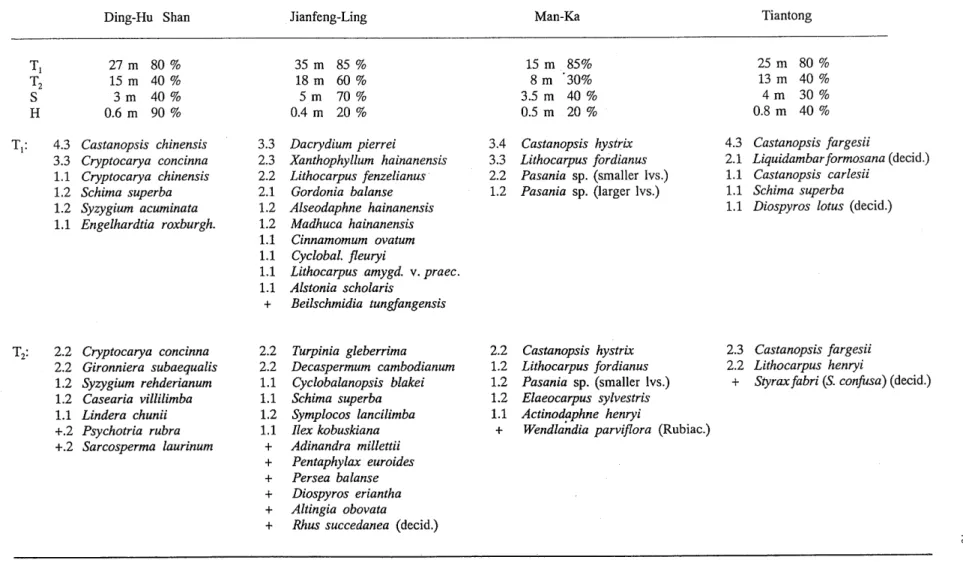
(18) 80 of the 88 genera. The eight genera which do not reach Japan are Fissistigma (Annonaceae, 60 spp.), Strychnos (Loganiaceae, 190 spp., especially in Africa), Semnostachya (Acanthaceae, 9 spp., western Malesia) , and Litosanthes (Rubiaceae, 5 spp.) with mainly tropical distributions; Engelhardtia (Juglandaceae, 5 spp. from the Himalaya to Malesia), Embelia (M~rsinaceae, 130 spp.), and Astronia (Melastomataceae, 70 spp.) which also have subtropical members; and Gordonia (Theaceae, 70 spp.). Gordonia apparently occurred in Japan before the Pleistocene glaciations and still has about 15 species in China and one in the southeastern USA. The number of endemics in the relev6 samples was rather high. This included 34 of the 117 dicotyledonous species and the one variety identified (plus one conifer and three monocotyledons). There were five endemics each in the main laurophyll families Lauraceae, Fagaceae, and Theaceae, a s well as two each in the Myrsinaceae, Rubiaceae, and the genus Ilex (Aquifoliaceae). Given the high taxon richness among laurophylls already noted, this .should be no surprise. The highest rate of endemism is in the Fagaceae and Theaceae, each with five endemics out of nine species recorded. Analysis of taxon occurrence in China is not done in detail, but some impressions can be gained from relev6s by two of the authors (KF, EB) at several well studied sites in southern China: Tiantong National Park, near Ningbo south of Shanghai (Box et al. 1991b; cf. Song 1995); Ding-Hu Shan Biosphere Reserve west of Guangzhou, the lowland part of which Kong et al. (1997) described a s "transitional to tropical"; unpublished; cf. Pignatti et al. 1990a, 1990b Wang et al. 1982; Jianfeng-Ling %@%montane forest in southwestern Hainan (Box et al. 1989); and Man-Ka mountain in the Menglun area of lowland, tropical Xishuangbanna, in southern Yunnan, near the Lao border (Box et al. 1991a). The compositions of the canopy and understorey tree strata of the most comparable of these stands are juxtaposed in Table 4. DingHu Shan and Tiantong span the subtropical zone in eastern China, while the short montane forest at 1070m on Man-Ka mountain in southern Yunnan is also a Castanopsis-dominated s b n d (each by a different species). Jianfeng-Ling %@%, at 890 m on Hainan, is tropical lower montane, with a much larger tropical component including the dominant Dacrydium pierrei (Podocarpaceae) and families such as Xanthophyllaceae and Pentaphylacaceae (monospecific). Its canopy and tree understorey still, however, contain four evergreen Fagaceae and four Lauraceae species. The canopy and sub-canopy compositions of relev6s a t these four locations in China are juxtaposed in Table 4. Even in different areas with different species, it appears that the basic overstorey structure of East Asian laurophyll forests can remain similar, with dominance shared by laurophyll species of Lauraceae and evergreen Fagaceae as well as other laurophyll families such as Theaceae. Total richness in these four relev6s varies from 108 species, 82 genera, and 47 families a t Jianfeng to 52 species, 42 genera, and 28 families in the Tiantong Castanopsis forest. The ratio of laurophyll to total species in the relev6s ranges from 17% at Ding-Hu to 52% at Tiantong XS (31% and 33% for the two mature Taiwan relev&). Absolute numbers of laurophyll taxa also vary widely, from 13 species, 10 genera and 7 families a t Ding-Hu to 42 species, 24 genera and 11 families a t Jianfeng. As Table 4 suggests, however, the number of laurophyll taxa in the canopy and sub-canopy appears to remain somewhat more consistent. For example, tropical montane Jianfeng had the largest number of laurophyll taxa a t all levels, but a greater fraction of them appeared only in understorey layers and may be restricted to successional status. In addition to Ohsawa's idea of separate noto-laurophyll and micro-laurophyll synusiae, Ohsawa and Nitta (1997) have posed two hypotheses concerning the structure of taxon richness.
(19) w. Table 4. Tree-stratum composition of selected Chinese evergreen broad-Leaved forest stands.. Ding-Hu Shan. Jianfeng-Ling. Man-Ka. Tiantong. Castanopsis fargesii Liquidambar formosana (decid.) Castanopsis carlesii Schima superba Diospyros lotus (decid.). T,:. 4.3 3.3 1.1 1.2 1.2 1.1. Castanopsis chinensis Cryptocarya concinna Cryptocarya chinensis Schima superba Syzygium acuminata Engelhardtia roxburgh.. Dacrydium pierrei Xanthophyllum hainanensis Lithocarpus fenzelianus Gordonia balanse Alseodaphne hainanensis Madhuca hainanensis Cinnamomum ovatum Cyclobal. fleuryi Lithocarpus amygd. v. praec. Alstonia scholaris Beilschmidia tungfangensis. 3.4 3.3 2.2 1.2. Castanopsis hystrrjc Lithocarpus fordianus Pasania sp. (smaller lvs.) Pasania sp. (larger lvs.). 4.3 2.1 1.1 1.1 1.1. T,:. 2.2 2.2 1.2 1.2 1.1 +.2 +.2. Cryptocarya concinna Gironniera subaequalis Syzygium rehderianum Casearia villilimba Lindera chunii Psychotria rubra Sarcosperma laurinum. Turpinia gleberrima Decaspermum cambodianum Cyclobalanopsis blakei Schima superba Symplocos lancilimba Ilex kobuskiana Adinandra millettii Pentaphylax euroides Persea balanse Diospyros eriantha Altingia obovata Rhus succedanea (decid.). 2.2 1.2 1.2 1.2 1.1. Castanopsis hystrrjc Lithocarpus fordianus Pasania sp. (smaller lvs.) Elaeocarpus sylvestris Actinodpphne henryi Wendlandia parviflora (Rubiac.). 2.3 Castanopsis fargesii 2.2 Lithocarpus henryi + Styraxfabri (S. confusa) (decid.). +.
(20) within laurophyll forests: 1 ) that genus richness remains similar a s species richness decreases, both toward the north and upward in mountains; and. 2) that the ratio of the notophyll and microphyll synusiae remains relatively consistent in different laurophyll forests and locations. The four Chinese relevBs tend to support the first hypotheses somewhat, especially within the canopy and sub-canopy layers. The ratio of notophyll to microphyll laurophyll species seems more variable, however, ranging from 6:10 a t Ding-Hu. to 10:6 a t Man-Ka. 5ii-k (9:7 and 14:ll in the. two mature Taiwan relevBs; based simply on the numbers of species occurring in families designated a s mainly notophyll or microphyll.) These are interesting hypotheses and deserve more detailed further study. Only one species occurred in more than three of the total of seven relevBs (i. e. three from Taiwan and four from China). That species was Schima superba, which along with its variety kankoensis in southern Taiwan occurred in all relev6s except Man-Ka in southern Yunnan, where it was replaced by Schima wallichii.. Climatic Position of East Asian and other Laurophyll Forests Terms such a s 'warm-temperate' and 'subtropical'. - even. 'tropical' (cf southern Taiwan). -. are. used commonly but quite inconsistently. In East Asia the situation is complicated by the conflict between the official system of climatic zones in China, based mainly on the growing season and agricultural potentials, and the more global, or a t least Northern Hemispheric, perspective of the system used in Japan and Korea, based on the main factor which limits vegetation zones, i. e. winter temperatures. Equivalences between the two systems have been given by Song (1995) and by Box (1991b, 1995a). Essentially, the Chinese usage of warm-temperate is for the temperate deciduous forest zone,* and zones are called subtropical a s soon a s the zonal vegetation becomes (broad-leaved) evergreen. This terminology seems to have come from the work of Alisov (1954) and is seen also in various European and other high-latitude perspectives. From a more global perspective (e. g. Walter 19851, a s well as from a wider East Asian perspective (e. g. Kira 1945, 1977, 1995; Suzuki 1952, 19531, the temperate deciduous forest zone is called temperate (or cool-temperate) and the adjacent first equatorward zone of evergreen broad-leaved forests is called warm-temperate, with recognition that this forest type may extend into the subtropics with little change in physiognomy. The transition into the subtropics is accompanied, however, by the largest turnover in taxonomic composition along the entire polar-tropical gradient. This taxonomic discontinuity is familiar in Japan, falling between the northern Ryukyu Islands, with flora much like that of Kyushu, and the southern Ryukyu Islands, with many tropical taxa similar or identical to those of Taiwan (cf. Hosokawa 1958). A similarly abrupt, major turnover in taxa is found in southern Florida, where most essentially temperate woody taxa from the north are replaced, over a northsouth distance of less than 100km, by an essentially Caribbean flora in south Florida (e. g. Little 1971). An attempt to provide global criteria for a comprehensive system of zonal terminology is given in Table 5 (cf. Box 1995a). The fundamental question in reconciling the two climatic perspectives involves the meaning of the term subtropical. The root 'sub' means almost. It seems semantically more reasonable to name the bioclimatic zones such that the boundary between tropical and temperate falls at the botanical discontinuity between tropical and temperate floras. This is.
(21) Table 5. Criteria for global climatic zonation in lowlands. w. Temperature extremes. Significance. Examples. TROPICAL. No frost or other "cold" temperatures ever. Extreme cold sensitivity of many truly tropical plants. Amazon Basin, East Indies. SUBTROPICAL. Occasional frost or near-frost, not every year and not below about -1°C. Frost sensitivity of tropical evergreen and most other tropical plants. South and Southeast Asia, southern Africa, southern Brazillnorthern Argentina. WARM-TEMPERATE. Light to moderate frost, everylnearly every year; absolute minima not < -15°C. Leaf-changing seasonal broadleaved evergreens tolerate, subtropical evergreens may not. Southern mainland Japan, east-central China, SE USA. TEMPERATE. Significant frost every year, occasional temperatures significantly below -15°C. Below coldness tolerance limit for extra-tropical evergreen broad-leaved plants. Deciduous forest regions of eastern North America, N Japan and NE China, most of middle Europe. COOL-TEMPERATE. Moderate to significant frost every winter, plus cool summer. Growing-season warmth marginal for many typical temperatezone plants, including deciduous. Northern Europe (not boreal), Hokkaido, NE U S A E Canada. BOREAL. Cool, short summer and long severe winter; absolute minima << -15°C and perhaps < -40°C. Growfng season insufficient for most deciduous trees (exceptions: larch, birch, etc.). Most of Russia, Canada-Alaska, and Fenno-Scandia except south (nowhere in Southern Hemisphere). AUSTRAL. Like cool-temperate but extremes moderated by essentially oceanic climate. Growing season marginal but snow-freelfrost-free periods longer: more evergreenness. Southern New Zealand, subantarctic and some subarctic islands,. POLAR. Short summers below 10°C and long severe winters. below O°C, extremes < -40°C unless oceanic. Growing-season too cool for wood-producing enzymes: no trees or significant shrubs. Polar regions and alpine belts of mountains.
(22) done in Table 5, unifying the basic terminology from a global perspective while focusing also on the main limiting factors of the main vegetation zones. This also coincides with the usage of Kira, Walter, and others, resulting in relatively well balanced tropical, temperate, and polar regions. In East Asia and to a lesser extent in southeastern North America, this results in evergreen broad-leaved forest spanning the warm-temperate and adjacent (humid) subtropical zone. -. and. spanning the major taxonomic discontinuity, without striking difference in physiognomy. The two parts of the evergreen broad-leaved forest zone, at least in the Northern Hemisphere, can be distinguished a s follows (cf. Fujiwara 1981-86): 1 ) warm-temperate evergreen broad-leaved forests are mainly lauro-fagaceous, with a few tolerant subtropical taxa and a temperate deciduous element; the secondary forest is mainly temperate deciduous; 2 ) subtropical evergreen broad-leaved forests are also mainly lauro-fagaceous, but with many taxa which are exclusively tropical/subtropical and very few truly temperate elements; the secondary forest is mainly evergreen, often formed by coppice of canopy species. The boundary between subtropical and warm-temperate is the taxonomic discontinuity, since the appearance of significant frost limits the tropical taxa. Subtropical (evergreen) plants can tolerate only infrequent, very short periods of very light frost, if they tolerate any frost a t all; warmtemperate (evergreen) plants tolerate a t least light frost every year and may tolerate temperatures a s low a s about -15°C overnight (cf. Larcher 1976; Woodward 1987; Box 1995a, 199513). In this sense, the laurophyll forests in the central Taiwanese mountains appear to be a t most only transitional to the subtropics, since there are few exclusively (sub)tropical taxa. The typhoon forest in southern Taiwan is marginally subtropical, a s seen from its larger component of non-laurophyll, (sub)tropical elements such a s Glochidion, Engelhardtia, and Pithecellobiurn. Lowland regions (and plants) should not be called tropical until truly tropical taxa appear inland, not just along a coastal strand (cf. southern Taiwan), and dominants of the warmtemperate lauro-fagaceous forest largely disappear or are a t least reduced to successional status.. Regeneration Potential of East-Asian Laurophyll Forests Not only proximal forest disturbance but also effects of global warming suggest that it may be important to examine the regeneration potential of laurophyll forests, both in situ and relative to dispersal and migration. Occurrence of canopy and tree-understorey species in the lower stand layers provides initial suggestions of regeneration potentials and is summarized in Table 6 for the three relev6s. This table also shows more graphically the differences in canopy structure between the mature laurophyll forest relev&, which are composed almost totally of laurophyll species, and the typhoon forest of southern Taiwan, with more non-laurophyll species. The first impression one gets from these data is that regeneration is occurring for most tree species but is rather idiosyncratic in any particular stand, with some canopy species showing seedlings and others not. There was also regeneration by woody laurophyll species not in the canopy (see Relev6 21, but in the other two samples the relativ.ely few seedlings in the herb layers were of canopy species. In the laurel forest sample the only woody seedlings in the herb layer were of. Beilschmidia erythrophloia, which also had saplings in the shrub layer. Schima superba (including var. kankoensis) was the only species common to the canopy of all three relev6s but did not occur in a lower relev6 layer except in the typhoon forest. Every other true canopy species occurred in a lower relev6 layer except Machilus kusanoi from the laurel forest (Relev6 1) and Castanopsis. '.
(23) 83. Table 6. Regeneration by main canopy tree species in Taiwanese Laurophyll forest stands studied.. Guan-Gao T, 'T2S H Lauraceae Actinodaphne nantoensis Beilschmidia erythrophloia Beilschmidia tsangii Cinnamomum insularimontanum Cinnamomum randaiense Cryptocarya chinensis Machilus japonica Machilus kusanoi Machilus thunbergii Machilus zuihoensis. ". . 3. . . 2. 2. . 1 2. Daphniphyllum glaucescens Eurya hayatai Helicia formosana Ilex cochinchinensis Ilex formosae Symplocos wikstroemifolia Syzygium euphlebium 0ther trees Astronia ferruginea Engelhardtia roxburghiana Eriobotrya deflexa Ficus formosana Glochidion lanceolatum Glochidion rubrum Pithecellobium lucidum Prunus phaeostica (Rosaceae) Sapium discolor (Euphorbiaceae) Scheflera octophylla (Araliaceae). . .. 1. 1. + . . 1. 1. .. .. + . .. 1. 1 + +. .. + . .. 1 . . l + .. . . . . . .. Fagaceae Castanopsis carlesii Castanopsis indica Castanopsis stellato-spina Cyclobalanopsis longinux Lithocarpus amygdalifolius Lithocarpus lepidocarpus Pasania brevicaudata Pasania kawakamii Quercus stenophylloides Other laurophyll trees Elaeocarpus sylvestris Evodia roxburghiana Gordonia axillaris Michelia compressa Schima superba (+ var kanko.) Turpinia formosana. Yi-Nu Pu-Bu T, T2 S H. + . .. . . .. 2 2 ..
(24) stellato-spina from the typhoon forest (Relev6 3). There seems to be less regeneration by shrubs than by tree species, perhaps due to the greater resources (light) available to the taller trees. The pattern of lower-level regeneration in the Chinese relev6s (not shown) was similar. Under global warming, dispersal potential becomes important along with the ability to germinate and grow in a forest understorey or opening. The kinds of species which might regenerate successfully under these conditions are suggested, for central Japan, by data on those species which invade planted forests of potential canopy species in urban and peri-urban areas (Fujiwara and Box, in press). In the 35 plots studied, woody species which entered the most plots the fastest included weedy shrubs such as Ligustrum japonicum, less undesirable species such a s Euonymus japonicus and Pittosporum tobira, but also deciduous trees such a s Celtis sinensis var. japonica and Aphananthe aspera (both Ulmaceae), and a few laurophylls such a s Cinnamomum japonicum and Neolitsea sericea (Lauraceae), Eurya japonica (Theaceae), and shrubs Fatsia japonica and Aucuba japonica.. Conclusion The richness of East Asian laurophyll forests, a s represented by the two mature stands documented from the mountains of central Taiwan, is extraordinary, but especially so in Lauraceae, in laurophyll taxa in general, and in higher-level relative richness (number of genera and families relative to richness in the next lower levels). In this respect these forests approach the tropical pattern, in which almost every individual in tropical rainforest plots may represent a different species, usually a different genus, and often a different family. This fact alone, however, does not make the laurophyll forests, tropical or even subtropical, since taxa which are limited to the tropics and subtropics may not be well represented. Most laurophyll species are not limited to the tropics and/or subtropics but rather come up through the subtropical zone and well into the warm-temperate zone a s their coldness sensitivities permit. Most East Asian laurophyll species tolerate significant frost, to temperatures a s low a s about -1 5°C a s a general limiting value (even for short-term exposure). The major taxonomic discontinu-. ity a s one enters the subtropics from the temperate zone occurs in the middle of the evergreen broad-leaved forest zone of the Northern Hemisphere, both in East Asia and in eastern North America. This is less clear in the Southern Hemisphere, but there is no compelling general biogeographic evidence to the contrary. As a result, one has the interesting situation in which evergreen broad-leaved forests, including laurophyll forests, span the warm-temperate and (humid) subtropical zones on continental east sides, with little change in physiognomy or in representation of laurophyll genera and families. -. but with a major genus-level discontinuity outside these. main laurophyll families. Evergreen broad-leaved. forests, including laurophyll forests, can be classified a s warm-. temperate or subtropical based on climatic criteria, the biogeographic ranges of the taxa in-. volved (mainly above the species level), and on the typical composition of their secondary forest vegetation after disturbance. These three classes of specific criteria usually agree; if not, the location in question may best be described a s transitional. Natural regeneration of East Asian laurophyll forests, both in situ after disturbance and involving dispersal and migration, appears to be relatively good. Many taxa characteristic of mature forests produce fleshy fruits which can be dispersed readily by birds, especially the Lauraceae, Elaeocarpaceae, Magnoliaceae, and Theaceae. In the subtropical zone these laurophyll taxa may have less competition from the bird-dispersed fleshy fruits of Rosaceae and other more typically.
(25) temperate taxa and so may be able to disperse faster, including migration a s necessary under conditions of global warming. The situation for laurophyll forests under global warming may be suggested somewhat by the composition of the typhoon forest shown in Relev6 3. Warmer conditions will cause canopy and subcanopy trees to die off (probably gradually), opening the canopy for colonization by other species. These other species may involve a greater number of tropical and subtropical taxa, a s in the. typhoon-forest sample. Canopy laurophyll species will not necessarily be eliminated from these areas, though, just because canopy individuals have died. Their seedlings may tolerate the warmer conditions and be able to remain in these locations quite well a s long a s they adapt their metabolism, biomass accumulation, and consequent respiration loads to the new conditions.. Acknowledgement We are greatly indebted to the following people who helped us during our fieldwork in Taiwan: Yieh Shih-Wen (Superintendent, Yu-Shan National Park); Chen Yueh-Fong (plant identifications in central Taiwan); Chiou Wen-Liang (plant identifications in southern Taiwan); Chan TehShi, Cheng Ching-Ming, Ching Chang-Fu, and Chaw Shu-Miaw; Lu Li-Chiang (guide) and Shen Shin-Ming (driver). @. References Alisov, B. P. 1954. Die Klimate der Erde (ohne das Gebiet der UdSSR).. German translation of. Russian original. 277 pp. Box, E. 0 . 1995a. Global and local climatic relations of the forests of East and Southeast Asia. In: Vegetation Science in Forestry (E. 0 . Box et al., eds.), Handbook Vegetation Sci., vol. 12/ 1, pp. 23-55. Dordrecht: Kluwer. Box, E. 0 . 1995b. Factors determining distributions of tree species and plant functional types. Vegetatio, 121 : 101-116. Box, E. 0 . 1996. Plant functional types and climate a t the global scale. J. Vegetation Science, 7 : 309-320. Box, E. 0 . 1997. Bioclimatic position of evergreen broad-leaved forests. In: Island and HighMountain Vegetation: Biodiversity, Bioclimate and Conservation, Proceedings, IAVS Symposium Tenerife, pp. 17-38. Universidad de L a Laguna, Serie Informes no. 40, Tenerife (Canary Islands), Spain. Box, E. O., K. Fujiwara, Hao Y.-L., Zhong Y., Fu Q.-H., & Xiao B.-Sh.. 1989. A tropical montane evergreen forest and other vegetation on Hainan Island, southern China. Bull. Inst. Environm. Sci. Technol., Yokohama Natl. Univ., 16 : 75-94. Box, E. O., K. Fujiwara, & Qiu X.-Zh. 1991a. Diversity and dissimilarity of three forest types in Xishuangbanna, tropical southern China. Bull. Inst. Environm. Sci. Technol., Yokohama Natl. Univ., 17 : 85-105. Box, E. O., Song Y .-Ch., A. Miyawaki & .K. Fujiwara 1991b. An evergreen broad-leaved forest in transitional eastern China. Bull. Inst. Environm. Sci. Technol., Yokohama Natl. Univ., 17 : 63-84. Chen Ling-Zhi, Chang Hs.-Sh., & Committee (eds.) 1986. Proceedings of the International Symposium on Mountain Vegetation. Botanical Society of China, Beijing. 297 pp. Chen Y.-F. 1984. (Plants and Vegetation of 0-Luan-Pi Park.) Kenting National Park Headquarters, Taipei. 118 pp, incl. color photos (in Chinese, with Latin names)..
(26) Chen Y.-F. 1985. (Coastal Vegetation of Kenting National Park.) Kenting National Park Headquarters, Taipei. 264 pp, incl. color photos (in Chinese, with Latin names). Flora of Taiwan Editorial Committee (eds.) 1975-79. Flora of Taiwan. 6 vols. Taipei: Epoch Publishing Co. 5000 pp., with bibliography, checklist, Chinese names, and index (Vol. 6). Fujiwara, K. 1981-86. Nihon-no jouryoku shoujou shinrin-no gunraku taikei (Phytosociological investigation of the evergreen broad-leaved forests of Japan). 4 parts. Bull. Inst. Enuironm. Sci. Technol., Yokohama Natl. Uniu., 7 : 67-133; 8 : 121-150; 9 : 139-160; 13 : 99-149 (in Japanese, with English summaries in parts 1 and 4). Fujiwara, K. 1986. Comparison of the subtropical evergreen broad-leaved forests of Japan and Thailand. INTECOL Bulletin, 13 (1986) : 29-32. Fujiwara, K. 1987. Aims and methods of phytosociology or "vegetation science." In: Papers on. Plant Ecology and Taxonomy to the Memory of Dr. Satoshi Nakanishi, pp. 607-628. Kobe Geobotanical Society. Fujiwara, K., & E. 0 . Box (in press). Evergreen Broad-Leaved Forests in Japan and Eastern North America: Vegetation Shift under Climatic Warming. In: Proceedings, International Symposium on Laurophyllization, Ascona, March 1997 (F. Kloetzli et al., eds.). Hara, M., K. Hirata, M. Fujihara, K. Oono, & Hsieh Ch.-Fu 1997. Floristic composition and stand structure of three evergreen broad-leaved forests in Taiwan, with special reference to the relationship between micro-landform and vegetation pattern. Nut. Hist. Res. (Chiba) , special issue no. 4 : 81-112. Hara, M., & Ch. Yonebayashi (eds.) 1997. Lucidophyllous Forests in Southwestern Japan and Taiwan. Natural History Research, Special issue no. 4. Chiba: Natural History Museum. 173 pp. Hayata, B. 1911. Materials for a flora of Formosa. Supplementary notes to the Enumeratio. Plantarum Formosanarum and Flora Montanae Formosae, based on a study of the collections of the Botanical Survey of the Government of Formosa, principally made a t the herbarium of the Royal Botanic Gardens, Kew. J. Coll. Sci. Uniu. Tokyo, 30 : 1-471. Hosokawa, T. 1958. On the synchorological and floristic trends and discontinuities in regard to the Japan-Liukiu-Formosa area. Vegetatio, 8 : 56-92. Hsieh Ch.-F., Lai I-L., Song G.-Zh., Liao Ch.-Ch., & Yang K.-Ch. 1997. Biodiversity and conservation of the evergreen broad-leaved forests in Taiwan. Tropics (Jap. Soc. Trop. Ecol.), 6 (4) : 36 1-370. Hsieh Ch.-F., Chao W.-C., Liao Ch.-Ch., Yang K.-Ch., & Hsieh T.H. 1997. Floristic composition of the evergreen broad-leaved forests of Taiwan. Nut. Hist. Res. (Chiba), special issue no. 4 : 116. Hiibl, E, 1988. Lorbeerwalder und Hartlaubwalder (Ostasien, Mediterraneis und Makaronesien).. Diisseldorfer Geobotan. Kolloq., 5 : 3-26. Institute of Botany (Academia Sinica) 1972-76. Zhonggue Gaodeng Zhiwu Tujian (Iconographia Cormophytorum Sinicorum). Science Press, Beijing. 5 vols.+2 supplements, each about 800-1300 pp (in Chinese, with Latin indices). Kira, T. 1945. Nougyou Chirigaku-no Kiso to shite no Tou-A no Shin Kikou Kubun (A new classification of climate in eastern Asia, a s the basis for agricultural geography.) Horticultural Institute, Kyoto University. 23 pp (in Japanese). Kira, T. 1969. (What is lucidophyll forest?) In: (Culture in the Laurel Forest Zone) (S. Ueyama, ed.), pp. 43-84. Hyokouron-sha, Tokyo. (In Japanese) Kira, T. 1977. A Climatological Interpretation of Japanese Vegetation Zones. In: Vegetation Science. and Enuironmental Protection (A. Miyawaki et al., eds.) , pp. 21-30. Tokyo: Maruzen..
(27) Kira, T. 1991. Forest ecosystems of East and Southeast Asia in a global perspective. Ecol. Res. (Japan), 6 : 185-200. Reprinted in: Vegetation Science in Forestry (E. 0 . Box et al., eds.), pp. 121. Dordrecht: Kluwer. Klotzli, F . 1984. The position of Fagaceae and Myrtaceae on the Pacific mountains. Erdwiss. Forsch., 18 : 337-354. Klotzli, F . 1988. On the global position of the evergreen broad-leaved (non-ombrophilous) forest in the subtropical and temperate zones. In: Contributions to Knowledge of the Flora and Vegetatio'n of Central Japan (A. Miyawaki and E. Landolt, eds.). Veroff. Geobot. Inst. ETH, Stiftung Riibel (Zurich), 98 : 169-196. Kong G.-H., Huang Z.-L., Zhang Q.-M., Liu S.-Z., Mo J.-M., & He D.-Q. 1997. Type, structure, dynamics and management of the lower subtropical evergreen broad-leaved forest in the DinghaShan Biosphere Reserve of China. Tropics (Jap. Soc. Trop. Ecol.), 6 (4) : 335-350. Larcher, W. 1976. Okologie der Pflanzen. 2nd ed. Verlag Eugen Ulmer, Stuttgart. Little, E. L., J r . 1971. Atlas of United States Trees. Vol. 5: Florida. US Dept. of Agriculture Misc. Publ. no. 1361. US Govt. Printing Ofc., Washington. 22 pp text, with 262 maps. Mabberley, D. J. 1987. The Plant Book. Cambridge Univ. Press. 706 pp. Miyawaki, A., Sh. Okuda, & R. Fujiwara (Mochizuki) 1994. Nihon Shokusei Binran (Handbook of Japanese Vegetation). New Revised Edition. Shibundo, Tokyo. 910 pp (in Japanese, with Latin species index. D. Ohsawa, M. 1991. Structural comparison of tropical montane rainforests along latitudinal and altitudinal gradients in south and east Asia. Vegetatio, 97 : 1-10. Ohsawa, M. 1995a. Latitudinal comparison of altitudinal changes in forest structure, leaf type, and species richness in humid monsoon Asia. Vegetatio, 121 : 3-10. Ohsawa, M., & I. Nitta 1997. Patterning of subtropical/warm-temperate evergreen broad-leaved forests in East Asian mountains with special reference to shoot phenology. Tropics (Jap. Soc. Trop. Ecol.), 6 (4) : 317-334. Oono, K., M. Hara, M. Fujihara, & K. Hirata 1997. Comparative studies on floristic composition of the lucidophyllous forests in southern Kyushu, Ryukyu, and Taiwan. Nat. Hist. Res. (Chiba), special issue no. 4 : 17-79. Ovington, J . D. (ed.) 1983. Temperate Broad-Leaved Evergreen Forests. "Ecosystems of the World" series, Vol. 10. Amsterdam: Elsevier. 241 pp. Pignatti, E., S. Pignatti, Huang Ch.-Ch., Ding G.-Qi, & Huang Zh.-L. 1990a. Phytosociological investigations in the Ding-Hu Shan forest (Guangdong South China). Rendiconti Fisiche Accademia Lincei, ser. IX, 1 : 335-356. Pignatti, E., S. Pignatti, Huang Ch.-Ch., Ding G.-Qi, & Huang Zh.-L. 1990b. Chorological analysis of the Ding-Hu Shan flora. Rendiconti Fisiche Accademia Lincei, ser. IX, 1 : 465-472. Rubel, E. 1930. Pflanzengesellschaften der Erde. Bern: Verlag Hans Huber. 464 pp. Song Y.-Ch. 1995. On the global position of the evergreen broad-leaved forests of China. In: Vegetation Science in Forestry (E. 0.Box et al., eds.), Handbook Vegetation Sci., vol. 12/1, pp. 6984. Dordrecht: Kluwer. Song Y.-Ch. (ed.) 1995. (Vegetation and Flora of Tiantong National Forest Park, .Zhejiang Province.) Shanghai Science and Technology Press, Shanghai. (In Chinese) Suzuki, T. 1952. Tou-A no Shin-Rin Shokusei (Forest Vegetation of East Asia). Kokon Shoin, Tokyo. 137 pp (In Japanese). Suzuki, T. 1953. The forest climaxes of East Asia. Jap. J. Bot., 14 : 1-12. Tagawa, H. 1997. Worldwide distribution of evergreen lucidophyll oak-laurel forests. Tropics (.
(28) J a p . Soc. Trop. Ecol.), 6 (4) : 295-316. Tagawa, H., & M. Hotta (eds.) 1997. Special issue on "Co-existence of the World Humid Evergreen Forest Ecosystems and People." Tropics (Jap. Soc. Trop. Ecol.), 6 (4) : 283-477. Walter, H. 1985. Vegetation of the Earth. 3rd ed. Springer-Verlag, New York. 318 pp. Wang Zhu-Hao, He D.-Q., Song Sh.-D., Chen Sh.-P. Chen D.-Ru, & Tu M.-Zh. 1982. The vegetation of Ding-Hu Shan Biosphere Reserve. Trop. Subtrop. For. Ecosys. (Guangzhou), 1 : 77-141. Whitmore, T. C. 1975. Tropical Rainforests of East Asia. Clarendon Press, Oxford. 282 pp. Woodward, I. 1987. Climate and Plant Distribution. Cambridge University Press..
(29) I. Appendix : Species identified from three laurophyll forest stands studied in Taiwan.. '. Identifications were made mainly by the Taiwanese co-author and colleagues, following the nomenclature of the "Flora of Taiwan" (Flora of Taiwan Editing Committee 1975-79). Species are listed by family, based on Mabberley (1987). Species occurrences in the three stands (see main text) are indicated as follows: G = Guan-Gao (Yu-Shan Mountains, central Taiwan); Y = Yi-Nu Pu-Bu (Yu-Shan Mountains, central Taiwan); K = Kenting National Park (Nan-Jen Shan, southern Taiwan). Information on distribution outside Taiwan is from .the "Flora of Taiwan" supplemented as needed by Miyawaki et al. (1994). Species not listed in the "Flora of Taiwan" are indicated by a following asterisk. Pteridophyta Adiantaceae (incl. Pteridaceae) Coniogramme sp. Pteris cretica (< Pteridaceae) Pteris fauriei Pteris tokioi Aspleniaceae (incl. Athyriaceae) Acrophorus stipellatus (< Dryopterid.) Arachniodes amabilis* (< Dryopteridac.) Arachniodes aristata Arachniodes pseudaristata Asplenium antiquum Diplazium dilatatum (Athyrioidae) Diplazium donianum (Athyrioidae) Diplazium mettenianum (Athyrioidae) Dryopteris sp. (< Dryopteridac.) Dryopteris sp, Dryopteris sp, Dryopteris sp, Pleocnemia rufinervis (< Aspidiac.) Polystichum hancockii (< Dryopteridac.) Polystichum sp.. I)lstribution outside Taiwan. .Y. .Y. .Y. G... (genus: Africa to Polynesia) tropicaI & temperate regions China to SE Asia and Japan S Japan. .Y. GY. G.. GY. G.. G.K G.K. N India to Pacific islands India, Malaysia, China to Japan Pakistan to Malaysia, Japan, Polynesia Japan, Ryukyus Japan, Ryukyus Indonesia, China, Ryukyus India, SE Asia, China, Ryukyus China, Japan (genus: cosmopolitan). ..K G.. .Y. .Y. .Y.. ..K G... India to Philippines (cf. Tectaria) S China to Japan. .Y.. Blechnaceae Blechnum orientale Dennstaedtiaceae Microlepia marginata Microlepia sp, Microlepia sp.. . .. Stands. tropical Asia, Pacific, AustraIia. G.. G.. .Y.. Hymenophyllaceae Trichomanes auriculatum (Vandenboschia) G. ... India, HimaIaya to S E Asia, Japan. Japan to Indonesia, Philippines. Polypodiaceae Microsorium buergerianum. GY.. Vietnam, China to Japan. Thelypteridaceae Pronephrium triphyllum. ..K. Sri Lanka to Japan, Australia.
(30) Stands.. Distribution outside Taiwan. Cephalotaxaceae Cephalotaxus wilsoniana. .Y.. endemic to Taiwan. Podocarpaceae Podocarpus formosensis. ..K. SE China. Gymnospermae. Angiospermae: Monocotyledonae. Araceae Epipremnum pinnatunz. Australia to China, Polynesia. Cyperaceae Carex lenta* Carex sp.. India, China to Japan (genus: cosmopolitan). Gramineae Lophatherum gracile Oplismenus compositus Schizostachyum diffusum (bamboo). India, Malaysia, China to Japan cosmopolitan Philippines. Liliaceae Aspidistra daibuensis Ophiopogon sp. Ophiopogon sp, Ophiopogon sp, Orchidaceae Calanthe arisanensis Calanthe sp. Cymbidium sp. Goodyera sp.. endemic to Taiwan (genus: eastern India to East Asia). .Y. ..K .Y. G... Palmae Daemonorops margaritae Smilacaceae Smilax bracteata ssp. verruculosa Smilax lanceifolia Smilax sp, Smilax sp, Smilax sp. (seedling) Smilax sp. Zingiberaceae Alpinia sp. Alpinia sp. (tall) Zingiber kawagoii. endemic to Taiwan. (genus: tropical and E Asia, Australia) (genus: world except Africa, polar). southern China. G... ..K .Y. .Y. .Y. ..K. .Y. G.. . K. SE Asia, Philippines Himalaya to SE China, Malesia (genus: tropical and subtropical). (genus: Old World tropics) endemic to Taiwan.
(31) Angiospermae: Dicotyledonae. Stands. ion outside Taiwan. Acanthaceae Codonacanthus pauciflorus Semnostachya longespicatus (now -cata). ..K ..K. India, S China, Ryukyus, Japan endemic to Taiwan. Annonaceae .Fissistigma glaucescens*. ..K. (cultivated). Apocynaceae Trachelospermum asiaticum Trachelospermum gracilipes. G.. Y K. (included in T. gracilipes) NE India through China to SE Asia. Aquifoliaceae Ilex asprella Ilex cochinchinensis Ilex formosae Ilex formosana Ilex matsudai. ..K ..K ..K GY. ..K. Luzon, SE China N Indo-China, Hainan endemic to S tip of Taiwan southern China endemic to S Taiwan (Hengchun Pen.). Araliaceae Acanthopanax trifoliatus Hedera rhombea Scheflera octophylla Boraginaceae Ehretia longiflora. s.l.: India to Philippines, China, Japan, Korea S China to SE Asia, Ryukyus. ..K. Caprifoliaceae Lonicera acuminata Viburnum odoratissimum Viburnum parvifolium. SE Asia, Hainan, Hong Kong. E India to China India, S China, Philippines, Japan endemic to Taiwan central mountains. Celastraceae Microtropis japonica. ..K. Japan, Ryukyus. Chloranthaceae Sarcandra glabra. ..K. Sri Lanka to Java, Philippines, Japan. Daphniphyllaceae Daphniphyllum glaucescens (= oldhamii) Daphniphyllum himalaense. ..K .Y.. Cambodia, Vietnam, S China to Japan China, 'Korea, Japan. Ebenaceae Diospyros eriantha. ..K. Malaysia to S China, Japan. Elaeagnaceae Elaeagnus sp.. .Y.. (genus: S Europe, Asia, N America). Elaeocarpaceae Elaeocarpus sylvestris. Y K. S China, Ryukyus, Japan.
(32) (Angiospermae: Dicotyledonae). Stands. Euphorbiaceae Glochidion lanceolatum Glochidion rubrum Sapium discolor Fagaceae Castanopsis carlesii Castanopsis indica Castanopsis stellato-spina Cyclobalanopsis longinux Lithocarpus amygdalifolius Lithocarpus lepidocarpus Pasania brevicaudata Pasania kawakamii Quercus stenophylloides (=Cyclobal. st.). Ryukyus Malaysia, Ryukyus Malaysia, S China. Y K ..K ..K Y K ..K GY. ..K GY. .Y.. Flacourtiaceae Idesia polycarpa drossulariaceae (< Saxifragaceae) Itea parviflora. s.1.: SE China Hainan endemic to Taiwan endemic to Taiwan SE China endemic to Taiwan SE China endemic to Taiwan endemic to Taiwan. Central China to Japan. GY.. endemic to Taiwan. Guttiferae Garcinia multiflora. southern China. Hydrangeaceae (c Saxifragaceae) Hydrangea chinensis. W and S China, Philipp., Ryukyus. Illiciaceae Illicium arborescens. endemic to Taiwan. Juglandaceae Engelhardtia roxburghiana. (India to Malaysia, W and S China). Lardizabalaceae Stauntonia hexaphylla Stauntonia sp.. Japan, Ryukyus (genus: eastern Asia). Lauraceae Actinodaphne nantoensis Beilschmidia erythrophloia Beilschmidia tsangii Cinnamomum insularimontanum Cinnamomum randaiense Cryptocarya chinensis Litsea acuminata Litsea nakai Machilus japonica Machilus kusanoi Machilus thunbergii Machilus zuihoensis Neolitsea buisanensis. e. .Y. GYK ..K .Y. G.. ..K GY. ..K GY. G.. GYK ..K ..K. (now in Litsea acuminata) Hainan, Ryukyus SE China (Guangdong) endemic to Taiwan endemic to Taiwan SE China, Ryukyus Japan endemic to Hengchun Peninsula Japan, Ryukyus, S Korea (now in Persea japonica) China, Korea, Japan endemic to Taiwan endemic to Taiwan.
図


関連したドキュメント
Species composition and quantitative aspects of totally 107 tall trees sampled in a deciduous broad- leaved forest stand surveyed in Vitya’z villege, Khasanskii raion
全国の 研究者情報 各大学の.
(2017) identified eight different perceived sensory dimensions of forest environments in urban areas (i.e., serenity, nature, species richness, space, prospect,
ABSTRACT We studied flowering and fruiting seasonality of understory shrubs of genus Medinilla (Melastomataceae) in the lower montane forest on Mount Kinabalu, Borneo, in
Satomi : The evergreen broad-leaved forest of Isle Aoshima in Obama City, Fukui Prefecture. : Rare species and their conservation,
東京大学 大学院情報理工学系研究科 数理情報学専攻. [email protected]
理工学部・情報理工学部・生命科学部・薬学部 AO 英語基準入学試験【4 月入学】 国際関係学部・グローバル教養学部・情報理工学部 AO
静岡大学 静岡キャンパス 静岡大学 浜松キャンパス 静岡県立大学 静岡県立大学短期大学部 東海大学 清水キャンパス
