
暫時約X線源の光度曲線について
7
0
0
全文
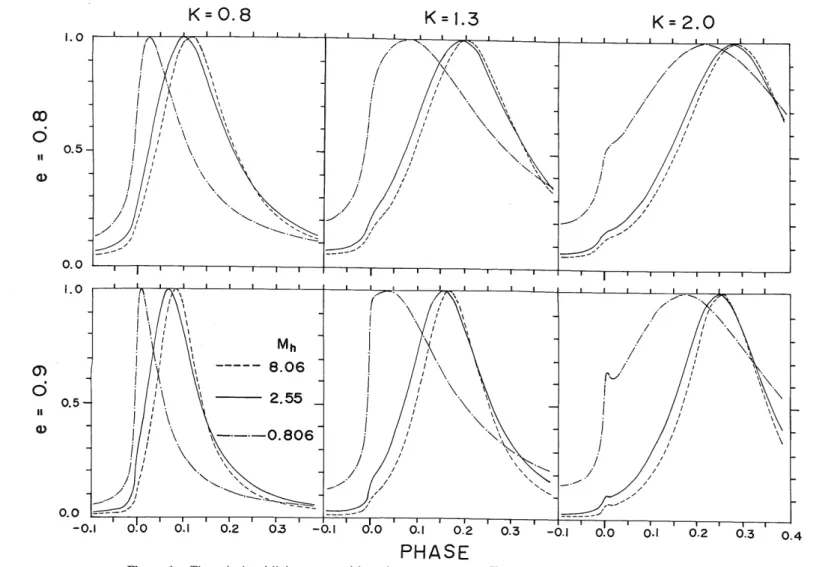
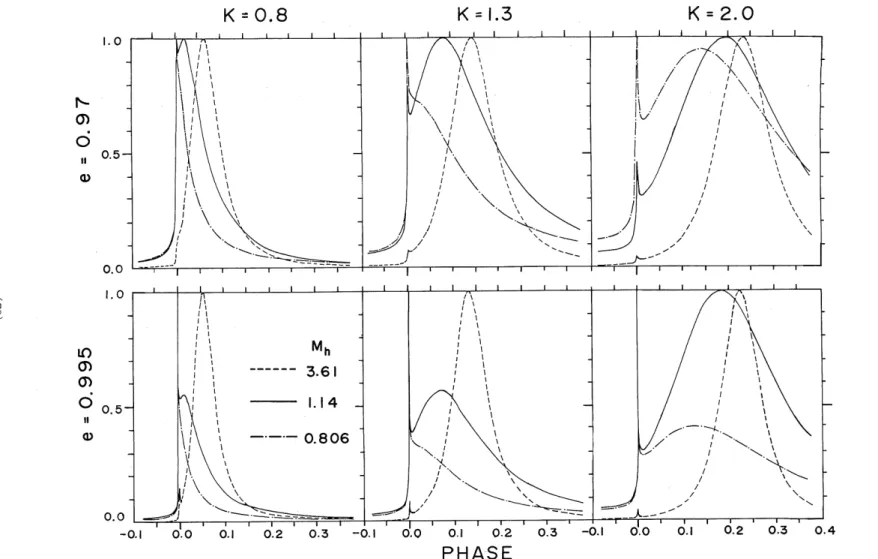
(2) Journal of Hokkaido University of Education (Section H B) Vol. 28, No. 2 February 1978. l^t±^^ (^2^B) ^28-f ^2-^- Bg?53^2^. On the Light Curves of Transient X—ray Sources. Tom OKUDA,Toshiyuki OMURA, and Chieko SANO Earth Science Laboratory, Hakodate College, Hokkaido University of Education Hakodate 040. tWXW^WM^^^^. H ffl -^ • ^ ^ {t ^ • f^ I? ^^:F. ^mMa±wwmws Abstract. The light curves of transient X-ray sources based on an eccentric-orbit binary model have been investigated. From the model with appropriate parameters, we obtain precursor peaks and secondary maxima of light curves as have been observed for many transient X-ray sources. The. light curves depend strongly on the eccentricity, the Mach number of the wind velocity and another parameter K which depends on the semi-major axis and period of the binary system. Some of the transient X-ray sources may be explained in terms of the eccentric binary model. 1. Introduction The eccentric-orbit binary model as a possible model for transient X-ray sources has been. investigated by several authors (Pacini and Shapiro, 1975; Tsygan, 1975; dark and Parkinson, 1975; Avni et al., 1976; Okuda and Sakashita, 1977, hereafter referred to as paper I ). We have now three transient X-ray sources exhibiting repetitive outbursts, that is, A0620—00, A0535+26 and 3U 1630—47. Especially the observations by Jones etal. (1976) showed that 3U 1630—47 was the first example of regularly spaced multiple outbursts with a 600-day period and that the X-ray source might belong to a class of transient X-ray sources which consist of compact objects in. highly eccentric binary systems. Some of the striking features of many transient X-ray sources are asymmetry, a precursor. peak and secondary maximum of the light curves. Stoeger (1976) showed that the precursor peak phenomena might be interpreted on the basis of accretion-disk behaviour with a rising accretion rate. In paper I, we examined the asymmetry of the light curves of the transient X-ray sources,. based on the eccentric binary model. In this further investigation, we show that the precursor peak and secondary maximum phenomena are also obtained from the model with appropriate parameters.. (67).
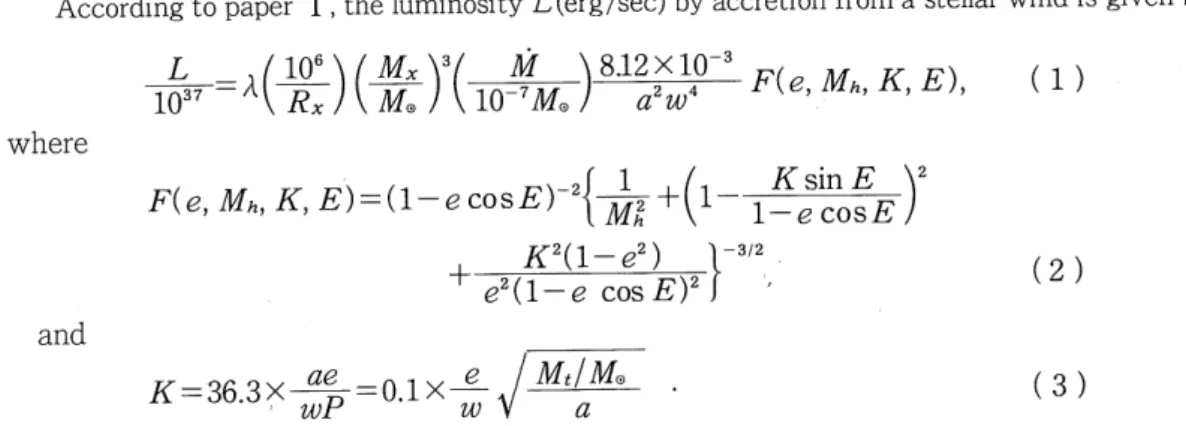
(3) T. OKADA, T. OMURA, and C. SANO. 2. Method and Results According to paper I, the luminosity L(erg/sec) by accretion from a stellar wind is given by. L _,/106\/Mx\3f M \8.12X10⁻³. ~w^=A[it) [1^) [-W^MT) "'^w" F(e-Ml"K-E)- <1) 103 where. K sin E \2 F{e, MH, K, E)==(l-ecosE)-2[-^+(l-^K ecosE /. '2(-[ _ ^,Z\ 1-3/2. e2{l-e cos£)2f ' and. K=36.3X^=0.1X^JM^MS- . (3) WP """" W V (3:. Here A is a constant of the order of unity, a the semi-major axis in the astronomical unit, e the. eccentricity of the orbit, E the eccentric anomaly, P the period of the binary system in the unit of day, w the wind velocity in the unit of 300km/sec, Mn the Mach number of the wind velocity, and Mi the total mass of the binary system. A shape of the light curve is determined by a set of parameters e, Mn and 7C The light curves with various parameters are shown in Figures 1 and 2, normalized to maximum luminosities. And the maximum values of F{e,Mh,K,E} with parameters are given in Table 1. From the figures, we see that the precursor peaks and the secondary maxima occur at the. time of the periastron passage and at later phases, respectively, particularly in highly eccentric cases. This follows from the fact that the density of the stellar wind through which a compact Table 1. The maximum values of F{e, Mn, K, E) with various parameters e, K and M^. e. 0 .8. M,. 0. 3.80. 1.33. 0.445. 2.59. 0.966. 0.364. 0.806. 0.835. 0.255. 0.112. 4.65. 1.63. 12.7. 2.55. 6.50. 2.46. 1.04. 0.806. 1.72. 0.423. 0.170. 30.8. 11.6. 5.32. 1.14. 4.14. 1.09. 0.524. 0.806. 3.78. 0.872. 0.239. 3.61. 0 .995. K=2.0. 2.55. 3.61. 0 .97. K=1.3. 8.06. 8.06 .9. K=0.8. 67.3. 24.9. 14.0. 1.14. 9.63. 2.25. 0.619. 0.806. 9.59. 2.25. 0.618. (68).
(4) K=1.3 1.0. K=2.0. CD. 0 II. 0.5^. CD. 0 0 r. 0. 0.0. ^. x. 0}. 0 18. Q?. 0.0 l=rf=. PHASE Figure 1. The calculated light curves with various parameters a, K and Mn, normalized to the maximum luminosities. Phase 0.0 corresponds to the time of periastron passage. Dashed, solid and dot-dash lines denote the cases of ^=8.06, 2.55 and 0.806, respectively.. 0.4.
(5) K=1.3. K=0.8 '. 1.0. '.. '. ^. ^. I. I. 1^. 0). 0 II. 0.5-1. (D. ^. Q ^ > 0 >. ^. 0>. g. a. w >. ID ff). 0. (D. 0 11. co. >. z 0. 0.5-1. <u. 0.0 -0.1. To. 0.1. 0.2. 0.3. -0.1. 0.0. 0.1 0.2. PHASE. 0.3. -0.1. o'.o. 0.1. 0.2. 0.3. Figure 2. The calculated light curves with various parameters e, K and M^, normalized to the maximum luminosities. Phase 0.0 corresponds to the time of periastron passage. Dashed, solid and dot-dash lines denote the cases of M/,=3.61,1.14 and 0.806, respectively.. 0.4.
(6) On the Light Curves of Transient X-ray Sources. star penetrates reaches the maximum value at the time of the periastron passage but that the accretion radius attains its maximum after the periastron passage due to the effect of the relative velocity of the compact star to the stellar wind. It should be noted that the transient sources A1118-61 (Ives et al., 1975; Eyles et al., 1975), A0535+26 (Rosenberg et al., 1975), A0620-00 (Elvis etal., 1975), A1524-62 (Kaluzienski etal., 1975), and A1103+38 (Ricketts etal., 1976) show such a precursor peak or subsequent dip phenomenon which separates the precursor peak from the primary maximum. The secondary maxima or plateaus of the light curves have also been observed for Cen X-4 (Evans et at., 1970), nine nova X-ray sources (Amnuel et al; 1974) and 3U. 1543—47 (Li et al., 1976). We thus suggest that the eccentric binary model may be responsible for the precursor peaks and secondary maxima as have been observed for many transient X-ray sources.. 3. Discussion In order to explain the precursor peak and secondary maximum phenomena in terms of the eccentric binary model, we require a very high eccentricity and K is comparable to unity. This may place severe constraints of application to the observed transient X-ray sources. When Vp and Vesc are the periastron velocity and the escape velocity, respectively, we have. w v z, w,. (4). if e is large.. According to the usual concept of a stellar wind,. (5) thus K^^/J^e-<l. However we emphasize that Vp may exceed w in the acceleration zone of a radiative wind or solar-type wind.. We notice that the recent observations of A0620—00 (Matilsky et al., 1976; Tsunemi et al., 1977) indicate a regular variability in the X-ray and optical flux, with a period of approximately 7.8 days. The period seems to be due to orbital motion. This fact may invalidate the eccentric binary model for A0620—00 because the orbital period is too short. In this respect, the accretion disk model of A0620—00 (Hayakawa, 1976) appears to be very plausible. In our eccentric binary model, we have assumed that the wind velocity or its Mach number. was constant through out the neighborhood of the periastron. The figures show that the calculated light curves depend strongly on the Mach number Mh. Therefore, in order to examime the light curve over the whole phases, we should require more realistic models of the stellar wind. In conclusion, some of the transient X-ray sources may be explained in terms of the eccentric binary model.. (71).
(7) T. OKADA, T. OMURA, and C. SANO. Acknowledgement We are grateful to Dr. S. Sakashita, Department of Physics, Hokkaido University, for his valuable discussions. We also thank Professors K. Oshite and Y. Tonosaki, Earth Science Laboratory, Hakodate College, Hokkaido University of Education, for their constant encouragement. Numerical computations were carried out on a FACOM230—75 at the Computer Center of. Hokkaido University.. References Amnuel, P. R., Guseinov, 0. H. and Rakhamimov, Sh. Ju. (1974), X-ray nova flares. Astrophys. Space Sci., Vol. 29, p.331-342. Avni, Y., Fabian, A. C. and Pringle, J. E. (1976), Transient X-ray sources: A discussion of the eccentric binary hypothesis and a model for A0620-00. Monthly Notices Roy. Astron. Soc., Vol. 175, p.297-304. dark, D. H. and Parkinson, J. H. (1975), Transient X-ray sources. Nature, Vol. 258, p.408-409. Elvis, M., Page, C. G., Pounds, K. A., Ricketts, M. J. and Turner, M. J. L. (1975), Discovery of powerful transient X-ray source A0620-00 with Ariel V Sky Survey Experiment. Nature, Vol. 257, p. 656-657. Evans, W. D., Belian, R. D. and Conner, J. P. (1970), Observations of the developement and disappearance of the X-ray source Centaurus XR—4. Astrophys. J. Letters, Vol. 159, p. L57—60. Eyles, C. J., Skinner, G. K., Willmore, A. P. and Rosenberg, F. D. (1975), Variable X-ray source near Cen X-3. Nature, Vol. 254, p. 577-578. Hayakawa, S. (1976), Accretion disk model of X-ray nova A0620—00. submitted to Astrophys. J. Letters. Ives, J. C., Sanford, P. W. and Bell Burnell, S. J. (1975), Observations of a transient X-ray source with regular periodicity of 6.75 min. Nature, Vol. 254, p. 578-580. Jones, C., Forman, W., Tananbaum, H. and Turner, M. J. L. (1976), Uhuru and Ariel V observations of 3U 1630—47 : A recurrent transient X-ray source. Astrophys. J. Letters,.Vol. 210, p. L9—11. Kaluzienski, L. J., Holt, S. S., Boldt, E. A, Serlemitsos, P. J., Eadie, G., Pounds, K. A., Ricketts, M. J and Watson, M. (1975), The light curve of a transient X-ray source. Astrophys. J. Letters, Vol. 201, p. L121-124. Li, F. K., Sprott, G. F. and dark, G. W. (1976), OSO-7 observations of the X-ray nova 3U 1543-47. Astrophys. J., Vol. 203, p. 187-192. Matilsky, T., Bradt, H. V., Buff, J., dark, G. W., Jernigan, J. G., Joss, P. C., Laufer, B., McClintock, J. and Zubrod,. D. (1976), The transient X-ray source A0620—00: Intensity variations and evidence for an 8 day periodicity. Astrophys. J. Letters, Vol. 210, p. L127-131. Okuda, T. and Sakashita, S. (1977), The eccentric-orbit binary model for the transient X-ray sources. Astrophys. Space Sci., Vol.47, p. 385-396. Pacini, F. and Shapiro, S. L. (1975), Possible models for some transient X-ray sources. Nature, Vol. 255, p.618—619. Ricketts, M. J., Cooke, B. A. and Pounds, K. A. (1976), X-ray transient source at high galactic latitude and suggested extragalactic identification. Nature, Vol. 259, p. 546—547. Rosenberg, F. D., Eyles, C. J., Skinner, G. K. and Willmore, A. P. (1975), Observations of a transient X-ray source with a period of 104 s. Nature, Vol. 256, p. 628-630. Stoeger, W. R. (1976), Accretion-disk scenarios of the precursor peak in X-ray transients. Nature, Vol. 261, p.211— 213.. Tsunemi, H., Matsuoka, M. and Takagisbi, K. (1977), Optical light curve and periodicity of A0620—00. Astrophys. J. Letters, Vol. 211, p. L15-18. Tsygan, A. I. (1975), The Crab Nebula pulsar as a binary-system component. Soviet Astron., Vol. 18, p. 798—799.. (72).
(8)
図
関連したドキュメント
There is a unique Desargues configuration D such that q 0 is the von Staudt conic of D and the pencil of quartics is cut out on q 0 by the pencil of conics passing through the points
From the above, one deduces this result in the case of the foliation F = T X , complementing the currently known connections between existence of curves with large deformation space
We recall here the de®nition of some basic elements of the (punctured) mapping class group, the Dehn twists, the semitwists and the braid twists, which play an important.. role in
A., Some application of sample Analogue to the probability integral transformation and coverages property, American statiscien 30 (1976), 78–85.. Mendenhall W., Introduction
The equivariant Chow motive of a universal family of smooth curves X → U over spaces U which dominate the moduli space of curves M g , for g ≤ 8, admits an equivariant Chow–K¨
Includes some proper curves, contrary to the quasi-Belyi type result. Sketch of
Linares; A higher order nonlinear Schr¨ odinger equation with variable coeffi- cients, Differential Integral Equations, 16 (2003), pp.. Meyer; Au dela des
More general problem of evaluation of higher derivatives of Bessel and Macdonald functions of arbitrary order has been solved by Brychkov in [7].. However, much more
