
Phonological Awareness in Foreign Language
Learning: Japanese Learners' Articulatory
Accuracy of Spanish Liquids
著者
Campos Tejero Oscar Miguel
学位授与機関
Tohoku University
学位授与番号
11301甲第18941号
Doctoral Dissertation
Phonological Awareness in Foreign Language Learning:
Japanese Learners’ Articulatory Accuracy of Spanish Liquids
(外国語学習における音韻意識
--日本人学生のスペイン語の流音の調音精度--)
Campos Tejero Oscar Miguel
2019
Doctoral Dissertation
Phonological Awareness in Foreign Language Learning:
Japanese Learners’ Articulatory Accuracy of Spanish Liquids
(外国語学習における音韻意識
--日本人学生のスペイン語の流音の調音精度--)
Campos Tejero Oscar Miguel
2019
PHONOLOGICAL AWARENESS IN FOREIGN LANGUAGE LEARNING: JAPANESE LEARNERS’ ARTICULATORY ACCURACY OF SPANISH
LIQUIDS
A dissertation submitted to the Faculty of the Graduate School of
International Cultural Studies of Tohoku University in partial fulfillment of
the requirements for the degree of Doctor of International Cultural Studies
in the International Graduate Program in Language Sciences
By
Campos Tejero Oscar Miguel
Sendai, Japan
May 2019
Doctoral Dissertation Abstract
Phonological Awareness in Foreign Language Learning:
Japanese Learners’ Articulatory Accuracy of Spanish Liquids
(外国語学習における音韻意識
--日本人学生のスペイン語の流音の調音精度--)
Tohoku University
Graduate School of International Cultural Studies
International Graduate Program in Language Sciences
(IGPLS)
Campos Tejero Oscar Miguel
Supervisor: Prof. Ono Naoyuki
Sub-supervisor: Prof. Shigaki Mitsuhiro
Phonological Awareness in Foreign Language Learning:
Japanese Learners’ Articulatory Accuracy of Spanish Liquids
Campos Tejero Oscar Miguel
B5KD2002
1. Introduction
In Linguistics, Phonological Awareness (PA) is a person’s sensitivity to the structure of sounds in oral language (Anthony & Francis, 2005); however, in the field of Foreign Language Education (FLE), PA is an instructional approach, especially for young kids, that accompany the students in their path of learning how to read and manipulate segments of speech, including words, syllables, and phonemes (Gillon, 2004); normally at the stage of kindergarten or at the first years of elementary school.
Unfortunately, the terms phonological awareness, phonetic awareness,
phonemic awareness and even phonics have been used interchangeably during the
history of oral linguistic research. Phonological awareness is a broader term including all the other terms and it can be defined depending of the phonological level it is being analyzed. Bernhardt and Stoel-Gammon’s model (1994) explains how PA is divided in these levels in relation to its development process: word → syllable → onset-rime → segmental. Furthermore, Phillips et al. (2008) and Anthony et al. (2003) add a continuum (no-sequential-stage) view to Bernhardt and Stoel-Gammon’s model, meaning that students do not need to master a skill of a level before they develop the next level skill, but that they can develop them at the same time.
On the other hand, Phonetic Awareness mainly oversees the articulatory aspect of the speech; whether or not learners are aware of the place and manner of articulation, voicing, lips use, muscular tension, and other specific concerns. Phonemic awareness, relates to how learners segment, blend and manipulate phonemes in order to create and modify word or phrase phonological structures (Gillon, 2004). Finally, phonics is a learning method to help students understand the relationship between phonemes and morphemes through sound patterns in prints, mainly with the purpose of preparing learners to be able to accurately read such patterns (Burns et al., 2003).
Japanese and Spanish are certainly two very different languages, in regard to their origin, grammatical structure, lexicon, writing systems, among many other areas. However, at the phonological level, Japanese and Spanish have some similarities (Ueda, 1977), both have 5 vowel sounds, share the same stops, share most of the fricatives, and more. Spanish phonological system has 3 liquid sounds. The rhotic [r] is an alveolar apical voiced trill which is one of the three liquid consonant sounds, very distinctive of Spanish language, that any average Spanish speaker can distinguish; besides the other apical rhotic (tap) [ɾ] and the only lateral [l]. Both Spanish rhotics are only found in contrastive distribution in intervocalic position, while in other word positions they are in complementary distribution; trill [r] prevails in word initial position and in onsets following [n], [l] and [s] segments. On the other hand, Japanese has only one liquid sound, generally uttered as an apico-alveolar tap [ɾ] (Hattori, 1951) and it occurs only in a CV onset structure.
Japanese language does not have distinctive liquid segments, but the Spanish sound inventory has three ([r], [ɾ] and [l]), and despite that there are several allophones of the Japanese liquid [ɺ], they do not trigger any miscommunication in all their possible
deviations. However, it is important that Spanish FLLs are able to identify the importance of these distinctive segments, as it could lead to misunderstanding, as in the case of the following minimal pairs:
pelo [l] (hair) - pero [ɾ] (but) - perro [r] (dog)
No tengo ni un pelo (I do not even have a hair) No tengo ni un pero (I do not even have a ‘but’ [objection])
No tengo ni un perro (I do not even have a dog)
Furthermore, due to some phonological correspondence in both languages, the three liquid segments had to be considered in this study, in order to be able to contrast the only Japanese liquid segment with the two Spanish ones sharing similar phonological categories and the trill segment which does not share any other category besides its manner of articulation.
2. Objectives
This study intends to increase awareness of the impact that PA training methodology has on the articulatory accuracy of liquid segments, of Japanese students of Spanish as a FL. In order to achieve this, the use of traditional instructional methodology for language learning and PA training (using active learning methodology) will be compared in regard to the phonological accuracy achievement of students.
Furthermore, the traditional PA model (Bernhardt and Stoel-Gammon, 1994) which is used to assess and, into a larger extent, instruct language learners has remained unchanged over the years, mainly due to its relation to the acquisition of reading skills in young kids (Badian, 1998; Smith, Simmons, & Kame'enui, 1998; Shaywitz, 2003). However, some insights will be given in regard to the footpath followed for young
learners versus how certain stages of the model could be skipped in the PA training of young-adult/adults subjects.
Finally, the phonological interferences, within the range of liquid segments, Japanese students struggle with while learning Spanish as a FL will be analyzed and schematize in order to address the phenomena from not only a pedagogical approach but also from a scientific/phonetical perspective, so that it is possible to identify the key areas of phonological improvement students need to focus on and maximize the effort in their FL learning process.
3. Research Questions
Based on the research described in the chapters of this paper, the main research questions were: 1) Do students improve their phonological accuracy of the Spanish liquids in a natural FL environment and without any explicit phonological training? 2) How much could phonological awareness affect the phonological accuracy of FLL after one single PA training intervention? 3) What are the phonological interferences involved in the articulation of the Spanish liquids in the reading process of FL students?
4. Research Hypothesis
The null hypothesis (H0), to be rejected later on in the discussion of this paper, states: Students learn liquid segments in a natural FL environment without any specific phonological training; and the alternative hypothesis (H1), which is the main proposal of this research work, states: Phonological Awareness training can significantly improve phonological accuracy of FLL.
5. Participants
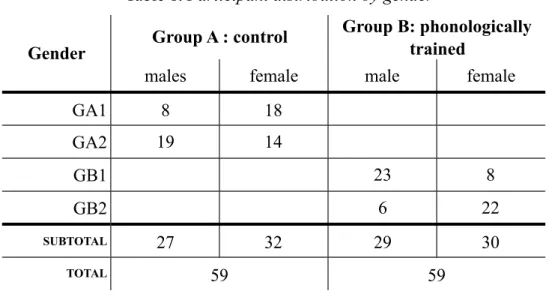
Subjects recruited were 123 Japanese university students (18+ years old) learning Spanish as a Foreign language and being within their first year of language training. From the students recruited 118 were selected; the rest were not included due to several factors . The subjects were divided into two groups: the Control group or GA and the Phonologically Trained group or GB. Each group consisted of 59 students; GA: 27 male and 32 female, and GB: 29 male and 30 female. Both GA and GB were subdivided into two subgroups (GA1, GA2, GB1 and GB2 respectively); each subgroup represented a university Spanish course (i.e. 4 class groups in total).
6. Data Collection
During two terms, the control group (GA) was assessed in multiple ways, which included a number of audio/video recordings, mainly for evaluating students’ reading and pronunciation skills. As a matter of confidentiality, all recordings were collected in audio format. Such audios were oral examinations based on a set of given texts studied during their program, where structures, vocabulary and others were previously analyzed in class, so that students were familiar with them at the time of recording. As a result, an actual 7-months span of 12 audio sets per student were analyzed for GA, with a total of 2987 audios of lexical units.
The PA Trained group (GB) was assessed before and after the training session. For assessing students before the training, a similar methodology used for GA was chosen. Later on, the students were trained in a 20-minute theoretical-practical session, where they were phonologically instructed on the Spanish liquid segments [ɾ], [l] and [r]. The session was prepared and carried out using an active learning methodology, with activities such as crowdsourcing, fishbowl and peer reviewing. After the session,
each student had a 5-minute one-to-one interview session with Spanish native speakers, in order to reinforce the content learned in the PA training, using re-modeling, minimal pairs and reading activities. At the end of the interview, after students recognized the studied segments in certain lexical units (words) they were asked to utter and differentiate the contrastive segments: [ɾ], [l] and [r] in some selected lexical units. Finally, students’ utterances were analyzed by the direct perception method using a checklist, where some lexical units were selected from the whole set used in the interview session. In total, considering the analysis before and after PA, there were 2063 audios of lexical units analyzed for GB.
7. Phonological Accuracy Analysis
For GA, each audio was analyzed by the direct perception method, supported by a speech analysis software (PRAAT) as recommended by Pearce (2011). This software allows researchers to not only identify sounds more accurately but gives a whole spectrum of phonological information that can be included for further analysis. From the audio sets, 7 lexical units with the target segment [r], 14 for the segment [l], and 13 for the segment [ɾ] were identified; such lexical units had different utterance distributions varying from 1-4 times per unit.
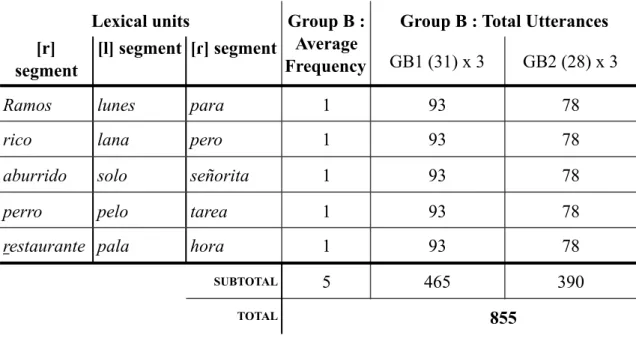
For GB, audio samples containing the segment [r] were selected from the pool of oral examinations available previous to the PA training, and underwent a similar analysis than the samples analyzed for GA. Different lexical units (4-5) were assessed for both groups for each of the target segments (with different utterance distributions, varying from 1-3 times per unit), this was because the assessment texts varied in GB1 and GB2. For the interview session (post training), five lexical units were selected from the sample, all of them were previously reviewed by students during the course of the
term subject and had equal distribution and frequency per student. Checklists were used to determine articulatory accuracy per student and per group.
8. Phonological Interferences Analysis
Even though, most of the recording were analyzed with the direct perception method, the speech analysis through PRAAT helped to precisely identify all the segmental categories through spectrograms, whether they came from the target segment or some phonological interferences. Also, at least 10% of the audios were randomly chosen to undergo this analysis to verify the accuracy of the direct perception method. After analyzing all the recordings, the interferences found were organized in three groups: segmental (L1 segment is transferred directly into L2), allophonic (certain features of the L1 closest segment are transferred into L2 as another segment in the L2 phonological inventory) and others (mainly coming from a pre-existing L2). Within these three groups, four main interferences were found: [ɺ] which is the main Japanese segment, [ɾ] and [l] which come from the Spanish inventory but share certain features with the former, and [ɹ] which was the most frequent and significant interference in this group. The groups and interferences were organized as follows (with their phonological categories): Segmental: [ɺ] : alveolar - lateral - flap; Allophonic: [ɾ] : alveolar - flap , [l] : alveolar - lateral - approximant; Others: [ɹ] : alveolar - approximant, [d]: alveolar - occlusive, [n]: alveolar - nasal.
9. Results
The phonological accuracy rate varied during the 7-month learning span (see Figure 1A, 1B & 1C) for GA, from the first assessment session (x̅ = 18.98 for [r] segment; x̅ = 46.19 for [l] segment; x̅ = 41.36 for [ɾ] segment) to the last (x̅ =27.16 for [r] segment; x̅ = 29.53 for [l] segment; x̅ = 96.43 for [ɾ] segment). Each one of the oral
assessments analyzed was represented with the lexical unit(s) found in the assessment texts. Both subgroups followed a relatively similar progression, independent of the segment, even though GA1 performed slightly better than GA2 only for segment [r]; however, considering their final accuracy rates for all segments, such small differences had no statistical significance between both subgroups ([r]: p = 0.918; [l]: p = 0.400 ; [ɾ]: p = 0.115 ).
GB was measured similarly to GA in terms of phonological accuracy before PA training and the rates were considered as the initial individual achievement; moreover, the results after the PA training were added as the final individual achievement. As expected, the general phonological accuracy rates, as well as the individual achievement rates, increased significantly after the PA training.
From the results, it was possible to notice how significant the impact of PA training was when comparing GA and GB’s accuracy means. Although both groups started in a very similar articulatory rate, the line progression of phonological articulatory improvement of the target segment is consistent with the results found, considering that there was only a single PA intervention during the process. Therefore, comparing the accuracy improvement means, at least for the segments [r] and [l], and considering the liquid segments as a whole learning set, the null hypothesis of phonological improvement in a natural FL environment during the learning process is rejected (p < 0.001), proving that phonological training needs to be included within the FL learning span.
10. Discussion & Conclusions
Based on the results found, there is a high significant relation between PA training and the phonological accuracy performance of learners. The more students are aware of the phonological mechanism of their L1 and target FL, the more their phonological accuracy will improve, as it was possible to notice in the results of this study in regard to the Spanish liquid segments. Moreover, it is necessary more evidence to project this results into long-term phonological accuracy performance, which needs to include other group of segments as well. For it, the design and development of a model that fits these needs has to be implemented in the learners’ learning and assessment processes.
Taking into account the impact PA training could have based on this study results, the logic of the phonological acquisition pathway seems to have a greater effect into this age range and satisfy their linguistic needs with an inverted sequential
follow-GA vs GB phonological accuracy rates
Segm Subgroup
General Achievement
Mean Initial Individual Achievement Final Individual Achievement
Initial Final Accurate subjects (%) Partially accurate subjects (%) Inaccurate subjects (%) Accurate subjects (%) Partially accurate subjects (%) Inaccurate subjects (%) [r] GA 18.98 27.16 7.69 38.46 53.85 0.00 69.49 30.51 GB 14.58 72.54 5.08 33.90 61.02 66.10 11.87 22.03 [l] GA 46.29 29.53 8.47 54.24 37.29 0.00 100 0.00 GB 29.10 100 0.00 77.97 22.03 100 0.00 0.00 [ɾ] GA 41.36 96.43 28.82 52.54 18.64 10.17 89.83 0.00 GB 66.22 98.64 18.64 81.36 0.00 96.61 3.39 0.00
interpret the development of phonological skills in young learners, in respect of their L1, but that can also be applied to unfold the phonological evolution in acquiring a foreign language. Therefore, taking into account the continuum view (Phillips et al., 2008; Anthony et al., 2003) of the model, the methodology to be chosen will depend on the learners’ phonological needs, rather than an unidirectional pathway, starting to sequentially address the levels in an ascending order, from segmental → onset-rime → syllable → word → syntactical structures, within the methodological planning of the learning process for young adult learners.
In this study, university students were assessed in the FL phonological acquisition of the Spanish liquid segments. Here, it was possible to unveiled how a PA intervention affects students’ phonological skills within their first year or language learning. Even though a traditional teaching approach can also contribute in certain extent to the acquisition of sounds, the liquid segments in this case (specifically the [ɾ] segment), it was possible to prove how PA gives students a comprehensive understanding of the articulatory processes of both, the sounds and their phonological contexts, and how it improves the learners’ articulatory accuracy by polishing the speakers’ utterances to reach a 100% rate in the pronunciation of the target segments.
TABLE OF CONTENTS
TABLE OF CONTENTS ……… i
LIST OF TABLES ……….. iii
LIST OF FIGURES ……… iv
CHAPTER 1 - INTRODUCTION TO PHONOLOGICAL AWARENESS ……… 1
1.1 Research on Phonological Awareness ………. 1
1.2. Phonological Awareness in Foreign Language Acquisition ……… 11
1.3 Research input in Phonological Awareness Instruction ……….. 15
CHAPTER 2 - SPANISH LANGUAGE INSTRUCTION ……… 21
2.1 Active Learning methodology ………..………….. 21
2.2 Teaching aspects of teaching Spanish pronunciation ……….. 26
2.3 Dialect varieties in teaching Spanish as a FL ……….. 38
2.4 Comparison between Spanish and Japanese liquids ……… 42
CHAPTER 3 - METHODOLOGY ……… 45
3.1 Objectives ………..….. 45
3.2 Research Questions ……….… 46
3.4 Participants ………. 47
3.5 Assessment Criteria ……….. 48
3.6 Data Collection ……….. 49
3.7 Phonological Accuracy Analysis ……… 54
3.8 Phonological Interferences Analysis ……….…. 56
3.9 PA Training Session ……….……….…. 58 CHAPTER 4 - RESULTS ……… 65 4.1 GA Results ……….. 65 4.2 GB Results ……….. 78 CHAPTER 5 - DISCUSSION ……….. 89 CHAPTER 6 - CONCLUSIONS ……… 101 REFERENCES ……… 108 APPENDIXES ………. 121
A. GA accuracy rates and interferences per word ……… 121
B. GA individual accuracy rates and interferences….……….. 128
C. GB accuracy rates and interferences per word -before PA training …… 134
E. GB accuracy rates and interferences per word - after PA training ……… 146
F. GB individual accuracy rates and interferences - after PA training …….. 149
G. GA Reading texts used in oral assessment ……….. 155
H. PA Training handout for GB students ……….. 165
I. Consent letter ……… 166
LIST OF TABLES Table 1. Participant distribution by gender ……….. 48
Table 2A. GA Lexical Units Frequency for [r] segment ……… 50
Table 2B. GA Lexical Units Frequency for [l] segment ……… 51
Table 2C. GA Lexical Units Frequency for [ɾ] segment ……… 51
Table 3A. GB Lexical Units Frequency for [r] segment before PA training ……. 52
Table 3B. GB Lexical Units Frequency for [l] segment before PA training ……. 52
Table 3C. GB Lexical Units Frequency for [ɾ] segment before PA training ……. 53
Table 4. GB Lexical Units Frequency for all segments after PA training ………. 54
Table 5. GA general and individual phonological accuracy rates ………. 68
Table 6C. GA rates of accuracy vs. rates of interference for [ɾ] segment ……..… 76 Table 7. GB general and individual phonological accuracy rates………..…. 78 Table 8A. GB rates of accuracy vs. rates of interference for [r] segment before PA
training ………..… 79 Table 8B. GB rates of accuracy vs. rates of interference for [l] segment before PA
training ………. 81 Table 8C. GB rates of accuracy vs. rates of interference for [ɾ] segment before PA
training ……….. 83 Table 9. GB rates of accuracy vs. rates of interference for all segment after PA
training……….. 85 Table 10. GA vs GB phonological accuracy rates………. 93
LIST OF FIGURES
Figure 1A. GA Phonological accuracy rate / learning span for [r] segment …… 65 Figure 1B. GA Phonological accuracy rate / learning span for [l] segment…… 66 Figure 1C. GA Phonological accuracy rate / learning span for [ɾ] segment…… 66 Figure 2A. GA Phonological Accuracy / Lexical Unit for segment [r]………… 70
Figure 2C. GA Phonological Accuracy / Lexical Unit for segment [ɾ]………… 76 Figure 3A. GA Phonological Interference rates per word for [r] segment…….… 72 Figure 3B. GA Phonological Interference rates per word for [l] segment………. 75 Figure 3C. GA Phonological Interference rates per word for [ɾ] segment……..… 77 Figure 4A. GB Phonological Interference rates per word for [r] segment before PA
training ……… 80 Figure 4B. GB Phonological Interference rates per word for [l] segment before PA
training ……… 82 Figure 4C. GB Phonological Interference rates per word for [ɾ] segment before PA
training ………. 84 Figure 5. Proposal of the Bernhardt and Stoel-Gammon’s phonological acquisition
CHAPTER I
INTRODUCTION TO PHONOLOGICAL AWARENESS
1.1 Research on Phonological Awareness
Second Language Acquisition (SLA) processes acknowledge the fact that Second Language Learners (SLLs) will substitute or transfer sounds in order to simplify speech; and use similar sounds from L1 when some sounds from L2 are not present in their phonological system (Crystal, 1987). Thus, phonological interference is defined by Berthold et al. (1997) as items used by a foreign language speaker which contain certain elements from their first language, including from single speech sounds (phonemes) to other prosodic features. Furthermore, Trubetskoy (2005), after studying the perceptive operational processes in SLA, added to the equation his well-known “phonological filter” proposal that stands for the speaker’s inability to perceive non-native segments, opposed to the solely idea of the articulatory inability in the utterance of a foreign language sound. SLLs will face these phenomena in all their range: the distribution and number of phonemes in the contrastive systems, syllable structure, allophonic variations, prosodic shortening and lengthening, diachronic usage, among others.
Furthermore, Flege's Speech Learning Model (Flege, 1987, 1995) states that SLLs will be more likely to distinguish L1 and L2 sounds when they are less similar in their phonological categories. In this way, SLLs will be able to establish one or some new L2 categories of a given L2 sound only if they can perceive the main differences
with their closest counterpart in their L1; if not, such sound might be assimilated within a single L1 category and therefore interfere in the learning process of the corresponding L2 category (Altmann & Kabak, 2011).
In Linguistics, Phonological Awareness (PA) is a person’s sensitivity to the structure of sounds in oral language (Anthony & Francis, 2005); however, in the field of Foreign Language Education (FLE), PA is an instructional approach, especially for young kids, that accompanies the students in their path of learning how to read and manipulate segments of speech, including words, syllables, and phonemes, normally at the stage of kindergarten or at the first years of elementary school. Unfortunately, the terms phonological awareness, phonetic awareness, phonemic awareness and even phonics have been used interchangeably during the history of oral linguistic research and, even though it seems possible to find some more consensus today about them, there is still some ambiguity in their use, especially in the education field, where authors use these terms unorthodoxly.
Phonological awareness is a broader term including all the other terms and it can be defined depending on the phonological level it is being analyzed. Bernhardt and Stoel-Gammon’s model (1994) explains how PA is divided in these levels in relation to its development process: word → syllable → onset-rime → segmental. Gillon1 (2004)
explains how each one of those levels works and is acquired during the learning process and schematize the progress in a hierarchical flux from a more complex phonological unit until the most simple ones (i.e. phonemes) and, in a broader extent, their phonological features, such as place of articulation, manner, voicing, and so on.
In this model, the sequence of PA development starts from the word manipulation skills. Learners are able to combine words to form a compound word and divide of delete one lexical unit contained in a compound word in order to utter the remaining unit. Then, it moves to the syllable level, where students are capable of count or divide syllables within a word and to join syllables to form a word. Following these two levels, the onset-rime level comes along; young learners are able to match words that rhyme with each other, recognizing when the coda and/or rime in a syllable matches another one in a different word or grouping words with the same onset and nucleus. Finally the smallest sound units come in; here, students are able to distinguish, associate, manipulated articulate single segments, this level is the one phonemic awareness focuses on.
Furthermore, Phillips et al. (2008)2 and Anthony et al. (2003) add a continuum
(no-sequential-stage) view to Bernhardt and Stoel-Gammon’s model, meaning that students do not need to master a skill of a level before they develop the next level skill, but that they can develop them at the same time. As seen in the the figure below, each one of the levels is overlapped, meaning that it is possible to learn different phonological skills in parallel. It is certain that smaller sound units represent a higher cognitive complexity respect to language, and children naturally acquire this explicit knowledge in later stages in their literacy process. However, this continuum helps us understand that Stoel-Gammon’s hierarchy is not applied in terms of learning capability, as students can learn a varied set of phonological skills at the same time, but only in how complex the explicitness of the phonological acquisition of a language is for young learners.
Adding this continuum provides a new aspect to the process, as it shows the opportunity the phonological acquisition could have in foreign language instruction, as the learning flux does not follow a fixed hierarchy pathway but surrounds a dynamic flexibility in the instructional process. Therefore, the linguistic complexity in which each level is addressed is dependent on the learner’s (phonological) needs rather than the structural functionality of the language being taught. This developmental aspect of the model enhances the individuality of the learners’ strengths and focuses on their weaknesses, so that the instruction time within a classroom could be used more efficiently.
Phonemic awareness, then, relates only to how learners segment, blend and manipulate phonemes in order to create and modify word or phrase phonological structures (Gillon, 2004). Thus, students must learn to isolate these sounds, one from another, and to categorize them in order to understand how words are spelled. It is this explicit, reflective knowledge which is the main focus of development for phonemic awareness. It is a conscious awareness of phonemes, which is different from the intrinsic sensitivity that enhance speech production and reception (Evans, 1998), and, therefore, speech as a whole.
On the other hand, Phonetic Awareness mainly oversees the articulatory aspect of the speech; whether or not learners are aware of the place and manner of articulation, voicing, lips use, muscular tension, and other specific concerns. Phonological rules,
within this area, limit speech-sound production for biological and environmental reasons, which are due to the limitations of the human articulatory-motor production system (Evans, 1998). Other boundaries on human speech ability is related to the way our brains classify and perceive phonemes, the minimal units of sound that make a difference to meaning.
Finally, phonics is a learning method to help students understand the relationship between phonemes and morphemes through sound patterns in prints, mainly with the purpose of preparing learners to be able to accurately read such patterns (Burns et al., 2003). However, the latter is a common methodology used in languages with a low degree of grapheme-phoneme correspondence, as it is the case of English, but not of Japanese and Spanish, which have high phonemic orthographies. Moats & Tolman, (2009) argue that PA instruction is usually confused with phonics instruction, when PA instruction only qualifies as phonics instruction when it involves teaching students to blend or segment the sounds in words using letters. Nevertheless, students may be taught to manipulate sounds in speech without any letters as well, and this does not qualify as phonics instruction.
Traditionally, and perhaps because some foreign languages own well defined phonemic orthographies, many language instructors tend to reduce or omit language pronunciation contents in their classes, mainly because they consider it as the least valuable compared to other language skills (Elliot, 1995). This is the reason why learning a foreign language (FL) for young adults has resulted in students being forced
to utter a certain number of foreign sounds without instruction or knowledge about them.
Trubetzkoy (1971) explains how FL learners struggle by trying to deal with such a load of phonological information carrying on a ‘phonological filter’ from their mother tongue (L1), resulting most of the time in direct phonological transfers from their L1 or in phonological interferences; moreover, depending on which pair of languages the learners go through as L1 and L2 (i.e. FL), the level and complexity of this phonological phenomenon can widely vary in their oral performance. Thus, Dziubalska-Kołaczyk et al (2013) emphasize the importance of PA training of a FL, as well as of L1, so that students are able to overcome several pronunciation problems that are likely to become more evident later in their oral performance.
Even if a FL student has phonological awareness skills in their mother tongue, it does not mean they will also be able to transfer such skills to their L2, or if it is the case, to L3 or L4 (Durgunoglu & Onëy, 2002). This has always been an indicator leading to unintelligible speech coming from articulatory inaccuracy and has produced a feeling of frustration and disappointment in both, the FL learner and the interlocutor; therefore, it is recommended to start developing PA skills in students within the first stages of the learning process (Kenworthy, 1987), in order to avoid an eventual counter-productive motivational effect in the learner.
Other definitions of PA differ basically in the phonological awareness skills that are being integrated or excluded. These skills are recognized by the phonological task
the word awareness unit level, for instance, there are two main structures being addressed, syllables or intra-syllabic units; and for the onset-rime unit level, the initial single or cluster consonantal sounds involved and the core vowel and posterior single or cluster consonantal sounds. Therefore, when focusing on the different unit levels it is possible to define, utilize and apply what phonological awareness is into different literacy curriculum and methodology, highlighting the process of phoneme-grapheme (sound-letter) correspondence or rime analogies (Anthony & Francis, 2005).
PA is vital in the process of pronouncing new words, and it is even more important in early stages of L1 phonological acquisition. Treiman (1991) explains how children use different methods in order to achieve such phonological aim; the first one is related to memorized associations between previously learned printed words and their actual pronunciation; and the second is related to uttering (speaking out) the new words by phonologically building them from their graphemic representations. In this way, young learners use their alphabetic knowledge and phonological awareness to decode unknown words.
The method of simply exposing students to an L2, without explicitly teaching them the sounds and how they are different or similar to the sounds of the L1, can cause problems in their understanding as a reader and in their abilities as a writer. This same issue can be found in the methodology of teaching Spanish as a FL. Moreover, Japanese speakers who learn Spanish as a FL need explicit instruction on the Spanish sounds in order to contrast them to the ones in the Japanese system and, therefore, will be able to
properly utter, read and even write the language they are aiming to learn. That is the main function and significance of Phonological Awareness.
Condemarin (1996) highlights that the interest in developing phonological awareness in children is based on numerous studies that demonstrate a positive correlation between the learner's ability to discriminate the elements that make up speech and his or her success in reading and writing. As before mentioned, phonological awareness is a metalinguistic ability, which introduces the learner into the system of speech sounds, through the functions that fulfill the words, rhymes, syllables and phonemes, and their combination, in all the possible phonological levels.
Reading must be taught and practiced, fundamentally, as an act of constructing meanings with a clear purpose for the student. Here, the development of phonological awareness is a complementary process that is of great interest, since it facilitates understanding insofar as it favors fluent reading. Thus, children learn to discriminate the initial and final sounds of words, learn to identify a phoneme with its corresponding grapheme, etc.
The cognitive knowledge of the phoneme is very necessary to understand the alphabetic principles but sometimes such knowledge is not obvious for FL learners, since the processing of oral language requires an implicit knowledge of phonological structure, that is, phonological awareness (Singorini, 1998). As PA is the ability that allows the students to be aware that words are made up of sounds and that these can be graphed, it helps them to realize that the combinations of these spellings form words.
This metalinguistic ability allows people to realize the minimal sound units (phonemes), which constitute the words and enables the realization of a series of voluntary operations, such as altering, varying, substituting, mixing or omitting the phonemes of a word. In other words, it is the ability that makes it possible to recognize, identify, manipulate the sounds that make up words. This awareness is the capacity of recognizing, perceiving and utilizing the phonetic components of oral language and the mastery of various processes that individuals can consciously perform on oral language.
This ability to perceive the relationship between letters and sounds of words has two potential benefits for the FL learner. The first reinforces the individual knowledge of letter-sound (grapheme-phoneme) relationships and the second, helps to reinforce the memorization of the word as a whole, so that they can recognize it accurately when they find it written in future learning.
If there is no good development or stimulation of this skill, the next learning stages will be limited, along with its components. Therefore, it will affect the level of oral phonological awareness and the interaction with written language, a process that is carried out with the help of the teacher, who provides the key concepts to establishing dynamic associations between them.
According to Melby-Lervåg et al (2012), phonological awareness has specific areas of development where the first skills that are developed are words and syllables, followed by initial sounds and rhymes, and ending with phonemes. These are: auditory awareness (to become aware of the world of the sounds in which you are immersed);
discrimination (ability to differentiate the same or different sounds); initial sounds (ability to discriminate speech sounds, which should not be presented in isolation, on the contrary, should be within a context of familiar words); final sounds or rhymes (after discriminating the initial sounds, you must exercise the final sounds of the words).
Within these areas, the one that will be aimed more specifically in this study is the phonemic one. Phonemic awareness can be defined as the specific ability to focus on and say phonemes in words expressed orally. That is, phonemic awareness allows a person to hear and repeat the individual sounds that are part of a syllable or a word in a language. Then, the phonics method connects the sounds to the graphemes in different ways in both languages.
1.2. Phonological Awareness in Foreign Language Acquisition
Phonological awareness has been one important core of research in the last decades, in regards to language acquisition and proficiency, and several studies also discuss how phonological awareness could be key for second language acquisition, especially in terms of developing the fundamentals for language literacy (Wagner & Torgeson, 1987). Gerber & Leafstedt (2005) sustain that PA helps and enhance the development of linguistic skills, learners become able to boost their skills in order reach language proficiency. Language instructors with enough phonological awareness training can use the learners’ L1 PA skills and knowledge in other to make relations between what the understand and manage with the new phonological system in the target FL, as well as the links with its orthographic system.
Young learners certainly learn languages in a different way than adults do. Phonological awareness knowledge can help instructors achieve the desired linguistic goals in their adult students in a foreign language as well it does with children in their L1 (Marinova-Todd et al., 2000). Even though there are several studies focused on phonological awareness in bilingual students, considering a wide range of languages and phonological systems, there is not enough research in how to harness this phonological knowledge in order to be applied in second language acquisition, and what are the methodological techniques for teachers to use in order to apply such knowledge with older students learning a certain foreign language.
Gerber & Leafstedt (2005) affirm that learning an L2 is much simpler for learners than when they learned their L1, as they could use all their previous linguistic knowledge as a basis for learning a new language. The key elements of phonological awareness have been extensively studied and defined, so that it is possible to understand how PA is used in the development of language skills (Wagner & Torgeson, 1987); therefore, when following the phonological awareness patterns in L1 language acquisition, instructors and researchers could use the same methodological footpath in order to be used effectively in second language learning practices. Gerber & Leafstedt (2005) also found that phonological awareness tasks in paired languages are comparable and there are several correlations that have been significant in the language learning process; hence, proving that PA has a high positive effect on second language acquisition. As this link between PA and FL acquisition can be established, it is possible to find new methodological understanding in language instruction so that students can acquire the necessary phonological skills in a foreign language more effectively.
Independently of which language we focus on, all languages display a sound system, phonological patterns and rules and implement different techniques to develop systems of speech. Considering these elements, that are extensively studied throughout language learning, it is possible to prepare and design the sufficient instruction methods for students to acquire a foreign language, by understanding the similarities and differences of the phonological systems in which an language teaching scenario is set; not leaving behind the similarities that can be found between the orthographic components of the languages involved in the process, if existing.
In that respect, phonological awareness becomes a key component in language training. Several studies pairing languages show that PA skills can be transferred to a foreign language being learned, if they have been acquired during learners’ first language acquisition. De Sousa et al. (2010) mention that students seem to have greater learning skills in the first levels of a foreign language when they have previous phonological knowledge, and when they are able to identify the correlations between their L1 and their target language in a certain phonological level. Farver et al. (2009) also show in their study that PA has a high impact on foreign language acquisition and that FL learners under PA training are able to transfer their phonological skills from their L1 to the target FL, being highly effective at improving outcomes.
The (American) National Education Association (2007) experts found that students learning a new language are more successful if they have PA skills and are able to recognize segments that are shared in both of the languages they are dealing with (L1 and FL) in the learning process, in a way that researchers believe it is possible to predict
how fast students can acquire language skills based on the PA levels they manage. A study performed by Yeung & Chan (2013) showed how PA test results had a strong correlation with reading and spelling skills; students with weak PA experienced slower language acquisition rates and lower outcomes for FL learning. However, there are also some studies suggesting that the correlation between PA and FLA is not always reciprocal, and not all skills can be transferred effectively from L1 to L2, as some skills (including PA skills) can have an impact on different other language skills and do not always facilitate or ease the language learning acquisition process. (Fabiano-Smith & Goldstein, 2010).
As PA demonstrates to be the ability of understanding and manage the basic and fundamental components of a language, it is possible to use this resource as a tool to acquire a FL faster and, therefore this benefit should carry the responsibility to FL instructors to change their teaching practices in order to include and boost PA instruction in their classrooms. The more instructors are aware of the benefits produced by PA instruction, the more programs and school with pride the enough resources to develop methodologies and materials, in order to provide students with the necessary skills for succeeding in their language acquisition plan. In that matter, more research should be carried out to include as many different language systems as possible and the possible correlations among them.
In this last matter, another important aspect of discussion related to PA and FLA is the transference and interference produced when pairing different languages in a learning process. Usually, a given L1 will intrinsically influence the acquisition and
impact on the learner, depending on how the FL instruction is orientated towards linguistic goals. Interference coming form L1 in the area of phonological acquisition can create several difficulties for learners, such as mispronunciation or misinterpretation and also has an effect of phonological memory, which is key for phonological processing. However, PA knowledge can also be transferred from L1 to a FL. Gerber and Leafstedt (2005) measured PA skills of Spanish (as L1) and English (as FL) students and found that the understanding of the predictive relationship of phonological patterns and decoding between the two languages, linked to the graphemic representation of both language systems, made students improve their phonological skills in their FL.
The more the orthographies of the languages involved are alike, the easier students will be able to transfer their PA skills from L1 to FL. Le Roux et al. (2917) found that the success students are capable of transferring their PA skills depends not only on the level PA they might have but also on the particularities of the language systems learners deal with. Even though PA skills development is parallel when comparing alphabetic languages, the rate of development and level of attitude vary. This fluctuation is based on the divergencies in the linguistic features of the languages in question. The simpler the phonological structure of a language, the less capable learners would be, in terms of PA, for transferring their skills into a new language.
1.3 Research input on Phonological Awareness Instruction
Phonological awareness instruction is very important for oral communication; it is also a significant part of the set of the skills to be learned for acquiring
communicative competence. In order to overcome possible communicational problems, FL teachers (Spanish, in this case) should convince their learners that the aim of pronunciation is not to gain a native accent but to help them pronounce correctly enough to be easily and comfortably understood by other speakers (Ur, 1984). According to Harmer (2007), simply knowing where the sounds are produced in the mouth and which syllables are stressed in words improves learners’ comprehension and understandability.
When it comes to the instruction of pronunciation, Bueno (2013) emphasizes that it is highly important to decide which is the level of phonetic precision that the learners are to acquire, in order to adapt the required methodology to the objectives. This can guide, narrow down or lead the teaching work, and will be directly proportional to the students’ objectives and the aims of the institution in which the learning program is taking place. When carrying out a contrastive analysis and a study of the students’ interlanguage, it is necessary to make a forecast of the errors that could be committed, and this will be easier to do if the instructor has the necessary knowledge about the student's L1, since a contrastive analysis has a predictive character and can, therefore, guide the way in how to address the pronunciation problems.
When teaching speech sounds, in a phonemic level, we need to consider both consonants and vowels. Each speech sound is characterized by a group of features, such as frication, nasalization, occlusion, etc. or voiced and unvoiced, or aspirated and unaspirated, and so on. Speech sounds that are similar in place and manner of articulation are the most easily confused (Moats & Tolman, 2009) and, therefore, will
represent a greater effort in differentiating those segments when instructing students. If learners are left on their own to realize what the identity of speech sounds are in every word, they may not be capable of detecting all the features that distinguish certain sound units without explicit instruction. Furthermore, speech sounds are not articulated separately (i.e. in isolation); they are coarticulated in every single word utterance, and thus, considering learners approach to a new language without previous explicit phonological knowledge, even in their L1, many of them will have some difficulty segmenting sounds in other to acquire all the necessary features to discriminate one foreign sound from the other. Direct teaching has been an important methodology over the years because it enables students to form accurate concepts of speech sounds that will attach to their learning of new words and will help to their reading and writing skills (Moats & Tolman, 2009).
One of the difficulties in acquiring phonological awareness is that the sound of any given phoneme can differ significantly, from word to word and speaker to speaker. These variations, which usually do not alter the written norm nor the given meaning of it but only the way they are uttered, includes into the picture an allophonic scene that needs to be consider when teaching certain language variety (Evans, 1998). For example, in the case of Spanish, the pronunciation of the word pollo (chicken) can vary from [poʃo], [poʎo], [poʒo], [poʝo] and [pojo], among other varieties, depending of the region in which Spanish is being spoken. Furthermore, phonemes are not isolated sound units that work on their own and can be ultimately learned in isolation, but they are co-articulated and appear in certain structural contexts forming syllabic units. For example
the word dedal is not a group of single distinct sounds we utter separately (i.e. /d/, /e/, / d/, /a/, /l/), but the utterance includes the reciprocal influence of the consonant sounds with the vowels and the articulatory effect that it involves (i.e. [deˈð̞al]).
Moats & Tolman (2009) argue that any type of instruction that could enhance phonological awareness is significant for students who are not aware of the internal phonological details within spoken words, independent of their age. They sustain that a well-designed language lesson must consider, even if small, certain pronunciation item, that involves brief, direct practice of specific phonological skills, such as syllabic structures, phoneme recognition and segmentation, phonological patterns, among others. It is possible to include this item in any section of the lesson, even as a warm-up exercise, that can precede a main activity, such as reading, spelling, vocabulary or conversation practice. Instruction in phonological awareness, as any other component of a language lesson, needs to be engaging, systematic, appropriate to the age of the learners and display a number of possible strategies to develop the necessary phonological skills in the students.
There is a significant reduction and ease in regard to the reading/speaking difficulties when phonological instruction is present within the language learning process, whether it is the learners’ first language or a foreign one (NICHD, 2000; Gillon, 2004). Teaching explicitly and directly phonological skills to students helps with the coding learning process of a given language, so that it is recommended that initial language programs (in at least A1 and A2 levels) include this type of instruction in its curriculum
In regard to the phonological levels that need to gather more attention in the phonological instruction, Snider (1995) suggest that working in in less complex phonological levels, such as rhyming or onset and rime may facilitate instruction in more complex skills. He sustains that integrated instruction, in the activities such as segmenting and blending, seems to provide a great benefit to reading acquisition. Blending phonemes into words and segmenting words into phonemes contribute directly to learning to read and spell correctly. Snider (1995) emphasizes that these two phonemic awareness skills provide the biggest contribution to the phonological learning acquisition process than any of the other activities under the phonological awareness umbrella, so that phonological awareness instruction planning needs to aim to systematically, and as early as possible, move language learners toward the phoneme level mastering these two activities.
Beside content, another issue that requires attention in phonological awareness instruction is curriculum design. Many instructors fail not in what they teach but in how they teach it and the methodological planning and effort that it requires in order to achieve educational goals. Chard & Osborn (1998) designed certain principles to be applied in order to increase students’ success in acquiring phonological skills:
• Start with continuous sounds rather than stop sounds • Carefully model each activity as it is first introduced • Move from larger units to smaller units
• Move from easier tasks to more complex tasks
As any other opponent of language teaching, gathering all possible information that could make a contribution to a better and more comprehensive understanding in regard to the contents, methodology, program duration and assessment within the phonological skills that need to be developed in the learners of a language program is critical for ensuring instructors can effectively teach PA in the classroom.
CHAPTER II
SPANISH LANGUAGE INSTRUCTION
2.1 Active Learning methodology
Active Learning is an instructional approach in which learners can dynamically engage and participate in their learning process. This teaching methodology can be very varied and can be used in any educational context and discipline. Usually, learners work in small or large groups in different activities; however, individual work can also be involved. Many educators think that all types of learning are active in essence and that students are able to engage in a lesson, regardless if they only listen to a lecture; however, Chickering & Gamson (1987) argue that students cannot only listen but also expand their active role with other activities, such as discussion, problem solving, extensive written production, reading out loud, in groups or personally, and so on. Also, considering Bloom’s taxonomy (1956), the cognitive level in which this engagement need to occur, needs to be higher than in passive learning, and must include tasks developing creativity, analysis, assessment, synthesis and reflective skills. Siraeva (2018) contributed to this matter, putting a higher emphasis on the know-how of the knowledge and not only in what is done: “active learning involves students in two aspects – doing things and thinking about the things they are doing”.
This wide range of teaching strategies stand in contrast to a traditional teacher-centered model, in which only a few students are able to interact with the instructor in asking or responding to directed questions, and where students are only passive
recipients of knowledge or listeners in a lecture (Faust & Paulson, 1998). In a lecture model, students themselves consider their role as receivers of information and, in the same way, instructors see themselves as the providers of such information. This one-way line of knowledge flux allows students to only acquire certain lower-order of thinking skills under Bloom’s taxonomy, and does not let students develop other higher skills which are vital to not only acquire knowledge, but also to use it.
Barnes (1989) stated but also proved background principles of active learning that helped understand where activities need to be planned towards, so that students could experience knowledge and apply it into different contextual situations. These seven principles are describe in the table below:
These principles built a theoretical background for the switch education needed to have in order to improve students skills and outcomes. In the traditional methods (under the “objectivism” paradigm), where students spend most of their time listening
Principle Description
Purposive The relevance of the task to the students’ concerns. Reflective Students’ reflection on the meaning of what is learned.
Negotiated Negotiation of goals and methods of learning between students and teachers.
Critical Students appreciate and review different ways and means of learning the content.
Complex Students compare learning tasks with complexities existing in real life and making reflective analysis.
Situation-driven The need of the situation is considered in order to establish learning tasks.
Engaged Real life tasks are reflected in the activities conducted for the sake of learning.
or watching to a lecture and most of their work is individual, the outcomes have been proved to be lower and inferior compared to active learning methodology (under the “constructivism” paradigm), where students actively engage with the knowledge being learned through solving problems, brainstorming, discussion, etc.
Programs based on active learning methodology aim students are able to apply the knowledge they are acquiring in a real life situation, whether it is for their personal every-day life on in a work or community setting, contribution to society and fulfilling their role in the contexts they are involved in. The Council for the Curriculum, Examinations and Assessment [CCEA] (2007) in the UK has researched for decades what was the shift in learning that needed to happen in order to achieve the aforementioned goal, preparing students for a life-long learning journey, for both teachers and students and summarized those roles in the following grids:
Passive learning traditional
methodology Active learning methodology
T E A C H E R S
Teacher-centered classroom Learner-centered classroom Product-centered learning Process-centered learning Teacher as a ‘transmitter of
knowledge’ Teacher as an organizer of knowledge Teacher as a ‘doer’ for learners Teachers as an ‘enabler’, facilitating
learners in their learning Subject-specific focus Holistic learning focus
An active, high engaging, and participatory learning environment involves that the teachers/instructors have a shift in their teaching practices and towards learning, from a teacher-centered model to a learner-centered approach. Also they have to dedicate more time and efforts in focusing their practices into the process of the learning goals, rather than the product or result. The changes allow teachers to have an introspective view of their role, and not only of the underlying learning and teaching principles and methods.
The role the teachers assume in an active learning environment, as facilitators, requires to support learners in their path of learning and developing skills, in tasks such as solving problems, team work, community decision-making, and so on. It is normal that in this type of environment, the facilitator role of the instructors assume certain
Passive learning traditional
methodology Active learning methodology
S T U D E N T S
Being passive recipients of knowledge Active and participatory learners Focus on answering questions Asking questions
Being ‘spoon fed’ Taking responsibility for their own learning - reflective learners Competing with one another Collaborating in their learning Wanting to have their own say Actively listening to opinions of others Learners of individual subjects Connecting their learning
function in the activities students perform, in order to fulfill certain learning goal or to challenge students cognitive structures. These functions can include being neutral before certain matter, letting students discover by themselves all the possible aspects of it; intendedly assuming a contrary side or opinion from their students’ one; taking part of the debate and support certain group in the classroom; informing students of the official regulatory statements given by an official organization or statutory laws; challenging students through questioning so that they have to defend and justify their point of view; among others (CCEA, 2007).
Strong evidence based on decades of research and commitment to education improvement show that there are several benefits in using active learning methodology, which include the increase of learning motivation in students, a decline in course failure, the improvement of students’ relational and social skills, the enhancement of information transfer and retention, the improvement of students’ critical thinking, etc. (Prince, 2004). Kuh et al. (2017) analyzed high impact practices through the National Survey of Students Engagement (NSSE) for about two decades, in thousands of students and their engagement and persistence in their learning processes. The results showed that practical, integrative and active learning experiences lead to high levels of student achievement and personal development. They also reflected on the use of these practices and concluded that they mark an important development in students’ success, meaning a high development in “academic achievement, engagement in educationally purposeful activities, satisfaction, persistence, attainment of educational objectives, and
acquisition of desired learning outcomes that prepare one to live an economically self-sufficient, civically responsible, and rewarding life”.
2.2 Teaching aspects of Spanish pronunciation instruction
Spanish as a Foreign Language (SFL) has been part of the most famous languages taught since the XVI century. The current reality is that the interest in learning the Spanish language is growing not only in Europe, but in all the world. Students’ main interest is the development of oral communication, an aspect that will allow them to get inserted into the international markets with greater perspectives, or simply for cultural and leisure reasons.
Throughout the teaching of Spanish as a foreign language many methods have been presented and applied; however, none of them seems to fully comply with the objectives of foreign students entering the SFL classroom, that is, learning to communicate both by speaking and by writing. Therefore, if the activities conducted inside and outside the classroom focus only on teaching grammatical rules, and do not include several speaking methodologies in order to achieve the communicational goal, it is not feasible that the students acquire such skills. That is the main and most important issue in the matter of teaching FL pronunciation.
Within this perspective, applying the most appropriate method in the classroom is the key to success, not leaving such methods to improvisation, chance or goodwill. They derive from a professional knowledge about the subject. This is the challenge of
around the world. This circumstance forces us to be aware of and to reflect on how to teach a language, as well as on the appropriate training for the future and current educators, a fact that has not been properly addressed in none of the cases, and that is reflected daily in the classrooms, where the students do not seem to be achieving a pronunciation level according to their expectations and, of course, their needs.
In regard to pronunciation, Richard and Schmidt (2002) define it as the way sounds are produced and it also considers the way sounds are understood by the listeners. They argue that pronunciation is a very important part of the language because mispronunciations make it difficult for listeners to understand the meaning of sentences correctly. Furthermore, Harmer (2007) states that pronunciation is not only the way the sounds of a language are made, but also includes word and sentence stress, pitch and intonation, and other features in order to convey meaning. If learners’ pronunciation is weak it can have a negative effect on their language ability. Incorrect pronunciation leads to misunderstanding and might threaten communication. In contrast, listeners might consider speakers’ language ability easily and effectively when there is a good pronunciation, regardless of possible grammatical mistakes; moreover, bad pronunciation confound them and results in misunderstanding even if speakers have advanced grammar or vocabulary (Pourhosein, 2012).
In regard to teaching pronunciation, many teachers and language instructors tend to be afraid of including pronunciation methodology into their classrooms because they do not feel competent in that area. However, Poch (2004) explains that is not necessary to be an expert in phonetics and phonology to do so. It is important to be clear about
some concepts of teaching didactics in a FL; that is, to know, for example, to differentiate between 'teaching pronunciation' and 'teaching phonetics', matters that are intimately related, but different, so it is essential to go through them in order to overcome such a fear of incompetence. On the other hand, teachers must be very clear that there are different dialects of Spanish and that, therefore, there is not a single possible pronunciation in many of the existing segments; it is also important to consider where the teacher of a given classroom is from, in case of being a native speaker, or what Spanish dialect they learned during their language training, in case of being non- native Spanish language teacher.
Regarding the teaching of phonetics, Llisterri (2003) explains that it consists of an explicit reflection on the system, usually carried out within the framework of philology studies and with it the aim is that the future specialist acquires a formal and detailed knowledge of the articulatory, acoustic and perceptual characteristics of the segmental and suprasegmental elements of the language. It is a task that, for Llisterri, will hardly be carried out by the SFL teacher if it is not at very advanced levels.
Pronunciation is the support of oral language, both in its production and in its perception, which makes it provide intelligibility to the learner’s oral utterance and facilitate listening comprehension. In fact, the students with a high level of phonological competence usually have a high level of listening comprehension. This is because phonological competence is also present in writing and reading, manifested in the inner voice of the writer and the reader. The communicative competence is a complex puzzle of competences in which pronunciation is one more piece, with as much importance as
![Table 2A. GA Lexical Units Frequency for [r] segment Lexical units](https://thumb-ap.123doks.com/thumbv2/123deta/5904195.1049676/70.892.193.690.759.1109/table-ga-lexical-units-frequency-segment-lexical-units.webp)
![Table 2B. GA Lexical Units Frequency for [l] segment Lexical units](https://thumb-ap.123doks.com/thumbv2/123deta/5904195.1049676/71.892.192.703.78.1262/table-ga-lexical-units-frequency-segment-lexical-units.webp)
![Table 3A. GB Lexical Units Frequency for [r] segment before PA training Lexical units](https://thumb-ap.123doks.com/thumbv2/123deta/5904195.1049676/72.892.142.764.542.1178/table-lexical-units-frequency-segment-training-lexical-units.webp)
![Table 3C. GB Lexical Units Frequency for [ɾ] segment before PA training Lexical units](https://thumb-ap.123doks.com/thumbv2/123deta/5904195.1049676/73.892.140.769.135.465/table-lexical-units-frequency-segment-training-lexical-units.webp)
![Figure 1A. GA Phonological accuracy rate / learning span for [r] segment](https://thumb-ap.123doks.com/thumbv2/123deta/5904195.1049676/85.892.85.804.763.1200/figure-ga-phonological-accuracy-rate-learning-span-segment.webp)
![Figure 1B. GA Phonological accuracy rate / learning span for [l] segment](https://thumb-ap.123doks.com/thumbv2/123deta/5904195.1049676/86.892.49.867.374.1027/figure-ga-phonological-accuracy-rate-learning-span-segment.webp)

![Table 6A. GA rates of accuracy vs. rates of interference for [r] segment](https://thumb-ap.123doks.com/thumbv2/123deta/5904195.1049676/90.892.196.728.984.1156/table-a-ga-rates-accuracy-rates-interference-segment.webp)
