
4-colorableグラフの点彩色問題に対する近似アルゴリズム
6
0
0
全文
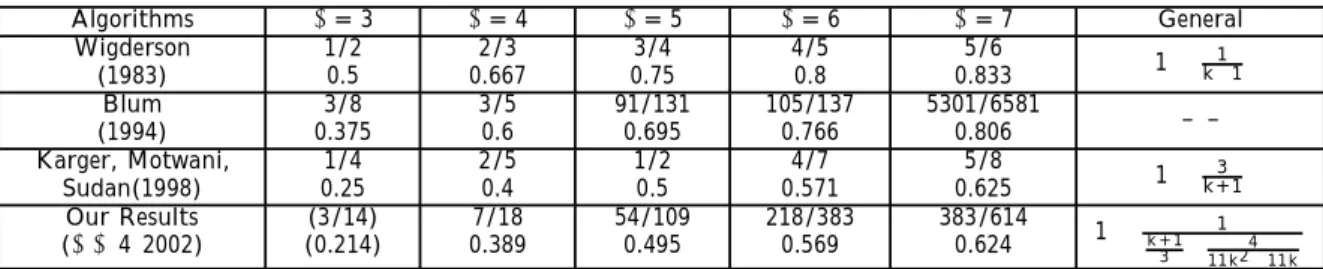
(2) approximately optimal graph coloring, that is, a coloring of the graph with a small number of colors. This along with the apparent impossibility of an exact solution has led to great interest in the problem of approximate graph coloring. The analysis of approximation algorithms for graph coloring started with the work of Johnson [8], who showed that a version of the greedy algorithm gives an O(n/ log n)-approximation algorithm for k-coloring. Wigderson [9] gave a simple algorithm for coloring k-colorable graphs with O(n1−1/(k−1) ) ˜ αk ) colors, where the αk colors. Blum [10] provided an algorithm for coloring k-colorable graphs with O(n satisfies a complicated recurrence relation. The first values of this sequence are α3 = 3/8, α4 = 3/5, and α5 = 91/131. Karger, Motwani and Sudan [11] showed, using semidefinite programming, that k-colorable ˜ 1−2/k ) colors, where the O ˜ notation hides a polygraphs of maximum degree ∆ can be colored with O(∆ logarithmic factor. Combined with the technique of Wigderson [9], they presented a polynomial-time ˜ 1−3/(k+1) ) colors. By combining the result of [11] algorithm for coloring k-colorable graphs using O(n with [10], Blum and Karger [12] obtained a polynomial-time algorithm that colors any 3-colorable graph ˜ 3/14 ) colors. In this paper we show how the coloring algorithms of [11] and [12] can be combined with O(n ˜ 7/18 ) in a simple way to yield a polynomial-time algorithm for coloring any 4-colorable graph with O(n Ck ˜ colors. More generally, k-colorable graphs can be colored in polynomial time with O(n ) colors, where 1 C2 = 0 and Ck = 1 − (k+1)/3−4/(11k 2 −11k) , for k ≥ 3. Wigderson’s algorithm [9], which colors any 3-colorable graph with O(n1/2 ) colors, considers the graph in two cases. If there is a vertex with large degree, color its neighbors with 2 colors and set them aside. The algorithm then recurses on the remaining graph using new colors. Once the maximum degree is reduced to some small ∆, the algorithm colors the remaining graph with (∆ + 1) colors. The basic idea of our algorithm is similar. When the graph has large degree, we use the techniques of [12] to color large “3-colorable neighbors” of a vertex. When the degree is reduced to some small ∆, we use the algorithm ˜ 1/2 ) colors. of [11] to color the remaining graph with O(∆. Algorithms Wigderson (1983) Blum (1994) Karger, Motwani, Sudan(1998) Our Results (k ≥ 4, 2002). k=3 1/2 0.5 3/8 0.375 1/4 0.25 (3/14) (0.214). k=4 2/3 0.667 3/5 0.6 2/5 0.4 7/18 0.389. k=5 3/4 0.75 91/131 0.695 1/2 0.5 54/109 0.495. k=6 4/5 0.8 105/137 0.766 4/7 0.571 218/383 0.569. k=7 5/6 0.833 5301/6581 0.806 5/8 0.625 383/614 0.624. General 1−. 1 k−1. –– 1− 1−. 3 k+1 1. k+1 4 3 − 11k2 −11k. Table 1. The Previously Available Algorithms and Their Performance. II. Preliminaries and Definitions Let us introduce the graph-theoretic notation that will be used throughout this paper. Given a graph G, let V (G) denote the vertices of G and E(G) denote the edges of G. We will use NG (v) to denote the neighborhood of a vertex v, dG (v) to denote the degree of v and ∆(G) to denote the maximum degree of the graph. That is, for G = (V, E), NG (v) = dG (v) = ∆(G) =. {u|(v, u) ∈ E}, |NG (v)|, max{dG (v)}. v∈V. The subgraph of G induced by U ⊆ V is the graph H(U, F ), where F. = {(u, w)|u ∈ U, w ∈ U, and (u, w) ∈ E}.. 2 −50−.
(3) III. Previous Results A. The Karger-Motwani-Sudan Algorithm Karger, Motwani and Sudan [11] introduced the notion of vector colorings of a graph, which is closely related to Lov´asz’s orthogonal representations and ϑ-function [13] [14] : Definition ([11]) Given a graph G = (V, E) on n vertices and a real number k ≥ 1, a vector kcoloring of G is an assignment of n-dimensional unit vectors vi to each vertex i ∈ V , such that for any two adjacent vertices i and j the dot product of their vectors satisfies the inequality hvi , vj i. −. 1 . k−1. (1). Karger, Motwani and Sudan [11] obtained the following results.. Theorem 1 ([11]) Every k-colorable graph G has a vector k-coloring. Theorem 2 ([11]) Any vector k-colorable graph on n vertices with maximum degree ∆ can be colored, ˜ 1−2/k ) colors. in probabilistic polynomial time, using O(∆ It is easy to see that if G is k-colorable then G also has a vector k-coloring. The semidefinite programming based coloring algorithm of Karger-Motwani-Sudan [11] can also be used to color k-colorable ˜ 1−2/k ) colors. graphs of maximum degree ∆ using O(∆. B. The Blum-Karger Algorithm By combining the results of [11] with [10] , Blum and Karger [12] proved the following result. Theorem 3 ([12]) There is a polynomial-time algorithm to color any n-vertex 3-colorable graph with ˜ 3/14 ) colors. O(n. C. The Wigderson Algorithm Wigderson [9] presented the following simple algorithm based on the two simple facts. Fact 4 ([9]) Any graph G can be colored in polynomial time with at most ∆(G) + 1 colors. Fact 5 ([9]) Let G = (V, E) be a 3-colorable graph. Then for every vertex v ∈ V , the subgraph of G induced by NG (v) is bipartite(2-colorable) and thus can be 2-colored in polynomial time.. Wigderson’s Algorithm W [9] Input: An n-vertex 3-colorable graph G = (V, E) Output: An O(n1/2 )-coloring of G 1. n ← |V |. 2. i ← 1. 3. While ∆(G) ≥ dn1/2 e do: Let v be a vertex of maximum degree in G. H ← the subgraph of G induced by NG (v). Color H with colors i, i + 1. Color v with color i + 2. i ← i + 2. G ← the subgraph of G, obtained by deleting the vertices in NG (v) ∪ {v} from G. 4. (∆(G) < dn1/2 e) Color G with colors i, i + 1, i + 2, ..., i + ∆(G) and halt. Theorem 6 ([9]) Algorithm W colors any 3-colorable graph G = (V, E) on n vertices with O(n1/2 ) colors, and runs in polynomial time.. 3 −51−.
(4) IV. Simple Combination of Karger-Motwani-Sudan and Blum-Karger By simply combining the results of Karger-Motwani-Sudan [11] and Blum-Karger [12], we first introduce ˜ 7/18 ) colors. a new algorithm for coloring 4-colorable graph with O(n Based on Fact 7, Theorems 2 and 3, we propose our algorithm as follows. Fact 7 ([9]) Let G = (V, E) be a k-colorable graph. Then for every vertex v ∈ V , the subgraph of G induced by NG (v) is (k − 1)-colorable. Algorithm-4 Input: An n-vertex 4-colorable graph G = (V, E) ˜ 7/18 )-coloring of G Output: An O(n 1. n ← |V |. 2. While ∆(G) > n7/9 do: Let v be a vertex of maximum degree in G. 0 0 (v) ← a subset of NG (v) with |NG (v)| = n7/9 . NG 0 (v). H ← the subgraph of G induced by NG ˜ 1/6 ) colors. Use the algorithm of Blum-Karger [12] to color H with O(n Remove the colors from the palette. 0 (v). G ← the subgraph of G, obtained by removing from G all the vertices in NG 7/9 ) 3. (∆(G) n 1/2 ˜ ˜ 7/18 ) colors and Use the algorithm of Karger-Motwani-Sudan [11], to color G with O(∆(G) )=O(n halt.. Theorem 8 Algorithm-4 runs in probabilistic polynomial time and it colors any 4-colorable graph on ˜ 7/18 ) colors. n vertices with O(n 0 (v) is 3-colorable, and can be colored by the Proof. Based on Fact 7, the subgraph H induced by NG 0 3/14 algorithm of Blum-Karger [12] with |NG (v)| colors. We observe that each time Step 2 is executed, we ˜ 1/6 ) colors. Note that this step can be executed at most n2/9 color n7/9 vertices using a new set of O(n times, and thus the number of colors used in this step is ˜ 1/6 ) = O(n ˜ 7/18 ). n2/9 O(n. (2). ˜ 7/18 ) colors by Theorem 2, so the total number of colors used Step 3 is executed only once and uses O(n 7/18 ˜ ). The time bound follows from the fact that both algorithms of [12] in both steps is bound to O(n and [11] run in probabilistic polynomial time. How can we use the idea of Algorithm-4 to color k-colorable graphs in polynomial time for any k, and what upper bound on the number of colors can we guarantee? Still based on Fact 7, we can recursively use the algorithm for (k − 1)-colorable graphs in the one for k-colorable graphs. Algorithm-k Input: An integer k ≥ 2 and an n-vertex k-colorable graph G = (V, E) ˜ Ck )-coloring of G Output: An O(n 1. If k = 2, color the graph with 2 colors, in linear time. ˜ 3/14 ) colors. 2. If k = 3, use the algorithm of Blum-Karger [12] to color the graph with O(n 3. For k ≥ 4, let Algorithm-3 refer to the algorithm of Blum-Karger [12]. ˜ Ck ) colors. For k = 3, C3 = 3/14. Assume that the graph can be colored with O(n 4. [Recursive coloring stage for k ≥ 4] Ck. While ∆(G) > n 1−2/k do: Let v be a vertex of maximum degree in G.. Ck. 0 0 (v) ← a subset of NG (v) with |NG (v)| = n 1−2/k . NG. 4 −52−.
(5) 0 H ← the subgraph of G induced by NG (v). Ck Ck−1 ˜ 1−2/k ) colors. Use Algorithm-(k − 1) to color H with O(n Remove the colors from the palette. 0 (v). G ← the subgraph of G, obtained by removing from G all the vertices in NG 5. [Karger-Motwani-Sudan coloring stage for k ≥ 4] Ck. (∆(G) n 1−2/k ) 1−2/k ˜ Ck ) colors and ˜ )=O(n Use the algorithm of Karger-Motwani-Sudan [11] to color G with O(∆(G) halt.. Theorem 9 Algorithm-k runs in probabilistic polynomial time and it colors any k-colorable graph on 1 ˜ Ck ) colors, where C2 = 0 and Ck = 1 − n vertices with O(n (k+1)/3−4/(11k2 −11k) , for k ≥ 3. 0 (v) is (k − 1)Proof. As in the previous proof, still based on Fact 7, the subgraph H induced by NG 0 Ck−1 colorable, thus H can be colored by Algorithm-(k − 1) with |NG (v)| colors. It is easy to observe that Ck Ck−1 Ck ˜ 1−2/k ) colors. Note that each time Step 4 is executed, we color n 1−2/k vertices using a new set of O(n Ck. this step can be executed at most n1− 1−2/k times, and thus the number of colors used in this step is C. k ˜ n1− 1−2/k O(n. Ck Ck−1 1−2/k. ˜ 1+ ) = O(n. Ck (Ck−1 −1) 1−2/k. ).. (3). ˜ Ck ) colors by Theorem 2, so the total number of colors used Step 5 is executed only once and uses O(n Ck ˜ in both steps is bound to O(n ) if the following equality holds: Ck = 1 +. Ck (Ck−1 − 1) . 1 − 2/k. (4). Solving this equation with respect to Ck , we obtain the recurrence relation: Ck = We can rewrite this relation as follows:. Let. k−2 . 2k − 2 − kCk−1. (5). (k − 1)(k − 2) k(k − 1) = k(k − 1) + . 1 − Ck 1 − Ck−1 βk =. then. k(k − 1) , 1 − Ck. β3 =. 84 11. and βk = k(k − 1) + βk−1 . We can prove that βk =. 1 4 k(k − 1)(k + 1) − , 3 11. thus Ck = 1 −. 1 k+1 3. −. 4 11k 2 −11k. 5 −53−. ,. k ≥ 3.. (6).
(6) V. Concluding remarks We proposed a coloring algorithm that slightly improves the result of Karger, Motwani and Sudan [11]. It is interesting to obtain further improvements. Blum [10] stated several ways of coloring techniques ˜ αk )-coloring of graphs. Finding large independent sets in a graph seems significant to towards an O(n reduce the number of colors. The algorithm of Karger-Motwani-Sudan [11] is used also to find large independent sets. Using the semidefinite programming technique, Alon and Kahale [15] obtained an algorithm that can be used to find large independent sets in a graph containing very large independent sets. Recently, Halperin et. al. showed that the algorithm of Alon and Kahale can be combined to obtain better approximation algorithms for graph coloring [16]. Coloring 3-colorable graphs using 4-colors is ˜ 3/14 )-coloring for also known to be NP-hard [17] [18]. It is a challenge to find better results than O(n 3-colorable graphs, which is supplied by Blum and Karger [12].. References [1] [2] [3] [4] [5] [6] [7] [8] [9] [10] [11] [12] [13] [14] [15] [16] [17] [18]. R. Karp. Reducibility among combinatorial problems. Plenum Press, 1972. M.R. Garey and D.S. Johnson. Computers and Intractability: A Guide to the Theory of NP-Completeness. Freeman and Company, 1979. P. Briggs, K.D. Cooper, K. Kennedy, and L. Torczon. Coloring heuristics for register allocation. In Proceedings of the SIGPLAN 89 Conference on Programming Languages Design and Implementation ACM, pages 275—284, 1989. G.J. Chaitim. Register allocation and spilling via graph coloring. In Proceedings of the SIGPLAN 89 Conference on Compiler Construction ACM, pages 98—101, 1982. G.J. Chaitim, M.A. Auslander, A.K. Chandra, J. Cocke, M.E. Hopkins, and P.W. Marjsteub. Register allocation via coloring. Comput. Lang., 6:47—57, 1981. C. Berge. Graphs and Hypergraphs. North-Holland, Amsterdam, The Netherlands., 1973. D.C. Wood. A technique for coloring a graph applicable to large-scale optimization problems. Comput. J., 12:317, 1969. D. S. Johnson. Worst case behavior of graph coloring algorithms. In Proceedigns of the 5th Southeastern Conference on Combinatorics, Graph Theory and Computing, Congressus Numerantium X:513—527, 1974. A. Wigderson. Improving the performance guarantee for approximate graph coloring. Information Processing Letters, 30:729—735, 1983. A. Blum. New approximation algorithms for graph coloring. Journal of the ACM, 41:470—516, 1994. D. Karger, R. Motwani, and M. Sudan. Approximate graph coloring by semidefinite programming. Journal of the ACM, 45:246—265, 1998. ˜ 3/14 )-coloring algorithm for 3-colorable graphs. Information Processing Letters, A. Blum and D. Karger. An O(n 61:49—53, 1997. L. Lov´ asz. On the Shannon capacity of a graph. IEEE Transactions on Information Theory, IT-25:1—7, 1979. M. Grotschel, L. Lov´ asz, and A. Schrijver. Geometric Algorithms and Combinatorial Optimization. Springer Verlag, 1993. Second corrected edition. N. Alon and N. Kahale. Approximating the independence number via the θ-function. Mathematical Programming, 80:253—264, 1998. E. Halperin, R. Nathaniel, and U. Zwick. Coloring k-colorable graphs using small palettes. 2001. Tel-Aviv University. S. Khanna, N. Linial, and S. Safra. On the hardness of approximating the chromatic number. Combinatorica, 20:393— 415, 2000. V. Guruswami and S. Khanna. On the hardness of 4-coloring a 3-colorable graph. In Proceedings of the 15th Annual IEEE Conference on Computational Complexity, 80, 2000. Florence, Italy.. 6 −54−.
(7)
図
関連したドキュメント
In Theorem 2.1, we give a combinatorial characterization of non-3-colorable graphs whose polynomial system encoding has a degree one Nullstellensatz certificate of
Proof of Theorem 2: The Push-and-Pull algorithm consists of the Initialization phase to generate an initial tableau that contains some basic variables, followed by the Push and
Proof of Theorem 2: The Push-and-Pull algorithm consists of the Initialization phase to generate an initial tableau that contains some basic variables, followed by the Push and
Zheng and Yan 7 put efforts into using forward search in planning graph algorithm to solve WSC problem, and it shows a good result which can find a solution in polynomial time
Restricting the input to n-vertex cubic graphs of girth at least 5, we apply a modified algorithm that is based on selecting vertices of minimum degree, using operations that remove
The basic bound on the chromatic number of a graph of maximum degree ∆ is ∆ + 1 obtained by coloring the vertices greedily; Brooks theorem states that equality holds only for
For groups as discussed in Section 5 experiments with the above algorithm show that already for a free group of rank 3, any surjection contains a primitive element for all groups
The dynamic nature of our drawing algorithm relies on the fact that at any time, a free port on any vertex may safely be connected to a free port of any other vertex without
