
Text Glossing Methods for Computer-Assisted Language Learning
7
0
0
全文
(2) Vol.2014-CE-127 No.9 2014/12/7. IPSJ SIG Technical Report. on the following topics: a) language learning through intensive reading; b) intensive reading and CALL; c) vocabulary acquisition methods; d) picture superiority effect in language learning; e) glossing L2 text. In using the learning through intensive reading method, the first question is: which learners are eligible for this method, and which are not? What level of language proficiency and what amount of text coverage is required for using this method? We can refer to Paul Nation and Robert Waring with their study “Vocabulary Size, Text Coverage and Word Lists” to answer this question. According to this study, a small number of words appear very frequently in foreign text, and if learner knows these words, the learner will be able to understand a very large proportion of the written or spoken text. As an example, we can refer to the statistics shown on Figure 2.1, which shows vocabulary size and corresponding text coverage rates for English language.. Fig 2.1: Text coverage rates for English language. While the same numbers may not be applicable for other languages, we can understand that with an intermediate L2 knowledge we can comprehend a large proportion of foreign text. However, both this study and other similar researches suggest that at least 95% coverage rate is required for adequate comprehension and pleasured reading. But, we need to keep in mind that no computer-assisted learning (CALL) technologies were used in these studies.. may considerably decrease this percentage, allowing even less-skilled learners comprehend foreign text. To analyze this phenomena, we can refer to Lara L. Lomicka’s study “To Gloss Or Not To Gloss” (1998). According to her study, “Through hypermedia-annotated text, readers will be able to approach the text more globally, rather than linearly. To achieve a more global understanding of the text, other multimedia annotations such as images, sounds, cultural, historical and geographical references, and guiding questions could enhance comprehension”. In her study she suggests that the ability to present the text in the variety of ways (e.g. visual or audio) and glossing may increase both text comprehension and easiness of reading. A large number of CALL applications serving this purpose, such as Rikaichan for Japanese language, prove that learners want foreign text to be glossed, rather than to use external dictionaries and sources, like in the “classic-style” printed-book reading. However, most of these systems do not have any extra features other than providing glosses with translations. Using visual information is also a popular topic for discussion among researchers. Picture superiority effect is analyzed in details by Paivio’s (1971, 1976) dual-coding theory. According to this theory, pictures are remembered better than words because they represent both visual and verbal codes. Shana K. Carpenter and Kellie M. Olson have studied this theory in deep in their paper “Are Pictures Good for Learning New Vocabulary in a Foreign Language? Only If You Think They Are Not” (2011). According to their paper, as well as other similar studies, picture superiority effect can be used efficiently, but to a limited category of words (called concrete words). These papers also gave a better understanding of how learner’s mind works, which, in turn, allowed us to introduce another learning method specific for Japanese language. In our Japanese language learning system we use Kanji decomposition method, where we show meanings of each separate Kanji the word contains, but we do not show translation of the word itself. Similarly to picture superiority, in this method we try to create additional “hints” in the learner’s mind for a better recognition of studied vocabulary entries. This method can be applied to non-concrete words, where picture superiority is not eligible. However, there are some limitations, which will be described later.. 3. Study Scenario. Another question is: how much vocabulary can the learner gain from text reading? If vocabulary gains would be very low, then the learning through intensive reading method would not have any reason for being. According to Nation and Waring, incidental vocabulary learning in reading foreign texts is 6 to 8%, depending on the type of text (fiction book, newspaper article, etc.). Another research conducted by Michael Pitts, Howard White and Stephen Krashen (“Acquiring Second Language Vocabulary Through Reading”, 1989) reveal similar results: 6.4 to 8.1%.. 3.1 Material Upload. While at least 95% coverage rate, as it is suggested, is required for pleasured reading of foreign text, using CALL technologies. Learning process starts with material upload. Any raw text data of learner’s choice can be used. In the prototype system, for. ⓒ2014 Information Processing Society of Japan. Fig 3.1: Material management interface. 2.
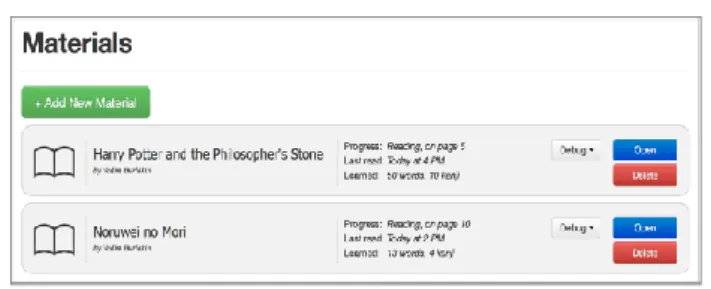
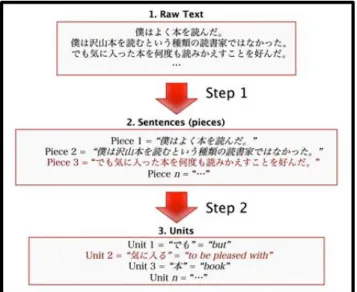
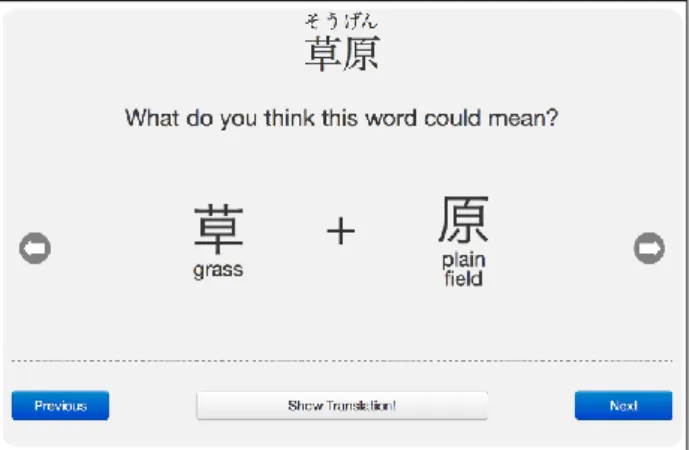
(3) Vol.2014-CE-127 No.9 2014/12/7. IPSJ SIG Technical Report. testing purposes we have used the books “Harry Potter and the Philosopher’s Stone” by J.K.Rowling and “Norwegian Wood” by Haruki Murakami. Figure 3.1 represents the material management interface. 3.2 Reading After the study materials have been uploaded to the system, the student is able to start the learning process. Figure 3.2 represents the reading interface.. Navigation through text elements is performed either by using the arrow keys on the computer’s keyboard, or by mouse. By pressing up arrow key and down arrow key the user can navigate through the sentences, while left arrow key and right arrow key moves the cursor between individual words. In the similar way, hovering the mouse pointer over text’s elements moves the reading cursor between text elements. If the learner encounters the word that he/she cannot understand, pressing Return button on the keyboard or left-clicking the word will show assistance. Glosses are provided for each element of the text by using the following three methods: i) pictures; ii) Kanji decomposition; iii) translation.. Fig 3.4: Picture gloss. Fig 3.2: Reading Interface. Since the goal of our system is to provide glosses and hints for the each entity of the text, we need to separate the text into sentences and individual words. This is done in real-time when the program loads the reading interface for a given material. The text is firstly divided into sentences - pieces, and the sentences are then divided into individual words or phrases - units. A unit is the longest entity for which a translation can be provided. For example, an expression 調子に乗る is a unit and will be shown to the learner as it is, because it has its individual meaning, even though it is constructed of two words and a Japanese particle の. An example of this process is shown on Figure 3.3.. Fig 3.5: Kanji gloss. Fig 3.6: Translation gloss. The first method (learn using pictures) is based on the picture superiority effect and is similar to other “learn vocabulary through pictures” methods. Figure 3.4 represents a gloss used by this method. The difference of our system is that we do not show the translation to the user immediately. Instead, we show the pictures only, and ask the user to guess what is the meaning behind these pictures. By incorporating a “guessing game” into the learning process, we believe that: i) we can increase the learner’s interest towards learning new vocabulary; ii) we apply an additional stimulation to the learner’s mind which will help for better vocabulary recognition. The Kanji decomposition method is based on the fact that a large number of Japanese words inherit their meaning from a combination of meanings of each individual character they contain. For example, the word 着陸 (landing; to land) is composed of two characters: i) to arrive; ii) the land. Similarly to the previously described learn using pictures method, we do not show the translation, but instead, show only information related to each separate character and ask the user to guess what would their combination mean (see Figure 3.5). In the example described above, the combination can be interpreted as “to arrive to the land”, which would be enough for comprehension. When both learn using pictures and Kanji decomposition methods are available, in the current implementation system shows Kanji gloss first. Then, if the learner cannot guess the meaning of the word, picture gloss is shown. If the user still cannot guess the meaning, by pressing the “Show translation” button we fall back to a regular translation gloss and show the word’s translation.. Fig 3.3: Text processing. ⓒ2014 Information Processing Society of Japan. However, both of the described above methods (learn using. 3.
(4) Vol.2014-CE-127 No.9 2014/12/7. IPSJ SIG Technical Report. pictures and Kanji decomposition) have a number of limitations (will be described in the Design and implementation section), therefore, there may be situations where both of them will not be available. In these situations we also fall back to the translation method, and show a translation gloss (see Figure 3.6).. definition (verbal code) does not create any associations and relations in the learner’s mind. On the contrary, learning vocabulary in its native environment creates a lot of associations: in which context was the word used, how does it sound, how does it look like, and others.. When assistance has been requested for a particular word (e.g. when we see that the user cannot understand a word), besides providing the glosses we also automatically add this word to the user’s study list. This information will then be used in the Practice section.. The idea of dynamic flashcards is to try to recall words through these word-specific associations and analogies, rather than learning the word’s definition only. To achieve this, we use a) images, in the same way that we use them in the reading process; b) audio guidance powered by text-to-speech engine; c) kanji compounds (Figure 3.7); d) context, where the word was encountered and can be used. For the latter we use the exact same sentence from the text where user had encountered the particular word, plus surrounding sentences to give more context information. This approach helps the user to create more natural associations with each word, which allows for a fast and effective recalling in real life situations.. 3.3 Practice In the Reading section of our system user enjoys reading his favorite book or magazine, at the same time incidentally learning new vocabulary and Kanji. However, the goal of Reading section is not only to provide a nice reading environment and entertaining guessing games, but also to collect the data about what the learner doesn't know. This data is stored in study lists and is used in the Practice section to check the recognition level of new vocabulary and consolidate user’s knowledge of these new materials. During text reading we collect: a) vocabulary for which assistance was requested; b) example sentences, which are taken directly from the text.. 4. Design and Implementation 4.1 End-User Client End-user client represents a web-browser (in the current prototype version). However, most of the communication between the web server and the client are conducted through JSON APIs, which allows easy implementation of third-party clients (e.g. iPhone or Android applications). 4.2 Ruby on Rails Application For website's core functionality, such as page rendering, navigation and user authentication, Ruby on Rails (RoR) platform has been chosen. The reasons for that is that: a) RoR provides all of the required functionality for creating a skeleton for a regular website out-of-the-box; b) RoR allows easy linking up with custom Ruby code and external APIs.. Fig 3.7: Kanji-based flashcard. Compared to traditional vocabulary drilling techniques, for example a typical flashcard method, we use a slightly different approach for the vocabulary learning: dynamic flashcards. While preserving the general idea of flashcard approach, where each item has a “question side” and an “answer side”, we try to add more word-specific information to the “question side” of each item. Furthermore, the flashcards are not persistent and may vary depending on the chosen study material and assistance methods available. A common problem of learning vocabulary through regular flashcards is a complete absence of word’s relationship to the real word situations and examples, as well as visual or audio information. A lot of students encounter a situation when a well-learned L2 word becomes very hard to recall in a real life situation. The reason behind it is that learning only word’s. ⓒ2014 Information Processing Society of Japan. 4.3 Text Segmentation Since our system requires text segmentation to provide learning assistance, MeCab text segmentation engine (https://code.google.com/p/mecab/) coupled with a custom-built UniDic dictionary has been chosen for this purpose. MeCab engine is widely used in natural language processing, and is also used in variety of devices and systems including iOS and Mac OS X operating systems, where it serves as Japanese language input engine. 4.4 Picture Glosses In our system we use images for more efficient study material acquisition. Therefore, our system requires an image database and a powerful search engine which would provide us with the most relevant results. For this purpose we use Google Image Search API. This API searches the Web for images by using keywords, and returns image URLs in the order of relevance, as well as other relevant information. The keywords are based on the filename of the image, the hyperlink text pointing to the image, and the text surrounding the image.. 4.
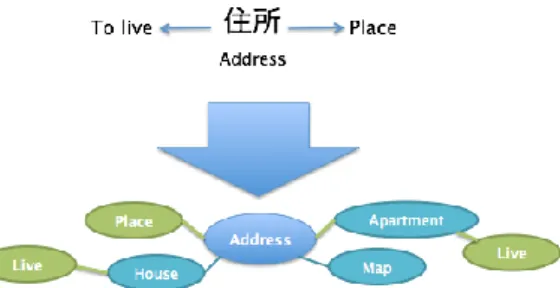
(5) IPSJ SIG Technical Report. Our goal in this part of the system is to use a foreign word as a search keyword, and use Image Search API to fetch images which would represent the word’s meaning. For example, for the word “apple” as a search keyword we expect to get an image containing a photo or drawing of an apple. We have conducted an experiment by using different types of words as the search keywords and analyzed the returned images. Different types of words include: a) concrete nouns; b) abstract nouns; c) verbs; d) adjectives. We used three manually-selected words of each type and collected four images for the each word (total 48 images) from the Google Image Search API. For the concrete nouns we were able to get very relevant results (e.g. images which truly represented the subject; Figure 4.2). For other categories, however, the resulting images were vague and therefore impossible to use in our system (Figure 4.3). However, as the results returned by Google Image Search API are unpredictable and uncontrollable, in some cases we were getting images not related to the original subject, even for concrete nouns. For example, for the word “apple” we were getting results both related to the apple fruit and to the Apple company. To eliminate this case we show three consequent images representing the subject, and ask the learner to unite the concepts behind each of the images into a single meaning. Based on the results of the experiment, we decided to use the learn by using pictures method only for concrete nouns, since it was the only case when the guess rate was sufficient. To discrete concrete nouns from other words automatically in the system, we used the JUMAN dictionary (http://nlp.ist.i.kyoto-u.ac.jp/index.php?JUMAN), which separates nouns into different categories. Categories include: places and regions, transportation-related words, food and drinks, animals, human-built things, and others. We then embedded this information into Unidic dictionary and recompiled it, so that we could obtain category information in the above-described MeCab + Unidic combination automatically.. Vol.2014-CE-127 No.9 2014/12/7. 4.5 Kanji Glosses In Japanese language, as well as in other ideographic languages, a large amount of words consist of several independent characters, each of which represents an independent sense (object, action, idea). The word, in turn, inherits these individual senses, which form the word’s target meaning. This can be exampled by a Japanese word 住所 which consists of two characters: i) 住 (to live); ii) 所 (place, location). Together these characters form a word “address; residence”. This feature of ideographic languages opens up new approaches for language learning. Instead of learning the characters and the words formed by them separately, the learning process can be combined. We use the same method as in the above-described learn by using pictures approach for the words consisting of two to three Kanji characters. We show senses of each individual character to the learners and ask them to combine these senses into a single concept. This technique allows learners: a) to remember the meaning of each individual character; b) to remember which characters are used in an each specific word; c) to create additional associations and analogies (codes) in their minds and thus increase recall efficiency. This approach especially helps to learn abstract words, where the learn by using pictures method is unavailable. However, in some cases this method cannot be used. An example of such cases can be the word 動物 (animal), which consists of characters i) 動 (to move); and ii) 物 (thing; object). In this case individual characters do not have a strong semantic relationship to the target meaning, which leads to an abstract concept of “moving objects”. It is true, however, that the entity “animal” does have a connection to this concept and can be described as a “moving object”, but this relation does not work backwards. To determine which words are eligible for this method we use WordNet to analyze the semantic connections between senses of individual characters and the word’s meaning (Figure 4.3). If the characters’ senses have a strong connection towards the target word’s meaning, then we assume that this method can be used for this particular word. For our project, we tested the algorithm against all JMDict entries consisting of two to three kanji characters, and embedded the results into the Unidic dictionary.. Fig 4.2: Search results for the word “ball”. Fig 4.3: Search results for the word “knowledge”. ⓒ2014 Information Processing Society of Japan. Fig 4.3: Analyzing semantic relationships. 5.
(6) Vol.2014-CE-127 No.9 2014/12/7. IPSJ SIG Technical Report. 4.6 Multi Glosses As above-mentioned, when several glossing methods are available for a particular word, we consecutively show different types of glosses. In the current implementation we show Kanji gloss first, picture gloss second, and finally, show the translation gloss (when other glosses are unavailable). Although this behavior is arguable, we are able to test the impact of every single glossing method on the learning efficiency. However, as a future work of this project we are also considering to use so-called multi-glosses. A multi-gloss is a gloss which contains both image and Kanji information. For example, in case of a word 動物 (animal), which is not eligible for Kanji glossing for the above-described reasons, when coupled with a corresponding image, Kanji information may also be useful. Consider the following scenario: learner encounters the word 動物 in the text. A Kanji gloss, asking “What does `to move` + `thing, object` mean?” is shown. Learner combines these two concepts into a single concept “moving objects”, and recalls some of the following (may vary from learner to learner): cars, people, machines, airplanes, etc. Some people may also recall “animals”, but the set of choices is too big. In this scenario, if the Kanji information would be coupled with a corresponding picture, then we could solve the above-described problem of backward-relations in Kanji glossing: learner would be able to narrow down the number of choices to a single concept “animals”. This phenomena is described in the Figures 4.4 and 4.5.. Fig. 4.4 Recalling process in a Kanji gloss. Fig 4.5 Recalling process in a multi-gloss. 4.7 Dictionary To provide translation assistance to the learner, a Japanese-English dictionary is required. For this purpose we use an open-source JMDict dictionary (http://www.edrdg.org/jmdict/j_jmdict.html). This dictionary is well-known for any Japanese language learner or Japanese language learning software developer. Such applications as “JED" or “imiwa?” for Android and iOS platforms respectively, are using this dictionary. The dictionary comes in a raw XML format, which is. ⓒ2014 Information Processing Society of Japan. unacceptable for our system due to very slow XML processing speeds compared to database engines. To solve this problem, we parsed the XML and imported all data into a MongoDB database. Furthermore, we mapped JMDict entry IDs to the Unidic entries and recompiled it, so that we could get translation information directly from the MeCab output. 4.8 Audio Guidance Language learning applications, as well as most of the textbooks, are usually equipped with an audio guidance for vocabulary learning and listening practice. Usually, a pre-recorded voice of a real native speaker is used. This method can be implemented easily when the study materials are predefined, but it contradicts with our system’s concept. To achieve the same goal, we use OpenJTalk (http://open-jtalk.sourceforge.net) - an open-source text-to-speech engine for Japanese language.. 5. Discussion While other researchers have already proved that using images has positive effect on learning efficiency, we have conducted a simple experiment to confirm this theory, and also introduced a solution for providing a “correct” image for each entity: by displaying several consequent images corresponding to each vocabulary entity. It is true, however, that this method strongly relies on external APIs and their algorithms (Google Image Search API, in our case), and therefore, can produce unexpected and uncontrollable results. This problem is addresses by many researchers in the image processing field, and numerous approaches for image ranking exist today. Also, ImageNet – the image database for WordNet synsets, could also serve our purpose. However, as a proof-of-concept, Google Image Search API showed acceptable results during our experiments. But as an improvement to this part of the system we consider replacing it with either ranking algorithms or an image database in the future. Kanji decomposition algorithm is also a subject for discussion. We have implemented a simple algorithm for analyzing the semantic relatedness between each Kanji in the word and the word’s meaning. We have also implemented a mechanism of a beforehand one-time analysis of all Japanese vocabulary and integration of its result (Kanji decomposition eligibility flag) into MeCab output. This allowed us to skip Kanji analysis procedure every time we display a gloss to the user. However, as the number of eligible words for this method (two- and three-character kango words) are finite, the necessity of an accurate Kanji analysis algorithm is arguable. Creating an algorithm capable of a very accurate Kanji analysis goes deep into natural language processing science and would consume a lot of time. To achieve our particular goal, the eligible words would be easier to separate by hand. There are approximately 50,000 two- and three-character kango words in Japanese language according to JMDict database, about half of which are relatively frequently used (words which have frequency factor above zero). Which means, that there are about 25,000 words. 6.
(7) Vol.2014-CE-127 No.9 2014/12/7. IPSJ SIG Technical Report. which are the targets for our glossing method. Separating this number of words would be relatively easier and would produce much more accurate results, than creating a highly accurate separation algorithm. We also have the Practice section partially implemented, but it needs further work. Current drawbacks of our system also include poor semantic relationship algorithms used in Kanji decomposition method, which is subject for a further research. We are also considering creating a tool for the manual separation of eligible words in our Kanji decomposition method. After these major improvements will be made, we are planning to test our prototype system on real language learners and compare the study efficiency of our system compared to: a) traditional learning by using printed textbooks; b) other reading tutor applications.. 6. Conclusion In this study we are trying to analyze the impact of using different glossing methods, both separately and their combinations, coupled with the learning through intensive reading approach. For this purpose, we have created a prototype system which is capable of providing three types of glosses for reading foreign text: i) picture glosses; ii) Kanji glosses; iii) translation glosses. The current prototype uses all three types of glosses separately, but future work of this project also includes creating multi-glosses containing different codes (for example, both Kanji and image information).. Technology Vol. 1, No. 2, January 1998: 41-50. 7) Kilickaya F., Krajka J. (2010). Comparative Usefulness Of Online And Traditional Vocabulary Learning. Turkish Online Journal of Educational Technology, 9(2): 55-63. 8) Folse S. (2004). Myths about Teaching and Learning Second Language Vocabulary: What Recent Research Says. TESL Reporter 37, 2 (2004): 1-13. 9) Olson M., Carpenter K. (2011). Are Pictures Good for Learning New Vocabulary in a Foreign Language? Only If You Think They Are Not. Journal of Experimental Psychology: Learning, Memory, and Cognition, Vol 38(1), Jan 2012: 92-101. 10) Johnson C., Johnson D. (2014). Why Teach Vocabulary? Anaxos, Inc. 11) MeCab – Japanese Morphological Analyzer, https://code.google.com/p/mecab/ 12) UniDic – Japanese Morphological Dictionary, http://mecab.googlecode.com/svn/trunk/mecab/doc/index.html 13) JUMAN – Japanese Morphological Dictionary, http://www.ninjal.ac.jp/corpus_center/unidic/ 14) The JMDict Project – Japanese-English Dictionary and Kanji Databases, http://www.edrdg.org/jmdict/j_jmdict.html 15) WordNet – A Lexical Database of English, http://wordnet.princeton.edu/ 16) ImageNet – Image database for WordNet, http://www.image-net.org/. We believe this learning system to be more efficient compared to traditional reading tutors and vocabulary learning methods. Our quick preliminary evaluation revealed the system to be more effective in terms of foreign text reading speed and vocabulary comprehension. As this is an ongoing research, however, this system has not yet been thoroughly tested.. Reference 1) Paivio A. (1971). Imagery and verbal processes. New York: Holt, Rinehart, and Winston. 2) Glenn M. (2008). The future of higher education: How technology is changing today’s classrooms. The Economist Intelligence Unit 2008. 3) Nation P., Waring R. (1997). Vocabulary Size, Text Coverage and Word Lists. Vocabulary: Description, Acquisition and Pedagogy: 6-19. Cambridge: Cambridge University Press. 4) Nation P., Waring R. (2004). Second Language Reading And Incidental Vocabulary Learning. Angles on the English Speaking World 4: 97-110. 5) Pitts M., White H., Krashen S. (1989). Acquiring Second Language Vocabulary Through Reading. Reading in a Foreign Language, 5: 271– 275. 6) Lomicka L. (1998). To Gloss Or Not To Gloss. Language Learning &. ⓒ2014 Information Processing Society of Japan. 7.
(8)
図
関連したドキュメント
tandem queue effect may be detected by traffic simulation methods, it is necessary to directly observe the two successive (upstream and local) overall sojourn times for a local
In this work we apply the theory of disconjugate or non-oscillatory three- , four-, and n-term linear recurrence relations on the real line to equivalent problems in number
In Section 4, we define the location-scale proportional hazard normal model and different methods for parameter estimation; we derive the information matrix and discuss likelihood
The purpose of this review article is to present some of the recent methods for providing such series in closed form with applications to: i the summation of Kapteyn series
The general context for a symmetry- based analysis of pattern formation in equivariant dynamical systems is sym- metric (or equivariant) bifurcation theory.. This is surveyed
[9] DiBenedetto, E.; Gianazza, U.; Vespri, V.; Harnack’s inequality for degenerate and singular parabolic equations, Springer Monographs in Mathematics, Springer, New York (2012),
In section 3 all mathematical notations are stated and global in time existence results are established in the two following cases: the confined case with sharp-diffuse
Using this characterization, we prove that two covering blocks (which in the distributive case are maximal Boolean intervals) of a free bounded distributive lattice intersect in
