Redefining First-Year Japanese University Students’
Self-Construals through Social-Psychological Intervention
Leung, Ricky Chi Yan
Abstract
This article presents the results of a pilot study on the effectiveness of a social-psychological intervention administered to a group of first-year Japanese university students. The results provide insight into how learners perceived and comprehended the intervention, along with any influential or lasting effects that may have occurred. The intervention was employed every week in class for a period of 14 weeks, and at the end of the study, an in-class questionnaire was completed by 55 students. The objective of the study was to identify whether a brief social-psychological intervention could affect learners’ self-construals and foster the creation of self-enhancement cycles. Results indicated that an intervention directed at modifying learners’ self construals can be somewhat effective in terms of influencing learner mindsets, altering these mindsets in a positive manner, and delivering short-term motivational effects.
Background
In recent years, social-psychological research has had an increased focus on student-centered interventions aimed at modifying learners’ self-perceptions and beliefs (Wilson & Buttrick, 2016). A learner’s interpretation of oneself, including personal beliefs, attitudes, and where one belongs in social environments was defined as self-construals by Ross and Nisbitt (1991). The ways in which individuals perceive and define their identities and sense of belonging to various social contexts is related to motivation. Bargh, Gollwitzer, and Oettingen (2010) defined motivation as the act of why an individual selects one action over another with energization or frequency.
Imagine a scenario faced by many first-year Japanese university students upon entering university. Initial setbacks may occur in terms of academic performance and fulfilling personal expectations and
responsibilities as the unfamiliarity of being in a new social and educational setting requires a period of transition. If a student does not respond well to these initial setbacks, the development and formation of self-defeating cycles can emerge, resulting in tendencies to easily give up when dealing with setbacks or simply avoiding challenges that might be difficult, but result in potential personal growth. Imagine the same scenario again, but this time the first-year university student responds differently to the initial setbacks. The initial academic and personal setbacks are reframed as learning experiences and personal growth opportunities rather than being viewed as permanent failures and disappointments. The student then begins to work harder and applies new strategies to adapt to their academic and social settings, leading to the development of a self-enhancing cycle of personal improvement. Student-centered, social-psychological interventions focus on a learner’s psychological state and self-construal. They are specifically designed and executed in classroom settings to help learners overcome beliefs that failure and success in academics and other facets of life are attributable to innate and fixed qualities such as intelligence or natural talent (Yeager & Dweck, 2012). A considerable amount of flexibility exists in learner construals and these beliefs and mindsets are fertile ground for interventions predicated on individual growth and self-enhancement (Yeager, Walton, & Cohen, 2013).
Past Studies on Social-Psychological Interventions
Social-psychological interventions are processes or stimuli implemented by educators to alter the initial self-construals and behaviors of learners, setting into motion recursive processes of individual achievement and development into the future (Yeager et al., 2016). A brief overview of past studies on the implementation and effects of social-psychological interventions on learners can be found in Blackwell, Trzesniewski, and Dweck (2007), Lin-Siegler, Ahn, Chen, Fang, and Luna-Lucero (2016), Brady et al. (2016), and Yeager et al. (2016).
Blackwell, Trzesniekwski, and Dweck (2007) used an 8-session workshop on effective study skills to teach middle-school students that intelligence is not fixed, but an incremental trait. The researchers showed students that the brain is like a muscle; that it develops new connections and becomes more intelligent as a person works hard on challenging tasks. The students who underwent the intervention condition displayed a sharp increase in math grades over the rest of the academic year whereas those in the control group (did not undergo the intervention) exhibited a decline in grades. Lin-Siegler et al. (2016) attempted to change high school students’ mindsets about scientific achievements by having students read stories about famous scientists’ intellectual and personal struggles. The life stories of notable historical figures such as Albert Einstein and Marie Curie were selected to show that even they had to work hard to overcome numerous personal and professional struggles to accomplish what they did; they were not just simply “smart people”. The group which underwent the intervention treatment read about both the struggles and achievements of these notable figures, while the students in the control condition only read about the scientist’s achievements. Their results showed that the group of students
who underwent the intervention treatment got better grades at the end of the semester than those in the control group, particularly students who were achieving poor grades to begin with (Lin-Siegler et al., 2016). Brady et al. (2016) investigated how value affirmations could be used as a social-psychological intervention to reduce the stress of being negatively stereotyped in school due to the association of being a member of an ethnic minority (Latino) in the United States. In class, the Latino students wrote about a core personal value that was important to them and this single affirmation exercise was found to have significant lasting effects after the initial intervention. A follow-up session conducted two years later with the same group of Latino students revealed that their grade point averages had improved as well as the development of more self-affirming and less self-threatening construals, assessed by an open-ended writing task (Brady et al., 2016).
Requisite Factors of Social-Psychological Interventions
Social-psychological interventions require pre-existing situational and personal factors in order to be effective. As shown in Figure 1, these factors can either be situation-centric, person-centric, or in ways that have a lasting effect or what Yeager, Walton, and Cohen (2013) defined as “wise interventions”. Situation-centric factors are specific detrimental causes that undermine the effective functioning of a given group of people in a given situation (Walton & Wilson, 2018). Person-centric factors refer to the available capacity in both the situation and individual to foster the building of critical skills, adaptive associations, and meaning-making for the self (Walton & Wilson, 2018). Wise interventions are situations susceptible to a modification in personal identity and beliefs, in which individuals’ changed behavior can become self-fulfilling and recursive by being embedded into the fabric and structure of their everyday lives, delivering personal benefits in time (Wilson & Buttrick, 2016). These three non-exclusive factors permit social-psychological interventions to operate and facilitate the transformation of negative self-construals or self-defeating cycles into altered meanings and channeling more adaptive behaviors for self-enhancing cycles (Walton & Wilson, 2018).
Figure 1. Requisite Factors for the Effectiveness of Social-Psychological Interventions, based on Walton & Wilson (2018)
Research Objectives and Questions
This pilot study was aimed at identifying whether a brief social-psychological intervention could affect learners’ self-construals and enable the formation of self-enhancement cycles that persist over time. The research questions examined the following key issues for this study:
1. Whether or not learners noticed the social-psychological intervention.
2. Whether or not learners could comprehend the social-psychological intervention. 3. Whether or not learners were influenced by the social-psychological intervention.
4. Whether learners felt they were positively or negatively influenced by the social-psychological intervention.
5. Whether or not the social-psychological intervention had any lasting effect on the learners. 6. Whether learners liked or disliked the social-psychological intervention.
Design of the Social-Psychological Intervention
The social-psychological intervention designed for this study were motivational quotes containing messages of perseverance, reflection and redefinition of self-construals, and growth-orientated themes. It was based on an iterative, student-centered design process that could be administered to entire classes, aiming to increase the academic performance of low-achieving learners while increasing the learner-orientated attitudes of low and high-achieving learners (Yeager et al., 2016). The majority of quotes were
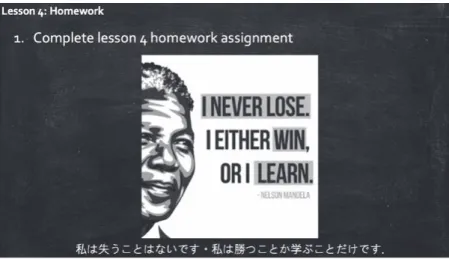
taken from some notable modern-day and historical figures and embedded into each lesson as an indirect message, displayed to students beneath their weekly homework assignment on a PowerPoint presentation slide. An example of the intervention and associated quotation is displayed in Figure 2.
Figure 2. Example of a Social-Psychological Intervention Quotation
The intervention was designed to be recursive, indirect, and stealthy, meeting the conditions of a wise intervention (Yeager & Walton, 2011). A recursive intervention is one that creates self-enhancing cycles that gradually integrate into the individual’s personal and social environment. For instance, learners who undergo an effective intervention are able to channel altered meanings of self and action into different facets of their lives, sustaining the recursive effects of the initial intervention. The delivery mechanism of the intervention was indirect and stealthy, avoiding direct and persuasive appeals (e.g., “Think positive!”). Indirect and stealthy approaches may be more effective than overt strategies as they minimize resistance and reactance to the message (Yeager, Walton, & Cohen, 2013). They come across as much less controlling and do not stigmatize students as in need of help, factors that could weaken or negate the intervention’s effects (Yeager & Walton, 2011).
The intervention was administered to students over a period of 14 weeks. The motivational quotations were shown along with the weekly homework assignments because that information tended to attract the most attention from the students as they wanted to know what they needed to do for their next class. The quotations were written in English along with a Japanese translation to facilitate comprehension and enable a deeper analysis of the message in the learners’ native language (Japanese). The motivational quotations and when they were presented to the students are displayed below in Table 1.
Table 1. Motivational Quotations Used as Social-Psychological Interventions
Data Collection
The data was collected from 55 first-year university students at a private university in the Tokyo area in July 2018. A closed-ended questionnaire, consisting of six Likert-type questions (see Appendix) was created by the researcher. To obtain more authentic data, a neutral answer option was deleted from the common one to five Likert scale and a one to six Likert scale was used (Edwards and Smith, 2014). The questionnaire was anonymous and completed in class by the students in their final class (lesson 15) after having undergone the social-psychological intervention treatment in the previous 14 lessons.
Research Results
Table 2 shows the frequency in which students noticed and read the social-psychological intervention. Students were asked in the questionnaire to self-report how often they read the quotes and
Lesson Motivational Quotation Notable Figure
1 Realize deeply that the present moment is all you ever have. Eckhart Tolle 2 Beauty begins the moment you decide to be yourself. Coco Chanel 3 He who is not courageous enough to take risks will accomplish nothing in life. Muhammad Ali
4 I never lose. I either win or I learn. Nelson Mandela
5 If you can’t fly, then run. If you can’t run, then walk. If you can’t walk, then crawl. But whatever you do, keep moving. Martin Luther King Jr.
6 I am my problem but also my solution. Unknown
7 If you do not believe in yourself, no one will do it for you. Kobe Bryant 8 A pessimist sees the difficulty in every opportunity. An optimist sees the opportunity in every difficulty. Winston Churchill 9 The value of a college education is not the learning of many facts but the training of the mind to think. Albert Einstein 10 Nothing in life is to be feared. It is only to be understood. Marie Curie 11 The key to success is to keep growing in all areas of life – mental, emotional, spiritual, as well as physical. Julius Erving 12 When we are no longer able to change a situation, we are challenged to change ourselves. Viktor E. Frankl 13 Nobody who ever gave his best regretted it. George Halas 14 There is always something to be thankful for. Unknown
based on the researcher’s personal in-class observations, students tended to either take a photo of, notice and read, or did not notice nor pay attention to the motivational quotes. It was presented at the end of each lesson in hopes of stimulating a recursive and lasting effect from week to week as students left each class with a motivational statement to reflect upon. No prior explanation or context was provided by the researcher as to why the interventions were displayed in order to deliver them in an indirect and stealthy manner. The top response was “sometimes” (32.72%) and “always” accounted for only 20.00%, which is substantially less than the majority of students who consistently took the time and effort to always notice and read the quotations.
Table 2. Notice and Reading Frequency of Intervention (N=55)
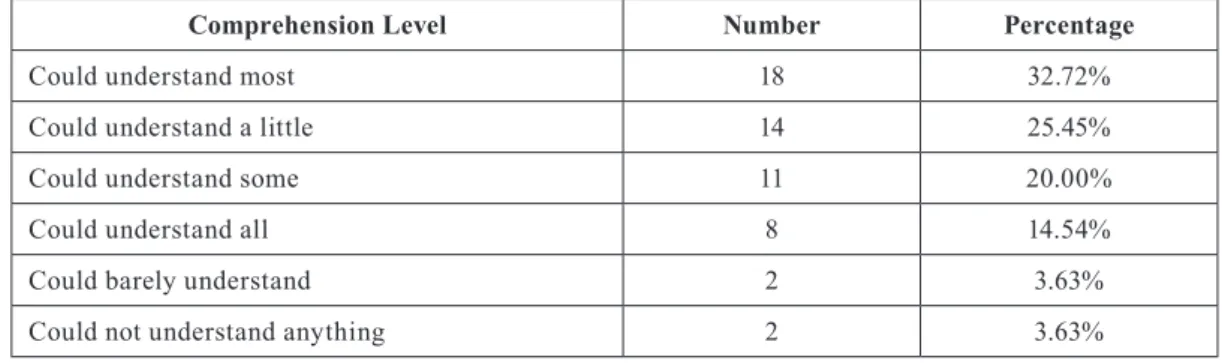
Students were also asked about their level of comprehension or how much they could understand the quotations. Shown in Table 3, 32.72% of the students could understand most of the quotations which was the highest response percentage. Those that could understand the quotes ranging from “a little”, “some”, “most”, and to “all”, accounted for a majority of 92.71%, suggesting that some level of comprehension, albeit minor, did occur. Some possible reasons for a lack of comprehension may be due to the lack of context or previous scaffolding for the presence of the messages. Moreover, the philosophical nature and underlying meaning of the quotes signify complex messages that may need to be further deconstructed beyond a single notice and reading of the message.
Table 3. Comprehension Level of Intervention (N=55)
Notice and Reading Frequency Number Percentage
Sometimes 18 32.72% Always 11 20.00% Occasionally 9 16.36% Often 8 14.54% Rarely 6 10.90% Never 3 5.45%
Comprehension Level Number Percentage
Could understand most 18 32.72%
Could understand a little 14 25.45%
Could understand some 11 20.00%
Could understand all 8 14.54%
Could barely understand 2 3.63%
Students were questioned about how much the motivational quotes influenced their thinking. The extent of influence of the intervention on the students is shown in Table 4. The majority of students were influenced “a little” (30.90%) and “somewhat” (27.27%), accounting for 58.17% of the total score. This suggests that although the motivational quotes do not have a significant level of influence on the majority of learners, this slight impact can be taken as an indication of the start of recursive processes and the reformulation of self-construals beginning to take effect.
Table 4. Extent of Influence from Intervention (N=55)
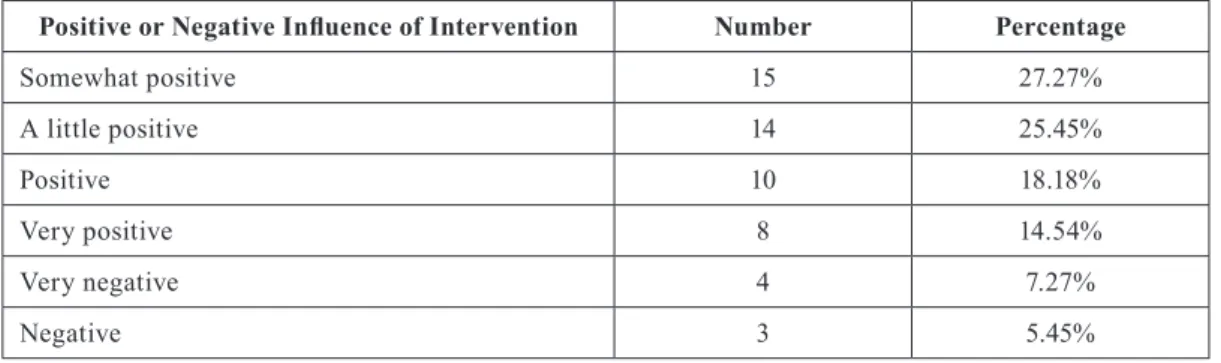
Students were then examined about whether or not the motivational quotes had a positive influence on them. In Table 5, the data shows the responses of “somewhat positive” (27.27%) and “a little positive” (25.45%) representing 52.72% of the student responses. The positive categories such as “somewhat positive” (27.27%), “positive” (18.18%), and “very positive” (14.54%) accounted for 59.99% of the total scores, suggesting that the motivational quotes generally had a positive impact on a slight majority of learners.
Table 5. Positive or Negative Influence of Intervention (N = 55)
Measure of Influence Number Percentage
A little 17 30.90% Somewhat 15 27.27% Mostly no 9 16.36% Yes 7 12.72% Not at all 5 9.09% Absolutely 2 3.63%
Positive or Negative Influence of Intervention Number Percentage
Somewhat positive 15 27.27% A little positive 14 25.45% Positive 10 18.18% Very positive 8 14.54% Very negative 4 7.27% Negative 3 5.45%
The questionnaire further examined students regarding whether they thought about the quotes later on upon initially reading them in class. In Table 6, 32.72% of respondents stated that they “probably did not think about them again” and 25.45% “thought about them on occasion”, representing 58.17% of total responses. A quick deduction of the data would suggest that students generally did not receive or generate much of a lasting effect from the interventions with only 16.36% who “thought about them sometimes”, 12.72% who “thought about them often”, and 3.63% who “thought about them always”.
Table 6. Lasting Effect of Intervention (N = 55)
Lastly, students were questioned about whether they liked seeing a motivational quote on the homework slides. The top three responses, “okay” (41.81%), “liked” (30.90%), and really liked (18.18%) accounted for 90.89% of the total answers. As can be seen in the data presented, it can be surmised that students generally have favorable attitudes towards experiencing the intervention treatment.
Table 7. Likeability of Intervention (N = 55)
Lasting Effect of Intervention Number Percentage
Probably did not think about them again 18 32.72%
Thought about them on occasion 14 25.45%
Thought about them sometimes 9 16.36%
Thought about them often 7 12.72%
Never thought about them again 5 9.09%
Thought about them always 2 3.63%
Likeability of Intervention Number Percentage
It was okay 23 41.81%
Liked 17 30.90%
Really liked 10 18.18%
It was not so bad 4 7.27%
Really disliked 1 1.81%
Discussion
The results from this study revealed that a brief social-psychological intervention consisting of motivational quotes shown to students at the end of classes does not affect the majority of learners’ self-construals in a significant way. Each one of the survey questions had a wide distribution of responses in which no single response item for each of the questions had a majority response. However, the intervention was successful in modifying self-construals for a smaller percentage of students to varying degrees. The study was a pilot experiment, conducted in a single university setting with a relatively small sample size (N=55) to evaluate the feasibility and possibility for a better designed study in the future.
For the minimal amount of time and effort it takes to implement this type of intervention, it is of value to educators to utilize this tool even if less than the majority of learners are affected, or the magnitude of academic and personal benefits may be modest. Additionally, receiving self-reported feedback and data from a questionnaire is beneficial for educators to better understand the students’ mindsets. This information can be useful in further refinement and delivery of the intervention, increasing the potential effect on larger student populations. Targeting students’ construals about themselves, their teachers, and their educational environment, with simple, inexpensive techniques, can lead to lasting improvements in academic performance (Wilson & Buttrick, 2016).
Current research studies on Japanese university students and modification of their self-construals is an area that has yet to be thoroughly investigated. Motivation among Japanese university students is highly variable as entrance into high-level universities, rather than academic performance during university, is used by industry to determine students’ abilities (Nagatomo, 2012). Moreover, the well-known conception that university in Japan is viewed as a “four-year vacation” reflects how socialization processes such as part-time jobs and club activities take precedence over academic and intellectual achievement (Nagatomo, 2012). Newby, Weko, Breneman, Johanneson, & Maassen (2009) indicated that most Japanese university students (75%) do not believe that the knowledge they accumulate in university will be applicable to their future careers in industry. Students may also be reluctant to put effort into their studies after going through the demanding process of university entrance examinations (Nagatomo, 2012). A substantial number of first-year university students in Japan may find themselves lost, unmotivated, and at the start of entering a self-defeating cycle as a less structured and more autonomous university environment requires much more self-awareness, discipline, and responsibility. Social-psychological interventions can work effectively to nudge the aforementioned learners into engagement and reflection of their self-construals for the purpose of adapting beliefs and behaviors that will result in positive personal growth.
Limitations
This study has a number of limitations with the most prominent being the fact that the data was self-reported and retrospective. Thus, it is impossible to gauge the true accuracy of the data reported. There could also be a possible disconnect between self-reports and actual behavior (Yeager et al., 2016). Further limitations of the questionnaire lie in the fact that answer categories such as “often” and “occasionally” or “a little” and “somewhat” can be considered rather subjective and cannot claim to produce precise results. The motivational quotes presented to the students in this study were passive messages rather than student-generated interventions which induce deep processing and prepares students to transfer the content to new settings (Yeager & Walton, 2011). The selection of motivational quotes also needs to be taken into further consideration as learners may not know these notable figures or how their quotation is relevant to their own personal situation. It would also be helpful to measure or know what the effect on the low-performing students were. Those students tend to have the lowest motivation for academic achievement and due to the questionnaires being anonymous, this effect could not be determined. The study could also largely be improved by having multiple long-term assessments of the learners’ self-construals and whether or not there are any changes in academic performance during their time in university. Another limitation was that the sample group (N=55) was from only one university. Relational dynamics between the teacher and students could also influence the meaning an intervention carries for students. For instance, a hostile relationship between a teacher and students could potentially undermine the effectiveness of the social-psychological intervention (Yeager & Walton, 2011). Lastly, there are numerous heterogenous effects that could occur between learners, teachers, and educational and social environments resulting in heterogenous intervention effects. Such effects must be more clearly identified and defined in order to produce more reliable and rigorous data and results in future studies.
Conclusion
The primary goal of this study was to identify whether or not learners’ self-construals had been influenced by a social-psychological intervention presented to them in class. The results indicated that although there was not a significant influence and lasting effect on the majority of learners, the intervention did have a positive impact on a smaller number of learners, signifying that the intervention was effective. Although numerous limitations exist within the study, it is possible to modify learners’ self-construals through the use of a precisely designed intervention such as the motivational quotes presented in this study. The conclusion that social-psychological interventions can be effective in changing mindsets is very promising for future studies. In particular, future projects could include more refined and precise data collection and analysis processes to deliver more reliable results. The potential to scale up these interventions and deliver them to larger student populations is another exciting possibility that could result in impacts and growth-orientated shifts in learners, educational institutions, and society.
References
Bargh, J. A., Gollwitzer, P. M., & Oettingen, G. (2010). Motivation. In S. Fiske, D. Gilbert, & G. Lindzey (eds.), Handbook of social psychology (pp. 268-316). New York: Wiley.
Blackwell, L., Trzesniewski, K., & Dweck, C. (2007). Implicit theories of intelligence predict achievement across an adolescent transition: A longitudinal study and an intervention. Child Development, 78, 246-263.
Brady, S. T., Reeves, S. L., Garcia, J., Purdie-Vaughns, V., Cook, J. E., Taborsky-Barba, S., . . . Cohen, G. L. (2016). The psychology of the affirmed learner: Spontaneous self-affirmation in the face of stress. Journal of Educational Psychology, 108, 353–373.
Edwards, M., & Smith, B. (2014). The effects of the neutral response option on the extremeness of participant response. Journal of Undergraduate Scholarship, 6. Available from http://blogs. longwood.edu/incite
Lin-Siegler, X., Ahn, J. N., Chen, J., Fang, F.-F. A., & Luna-Lucero, M. (2016). Even Einstein struggled: Effects of learning about great scientists’ struggles on high school students’ motivation to learn science. Journal of Educational Psychology, 108(3), 314-328.
Nagatomo, D. (2012). Exploring Japanese university English teachers' professional identity. Bristol: Multilingual Matters.
Newby, H., Weko, T., Breneman, D., Johanneson, T. & Maassen, P. (2009). OECD reviews of tertiary education. Japan: OECD Publishing.
Ross, L., & Nisbett, R. E. (1991). The person and the situation: Perspectives of social psychology. New York: Mcgraw-Hill Book Company.
Walton, G. M., & Wilson, T. D. (2018). Wise interventions: Psychological remedies for social and personal problems. Psychological Review, 125(5), 617-655.
Wilson, T. D., & Buttrick, N. R. (2016). New directions in social psychological interventions to improve academic achievement. Journal of Educational Psychology, 108(3), 392-396.
Yeager, D.S., & Walton, G.M. (2011). Social-psychological interventions in education: They’re not magic. Review of Educational Research, 81, 267–301.
Yeager, D. S., & Dweck, C. S. (2012). Mindsets that promote resilience: When students believe that personal characteristics can be developed. Educational Psychologist, 47, 302–314.
Yeager, D.S., Walton, G., & Cohen, G. L. (2013). Addressing achievement gaps with psychological interventions. Phi Delta Kappan, 94, 62-65.
Yeager, D. S., Romero, C., Paunesku, D., Hulleman, C. S., Schneider, B., Hinojosa, C., . . . Dweck, C. S. (2016). Using design thinking to improve psychological interventions: The case of the growth mindset during the transition to high school. Journal of Educational Psychology, 108, 374 –391.
Appendix
Social-Psychological Intervention Questionnaire Instructions:
• At the end of each class on the homework information slide, there was a quote (名言) like the one below. 毎回の授業の終わりにお見せする宿題に関するスライドに下記のような名言があります。
• Please circle one answer for each question. 各質問の答えに〇を付ける。 1. How often did you read the quotes (名言) on the homework information slides?
課題のスライドにあった名言を、どの程度読みましたか?
2. The quotes were written in both English and Japanese. Could you understand the quotes? 名言は日本語と英語で書かれていましたが、その意味を理解しましたか?
A B C D E F
never rarely occasionally sometimes often always
一度もない ほぼ読んだことが
ない たまに読んだ 時々読んだ よく読んだ いつも読んだ
A B C D E F
could not understand
anything could barely understand could understand a little could understand some could understand most could understand all
全く理解
3. Did the quotes on the homework slides influence your thinking? 課題のスライドにあった名言はあなたの考え方に影響をあたえましたか?
4. Did the quotes on the homework slides influence you in a positive way? 課題のスライドにあった名言はあなたにポジティブな影響をあたえましたか?
5. After seeing and reading the quotes, did you think about them afterwards? 名言をみたり読んだりした後、それらを考えたことはありますか?
6. Did you like seeing a quote on the homework slides? 課題のスライドにあった名言を読むことは好きでしたか?
A B C D E F
not at all mostly no a little somewhat yes absolutely
全く影響はなかった ほとんど影響は
なかった 少し影響はあった ある程度影響は あった だいたい影響は あった かなり影響はあった
A B C D E F
very negative negative a little positive somewhat positive positive very positive
まったくポジティブ
ではなかった あまりポジティブ ではなかった 少しポジティブな 影響があった ある程度ポジティブ な影響があった かなりポジティブな影響があった 非常にポジティブな影響があった
A B C D E F
never thought about them again
probably did not think about them
again
thought about them
on occasion thought about them sometimes thought about them often thought about them always
まったくない ほとんどない 少しある 時々ある かなりある いつもある
A B C D E F
really disliked disliked it was not so bad it was okay liked really liked