ig-.",eg".JS<i}t;{iX'.-.iftit:ftZ'5Eff{)`EI'iffi$ffVo.IO 2003
-65-CONNECTICUT AND ITS
ENVIRONMENTAL
POLICIES
Yoshiyuki Wada"
Abstract
This paper gives a case-study of one U.S. state's environmental policy. By comparing
the state's characteristics and environmental policies in effect, we find that there is a strong relationship between each state's peculiar circumstances and the resulting policies. It is also
shown that several departments are responsible for environmental programs.
I . INTRODUCTION
Global warming is one of the mostwide-spread environmental problems in the world.
Each country, however, shows different
attitude toward this problem for various
reasons. For each country has its own peculiar affairs in designing policies including
envi-ronmental protection. This paper
investi-gates how environmental policies are
imple-mented in the U.S. by focusing on one U.S.
state, Connecticut.
The U.S.A. is a polar nation with
respect to environmental policy
implemen-tation reflecting unilateralism in the sense of pursuing its own benefits. Environmental
policy is strongly dominated by economic
policy. In the process of case study, it can be
possible to know what the purpose of U. S . ellvironmental policy is at state level, and who is in charge of each policy.
[3] discuss poilution control policies in the U.S. but their contribution is restricted
to nation level and comprehensive. i At
least at internationally recognized journalleveL there is no literature which deals with
state ievel environmental policies in the U.S. in a concrete manner. This paper can
be regarded as complementing this defect in, the literature. It is made ciear that environmental
policies in the state of Connecticut are
orga-nized by several departments in the form of
programs. Its categorization deeply reflects
surrounding circumstances in both economic and environmental or geographical senses.
The rest of this paper is organized as fol-lows. Section II introduces what the state of Connecticut is. Subsequent section expl•ains
1 ) In order to utilize page space efficiently, we
show references by means of numbers inserted in brackets throughout the paper.
'The idea of this article was conceived while I stayed at the University of Connecticut during 2000-2001. I express my deep gratitude for both Shiga University and the University of Connecticut. And Meg Enkler provided important information concerned with deposlt program to me. I aiso appreciate her
-66-
?rk"Lk"Jfvr:2ii,=Ky'ft:AIii;gBaJlit;)t.itt `rpeeVo. 10 2003environmental policies in the state in detail. In
the last section we conclude the paper.
U. WHAT IS CONNECTICUT ?
In this section, we review what the state of
Connecticut is, especially its peculiar features
different from other states in the U.S. We shed light on the state from four aspects:
history, geography, political concern as well as
system, and econom..y. It is helpful to under-stand these respects in investigating envi-ronmental policies in Connecticut.
1. HISTORY
e
Connecticut is one of the most historic states in the U. S. Its prime events after
European people touched what is now
called the state of Connnecticut aresumma-rized in Table l. As the table shows, the
state of Connecticut is filled with the `first's
and `innovative's. Among them the state's
Fundamental Orders enacted in 1639 were
the first written constitution drafted in the
New World which were refereed to in the
process of drafting the Constitution of the
United States ([4]) .2 This fact is reflected in
the official nickname of the state, the
Constitution State, which was adopted by the Act of the Legislature 1959 ([12]).3 On the
other had, Connecticut boasts forerunners
in clvil right movements who contributed
the emancipation of slaves such as Harriet B.
Stowe (author of Uncle Tom's Cabin) ([4])
and Prudence Crandall who taught an
2) However, according to [5] ,this assertion
is said to be no better than an anecdote.
African-American child in spite of the oppo-sition of neighbors (in l832 in [6] while in 1833 aceording to [5]) .4 It might be
possi-ble to imagine that such a spirit has been
inherited by the subsequent generations.
Connecticut also has a iong history on
reli-gion.[8]proved that Connecticut can be
compared with Massachusetts with' respect to record of churches in the 19th century. Connectlcut's history, however, is described
as that of confrontations and wars just as
the U.S. history as a whole. From the
viewpoint of English settlers coming into Connecticut from Massachusetts, Puritans,
they firstly dominated the Dutch by
con-structing towns called colonies, gaining position
as the representative European newcomers in
the regions ([5]). Secondly, they brought
the Native Indians, the Pequot tribe in
par-ticular, under their control after Wars of
3 ) The State of Connecticut has other unofficial
nicknames such as Provisions State because of
the tradition of contribution to the army since the
Revolutionary War ([2],[4],[5]), IVutmeg State
which comes from a tale that early traders
sold wooden nutmegs brought by sailors from
Spice Islands ([4],[5],[6]), or the Land of
Steady Habits which stems from a legend that
" Connecticut's insurance companies have a
reputation for always paying what they promise"([4],[5]). Meanwhile, the name,
Connecticut, originates from the AIgonquian Indian word, Quinnehtufeeut in [4] and [12] or
qumniht"feeut in [5], meaning "at the long
tidal river" (in [5], [6]) or "besides the long river" in [4] or "Long River Place" ([12]). The present capitai is Hartford although both
Hartford and New Heaven had been the
capitals from 1703 to 1875 ([l2]).
4) In 1995 she was honored as the official state
heroin. Meanwhile the state adopted Nathan
Hale, a patriot in the Independence War, as its
CONNECTICUT AND ITS ENVIRONMEttTAL POLICIES
(Yoshiyuki XETada)-67-Pequot (l637) and King Philip (l675-76)
([4], [5], [6]). On the other hand, the
Mohegan, another powerful native tribe,
were friendly to the English. In the French and
Indian War <l754-63) , in which England and France fought over controi of North America, the Colonists, people in the colonies,
con-tributed to the victory of England ([4]) .
Only twelve years later, however, they
turned their fire on England in the War ofIndependence or the Revoiutionary War
(1775-83) in pursuit offreedom, and they won([4].[5]) .Finally (except for wars in
the 20th and subsequent centuries) they
fought for justice in the form of abolition in the Clvll War (l861-65) , and they succeeded in releasing the slaves ([4] , [5]) .5
2e GEOGRAPHY
Connecticut belongs to the New England
which besides Connecticut consists of the states
of Maine, Massachusetts, New Hampshire,
Rode Is}and, and Vermont ([4]) .The state is
adjacent to the states of New York in the
west, Massachusetts in the north, Rhode
Island in the east, and faces the Atlantic(Long Isiand Sound) in the south. Roughly speaking it takes the shape of a rectangle
with the east-to-west side by 90 miles
(about 144 km) and the north-to-south side5 ) European American people, however, had a somewhat selfish idea at first. They believed that the African people who had begun to be brought into the colony as slaves in the early 1600 s should not be slaves, but they hesitated to agree that the Africans have the same rights
as themselves, whlch led to the objection against PrudeRce Crandall's idea explained
above ([5])
by 55 miles (about 88km) which amounts to an
area of 5,O18 square miles (about 12,997
square kiiometers) ,which ranks Connecticut as the 48th in the U.S. (preceding only thestates of -Delaware and Rhode Island).
([4], [5], and [12]) The highest point in
the state is Mount Frissell in Salisbury
(2,380 ft or about 714m) , while the lowest
polnt is Sea level along the Long Island
Shore ([4], [5]). The Connecticut River
runs through almost the central area of the state north to south, and drains into the Atlantic Ocean. The climate is relativelycomfortabie since the temperature in average
ranges frorn 25Q -300 F (about-sO--oOC)
in winter to 700-850F (about 200-250C)
in summer ([4], [5], and daily whether
forecast) . The population is 3,425,074 in 2001 according to [7] (29th in the U.S.) .
There seems to be a contrast within the
state. On the one hand, denseiy populatedand industrialized cities are observed.
About 30 O/o of the whole population
concen-trates on city areas such as Bridgeport,
Hartford, and New Heaven ([4]). And the
southwestern area in the state in effect
plays a role of suburbs of New York City.0n the other hand, there are many small
coloniai towns or villages, especially in the
northern area of the state. The
northeast-ern area is sometimes called `Quiet Corner" ([6]) by the Connecticutters, the peopie liv-ing in the state ([5]).
3. POLITIAL CONCERN AND SYSTEM
As the state's official nickname shows,Connecticut's people traditionally have deep
-68-
ith,k"JÅ}c!'}lif-$Å}}(?ft!ptItig31ijfa.ta: ffeeVo. 10 2003Charter Oak is said to be "the most
colorful symbol of Connecticut's love of
freedom" ([5], [6]).When the British
envoy tried to regain the charter in 1687
which guaranteed self-government of the
colony, the settlers hid it behind an oak tree
and succeeded in holding it. On the other
hand, in 1787 when the U.S. Constitution was drafted, R. Sherlnan of Conneeticut played an important role. He proposed a solution to the
problem of how many lawmakers each state
should send to the Congress. He asserted that
each state send two in the Senate while
principle of proportional representation be adopted in the Representatives. This is the
famous "Connecticut Compromise" ([4]).
Nowadays the State of Connecticut sends 2 U. S. Senators and 6 U. S. Representativesand therefore has 8 Electoral votes, and its own parliament consists of 36• State Senators and 151 State Representatives ([4] , [5]) .
4. ECONOMY
Industries in Connecticut have been
vari-ous both in historical and contemporary
contexts mainly thanks to its geographicalvariety. In the l9th century, cities located along the shoreline udiized their advantage of
being faced• to the Atlantic to a great
extent. The City of New London at the
west side of the mouth of the Thames
River with its deepwater anchorages is
famous for having boasted shipbuilding
([4]) and whaling ([6]) industries. Groton at the east side of the mouth of the same river, on the other hand, had a prosperous
time by means of shipping, and it had a
facility of building submarines including the
USS Ndzatilzas ([4],[5]',[6]) .6 Likewise
Essex near the mouth of the Connecticut River was a shipbuilding center while Mystic at the
mouth of the Mystic River was famous for
inshore fishing shipbuilding- ([6]). Other than
them} commodities such as clocks, hats, locks were main products in the 18th through early
20th centuries ([4]) .7 Old Connecticutters also
were active in sales business. The Yankee
Peddlers in the 18th and 19th centuries, in partic-ular, were famous for door to door sales and their wide business area around the nation by hawking Connecticut products including
house-wares goods such as needles and buttons in
addition to the above goods packed in carts ([4] , [5] , [6 ]) ,8
At present electric products, chemicals,
plastics, jet engines are among leading
man-ufactured goods in the state ([5]) .9
Severai service industries have founded
their roots in the state. In particular, many
6 ) Connecticuters also have a long tradition of
submarine building. In 1775 D. Bushnell
invented a primitive one called American Turtle,
trying to make a contribution in the
Revolutionary War. In 1900, a U. S. Navy submarine was lunched for the first time, which Ied to the success of first nuclear submarine in 1954. ([12])
7) The old Connecticuters exhibited their
intelligence in inventing various products. For example, process of vulcanizing rubber by C.
Goodyear in 1839 ([4] , [6]) , portable
typewriter inl843 ([12]) , sewing machine by
E. Howe in 1846 ([l2]),Frisbee in 1920
([12]) ,Polaroid camera in 1934 ([l2]) ,and
helicopter by I. Sikorsky in 1939 ([12]) have their origins in the state,
8 ) The word, " Yanfeee" has severai meanings. It
is a nickname for New Englanders (residents
in New England) originating in Jan Kees, a Dutch nickname for Connecticut's English settlers
([4]) ,while according to [5],it means
CONNECTICUT AND ITS ENVIRONMENTAL POLICIES
(Yoshiyuki Wada)-69-insurance companies have their
headquar-ters within this state. About 150 headquarheadquar-ters of them are Iocated in Connecticut, and 55 of
which are Iocated in Hartford ([4]) .
Therefore, Hartford is sometimes called theInsurance City- ([5]) . Agriculture or
farming has been continued in this state
even though its importance has greatly
declined since the development of manufac-turing sector. About 1O/o (3,500 families) of a!1 of the workers in the state engagethemselves in agriculture including broadleaf
tobacco and dairy products such as egg and mllk ([4] , [5]) .In addition, gambling or management of casinos is a peculiar source
of income for the Native Americans. Since it is only them who can legitimately engage in this kind of activities, they have a
monopo-iistic position and earn enormous revenue.
Mashantucket is the most famous place of
this kind in the state ([6]) .iO
As for living standard of the people in the
state, the average income is $28,OOO which
contributes to the fact that Connecticut is
the first-ranked state in the nation with
respect to per capita income ([4], [5],
and [7]).ii Connecticuters incur such taxes as
6O/o sales tax and iOO/o admissions tax.
9) Of 1.7 million workers, 34 O/o (575,OOO)
engage in service industry, 210/o (360,OOO) in
manufacturing, 120/o (200,OOO) working for
the government ([4] , [5]) .
10) Residents of Connecticut are composed as follows. European (mainly Italian, Irish, British) : 87C/o, African' 8 O/o, Hispanic: 6,50/6,
Asian: 2 O/o, American Indian: O.20/o which are
calculated based on [4] .
M. ENVIRONMENTAL POLICIES
IN CONNECTICUT
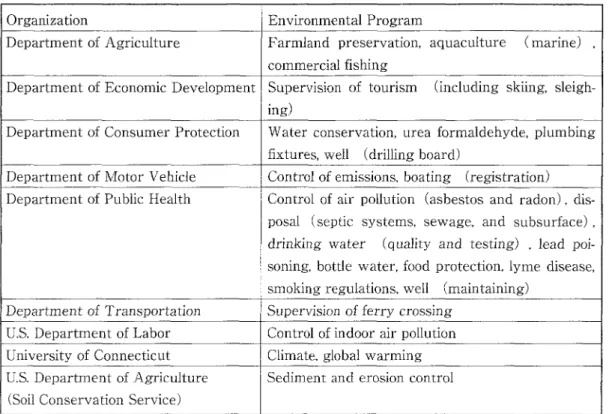
In this section, we explore what kinds ofenvironmental policies the state of Connecticut
carries out. In examining them, it is proved that the policies refiect natural conditions
within the state. First of all, we need to
recog-nize that according to [2] ,environmental
policies eailed Environmental Programs
are implemented by several administrativeorganizations, not by a single department or
bureau. And sorne prograrns are controlled
by several authorities. Major organizations
and their principal programs in charge are
listed in Table .?.. The authorities inciude
Departments of Economic Development,
Motor Vehicle, and Transportation and
even the Universjty of Connecticut. Thjs
fact shows that environmental policies are not
exclusively delegated to the Department of
Environmental Protection, and that the poli-cies are shared among the relevant bodies. It
follows that this system has both merits
and demerits. While the policies are expected
to refiect peculiar features each program
has, the overall responsibility becomes vague.
How are possible obstacles resulting from inconsistencies among programs implemented
by several authorities solved ?
Table 3 shows what each program
tar-gets, or what subjects are included in
which program. This table indicates that
11) In the latest statistics (Census)
Connecticut is ranked the second-highest state
following the state of New Jersey. In relation to this, the proportion of the population who graduated from college is 27C/o (5th in the
-70-
?ke-LkM3c{•i7\:$.-•?.3t,i!?}5,"leBel e,iZffewvo. Io 2003environmental programs target a very wide
range of subjects, aiming at both pollution control and environmental protection.
Among them, there exists an unique
pro-gram called ERvironmental Equity Propro-gram
which is deposit program for beveragecon-tainers and simply called "Bottle Bil1" as its
subjects imply.i2 This policy started over
20 years ago in order to reduce litter and to
promote recyciing. i3 The program is
com-pulsorily run by clistrib.utors, .and retaiiers.
The mechanism is as follows. Retailers collect
deposit from consumers ( 5 cents per con-tainer) when they sell reiated goods
(bQt-tles and cans) to them, and pay the deposit
back out when consumers return them.
The distributors collect deposit funds and
reimburse retailers for what they must
refund. Consumers have no obligation to
return the goods. Therefore some deposlts are never refunded •because the empty cansget thrown out or put in municipal
recy-cling bins. And the distributors keep these unclaimed deposits.
Although this program is fascinating in
the sense that it has a function to make
consumers have an incentive to return thegoods, it also involves weak points. Firstiy, as
mentioned above, this program coexists with
12) This paragraph owes intensively and
exclusively to Meg Enkler.
13) As the name "Bottle Bill" indicates, this
program is stipulated in Section 22a-243 in Chapter 446d Solid Waste Management of the Connecticut General Statutes. In the text, terms such as " beverage" ," beverage container", "consumer","dealer","distributor", "manufacturer", "piace of business of a dealer","redemptlon center", "use of consumption", and"nonrefillabie beverage container"are clearly defined
municipal recycling service. On the one
hand, this guarantees to consumers two
ways to treat empty bottles and cans. On
the other hand, the state must incur costnecessary in recycling process which can
be saved if the deposit-refund system func-tions perfectly. Secondly, the law does not require retailers and. distributors to report how many bottles or cans they receive for a
certain term And the authority has no data concerning the effect of this program. If
government wishes to control pollution'
effi-ciently it is needed to collect these data
reg-ularly.
IV. CONCLUDING REMARKS
Connecticut and Shiga in Japan share
many aspects in common. Geographically,
there exists a large body of water in eacharea; the Connecticut River in Connecticut,
Lake Biwa in Shiga. From a viewpoint of
economy, both areas produced similarmer-chants. In Connecticut, the Yankee Peddlers
were active in the 18-l9 centuries as
explained in the text, while in Ovei (old nameof Shiga) Omi Shonin (Omi Merchants)
resounded their name throughout the country in the Edo Era.i4 It is very interesting thatboth peop}e did business mainly by
ped-dling during almost the same period. Thesehistorical background may be helpful in
designing policies including environmental schemes.This paper focused on environmental policies
l4) The literature and
Omi Merchants have
and released. [9] them.WEB
been and pages concernlng widely published [10] are amongCONTNECTICUT
AND ITS ENVIRONMENTAL POLICIES
(Yoshiyuki Wada)-71-in one state of the U.S. Connecticut. The
investigation shows us that the policies are well arranged, but have some difficulties at
the same time. Environmental policies are implemented not only by the Department of
Environmental Protection but also by several
other departments, which might bring
about conflicts of interests among the bodies.In the U.S. environmental policies are
carried out at both federai and local levels in
the sense of government. Then it is possible
to have a case that the poiicies cannot be
enforced efficiently.i5 It will be required to
empirically study such a problem by
focus-ing on real cases.
REFERENCES
[1] BaumoL W. J.and W. E.Oates (1988),
77he Theory ofEnvirownental Poliay ( .?. nd ed.) ,
Cambridge: Cambridge University Press.
[2 ]/ CT Department of Environmental
Protection, Environmental Geographic
Information Center (2000) , A Listing of
Envzronmental Programs of the Connecticttt Department ofEnmronmen tal Pro tection and Related Agencies, D.E.P. Bulletin No. 13.
[3] Davis, J, C. and J. Mazurek (1999) ,
Pollutzon Control in the United States-Evuluating the
S),stene-, Washington, D, C.: Resources for the
Future,
[4] Fradm, D. B.and J. B.Fradin (1997),
From Seu to Shining Sea Connectzcut, Chicago' Children Press.
[5] Gelman, Amy (1991),Hello U,S.A.
Connecticut, Minneapolis: Lerner Pubiications
Company.
[6] Harry N. Abrams, Inc- Publishers
(2000) , Connectzcut-77he S)pintofAmerica-, N.Y.
[7] Morgan, K 0 and S. Mor.cran <eds),
Connectzczit in Perspective 2002 (l3th ed) , Kansas: MorgaR QLiitno Corporation.
[8] Olds, K, <19. 94) , "Privatizmg the
Church: Disestablishment m Connecticut and Massachusetts" , lournal ofPoliticdilEconomy, vol. I02, pp 277-297.
[9] Suenaga, K (2000), The Omi Merchants
(m Japanese) , Tokyo' Chuo-Koron.
[10] http.//wwwbiwane.jp/ (Accessed
September 30, .?.O03) .[Il] httpi//www.census.gov/ (Accessed
September 25, 2003) .
[12] http://www.ct.gov/ (Accessed September 24. 2003) .
l5) [1] surveyed theoretical analysis of this
-72-
?thkMJf<J,i!='S,X,,the}EgKut PÅí`Ili$itVo. 10 2003Table 1: Prime Events O ccurred in Connecticut After Europeans Arrived There16
Year
1614 1633 I638 1639 1662 1701 1764 1784 1788 I792 1795 l835 1839 l848 I861 1877 1954Event
Dutch explorer, A. Block sails up the Connecticut River.i7
English Puritans from Massachusetts Bay Colony led by R. T. Hooker start their
set-tlements. (Windsor, Wethersfield, and Hartford appear in 1633, 1634, and 1635,
respectiveiy. And they form the Connecticut Colony in 1636.)
Another Puritans settle in New Heaven. The State's Fundamental Orders are drafted.
King Charles ll gives the Charter to the Colony of Connecticut. Yale College (later Yale University) is established.
Connecticut Courant (later Hartford Courant) , the oldest newspaper in America
starts.
The first law school in America is established by T. Reeve in Litchfield Con•necticut becomes the 5th State in the U. S. A. on January 9. EIi Whitney invents the cotton gin.i8
Mutua} Assurance Company (the first insurance company ln America) is founded
in Norwich
Samuel Colt invents a pocket revolver, Colt Firearm. The slave ship, Amistad, arrives at New London. Slavery is outlawed within the state.
Yale University awards the first Ph. D. degree in philosophy in the U.S. FIrst telephone exchange in the world is established in New Heaven.i9 First atomic-powered submarine, USS ?Vautllus, is launched in Groton.
16) This table is made
literature in References.
17) Accordingto [5],
1610.
up by summarizing
this event happened in
18) According to [4],Whitney invented the
machinery in 1793 while [12] mentioned that it happened in 1794.
19) [l2] reports that the establishment
pened in Bridgeport.
20) These tables originate from [2] ,and mation in them is reorganized by the author of this paper.
CONNECTICUT AND ITS ENVIRONMENTAL POLICIES
(Yoshiyuki Wada)-
73-Table 2 : List of Environmental Programs in the state of' Connecticut 20
Organization
EnvironmentalProgram
DepartmentofAgriculture
Farmlandpreservation,aquaculture(marine),
commercialfishingDepartmentofEconomicDevelopment
Supervisionoftourism(includingskiingsleigh-ing)DepartmentofConsumerProtection
Waterconservation,ureaformaldehyde,plumbing
fixtures,well(drillingboard)DepartmentofMotorVehicle
Controlofemissions,boating(registration)
DepartmentofPublicHealth
Controlofairpollution(asbestosandradon),dis-posal(septicsystems,sewage,andsubsurface),
drinkingwater(qualityandtesting),leadpoF
soning,bottlewater,foodprotection,lymedisease,
smokingregulations,well(maintaining)
DepartmentofTransportation
Supervisionofferrycrossing
U.S.DepartmentofLabor
ControlofindoorairpollutionUniversityofConnecticut
Climate.giobalwarming
U.S.DepartmentofAgriculture
(SoilConservationService)Sedimentanderosioncontrol
Tabie 3 : Environmental Programs and their Subjects20
Program
Air management
Boating safety
Subject
Acid rain, air, asbestos, bubble policy, automobile emissions,
burning, catalytic converter, chlorofluorocarbons, coal,
continuous emission monitoring, data processing, fugitive dust, emissions testing, exhaust emissions, Freon, fumes, indirect source permit, federal and state legislation (clean
air act, etc.) , notice of violation, odors, oxygenated gasoline,
ozone, permits and licenses (boiler, point source) ,public participation, radiation, sandblasting, state, sulfur contents
in fueL tax relief application, transportation, vapor recovery,
wood burning stoves, X-ray equipment inspections
Boating, Long Island Sound. motorboat information,
-74-
ith kM. )kl :]= fi .Je ?.Sit sM,4, gts Eff p,:,tstlll$itVo. 10 2003Environmental equity program
ForestryInland fisheries
Marine fis heries
Inland water resource management
Law enforcement
Land acquisition
and management
Bottle bill, beverage container deposit law
Arbor day, cordwoQd cutting permit, fire warden,
firewood cutting, foliage information, forest, forester registration, gypsy and control, land, logging, lumber, northeastern forest fire protection commission, forest
trees nursery, permits and licenses, pruning trees
information, rural community fire protection, sawmill, seedling sales, state, tent caterpillars, timber sales
(state and private land) ,tree, urban forestry
Aquatic resources education, Atlantic salmon,
scientific collector's permit, commercial fishing,
fishing derby/tournament, all inquiries on fish,
fisheries conservatiQn management act, fisheries
management, fishing, flood, fly fishing oniy areas, fish
hatcheries, lakes and ponds, no kill fishing area,
permits and licenses, private water registration act, pond public fishing, record fish, shad, spearfishing,
sport fishing, stream fishing, striped bass, trout
stocking, wildlife
American shad, anadromous fish restoration program,
Atlantlc salmon, blue crabs, commerciai fishing,
fishing, lobsters, marine resources, menhaden, whales
State building code, dam inspection and safety, diversion
programa, encroachment line program stream channeL
erosion control, federal emergency management
agency, fiood, inland wetland commissions, federai and state legislation, low flow program, maps, marsh
land, municipaL permit and licenses, rainfalL riparian rights, river levels, river management, river
protec-tion commissions, sediment and erosion control,
stream, swamps, municipal training, water, disposal of
water company land, water diversions
Terrain vehicles regulations, boating, conservation,
fishing, game, gun confiscation, hunting, jacklighting,
law enforcement (natural resources) , poaching,
snowmobiling, wildlife
CONNECTICUT AND ITS ENVIRONMENTAL POLICIES
'
(Yoshiyuki Wada)
-75-Licensing and revenue
Long Island Sound programs
Parks
Pesticide management
RecyclingWaste management
state, grants, land (public act 490) , leases, municipal,
open space, outdoor recreation grants, property
(DEP) .relocation assistance, states, survey
Archery, hinting permit, bait store licenses, bow
hunting permit, bus passes (DEP employees) ,
fishing, hunting, menhaden, permits and licenses,
scuba divingBeach and shore eroslon, beach improvement, bypass channel, coastal, disposaL dock construction permit, dredging and marine construction in coastal areas, films. grants, harbor management planning, "land's end" -Long Isiand Sound Program newsletter, federal
and state legislation, Long Island Sound, maps, marine
resources. march land, municipaL navigable waters,
navigation projects (dredging) , offshore oil and gas
development, permits and licenses, seawalls, stream,
structures and dredging in coastal areas, tidal
wetlands and waters, water, wetland managemen-t,
coastal zoning
Bus passes(state parks) . all inquires on camping, canoeing, C.A.R.E. Charter Oak Pass/Senior citizens Pass, concessions on state land, dog sledding on DEP Iand, dogs in state parks, equestrian trails, grass cutting on DEP land, handicapped access, hiking on state land, historic monuments and sites, horse, ice
skating on state land, naturalist interpretation
program, state land life guard, parks maintenance, metal detecting, motorcycle trails, museum exhibitsand Gillette Castle and Dinosaur Park, Parks and
recreational areas, permits aRd liceRses, picnicking,
recreation, scuba diving, ski touring, snowmobiling,
state, swimming, trails on state land only, tubing on the
Farmington River
Alar, pesticide permit for algae control
Automobile (oil and battery replacement) , used
motor oil
- 76-
1'th kn JJ<i,,ils•Mz`x!i=If;gBiiff t;tttttff$EVo. 102003
Water management
waste, bulky waste, chemical spilL collection of chemical
liquids and hazardous waste and endangered species/
plants, commercial recycles, composting, delegation of authority to local governments, disposal, disp'osal area
operator, energy, landfills englneering evaluations,
explosions federal insecticide (fungicide and rodenticide
act liaison) , garbage, gypsy moth control, hazardous
materials (declarations relating to property transfers) ,
hazardous waste, control of hornets, household cleaners and hazardous waste, iliegal chemical dumping, insect control, control of Japanese beetles, lakes and ponds, landfill (sanitary) , lawn and garden chemicals, leaf
disposal, federal and state legislation, manifest system,
medical waste, mercury, municipal, oil and solvents, oii spills, packaging, paper recycling, permits and
licenses, pesticides, pollution prevention office, poly-chlorinated biphenyls, pesticides in pressure treated
wood, public participation, publications, recyciing, resource conservation and recovery (act of 1976) , resources recovery permit coordination, soil contamL
nation, solid waste, solvents and oils, source separa-tion, spill, storage tanks and underground for oil and
gasoline and chemicals, termite control/compiaints,
toxic substances control act of 1976, transfer station
per-mit, underground storage tanks, control of wasps,
'waste disposal sites for hazardous materials, waste oil disposal (storage) , waste reduction, wastewater, water weed control (pesticides)
Basin planning, car wash regulations, clean water act,
construction grants and municipal sewer, discharges into surface water (sewers and groundwater) ,
dis-posal, contamination of drinking water, eutrophication of
lakes, federal water pollution control act, grants,
groundwater (aquifers) , groundwater quality
sam-pies, lakes and ponds, leaching fields (septicsys-tem) , federal and state legislation, licensed environ-mental professional, Long Island Sound, maps, municipal,
CONNECTICUT AND ITS ENVIRONMENTAL POLICIES
(Yoshiyuki Wada)-
77-Wildlife
negative declaration, permits and licenses,
phos-phates, public participation, safe drinking water act of
I974, SARA, septic systems and sewage disposal
(subsurface) , sewage treatment plants, sludgedis-posal, state, stream, superfund sites, transfer bill,
wastewater, water, water quality, water sample,
water softeners, water use
Non domestic animals, injured animals, archery
information and wildlife issues, animal bag limits, baldeagle program, bat infestation, beaver/muskrat
trapping, bluebird program, breeder's license game,
scientific collector's permit, deer program, dog field trials, ducks, game, geese, hunter education, hunting, non harvested wildlife, nuisance wildlife. oil covered