Improvement of Self-Efficacy through Creating
Learner Autonomy Promoted by Visualization
―― Examining the Effects of a Self-Evaluation Worksheet ――
Yoshie OCHI
松 山 大 学
言語文化研究 第 巻第 号(抜刷) 年 月
Matsuyama University Studies in Language and Literature
Learner Autonomy Promoted by Visualization
―― Examining the Effects of a Self-Evaluation Worksheet ――
Yoshie OCHI
Abstract
The purpose of this study is to explore the improvements in self-efficacy stimulated by learner autonomy and factors that enhance those improvements from the perspective of Visualization. It is the method used by the author to increase the efficacy and competency of students engaged in an English learning process. The author used awareness of students’ input, intake, and output in English, and made these steps in that process more visible. This article analyzes the change in self-efficacy and learner autonomy made during the course. The analyses are based on the responses of questionnaires and classroom practices. The learners self-evaluated their efforts in the classroom, their learning time for assignments, their autonomous learning time and review by using a “Self-Evaluation Worksheet” to reflect on their English study, and the learners’ comments described on the “Self-Evaluation Worksheet. The two research questions were :( ) does the Self-Evaluation Worksheet on autonomy lead to improvements in self-efficacy” ? If so, how ? And,( ) does consciousness about English study change through visualization of what students study with the Self-Evaluation Worksheet ? If so, how ? The participants were first-year and second-year university students who were taking an English class as a general English course. Participants were divided into
three groups by proficiency. A version of the Self-efficacy Scale was used to measure the change in their consciousness in self-efficacy. The results suggest Visualization using the Self-Evaluation Worksheet enhances their self-efficacy significantly, especially among students with middle English proficiency.
.Introduction
It is crucial for the teacher in the English as a Foreign Language(EFL)context to not only give interesting classes, but also to encourage students to study by themselves to nurture learners who have good reasons for learning. It is sometimes found, however, that students with a low sense of self-efficacy in the language-learning domain are not able to work on tasks well and perceive difficult tasks as obstacles. As a result, they are likely to give up. If teachers can increase student’s self-efficacy, which means confidence in one’s own ability to achieve intended results, students can believe in themselves as learners, and it will enhance their ability to learn.
The concept of learner motivation has also been at the heart of learner autonomy. Dörnyei( ) states the relevance of autonomy to motivation in psychology has been best highlighted by his influential ‘self-determination theory.’ According to this theory, the freedom to choose and to have choices, rather than being forced or coerced to behave according to someone else’s desire, is a prerequisite to motivation.
The literature on self-evaluation has been linked to the idea of autonomy in language testing. Oscarson( ) states that self-assessment raises learners’ awareness of the learning process and stimulates them to consider course content and assessment critically. Sugawara and Takahashi( ) carried out learning activities, including self-assessment, presentation, and interview, and reported
changes in learners’ self-assessment. Blanche( ) also observes that in a number of studies, self-assessment is seen to increase learner’s motivation.
The purpose of the present study was to determine whether the classroom practices in which the learners self-evaluated their efforts in the classroom, their learning time for assignments, their autonomous learning time and review by using a “Self-Evaluation Worksheet” to reflect on their English study would contribute to improvements in self-efficacy during the course.
.Literature Review and Research Rationale
. Facilitating autonomy to enhance self-efficacyEarly interest in the concept of autonomy within the field of language education goes back to the political turmoil in Europe in the late s as a response to ideals and expectations in the concept of autonomy within the field of language education (Gremmo & Riley, ). Holec( )first reported it to the Council of Europe, where learner autonomy is described as ‘the ability to take charge of one’s own learning.’ Learner autonomy was developed in response to the situation at the end of the s in which the development in all so-called industrially advanced Western countries of a socio-political tendency was characterized by a definition of social progress in terms of an improvement in the quality of life.
Since then, learner autonomy(LA)has inspired much discussion. In contrast to Holec, Littlewood( ) argues that autonomy as a capacity involves two components, ability and willingness. Willingness depends on having both the motivation and the confidence to take responsibility for the choices one makes (Littlewood, ). Sykes( )demonstrated how the self-access center in the university was designed to promote learner autonomy. He notes the system guides the students through the process of analyzing their needs, setting goals, making a
study plan, recording their study, measuring their progress and reflecting on the efficacy of their study method.
In another study, Benson( )raised the question whether it is possible for us to find effective ways of fostering autonomy and putting learners in control of their language learning. In his book, autonomy refers to a capacity that learners possess and display to various degrees in different contexts.
Within Benson’s( )main focus on fostering autonomy, he has differentiated the variety of approaches that can be applied in the language education into six types. First, in resource-based approaches, learners have the opportunity to exercise control over learning plans, the selection of learning materials, and the evaluation of learning. Second, in technology-based approaches, the development of autonomy is focused on the technologies used to access resources. Third, learner-based approaches focus directly on the production of behavioral and psychological changes that will enables learners to take greater control over their learning. Fourth, classroom-based approaches focus on collaborative work as beneficial to the development of autonomy, in part because the focus of attention in the classroom is shifted from the teacher to the students themselves. In addition, learner control of the curriculum and learner control over the planning and evaluation of learning are emphasized. Fifth, in curriculum-based approaches, the principle of learner control over the management of learning based on the curriculum as a whole is extended to autonomy, in which learners are expected to make the major decisions concerning the content and procedures of learning in collaboration with teachers. Finally, in teacher-based approaches, the emphasis is placed on the teachers who play a crucial role in mediating ideas about language learning to their students. In this approach, teachers themselves must display a degree of autonomy in their approaches to teaching and learning.
exposure to English to get a plenty of L input, as Hiromori( a)points out, the need for learner autonomy is defined as the learners’ desire to engage in English learning autonomously, for their actions to be self-determined, and to take responsibility for their actions. Agawa and Takeuchi( )reexamined the items designed to gauge relationships between the teacher and students and those intended to measure autonomy. The items measuring autonomy-supportiveness were included in their teacher-students relationship construct, which was originally thought to belong to two different constructs. It is because when a teacher wants to support students’ autonomy, the teacher needs to trust them and respect their feelings and thoughts, which inevitably entails a good relationship between the teacher and students. It is apparent that teachers’ autonomy supportiveness is considered more important than controlling autonomy. As Sykes( )put it, in order to facilitate the development of learner autonomy, a support system needs to be established guiding learners through the process of analyzing their needs, setting goals, making a study plan, recording their study, measuring their progress, and reflecting on the efficacy of their study methods.
It is widely believed that students’ self-efficacy beliefs are necessary for the development of language acquisition. As Bandura( )notes, students with a strong sense of academic self-efficacy willingly undertake challenging tasks, expend greater effort, show increased persistence in the presence of obstacles, demonstrate lower anxiety levels, display flexibility in the use of learning strategies, demonstrate accurate self-evaluation of their academic performance and greater intrinsic interest in scholastic matters, and self-regulate better than other students. Consequently, they attain higher intellectual achievement. Conversely, students with low self-efficacy prefer to complete only uncomplicated academic tasks to which they apply minimal effort and limited persistence, or they might choose to entirely avoid the completion of an academic assignment. Makino( )confirms the progress of
learners’ English learning and their realization that self-regulated learning is an effective method to develop an understanding of what they are learning. Moreover, their self-efficacy significantly improved ; specifically, they gained confidence in their English learning. For these reasons, self-efficacy beliefs are often said to be better predictors of academic success than are actual abilities.
. Research Based on Self-assessment
Research in the area of self-assessment in language learning grew out of an interest in the area of autonomous learning or learner independence(Patri, ). Benson’s classroom-based approaches have involved evaluating classroom learning. Self-assessment has been linked to the idea of autonomy in the language-testing field. Oscarson( ) distinguishes between assessment as an internal self-directed activity and assessment as an external other-self-directed activity. Benson ( ) points out from the perspective of autonomy, the formative aspects of internal assessment are of greater significance than learners’ ability to match their own assessments with external assessments of their proficiency. In this sense, self-assessment includes reflection on goals, learning activities, and appropriate assessment criteria.
Dörnyei( )suggests that the key issue in increasing learner involvement is to share responsibility with the learners about their learning process, including allowing learners choices about many aspects of the learning experience, giving students positions of genuine authority, encouraging student contributions and peer teaching, encouraging project work, and allowing learners to use self-assessment procedures. Among them, he notes that self-assessment raises the learners’ awareness about the mistakes and successes of their own learning, and gives them a concrete sense of participation in the learning process. In addition, Oscarson ( )identifies four main benefits of formal self-assessment for learners : First,
self-assessment trains learners to evaluate the effectiveness of their communication, which is beneficial to learning in itself. Second, it raises learners’ awareness of the learning process and stimulates them to consider course content and assessment critically. Third, it enhances their knowledge of the variety of possible goals in language learning, which leaves them in a better position to exercise control over their own learning and to influence the direction of classroom activities. Finally, it expands the range of assessment criteria to include areas in which learners have special competence, such as the evaluation of their own needs and affective dimensions of the learning process. Moreover, Smolen, L., Newman, C., Wathen, T. and Lee, D.( ) argue that establishing personal goals based on self-evaluation of their work significantly affected student involvement in their learning process, encouraged students to make decisions about what to focus on next in their learning, and positively affected their view of themselves as learners and decision makers.
As the literature review above suggests, a classroom that encourages students to set a goal and use self-assessment encourages them to raises their awareness about their own learning, gives them a concrete sense of participation in the learning process, control over their own learning, and helps them to develop learner autonomy. The purpose of this paper is to examine the roles of the self-evaluation worksheet for raising student awareness and improving self-efficacy. By introducing the self-evaluation worksheet with a full view of the entire learning process, learning time, learners’ goals, and their progress based on learner autonomy skills, the sense of what they can achieve is increased and the self-efficacy of Japanese EFL students is affected are demonstrated. This study set up the following two research questions :
( ) Does the Self-Evaluation Worksheet with autonomy improve self-efficacy ? If so, how ?
( ) Does consciousness about English study change through visualization of what students study with the Self-Evaluation Worksheet ? If so, how ?
.The Study
. ParticipantsThe participants were first-year and nine second-year university students learning English as a foreign language(EFL)at a university in Japan. Their majors ranged across the economics, business administration, law, and sociology faculties. They were enrolled in a mandatory -week English course in which they were expected to acquire the skills of reading, listening and speaking, and to nurture the attitudes that foster autonomy. Their general English proficiency level varied from elementary to intermediate according to their TOEIC bridge scores. There were three groups classified into a low-, a middle- or an upper middle-proficiency group based on their TOEIC bridge test scores : upper middle(M= .), middle (M= .), and eight low(M= .)proficiency students. At the time of this experiment, the students in the low and the middle-proficiency group met twice a week and the students in the upper middle group met once a week for weeks. Before the study commenced, informed consent was obtained from each participant. The consent form contained a brief description of the study and its purpose.
. Materials
The scale contains eight items as shown in table , in order to assess learners’ self-efficacy for L learning. The scale was developed by Pintrich and De Groot ( )and validated in a different study(Makino, ). All of these items were rated on a five-point Likert scale ranging from (strongly disagree)to (strongly agree), with higher scores indicating strong self-efficacy. Matsunuma( )
measured the reliability of the scale with Cronbach’s alpha and reliability ofp=. was obtained.
Murase( )created a comprehensive and systematic framework to measure learner autonomy in language learning, which contained four types of autonomy : Technical Autonomy, Psychological Autonomy, Political-Philosophical Autonomy, and Socio-Cultural Autonomy. The scale I used for the research contains question items from each section Murase developed, as shown in Table .
The Self-Evaluation Worksheet used for this research was developed by the author based on a previous autonomous study that used a record of work form at the University of Hong Kong(Benson, ). The worksheet I used was designed to encourage learners to record what they had learned in classroom activities, the study time for the class, to comment on what they had done, and on how useful and enjoyable their activities were. Additionally, they assessed their classroom activities on a five-point Likert scale ranging from (working very idly) to (working very hard)as a tool for self-monitoring and self-assessment. At the end
of every classes students were required to fill in the columns and evaluate their class activities.
A one-item open-ended questionnaire was created to be administered with the question, “What effect did you have by filling in the self-evaluation worksheet ? Include evaluating yourself at the end of the class, writing your study time at home for preparation for the class and for autonomous learning, scores of the quiz you took during the class, and your comments about class room activities. Write as concretely as possible.” This question was translated into Japanese and administered in the middle and post-survey. To encourage honest feedback from the participants, one point was emphasized : The feedback that the participants filled out would not matter to their grades.
adopted from Pintrich & De Groot( ), and the Measurement in Language Learning Autonomy(MILLA)(Table .)was adopted from Murase( ). They were administered to the groups in the first, middle and last meeting.
Table . Self-Efficacy Measurements I think I’m a good student.
I’m certain I can understand the ideas taught in this course. think I will receive a good grade in this class.
I am sure I can do an excellent job on the problems and tasks assigned for this class. I expect to do very well in this class.
I think I know a great deal about the subject.
I know that I will be able to learn the material for this class. My study skills are excellent.
Note. I delete phrase “compared with others in this class” in the item , and to have them express their own thoughts.
Table . Autonomy Measurements
I set long-term goals and plans in learning English.
I set goals and make study plans before I start studying English. I try to create the conditions under which I can study English best.
If I have a limited amount of time available for study, I decide in what order the things need to be done.
I try to create the conditions under which I can study English best. I reflect upon what I learned after I finish studying English for the day. I assess the effectiveness of my English study plans.
I take notes about how much time I spent on my English study. I am aware of the goals of the English class(es)I am taking.
I sometimes want to ask my teachers and other students for advice about my English learning.
Students can help each other learn English.
. Procedures
The survey targeted students in a week-English class during one semester. During the first week of the class(T ), an introduction, including a general explanation of the class, syllabus, evaluation, assignments, how to use the self-evaluation worksheet, class rules, and the self-efficacy and autonomous learning survey were explained to the participants and the surveys(SA Survey ; required time : approximately five minutes) were conducted. During the seventh week of the class(T ), a second self-efficacy and autonomous learning survey (SA Survey )and the first open-response questionnaire(approximately minutes in total)were administered. In the fifteenth week of the class(T ), a final self-efficacy and autonomous learning survey(SA Survey ) and a second open-response questionnaire(approximately minutes in total), as well as an end-term test were given.
. Data analysis
In order to identify the relationships between self-efficacy and autonomous learning, the twelve types of autonomous factors and the eight types of self-efficacy factors were measured with the SA Survey , the SA Survey and the SA Survey . This study focuses on the autonomy of L learners as the variable of interest, and then describes changes in self-efficacy through a series of longitudinal surveys, identifies points in which transitions in self-efficacy are observed, and identifies factors that have a significant influence on the transitions in self-efficacy. Based on the findings, a model is presented that explains the system by which motivation may change and develop. The analysis was repeated with the data collected in the fifteenth week.
The open-response questionnaire was analyzed through the process of qualitative analysis suggested by Brown( , p. − ):( )transcribing the
Self-efficacy
Group 1 Group 2 Group 3
Time 1 Time 2 Time 3
2.8 2.7 2.3 2.1 2.2 2.5 3.0 2.6 3.1 2.5 2 3.5 3
data,( )finding the useful and interesting patterns,( )clustering information into categories,( )reducing the categories to patterns, and( )interpreting the patterns and presenting the findings. The self-efficacy and autonomy change was analyzed quantitatively.
.Results and Discussion
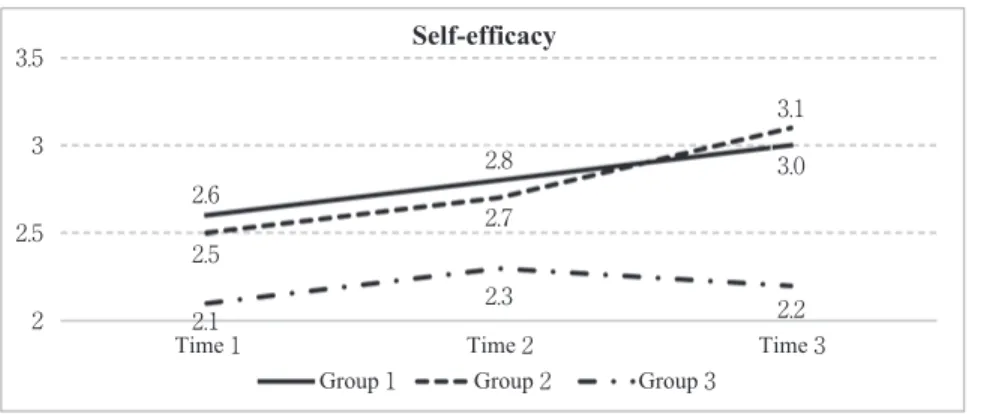
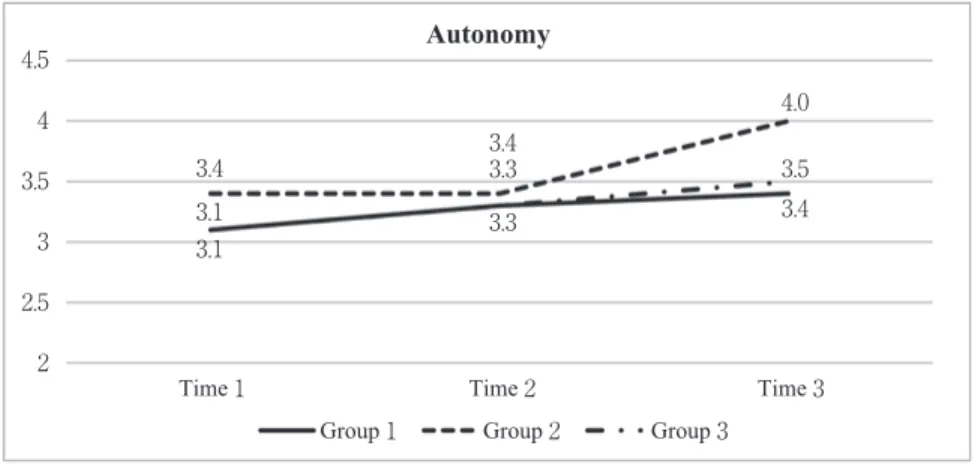
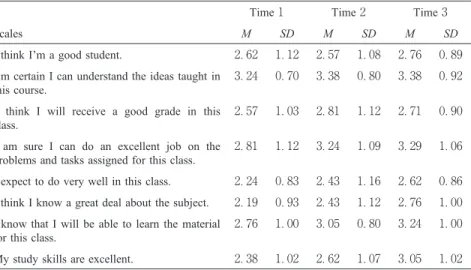
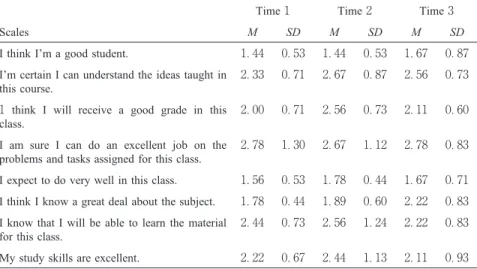
. Relations between transitions in self-efficacy and autonomous learning The first question of the study concerned the relations between transition in self -efficacy and autonomous learning. Figure illustrates the self-efficacy changes in these three groups : upper-middle(group ), middle(group ), and low(group ). Means, and standard deviations for all variables in the study are presented in table for upper-middle, table for middle and table for low groups.
As figure illustrates, Group shows a constant increase in self-efficacy from T −T , while Group exhibits a healthy increase in self-efficacy from T −T and indicates a spike in self-efficacy from T −T . Although Group shows a healthy
Autonomy
Group 1 Group 2 Group 3
Time 1 Time 2 Time 3
3.3 3.4 3.3 3.1 3.1 3.5 3.4 3.4 4.0 2.5 2 3.5 3 4.5 4
increase from T −T , there is a moderate decrease in self-efficacy from T to T . Autonomy is described as ‘the ability to take charge of one’s own learning’ by Holec( ). In contrast, Littlewood( )argues that autonomy as a capacity involving two components, ability and willingness. Hiromori( a)points out the need for autonomy is defined as the learners’ desire to engage in English learning autonomously, for their actions to be more self-determined, and to take responsibility for their actions. Figure indicates the autonomy changes in these three groups. Although Group means were high in autonomy from the beginning but exhibited no increase from T −T , there was a sudden increase from T to T . On the other hand, Group and Group show very moderate increases in autonomy. Group exhibits the most moderate increase in autonomy.
It is inferred from the results that students in the upper-middle group have an accustomed way to learn English and some confidence in their learning style from the beginning. Students from the middle group, however, exhibit strong desires to catch up and overtake the upper-middle group to show what they have done in the
class. The competitive attitude of the middle group has been reflected in the increase in their autonomy scores. This is consistent with Benson’s( )learner-based approaches, which focus directly on the production of behavioral and psychological changes that enable learners to take greater control over their learning. The data also support Hiromori’s( a)definition of the need for autonomy as the learners’ desire to engage in English learning autonomously for their actions to be more self-determined, and to take responsibility for their actions. It is also inferred from the results that the increase in self-efficacy scores for students in the lower group from T −T shows their desire to try to improve their English ability. Though their efficacy increased from T compared to T , their decrease in self-efficacy from T −T reveals they show enthusiasm for learning at the beginning but it is rather difficult to maintain that enthusiasm to the end.
Time Time Time
Scales M SD M SD M SD
I think I’m a good student. . . . . . . I’m certain I can understand the ideas taught in
this course.
. . . . . .
think I will receive a good grade in this class.
. . . . . .
I am sure I can do an excellent job on the problems and tasks assigned for this class.
. . . . . .
I expect to do very well in this class. . . . . . . I think I know a great deal about the subject. . . . . . . I know that I will be able to learn the material
for this class.
. . . . . .
My study skills are excellent. . . . . . . Table . Changes in self-efficacy scores across weeks in each measurement in group
Time Time Time
Scales M SD M SD M SD
I think I’m a good student. . . . . . . I’m certain I can understand the ideas taught in
this course.
. . . . . .
think I will receive a good grade in this class.
. . . . . .
I am sure I can do an excellent job on the problems and tasks assigned for this class.
. . . . . .
I expect to do very well in this class. . . . . . . I think I know a great deal about the subject. . . . . . . I know that I will be able to learn the material
for this class.
. . . . . .
My study skills are excellent. . . . . . . Time Time Time
Scales M SD M SD M SD
I think I’m a good student. . . . . . . I’m certain I can understand the ideas taught in
this course.
. . . . . .
think I will receive a good grade in this class.
. . . . . .
I am sure I can do an excellent job on the problems and tasks assigned for this class.
. . . . . .
I expect to do very well in this class. . . . . . . I think I know a great deal about the subject. . . . . . . I know that I will be able to learn the material
for this class.
. . . . . .
My study skills are excellent. . . . . . . Table . Changes in self-efficacy scores across weeks in each measurement in group
(n = )
Table . Changes in self-efficacy scores across weeks in each measurement in group (n = )
. Process of change in self-efficacy and autonomous learning through self-evaluation worksheet and classroom activities
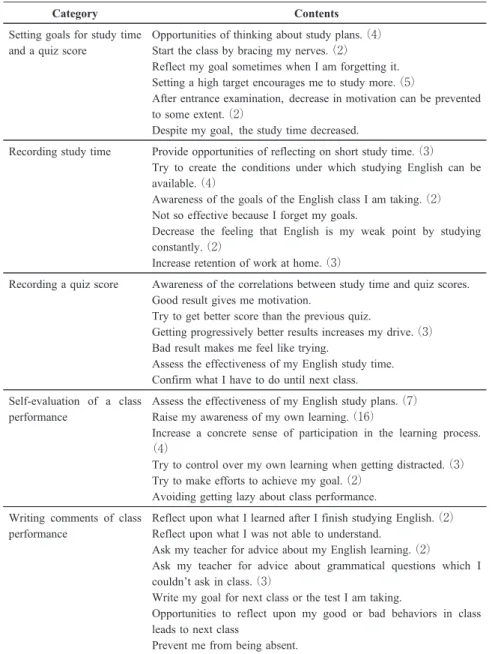
The results of the questionnaire on self-evaluation worksheet can be used to suggest several ways to improve self-efficacy and autonomous leaning. The details of what worked with the learners are described in Table . The categories are as follows.
⑴ Recording quiz scores
⑵ Self-evaluation of class performance ⑶ Recording study time
⑷ Writing comments of class performance ⑸ Setting goals for study time and a quiz scores ⑹ Communicative tasks
⑺ Presentations ⑻ Pair work
In these courses, the learners were told to think about their goals on the first day. They were instructed to set their goals for study time and a quiz score on the second day. And as the daily activity, the learners came to the class and voluntarily completed their daily self-evaluation worksheets as weekly homework, specifying their study time for preparation and review before starting the classes. At the end of the class they made a comment on what they had done, and on how useful and enjoyable their activities were. Additionally, they assessed their classroom activities on a five-point Likert scale ranging from (working very idly) to (working very hard) as a tool for self-monitoring and self-assessment. Students’ feedback suggested five points.
First, learners’ comments reveal that they are conscious of their attitude for studying English. They reflect on what they did and are motivated to keep
working. Many learners admit that just recording the study time every class is very effective because it helps them to stay focused on their goal and maintain their motivation to study. Just one student answered it was not effective because of forgetting the goal.
Second, they take a quiz at the beginning of every class and record their scores. Some learners pay attention to the correlations between study time and quiz scores to assess the effectiveness of their study time to confirm what they have to do before the next class. Others feel that both good and bad results help them increase their drive. Still others think reviewing the results just by looking helps them reflect with ease and helps motivate them to study constantly.
Third, Self-evaluation of their class performance at the end of the class seems to be effective in raising their awareness about their activities in the class and helps them to try to control their own learning. It also helps prevent them from getting lazy about class performance. Every time I check their self-evaluation worksheet and their evaluation of the activities, their evaluation is pretty much the same as my evaluation about their performance, although I feel some girls undervalue and a few boys occasionally overvalue their performance.
Fourth, learners’ notes reveal that writing comments about their class performance at the end of the class encourages them to ask questions about what they are not able to ask in front of other students. It also provides them with opportunities to reflect upon their good or bad behavior and what they can understand or not understand in the class. As a result, it encourages regular attendance. In addition, self-evaluation worksheets give them an overview of their study habits and always make them consider their attitude about English. Getting a quick impression of the current state of their study seems to inspire them to keep working and to prevent demotivation. At the same time, writing in their self-evaluation worksheets every class makes them alert.
Category Contents Setting goals for study time
and a quiz score
Opportunities of thinking about study plans.( ) Start the class by bracing my nerves.( ) Reflect my goal sometimes when I am forgetting it. Setting a high target encourages me to study more.( )
After entrance examination, decrease in motivation can be prevented to some extent.( )
Despite my goal, the study time decreased.
Recording study time Provide opportunities of reflecting on short study time.( ) Try to create the conditions under which studying English can be available.( )
Awareness of the goals of the English class I am taking.( ) Not so effective because I forget my goals.
Decrease the feeling that English is my weak point by studying constantly.( )
Increase retention of work at home.( )
Recording a quiz score Awareness of the correlations between study time and quiz scores. Good result gives me motivation.
Try to get better score than the previous quiz.
Getting progressively better results increases my drive.( ) Bad result makes me feel like trying.
Assess the effectiveness of my English study time. Confirm what I have to do until next class. Self-evaluation of a class
performance
Assess the effectiveness of my English study plans.( ) Raise my awareness of my own learning.( )
Increase a concrete sense of participation in the learning process. ( )
Try to control over my own learning when getting distracted.( ) Try to make efforts to achieve my goal.( )
Avoiding getting lazy about class performance. Writing comments of class
performance
Reflect upon what I learned after I finish studying English.( ) Reflect upon what I was not able to understand.
Ask my teacher for advice about my English learning.( ) Ask my teacher for advice about grammatical questions which I couldn’t ask in class.( )
Write my goal for next class or the test I am taking.
Opportunities to reflect upon my good or bad behaviors in class leads to next class
Prevent me from being absent.
Getting feedbacks from a teacher
Decrease a feeling of dislike for English
Teacher’s comments make me relaxed and encourage me to keep trying.( )
Self-evaluation worksheet Having a bird’s eye view of my study always makes me reflect my attitude for English.( )
Getting a quick overview of the current state of my study makes me keep working.( )
Recording self-evaluation worksheet in every class brings a good feeling of tension.( )
Recording self-evaluation worksheet in every class makes me realize how poor my performance is.( )
Reflecting repeatedly and confirming what I did.
Encouraging me to keep studying which reduced my disgust about English.
Making me realize what I should study but couldn’t make it through.
Not very successful for my motivation.
Reflecting on what I do but couldn’t increase my study time. Classroom activities Pair-work prevents me from getting bored.
Pair-work to check understanding and share our thoughts.( ) Pair-work reduces anxiety and gives opportunities to speak in English.( )
Pair-work gives me responsibility.( ) Opportunities to output in English.( )
Small presentations in front of people make me prepare beforehand. ( )
Necessary comprehension and grammar explanation in L encourage me to output in English.( )
Gaining a little confidence in making a presentation in English.( ) Classroom activities give chances to concentrate.( )
Opportunities to output in English makes me increase retention in English.( )
Finally, pair-work, group-work, and communicative tasks appear to be effective in increasing the joy of having opportunities for output, talking in English, and decreasing learners’ anxiety. As Krashen( ) claims, lowering the affective filter to reduce learners’ anxiety is necessary. For example, when asking students to answer the questions, they answer without hesitation after checking their answers with a partner. Some learners fail to understand some parts of the contents or grammar points. Pair-work or group-work can make up for difficulties in understanding because students may help one another by sharing their knowledge that the other lacks. Providing the opportunity for output can decrease their nervousness and anxiety about speaking in English and improve their confidence.
Results reveal the classroom that encourages students to set a goal and use self-assessment inspires them to raise their awareness of their own learning. It gives them a sense of participation in the learning process, control over their own learning, the opportunity to plan and monitor their tasks, and to develop learner autonomy that can lead to self-efficacy.
.Conclusion
This study explored the improvements in self-efficacy promoted by learner autonomy and factors that enhance those improvements from the perspective of Visualization in university classrooms. The study began with an attempt to enhance motivation by increasing the efficacy and effectiveness of an English learning process by being aware of the input, intake, and output in English. It makes these steps in that process more visible and makes the classes more enjoyable compared to before. The research question, on how the Self-Evaluation Worksheet with autonomy could lead to improvements in self-efficacy, was answered as follows :
EFL Japanese students’ ability to use autonomous strategies to plan, monitor, reflect on, assess, and cooperate during tasks increases self-efficacy in perceived competence and confidence in performance of class work. The second research question, on how their consciousness about English study has changed through Visualization of what they study with the Self-Evaluation Worksheet, was answered as follows : Their awareness of their own learning increases and a sense of participation in the learning process is enhanced. Additionally, having control over the learning, planning, and monitoring of their tasks can help learners develop autonomy that leads to self-efficacy.
Implications are often interpreted in light of potential limitations. The results depended on students’ self-evaluation. Their evaluation is based on the results of questionnaires and classroom practices reviewed by using a Self-Evaluation Worksheet. Self-report instruments do not necessarily capture the participants’ perceptions and feelings. Students remember what they like, and they forget what they don’t like, and their memories interpret events to suit their own perceptions of the way things should be. Also, the relationships between self-efficacy promoted by learner autonomy and academic performance should be obtained with appropriate measures such as TOEIC, TOEIC Bridge or Eiken. Further research should evaluate the relationships between self-efficacy, learner autonomy, and academic achievement for students studying English.
References
Agawa, T., & Takeuchi, O.( ). A new questionnaire to assess Japanese EFL learners’ motivation : Development and validation. ARELE Journal , , − .
Bandura, A.( ). Self-efficacy : The exercise of control . New York : W. H. Freeman. Benson, P.( ). Teaching and researching autonomy in language learning. Harlow :
Longman.
Blanche, P.( ). Self-assessment of foreign-language skills : Implications for teachers and researchers, RELC Journal , , − .
Brown, J. D.( ). Open response Items in Questionnaires. In J. Heigham & R. A, Croker (Eds.), Qualitative Research in Applied Linguistics(pp. − ). New York : Palgrave
Macmillan.
Dörnyei, Z.( ). Motivational strategies in the language classroom. Cambridge : Cambridge University Press.
Fukuda, S. T., Sakata, H. & Takeuchi, M.( ). Facilitating autonomy to enhance motivation : Examining the effects of a guided-autonomy syllabus. Electronic Journal of Foreign Language Teaching, ( ), − .
Gremmo, M. -J. & Riley, P.( ). Autonomy, self-direction and self-access in language teaching and learning : the history of an idea. System, ( ), − .
Hiromori, T.( a). Gaikokugo gakushusha no doukizuke wo takameru riron to jissen[Theory and practice to improve foreign language learners]. Tokyo : Taga-Shuppan.
Holec, H.( ). Autonomy in Foreign Language Learning. Oxford : Pergamon.
Krashen, S.( ). Acquiring a Second Language. World Language English / . CITY : Publisher.
Little, D.( ). Language learner autonomy : Some fundamental considerations revisited. Innovation in Language Learning and Teaching, ( ), − .
Littlewood, W. T.( ). Autonomy : An anatomy and a framework, System, ( ), − .
Makino, M.( ). Eigo remediaru kyoiku niokeru jikochoseigakusyu no kokoromi [Self-regulated learning in a class of low English proficiency university students]. Remediaru Kyoiku Kenkyu, ( ), − .
Matsunuma, M.( ). Eigo jikokouryokukan(ESE)shakudo no sakusei[Making questionnaires to assess English learners’ self-efficacy]. Journal of Waseda University Graduate School of Education, ( ), − .
Murase, F.( ). Measuring learner autonomy : Problems and possibilities. In C. Everhard & L. Murphy(Eds.), Assessment and Autonomy in Language Learning(pp. − ). Basingstoke :
Palgrave Macmillan.
Oscarson, M.( ). Self-assessment of language proficiency : Rationale and applications, Language Testing, , − .
Patri, M.( ). The influence of peer feedback in self and peer assessment of oral skills. Language Testing, , − .
Pintrich. R., & De Groot, E. V.( ). Motivational and self-regulated learning components of classroom academic performance, Journal of Educational Psychology, , − .
strategies, TESOL Journal , ( ): − .
Sugawara, K., & Takahashi, S.( ). Gakushusha no jikohyoka wo unagasu projekuto katudou [Project activity encouraging learners’ self-evaluation]. Nihongo kyoiku jissenkenkyu forum, , − . Retrieved from http://wwwsoc.nii.ac.jp/nkg/kenkyu/Forumhoukoku/ sugawara. pdf
Sykes, J.( ). Establishing Self-Access in Akita University. Annual Research Report on General Education Akita University, , − .