NII-Electronic Library Service
【論 文 】 日本建 築学会構造 系論 文 報 告 集 第 439 号 ・1992年 9 月
Journa]of Struct. Censしr, Engng, AIJ, No、439t Sep、,】992
AFUNDAMENTAL
STUDY
ON
NONLINEAR
WAVE
PROPAGATION
IN
INHOMOGENEOUS
MEDIA
不均 質媒体 中の非線 型 波動伝 播に関する基礎 研究
Yasuhiro
OHTSUKA
* andTakWf
KOBOR
∫*ま
大 塚 康 弘, 小 堀 鐸 二
This paper investigates the characteristics 、 of nonhnear wave propagation in inhomogeneeus media . The density of the inhomogeneous medium treated herein is assumed to change slowly in the spatial direction. An approach utilizing .the Soliton Theory is proposed to analyze nonhnear wave phenomena in(simple )inhomogeneous media , The results are summarized as follows:The final equation f6r a plane wave propagating in a l・dimensional finite elastic medium with in−
homogeneity is represented by the modified K−
dV
equation including thedissipative
term. From numerical analyses , the number of scattering solitary waves due to the medium ’s inhomogeneity increases with the intensity of the inho皿ogeneity .Keywords :inhomogeneity, nohlinear wa ・ve,50titon theory, modtfied κ一dV e4uation ,
dis5iPative
term, ∫跏 ガ館 deformatien不均質性,非 線 型 波 動,ソ リ トシ理 論,変 形
K
−dV
方 程 式,散 逸 項,有 限 変 形1
.lntroduction
In genera1,0ne of the characteri ’stics of nQnlinear phenomena is shown
by
destroying
the prinCiple of superposition (of wave motion )and most natural phenomeha are governedby
nonlinear wave motion . As is wellknown , the earthquake wave isan example of this kind.of wave motion ,.
artd many resea 厂chers
have
investigated the characteristics of earthquake wave propagation in nonlinear soil m ’edia、 Nonlinear waves canbe
broadly
classified as either dispersive waves ordissipative
waves . In particular, the
nonlinear −stationary wave
, which is gen6rated by balancing the nonlinear and dispersive effects , is
called a “
Solit6n
”(or
Solitary
Wave ),About 160 yeaTs ago
,
John
Scott
−
Russel
observed solitaエy waves going up a cana1 , and D .J
.Korteweg &
G
. de Vries forIhulated the nonlinear constitutive equationfor
solitary waves , the so ・called“
K −
dVequation
”, in 1895. In 1965,
N
,J
. Zabusky &M
. D ,Kruskal
solved numerically the K −dv
equationby
treating the solitary wave as a particle, which they called a ‘‘Soliton
”.Since
theri, the
. Sohton Theory has been rapidly developed by many researchersi }一’4}and applied in many
fields
:FluidMechanics, Ωuantym Physics, Electronics and so on .
In
Earthquake
Engineering, 1925, Matsuzawasl postulated that earthquake waves showed the
characteristics of solitary waves as indicated by
furrow
shaped corrugations appearing Qn the surface of rice fields after the Great KantoEarthquake
(
1923
).He
theoreticallydiscussed
the existence ofgravitatiorial waves in very soft soil covered with lnud .
Although
discuss
三〇n of viscousfluids
was applied to waves propagatingin
.soft soil, he could not prove the existence of solitary wa ヤes (or ponlinear stationary waves )by
usingStokes
’approxim 尋te equations , Recently, Kobori. et al.帥* Senior
Research Engineer, Kebori Research Cothplex. Kajima
CorporaIion, Sc. M .
鱒 Emerit
ロs Prof., Kyoto Univ.
jimaCorporation, Dr, Eng.
Executive Vice President of Ka.
鹿 島建 設 株 式 会 社 小 堀 研 究 室 主任研究 員・修 士(理学1 京都 大 学 名 誉 教 授 鹿 島建設株式会 社 副社長 ・博士 (工
学〉
一
33
一Architectural Institute of Japan
NII-Electronic Library Service
ArchitecturalInstitute of Japan
proposed an approach utilizing the
Soliton
Theory
to analyze thephenomena of earthquake wave rnotions, which seem tobe
stationary processes, likesome of the ground motions recordedin
Mexico
City,
Sept.
1985.Later,
Izumi
&
Xuenng}
investigatedthe characteristics of wave propagationin1-dimensional
homogeneous
elastic soils with a nonlinear relation of stress-deformation gradient,adopting the
Soliton
Theory
toanalyze earthquake wave propagation duringa greatearthquake.They
noted that the relationbetween
stress anddeformation
gradientisnonlinear under the assumption offinite
deformatio'n
in
an elastic medium,hereafter
called "finite elastic medium", even thoughit
is
assumed tob,e
linear,
They
clarified that shear wave propagationina(homogeneous)
finiteelastic rnedium isgovernedby
the modifiedK-dV
equation,hereafter
callecl the "mK-dVequation", as
is
well known
in
theSoliton
Theory.
Thispapet extends the in"yestigations of Izumi
&
Xue tothe problem of nonlinear wave propagationinan inhomogeneous finiteelastic medium. The
density
of theinhornogeneousmedium treated hereinis
assumed to change slowly in the spatial direction.We
derive
the constitutive equationfor
aninhomogeneous
finite
elastic mediurn and clarify the characteristics of wave propagationinsuch amedium.
2.
Propagation
ot1-Dimensional
S-Wave
In
thisstudy, we considerplane
waves(S-waves)
propagatingina 1-dimensionalfinitelinear
elastic medium with inhomogeneity,The
following
assumptions are made :Al.
Deformation isfinite.(i.e.,
displacement
is
notinfinitesimal.)
A2,
Relation
between
stress and strain islinear.(constitution
of material islinear,
)
A3.
Density
of medium changes slowly inspatialdirection.
A4.
Length
of propagation waveis
sufficientlylong.
Let us derivea
balance
equationbased
on these assumptions. First,we show the nonLinear elastic constitutive equationderived
by
Izumi
&
XueSi・").
Usually
asin
thelinear
elastic theory, the strainpotentialis represented by a quadratic polynomial approximation of a strain component according to
Lagrangian
foTmulationie)
:
Z=A+BE+CE2:strainPotential-・-・-・-・・・・・・・・・・・・・・・・・・・・・・-・・・・・・・・・-・・・・"・・・-・・・・・----・・-・・・・・・・J・・・(2,1)
where
A=:S-,t+g(R+2,i),
B-,t+t(A+2stLc-S(A+2;t),
E=g(pZ-1) : Lagrangi'anstrain, p=
aaxU:cipformation gradient,
y(X, Y, t)==Y+u(X,t):Plane SLzvave motion, x,y:spatinl coondnates,
X,Y:materialcoordinates,
u:sheardsPlacement,A,pt:Lame'sconstants,・・・・・・・・-・・-・-・・(2.2)
and the X-axis isdirectedalong the
direction
of wave propagation.
As
we are considering 1-dirpensionalS-wave
propagation along the X-axis and assume thatthe material isinitiallyinthe stress-free state, the nonlinear elastic constitutive equation can beexpressedinthe
following
form8)・9}
:T==
{Zi
£p
=Lip+g(A+2")pS
:PVola-1finchhoffpseudostress・・・・・・・・・・・・・・・・・・・・-・--・-・・・・・・・・・i・J・・・・-(2.3)isthe shear stres$ acting on the surface
IX==constan4.
Therefore,itisconfirmed that the stress isrepresented
by
the nenlinear term, which is the third orderof
deformation
gTadient,evenif
the relationbetween
stress and strainis
linear.
The 1-dimensional
finite
linear
elastic medium with inhomogeneity canbe
replaced by a1-dimensional
lattice
inwhich an infinitenurnber of particlesis
connected totheirnearest neighbouTsby
inhornogeneoussprings.
Force
balance
on the nth masspoint,
neglecting thebody
force,
isgiven
by
-34-NII-Electronic Library Service
AxA,
dd2tU,"
==T..,-
7h・・:・・・・i・・・1---・J・----・---・・・-・r-・--・・・・-・・・・・・・・--・・・・・・・・・--・・--(2.4a
)
d2Un-i
.dt2 =:Th'7;z-i''''''''''''''''';''''''''''''''''-'-''''''''''''''''''-''"'''''''---・・・(.2.4b)
AXpn-i
'
where
u. : ctisplacement
of
nth-massPoint,
A,:densic),
of
nth-maFsPoint,
T. :stressofnth-massPoint,
AX
:length
betzveen
t.ze,omassPoints・・・-・-・・,・・・・・--・・-・・・・・--・・-・--・・-・(2.5)Subtractingeq,(2,4b)
from
eq.(2.4a), wehave
ph
(iTA(ih'i)
ddt',
(Uniiilin-O=
Tn+i-(A2
xL)i,+
Tn-]
・--・---・・・-",,,.m,,...".".-...".,,,(2.6)From assumption A3, eq.
(2,6)
canbe
approximated as :ddi,
("niiilln-i)
=il:(
Tn-i-(A2 xTh),+7h-i)
..HHH.HHH...HH..."...,..,,.,.".".,..(2. 7)
Since
thelength
AX issufficiently small cornpared to thelength
of the propagatingwaves, thefollowing
approximate expressionholds.
'
(Un-Un-1)
Pn=
Ax ''''"'""""'H'''''H""""'''HH'"H"HH'''H'''HH"'''''''''''''"'・・t-・・-・-・"・・・・(2.8)Substitutionof eqs,(2.3) and
(2,8)
intoeq.(2.7) givesddt',
p.=ii;(T"'iT(i
x7;>t,+
7}'-i)-・・・・・・・・・・・・・・・・・・・・・・・・:・・・・・・・・・・・・・・・-:----・・-・-・・・・・・-・・・・・・・・--・・・・-<2. g)
From Taylor'sexpansion of p..,about pn,
p.±i= p.±
AiX!
aaPx"+(A21I,l)2
Oa2i"!(A31;)S
.ao3i"+(A4i,I)`Oa`i"±・・・・-・・・・・-・・・・・・・・・・---・・・・・-.(2.io)
Substituting
eqs.(2.3) and(2.
10)into
eq.(2.9),
we can obtain thebalance
equatibn asfollows:
a,2
,"r-f.(O,2i"+",
a,`.","+("l2g) a,Z.pi)・・・・・・・・・-・・・-・・・・・・・・・・・・・----・-・・・・・・・・-・--・・-・-・・・・・・
(2.ii)
This is the wave propagatingequation, called the Boussinesq equation with spatial vanable
coefficients inthe inhomegeneous medium. Here,we assume that
AX=1,
which means that the interval of the mass pointwithout an externalforce
isunity.The
thirdof the right side of eq.(2.
ll)has
the coefficientdepended
on thedilatational
wave component(i.e,,
A+2p).This
component is automaticallydue
to the nonlinear teTm of the nonlineai elastic constitutive equation(2.3).
The
constitutive equation(2.
3)shows the shear stressi acting on the surface with fixednormaldirection
of wave propagation.It seems thatthe nonlinear term of eq.(2.
3)viith'
thedilatational
wave component isinduced by the assumption of
finite
deformationand thedistinct
directions
of the str6ss and the wave propagation. This isone ofdiscrepancies
between
thefinite
deformation
thgory and the infinitesimaldeformation
t,heory.' '
3.
DerivationofModified
K-udVEquation
inoluding
Pissipative
TermThe
previoussectionderives
thenonlinear wave equati6n, whichdescribds
aplanewave propagatingin a 1-dimensienal
finite'elastic
medium considering inhomogeneity, as follows:c(ix),
aa2,P,
-aOiP,++, aax`P,+3K
aax
(p2
eOxP
),
for
V(x,
t)ERxR' ・---・・・・・-・-・・・-・・・・・-・・c3.i)
where
1
ac
c(x)2=p("x), C(X)ECco(R),
oax
<1,K=Al;2"=ii"-2". , p= oaxU, v:
pbissoh's
rntio ・・・・・----・----・--・・・・・-・---・-・--・・・・・----・(3.2). and R, R' and Cco(R)denote
the1-dimensionalreal space, the 1-climensionalpositivereal space and the--Architectural Institute of Japan
NII-Electronic Library Service
ArchitecturalInstitute of Japan
infinitely
differentiable
function
space over R, respectively.Thissection
derives
a non}inear wave equation representing spatial evolution of planewaves and we extend the Reductive PerturbationMethod, assurning along-wave-length
approximation<assumption
A4),
proposedby
Taniuti]) et al. tothe planeS-wave
propagationproblemin
theconsidering modelherein.
As
thedensity
of the medium isassumed to change slowly inthe spatialdirection,
we introducetheexten'ded
Gardner-Morikawa
transformationi)"`)asfollows
:T-E"(f2 ,d,X.,-t),
g==E}(f2
,d,X.,)--・・・・・・・・・・・・・・-・-・--・・--・---・・-・・-・・---・・・・・・・・・-・J(3,3)
From
eq.(3.3), partialderivatives
with respect to(X,t)
canbe
obtained as follows:o
.,,..,."...-・-・a-・----・-''''''''''HH''''Z'''''"''''''(3.4)
Ei
c
Using
thistransformation and the asymptotic expansion about the constant value p{O' with respect toinfinitesimalparameter E :
p= ptO)+EipU)+ Epva)+ Egp{3)+.", ..".."...,.,,.-""..."h..."-.H.,.,..,,.,,....,..,...,...(3.5) we transform eq.(3.1) to the perturbedequation,
The term of theminimum order intheperturbedequation isESi2and thisequation
has
infinitetermsofhigher
order(
e3,e'/2 indue
order).By
puttingthefirst,
second and thirdorder terms, eS!2, E3 and E'12,respectively, as
identically
O,eq.(3.1) canbe
approximated(up
to the thirdorder)by
thefollowing
equatlons :,a,
[
a,P,`i'+3,"
p["'{lll;"+,,i,,
OSeii'+g
,O,
(-5)p"'l-=o,
--・・・・・・・・・-・・・--・・・・・・・-・--・・・・(3.6a),a,
(
O,Pe(2'+3,K
aP5';P`"+,,i,,
aSel2'+S
,Oe
(e)p`z)]-o,
・・-・・・・・・・---・-・--・・-・---・・・-・・(3.6b),a,
(
O,pi3'+3,"
Op5'lp(3'+,,',,aSeiS'+-S
8,
(-iS')p(3]]
=
-oa.
I3
Kp`"'aaPe`i'+3,K
aP5".P[!"+
C,K
oae
('5)p['"+,,ic,
(i,+3)
aa.:,Pii#+,i,
(t,+2)
,a,
(i)
Ogel')1-e[ e3?li'+c
,O,
(2f)
ilili"]-・・---・-・・・・・-・・・・・(3.6c)
Finally,the mK-dV equation with spatial variable coefficients is obtained
by
integratingeq.(3.6a)
with respect to T asfollows:
a,"i')+3,K
p("'O,P,`"+,,i,,
aii?i"+-li-8g
(-5)p`"-o・・・・-・・-・・・・・・・・・・・・-・・・・-・・-・・・・・・・・・・・-・・・・・(3.7)
We introducethe.following change of variables :
n=fZ
cfS,・
v-Cp`"--J・--・---・・-・--・・・・-・--・・・--・・・・・-・・・・・・・・・-・・・・・----・-・・・-・・・・・-・-・(3.s)
Finally,
eq.(3.7) can be transformed as follows:- aoVrp+32K v2 aoV.+it
aa3.?+p(rp)v=o,
-i・i----・--・・・・・-・・・・・・・・t・・・・---・-・・・・・・---・・・・-・・・-・(3.g)where
3d
v(o)=-2
drp
(log
C}
--・---・・・---・・・---・・・--・・・・・-・・--・・・-・・-・-・・・-・・・--・-・・・・・・・・-・-・・-・・-・(3.
10)
Boussinesq
eq.(3.1)
with spatial variable coefficients isthus reduced to the spatial evolutionary7nK-dV eq.(3.9)
including
thedissipative
term. For homogeneous media,Le.,
where C(X) is constant with respeet toevery spatial value X, eq.(3.
9)isequivalent tothe mK-dV equation obtainedNII-Electronic Mbrary
oataax
1-El 1 ETc aaraoeNII-Electronic Library Service
'
'
by
Izumi and Xue')t'9),because
v(n) vanishes.The above method of derivingthe model equation, making a balance between the n6nlinear and
.dispersiveterms with respect to the infimtesimalparameter
(e),
isusually called the ReductivePeTturbation
Methodiir`),
'
'
4.
Conservative
Quantity
for
Modified
K-dV
Equation
lncluding
Dissipative
Term
.In this sectio'n, we calculate a conservatiye quantity
for
eq.(3.9) and 'predictthe behaviour of
propagating
waves ininhomogeneous media, '
Eq.
(3.9)
canbe
writteh in thefollowing
form:
'
. O,",==-,a.('l;v3+,i, a,2.e)-v(n)vH-:・""・---・---(4,i)
Let us assume the rapidly
decreasing
boundary
conditions of T at infinityas '' a2v av =O----・-・--・---・・・・・・-・---・--・・・・-・・・・・・・・-・-・--・・t-・・・・・-(4,2) =1im
1im
v=1irn T- ±co r-+±co aT T- ± oe Ort
These
conditions mean that the farfieldisan absorbingbarrier
or source-free of energy. The'
following
discussion
is
also valid under periodicboundary
conditions, ・ ,
First,
integration
of eq.(4.1) with respect to Tgives ・ddn
Xi
vdT=-v(o)X["
vdT ・・・・・・・・・-・-・-・-・・・・・:・・・・・・・-・・-・・・-・・-・-・-・・・-・・-・-・・・・・・-・・・・t-・・-・--・・・・-・・・(4.3)Then we obtain the
first
order conservative quantityasfollows:
'
ddrp
L(n)=-v(rp)L(n),
A(v)
:=fvdT--・'''-'-'-'''''''''''''''''''''''''''H"''''''''H''''・-・--・・・・(4.4)Multiplying
both
sides of eq.(4.
1)by
v yieldse
OaVi=-aa,
(3sK
v3+tt vao2,Z
-dg(OaV.
)2)-v(rp)v2・・・・・・・・・・-・--・・・・・-・・・・・----・・・・・・・・--(4.
s)
Integrating
thisequation with respect to T yielclsll
8n
Jl'
v2dT=-v{ rp)rf
v2dT ''''''''''-'''''''''''`'"''''''''''`'-''-'-''H'''''''"'''''''--'''''''''''''(.4,6)Thus, we obtain the segond order conservative quantityas
follows
:ddny
ib(o)=-2 v(rp)h(rp),G(n):
=1'-ll[2-
dT・・---・・・---・----・・-・・・-・・-t-・・-・・--・・・・・・-・・・--・・-(4.7)
From
theboundary
conditions(4.
2),theinhomogeneitycanbe
restricted toa16cal
regionin
o-spaceand v(o) can
be
equalto
Oin
the exterior oflocal
regien, namelysumplv(rp)IC[oi,rp2], o]:=n(XD>O, o!:=o(X:)>O・・・・・・・・・・・・・・=-・---・v・・・・・;・・・---・・・-・(4.8)
where `sump' means a support ef fupctionv(o).
Integrating
eqs,(4.4) and(4.7)
with respect to o yieldsJl(n)=A(oDexp(-JCr
y(s)ds], 11(oi):==1;..,,.,vdr''''''''''''''''''"'''''''H'"'-"'''''-'(4・9)
h(n)=k(o)
exp(-2J:r
v(s)ds],G(oi):
=ll..,.,
V2ZdT''''''''''''''-''''''''-''-''-'''''''-
(4,
10)Where rpsatisfies o)o,, eqs.(3,10),
(4.9)
and(4.10)'give
'
Il(n,)=L(o,)exp(glogCl:r]==L(v,)(:li)},
-・---・--・-・-r・・----・-・・・・・・・・-・・・-・・・・・・・t・・・(4.ii)h(
n,)=E(o,>expl3
1og
cl:il=b(oJ
(
gl
)3
・・・・-・・---・--・・・---・・・-・-・・・・・---・・・・・・・-・・--(4.
12)where
'
Ci=CCoJ
fornSrpi,
C2=
C(n2)
forn2n2
-・・・・・・・・・・・・・・・・・・・・・・・・・・・・・・・・-・・----・・・・・:・・---・・・・v(4.13)
Considering
the inhomogeneous model as monotonedecreasing
the phasevelocity C(increasing
thedensity
pdue tothefirst
expiession of eq.(3.
2))
in
thepositivedirection
ofX,
eqs,(4.
11) and(4.
12)t t
. .'
Architectural Institute of Japan
NII-Electronic Library Service
Architectural Institute of Japan
yield the
following
importantresults :ci>c2
=>l
E((
:lliil
2:
Zij
--・・・・・-・・・・-・・・・・・・・・・-・・・-・・・・・・・-・・・・・・・・・・+・・・--・-r・・・・・-・-・・・----i・-・・(4.
i4)
Therefore,
it
is
confirmed thattwo conservative quantitiesA
andE
decrease
inthisinhomogeneousmodel.
The
amplitude v of eq.(3.
9)decreasesinthe inhomogeneous region because v<n)ineq.(3.
10)ispositivewith
decreasing
velocityC.
Hence,
the second of eq.(3,8)
gives
C,
V(rpi,T)> V(rp,,T) => C,pS'i>C,pS"O
pti'>pLiL・・・-・・-・--・-・・・-・・--・-"'''''-''''"''''''''''''
(4.
15) C2
Although
thelast
inequalityof(4.
15)can notdetermine
any sizes ofdeformation
gradients,it
showsthe relation of
deformation
gradientsatdifferent
points,
5.
Influenceof DissipativeTerm due tolnhomogeneity '
This
sectiondiscusses
theinfluence
of thedissipative
termin
thederived
equation(3,
9)consideringthe initialvalue problem
for
one soliton that isan incidentwave.
Generally,
one particular solution of eq.(3.9) without thedissipative
term(i,e.,
inthe case of
homogeneous
media) isderived
as:v=
rk
sechlk(241c,
rp-T+o)] '`'''''''''''''''''-''''''''''HH''''''''''H'''・'・・・・・-・--(s.1>
where 0 isan integrationconstant.
If
the initialpointis
defined
as rp=e, eqs.(4.9) and(4.10)
give two conservative quantities as
follows
:L(o)=L(o)exp(-J('"v(s)ds),
-・-・-・・-・---・-t--・-・・-・・・・・---・・-・・-・-・----・・--・--J--・・・--・-(s.2)h(o)=k(o)expl-2Jl'"
v(s)dsl, ・--・・--・ -・・・--J ・----・・・--・-・・-・・---・・--・・-(s.3)
where
2
Il(O) : ==
XI.,,.,
vdT,h(O>
:=.II.,,.,-IZIdr
''-''''''''''-''''''-'"''・・--・・・--・・-・-・--・・・・・・--J-(s,4)
Assuming
that the phase velocityC(X)
is monotonedecreasing
in
thepositivedirection
of X, theamplitude of the propagating wave
(i,e.,
v(n,T))decreases
due
to thedissipative
effect.Let us examine a stationary wave solution forinitialvalues at o=O
inothe
follewing
form
:v1n..o=de sech(7il : T1''''''''"'''''''''''''''''''''''-''H""''''"''"-""i'"'-・`""-・・・--・・-(s.s)
First,
we seek aformal
solution of eq.(3,9)
satisfying the initialcondition<5.5)
as :v=vs+vp・・・-''''H-''''"''""''''''''''''''"""''''H''H''"''・・-・・'''H'''"'''''''-''''"'"''''''''''--(5.6)
The firstterm on the Tight side ef eq.
(5.
6) isadamping
solitary-wave solution withdecreasing
rpinqluding an unknown
function
A(o)
as follows: .vs(n, T)=:tmi
n sechI7i:ltrpr
(i4
X"
Als)
ds-r)]
・・''・''-・・--・・-・--・--・-・・-・・-・-・-・・・-・・-・-・(s.7)
where
A(o)=c,--・・---・-・-・---・-・-・-・-t--・・・・・---・・・・・・・・・・・・・・・・・-・-・-・・--・--;--・-・・-・・--・・・・・・・・---(s.s)
and vp isa selution excluding the
damping
solitary-wave soiution. .
The
second o.rder conservative quantityof v, isobtained fromli(O)=Jf
ZS:
d'=12
KIA(o).(SeCh2[thn("t
J['"Als>
dS-r)ld'::'
nin
6K '''''''''''(5'9)
(Where
we use theformula
./fsech2x
dx=2.)
-38- .
NII-Electronic Library Service
However, eq.(5.3) gives
G(o)=
i2kc,
rfsech!(72:
rl exp(-2X"
v(s)ds]d; T=ve]i6K exp
(-2
JC"
v(s)dsl:-・・-・・・・--・・--・--・・・・・・・・・・・・-・----・-・----・・・・・・・・--・(s.
io)
Using
eqs.(5.6) and(5,10),
we calculate the amplitude of eq.(5.7) as follows:thn
=k exp['2X"
v(s)ds]=th] exp(3
iog
(
Ci?)))=k
(
Ci?))S--・--・
(s.
ll)Substituting
thisequation into eq,(5.
7),thedamping
solitary-wave solution v, canbe
representedby
vs(n, T)==
de
(
Ci7))3
sech(71i
(
Ci7))3
(
24ic,f"
(
Cii))`ds-Tll----t-4--・--
(s.
i2)The firstorder conservative quantityof v takes the form
A(rp)=lvsdT+lvpdr=
rk
(
CiZ)
)S
Xsech
(
7
:
(
Ci?))'
(
24ic,X"
(
Ci?))6ds- rlldT
+XvpdT=rd?+Xvpdr---・・・-・-・・・・・・---・-・-・・・・・・-・・---・・・・・・----・・・・・・・・・(s.13)
Using eqs.(5,2) and
(5.5),
we have 'L(o)=rk
Xsech
(k
TldT expI-X"
v<s)dsl=rd?=
expI-X"
y(s)ds] ・・・・-・(s.
14)
Subtracting
eq.(5.
14)from
eq.(5.
13)
yields thefirst
order conservative quantity of v. as follows:'
.tl
vpdT=rdlk:
1exp
(-.]('"
v(s)ds]-il=rdlii
I(
C6?))t-i]・i・・t・・・-・・・・-・・・-1.,,.,...
(s.
is)'
The
terrnin
the6race
has
negative valuesdue
tothemonotonedecrease
in
thephase velocity. Hence,we
have
thefollowing
ineqllality.
.L'vFdt<o''"-・-・・・・・・・・・-・・・・・・:・・・・-・lr・・・・・・・・・・・・・・・-・・・・・・・-・t・・・・・・---・・・・J・・・・--・-・・・・・・・・・(s.i6)
This
ineqtialityshows thattheamplitude of vpwhich means thesolution excluding the solitary!wavesoluti.on,
is
negative on average.For thesoil model with a monotene increasingphasevelocity
(decreasing
soil depsity),theterm inthe
brace
on the right side of eq.(5.
15)haspositive values. Thus, we havethefollowinginequality.
,
JCv,dT)SOt・t--・・---・---・・・-・・・・・・・・-・--・・・・-・・・・・・・・・-・・・・・・・・・・-・・・・・・・・・-・-・-・・;・・・・・-・・・--・---・(5.17)
'Consequently
the amplitude of v. ispositiv,eon' average."
This
shows theinfluence
of thedissipative
term inthederived
eq.(3.
9)forma,11y
solving theinitial
"
value problem
for
the incidentsoliton. Thefollowing
canbe
predictedbased
on the analogy of thetheoryof an inhomogeneous nonlinear ladder-network`): .
1)
Gererally
the solution v.is
c'alled alplateau'
and inducesthesecond solitary wave(the
scatteringwave) propagating through the
inhomogeneou$'region
in the soil model which has a monotoneincreasingph4se velocity
(decreasing
soil density),''
2) The number of scattering solitary waves inducedby the plateau increaseswith the intensityof the m6dium's inhomogeneity,
'
These estimations show theoccurrence of nonlinear scattering waves
due
totheinhomogeneity
of a medium assumed tohave
afinite
deformation.
To
provetheses estimations, we will examine a solitary wave solutionfor
the initiil values at rp=oin
'
the
following
form: ' ' 'vl n-uo=
Ao
sechlVG-k-Aod
''H'''''''-'':'''-'H""''''''''''・'''-''''-'''''"''''''''"''"'''"'''"'''''''(5・
18) whereA,
denotes
amplitude and v(o) satisfies'the inhomogeneous condition(4.s).
-39-Architectural Institute of Japan
NII-Electronic Library Service
ArchitecturalInstitute of Japan
From
the condition(4.8),
eqs.(5.2)
and(5.3)
give two conservative quantitiesas :ll(ot)=Il(O>=JCAosechiV6-R'AoTldT=wh,
-・---・----・--・・・-・・--+・・・-・-・t・-・・・・(s.1g)h(o,)=h(o)=:XI!
L9
sech2kl6KAoTIdr=
7gl
f
・--・・・---・・--・・・-・・-・・・・-・・・・-・・---・-・-・・-<s.
2o)If
N-solitary
waves ofdistinct
amplitudes canbe
inducedby
the plateauforo>n,, wehave
11(o>op,)=tf.li,
JfAJ
sech(vte-]l-AJTIdT=th' , ・・---・・・--・・・・-・・・・・・-・・・----・---・--・・--・-(s.21)
h(o>
rp2)=tY.,ISIsech:IJ6-k"AJrI
dT=,i.,
XIilf
'-"'''"---・-・・・t・・-・・・・--・-・・・・・・・・・・-・-・・(s.
22)
where A, denotesjth
amplitude and A,XA,(i#
j}
can be equal to O withoutloss
ingenerality.
Considering
the inhomogeneous condition(4.8),
eqs.(4.11)
and(4.
12), eqs.(5. 21) and(5.22)
become
k<op>n2>=L(n,)==L(o)exp
(-lir'
v(s)ds]=7Elir
(X'
)l,
・-・-・・・・・--・・・・-・・・-・---・-・・(s.
23)G(rp>lp)==
A(ip)=k{o)
expI-2
./Cr'y(s)dsl=
7glii=
(-Si'
)3
-・----・・・-・・・・・・・・----・・・-・・・-・・a・・-・(s.
24)
Hence,
using eqs.(5.21)-<5.24), we can obtain thefollowing
equations:C(o,)=:NiC(nD
for
VNEZ+'''m''''H'''''H''''''''H''""'"""'"H"''-'''''H"'''・・-''''-'''・・(5.
25) N£
A,=NeA,--・・--・・-・--・---・---・---・-J---・・・-・・-・・・・--・・・-・・-・・・・・--・・-・・・・・(5.26)
J=1
where
Z"
denotes
the positiveinteger
set.
Eq.
(s.
2s) shows that the plateauinduces
solitary waves propagatingthrough theinhomogeneous
region inthe soil model whichhas
a monotone increasingphasevelocity,but
any solitary waves are netinduced
by
the plateauin
the converse model,because
C(rp2)<C(ni)
yields N<1.Moreover,
the sameequation shows that N
(i.
e. , the number of solitary waves inducedby
the plateau) increaseswith the ratio of C(n2)to C(oi).Those estimations are thus proved and wi!1 also
be
confirmedby
numerical analyses inthelatter
sectlon.
6.
Comparison with CharacterjstjcsolLjnear Wave
This
section shows a comparisonfor
linear
wayes propagatingin
a 1-dimensionallinear
elastic medium withinhomogeneity.
The
waye equation cQrresponding toBoussinesq
equation(3.
1)
is represerited hereinthefollowing
form:
c(ix),
aa2tP,
=aax2P,
,for
V(x, t}ERxR', ・・・---・・・-・---・-・・-・----・・-・・--・・・・・・・・-・・・・・(6.o wherec(x)!=p("x),
c(x>Ectu(R),
{IrgxC
<i・-・--・--・----・・・-・・・・・-・----・-・・-・--・-・-・--・(6.2) The densityof the medium isassumed tochange slowly inthe spatialdirection,
as assumed insection3.As in section 3, we trahsform eq.
(6.
1)by
the extendedGaTdner-Morikawa
transformation(3.
3)
to the spatial evolutionary wave-equation :O,Pi"+g
,ae
(e)p"'-oJ・--・-・・----・---・----・---・・・・--・・・・・-・・--・---・・--・・・--・・-.."".(6.
3)and transform this equation according to thetransformation
(3.8)
tothefinal
equation :-40-NII-Electronic Library Service
aaVn+v(v)v==O''""'HH"'""""'-H"--'"-h'''''""'''''''H'''''''"'H''''''''''"m''''''''''--・(6.4)
'
where
v(n)=-g.ddo
(iog
c) ・・・・・・・-・・-・・・・・・・-・-・・・・-・・・・・-・・・・---・-・・・・・・・・・・・・・・・・-・----・・・・・・・・-・・-・(6. s)
Evidently,
eq.(6.4)
shows thefirstorder linearwave-equation with the nonlinear and dispersiyeterms
dropped.
The general solution of eq,(6.4) with an arbitraryinitial
wave,f(T),
is ,b(
rp,T)=f(T) expl-./C"
v(s)dsl=f(T)(
Ci7)
){
-・・---・--・・・・・・・J・
・・・・・・・-・-・・・・・・・・・・・(6.6)By comparing the right side of eq.
(5.
12)with thatof eq.(6,
6),itis confirmed thatthedamping
of a'
solitary wave isstronger than that of a linear
inTave.
Thischaracteristic of thedamping
for
thenonlinear wave motion occursbecause
thesoiitary wave widens withdecreasing
amplitude' flom eq.(5.
7). We・ confirm that there arepo
scattering waves with the appearance of a plateauin
accordance withpropagatingthe incidentwave through the inhomogeneous region.
7.
Numerical
Analysis
Method
',
Insections 3and 4,we confirmed thatthe
behaviour
of planewaves propaggtingin
a 1-dimensionalfinite
linear-elastic
rnedium withimhomogeneity
is
governedby
thenonlinearBoussinesq
equation withspatial variable coefficien'ts and this equation is reduced tothe spatial evolutionary mK-dV equation
includingthe
dissipative
term using the ReductivePerturbationMethod,
This
section formulatestheinitialvalue problem
((3.9)
and(5.5))
using thefinite
difference
scheme asfollows.
Since the physical space
(X,
t)corresponds one to ong to the irnagespace(n,
r) givenby・the
coordinate'tFansformations
(3.
3)and(3,
8),eq,(3.
9)canbe
approximated toadifference equation ina computational coerdinate(no+iAn,
th+nAT) transformeddiscrete
data
of physicalspace.
Using
the
centraldifferen,ce
with respect toT and theAdams-Bashforth
Methodi])
with respect torpleq:
(3.9)
isreduced to the followingform:v7.i=v7+gg?-Sg7-i---・-r---・・-・-・-・-・・・・-・・・・・・・・-・---・-・-r・・・-・---・・・--:-(711)
'
where
v? :== V<m7+-
iAv,
th+nAT),'
9?':=P[-litt V?'i-l'l}rAr2(v7'i}'-it
l
v7'i'+
[5AT2(v7-'i)!-it
l
vl-i+"t v?・'2]-zSolt v7,p : ==
i?rO,
, Z!T, Ao : incfements of r and o・---・--・-・---;-・・・・・・・・・・--・-・・・・・・・--・..
(z
2)'
Consequently, we can obtain a
difference
approximate solution which solves the'diffeience equatiop(7.
1)and satisfies theinitial
condition(5.
5).
Inparticular,if'weconsicler thestationary wave soiution as'
v{o, r)=v(241c, n-v),
Cs
: characteristic velociby, ・・・・-・・-・-・・--・・---・-・・・・・・・・・・・・・・・-・・・・-・・(7.3) a necessary conditionfor
convergence to an approximate solutionfor
eq.<7.1) isgiven
by
2".
<4s
c,
---・----・・---・・-・---1・---l-".(7. 4)
In
fact,
the regions ofdependence
for
the initial value at rp==O, with respect to the exactstationary-wave solutien at
(th,
Tb) ancl thedifference
approximate solution, are representedby
9=[th-'241c, th,.Tla+241c, oo],-'''''''''''''''''''''''"H"'''"'-'"''''H-'''''''''''''''''''-'""'(7. s)
. t
Architectural Institute of Japan
NII-Electronic Library Service
ArchitecturalInstitute of Japan
gA.=[Tb-2AAoT m, k+2AAor rpo], ---J・-・---・--J・・-・i--・・-・・・・-・・・・・-・---・・-・-・・・・・・i---i(7,6) respectiyely.
Hence,
the necessary conditionfor
convergence to an approximate solution is9C9dr''''''''''`''""'""-''"-''''"'H''"i'''''''H'''-''''''''H`'''-"-"'-'''''''"'''''''-''''(7.7)
Then the
inequality
(7,4)
isvalid.8.
Numerical ExamplesTo show the validity of thepredictionsof section 5,numerical solutions forthe
forrnulated
differenceequation
(7.1)
satisfying aninitial
conditionv1x--xe==
7g=ks]
sech(k t],xoER"'''"'''''""''-''"'''H""'''"''''m'--''''''"'---・・・-(s. i) are shownin
thefollowing
typical models of studied soil media.8.1 Amalyticalmodel
A homogeneous soil medium with a constant phase velocity expressed as :
C(X)=C,==C,・-・-・--・----・----・---・-・--・--・---・・・--・---・・・-・・・・・----・-・・・-・-・・・・・・・--(8.2)
is
noted as Model A. Next, an inhomogeneous soil medium with twodifferent
phase velocitiesconnected
by
a sine curve expressed as:
C,
XKX,,
Xi
+ X2C(X)=
C';C!-Ci;C!sin(X-x,-lli, n) x,sx<-x,,`HHH'""'''""--H''''-H-"'''(8'3)
C,
X2X,isnoted as Model B
(Fig.1(a)).
We also consider another inhomogeneous soil medium with aninhomogeneous
region embedded ina homogeneous mediurn with phase velocities connectedby
twosine curves expressed as :
c, xsx,
gr
x2x.X,+X,
Ci;C2.CiiC2sin(X-
x,-ft,
n)XigXSX2,
c(x)=
---・-・---・(8.4) c, x,sxgx,,X3+&
CisC2+Ci;C2sin(XM
x,-k, rr) x,sxSX"This
modelis
noted asModel
C
(Fig.1(b)).
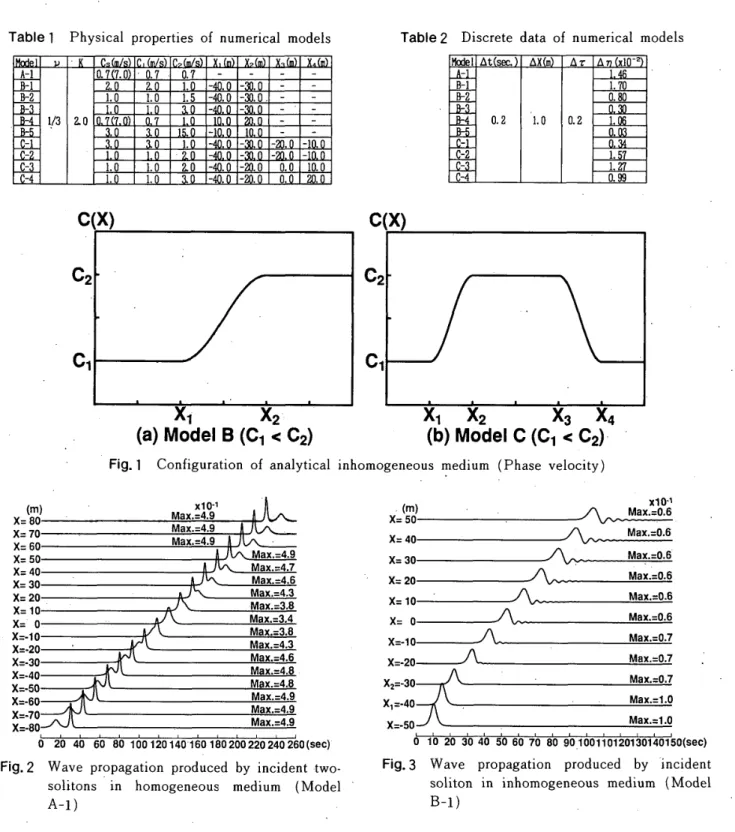
The physicalpropertiesof these models are summarized inTable 1. As shown inTable 1,Model A-l and B-4 havetwo solitary initialwaves of
different
amplitudes and the valuein
the parenthesisshows the initialphase velocity with alarge
amplitude.Model
B-5
shows thelinear
wave propagation.Table
2 showsdiscrete
data
ineach model.Since
the setting updata
satisfies theinequality
T>e, wecan suppose, without
loss
of generality,that e=1, whe.re E indicatesthe infinitesimalpararnetershownin eq.(3.5).
In
Table2,
At
andAX
are time and spatialincrements.
8.2
Results
of
Aualyses
The results of the analyses are shown in
Fig.2-Fig.7.
In
each Figure, thehorizontal
axis 'istime(seconds)
and the vertical axis isthedeformation
gradientcoordinate p.The
lowest
line
of eachFigure
isthe input
line
and the solved wave shapes propagateupward.These
propagatingwaves are plottedat equal 10.0rn intervals.
Fig.2
shows thebehaviour
ef nonlinear waye propagation with two solitaryincident
waves ofdifferent
amplitudes inthehomogeneous
medium.Generally,
as iswellknown
influidclynamics,
electronics and so on, we confirm the typical
interaction
of two solitons at succeeding spaces so that the-42-NII-Electronic Library Service
Table1Physicalpropertiesof numerical models
c(x)
C2
Cl
Xl
X2・
(a)
Model
B
(Ci
<C2)
Fig1 Configurationof analytical in{m}x=so XIO-1Max,=4,9Max.=4,9 X.70 Max.=4.9 ' X=60X.50 'Max.=4,g X.40 Max.=4.7Max.=4.6 X=30X.20 Max.=4.3Max.=3.8 X.10xi Max.=3,4 oX=-IO Max.=3.e x--2e' Max.=43Max.=4,6 X=-30 Max,-4 X.-40 Max,=4.e X=-50X.-60 Max,=4.9Max.=4,9 X.-70 Max.=4.9 x=-se Table2
c(x)
e2
Cl
Discretedataof numerical models
Xl
X2
X3
X4
(b)
Model
C
(Ci
(C2)・
'
homogeneous medium
(Phase
velocity)x=(?o)3 '. X= 40u
e
x=3e"X. 20tv
X.IO"x= ots
XsOts
7 x.2ots
7 X2.-30Xl=-40X.-50 Fig.2o 2o 4o eo eo loo12o14o16oleo2oo22e24o26o(sec)Wave prppagation produced by incident two-solitons in homogeneous medium
(Model
A-1)eFig.3lo2o 3o 4o so 6e 7o sogo.teollo12o13o14elso(see}
Wave propagation produced by incident
soliton in inhornogeneous medium
(Model
B-1)
fast
soliton ispushedforward
apd the slow oneis
retarded withoutdestructien
by
mutual collision orpassing.
The
rate of phase shift of the small-amplitucle(slow)
soliton isgre4ter than that of thelarge-amplitude
(fast)
one.This
is
due
to the interactionof the two solitons,Fig.3 shows the
behaviour
of nonlinear wave prop'agationinthe inhomogeneous medium with adecreasing
phase velocity(increasing
soil'clensity) with' sine shaped variation,for
ModelB-1.
It
is
confirmed that the scattering wave with anegative amplitude
(plateau)
isgeneratedclue
to theinfluence
of
inhomogeneity
and afterward inducessmall oscillatory waves. The region of srnall oscillatory wav'eswidens with increasing
distance
X.
Fig.4 shows the
behaviour
of nonlinear wave propagationinthe inhomogeneous medium withincreasingphase velocity
(decreasing
soildensity)
with sine shaped variation.As
shownin
Fig.
4,the scattering wave with a positiveamplitude(-plateau)
is
generatedby
theincident
wave.propagatingin
theinhornogeneousregion and
develops
the second s.olitary wave. By comptiring Fig,4(a)w'ithEig.
4(b),.-43-Architectural Institute of Japan
NII-Electronic Library Service
ArchitecturalInstitute ofJapan X. 50X. 40X. 30X. 20X.10x=X=-10X.-20 m) XIO-1Max.=5.0
::
Mar.=5.2Max.=5.1 30 Max.=5.1 20 Max,=5.1:1
Max.=5.0Max,=4,9 20 Max.=4.6 X2="Ots
Xl=-40-X.-50-XXXXXxXXX290 tOO "O rl2e(see)
xl..4o- M29 x=-soW M29 O 10 20 Fig.4 30 40 50 60 70 SO
(a)
Model B-2Wave propagationproduced byincident
o lo' 2o 3o 4o so 6o 7o so go loo(sec)
(b)
ModelB-3soliton ininhomogeneous meclium
x= {m} M,,.X.194' =80 Max,=7.2 .70 Max,=7,3 =60 Max.=7.3 =50.40.-.30.20.10 x.=7,Ox..7.0Max,=6.1Max.=3.8Max.=3.4 =o Max.=3.B =-10 Max.=4.3Max.=4.6Max.=4,S .-20.-30.-40..50=-60=-70=-80 Max.=4.8Max,;4.9Max.=4.9Max,-4.9
20 40 60 8e 100120140 160-18e2ooan0240{sec} Wave propagation produced byincident two-solitons in inhomogeneous medium
(Model
B-4) (mX= 50x= 4eX.30x= 2eX2= 10X= D }x
x
ii
r
s
2l
l
2r
a
2u
s
2=JAJ=
=
, Xl=-lon v 6 x..2onv
6 x..3on v M06 x..4on v 6 x=-se- 6 oFig.5 Fig6o lo 2o 3o ao so 6o 7o so{sec} Wave propagation producedby
incidentsolitonininhomogeneousmedium
(Model
B-5)it
is
confirmed that the number of scattering solitary wavesincreases
with the intensityofinhomogeneity. Thus, Figs.3-4 confirm that the estimations insection
5
are numericaliy valid.Fig.5shows the behaviourof nonliner wave propagationwith two solitary incidentwaves of
different
amplitudes inthe inhomogeneous medium with increasingphase velocity(decreasing
soildensity)
with sine shaped variation, forModel
B-4. The second solitary wave isgenerated due tothe inhomogeneityand the
interaction
of two solitons isshown inFig.5. Since the phase velocitydepends
on the waveamplitude, as shown inthe solution
(5.
12),the behaviourof phase shifts due tothe interactionof two solitons isdifferentfrom
that inhomogeneous
mediurn,Modei
A-1
(Fig.2).
Fig.6 shows the
behaviour
oflinear
wave propagatignin
theinhomogeneous
medium withincreasing
phase velocity
(decreasing
soildensity)
with sine shaped variation,for
Model
B-5.
Although the changein
wave amplitudedue
to the inhornogeneityisas shown inFig.6,no scattering waves(plateau
)
are
induced
by
the inhomogeneity of the medium, unlike the nonlinear wavepropagation.
'(a)
Fig,
7
shows thebehaviours
of nonlinear wave propagationin the inhomogeneous medium. InFig.7
(Model
C-1),
themediumhas
an embedded region[-30.
0m, -20. 0m] of smallerPhase
velocity(larger
soildensi,ty)
than thehomegeneous
region.As
shown inFig.
7(a),asmall plateauis
induced
by
the
inhomogeneity
and propagationinthe medium without destruction,Figs,7(b), 7(c)and 7(d)$howthe
behaviour$
of nonlinear wave propagation in the inhomogeneous medium with the embedded region-44-NII-Electronic Library Service x=(sMo} Max.X--.ioO.g` X. 40t
s
X= 30jl:i:fx=
ojjX4=11OXs=・20t
s
Xl=-30Xl=-40x.Lso Mex.=O,3 xlD-1 x.(sMo)di
Max18 x.4oec
Max19 x.3o" . Max18 x.2o" Max19 x.Ioec
Max19 x=X4=-10X3=-20X2=-30 ' 'o" M24Max,=3.0Max,=6.0 Max.=O.6u
l
v
Xl=-40-xu-soW o lo 2o 3o 4o so 6o 7o so go loo(sec)(a)
ModelC-1
x.(sMo)tnv
.E1201i O 10 20 30 {m)X= 50 40.50 6.070 8090:oOllO12013o14o{sec}.(b)
Model
C-2
XIO・1 Max.=1.7x.4o" Max24X= 40. Max.=1.7
x=3o" Ma25 x=2o" Max23 X,.lon
y
M3t
s
x=3s c Max2O X3=.OX=-,10X,=-20Xk.30t
s
t
v
t
s
4-x=aoxs= oX=:10X2=-20X.-30 x-2o" Max3Ot
s
t
s
k
4k
e
t
s
5 xt.-4o.W M2g Max.=2.g 'X=-soU M29 x..so- Max2g O 10?O
3040 50 6070 80 90100"O120130140(seC) O 10 20 30 40 50 60 70 80 go loOllO120{sec)(c)
Model
C-3
(d)
Model
C-4
Fig.7 Wave propagation produced by incidentsoliton ininhomogeneousmedium
of
larger
phase velocity(smaller
soildensity)
than thehomogeneous
region,i.
e., the converse ofModel
C-1
(Fig.
7(a)).
These
figures
confirm thatthebehaviours
ofinduced
solitary wavesdrastically
change
due
to thelength'
andintensity
of the medium'sinhomogeneity.
.
9.
Conclusions-
, ,
Concluding
remarks and thefuture
direction
for
researchbased
on thisinvestigation
are asfollows.
1) A planewave propagatingina 1-dimensional
finite
linear-elastic
medium with inhomogeneity isgoverned
by
the mK-dV equation includingthedissipatiye
term, which isobtainedby
approximating the nonlinearBoussinesq
equation with spatial variable coefficients using theReductive
Perturbation
Method2)
A plateauisgeneratedby an incidentwave propagatingin an inhomogeneous region with a
monotone increasingthe phase velocity
(decreasing
soildensity),
anddevelops
a second solitary wave(scattering
waye), The sign ofthe amplitude of the second solitary wavedepends
on thephase velocity(or
the density)'ofthe medium. . ・ ,'' 3)
The
nurnber of scattering solitary wayes increaseswith theintensity
of the mediuni]sin-homogeneity,
The
characteristics of'scatteringselitary
wayesdrastically
changedue
todiscrepancies
inthe medium's inhomogeneity.
These results are obtained
from
analysesbased
on thefirst-order
perturbed approximation. However,in the approximate expression with increasingintensityof inhomogeneity, we must censider the
Architectural Institute of Japan
NII-Electronic Library Service
Arohiteotural エnstitute of Japan
influence
of terms up tohigher
order , as afttture
study topic.Another
is
toinvestigate
actualphenomena of earthquake wave 皿otion in the finite elastic 皿 edia with the inhomogeneity treated
herein
.
Computation
was made on the YHP −DN 10000 at Kobori Research Complex of Kajima Corporation.Helpful
suggestionsby
Dr
.K
.Miura
andDr
,M
.Motosaka
of theKobori
ResearchComplex
ofKajima
Corporation
are gratefully acknowledged .Re暫erences
1> Taniuti, T. and Mslhhara , K.;NonlineエWaves , John Wiley & Sons Ltd.,ユ986
2) Toda, M .:Nonlinear Waves and Soliton, Nippon・HyouTon−Sha Co., Ltd.,1983.5
3) Toda, M. and Watanabe, S.;Nonlinear Mechanics, Kyourltsu・Sy皿ppan Co., Ltd.,1984.1 4) Watauabe , S.:Introductio皿 to Soliton Physics, Baifukan Co., Ltd.,1985.6
5) Matuzawa, T.;On the Possibility of GravitationaL Waves in Soil and Allied Problems, Journal of lnstitute of Astrenomy and
Geophysics, No.3, pp.161〜174,1925.
6> Kobori, T. and Yamada, A. et al.;The Propagation Characteristics of Nenlinear Seismic Waves,7th Japan Earthquake
Engineering Symposium, pp.505−510,1986.12
7) Izumi, M and Xue, S.:AStudy on Nonlinear Wave Propagating Equation, Annuat Meeting(Summarie$ofAIJ ),No.2403,
pp.805−806, 1989.10
8) Izumi, M. and Xue, S.:Nonlinear Wave Propagation in Elastic Continua, Joumal of Stru伽 ral and Construction
Eng重neering (Transactiens of AIJ). No.414, pp.47〜54,1990.8
g) Xue. S.;Derivation of Censtitutive Laws for Nonlinear Viscoelastic Material with Fading Memory and Their Applicatiens
to Wave Propagation Prob[ems in Earthquake Engineeiing, Doctoral Thesis(Tohoku Univ.),1991.1
10) Eringen, A、 C. and Suhubi, E. S.:Elastodynamics , Vol.1, Academic Press New York and Londen, lg74. 11) Roache, P.J.:Computational Fluid Dynamlcs, Hermosa Pub且ishe[s Inc.,1976,
(Papers listed above are written in Japanese except 1},5),6>,9),10),11).)
〔ManuscTipt received November 5,1991 ;Paper Accepted June 8,1992>
和 文要約 1.序 本 研 究で は,媒 体の密 度が空 間 方 向に緩や かに変化 す る よ う な不 均 質 性 を持つ 1次 元 有 限 変 形 線 型 弾 性 体 中を 伝 播す る非 線型波 動の特 性 を検 討する。こ の よ うな不 均 質媒体 中の非線 型 波 動 が 散 逸 項 を持つ変 形 丿(−dy 方 程 式で記 述さ れ ることを 示し,数 値 解 析に よ り不 均 質 性に よっ て発 生する (散 乱 )弧 立 波の挙 動を調べ る。 2.1次 元S波 伝 播 問 題 本 研 究で は 以下の仮定を充た す不 均質な 1次元有限変 形 線 型 弾 性 体を伝 播す る平 面 波 (S波 )を考察の対 象と す る : Al . A2. A3 , A4 , 有 限 変 形 応 力 度とひずみ度は線 型 関 係 媒 体の密 度は空 間 方 向に緩 やか に変 化 する 対 象とする平 面 波は長 波 長の波とする こ の節で は以上の仮定を充たす 媒 体 を伝 播 する平 面 波 を 支 配 する平 衡 方 程 式 を 導く。 最 初に和 泉 ・薛 (文 献 8),9))に よっ て導 出され た非 線 型 構 成 式 を示す。 一般に線 型 弾 性 理 論で は,Lagrange の定式化により, ひずみポテ ンシャ ルは (2,1) 式 (文 献10 ))で,応 力 度 と変形 勾 配 との 関 係 を 表 す 非 線 型 構 成 式は (2.3) 式 で与え ら れ る。(2.3 )式は X 面に作 用する せ ん断 力 を 表し,有限変形仮定の もと で は応 力 度 とひずみ度が線 型 関係で あっ て も,応 力 度は変 形 勾 配の 3次の非 線 型 項で 表され るこ とがわか る。 次に, 1次 元 有 限 変 形 線 型 弾 性 体 を “ば ね一質 点 系モ デル”に置 換 する と,π 番 目の質点に働く力の釣合式は (2.4)式で表さ れ る。不均質性の 仮 定を考慮して (2.4) 式を計 算す る と平 衡 方 程 式 (2.11 )が導か れ る。こ れ は 空間変数係 数 を 持つ (非 線 型)Boussinesq方 程 式である。 (2,11)式の右 辺 第 3項は非 線 型 構 成 式 (2.3)の非 線 型項に対応する P波 成 分 (λ+2μ)に比 例する係 数を含 む。これ は有限変形 仮 定であること, 波の伝 播 方 向 と 応 力の向き が異なることに起 因 すると考えられ る。 3.散逸 項 を含む変形K −dY 方 程式の導 出 前節の議 論か ら不 均質な 1 次元有限変形線 型弾性体 中 一
46
一 N工 工一Eleotronio LibraryNII-Electronic Library Service を 伝 播する平面 波の支配方程式は変 数 係 数の非 線型波 動 方 程 式 (3.1)に帰 着された。こ の節で は,谷 内 (文 献1)) に よっ て提 案 され た長 波 長 近 似 を用い た逓 減 摂 動 法 を拡 張 し て不 均 質モ デ ル に対する S波 伝 播問題に適用 する。 (3,ユ)式は,拡 張 型Gardner−MQrikawa 変 換 (3.3>式 (文 献1)〜4))と微 小パ ラメ ータ εに対す る摂 動 展 開 (3.5) 式 を 用い て (3.6) 式に変 換され る。特に,εにつ い て の最 低 次 数の (3.6a >式 をτ につ いて積分 し,さ らに 変数 変 換 (3.8) を施せ ば最 終 方 程 式 (3.9)を得る。 こ の式は非 線 型 波 動の空 間 発 展 を記 述す る変形 K −dV 方 程 式であり, 媒 体の不 均 質 性 が散 逸項 (3.10)と して取 り込 まれ てい る点が特 徴 的である。特に,媒体が均 質な 場合は この散 逸 項が消え て和 泉 ・薛 (文 献 9))に ょっ て得 ら れ た変 形K −dV 方 程 式と一致す る。 こ の節で述 べ た方 法は, 一般に逓 減 摂 動 法 (文 献 1))と呼ばれ る もの で,微 小パ ラ メータ に関 して非線型 項 と 分 散項と を 釣り合わ せ て モ デル方 程 式 を導く方 法で あ る。 4.散 逸 項を含む変形 K−dy 方 程 式の保 存 量 最 終 的に得られた変形 K −dV 方 程 式 (3,9)の保 存 量 か ら,媒体の不 均 質 性に よ る波 動の ふ る まい を予 想 する。 τ に関す る無 限 遠 方で の境 界 条件 (4,2}の下で (4.1) 式 を τ につ い て積分 する ことによ り,1次の 保 存 量 (4.4) 式が得ら れ る。ま た, (4,1)式の 両辺 に v を掛けて τ にっ い て積 分す ると2次の保 存 量 (4.7)式を得る。 こ こで, 媒体の不 均質性を あ る局所領 域に制 限し,そ の領域の外 部で は均質性を仮定す る。 2つ の保 存 量から 位相速 度と保存量 との 関 係 式(4.9)〜(4,13 )が導か れ る。 特に,位相速度C (密度ρ)が X の正方 向に単 調 減 少 (単 調増加