journal or
publication title
言語教育研究
volume 20
page range 45‑67
year 2009‑11
URL http://id.nii.ac.jp/1092/00000480/
The Whole as a Sum of the Parts:
A Holistic Approach to Language Learning for Japanese University Students
Dwayne Cover
Abstract
The primary purpose for this project was to investigate the relationship between a number of individual factors (international posture, motivation, anxiety, learning strategies, and willingness to communicate) and language proficiency with Japanese learners. Data was collected through a questionnaire admini- stered to second and third-year students at a university in Eastern Japan.
Findings indicated that the strongest relationships were between motivation and proficiency, along with anxietyand proficiency.
Introduction
Language development in the L2 is an incredibly complex process. Individually, each learner brings their own strengths and weaknesses, experiences and biases when stepping into the classroom. In addition, affective factors such as anxiety and motivation along with more macro-level considerations like socio-cultural history merge to create unique landscapes on which learners encounter and attempt to grapple with the new language. Despite this complexity, many studies into language development isolate single factors to determine their effect upon the learner’s progress. Although these types of studies are indeed valuable, they are not able to truly take account of the multifarious nature of the undertaking.
The current project attempts to move toward a broader perspective
simultaneously incorporating a range of considerations into a single study with Japanese learners. The factors included in the present investigation are international posture (i.e. attitude), motivation, anxiety, learning strategies, and willingness to communicate (WTC). The primary goal is to determine the relationship of these variables with language proficiency and their interrelationships with each other.
This project was heavily influenced by previous studies with a similarly wide scope.
One of the first such projects was conducted by Gardner, Tremblay, and Masgoret (1997). In research with native English-speaking learners studying French at a Canadian university, Gardner et al. stated that, “[a]lthough the relationships between some of these variables have been investigated, no study has considered them together in the same sample of L2 learners” (1997, p. 344). The researchers included attitude, motivation, self-confidence, learning strategies, achievement, language aptitude, and field independence as factors under consideration. The design and findings from this project then inspired further investigation into a vari- ety of English as a Second Language (ESL) and English as a Foreign Language (EFL) contexts including Japan.
Brown, Robson, and Rosnkjar (2001) looked at a similar range of variables with a group of Japanese university learners. They selected personality, motivation, anxiety, learning strategies, and language proficiency for inclusion in the study.
At the time of publication, the researchers stated that “no published research [had]
included all five variables in one study with a focus on a single nationality and age group” (2001, p.365). Along with providing basic descriptive statistics to
characterize their participant group, they looked at correlations between the factors and tested the validity and reliability of measurement instruments.
Japanese university students were also the focus of a study by Yashima (2002) in testing her communication model. She included attitude, motivation, communicative competence, and proficiency as potentially significant factors on the learner’s willingness to communicate. In designing her model, Yashima modified the constructs of attitude and motivation to better suit Japanese students learning English in a foreign language (as opposed to a second language) context.
The rationalization and methodology for these changes will be covered in more detail below.
The following sections will address each individual factor incorporated into the current study in turn, briefly reviewing the origin of the concept in L2 research and its specific relevance to Japanese learners of English.
Attitude & Motivation
Attitude and motivation in L2 studies are often associated with the work of R.C.
Gardner (1985) and various research partnerships (Gardner & Lambert, 1972;
Gardner & MacIntyre, 1993). These two constructs may be among the most fre- quently tested individual affective factors with Gardner’s socioeducational model as the theoretical rationalization and the Attitude and Motivation Test Battery (AMTB) as the predominant measurement instrument (Masgoret & Gardner, 2003). Despite the frequent utilization of the AMTB in many L2 contexts, the scale has been criticized for its lack of suitability to some learning situations; particular-
ly those where the L2 does not have official standing and functions as a foreign language (e.g. Japan).
Yashima (2000) looked specifically at the suitability of attitude and motivation instruments for the study of English by Japanese learners. She pointed to the work of Dornyei, (1994) who argued that instrumentalmotivation (i.e. for social or eco- nomic benefit) could have an equal, or even greater, influence than integrative motivation (i.e. for communication and interaction with native speakers) on learners studying in a foreign language context. Citing the lack of opportunities Japanese learners would have to actually interact with native English-speakers, Yashima proposed an alternative construct labelled “international posture” to better capture the broader associations English might hold for Japanese learners (2002, 57). International posture included the factors interest in foreign or international affairs, willingness to go overseas to stay or work, readiness to interact with international partners, and attitude toward different cultures. These categorizations were identified in a factor analysis of Japanese learners’
orientations (Yashima, 2000) and further refined for test-retest reliability (Yashima, 2002). Employing the new construct in a communication model tested with Japanese university students, Yashima found that international posture successfully predicted motivation, which in turn predicted language proficiency, just as the construct attitude had in Gardner’s socioeducational model. The construct was again tested by Yashima, Zenuk-Nishide, and Shimizu (2004) with Japanese students, although at the high school level, and found to successfully predict motivation with relatively high levels of reliability (as measured by Cronbach’s Alpha).
Language Anxiety
In much of the previous research into L2 language anxiety, a negative relationship to proficiency has been hypothesized and repeatedly supported (Clement, Dornyei
& Noels, 1994; MacIntyre & Gardner, 1991; Horowitz, Horowitz & Cope, 1986).
The Foreign Language Classroom Anxiety Scale (FLCAS), developed by Horowitz, Horowitz and Cope (1986), has been consistently utilized as one of the primary measurement instruments for this construct. The FLCAS focuses upon three categories of anxiety: communication apprehension, test anxiety, and fear of negative evaluation.
As articulated by Yamashiro and McLaughlin (2000), the social pressure to conform to group norms and the importance of preserving “face” in group situations make anxiety a significant consideration for Japanese students. Thus, L2 language anxiety has often appeared in studies of individual affective factors with Japanese learners (Matsuda & Gobel, 2004; Yashima, 2002; Brown, Robson, &
Rosenkjar, 2001). Yamashiro and McLaughlin (2000) adopted the FLCAS in a study with Japanese junior college and university-level students to determine the relationship between individual affective variables and language proficiency. With 220 respondents to their survey, they found that anxiety was negatively related to proficiency. The same instrument was employed in a study by Robson (cited in Brown et al., 2001) and revealed that language anxiety demonstrated a significant relationship with language learning proficiency.
Language Learning Strategies
Providing students with a range of language learning strategies to assist them
in developing skills and dealing with difficulties they encounter in the course of study has received a great deal of support in L2 literature. Oxford (1990; Oxford &
Burry-Stock, 1995) has been prominent in exploring this area, developing the Strategy Inventory for Language Learning (SILL) as a measurement instrument.
The SILL, which has two versions, (1) for native English-speakers learning a foreign language and (2) for ESL/EFL learners, is comprised of six subscales:
memory strategies, cognitive strategies, compensation strategies, metacognitive strategies, affective (emotional, motivational) strategies, and social strategies.
Although there are other options for measurement instruments (see Oxford &
Burry-Stock, 1995; Brown, Robson, & Rosenkjar, 1999), the SILL has been employed extensively in ESL/EFL environments including Japan.
Mochizuki (1999) surveyed first and second-year Japanese university students to determine which language learning strategies they employed most often and the relationship between strategy use and proficiency. His findings revealed that compensation strategieswere the most prominent and affective strategiesthe least.
Furthermore, the most proficient language learners (as measured by the STEP test) demonstrated greater use of cognitiveand metacognitive strategies than less proficient learners. Brown, Robson, and Rosenkjar (1999) also looked at strategy use with Japanese university learners. Respondents indicated that metacognitive strategies were the most commonly employed with compensation strategiesclosely following.
Willingness to Communicate
Willingness to communicate (WTC) evaluates the likelihood that an individual
would engage in communication with different interlocutors in different situations.
It includes considerations of language anxiety (at the state, situation-specific and trait levels), motivation (with regard to communication in the L2) and time (MacIntyre, 2007). Although it originated with work in the L1 context (McCroskey
& Richmond, 1987), the concept has also received attention in L2 studies (MacIntyre, 1994; MacIntyre & Charos, 1996). However, significant differences have been highlighted between WTC in the L1 and WTC in the L2 regarding issues of self-confidence, and social and political factors potentially complicating the lat- ter context (MacIntyre, Clement, Dornyei, & Noels, 1998).
Yashima explored WTC in a L2 with Japanese university students after suggesting that communication could become a central goal for learners following govern- ment-led changes to the English curriculum at all levels of education promoting communication over simply the accumulation of knowledge (see Yashima, 2002;
MEXT, 2003). Utilizing the WTC scale produced by McCroskey (1992), she found support for the model with a lower anxiety level leading to a greater willingness to communicate in English. Yashima, along with Zenuk-Nishide and Shimizu (2004), attempted a similar investigation of WTC with Japanese learners but at the high school level. Once again anxiety had a negative relationship with WTC and inter- national posture (i.e. attitude) successfully predicted greater willingness to com- municate.
Current Study
As explained above, the current project is concerned with investigating the rela- tionship between multiple factors and English language proficiency in a group of Japanese university learners. Each of the factors has appeared in previous studies in the Japanese context (Brown, Robson, & Rosenkjar, 2001; Yashima, 2002), how- ever, a number of years have passed since their undertaking. The Ministry of Education, Culture, Sports, Science, and Technology’s (MEXT) Action Plan to Cultivate Japanese with English Abilities, concerned with improving the quality of and learner access to English language classes in public schools, was not put into effect until 2003 (see MEXT, 2003). In addition, exposure to English in various forms of media (e.g. movies, the Internet, advertising, etc.) has remained pervasive in the surrounding environment. Thus, it seems appropriate to revisit the individual factors under consideration with regard to Japanese learners.
The research questions motivating the current study are as follows:
1) Which factors (international posture, motivation, anxiety, learning strategies, WTC) are the most significant for predicting English language proficiency in Japanese learners?
2) How are the incorporated measures (international posture, motivation, learn- ing strategies, and proficiency) interrelated?
Method Participants
The participants for this study were 111 second and third-year students at a mid-level university in Eastern Japan. All were enrolled in a language-focused
program which included eight periods of English per week in the first year and four periods of English per week in the second year. Given that the students were all sophomores their ages ranged from 19 to 22 years of age. 88 (79%) of the participants were female and 23 (21%) of the participants were male. Although this balance is clearly skewed toward female respondents, it is reflective of the overall student population at the institution. Upon completion of the questionnaire, each respondent was given a 500-yen gift card for their participation.
It should be noted that the participants in this survey have selected an English language program with an international focus for their post-secondary studies.
This may suggest a particular orientation toward the language and potentially the broader international community that is specific to this group and may not be generalizable to all university students in Japan.
Procedure
Items included in the final draft of the questionnaire were translated from the original English to Japanese by a native Japanese-speaking research assistant. The items were then back-translated into English by a different native Japanese-speak- ing research assistant and compared for consistency. The questionnaire was test- ed with a group of senior-level students to ensure that the directions were clear and the format was easy to follow. Questionnaires were administered to participants in a single sitting and were completed within a 30-minute period by all participants.
Measures
The following measures were selected to determineinternational posture, motiva-
tion, language anxiety, use of language learning strategies, willingness to communi- cate, and English proficiency level. All had previously appeared in studies with Japanese learners.
International posture was composed of four subscales borrowed from the work of Yashima (2000, 2002). Intergroup avoidance tendency (IAT) was measured with a 7-item scale. Four items were positively worded and two items were negatively worded. Interest in international vocation/activities (IVA) was measured with a 6-item scale. Three items were positively worded and two items were negatively worded. Interest in international news (IIN) included two items, both positively worded. Intercultural friendship orientation (IFO) included four items, all positively worded. Responses to all items were given on a 5-point Likert scale ranging from strongly disagree to strongly agree.
Motivation was composed of two measures, also drawn from Yashima (2000, 2002).
These measures, motivational intensity (MI) and desire to learn English (DLE), were each measured with a 6-item scale and all items were positively worded. Once again, responses were offered along a 5-point Likert scale (strongly disagree to strongly agree).
The 33-item Foreign Language Classroom Anxiety Scale (FLCAS), developed by Horowitz, Horowitz, and Cope (1986), was included to measure L2 language anxiety. The FLCAS included 24 items which were negatively worded (with regard to high anxiety levels) and nine items which were positively worded.
Three primary categorizations can be drawn from the scale: Foreign Language
Speaking Anxiety (FLS), Foreign Language Classroom Anxiety (FLC), and Foreign Language Non Anxiety (FLN). During piloting of the questionnaire, a number of participants indicated ambiguity with the wording of three items and these items were dropped from the final questionnaire. This measure also employed a 5-point Likert scale (strongly disagree to strongly agree).
The following measures are for the 50-item Strategy Inventory for Language Learning(SILL), intended for use with respondents studying English as a Second or Foreign language (Oxford & Burry-Stock, 1995). A 5-point Likert scale with responses ranging from never or almost never true to always or almost always true wasemployed for all strategies.
The category memory strategies (SILLms) was composed of nine items focusing upon various techniques that learners could employ to improve memorization of new English vocabulary and phrases. Cognitive strategies(SILLcog) contained 14 items. Analyzing and summarizing, along with some general practice techniques, are the primary skills captured with this measure. Compensation strategies (SILLcom) are those employed to bridge gaps in understanding (i.e. guessing from context) or in making oneself understood (e.g. the speaker uses gestures to assist in explaining a word they do not know or cannot remember). Six items were included in this category. Metacognitive strategies(SILLmet) covered self-evalua- tion, planning out learning times/opportunities, and being cognisant of one’s errors and improvements. This category held nine items. Affective strategies (SILLaff), which included self-encouragement and anxiety management in communicative situations, was measured with six items. The final measure
from the SILL looked at social strategies (labelled SILLsoc). These included interest in the native English-speakers’ culture and techniques used to improve communication during an actual speaking event (e.g. asking the speaker to slow down and/or to repeat what he/she had said). The category contained six items.
McCroskey’s (1992) 20-item willingness to communicate scale was utilized to measure learners’ WTC. The scale covers four specific communication contexts:
public speaking, talking in meetings, talking in groups, andtalking in dyads. It also offers three different interlocutors: friends, acquaintances, andstrangers. From the 20 items, eight dummy variables were removed. Respondents offered a time estimate (from 0% to 100%) for approximately how long they would engage in communication in each situation.
Given the time constraints for the availability of the participants, the Test Of English for International Communication (TOEIC) was selected as a measure of proficiency. All students in this participant group are required to have a minimum score of 650 to graduate from the university and, thus, the majority write the test a number of times throughout their university career. Therefore, this requirement guaranteed that all survey respondents would have a valid score on a standardized test. In addition, and perhaps even more importantly, the test can be seen as extremely meaningful for all students - an important consideration as opposed to the alternative of selecting another proficiency measure that would only have relevance to this study and might not encourage participants to give full effort in their responses.
Results
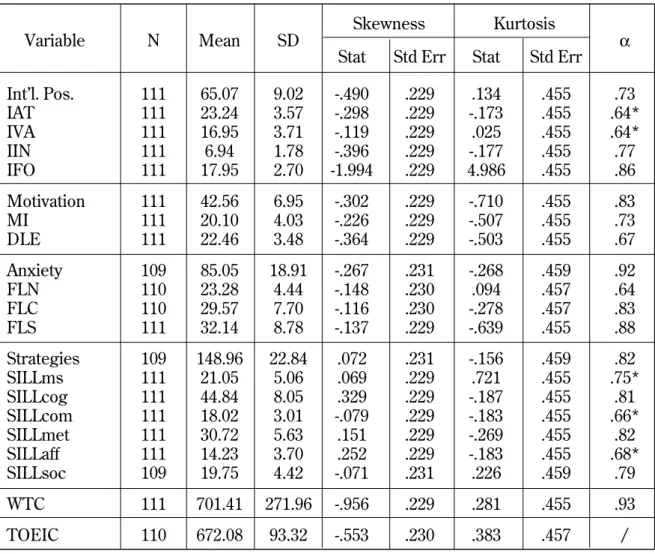
Questionnaire data was first entered into SPSS Version 11.5 to gather basic descriptive statistics from the participant group. The results for each scale and its composite subscales, including number of valid respondents (N), mean, standard deviation (SD), skewness, kurtosis, and reliability (measured by Cronbach’s Alpha - α) are offered in Table 1.
Table 1: Basic Descriptive Statistics
Variable N Mean SD
Skewness Kurtosis Stat Std Err Stat Std Err α
Int’l. Pos. 111 65.07 9.02 -.490 .229 .134 .455 .73
IAT 111 23.24 3.57 -.298 .229 -.173 .455 .64*
IVA 111 16.95 3.71 -.119 .229 .025 .455 .64*
IIN 111 6.94 1.78 -.396 .229 -.177 .455 .77
IFO 111 17.95 2.70 -1.994 .229 4.986 .455 .86
Motivation 111 42.56 6.95 -.302 .229 -.710 .455 .83
MI 111 20.10 4.03 -.226 .229 -.507 .455 .73
DLE 111 22.46 3.48 -.364 .229 -.503 .455 .67
Anxiety 109 85.05 18.91 -.267 .231 -.268 .459 .92
FLN 110 23.28 4.44 -.148 .230 .094 .457 .64
FLC 110 29.57 7.70 -.116 .230 -.278 .457 .83
FLS 111 32.14 8.78 -.137 .229 -.639 .455 .88
Strategies 109 148.96 22.84 .072 .231 -.156 .459 .82
SILLms 111 21.05 5.06 .069 .229 .721 .455 .75*
SILLcog 111 44.84 8.05 .329 .229 -.187 .455 .81
SILLcom 111 18.02 3.01 -.079 .229 -.183 .455 .66*
SILLmet 111 30.72 5.63 .151 .229 -.269 .455 .82
SILLaff 111 14.23 3.70 .252 .229 -.183 .455 .68*
SILLsoc 109 19.75 4.42 -.071 .231 .226 .459 .79
WTC 111 701.41 271.96 -.956 .229 .281 .455 .93
TOEIC 110 672.08 93.32 -.553 .230 .383 .457 /
*Note* Q16, Q25, Q68, Q87, and Q104 were removed from further analysis because they significantly lowered the reliability of their respective subscales.
Although a full analysis of the descriptive statistics would be too extensive to include here, one significant finding worth highlighting is the skewness (-1.994) and kurtosis (4.986) values for the subscale IFO (Intercultural Friendship Orientation). Both values are well outside the bounds of normality and suggest a closer examination. Inspecting the frequency distribution reveals the vast majority of respondents strongly agreed with all four items in this measure.
The individual items were as follows (percentage values for respondents who indicated strongly agreeare included):
Q29 - Learning English will allow me to meet and speak with more people. (66%) Q30 - Learning English will allow me to get to know various cultures and people.
(62%)
Q31 - If I learn English, I will be able to participate more actively with people from different cultures. (56%)
Q32 - I’d like to make friends with foreigners. (68%)
Clearly this indicates an awareness of the importance of English for Japanese learn- ers and a strong desire to associate with native speakers. This point will receive more attention in the discussion section below.
The following step was to calculate Pearson product-moment correlations, which describe the relationship between two variables. Although this statistic does offer an indication of the strength of the relationship between the variables, it does not indicate causation (Muijs, 2004). The results of the correlation analysis are given in Table 2.
Table 2: Pearson Product-Moment Correlations
Motivation Int’l Posture Anxiety Strategies WTC
Motivation 1
Int'l Posture .615** 1
Anxiety -.395** -.304** 1
Strategies .716** .610** -.410** 1
WTC .283** .282** -.143 .331** 1
Proficiency .424** .305** -.459** .316** .193*
** Correlation is significant at the 0.01 level (2-tailed).
* Correlation is significant at the 0.05 level (2-tailed).
A very strong relationship between learner motivation and the use of language learning strategies is evident (.716), as is the correlation between motivation and international posture (.615). International posture also appears strongly associated with the use of learning strategies (.610). Language anxiety reveals a negative relationship with all other factors, meaning higher levels of anxiety are connected with lower motivation (-.395), a more negative international posture (-.304), less frequent use of learning strategies (-.410), a lower level of WTC (-.143), and a lower level of proficiency (-.459). In fact, the negative relationship with language anxiety reveals the strongest level of correlation of all factors for the proficiency measure. From the correlation values, all relationships were statistically significant to the 0.01 level, except proficiency and WTC (significant to the 0.05 level) and anxiety and WTC.
Structural Equation Modeling (SEM)
Structural equation modeling (SEM) is a statistical procedure that allows the researcher to test a hypothesized structure of relationships between indicator
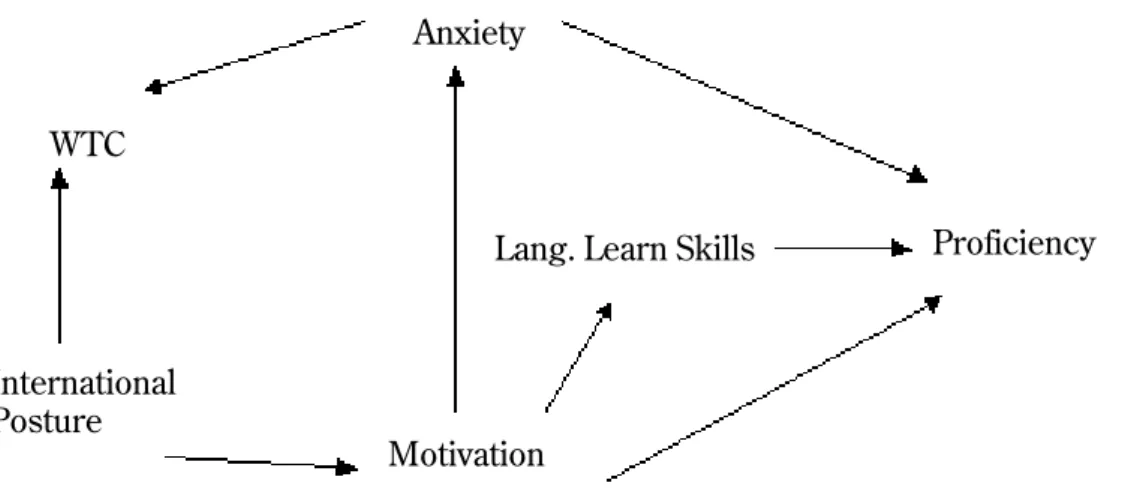
Fig. 1: Hypothesized relationships between latent factors Anxiety
WTC
Proficiency Lang. Learn Skills
Motivation International
Posture
variables and latent variables (Kline, 2005). In plain terms, the researcher must have a theoretically-grounded outline of the relationships between the factors before he/she begins. It is then possible to collect data using observable measures (such as the WTC scale and SILL mentioned above) and subsequently test the researcher’s model using SEM software (EQS Version 6.1 in this study).
For the current study, the relationships between the observable and latent variables are illustrated in Fig.1 below. Theoretical justification for these assertions was drawn from previous research, most notably from Gardner et al.
(1997) and Yashima (2002; with Zenuk-Nishide & Shimizu, 2004). Table 3 summarizes the relationships and provides theoretical references.
Table 3: Relationships between Latent Variables
Relationship References
Int’l Posture →Motivation Yashima (2002), Yashima et al. (2004) Yamashiro & McLaughlin (2000)1, Gardner et al. (1997)1
Int’l Posture →WTC Yashima et al. (2004), Yashima (2002)
Data was entered into the EQS program in raw form and the Diagrammerfunction allowed for a visual representation of the hypothesized factor structure to be input.
Initial attempts to process a solution ran against problems with multicollinearity– a condition in which separate variables are actually measuring the same thing (Kline, 2005). Suggested remedies for addressing this difficulty include either deleting a variable or combining the two co-conspiring variables into a single mea- sure (Kline, 2005, p.56-7).
In eliminating variables from the hypothesized structure of relationships, a satis- factory solution could not be found until the integrity of the model had severely deteriorated. Thus, it was not possible to fully investigate the interactions of the individual factors posited in the current model.
Discussion
With respect to the first research question, regarding the most significant factors for predicting English language proficiency in Japanese learners, anxiety and motivation appear to have the strongest relationships. Again, it is critical to note that the
Motivation →Anxiety Gardner et al. (1997)2, Yashima (2002) Motivation →Proficiency Skehan (1989), Yamashiro &
McLaughlin (2000), Yashima (2002) Motivation →Learning strategies Gardner et al. (1997)
Learning strategies →Proficiency Oxford & Burrystock (1995) Anxiety →Proficiency Yamashiro & McLaughlin (2000)
Anxiety →WTC MacIntyre (1994), Yashima (2002)
1 Attitude appeared in place of international posturein these studies.
2 Self-confidence appeared in place of anxiety(i.e. in opposition to anxiety).
correlation between anxiety and proficiency is negative, meaning that higher levels of language anxiety are connected with lower levels of proficiency and that the inverse is also true. This finding is well-supported in the literature with many previous studies producing a similar finding (Horowitz et al., 1986; Brown et al., 2001). Motivation also demonstrated a moderately strong correlation with proficiency. This assertion has similarly been put forth in the work of Gardner (1985), Dornyei (1990) and many others. Thus, the results from the current study can be seen to offer further support for the importance of these two factors with regard to learner proficiency.
In the classroom, it seems evident that lowering learner anxiety and increasing motivation should receive a great deal of focus from the teacher. This necessarily connotes a good understanding of learner preferences for tasks and activities, and for establishing and maintaining a comfortable and supportive classroom environment. One method towards achieving these ends might include more input from the learners into the types of tasks and activities chosen through either open dialogue or anonymous surveys. Given the importance of learner anxiety and motivation, it appears that gaining a grasp of how the students are feeling may be as important as preparing pedagogically-sound lessons; if the lesson is well- prepared, but the atmosphere is not conducive to learning for the individual, learning may not occur.
Another interesting finding was with regard to learning strategies. Strategies revealed a fairly low level of correlation with language proficiency. This is somewhat curious since a number of the strategies included in the SILL,
particularly those associated with memorization, would appear highly useful to learners in preparing for a standardized test such as TOEIC, the isolated proficiency measure for this study. It is also worth noting that respondents to this survey do receive some instruction in language learning strategies as part of their first-year course work. However, a potential explanation may lie in the work of Gardner et al. (1997) from their earlier study with English speakers studying French. The researchers found that learners with higher levels of achievement in their classes and on tests administered during the survey had lower levels of use with learning strategies. They suggested that more proficient learners might be comfortable with a limited set of strategies because they had already achieved success, while less proficient learners might still be searching for the right combination (Gardner, Tremblay, & Masgoret, 1997, p.353). The measurement instrument (the SILL) is guided toward how often learners employ different strategies and not necessarily how successful they are with the use of their strategies. This may suggest that future research into language learning strategy use could take into account the effectiveness of strategies, as well as their frequency.
With regard to the second research question, how are the individual factors interrelated, there are also notable findings. International posture and motivation demonstrated the strongest relationship, and this is well-supported through the work of Gardner (1985) and others with the construct attitude in place of international posture. This may suggest that Yashima’s work in tailoring attitude to an EFL environment, specifically Japan, has been well founded. In addition, international posture held a strong correlation with strategies, as did motivation.
Unfortunately, without successfully completing the SEM portion of this project, it is not possible to comment on the interrelationship between all of these factors simultaneously. However, further research into this area in the future may prove valuable.
Returning the focus to the classroom, the relationship between international pos- ture and motivation could definitely be capitalized upon. The former construct cen- tered around associating with and learning more about native English-speakers and their home cultures. Perhaps supplementing specifically language-focused tasks with information about foreign cultures would be beneficial. As indicated by the responses to the subscale Intercultural Friendship Orientation, the majority of learners had a great interest in utilizing English to connect to the broader world (e.g. meet more people, learn more about foreign cultures, make foreign friends).
Conclusion:
The primary goal of this study was to investigate the relationships between the individual factors international posture, motivation, anxiety, learning strategies, willingness to communicate andproficiency. Although it was not possible to test the complete hypothesized model, the findings were still able to offer a good deal of insight toward Japanese learners at the university level. Continued research with a more holistic perspective toward the development of language skills would certainly prove beneficial.
References:
Brown, J.D., Robson, G. & Rosenkjar, P. (2001). Personality, motivation, anxiety,
strategies, and language proficiency of Japanese students. In Z. Dornyei &
R. Schmidt (Eds.), Motivation and second language acquisition (Technical Report #23, pp.361-398). Honolulu, University of Hawaii, Second Language Teaching and Curriculum Center.
Clement, R., Dornyei, Z., & Noels, K. (1994). Motivation, self-confidence, and group cohesion in the foreign language classroom. Language Learning, 44, 417-448.
Dornyei, Z. (1994). Motivation and motivating in the foreign language classroom.
The Modern Language Journal, 78(3), 273-284.
Gardner, R. C. (1985). Social psychology and second language learning: The role of attitudes and motivation. London: Arnold.
Gardner, R. C., & Lambert, W. E. (1972). Attitudes and motivation in second-lan- guage learning. Rowley, Mass: Newbury House Publishers.
Gardner, R. C. & MacIntyre, P. (1993). A student’s contribution to second language learning: Part II. Affective Variables. Language Teaching, 26, 1-11.
Gardner, R.C., Tremblay, P., & Masgoret, A.M. (1997). Towards a full model of second language learning: An empirical investigation. The Modern Language Journal, 81(3), 344-363.
Horowitz, E. K., Horowitz, M. B., & Cope, J. (1986). Foreign language classroom anxiety. The Modern Language Journal, 70, 125-132.
Kline, R. (2005). Principles and practices of structural equation modeling. 2nd ed.
New York: The Guilford Press.
MacIntyre, P. D. (1994). Variables underlying willingness to communicate: A causal analysis. Communication Research Reports, 11, 125-142.
MacIntyre, P. D. (2007). Willingness to communicate in the second language:
Understanding the decision to speak as a volitional process. The Modern Language Journal, 91 (4), 564-576.
MacIntyre, P. D., & Charos, C. (1996). Personality, attitudes, and affect as predic-
tors of second language communication. Journal of Language and Social Psychology,15, 3-26.
MacIntyre, P. D., Clement, R., Dornyei, Z., & Noels, K. (1998). Conceptualizing willingness to communicate in a L2: A situational model of L2 confidence and affiliation. Modern Language Journal, 82, 545-562.
MacIntyre, P. D., & Gardner, R. C. (1991). Language anxiety: Its relation to other- anxieties and to processing in native and second languages. Language Learning, 41, 283-305.
Masgoret, A.M., & Gardner, R.C. (2003). Attitudes, motivation, and second language learning: A meta-analysis of studies conducted by Gardner and associates. In Z. Dornyei (Ed.), Attitudes, Orientations, and Motivations in Language Learning, (167-210). Oxford, UK: Wiley-Blackwell Publishing.
Matsuda, S., & Gobel, P. (2004). Anxiety and predictors of performance in the foreign language classroom. System, 32, 21-36.
McCroskey, J. C., & Richmond, V. P. (1987). Willingness to communicate. In J. C.
McCroskey & J. A. Daly (Eds.). Personality and interpersonal communication (pp. 129-156). Newbury Park, CA: Sage.
McCroskey, J. C. (1992). Reliability and validity of the willingness to communicate scale. Communication Quarterly, 40, 16-25.
Ministry of Education, Culture, Sports, Science, and Technology (MEXT). (2003).
Regarding the establishment of an action plan to cultivate Japanese with English abilities. Retrieved from
http://mext.go.jp/English/topics/03272801.htm.
Mochizuki, A. (1999). Language learning strategies used by Japanese university students. RELC Journal, 30, 101-113.
Muijs, D. (2004). Doing quantitative research in education with SPSS. London: Sage Publications Ltd.
Oxford, R. L. (1990). Language learning strategies: What every teacher should know.
New York: Newbury House.
Oxford, R.L. & Burry-Stock, J.A. (1995). Assessing the use of language learning strategies worldwide with the ESL/EFL version of the Strategy Inventory for Language Learning (SILL). System23(1), 1-23.
Skehan, P. D. (1989). Individual differences in second language-learning. London:
Edward Arnold.
Yamashiro, A.& McLaughlin, J. (2000). Relationships among attitudes, motivation, anxiety and English language proficiency in Japanese College students. In S.
Cornell & P. Robinson (Eds.), Individual Difference in Foreign Language Learning: Effects of Aptitude, Intelligence, and Motivation. Tokyo: Aoyama Gakuin University.
Yashima, T. (2000). Orientations and motivation in foreign language learning: A study of Japanese college students. JACET Bulletin, 31, 121-133.
Yashima, T. (2002). Willingness to communicate in a second language: The Japanese EFL context. The Modern Language Journal 86(1), 54-66.
Yashima, T., Zenuk-Nishide, L., & Shimizu, K. (2004). The influence of attitudes and affect on willingness to communicate and second language communica- tion. Language Learning, 54(1), 119-152.