ESL Learning Strategies, Motivation, and Proficiency: A Comparative Study of University
and High School Students in Japan
Ben Olah
*Abstract
This study compared university and high school students in Japan in terms of ESL learning strategies and motivation,and examined how these variables influence English proficiency. The strategies used for learning English by the two groups of subjects, university and high school students,were investigated using a questionnaire designed by Oxford (1989)called the Strategies Inventory of Language Learning ( SILL) , the most widely accepted instrument for measuring learning strategies. In addition to the SILL, a set of questions relating to motivation was given to the subjects. The study found that the use of Social strategies in university students and Memory, Social and Cognitive strategies in high school students correlated with a high level of English proficiency and that certain types of motivation for learning English may detrimentally affect proficiency.
Introduction
Some theories of Learning Strategies
In order to introduce the background of ESL learning strategies,a review of some of the literature that has addressed this ever expanding area of language study is helpful. There are some subtle semantic differences within the widely used definitions of learning strat-
egies that should be highlighted. Cohen (1996)defines second language learner strategies as “the steps or actions selected by learners either to improve the learning of a second language, the use of it, or both” ( p. 2) . Cohen compliments this definition by making a
― ―
*人間学部
distinction between the strategies that are used to acquire new language,“second language learning,”and what he calls “language use strategies,”which are those methods employed by learners to put to use the current language they possess ( pp .2‑3) .
In their definitive study on the subject,Oʼ Malley and Chamot (1990)present the concept of learning strategies in the following way: “the special thoughts or behaviors that individuals use to help them comprehend, learn, or retain new information”( p. 1) . It is interesting to note here an important difference between these two definitions. In the Cohen definition,the focus is on behavioral elements ( i . e.“steps or actions” )whereas the Oʼ Malley and Chamot definition states not only that behavior constitutes learning,but also includes mental processes ( i . e.“special thoughts” ) . This distinction has important impli-
cations for the study of learning strategies because if strategies are based primarily on behavior,then they can be observed,the more predominant belief however is that learning strategies also incorporate a large number of mental activities,meaning observation alone will not give an accurate insight into the nature of learning strategies,an inadequacy that necessitates some kind of self reported information.
Any study of learning strategies invariably turns to Oxfordʼ s huge body of work on the subject as a base from which to begin new research. Oxford developed a questionnaire called the Strategy Inventory for Language Learning ( SILL ) , a research instrument used to comprehensively assess the degree to which learners use various strategies when studying a language. Oxford (1989)then organized the50items of the SILL into strategy groups or factors, each containing varying numbers of items. These factors are as follows:
1) Memory strategies: such as grouping,imagery,rhyming,and structured reviewing (9items ).
2) Cognitive strategies: such as reasoning, analyzing, summarizing ( all reflective of deep processing) , as well as general practicing (14items ).
3) Compensation strategies ( to compensate for limited knowledge ) :such as guessing meanings from the context in reading and listening and using synonyms and gestures to convey meaning when the precise expression is not known (6 items ) .
4) Metacognitive strategies: such as paying attention, consciously searching for practice opportunities,planning for language tasks,self ‑ evaluating oneʼ s progress,and monitoring error (9items ) .
5) Affective ( emotional, motivation‑ related ) strategies: such as anxiety reduction, self ‑ encouragement, and self ‑ reward (6 items ) .
6) Social strategies:such as asking questions,cooperating with native speakers of the
― ―
language, and becoming culturally aware (6items ) . ( Oxford,1989)
One thing that stands out in Oxfordʼ s findings is that cognitive strategies consist of the largest number of items. This result was not unexpected,as previous research on learning strategies suggests that cognitive strategies have the widest variety, encompassing strat-
egies related to practice, analysis, and synthesis of new information.
Ellis (1994) outlines the determinants of learning strategies as follows: “individual learner differences ( beliefs, affective strategies, general factors, and previous learning experiences )together with various situational factors ( the target language being studied,
whether the setting is formal or informal, the nature of the instruction, and the specific tasks learners are asked to perform)determine the learnerʼchoice of learning strategies”
( p.529) . This explanation places a lot of emphasis on the variables that can affect the use of learning strategies, and these influences should always be considered when examining how strategies are formed and used. As Ellisʼ s definition points out, some of these influences are exterior, such as teachers and interactions with others, while some are related directly to the individual,such as motivation,personality traits and understanding of learning methods. A study by Oxford & Nykos (1989)proposed that motivation is the most influential element in the studentsʼchoice of learning strategies: “We start our discussion with motivation, which exerted the strongest influence on strategy choice” ( p.
295) . This paper examines this important role of motivation and how it may relate to learning strategies, in two of the major educational institutions which teach English in Japan, high schools and universities. Another reason why motivation was chosen as a focus of this research is that among the aforementioned learning strategy influences,
motivation is the only one that can easily and objectively be ascertained through self reporting.
The primary objective of this study was to see if there is any correlation between English proficiency ( measured in terms of academic achievement) and learning strategies.
Obtaining information about this relationship can be seen as more valuable than any other pursuit within the study of learning strategies, as it can provide practical information which teachers can implement into their materials and teaching practices. This study examined motivation,and the relationship between strategy and academic achievement for both university and high school students with the aim of elucidating what strategies may be appropriate for students in these two educational environments. While it is always necessary for ESL teachers to vary their teaching materials and methods depending on the educational situation, this adjustment of teaching approaches is especially important in
― ―
Japanese high schools and universities. Although only a few months separate the end of high school and the beginning of university,the educational environments and the goals for learning English at these two institutions are very different. Learning strategies however become habitual, so that if students have become accustomed to using certain learning strategies, a concerted effort from both teacher and student is required to change these strategies to best suit the learning environment and the goals of the individual. An understanding of learning strategies and motivation,and their effect on English proficiency for both high school and university students is thus invaluable for ESL teachers in Japan.
High school teachers should be able to make their students aware of the learning strategies they use and how these may need to be changed once they enter university while teachers working at universities must take into consideration the residual effects of the learning strategies that their students used during high school.
Research Questions
This study had three main objectives: (1) to compare the learning strategies of high school and university students in Japan; (2)to investigate whether there is a correlation between certain learning strategies and academic achievement; (3) to compare the motivation for studying English among college students and high school students and consider how motivation may influence learning strategies and academic achievement.
Methodology
Sample
The sample consisted of101( male and female )first year students studying in the Global Media Studies department at Komazawa university and 49students (33first year and 16
third year )studying at Gakushuin boys high school. Both schools are located in Tokyo, Japan. All the students in the sample were taking a compulsory English oral communica- tion course taught by the researcher.
Instrumentation
The main instrument for this study was a questionnaire,or inventory,aimed at assessing the use of language learning strategies. The questionnaire used was Watanabeʼ s (1990)
Japanese translation of the Strategy Inventory for Language Learning ( SILL ) . It is
― ―
estimated that 40‑50major studies, including a dozen dissertations and theses have been done using the SILL ( Oxford and Burry ‑ Stock,1995) . The continued use of the SILL in research, along with its high degree of reliability and validity, makes it the only widely accepted instrument available to assess language learning strategy. One of the reasons the SILL is recognized as the best way to discover the learning strategies of ESL students is that it is a self assessment based questionnaire,in which the student can reflect upon,and give honest answers about the ways in which they learn.
As was discussed in the introduction, learning strategies involve not only behavior, but also a great deal of mental activity, which means that observation alone is insufficient in getting an accurate, standardized description of studentsʼlearning strategies. Some skeptics attack the validity of self ‑ reported data but in this field of study,the majority of researchers believe that subjects are able to give accurate feedback about the strategies they use, as Ellis (1994)points out: “Methods such as these ( structured interviews and questionnaires )have provided the most detailed information about learning strategies” ( p.
534) .
The version of SILL used for this study was the one designed for learners of English as a second language or foreign language,and contains50items. The response options to the SILL were from a five point Likert‑ scale for each question:never or almost never true of me, generally not true of me, somewhat true of me, generally true of me, and always or almost always true of me.
In addition to the SILL, subjects in the study were asked to respond to three questions related to motivation. “Why do people study English,”“Why do you study English,”and
“What are your objectives for studying English . ”There were seven responses available for each question. These questions and responses were based on a study about motivation for studying English among Japanese university students done by Kato (2005) . In that study,
the three questions were given to a group of university students in an open ended response format. The seven most common responses to the open ended questions about motivation were used as the multiple choice responses for this study. For comparison of learning strategies with academic achievement, grades (0‑100) from the sampleʼ s English Oral communication course taught by the researcher were used.
Data collection and analysis
It is common in studies on learning strategies that employ the SILL,to use a statistical technique called factor analysis to give a more simplified picture of the 50variables that make up the inventory. This statistical procedure has its origins in psychometrics, and tries to determine interrelationships among large numbers of variables in order to reduce
― ―
these variables into clusters or “factors . ” By finding natural relationships in which variables are maximally correlated with each other and minimally correlated with other variables,factor analysis is able to group the variables based on these relationships. This study utilized 5 factors that were extracted from a study done by Kato (2005) ( see Appendix A ) . Factor 1 : Metacognitive ‑ affective strategies (14items ) , Factor 2 : Mem-
ory ‑ compensation strategies (12 items ) , Factor 3 : Social strategies (8items ) , Factor 4 : Cognitive strategies (5 items ) , Factor 5 : Entrance ‑ exam strategies (11 items ) . These factors are applicable to this study because internal reliability or consistency of the items in an index measure using Cronbachʼ s Alpha equaled .85 with 194 Japanese university students. Descriptive statistics were calculated using the data related to strategy use from both the high school subjects and the university subjects to illustrate the frequency of use of the five strategy factors. In order to determine the relationship between strategy use and academic performance,a correlation analysis was performed to see if in fact strategy use had an effect on academic achievement.
Results
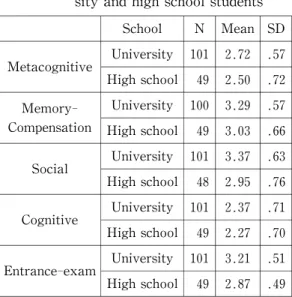
Table 1 provides data which addresses the first research question: To compare the learning strategies of high school and university students in Japan. The means for all strategy factors were higher in university students than in high school students with the largest difference between the two groups apparent in factor 3 , Social strategies ( univer-
sity mean: 3.37/ high school mean: 2.95) . It can also be seen from this table that the most frequently used strategy factors for both groups were Memory ‑ compensation and Social strategies.
Tables2and 3show the correlation between strategy factors and academic performance, the information relevant to the second research question: to investigate whether there is a correlation between certain learning strategies and academic achievement. In high school students, there was a significant correlation between grade and Memory strategy
( p <.01) and a moderate correlation between grade and Social / Cognitive strategy ( p <.05) . For university students, there was a moderate correlation between Social strategies and academic performance ( p <.05) .
― ―
Table 4shows the difference between high school and university students with regards to their motivation for studying English, addressing the third research question: to com-
pare the motivation for studying English among college students and high school students, and consider how motivation may influence learning strategies and academic achievement.
The response frequencies for the first and second questions relating to motivation provided the greatest insight into the differences between high school and university students. The largest difference between the two groups occurred in the response “everyone around me studies English”with a response rate of 0 % for university students and 12.2 % for high school students. Another result that showed a significant difference was the response “I
Table 1 Descriptive statistics for univer sity and high school students
School N Mean SD
Metacognitive University 101 2.72 .57 High school 49 2.50 .72 Memory ‑
Compensation University 100 3.29 .57 High school 49 3.03 .66 Social University 101 3.37 .63 High school 48 2.95 .76 Cognitive University 101 2.37 .71 High school 49 2.27 .70 Entrance ‑ exam University 101 3.21 .51 High school 49 2.87 .49 -
Table 2 Correlation Analysis between Grade and the 5 Factors Among University Students
Metacognitive Memory Social Cognitive Entrance ‑ exam
Grade .195 .066 .244
*.106 .042
*
p <.05
Table 3 Correlation Analysis between Grade and the 5 Factors Among High School Students
Metacognitive Memory Social Cognitive Entrance exam
Grade .276 .536
**.365
*.347
*.275
**
p <.01
*p <.05
― ―
want to be able to view things from various perspectives,”with 13.9 % of university and 6.1 % of high school students giving this response. What these two results suggest is that university students may be more focused on how the study of English can benefit them,
while high school students feel that they study English simply because they have to.
The most pertinent result from the motivation questions was that none of the university students answered that the reason they study English is to pass exams,while 8.2 % of high school students responded that success in examinations was their primary reason for studying English. While this result is hardly surprising, what these figures illustrate is that university students have a comparatively high use of Exam strategies ( Table 1)
despite the fact that they say passing exams is not their motivation for studying English.
This shows that the effects of Entrance ‑ exam strategies are residual and university students continue to use these strategies even after the objective of passing entrance examinations is no longer present. These results provide a valuable insight into strategy
Table 4 Why do you think people study English?
College ( %) High school ( %) 1 Because we live in a global society and English is
the international language 33.7 24.5
2 For the future /better employment opportunities 41.5 51.0 3 Because English is a compulsory subject at school 5.0 8.2
4 For entrance exams 1.0 8.2
5 For their own interest 8.9 6.1
6 For broadening their horizons 8.9 6.1
7 Other reasons 1.0 2.0
Why do you study English?
College ( %) High school ( %) 1 I want to travel to many countries and communi
cate with many people 6.9 4.1
2 It is beneficial for my future 59.4 53.1
3 Everyone around me studies English 0 12.2
4 I want to be able to view things from various
perspectives 13.9 6.1
5 To pass examinations 0 8.2
6 Speaking English is cool 5.9 6.1
7 Other reasons 13.9 10.2
-
― ―
use, seeing as entrance exam strategies were not found to have a significant correlation with academic performance.
Discussion
The results of this study shed light on the types of learning strategies used in high schools and universities in Japan and more importantly, how these strategies affect academic achievement. These findings have practical implications for both teachers and students in Japan, providing guidelines for what learning strategies should be discouraged and those that should be used in these two different educational environments.
The correlation analysis of learning factors with proficiency showed that there was a strong correlation between academic performance and Memory related learning strategies and a moderate correlation for Social and Cognitive strategies among high school students.
In university students however, the data obtained did not show as much correlation between strategies and performance, with only a moderate correlation between Social strategies and proficiency emerging. It is interesting to consider these results with reference to a study done by Takeuchi (1993)that examined the relationship between the items on the SILL and level of achievement on the Comprehensive English Language Test among Japanese university students. In the Takeuchi study, only four individual strat-
egies predicted a high level of language achievement: writing notes, messages, letters or reports in English,dividing words into parts to find meaning,trying not to translate word ‑
for ‑ word, and paying attention when someone is speaking English. In the current study, the strategy trying not to translate word ‑ for ‑ word is one of the items that makes up Memory strategies ( see Appendix A) , the factor that had the highest correlation to proficiency among high school students ( Table 4) . The mean use of this strategy among university and high school students was 2.96and 2.71respectively( see Appendix B) ,both levels which were in the lower half of mean use for all the 50strategies. In addition,the strategy writing notes,messages,letters or reports in English is one of the items included in the Cognitive factor, which had a moderate influence in determining student perfor-
mance among high school students ( Table 4) . The mean use of this strategy among university and high school students was 1.93and 1.65 ,levels that indicate that this strategy was third and second least used of all the strategies.
One encouraging point that emerged from the results is that Social strategies were the most frequently used strategies among university students and Memory strategies the most
― ―
frequently used among high school students. These strategies proved to have the highest correlation to academic achievement ( grade )for the respective groups of students.
As was pointed out in the results section, the questionnaire on motivation proved what could logically be presumed to be true, that high school students have a much stronger focus on passing exams than university students do. The correlation analysis however,
showed that there was no significant relationship between the strategies aimed at passing entrance exams and a high level of English proficiency. In a study done by Watanabe
(1990)students who had entered university by taking an entrance exam were compared with those who had entered through recommendation. The key point from that investiga-
tion,with relation to the findings in this study,was that the motivating element of studying for an exam had not increased the studentsʼuse of what Watanabe called “socio ‑ affective”
strategies. “This might be one of the reasons why the students who entered college can not always use English in actual communicative situations” ( p 40) . It is an accepted idea among teachers,as well as the ministry of education,that this lack of ability in communica-
tive situations is the biggest problem area of Japanʼ s English education system. The absence of a correlation between Exam strategies and proficiency in this study adds strength to Watanabeʼ s research,showing that the practice of focusing on passing entrance exams does not lead to long term success in improving English proficiency. Obviously,
high school students must employ strategies aimed at passing entrance exams but they must also be aware that they should make a conscious effort to change their learning strategies once they finish high school because the results of this study showed that university students continue to use these same strategies even though they are no longer necessary.
The Japanese education system is renowned for the harsh emphasis it places on univer- sity entrance exams, and this emphasis has come under criticism repeatedly from people within the government and in schools who feel that this system does not provide the best form of overall education. Brown and Yamashita (1995) looked at the content of 21
English university entrance exams in Japan and found that although the government had pushed for exams that more closely resembled practical English use,the bulk of the exams still comprised of translation type questions, and furthermore that the structure of the exams gave results that showed the candidates ability to take a test, rather than their general language proficiency. The results of this study elucidate the fact that years of preparing for university entrance exams moulds the learning strategies of students and that these strategies continue to be used even after entrance examinations are no longer an explicitly motivating factor for studying. These residual effects of having to be so
― ―
completely focused on the passing of entrance exams retard the progress of people studying English in Japan after they graduate high school. The descriptive statistics showed that the university students still used Entrance ‑ exam strategies far more than high school students ( the second largest difference in use among the two groups )even though in the motivation questionnaire they answered that studying for exams is not the reason they study English.
Classroom implications
This study gave additional support to studies that have proved there are relationships between learning strategies and academic achievement. Teachers must embrace these relationships and make the use of strategies that have a positive correlation with profi-
ciency an integral part of their teaching practices. One example of this is for teachers to consider the surprisingly low use of the strategies mentioned in the Discussion section above: trying not to translate word ‑ for ‑ word and writing notes, letters, messages and reports in English. This study gave support to Takeuchiʼ s (1993)findings that these two strategies have a correlation with high academic achievement,so teachers should encour-
age the use of these strategies, both in high school and university students.
Teachers must consider whether they explicitly check for individualsʼlearning strategies or use a more subtle way of interweaving beneficial strategy use into other class room activities. Teachers may want to use self analysis methods ( such as the SILL )as a means of determining what individualsʼlearning strategies are, and then advising individual students on the use of strategies. The other approach is for teachers to use a more integrated technique in which they pay less attention to individualsʼways of learning,and model the strategies that they believe would be most beneficial to all students in the class,
while presenting other language points as part of the normal teaching process. Oxford and Nyikos (1993)favor the latter approach: “When language content is integrated with strategies for making incoming material comprehensible, memorable, and retrievable,
students report that they better understand how to learn” ( p. 20) .
Direction for future research
One thing that seems to be decidedly lacking in the body of research into learning
― ―
strategies is more detailed analysis of how these strategies relate to proficiency. In particular,how should students balance and employ the use of various learning strategies.
If we use the SILL as a representation of learning strategies, then there are at least 50 different ways to learn and practice a new language. While the use of a variety of strategies will most likely benefit the learner, trying to juggle the use of all 50within the learning process,may well be detrimental to students. One area of study that could shed light on this issue would be the investigation of what an optimal number of strategies might be for effective language learning. Research of this type may discover the benefits of using, for example, 10to 20 learning strategies for the acquisition of a new language .
The high school students that made up the sample in this study were all in their first year of study, with their university entrance exams still two years away. This could be one reason why their use of exam strategies was considerably lower than in university students.
Furthermore,the high use of exam strategies found in the university students in this study may be because they were all freshmen,who had just recently finished doing their entrance exams. Future research investigating whether the level of exam strategy use changes depending on the year of study( i . e.checking for strategy use in third year high school and fourth year university students ) would provide useful information on how strategy use evolves and changes.
Another area of research involving learning strategies that could provide very meaning- ful information to teachers and students is further investigation into the relationship between strategies and language ability in other educational institutions and environments.
This study looked at two of the major institutions at which English is taught in Japan,high schools and universities, both elementary schools and junior high schools however have English as a regular part of their curriculums too and there are millions of adults who study English at conversation schools and as part of job training programs. Research into what strategies lead to progress in English within these other educational settings would make it easier for teachers and students to focus on those strategies that improve language ability and academic performance.
In an empirical study of self perceived language learning environments among Japanese university students,Pritchard and Maki(2006)made a link between students who believed they had opportunities to use English outside the classroom and those that actually used strategies that focused on external sources as a means of enhancing learning. In their study, they found that 43 % of the students they surveyed disagreed with the statement:
“The only opportunity for using English is in the classroom as long as I am in Japan,”and that the students who disagreed with the statement were the same students who claimed
― ―
to use strategies beyond the classroom as a means of learning English, such as reading English newspapers, looking at English internet sites and watching English news on television. An interesting point for future research would be investigating whether it is initial exposure to English stimuli outside the classroom that brings with it the belief that there are chances to use English outside the classroom, or if the psychological process actually works in reverse .
Conclusion
This study furthers the work of earlier research by showing how strategies have an effect on student performance,and furthermore,that strategies can be extremely variable,
depending a multitude of internal and external influences which include motivation and educational setting. Students need to become more aware of the different types of learning strategies they are using and whether these strategies are appropriate for their goals. Teachers must understand that while time spent in the classroom is invaluable to studentsʼprogress in a language,learning strategies are tools that extend beyond teacher/
student interaction and are equally as important as the specific language instruction that the teacher is involved in,as Oxford and Nyikos (1993)state:“Use of appropriate learning strategies enables students to take responsibility for their own learning by enhancing learner autonomy, independence, and self direction”( p. 1) . Teachers should explore a variety of different learning strategies with their students,and think carefully about which strategies offer the greatest prospect for improvement for students within a specific educational environment .
References
Brown, J. D. and S. O. Yamashita (1995) . English language entrance examinations at Japanese universities : what do we know about them? JALT Journal 17(1) : 7‑30 .
Cohen, A. D. (1996) . Second language learning and use strategies : Clarifying the issues.
CARLA Working Paper Series # 3. Minneapolis, MN. : The University of Minnesota.
Ellis, R. (1994) . The study of second language . New York : Oxford University.
Kato,S.(2005) . How language learning strateties affect English proficency in Japanse university students,Journal of the faculty of Human studies Bunkyo Gakuin University , 7(1) .
Oʼ Malley, J.M. & Chamot, A. U. (1990) . Learning strategies in second language acquisition.
― ―
Cambridge : Cambridge University Press.
Oxford,R.L.(1989)Use of language learning strategies : A synthesis of studies with implications for strategy training. System 17 , 235‑247 .
Oxford,R.L.& Nyikos,M.(1989) . Variables Affecting Choice of Language Learning Strategies by University Students. Modern Language Journal, 73 , 166‑174 .
Oxford, R. L. & Nyikos, M. (1993) . A Factor Analytic Study of Language ‑ Learning StrategyUse : Interpretations from Information ‑ Processing Theory and Social Psychology.
The Modern Language Journal, 77 , 11‑22 .
Oxford,R.L.,& Burry ‑ Stock,Judith A.(1995) . Assessing the use of language learning strategies worldwide with the ESL/ EFL version of the strategy inventory for language learning ( SILL) . University of Alabama, Tuscaloosa, AL, USA.
Pritchard, R. M. O. & Maki, H.(2006) . The Changing Self ‑ Perceptions of Japanese University Students of English. Journal of Studies in International Education, 10 , 141‑156 .
Takeuchi,O.(1993) . A study of language learning strategies and their relation to achievement in EFL listening comprehension. Bulletin of the Institute of Interdisciplinary Studies of Culture , 10 ,131‑141 .
Watanabe,Y.(1990) . External variables affecting language learning strategies of Japanese EFL learners : Effects of entrance examination, Years spent at college / university, and staying overseas. Report‑ Research/ Technical, (143) , 1‑121 .
Appendix A
The Results of Factor Analysis for the 50 Items in the Questionnaire ( N =194)
Item Factor
1 2 3 4 5
34 To plan my schedule to study .93
35 To look for people to talk with in English .66 33 To try to be a better learner of English .62 36 To look for opportunities to read in English .60
37 To have clear goals .52
47 To practice English with other students .48
38 To think about my progress .46
39 To try to relax .44
43 To write down my feelings in a diary .44 44 To talk to someone else about how I feel about English
learning .41
50 To try to learn about the culture of English speakers .40 42 To notice if I am tense or nervous when Iʼ m learning English .38
14 To start conversations in English .34
18 To skim an English passage, and read carefully .26
2 To use new English words in a sentence .62
― ―
22 To try not to translate word for word .58 28 To guess what the other person will say next .49
9 To remember words by remembering their location on the
page etc. .46
1 To think of relationships between what I already know and
new things .46
4 To remember a new word by making a mental picture .43 30 To try to find many ways to use English .37 29 To use a word that means the same thing .36 24 To make guesses on unfamiliar English words .34
13 To use English in different ways .34
31 To notice my English mistakes .32
3 To connect the sound and an image of the word .31 46 To ask English speakers to correct my mistakes .74
45 To ask the other person to slow down .69
48 To ask for help from English speakers .65
49 To ask questions in English .64
25 To use gesture .43
40 To encourage myself to speak English .35
11 To try to talk like native English speakers .25 26 To make up new words if I donʼ t now the right ones .13
16 To read for pleasure in English .85
15 To watch English TV shows or movies .61
17 To write notes, messages in English .58
23 To make summaries of information in English .36
7 Physically to act out new English words .30
19 To look for words in my own language that are similar to
new words .57
12 To practice the sounds of English .55
10 To say or write new words several times .44
27 To read English without looking up every new word .39
6 To use flashcards .36
41 To give myself a reward or treat .35
20 To try to find patterns in English .33
8 To review English lessons often .29
21 To find the meaning of word by dividing it into parts .27
5 To use rhymes to remember .25
32 To pay attention when someone is speaking English .15
Note. Results were calculated using the maximum ‑ likelihood method with a Promax rotation.
( Kato, 2005)
― ―
Appendix B
Mean strategy use for the 50 items of the SILL.
University
Strategy Item Mean
s 43 1.39
s 7 1.84
s 17 1.93
s 16 2.14
s 26 2.19
s 8 2.32
s 35 2.33
s 47 2.4
s 44 2.44
s 38 2.47
s 6 2.49
s 34 2.51
s 36 2.54
s 27 2.58
s 5 2.64
s 28 2.66
s 39 2.67
s 14 2.69
s 13 2.77
s 23 2.8
s 22 2.96
s 4 3
s 12 3.11
s 49 3.11
s 15 3.12
s 40 3.12
s 9 3.13
s 33 3.13
s 18 3.16
High School