Special Article
Evi dence ‑ Bas ed Medi ci ne( EBM)and t he Art of Medi ci ne
Toshihiko AGATA and Hidesuke S HIMIZU
Department of Public Health and Environmental Medicine The Jikei University School of Medicine
ABSTRACT
We considered present st ate of an effective verification of medical treatment technology. So we have much attention to Evidence‑based medi cine(EBM)and the art of medicine. We inves- tigated the concept and practice of EBM thoroughly. There are 8 contents which are a definition of EBM,the reason and important factors of rapid spread of EBM,the actual steps of EBM practice, useful internet site for EBM,levels of evidence,study design,limitation of EBM and Extension of EBM. And we studied the art of medicine. Resear ch evidence and clinical expertise(including art of medicine)were closely connected and indispens able to practice EBM.
(Jikeikai Med J 2002;49:101‑13) Key words:evidence‑based medicine(EBM),medical technology assessment,meta‑analysis,criti
cal appraisal,art of medicine
-
I. PRESENT STATE OF AN EFFECTIVE V ERIFICATION
OF MEDICAL T REATMENT T ECHNOLOGY
According to a report of“consideration commit- tee about a way of a medical treatment technology evaluation”,President Takaku( Jichi Medical School, the chairman of committee)et al defined whatʻAn evaluation of medical treat ment technologyʼis.
On the other hand,medical expense of our coun- try reaches 30.9 trillion yen(1999). There is a few research that verifies whet her medical expense is effectively used or not.
And the increase of medical expense goes to 75 times with 30.9 trillion yen with 0.4 trillion yen in past forty years. Against the gr owth national product (GNP)or the growth domestic products(GDP),medi- cal expense increased from 3 percents to near 8.1 percents and 2.7 times in t hese 40 years. This ten- dency is more remarkable in America,Canada,Great Britain than in Japan.
We have many problems for medical technology evaluation. They are the needs for standard of treat- ment,improvement of treatment quality,specializa- tion of treatment and so on. It is Evidence‑Based Medicine(EBM)that is mos t relevant methodology of an evaluation of medical treatment technology and was made an appearance recently .
EBM remains a relatively young discipline whose positive impacts are just begi nning to be validated and it will continue to evolve. Thi s evolution will be enhanced as several under graduate,post‑graduate, and continuing medical education programs adopt and adapt it to their learnersʼneeds .
II. EBM
1. A definition of EBM
EBM is t he conscientious,explicit and judicious use of current best evidence in making decisions about the care of individual patient s. And it is the integra- Jikeikai Med J 2002;49:101‑13
縣 俊彦 清水 英佑
Mailing address:Toshihiko AGATA,Department of Public Health and Environmental Medicine,The Jikei University School of Medicine,3‑25‑8,Nishi‑Shimbashi,Minato‑ku,Tokyo 105‑8461,Japan.
e‑mail:agata@jikei.ac.jp
101
tion of best research evidence with clinical expertise and patient values.
EBM,whose philosophical origins extend back to mid‑19th century Paris and ear lier,remains a hot topic for clinicians,public heal th practitioners,pur- chasers,planners,and the public. There are now frequent workshops in how t o practice and teach it
But enthusiasm has been mixed with some nega- tive reaction . Criticism has ranged from evidence
‑based medicine being old‑hat to it being a dangerous innovation,perpetrated by the arrogant to serve cost
‑cutters and suppress clinical freedom. As evidence
‑based medicine continues to evolve and adapt. A best research evidence is an outcome of a clinically relevant research,of ten from the basic sci- ences of medicine,but especially from patient center- ed clinical research into the accuracy and precision of diagnostic tests(including t he clinical examination), the power of prognostic markers,and the efficacy and safety of therapeutic,rehabi litative,and preventive regimens.
The clinical expertise is the ability to use our clinical skills and past exper ience to rapidly identify each patientʼs unique healt h state and diagnosis,their individual risks and benef its of potential interven- tions,and their personal values and expectations.
The patient values are the unique preferences, concerns and expectations each patient brings to a clinical encounter and whi ch must be integrated into clinical decisions if they ar e to serve the patient.
When these three elements are integrated,clini- cians and patients form a diagnostic and therapeutic alliance which optimizes cl inical outcomes and quality of life.
But by medical facilities and circumstances of the hospitals we are limited our medical treatment. So this is added to the element s of EBM.
2. The reasons and important factors of rapid spread of EBM
Thes e ideas have been around for a long time.
We identify with their expression in post‑revolution- ary Paris(when clinicians like Pierre Louis rejected the pronouncements of aut horities and sought the truth in systematic obser vation of patients),and a colleague has nominated a much ear lier origin in ancient Chinese medicine. I n the current era,they were consolidated and named EBM in 1991 by a group led by Gordon Guyatt at McMas ter University in Canada. Professor Guyat t said that I coined the term in 1990,and in that year it appeared in the information packages about our internal medicine residence pro- gram (which I was then directing) . It took a year before it appeared in the literature. Since then,the number of articles about evi dence‑based practice has grown exponentially (from 1 publication in 1991 to about thousands in 2000)and international interest has led to the development of 6 evidence‑based journals (published in up to 6 languages)that summarize the most relevant studies for cl inical practice and have a combined world‑wide circul ation of over 200,000.
The subsequent rapid spread of EBM has arisen from 4 reasons and is made possible by 5 recent impor- tant factors.(Table 3,4)
The reasons,attested to by ever‑increasing num- bers of clinicians,are:
1) Our daily need for valid information about diagnosis,prognosis,therapy and prevention(up to 5 times per in‑patient and t wice for every 3 out
‑patients).
2) The inadequacy of traditional sources for this information because they ar e out‑of‑date(textbooks), frequently wrong (experts), ineffective (didact i c continuing medical educati on)or too overwhelming in their volume and too var iable in their validity for practical clinical use(medi cal journals).
3) The disparity between our diagnostic skills and clinical judgement,whi ch increase with experi-
Table 1. Three elements of EBM.
1. Best research evidence 2. Clinical exper tise 3. Patient value
Table 2. Four elements of EBM.
1. Best research evidence 2. Clinical exper tise 3. Patient value
4. Medi cal facilities and circumstances
ence,and our up‑to‑date knowledge and clinical per- formance,which decline.
4) Our inability to afford more than a few sec- onds per patient for finding and assimilating this evidence,or to set aside mor e than half an hour per week for general reading and study.
Until recently,these problems were insurmount- able for full‑time clinicians. However,5 important factors have permitted us to turn this state of affairs around:
1) The development of strategies for efficiently tracking down and apprai sing evidence(for its valid- ity and relevance).
2) The creation of systematic reviews and con- cise summaries of the effects of health care(epitom- ized by the Cochrane Collaboration).
3) The creation of evidence‑based journals of secondary publication(that publish the 2% of clinical articles that are both valid and of immediate clinical use).
4) The creation of information systems for brin- ging the foregoing to us in seconds.
5) The identification and application of effective strategies for life‑long lear ning and for improving our clinical performance.
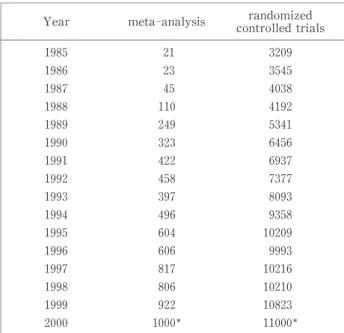
We describe these innovations,demonstrating their application to clinical problems,and show how they can be learned and pr acticed by clinicians who have just 30 minutes per week t o devote to their continuing professional devel opment. And we can have many literatures of met a‑analysis and random- ized controlled trials(Table 5).
3. Actual steps of EBM practice
The practice of EBM comprises 5 steps(Table 6), and theses are as follows;
Step 1 Converting the need for information(about prevention,diagnosis,prognos is,therapy,causation, etc)into an answerable question.
Step 2 Tracking down the best evidence with which to answer that ques tion.
Step 3 Critically appraising that evidence for its validity(closeness to the t ruth),impact(size of the effect),and applicability ( usefulness in our clinical practice). The methodologi es of that were exactly and minutely explained by EBM wor king group in MacMaster University .
Step 4 Integrating the critical appraisal with our clinical expertise and with our patientʼs unique biol- ogy,values and circumstances.
Evidence‑Bas ed Medicine(EBM)and the Art of Medicine June,2002
Table 3. Four reasons of rapid spread of EBM.
1. Daily need for valid information 2. Inadequacy of traditional sources
3. Disparity between diagnos tic skills and clinical judgement
4. Inabi lity to afford more than a few seconds
Table 4. Five important factors of rapid spread of EBM.
1. Development of strategies
2. Creation of systematic reviews and concise summaries 3. Creation of evidence‑based journals
4. Creation of infor mation systems
5. Identification and application of effective strategies
Table 5. Chronological trends of meta analysis,random- ized controlled trials.
(from PubMed, :estimation) Year meta‑analysis contrandomirol led zedtrials
1985 21 3209
1986 23 3545
1987 45 4038
1988 110 4192 1989 249 5341 1990 323 6456 1991 422 6937 1992 458 7377 1993 397 8093 1994 496 9358 1995 604 10209 1996 606 9993 1997 817 10216 1998 806 10210 1999 922 10823 2000 1000 11000
Table 6. 5 steps of EBM practice.
1. Formulating Answerable Clinical Questions 2. Searching for the Bes t Evidence
3. Critical Apprai sal of the Evidence 4. Applying Evidence to Patients 5. Evaluation
103
Step 5 Evaluating our effectiveness and efficiency in executing Steps 1‑4 and s eeking ways to improve them both for next time.
When we carry out practice of EBM,we need much time to do step 3(cr itically appraising). It is important to seek the liter ature of meta‑analysis and randomized controlled tri als to obtain information.
The number of papers published on meta‑analyses and randomized controlled trials in medical research has increased sharply in t he past 15 years(Table 5). We conserve our time by seeking out critical appraisals already performed by others who describe explicit criteria for deci ding what evidence they selected and how they deci ded whether it was valid.
That is,we leave out the time‑consuming Step 3(criti-
cally appraising)and carry out just Step 2(searching) but restrict the latter to sources that have already undergone critical apprais al(Cochrane Reviews,Best Evidence,and the like).
When we find the best evidence we must integrate it with our clinical expert ise and with our patientʼs unique biology,values and circumstances
4. Useful internet site for EBM
And we can t ake many informations from inter- net WWW. We show useful internet site of EBM (Table 7‑9).
Table 7. Useful internet site for EBM (Search) ADEPT:Applying Diagnosis Etiology Prognosis Therapy Filters ScHARR
http://www.shef.ac.uk/〜scharr/ir/adept /intro.htm
Agency for Health Care Pol icy and Research(AHCPR),U.S.A
http://text.nlm.nih.gov/ftrs/pi ck?collect=ahcpr&cc=1&oldK=34464&t=0&t=874476543 Center for Evidence‑Based Medicine,Oxford
http://cebm.jr2.ox.ac. uk/
Center for Evidence‑Based Mental Health,Oxford http://www.psychiatry.ox. ac.uk/cebmh/ Center for Evidence‑Based Medicine,Swizerland
http://www.sams.ch/ebm/ default.html ClinicalTrials.gov
http://cl inicaltrials.gov/
Cochrane Database of Systematic Reviews Cochrane Library
http://www. cochrane.org/cochrane/cdsr.htm Controlled Trials in Hi story
http://www.r cpe.ac.uk/controlled trials/index.html Evidence‑based Filters for Ovid CINAHL
http://www.urmc.roches ter.edu/miner/educ/ebnfilt.htm Evidence‑Based Healthcare Links Pages ScHARR
http://www.shef.ac.uk/〜s charr/ir/links.html The Evidence‑Based Heal thcare Project
http://evidence.ahc. umn.edu/ Evidence‑Based Medicine Reviews
http://www.ovid. com/products/clinical/ebmr.cfm Evidence‑Based Medicine Information
http://jeffline.tju.edu /Education/courses/informatics/activities/ebm info.html Evidence‑Based Medicine Italian
http://www.gimbe. org/ Evidence‑Based Topics
http://www. ohsu.edu/bicc‑informatics/ebm/ebm topics.htm
Evidence That Changed Medical Practice
http://www.hsc.usf. edu/〜bdjulbeg/oncology/practice‑change.htm Filtering the literature ScHARR
http://www.shef .ac.uk/〜scharr/ir/filter.html Finding the literature ScHARR
http://www.shef .ac.uk/〜scharr/ir/finding.html Focusing the question ScHARR
http://www.shef .ac.uk/〜scharr/ir/focusing.html Health Information Resear ch Unit,McMaster,Canada
http://hiru.mcmaster.ca/ebm/ overview.htm Health Reviews for Pr imary Care Providers
http://library.mcphu. edu/resources/reviews/revw ind.htm Healthy Resources for Evidence Based Medicine
http://www.ecmag.net/ EC2000/sullivan12.html How to Teach Evidence ‑based Clinical Practice
http://hiru.mcmaster.ca /ebm/default.htm InfoPOEMS
http: //www.infopoems.com/POEMs/POEMs Home.htm Literature Searching ScHARR
http://www.shef .ac.uk/〜scharr/ir/litsrch.html
Medicina basada en pruebas:Evi dence‑Based Medicine(EBM) http://usuarios.bitmailer.com/rafabravo/mbe.htm
Netting the Evidence,Shef field
http://www.shef .ac.uk/〜scharr/ir/netting/ The Oxford Pain Internet Site
http://www.jr 2.ox.ac.uk/bandolier/booth/painpag/ PEDro‑Physiotherapy Evidence Database
http://ptwww.cchs.us yd.edu.au/pedro/
Register of Reviews of Effectiveness in Health Promotion http://eppi.ioe.ac.uk/rev sear ch1.htm
RehabTrials.org
http:// www.rehabtrials.org RES&WCE
http: //www.shef.ac.uk/〜scharr/reswce/reswce.htm ScHARR‑Lockʼs Guide to the Evidence ScHARR
http://www.shef.ac.uk/uni /academic/R‑Z/scharr/ir/scebm.html Seeking the Evidence:a protocol ScHARR
http://www.shef.ac.uk /〜scharr/ir/proto.html Sheffield EBM pages
http://www. shef.ac.uk/uni/academic/R‑Z/scharr/ebm/
Sources of Evidence(CASPFEW)
http://wwwlib.jr2.ox.ac.uk/caspfew/sources.html SUMSearch
http: //SUMSearch.UTHSCSA.edu/cgi‑bin/SUMSearch.exe Teaching/Learning skills for Evi dence‑Based Practice
http://www.mdx.ac.uk/www /rctsh/ebp/main.htm TrialsCentral
http:// www.trialscentral.org/
Turning Research Into Practice(TRIP)Database http://www.tripdatabas e.com/
World Wide Web‑Based EBM Hedges
http://www.mssm. edu/library/ebm/ebmhedges.htm
105 Evidence‑Bas ed Medicine(EBM)and the Art of Medicine
June,2002
Table 8. Useful internet site for EBM (Cochrane Collaboration& PubMed) Australian Cochrane Collaboration http://www.cochrane.org.au/
Canada Cochrane Collaboration http://hiru.mcmaster.ca/cochrane/ DeuchesCochrane Collaboration http://www.cochrane.de/
Nordic Cochrane Collaboration http://www.cochrane.dk/default.html SpanishCochrane Collaboration http://www.cochrane.es/default.html
UKCochrane Collaboration http://www.update‑software.com/ccweb/default.html USCochrane Collaboration http://www. cochrane.org/
PubMed http://www.ncbi.nlm.nih.gov/PubMed/
Table 9. Useful internet site for EBM (Journals) ACP Journal Club
http://www. acponline.org/journals/acpjc/jcmenu.htm Bandolier
http: //www.jr2.ox.ac.uk:80/Bandolier Bandolera
http: //www.infodoctor.org/bandolera/ Effective Health Care Bulletins
http://www.yor k.ac.uk/inst/crd/ehcb.htm Effectiveness Matters
http://www. york.ac.uk/inst/crd/em.htm Evidence
htt p://www.bangor.ac.uk/hs/evidence/ Evidence‑Based Health Care
http://www.har court‑international.com/journals/ebhc/ Evidence‑Based Medicine
http://www. acponline.org/journals/ebm/pastiss.htm Evidence‑Based Medicine‑Edi zione Italiana
http://www.infomedi ca.org/ebm/
Evidence‑Based Medicine Journal
http://cebm.jr2.ox. ac.uk/docs/hiru/ebmj/default.htm Evidence‑Based Mental Heal th
http://www.ebment alhealth.com/
Evidence‑Based Nursing
http://www. bmjpg.com/template.cfm?name=specjou nu Evidence‑Based Purchasing
http://www. doh.gov.uk/research/swro/rd/publicat/ebpurch/ International Journal of Epidemiology
http://ije.oupjournal s.org/ Journal of Clinical Epidemiology
http://www.els evier.co.jp/inca/publications/store/5/2/5/4/7/2/?menu=gen.aimsandscope Journal Club on the Web
http://www. journalclub.org/
Journal of Family Practice POEMs(Patient Oriented Evidence that Matters) http://jfp.msu.edu/
JSCAN‑Online
http:// www.uaeu.ac.ae/jscan/
New Zealand Evidence‑Based Healthcare Bulletin http://www.nzgg.org.nz /news/bulletin.cfm
5. Levels of evidence
What ar e we to do when the irresistible force of the need to offer clinical advice meets with the im- movable object of flawed evidence? All we can do is our best:give the advice,but alert the advisees to the flaws in the evidence on whi ch it is based.
The ancestor of this set of pages was created by Suzanne Fletcher and Dave Sacket t 20 years ago when they were working for the Canadian Task Force on the Periodic Health Exami nation . They gener- ated“levels of evidence”for ranking the validity of evidence about the value of preventive manoeuvres, and then tied them as“grades of recommendations”to the advice given in the repor t.
The levels have evolved over the ensuing years, most notably as the basis for recommendations about the use of anti‑thrombot ic agents ,have grown increasingly sophisticated ,and have even started to appear in a new generati on of evidence‑based text- books that announce,in bold marginal icons,the grade of each recommendation that appears in the texts in bold icons.
These levels were generated in a series of itera- tions among members of the NHS R & D Center for Evidence‑Based Medicine( Chris Ball,Dave Sackett, et al)
Homogeneity is a systematic review that is free of worrisome variations(het erogeneity)in the direc- tions and degrees of results between individual studies. Not all systemati c reviews with statistically significant heterogeneity need be worrisome,and not all worrisome heterogeneit y need be statistically sig- nificant. As noted above,studies displaying worri-
some heterogeneity should be tagged with a“−”at the end of their designated level.
6. Study design
We show you a definition and a comparison of the advantages and disadvant ages of the different study design.
Case‑control studies are studies which involve identifying patients who have the outcome of interest (cases)and patients without the same outcome(con- trols),and looking back to see if they had the expo- sure of interest. They have 4 advantages (quick, cheap,only feasible method for very rare disorders or those with long time lag bet ween exposure and out- come and fewer subjects needed than cross‑sectional studies)and 4 disadvantages( reliance on recall or records to determine expos ure status,confounders, difficulty of selection of control groups and potential bias(recall,selection)).
Cross‑sectional survey is the observation of a defined population at a si ngle point in time or time interval. Exposure and out come are determined simultaneously. It has 3 advantages(cheap,simple and ethically safe)and 5 di sadvantages(no causality of association,recall bias susceptibility,unequal dis- tribution of confounders,Neyman bias and inequality of group sizes).
Cohort study involves identification of 2 groups (cohorts)of patients,one which received the exposure of interest,and one which did not,and following these cohorts forward for the out come of interest. It has 7 advantages(ethically safet y,match of subjects,estab- lishment of timing and directionality of events,stan-
Table 10. Levels of Evidence(For Therapy/Prevention,Etiology/Harm) 1a:Meta‑analysis(with homogeneity)of RCTs
1b:Individual RCT (wi th narrow Confidence Interval) 1c:All or none
2a:Met a‑analysis(with homogeneity)of cohort studies
2b:Individual cohort study( including low quality RCT;e.g.,<80% follow‑up) 2c:“Outcomes”Research
3a:SR (with homogeneity)of case‑control studies 3b:Individual Case‑Cont rol Study
4:Case‑series(and poor quality cohort and case‑control studies)
5:Expert opinion without explicit critical appraisal,bench research or“first principles”
107 Evidence‑Bas ed Medicine(EBM)and the Art of Medicine
June,2002
dardization of eligibility criteria and outcome assess- ments and administrative easiness and cheapness than RCT)and 5 disadvantages( controls may be difficult to identify,exposure may be linked to a hidden con- founder,blinding is difficult;randomization not pres- ent,and for rare disease,large sample sizes or long follow‑up necessary).
Randomized controlled trial means that a group of patients is randomized into an experimental group and a control group. Thes e groups are followed up for the variables/outcomes of i nterest. It has 3 advantages (unbiased dis tribution of confounders, blinding more likely and randomization facilitates statistical analysis)and 3 disadvantages(expensive (time and money),volunteer bias and ethically prob- lematic at times).
Crossover design is the administration of 2 or more experimental therapi es one after the other in a specified or random order t o the same group of patients. It has 4 advantages( all subjects serve as own controls and error var iance is reduced thus reduc- ing sample size needed,all subjects receive treatment (at least some of the time),statistical tests assuming randomization can be us ed and blinding can be maintained)and 3 disadvant ages(all subjects receive placebo or alternative treat ment at some point,wash- out period lengthy or unknown and cannot be used for treatments with permanent effects).
7. Limitations of EBM
There ar e 3 limitations that are unique to the practice of EBM. First,t he need to develop new skills in searching and crit ical appraisal can be daunt- ing,although evidence‑based care can still be applied if only the former has been mas tered and directed toward pre‑appraised resour ces. Second,busy clini- cians have limited time to master and apply these new skills,and the resources requi red for instant access to evidence are often woeful ly inadequate in clinical settings. Finally,evidence t hat EBM “works”has been late and slow to come.
On the other hand,the ensuing discussion and debate has clarified some“ps eudo‑limitations”that arise from misunderstandi ngs of the definition of
EBM. An examination of the definition and steps of EBM quickly dismisses t he criticisms that it deni- grates clinical expertise, is limited to clinical research,ignores patientsʼval ues and preferences,or promotes a cookbook appr oach to medicine. More- over,it is not an effective cost‑cutting tool,since providing evidence‑based car e directed toward max- imizing patientsʼquality of life often increases the costs of their care and rai ses the ire of health econo- mists.
8. Extension of EBM
EBM rei nforces the need for,and mastery of,the clinical and communication skills that are required to gather and critically apprai se patientsʼstories,symp- toms,and signs and to identify and incorporate their values and expectations int o therapeutic alliances.
It fosters generic skills for use in finding,apprais- ing and implementing evidence from the basic sci- ences and from other applied sciences.
It provides an effective,efficient framework for post‑graduate education and s elf‑directed,life‑long learning;when coupled wi th“virtual libraries”and distance learning programs i t supplies a model of worldwide applicability.
Although not its primary aim,by identifying the questions for which no sat isfactory evidence exists it generates a supremely pragmat ic agenda for applied health research
And now EBM i s spread to the method of Evi- dence‑Based Clinical Practice,Evidence‑Based Nurs- ing,Evidence‑Based Mental Health,Evidence‑Based Dentistry,Evidence‑Based Sur gery,Evidence‑Based Gynecology Evidence‑Bas ed Health Care Evidence
‑Based Public Health,Evidence‑Based Policy and Evidence‑Based Education et al.
III. A RT OF MEDICINE
Evidence‑based medicine is the conscientious, explicit and judicious use of current best evidence in making decisions about the care of individual patients. The practice of evidence‑based medicine means inte- grating individual clinical expertise with the best