Fukushima Medical University
福島県立医科大学 学術機関リポジトリ
This document is downloaded at: 2021-11-07T23:46:52Z
Title
Factors associated with enrollment and adherence of outpatient cardiac rehabilitation in Japan( 本文 )
Author(s)
遠藤, 教子
Citation
Issue Date
2015-03-24
URL
http://ir.fmu.ac.jp/dspace/handle/123456789/619
Rights
Fulltext: © 2015 Wolters Kluwer Health, Inc. This is a non- final version of an article published in final form in "J Cardiopulm Rehabil Prev. 2015 May-Jun;35(3):186-92".
DOI
Text Version
ETD
博士論文
Factors associated with enrollment and adherence of outpatient cardiac
rehabilitation in Japan
日本における外来型心臓リハビリテーションの 参加関連要因と継続関連要因についての検討
福島県立医科大学大学院医学研究科医学専攻 疫学・地域保健学分野
遠藤 教子
1
概要
心臓リハビリテーション(以下心リハ)は、運動耐容能、生活の質( Quality of Life ) 、 そして、生命予後の改善といった効果が示されている。我が国では、心疾患患者への 心リハ実施率は諸外国に比較して低い。実施施設においても、参加率並びに継続率は 低いことが報告されている。本研究の目的は、外来通院型心リハにおける参加関連要 因と、継続関連要因を明らかにすることである。
方法:本研究は症例対照研究で、対象者は一市中病院において、 2010 年 3 月から 2 年間に入院し、心リハを施行された 544 人である。外来型心リハに参加した患者は 78 人(参加群)であり、その内 3 ヶ月外来型心リハを継続できたのは 23 人(継続群)
であった。対照群は、外来型心リハ非参加者から無作為に抽出した 179 人である。調 査項目は患者基本属性、心疾患の詳細、冠危険因子、内服加療内容、心機能関連項目、
リハビリ関連項目等であり、電子カルテ、心臓カテーテルデータベースから転記した。
分析 1 では、心リハ参加関連要因について解析した。参加群と非参加群を単変量解析 にて比較し、有意項目に基本属性を加えて多変量解析を実施した。分析 2 では、心リ ハ継続関連要因について解析した。継続群と非継続群の特性を単変量解析にて比較し、
有意項目に基本属性を加えて多変量解析を実施した。
結果:分析1では高齢(オッズ比[以下 OR ] , 0.96; 95% 信頼区間[以下 CI ] , 0.93 – 0.98;
p=0.003 ) 、病院までの距離( OR, 0.97; 95% CI, 0.95 – 0.99; p=0.014 )が有意な参加関連 要因であった。分析2では、虚血性心疾患( OR, 6.03; 95% CI, 1.62 – 22.5; p=0.007) 、安 定剤等の内服( OR, 4.14; 95% CI, 1.07 – 16.0; p=0.039 )が有意な継続関連要因であった。
考察:外来通院型心リハの参加関連要因として、社会的要因(高齢、病院までの距離)
が参加阻害因子として挙げられた。継続関連要因としては、身体的要因(虚血性心疾 患、安定剤等の内服)が継続促進因子として挙げられた。外来通院型心リハの参加、
継続を向上させるためには疾患の詳細だけでなく、患者のセルフマネジメント力や病
院へのアクセス、心理的状態を把握し、参加しやすい包括的なシステムを構築するこ
とが必要である。
2
ABBREVIATIONS CR: cardiac rehabilitation
OCR: outpatient cardiac rehabilitation
AMI: acute myocardial infarction
JCS: the Japanese Circulation Society
ICR: in-hospital cardiac rehabilitation
CABG: coronary artery bypass grafting
IHD: ischemic heart disease
LVEF: left ventricular ejection fraction
ATV .
O
2: cardiopulmonary exercise test results including anaerobic threshold
Peak V .
O
2: peak oxygen consumption
V .
E: minute ventilation
V .
CO
2: carbon dioxide output
3
INTRODUCTION
Cardiac rehabilitation (CR) is highly effective at increasing exercise tolerance,
preventing recurrent events, improving quality of life, and improving long-term prognosis.
1,2In Japan, CR is recommended for patients who have undergone open-heart surgery
2,3,4or
experienced various forms of cardiovascular disease, including acute myocardial infarction
(AMI),
2,5angina pectoris,
2,6chronic heartfailure,
2,7,8and peripheral arterydisease.
2,9The first
nationwide CR survey in 2004 included 526 cardiology training hospitals and reported that
in-hospital CR (ICR) was 53% of the hospitals. However, only 9% of those hospitals reported
offering outpatient CR (OCR).
10-12According to the most recent government report by the
Ministry of Health, Labor and Welfare’s Circulatory Disease Research Commission, the
implementation of ICR and OCR had increased to 64% and 21%, respectively.
10,12The above-mentioned increase in the outpatient implementation percentage at the
hospital level could be explained in part by the recent shortening of hospital stays, which has
followed the latest revision of the treatment guidelines.
2In 2004, the mean duration of
hospitalization for AMI patients was 19 days, whereas in 2009, it was only 15 days.
12Nevertheless, the length of hospitalization is much longer in Japan as compared to North
America and European countries. In order to achieve further shortening of the hospital stay in
Japan, it is necessary to promote wider implementations of outpatient rehabilitation because
OCR provides an important opportunity for increased patient follow-up.
4
In Japan, insurance covers CR for 150 days and the 150-day count starts on the first
day of ICR. However, since the length of hospital stay differs for each patient, so does the
number of days available for OCR. The JCS guidelines recommend an OCR frequency of 2-3
times a week
2, but despite increases in the need for OCR and the implementation percentage
at the hospital level, it remains difficult to encourage some patients to continue rehabilitation.
In addition, no national data are available on enrollment at the individual level and the data
available from small-scale studies vary considerably across Japanese hospitals. For example,
one hospital reported that only 22% of suitable patients enrolled in OCR and only 52% of
those patients continued for 1 month.
13But another hospital reported approximately 40% of
suitable patients enrolled in OCR.
14According to a recent report, nearly 17% of OCR patients
in the United States dropout before 3 months in the program.
15Japanese data on the barriers and motivators of OCR enrollment are limited.
Previous studies conducted outside Japan have reported several factors that facilitate OCR
enrollment, namely, having social support,
16male sex,
16post coronary artery bypass grafting
(CABG),
18and recommendation by a physician.
17On the other hand, several factors have also
been reported to negatively affect OCR enrollment, including living far from the hospital,
19transportation issues,
20,21being employed,
16,20-22younger age,
23and being depressed.
21Moreover, it has been reported that having social support facilitates OCR adherence,
16,24but
that smoking,
25female sex,
26,27and being depressed
27negatively effect OCR adherence.
5
Previous studies in Japan have investigated adherence to OCR. However, no study
has yet investigated the background factors related to OCR enrollment in a multifaceted
manner. Accordingly, the aims of this study were to investigated the background factors
associated with enrollment in OCR (Objective 1) and adherence to OCR (Objective 2). In
addition to clinical characteristics, we also considered socioeconomic factors.
METHODS Study Design
This was a single-hospital, case-controlled study that used data derived from electronic
medical charts and a cardiac catheterization database at Ohta-Nishinouchi Hospital in
Fukushima Prefecture. Between March 2010 and February 2012, 544 patients were
hospitalized for ischemic heart disease (IHD); including AMI and angina pectoris, chronic
heart failure or open-heart surgery and were recommended for ICR. We defined patients who
participated in OCR at least one time after discharge as ―enrollers
‖, whereas patients were
defined as ―adherers
‖if they participated in at least one additional session during the 3
months following the start of OCR; which is equivalent to 60% of the insurance benefit
period.
For Objective 1, the 78 patients who participated in OCR were included in our study
as enrollers. From the patients who did not participate in the OCR, we randomly selected 179
patients to be included as controls (nonenrollers) . On the basis of previous reports in the
6
literature, the OCR participation rate was expected to be low and so the size of the control
group was designed to be 3 times larger than the treatment group. This was done to improve
statistical power.
28For Objective 2, 23 of the 78 patients enrolled in OCR met the definition
of adherers.
Demographic and Clinical Data
The following information was collected from the hospital database: baseline characteristics
(age, sex, employment status, family structure, and distance from the hospital); cardiac
diagnosis; IHD status; heart failure status; coronary risk factors (hypertension, dyslipidemia,
diabetic mellitus, and smoking history); attending physician’s specialty; duration of
hospitalization; prescriptions (sleeping pills and/or antidepressants and cardiovascular
medications); date the patient started ICR; left ventricular ejection fraction (LVEF) primarily
measured by echocardiography; and cardiopulmonary exercise test results including
anaerobic threshold (ATV .
O
2), peak oxygen uptake ( V
O
2), and minute ventilation versus carbon dioxide production (
VEvs V
CO
2slope). For the OCR enrollers, medical records were used to determine the starting date, the date of the most recent participation, and the
totalnumber of times each patient participated in OCR.
Statistical Analysis
The enroller and non-enroller groups were compared to assess factors associated with
enrollment in OCR (Objective 1). The enroller group was divided into patients who were
7
adherers in OCR for at least 3 months and those who did not (―nonadherers
‖). These 2 groups
were compared in order to examine factors associated with adherence to OCR (Objective 2).
For both analyses, univariate analyses compared the groups using the Chi-square test for
categorical variables and the Mann-Whitney U test for continuous variables. We then
performed multivariate logistic regression analyses, adjusted for age and sex, as well as each
of the factors that were significant in the univariate analyses. Odds ratios (ORs) with 95%
confidence intervals (CIs) and P values were calculated from the regression models. Analyses
were performed using SPSS statistical software for Windows version 17.0 (IBM SPSS, Inc.,
Chicago, IL, USA).
Ethical Considerations
The ethics committees of Fukushima Medical University (No. 1465) and Ohta-Nishinouchi
Hospital approved our study protocol. All data were collected without using personal health
identifiers.
RESULTS
The OCR enrollment percentage was 14% (78/544) among patients who were recommended
to start ICR.
Objective 1
A total of 257 patients were included in the analyses, comprising 78 OCR enrollers and 179
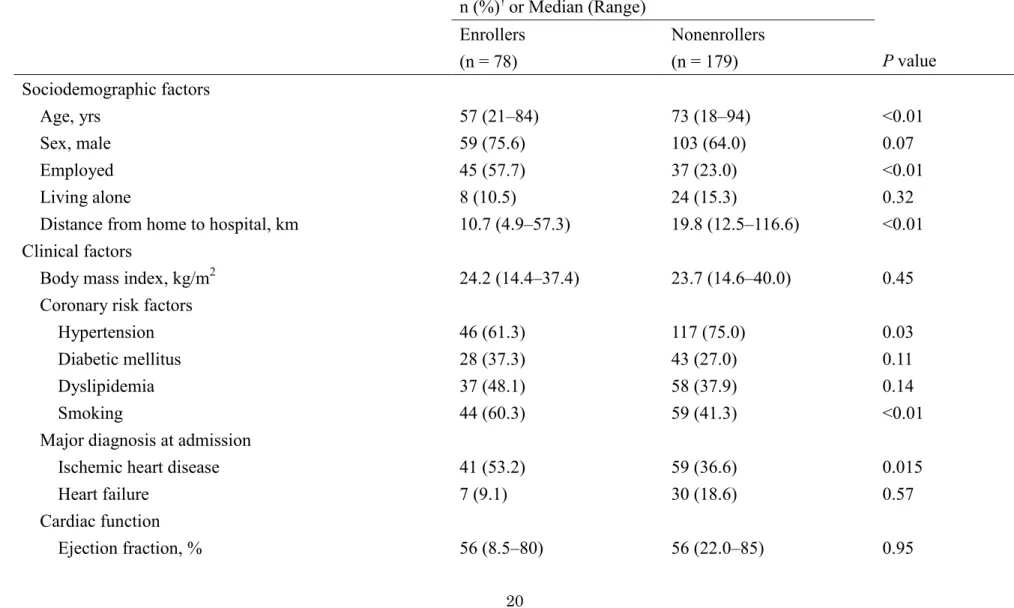
non-enrollers. As presented in Table 1, the median age was significantly lower and included a
significantly larger proportion of men in the enroller group. Other significant factors in the
8
univariate analyses included employment, distance from the hospital, history of hypertension,
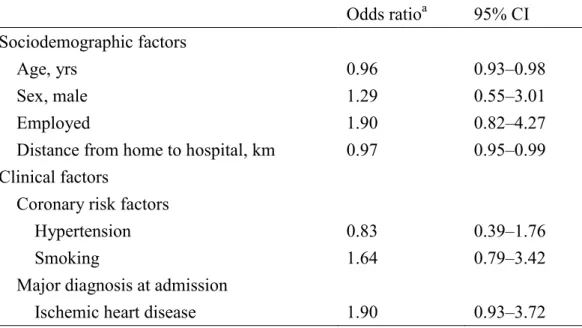
smoking status, and a diagnosis of IHD. In the multivariate analysis, age and distance to the
hospital remained significant independent factors (Table 2).
Objective 2
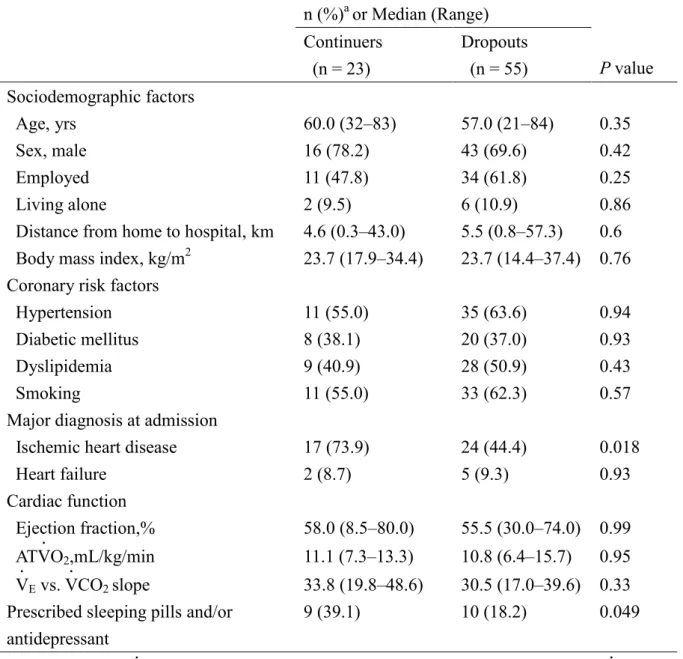
For these analyses, 23 patients were classified as adherers and 55 patients were identified as
non-adherers. The following variables were significant in the univariate analyses: IHD and
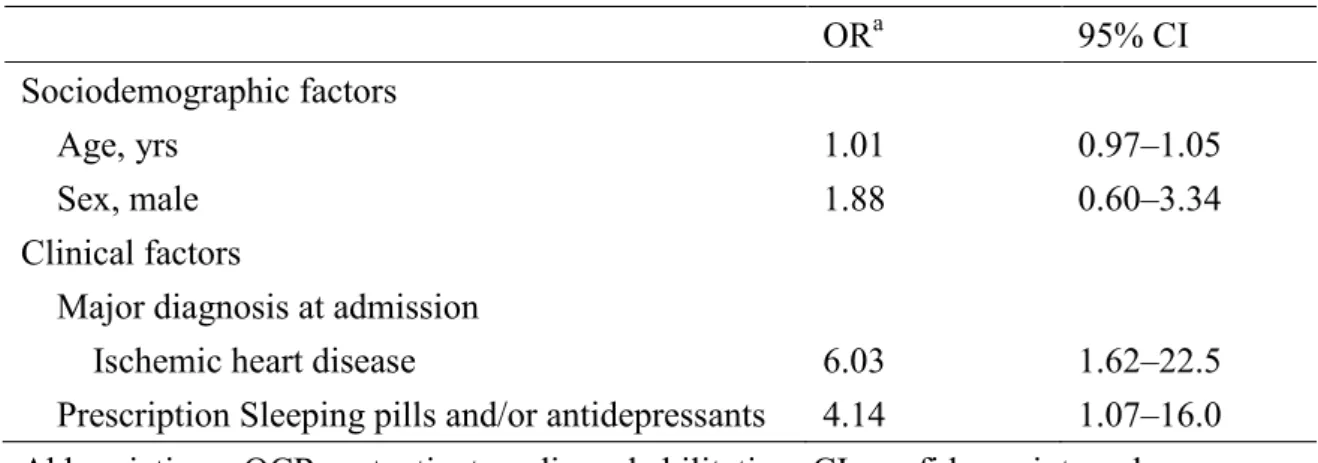
use of sleeping pills and/or antidepressants (Table 3). Multivariate logistic regression analysis
was performed including these significant variables, as well as adjusting for age and sex
(Table 4). IHD and the use of sleeping pills and/or antidepressants remained significant in the
multivariate model.
DISCUSSION
Our results indicate that sociodemographic factors were primarily associated with OCR
enrollment whereas clinical factors were associated with OCR adherence. Similarly, a recent
meta-analyses reported that social factors, rather than clinical factors, were associated with
initiating CR
16and our results support these previous findings among Japanese patients.
In our study, the OCR enrollment proportion was 14%, which is slightly higher than
the average enrollment proportion of cardiology training hospitals reported by Goto et al in a
nationwide survey (10.6%).
11However, the enrollment proportion is still low in comparison
to North American OCR programs. To improve the CR enrollment proportion, it is also
9
necessary to consider the methodology used to prescribe OCR. In North America, a previous
study reported that a systematic referral system was effective for achieving good adherence.
29In addition, weekly patient group meetings have been demonstrated to effectively reinforce
the recognition of the need for OCR.
30These methods may also contribute to improving the
enrollment proportion in Japan and should be the focus of future research.
Our results indicated that older age is one of the barriers to starting OCR. Previous
studies have described how physical activity declines with age,
31which is linked with
decreased skills for self-managing diseases.
32,33Thus, we recommend more careful
monitoring of the physical activity and disease management capacity, especially for older
patients.
Consistent with our findings documenting an association between OCR enrollment
and the distance between the patient’s residence and the hospital, a previous study found that
distances ≥1-hour drive decreased CR participation.
34Another study determined that
non-drivers were especially likely to be non-participants.
26Accordingly, OCR enrollment at
our hospital could perhaps be increased by improving access to the hospital. In the current
study, data regarding the means of transportation of the patients was not available and so we
analyzed distance. To address this issue, we propose to carefully assess at discharge the
available transportation and the time required for travelling to the hospital from home. This
will hopefully help us to suggest means to facilitate more frequent visits to OCR. Currently,
10
there is a shuttle bus service between our hospital and a nearby train station, and we
recommend mapping and assessing whether this service covers the areas where most patients
of the patients live and whether altered routes may help increase the OCR use.
In addition to the factors significantly associated with OCR enrollment in the
multivariate analysis, the fact that we did not observe a significant association between
disease severity and OCR enrollment deserves attention. If physicians would make a stronger
recommendation for OCR to patients with more severe conditions and if those patients would
recognize the need to start and continue OCR, we might likely observe a significant
association. Our findings suggest that the severity of the disease and the need for OCR were
not effectively communicated to the patients who could benefit the most from OCR.
We found that IHD was one of the motivating factors for OCR adherence among our
patients. A previous randomized controlled trial reported that coronary artery disease patients
demonstrated good adherence to CR,
35whereas a review by Jackson and colleagues
36stated
that there were no clear predictors associated with the long-term behavioral changes in these
patients. These authors also found that patients with percutaneous trans luminal coronary
angioplasty, angina, or coronary artery bypass grafting were referred more often to CR,
suggesting different levels of physician endorsement of the program depending on the
patient’s condition.
36To encourage enrollment in OCR, we recommend conducting automated
computerized referrals, as suggested by Grace et al,
29and performing subsequent monitoring
11
of enrollment and adherence status. Additional adherence factors were found to include
perception of the severity of the heart disease.
27Hence, for patients with chronic diseases
such as IHD, it is beneficial to be competent at self-management of their medical treatment in
the long-term,
37and we recommend careful monitoring the patients’ comprehension of
self-management.
In this study, patients using sleeping pills and/or antidepressants were typically
adherers to rehabilitation. With respect to the mental health of the patients, it has been
reported that anxiety and depression are significant factors for OCR non-enrollment and
non-adherence.
27Although it may seem that our results are inconsistent with this previous
finding, Bauer and colleagues reported that patients with anxiety have high levels of health
behavior.
38We speculate that the use of sleeping pills and/or antidepressants by patients could
evidence a greater degree of motivation to improve their health status, thereby resulting in
better OCR adherence. Although mental health assessment and counseling is included in the
Japanese guidelines for OCR
2, our hospital has not yet introduced this assessment, which is
why we used the use of anti-depressants or sleeping pills as a proxy indicator. We suggest that
there is a need to introduce routine mental health assessment for these patients.
LIMITATIONS
This study had 2 major methodological limitations. First, this was a single hospital study,
which included a limited number of cases. Moreover, the number of patients included in the
12
multivariate analysis for adherence was low; hence, the CIs were quite wide for some of the
variables. Second, the database used may not have included some important determinants of
enrollment and adherence, resulting in relatively low R
2values (0.30 for Objective 1 and 0.26
for Objective 2, respectively). In particularly, we were unable to include information
regarding income or educational level, which is considered highly important information
potentially affecting enrollment and adherence and it is not routinely collected at our hospital.
In addition, psychological status was not routinely assessed for the patients in this study and,
therefore, we used psychiatric medications as an indicator of psychological status. A
multicenter study with a larger sample size and data on socioeconomic and psychological
factors is necessary to confirm these results. However, despite these limitations, our analysis
of typical data available in hospital records has resulted in practical recommendations for
improving OCR enrollment and adherence in Japan.
CONCLUSIONS
In conclusion, our results indicated that sociodemographic factors may need to be considered
when encouraging patients to initiate OCR and that clinical factors should be considered
when encouraging patients to continue attending OCR. Younger age and living closer to a
hospital promoted OCR enrollment, whereas a history of IHD and the use of prescription
psychiatric medication were associated with improved OCR adherence. We propose
systematic prescription of OCR, self-management by the patients, an organized hospital
13
transportation system, and a mental health assessment to facilitate increasing patient access to
OCR services and improving health awareness.
ACKNOWLEDGMENTS
This work was co-authored with Aya Goto, Tomoko Suzuki, Shin Matsuda and Seiji
Yasumura, and published in the Journal of Cardiopulmonary Rehabilitation and Prevention
2015. [Epub ahead of print]
14
REFERENCES
1. Goto Y. Cardiac rehabilitation: evidence and perspective. J Cardiol Jpn Ed 2009; 3:
195-215. (article in Japanese)
2. JCS Joint Working Group. Guidelines for Rehabilitation in Patients with Cardiovascular
Disease (JCS 2012). Available at
https://www.jstage.jst.go.jp/article/circj/78/8/78_CJ-66-0094/_pdf.
3. Takeyama J, Itoh H, Kato M, et al. Effects of physical training on the recovery of the
autonomic nerves activity during exercise after coronary artery bypass grafting: effect of
physical training after CABG. Jpn Circ J 2000; 64: 809-813.
4. Ueshima K, Kamata J, Kobayashi N, et al. Effects of exercise training after open heart
surgery on quality of life and exercise tolerance in patients with mitral regurgitation or aortic
regurgitation. Jpn Heart J 2004; 45: 789-797.
5. Clark AM, Hearling L, Vandermeer B, Lissel SL, McAlister FA. Secondary prevention
programmes for coronary heart disease: a meta regression showing the merits of shorter,
generalist, primary care based interventions. Eur J Cardiovasc Prev Rehabil 2007; 14:
538-546.
6. Belardinelli R, Paolini I, Cianci G, Pive R, Georgiou D, Purcaro A. Exercise training
intervention after coronary angioplasty: the ETICA trial. J Am Coll Cardiol 2001; 37:
1891-1900.
15
7. Belardinelli R, Georgiou D, Cianci G, Purcaro A. Randomized, controlled trial of
long-term moderate exercise training in chronic heart failure: effects on functional capacity,
quality of life, and clinical outcome. Circulation 1999; 99: 1173-1182.
8. O’Connor C, Whellan DJ, Lee KL, et al. Efficacy and safety of exercise training in patients
with chronic heart failure: HF-ACTION randomized controlled trial. JAMA 2009; 301:
1439-1450.
9. Girolami B, Bernardi E, PrinsMH, et al. Treatment of intermittent claudication with
physical training, smoking cessation, pentoxifyl line, or nafronyl: a meta-analysis. Arch
Intern Med 1999; 159: 337-345.
10. Nakanishi M, Nagayama M, Adachi H, et al. Changes in implementation of cardiac
rehabilitation for acute myocardial infarction in Japan: a nation-wide survey [in Japanese].
Jpn J Card Rehabil 2011; 16: 188-192.
11. Goto Y, Saito M, Iwasaka T, et al. Poor implementation of cardiac rehabilitation despite
broad dissemination of coronary interventions for acute myocardial infarction in Japan: a
nationwide survey. Circ J 2007; 71: 173-179.
12. Goto Y. Current state of cardiac rehabilitation in Japan. Prog Cardiovasc Dis2014; 56:
557-562
13. Kusunoki S, Maruji A, Kobayashi K, et al. Subjective barriers to adherence to cardiac
rehabilitation program after hospital discharge in patients with acute myocardial infarction [in
16
Japanese]. J Jpn Coron Assoc 2008; 14: 206-210.
14. Ishii N, Saito M, Yamada T, et al. The main reason not to participate in outpatient cardiac
rehabilitation program [in Japanese]. Jpn J Card Rehabil 2009; 14: 145-148.
15. Arthur RM, Lavie CJ, Milani RV, et al. Cardiac rehabilitation in the United States. Prog
Cardiovasc Dis. 2014; 56: 522-529.
16. Clark AM, King-Shier KM, Thompson DR, et al. A qualitative systematic review of
influences on attendance at cardiac rehabilitation programs after referral. Am Heart J 2012;
164: 835-845.e2.
17. Ades PA, Waldmann ML, McCann WJ, Weaver SO. Predictors of cardiac rehabilitation
participation in older coronary patients. Arch Intern Med 1992; 152: 1033-1035.
18. Bunker S, McBurney H, Cox H, Jelinek M. Identifying participation rates at outpatient
cardiac rehabilitation programs in Victoria, Australia. J Cardiopulm Rehabil 1999; 19:
334-338.
19. De Vos C, Li X, Vlaenderen I, et al. Participating or not in a cardiac rehabilitation
programme: factors influencing a patient’s decision. Eur J Prev Cardiol 2013; 20: 341-348
20. Ramm C, Robinson S, Sharpe N. Factors determining non-attendance at a cardiac
rehabilitation programme following myocardial infarction. NZ Med J 2001; 114: 227-229.
21. Deskur-Smielecka E, Borowicz-Bieńkowska S, Brychcy A, Wilk M, Przywarska I,
Dylewicz P.Why patients after acute coronary syndromes do not participate in an early
17
outpatient rehabilitation programme? Kardiol Pol 2009; 67: 632-638.
22. Mak YM, Chan WK, Yue CS. Barrier to participation in a phase II cardiac rehabilitation
programme. Hong Kong Med J 2005;11: 472-475
23. Evans J, Bethell H, Turner S, Yadegarfar G. Characteristics of patients entering cardiac
rehabilitation in the United Kingdom 1993-2006. J Cardiopulm Rehabil Prev 2011; 31:
181-187.
24. Clark AM, Munfy C, Catto S, MacIntyre PD. Participation in community-based exercise
maintenance programs after completion of hospital-based cardiac rehabilitation. J
Cardiopulm Rehabil Prev 2011;31:42-46.
25. Oldridge NB, Donner AP, Buck CW, et al. Predictors of dropout from cardiac exercise
rehabilitation. Ontario Exercise-Heart Collaborative Study. Am J Cardiol 1983; 51: 70-74.
26. Worcester MU, Murphy BM, Mee VK, Robert SB, Goble AJ. Cardiac rehabilitation
programmes: predictors of non-attendance and drop-out. Eur J Cardiovasc Prev Rehabil
2004; 11: 328-335.
27. Yohannes AM, Yalfani A, Doherty P, Bundy C. Predictors of drop-out from an
outpatient cardiac rehabilitation programme. Clin Rehabil 2007; 21: 222-229.
28. Motulsky H. Intuitive Biostatistics. first edition.New York, NY. Oxford University Press;
1995:195-204.
29. Grace SG, Leung YW, Reid R, et al. The role of systematic inpatient cardiac
18
rehabilitation referral in increasing equitable access and utilization. J Cardiopulm Rehabil
Prev 2012; 32: 41-47.
30. Pack QR, Mansour M, Barboza JS, et al. An early appointment to outpatient cardiac
rehabilitation at hospital discharge improves attendance at orientation: a randomized,
single-blind, controlled trial. Circulation 2013;127:349-355.
31. Davis MG, Fox KR, Hillsdon M, et al. Getting out and about in older adults: the nature of
daily trips and their association with objectively assessed physical activity. Int J Behav Nutr
Phys Act 2011; 8: 116.
32. Du HY, Newton PJ, Zecchin R, et al. An intervention to promote physical activity and
self-management in people with stable chronic heart failure—The Home-Heart-Walk study:
study protocol for a randomized controlled trial. Trials 2011 2; 12: 63.
33. Evangelista LS, Berg J, Dracup K. Relationship between psychosocial variables and
compliance in patients with heart failure. Heart Lung 2001; 30: 294-301.
34. Brual J, Gravely-Witte S, Suskin N, Stewart DA, MacPherson A, Grace SL. Drive time to
cardiac rehabilitation: at what point does it affect utilization? Int J Health Geogr 2010; 9: 27.
35. Hansen D, Berger J, Dendale P, De Rybel R, Meeusen R. Training adherence in early
cardiac rehabilitation: effect of exercise session duration. J Cardiopulm Rehabil Prev 2009;
29: 179-182.
36. Jackson L, Leclerc J, Erskine Y, Linden W. Getting the most out of cardiac rehabilitation:
19
a review of referral and adherence predictors. Heart 2005; 91: 10-14.
37. Bandura A. Health promotion by social cognitive means. Health Educ Behav 2004; 31:
143-164.
38. Bauer LK, Caro MA, Beach SR, et al. Effects of depression and anxiety improvement on
adherence to medication and health behaviors in recently hospitalized cardiac patients. Am J
Cardiol 2012; 109: 1266-1271.
20
Table 1. Baseline Characteristics of Study Participants Related to Enrollment (Objective 1) n (%)
†or Median (Range)
P value Enrollers
(n = 78)
Nonenrollers (n = 179) Sociodemographic factors
Age, yrs 57 (21–84) 73 (18–94) <0.01
Sex, male 59 (75.6) 103 (64.0) 0.07
Employed 45 (57.7) 37 (23.0) <0.01
Living alone 8 (10.5) 24 (15.3) 0.32
Distance from home to hospital, km 10.7 (4.9–57.3) 19.8 (12.5–116.6) <0.01 Clinical factors
Body mass index, kg/m
224.2 (14.4–37.4) 23.7 (14.6–40.0) 0.45
Coronary risk factors
Hypertension 46 (61.3) 117 (75.0) 0.03
Diabetic mellitus 28 (37.3) 43 (27.0) 0.11
Dyslipidemia 37 (48.1) 58 (37.9) 0.14
Smoking 44 (60.3) 59 (41.3) <0.01
Major diagnosis at admission
Ischemic heart disease 41 (53.2) 59 (36.6) 0.015
Heart failure 7 (9.1) 30 (18.6) 0.57
Cardiac function
Ejection fraction, % 56 (8.5–80) 56 (22.0–85) 0.95
21
ATV .
O
2, mL/kg/min 10.9 (6.4–15.7) 10.3 (6.7–13.2) 0.36
V .
E
vs. V .
CO
2slope 31.4 (17.0–48.6) 30.1 (22.4–48.4) 0.80
Prescription sleeping pills and/or antidepressant 19 (24.4) 49 (31.0) 0.29
Length of hospitalization, days 31 (21–193) 32 (24–262) 0.33
Abbreviations: ATV .
O
2, anaerobic threshold; V .
CO
2, carbon dioxide output; V .
E
, minute ventilation.
a
Totals for some variables do not equal the group total because of missing data.
22
Table 2. Statistically Significant Variables Associated with OCR Enrollment Odds ratio
a95% CI Sociodemographic factors
Age, yrs 0.96 0.93–0.98
Sex, male 1.29 0.55–3.01
Employed 1.90 0.82–4.27
Distance from home to hospital, km 0.97 0.95–0.99 Clinical factors
Coronary risk factors
Hypertension 0.83 0.39–1.76
Smoking 1.64 0.79–3.42
Major diagnosis at admission
Ischemic heart disease 1.90 0.93–3.72
Abbreviations: CI, confidence interval; OCR, outpatient cardiac rehabilitation.
a
Odds ratios were calculated from a multivariable logistic regression analysis that included all
factors that were significant in the univariate analyses, as well as sex. The R
2for the model
was 0.30.
23
Table 3. Baseline Characteristics of OCR Enrollers (Objective 2) n (%)
aor Median (Range)
P value Continuers
(n = 23)
Dropouts (n = 55) Sociodemographic factors
Age, yrs 60.0 (32–83) 57.0 (21–84) 0.35
Sex, male 16 (78.2) 43 (69.6) 0.42
Employed 11 (47.8) 34 (61.8) 0.25
Living alone 2 (9.5) 6 (10.9) 0.86
Distance from home to hospital, km 4.6 (0.3–43.0) 5.5 (0.8–57.3) 0.6 Body mass index, kg/m
223.7 (17.9–34.4) 23.7 (14.4–37.4) 0.76 Coronary risk factors
Hypertension 11 (55.0) 35 (63.6) 0.94
Diabetic mellitus 8 (38.1) 20 (37.0) 0.93
Dyslipidemia 9 (40.9) 28 (50.9) 0.43
Smoking 11 (55.0) 33 (62.3) 0.57
Major diagnosis at admission
Ischemic heart disease 17 (73.9) 24 (44.4) 0.018
Heart failure 2 (8.7) 5 (9.3) 0.93
Cardiac function
Ejection fraction,% 58.0 (8.5–80.0) 55.5 (30.0–74.0) 0.99 ATV .
O
2,mL/kg/min 11.1 (7.3–13.3) 10.8 (6.4–15.7) 0.95 V .
E
vs. V .
CO
2slope 33.8 (19.8–48.6) 30.5 (17.0–39.6) 0.33 Prescribed sleeping pills and/or
antidepressant
9 (39.1) 10 (18.2) 0.049
Abbreviations: ATV .
O
2, anaerobic threshold; OCR, outpatient cardiac rehabilitation; V .
E
, minute ventilation; V .
CO
2, carbon dioxide output.
a
Totals for some variables do not equal the group total because of missing data.
24
Table 4. Variables Associated with Attending OCR
OR
a95% CI
Sociodemographic factors
Age, yrs 1.01 0.97–1.05
Sex, male 1.88 0.60–3.34
Clinical factors
Major diagnosis at admission
Ischemic heart disease 6.03 1.62–22.5
Prescription Sleeping pills and/or antidepressants 4.14 1.07–16.0 Abbreviations: OCR, outpatient cardiac rehabilitation; CI, confidence interval.
a