A CASE OF RUPTURED MITRAL VALVE ANEURYSM DUE TO INFECTIVE ENDOCARDITIS
(459)
REIKO MIZUNO', SHINICHI FUJIMOT0
2 ,HIROYUKI KAWATA', HIDEHITO SAKAGUCHP, SHIGEKI T ANIGUCHP, TOSHIO HASHIMOTO' and KAZUHIRO DO HI'
'First Department of Internal Medicine, 'Department of Clinico-Laboratory Diagnostics, and 3 Third Department of Surgery, Nara Medical University
Received August 18, 1999
Abstract: A 58-year-old woman with aortic regurgitation was admitted to our hospi- tal because of high grade fever. She had infective endocarditis and an aneurysm of the anterior mitral leaflet. Doppler echocardiography indicated a ruptured mitral valve aneurysm. Aortic regurgitant flow along the anterior mitral leaflet was suspected to have contributed to mitral valve endocarditis, aneurysm formation and rupture. She was initially treated with high-dose intravenous penicillin, but congestive heart failure worsened. Mitral valve replacement was then successfully performed.
(~~tt.
J. Nara Med. Ass. 50, 459-463, 1999)
Key words : echocardiography, infective endocarditis, mitral valve aneurysm
INTRODUCTION
In infective endocarditis there is a microbial infection of the endothelial surface of the heart.
Heart valves are commonly involved. In some patients with aortic valve endocarditis, the infection may spread to the mitral aortic intervalvular fibrosa producing abscesses, aneurysms, and perforation into the left atrium'l. Less frequently, an infected aortic regurgitant jet striking the ventricular surface of the anterior mitral leaflet can result in the formation of an aneurysm of this leaflet
2l. Reports on mitral valve aneurysms have indicated that such aneurysms characteristically occur in association with aortic valve endocarditis
3 - 8l. We describe a typical case of infective endocarditis with mitral valve aneurysm.
CASE REPORT
A 58-year-old woman with preceding aortic regurgitation was admitted to our hospital because of high grade fever. Two weeks before admission she developed general fatigue and fever. She visited a local clinic and received antibiotics, but her symptoms worsened. She was diagnosed as aortic regurgitation three years before admission and had been treated with diuretic. There was no precipitating history contributing to infection such as surgical proce- dures, dental extraction and so on. On admission, her hight was 150 cm and her weight was 49 kg. The blood pressure was ll0/60 mmHg. The first and second heart sounds were normal.
At the apex of the heart, a holosystolic murmur (Levine 4/IV) was noted. A transthoracic
echocardiogram revealed a small vegetation attached to the right coronary cusp of the aortic
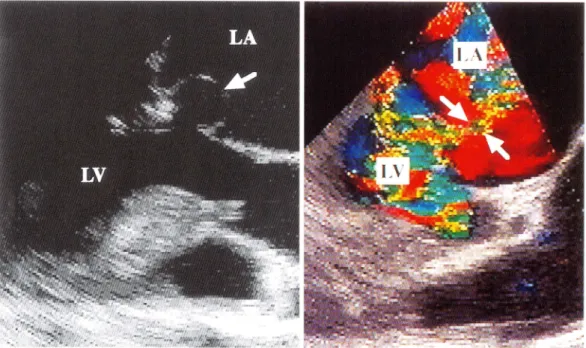
valve and a dome formation of the anterior leaflet of the mitral valve (Fig.
1).A transeso-
phageal echocardiogram showed a dome formation of the anterior leaflet of the mitral valve
(460) R. Mizuno et al.
Fig. l. Transthoracic echocardiogram.
Apical four-chamber view shows a dome for- mation of the anterior leaflet of the mitral valve (arrow).
Fig. 2. Transesophageal echocardiogram.
A: Long-axis view shows a dome formation of the anterior leaflet of the mitral valve (arrow). Perforation is suspected from the echo lucency on the top of the dome.
B : Calor Doppler imaging shows turbulent flow within the dome and a narrow regurgitant jet through the perforation (arrows).
Ruptured mitral valve aneurysm due to IE (461)
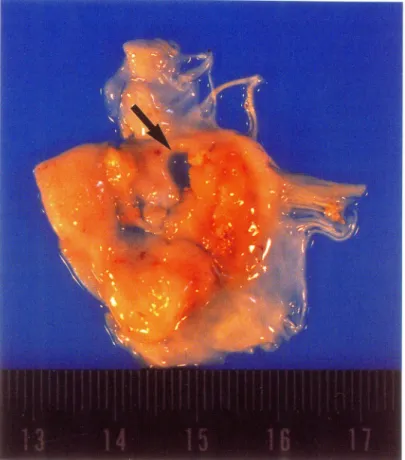
and an echo lucency 2. 5 cm in diameter on the top of the dome (Fig. 2) . Col or Doppler imaging showed an aortic regurgitant jet striking the ventricular surface of the anterior mitral leaflet and a narrow systolic flow from the left ventricle into t he left atrium through the echo lucent area of the anterior mitral valve leaflet (Fig. 2) . The patient had negative blood cultures ; however, this was expected since she had received antibiotics bofore blood sampling. High- dose intravenous penicillin was administered. Subsequently, mitral valve replacement was performed on the 27th hospital day. A specimen of the resected mitral valve confirmed a ruptured mitral valve aneurysm (20
X15 mm ) (Fig. 3) . Microscopic examination of the resected specimen revealed infiltration of inflammatory cells, mainly neutrophi ls, indicating the existence of a mitral valve bacterial infection. We there fore diagnosed this case as a ruptured mitral
1valve aneurysm due to infective endocarditis.
Fig. 3. Surgical specimen of the mitral valve.
A large valvular aneurysm (20 X 15mm) with perforation (arrow) is seen at the anterior leaflet of the mitral valve.
(462) R. Mizuno et al.
DISCUSSION
1 . Echocardiographic detection of infective endocarditis complicating mitral aneurysm In 1729, Morand described the first case of a mitral valve aneurysm
9l.Since then, several case reports have appeared sporadically
3 - 8l.The present case revealed the typical echocardiogra- phic (transthoracic and transesophageal) characteristics of patients with this type of lesion. As stated by Ecker in 1842, the valve, like other parts of the walls of the heart, can become the site of circumscribed pocket-shaped or saccular enlargements
9l.Judging from several previous reports and based on our case findings, aneurysmal enlargement of valves appears to occur almost exclusively in the mitral valve. Mitral valve aneurysms are most frequently associated with endocarditis, but rare cases of these aneurysms in patients without endocarditis, such as those with connective tissue diseases, have also been reported
10' 11l.In our case there was no confirmatory evidence for infective endocarditis (i.e. negative blood culture). However, the patient had received antibiotics before blood samples were obtained for microbiological analysis. On the other hand, a positive echocardiogram indicating the presence of a definitive vegetation and new mitral regurgitant jet confirmed our diagnosis in this patient. Finally, our case met the definitive Duke criteria for infective endocarditis
12l.In our case the mitral valve aneurysm was perforated by the time it was diagnosed, and this was the main mechanism of mitral regurgitation.
In the absence of surgery to correct valvular dysfunction, congestive heart failure due to valvular regurgitation is associated with very high mortality rates
13 ' 14l.With appropriately- timed surgery, this increased mortality can be largely avoided. Our patient was initially treated with high-dose intravenous penicillin, but congestive heart failure worsened. Hence, mitral valve replacement was performed. In previous cases of mitral valve aneurysm, transesophageal echocardiography was superior to transthoracic echocardiography in detecting and assessing aneurysms. Therefore, the routine use of transesophageal echocardiography may be necessary in patients with suspected endocarditis. In addition, Doppler echocardiography to rule out rupture of a mitra.l aneurysm should be performed in patients with infective endocarditis complicating aortic regurgitation.
2 _ Mechanism of formation and perforation of mitral valve aneurysm
Less frequently, mitral valve aneurysm is associated with aortic valve endocarditis. In this
case, we found echocardiographic evidence of aortic valve endocarditis (i.e. oscillating vegeta-
tion attached to the right coronary cusp of the aortic valve). Col or Doppler echocardiography
revealed an infected aortic regurgitant jet striking the ventricular surface of the anterior mitral
leaflet. Thus, this aortic regurgitant jet may produce a secondary infection focus on the
anterior mitral leaflet and result in the formation of an aneurysm of this leaflet. Moreover, this
aortic regurgitant jet may also contribute to rupture of the mitral aneurysm subsequently to its
formation. However, the precise mechanism of formation and perforation of mitral valve
aneurysms is obscure. Mitral valve aneurysms may often be confused with diverticulum of the
mitral valve, an extremely rare congenital abnormality. In this condition, the characteristic
echocardiographic picture is an aneurysmal sac that bulges into the left ventricular outflow
tract
15l.Ruptured mitral valve aneurysm due to IE (463)
In conclusion, the treatment of mitral valve aneurysms has not been defined. Several previous cases have shown that conservative management is possible16l. Therefore, echocardio- graphic detection of mitral valve aneurysms is not, by itself, an immediate surgical indication.
However, when they are associated with heart failure, surgery is mandatory and valve replace- ment or valve repair should be undertaken.
REFERENCES
1) Karalis, D. G., Bansal, R. C., Hauck, A. J., Ross, J. R Jr., Applegate, P. M., Jutzy, K. R., Mintz, G. S.
and Chandrasekaran, K. : Transesophageal echocardiographic recognition of subaortic complications in aortic valve endocarditis. Circulation 86: 353-362, 1992.
2) Reid, C. L., Chandraratna, A. N., Harrison, E., Kawanishi, D. T., Chandrasoma, P., Nimalasuriya, A.
and Rahimtoola, S. H. : Mitral valve aneurysm: Clinical features, echocardiographic-pathologic correla- tions.
J.
Am. Coil. Cardiol. 2 : 460-464, 1983.3) Mollod, M., Felner, K. J. and Felner, J. M.: Mitral and tricuspid valve aneurysm evaluated by transeso- phageal echocardiography. Am.
l
Cardiol. 79: 1269-1272, 1997.4) Vilacosta, I., Peral, V., San Roman, J. A., BatHe, E., Tello, R., Rodriguez, P. and Castillo, J. A.: Mitral naive aneurysm. Circulation 95 : 2169, 1997.
5) Harpaz, D., Shah, P., Hicks, G. and Meltzer, R.: Transesophageal echocardiographic recognition of an unusual complication of aortic valve endocarditis.
l
Am. Soc. Echocardiogr. 7: 72-78, 1994.6) Decroly, P., Vandenbossche, J. L. and Englert, M.: Anterior mitral valve aneurysm perforation secon·
dary to aortic valve endocarditis detected by Doppler colour flow mapping. Eur. Heart
J.
10: 186-189, 1989.7) Lindner, J. R., Case, R. A., Dent, J. M., Abbott, R. D., Scheld, W. M. and Kaul, S.: Diagnostic value of echocardiography in suspected endocarditis. An evaluation based on the pretest probability of disease.
Circulation 93: 730-736, 1996.
8) Matsumura, N., Fujimoto, S., Nakano, H., Mizuno, R., Negoro, K., Yamamoto, Y., Yabuta, M., N onaka, H. and Do hi, K. : A case of ruptured mitral valve aneurysm complicating long-standing aortic regurgitation. Echocardiography 15: 401-403, 1998.
9) Jarcho, S.: Aneurysm of heart valves. Am.
l
Cardiol. 22: 273-276, 1968.10) Ednak, G. M. and Rawson, A. J.: Ruptured aneurysm of the mitral valve in a Marfan-Iike syndrome. Am.
J.
Cardiol. 11 : 67 4-677, 1963.11) Lebwohl, M. G., Distefano, D., Prioleau, P. G., Uram, M., Yannuzzi, L. A. and Fleischmaier, R.:
Pseudoxanthoma elasticum and mitral valve prolapse. N. Engl.
J.
Med. 307: 228-231, 1982.12) Durack, D. T., Lukes, A. S., Bright, D. K. and Duke: Endocarditis Service. New criteria for diagnosis of infective endocarditis: utilization of specific echocardiographic findings. Am.
J.
Med. 96 : 200-209, 1994.13) Croft, C. H., Woodward. and Elliott, A. : Analysis of surgical versus medical therapy in active compli · cated native valve infective endocarditis. Am.
J.
Cardiol. 51 : 1650-1662, 1983.14) Mansur, A. J., Grinberg, M., Lemon da Luz, P. and Bellotti, G.: The complications of infective endocar- ditis: A reappraisal in the 1980's. Arch. Intern. Med. 152: 2428-2438, 1992.
15) Maier, J. H., Seward, J. B., Miller, F. A., Oh, J. K. and Enriquez-Sarano, M.: Aneurysms in the left ventricular outflow tract: clinical presentation, causes, and echocardiographic features.
J.
Am. Soc.Echocardiogr. 11: 729-745, 1998.
16) Gin, K. G., Boone, J. A., Thompson, C. R. and Bilbey, J. H.: Conservative management of mitral valve aneurysm.