Effect of temperature on achene germination in five Mutisieae understory herbaceous species(
Asteraceae)
著者 Kawarasaki Satoko, Abe Yoshiko, Hori Yoshimichi
journal or
publication title
植物地理・分類研究 = The journal of phytogeography and toxonomy
volume 52
number 2
page range 159‑166
year 2004‑12‑30
URL http://hdl.handle.net/2297/48795
Introduction
Germination success is an important factor de- termining the fitness of plants, especially in plants that regenerate only by seeds. Pertya ro- busta(Maxim.)Beauverd, P.triloba(Makino)
Makino,P.rigidula(Miq.)Makino,Ainsliaea ac- erifoliavar.subapoda Nakai(hereafter,A.aceri- folia)and A. apiculata Sch.Bip. are understory perennial herb species belonging to the tribe Mutisieae(Asteraceae)and regenerate only by achenes. These five species have specific distri- bution areas(see Fig. 1). As plant physiological responses are thought to be closely correlated with climatic conditions of habitats, we therefore expect temperature effects on germination traits and the existence of intra-and interspecific vari-
ation in germination traits among these species.
The achenes of the five species are relatively large weighting 7―13 mg, except forA.apiculata
(1 mg). In general, understory plants produce larger seeds than plants growing in open habi- tats(Salisbury 1975 ; Luftensteiner 1979 ; Fos- ter and Janson 1985 ; Mazer 1989). Plants with large seeds have large seedlings and can tolerate shaded environments(Salisbury 1975 ; Moles and Westoby 2004), or they may possess the ability to germinate below the litter(Leishman and Westoby 1994). On the other hand, plant mortality is higher in the seedling stage than in other life stages(Harper 1977 ; Solbrig 1980). Mortality may also be high during seed germina- tion because many physiological processes occur
1Laboratory of Ecology, Faculty of Science, Ibaraki University, Bunkyo 1―1―1, Mito, Ibaraki 310―8512, Japan ;
2Department of Forest Vegetation, Forestry and Forest Products Research Institute, Matsunosato 1, Tsukuba, Ibaraki 305―8687, Japan ; 3Present address : Faculty of Engineering, Seikei University, 3―1 Kichijoji-kitamachi 3-chome, Musashino, Tokyo 180―8633, Japan
!The Society for the Study of Phytogeography and Taxonomy 2004
Satoko Kawarasaki
1,2,3, Yoshiko Abe
1and Yoshimichi Hori
1: Effect of temperature on achene germination in five Mutisieae understory herbaceous species(Asteraceae)
Abstract
We measured the final germination rates of achenes, the number of days needed to accomplish 50% of the final germination(T50), and mortalities under various temperatures in the range 5 to 25℃for five understory peren- nial herbs(four species with large achenes of ca. 10 mg weight : Pertya robusta,P.triloba,P.rigidulaandAin- sliaea acerifoliavar.subapoda, and one species with small achenes(1 mg):A.apiculata)to investigate variation of these traits. Achenes were collected in Ogawa and Mito in Ibaraki Prefecture, and in Iwakuni in Fukui Prefec- ture. T50ranged from 35 to 76 days at 5℃and became shorter with increasing temperature. The final germina- tion rates of most samples were over 95%.Ainsliaea acerifoliahad the longest T50(76 days)and the lowest final germination rate(86.1%)at 5℃, showing a dormant ability to some extent. Moreover,A.apiculata possessing small achenes showed a lower final germination rate(83%)at 25℃, and dormancy at higher temperatures. Fun- gal attack was thought to cause the death of achenes during the germination period, and mortalities increased with increasing temperature. However, there were no significant differences in final germination rates and T50s between two populations ofP.robustafrom Ogawa and Mito, though the Ogawa population had a higher mor- tality than the Mito population(27% vs. 18% at 25℃). Mortalities were higher inP.trilobaandP.rigidulathan in the other species. There were intra- and interspecific variations of temperature dependency of achene mortal- ity during germination, and these variations may be one of the factors limiting the distribution of each species.
Key words: achene germination response to temperature, final germination rate, mortality, T50, understory herbaceous species.
159
in seed germination, and plants may be sensitive to external factors during the transition from seeds to seedlings. Although large seeds are con- sidered advantageous for survival because of their larger resource under shaded conditions, some seeds do die during germination. What fac- tors cause the death of large achenes and how many seeds die in actual populations of the five Mutisieae species? Are there temperature de- pendencies for factors contributing to the death
of achenes, and is there intra- and interspecific variation of achene mortality?
A theoretical study proposed that large seeds tend to lack an ability to lie dormant because seedlings of large-seeded plants have a larger re- source and can establish themselves in relatively unfavorable environments, such as shaded condi- tions(Rees 1994). On the other hand, non- dormant seeds during germination would be un- der strong selective pressure by unexpected events such as a sudden coldness, a late frost, a severe drought and so on, since they cannot avoid unexpected unfavorable conditions through the utilization of a dormant period. Therefore, germination traits of non-dormant seeds may be coupled with the climatic conditions of their habitats. We wanted to determine whether these five species have a dormant ability and, espe- cially, whether the germination traits ofA.api- culata were different to those of the other spe- cies sinceA.apiculatahas conspicuously smaller achenes than members of the other species.
Moreover, if dormancy is detected, does the dor- mant ability depend on temperature and are there intra- and interspecific differences in dor- mancy?
We examined temperature effects on germina- tion responses, including final germination rates, the number of days needed for 50% of the final germination rates(T50), mortalities, and whether there exist variations in germination responses among the five species and among intraspecific regional populations.
Materials and methods
The five Mutisieae species are understory per- ennial herbs that reproduce only by achenes.
They flower in the autumn and then disperse their achenes. Achenes commence germination in the next spring. All of the species, with the exception of A. apiculata, are summergreen herbs and have chasmogamous flowers. Ainsli- aea apiculata is an evergreen herb and bears cleistogamous flowers. The distribution ranges of these species are shown in Fig. 1. In the autumn of 1995, we collected achenes before dispersal at three sites. Achenes of P. robusta, P. triloba andA.acerifoliawere collected from Ogawa For- est Reserve, Ibaraki, where their distributions Fig. 1. Distribution areas of Pertya and Ainsliaea
species. A : P.robusta,P.trilobaandP.rigidula modified from Suzuki(1975). Stars in the figure represent achene collection sites. B : A. acerifolia var.subapoda andA. apiculata. These rough dis- tribution areas are based on islands and/or admin- istrative regions from descriptions by Ohwi(1965)
and Tseng(1996).
植物地理・分類研究 第52巻第2号 2004年12月
160
are sympatric(Kawarasaki and Hori 2001). Ach- enes of P. robusta and A. apiculata were col- lected from Mito, Ibaraki, where their distribu- tions are sympatric. Achenes ofP.rigidula were collected from Iwakuni National Forest, Fukui.
The achenes of each species were collected from more than one-hundred individuals. Their locali- ties, elevation, environmental characteristics and achene weights are shown in Table 1. The ach- enes were air-dried at room temperature for ca.
one month and then kept at almost the same air temperature as that of the outdoors, in Ibaraki University in Mito, Ibaraki.
Fifty achenes from each species/population were placed in a petri dish(φ8.5 cm)with soil that had been sieved through a 5 mm mesh on May 8, 1996. To mimic the natural habitat of achenes during germination, we put the petri dishes into soil. The soil was derived from the achene collection sites, except for P. rigidula, whose soil was from Mito. Pappuses were re- moved from achenes just before the experiment.
Achenes were incubated at five constant tem- peratures(5, 10, 15, 20 and 25℃)using a regime
of 12-h light and 12-h dark with four replica- tions in temperature-gradient growth chambers
(TG-200-ADCT, Nippon Medical & Chemical In- strument, Osaka). In order to keep achenes from drying, we put distilled water into the 20 and 25℃petri dishes almost daily, and almost every three days for the other petri dishes. We re- corded the number of germinated and dead ach- enes everyday, and removed those that had either germinated or died. Germination was de- fined as protrusion of a radicle, and the death of an achene was confirmed from its softness when pinched with a pair of tweezers. The duration of the experiment was 120 days, except for A. ac- erifolia achenes incubated at 5℃, for which 150 days were needed.
Final germination rates, mortalities and T50
(the number of days to reach 50% germination of the final germination)estimates for each dish were calculated. Final germination rates are the number of germinated achenes per number of all live achenes during the incubation time. The fol- lowing logistic equation is a good representation of the relationship between the cumulative per- Acene collection site
(Location ; altitude) Forest type
Air temperature(℃)
Rainfall
(mm)
Collected achenes
Achene mass annual (mg)
mean Max. Min.
Ogawa Forest Reserve, Kitaibaraki city, Ibaraki Pref.
(36°55′N,140°35′E ; 650 m)
Cool temperate broad- leaved deciduous forest, dominated byFagus crenata,F. japonica, Quercus mongolica, Q. serrataand so on
10.7 15.9 5.8 1,910*1 P. robusta 12.50±4.15
9.4 13.4 6.3 1,615*2 P. triloba 9.73±3.68
A. acerifolia var.subapoda
6.71±3.32
Tano, Mito city, Ibaraki Pref.*3
(36°25′N, 140°24′E ; 70 m)
Temperate deciduous broad-leaved secondary forest dominated by Q.serrata,Castanea dentataandCarpinus laxiflora
13.6 18.2 9.4 1,409 P. robusta 13.40±3.89
A. apiculata 1.12±0.24
Iwatani National Forest, Imajo town, Fukui Pref.*4
(35°41′N,136°20′E ; 550 m)
Cool temperate broad- leaved deciduous forest, dominated byF.crenata, Q.mongolicaandAcer species
10.6 15.5 6.4 2,502 P. rigidula 7.43±2.80 Table 1. Localities and environmental conditions of achene collection sites and wind-dried achene masses(mean
±SE, n=50)ofPertyaandAinsliaeaspecies
*1Mean value for 10 years from 1986 to 1995(Mizoguchi et al. 2002).*2Values for 1996(Forestry and Forest Products Research Institute 2003. “Forest Dynamics Database. http : //fddb.ffpri-108.affrc.go.jp/”. Viewed August 17, 2004).*3Mean values for 10 years from 1987 to 1996 of the nearest meteorological stations(Mito).*4Mean values for 10 years from 1987 to 1996 of the nearest meteorological station(Imajo at 160 m a.s.l.). Temperatures in Iwatani were estimated from mean values minus altitudinal lapse rate of temperature with 0.55 K per 100 m of altitude.
161
centage to the final germination rate and time of incubation(Thornley 1986):
P = 100 /[1 + A exp(−RT)],
where P is the relative percentage to the final germination rate, A and R are fitted parameters, and T is the incubation time(expressed in days). From the fitted equations, T50 can be calculated as follows :
T50=(ln A)/R .
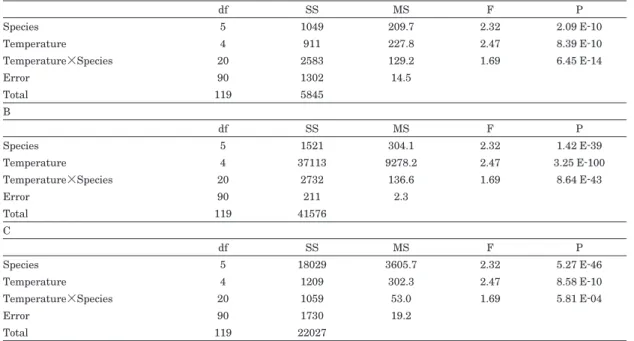
The effects of temperature and species on final germination rates, T50s and mortalities were ex- amined using two-way analysis of variance
(ANOVA)and a post-hoc test by the least squares method. The final germination rates and mortalities were arcsine transformed for these tests.
Results
Final germination rates of most treatments were over 95%(Fig. 2 A). Temperature had a significant effect on germination rate(Table 2 A). Final germination rates at 5℃were significantly lower than those at other temperatures(p<0.01 ; least squares test). The final germination of A.
apiculata showed significant differences from that of the other species(p<0.05 ; least squares test), and unlike the other species, A.apiculata had a low germination rate at a lower tempera- ture(83.0% at 25℃). There was no intraspecific variation of final germination between the two populations ofP.robusta.
Temperature also had a significant effect on T50(Table 2 B). T50decreased exponentially with increased temperature(Fig. 2 B)and there were significant differences between all temperature combinations, except for temperatures between 20℃and 25℃(p<0.05 ; least squares test). In all populations, T50s at 20℃and 25℃were shorter than 12 days, and T50 at 5℃was 35―76 days. The longest T50was observed inA.acerifo- lia at 5℃(76 days), and there were significant differences betweenA.acerifolia andP.robusta collected in Ogawa(p<0.05 ; least squares test), A. acerifolia and P. triloba(p<0.01 ; least squares test), and A.acerifolia and P.rigidula
(p<0.05 ; least squares test). The T50ofA.api- culata showed significant differences from that of the other species(p<0.05 ; least squares test), and A. apiculata had the smallest T50 at lower
temperatures(34.8 days at 5℃).Pertya robusta did not display intraspecific variation in T50 be- tween the two sampled populations.
Temperature had a significant effect on T50
(Table 2 C). The mortality of achenes tended to increase with increasing temperature(Fig. 2 C), and there were significant differences between T50 estimates at 25℃and other temperatures, between those at 20℃and 10℃and those at 20℃ and 5℃(p<0.05 ; least squares test). Pertya triloba andP.rigidula showed relatively high mortalities(20―40%)in all temperature re- Fig. 2. Relationships between final germination rate of achenes and temperature(A), between T50(the number of days required to reach 50% of final ger- mination rate)and temperature(B)and achene mortality and temperature(C)forPertya robusta from Ogawa(closed circle),P.robusta from Mito
(open circle), P. triloba from Ogawa(closed square),P.rigidulafrom Iwakuni(upper open and lower closed square),Ainsliaea acerifoliavar.sub- apodafrom Ogawa(closed triangle)andA.apicu- lata from Mito(open, inversion triangle). Bars show SE.
植物地理・分類研究 第52巻第2号 2004年12月
162
gimes, and there were significant differences in mortality between P.triloba and the other spe- cies and betweenP.rigidula and the other spe- cies(p<0.01 ; least squares test). The two spe- cies in the genusAinsliaeashowed relatively low mortalities(<10%)throughout the experiment.
The mortality was significantly different be- tween the Mito and Ogawa populations ofP.ro- busta(p<0.01 ; least squares test), and between the twoAinsliaeaspecies(p<0.01 ; least squares test).
Discussion
Conspicuous dormant ability was observed both in large-achened A. acerifolia at 5℃and small-achened A. apiculata at higher tempera- tures.Ainsliaea acerifolia had a lower final ger- mination rate and a longer T50 at 5℃than the sympatric species P. robusta and P. triloba in Ogawa. No difference was observed in final ger- mination rates or T50s between the two Pertya species. In a study ofPlantago asiatica from sev- eral sites over the Japanese archipelago, popula- tions from higher latitudes or higher altitudes had a narrower range of temperature for germi-
nation and tended to be dormant at lower tem- peratures(Sawada et al. 1994). The authors sug- gested that seedlings of these populations have adapted to survive the low temperatures that frequently occur in the early growing season at these locations. On the other hand, on Mt. Fuji, seeds of Reynoutria japonica from higher eleva- tions had higher final germination rates and higher germination speeds(being the reciprocal of T50)at lower temperatures than seeds from lower elevations(Mariko et al. 1993). The authors concluded that the greater germination ability of upland plants at low temperature com- pensates for the shortened growing season at up- land locations. The interspecific variation of ger- mination traits among A. acerifolia,P. robusta and P. triloba from Ogawa may be due to the same factors controlling germination traits in Plantago asiatica. The distribution of A.acerifo- liaextends far north to China(Fig. 1 B). The cli- mate at the center of the distribution ofA.aceri- folia is expected to be cooler than that associ- ated with P. robusta and P. triloba. Ainsliaea acerifoliashows dormancy to some extent at 5℃, and this appears to be an adaptation to low tem- A
df SS MS F P
Species 5 1049 209.7 2.32 2.09 E-10
Temperature 4 911 227.8 2.47 8.39 E-10
Temperature×Species 20 2583 129.2 1.69 6.45 E-14
Error 90 1302 14.5
Total 119 5845
B
df SS MS F P
Species 5 1521 304.1 2.32 1.42 E-39
Temperature 4 37113 9278.2 2.47 3.25 E-100
Temperature×Species 20 2732 136.6 1.69 8.64 E-43
Error 90 211 2.3
Total 119 41576
C
df SS MS F P
Species 5 18029 3605.7 2.32 5.27 E-46
Temperature 4 1209 302.3 2.47 8.58 E-10
Temperature×Species 20 1059 53.0 1.69 5.81 E-04
Error 90 1730 19.2
Total 119 22027
Table 2. Two-way ANOVA of the effects of species and temperature on germination traits, including(A)final ger- mination rate,(B)T50and(C)mortality with species
df : degree of freedom. SS : sum of squares of deviations. MS : mean of SS. F : F statistic. P : probability.
163
perature as a means of avoiding damage to seed- lings by unexpected coldness or late frost in the early growing season. Furthermore, leaf expan- sion was earlier and optimal temperature for photosynthesis lower inA.acerifolia than in the other two sympatric species(Kawarasaki and Hori in preparation). These facts may also sug- gest thatA.acerifolia has better adapted to low temperature than the other two species.
The achenes ofA.apiculata are much smaller than those of the other species, and they become dormant at high temperatures. The possession of small achenes in this species contradicts the no- tion that plants inhabiting unfavorable environ- ments, such as shaded environments like under- story, have large seeds with a larger reserve in order to tolerate poor growth conditions(Venable and Brown 1988 ; Rees 1994).Ainsliaea apicu- lata is normally considered an understory plant.
Although it bears only 2―4 leaves within one year after germination on the forest floor, it ex- pands many leaves successively and develops an elongated flower stem within three months in the laboratory under high light conditions. As a consequence, Hori and Kawarasaki(1996)consid- ered it a “pseudo-understory” plant. This species is also unlike typical understory plants in view of its smaller achene size, dormancy at higher temperature and leaf phenology. Dormancy at higher temperature, which is found in many summer annual plants, is considered an adapta- tion to avoid hot and/or dry conditions during summer(Baskin and Baskin 1988). Small- achened A. apiculata differs from the large- achened species in germination traits. Further study is needed to clarify how A.apiculata ac- quired small-shaped achenes and an ability to become dormant at higher temperatures.
Pertya triloba and P. rigidula showed slight dormancy at 5℃. On the other hand, geographi- cal variation was not observed in final germina- tion rates or T50s between the two populations of P. robusta, even though the average air tem- perature in Mito is ca. 3℃warmer than it is in Ogawa(Table 1). A larger difference in tempera- ture may be needed to generate sufficient selec- tive pressure essential for the development of in- traspecific variation in final germination rate and T50.
Achene mortalities depended on temperature throughout the experiment, and dead achenes were always covered by fungal hyphae, suggest- ing that the main cause of achene death is pathogenic fungi. The seeds had a structural in- jury caused by fungi(Tillman-Sutela et al. 2004), and the fungi were responsible for the death of the seeds(O’Hanlon-Manners and Kotanen 2004). There were interspecific variations in mortality. Furthermore, our study also revealed the existence of intraspecific variation of mortal- ity of P. robusta achenes : the Ogawa popula- tion had a higher mortality than the Mito popu- lation(Fig. 2 C). Two causes of intraspecific vari- ation in mortality may be considered. First, there are variations in resistant ability of ach- enes to fungal injury between the two popula- tions. Second, soil from Ogawa contained more and/or stronger fungi. Through one way or an- other, achene mortality would be one of factors that limit the distribution areas of the species.
In spite of the possession of large seeds, P. tri- loba and P.rigidula showed higher mortalities.
In contrast, small-achened A. apiculata unex- pectedly had a low mortality. These mortalities would strongly affect the distribution areas of each species.
Acknowledgements
We thank Mr. Hiroshi Matsushita for collect- ing achenes of P. rigidula around Iwatani Na- tional Forest, Drs. Osamu Kitade, Masae Shi- yomi, Yasuo Yamamura and Tsuyoshi Kobayashi for valuable advice, and Ms. Kayo Ito for assist- ing in the preparation of the experiment. We also thank the members of Department of Vege- tation, Forestry and Forest Products Research Institute for encouragement throughout this study.
References
Baskin, C. C. and Baskin, J. M. 1988. Germina- tion ecophysiology of herbaceous plant species in a temperate region. Am. J. Bot.75 : 286―
305.
Foster, S. A. and Janson, C. H. 1985. The rela- tionship between seed size and establishment conditions in tropical woody plants. Ecology66 : 773―780.
植物地理・分類研究 第52巻第2号 2004年12月
164
Harper, J. L. 1977. Population biology of plants.
892 pp. Academic Press, London.
Hori, Y. and Kawarasaki, S. 1996. The ecology of Asteraceae plants growing in a forest floor.
Shuseibutsu-kenkyu(20):51―56.(in Japa- nese)
Kawarasaki, S. and Hori, Y. 2001. Flowering phenology of understory herbaceous species in a cool temperate deciduous forest at Ogawa Forest Reserve, central Japan. J. Plant Res.
114 : 19―23.
Leishman, M. R. and Westoby, M. 1994. The role of large seed size in shaded conditions : ex- perimental evidence. Funct. Ecol.8 : 205―214.
Luftensteiner, H. W. 1979. The eco-sociological value of dispersal spectra of two plant commu- nities. Vegetatio41 : 61―67.
Mariko, S., Koizumi, H., Suzuki, J. and Fu- rukawa, A. 1993. Altitudinal variations in ger- mination and growth responses of Reynoutria japonica populations on Mt. Fuji to a con- trolled thermal environment. Ecol. Res.8 : 27
―34.
Mazer, S. J. 1989. Ecological, taxonomic and life history correlates of seed mass among Indiana dune angiosperms. Ecol. Monogr. 59 : 153―
175.
Mizoguchi, Y., Morisawa, T. and Ohtani, Y. 2002.
Climate in Ogawa Forest Reserve. Nakashi- zuka, T. and Matsumoto, Y.(eds.). Diversity and interaction in a temperate forest commu- nity, Ogawa Forest Reserve of Japan, pp. 11―
18. Springer-Verlag, Tokyo.
Moles, A. T. and Westoby, M. 2004. Seedling survival and seed size : a synthesis of the lit- erature. J. Ecol.92 : 372―383.
O’Hanlon-Manners, D. L. and Kotanen, P. M.
2004. Logs as refuges from fungal pathogens for seeds of eastern hemlock(Tsuga canaden- sis). Ecology85 : 284―289.
Ohwi, J. 1965. Flora of Japan. Revised edition.
pp. 1306―1307. Shibundo, Tokyo.(in Japanese)
Rees, M. 1994. Delayed germination of seeds : a look at the effects of adult longevity, the tim- ing of reproduction, and population age/stage structure. Am. Nat.144 : 43―63.
Salisbury, E. J. 1975. Seed size and mass in re- lation to environment. Proc. R. Soc. London B 186 : 83―88.
Sawada, S., Nakajima, Y., Tsukuda, M., Sasaki, K., Hazama, Y., Futatsuya, M. and Watanabe, A. 1994. Ecotypic differentiation of dry matter production processes in relation to survivor- ship and reproductive potential in Plantago asiatica populations along climatic gradients.
Funct. Ecol.8 : 400―409.
Solbrig, O. T. 1980. Demography and natural se- lection. Solbrig. O. T.(ed.). Demography and evolution in plant populations, pp. 1―20.
Blackwell, Oxford.
Suzuki, M. 1975. Biosystematic study on the ge- nus Macroclinidium(Compositae-Mutisieae). Biological Science(Tokyo)27 : 180―188.(in Japanese)
Thornley, J. H. M. 1986. A germination model : responses to time and temperature. J. Theor.
Biol.123 : 481―492.
Tillman-Sutela, E., Kauppi, A., Hilli, A. and Kaitera, J. 2004. Fungal injury to seed tissues of Norway spruce,Picea abies(L.)Karst. Trees 18 : 151―156.
Tseng, Y.-C. 1996. Compositae(9)Mutisieae.
Tseng, Y.-C.(ed.). Flora Reipublicae Popularis Sinicae. Tom. 79, pp. 57―59. Science Press, Beijing.(in Chinese)
Venable, D. L. and Brown, J. S. 1988. The selec- tive interactions of dispersal dormancy, and seed size as adaptations for reducing risk in variable environments. Am. Nat. 131 : 360―
384.
(Received June 21, 2004 ; accepted November 22, 2004)
河原崎里子1,2,3・安部良子1・堀 良通1:キク科コウ ヤボウキ連林床草本 5 種の痩果の温度勾配に対す る発芽反応
大きな痩果(約10 mg)をつける林床多年生草 本5種(カシワバハグマ,オヤリハグマ,クルマ バハグマ,オクモミジハグマ,キッコウハグマ)の 痩果を茨城県北茨城市小川と水戸市田野,福井県南 条郡今庄町岩国の3カ所から6サンプルを採取し,
5―25℃の温度勾配に対する最終発芽率・発芽速度・
発芽時の死亡率を調べた。温度が高いほど発芽速度 は大きく,ほとんどの処理で95%以上の最終発芽 率を示し休眠は観察されなかったが,オクモミジハ
グマは5℃ で発芽速度が著しく遅く,さらに最終
発芽率が低く(86.1%),低温で弱い休眠性を示し た。また,小さな痩果(1 mg)をつけるキッコウ 165
ハグマは,その発芽速度が他種より高く,25℃ で 17%が休眠を示し,発芽特性において他種と異な った挙動を示した。発芽時の死亡は痩果へのカビの 繁茂によるもので,温度が高いほど死亡率が大きく なった。小川と田野のカシワバハグマの痩果は最終 発芽率と発芽速度に有意な差はなかったが,死亡率 は小川の方が高かった。また,痩果の死亡率はオヤ リハグマとクルマバハグマで高かった(20%以上)。
発芽時の温度依存性のある死亡は種内変異があると ともに,種間の相違もあり各種の分布域を制限する 要因になるかもしれない。
(1〒310―8512 茨城 県 水 戸 市 文 京1―1―1 茨 城 大 学理学部生態学研究室;2〒305―8687 茨城県つく ば 市 松 の 里1 森 林 総 合 研 究 所 森 林 植 生 研 究 領 域;3現住所 〒160―8633 東京都武蔵野市吉祥寺
北町3―3―1 成蹊大学工学部応用化学科)
植物地理・分類研究 第52巻第2号 2004年12月
166