Effects of Incremental Doses of Chloroquine
Phosphate on the Formed Elements of Blood.
Timothy OTHMAN1•õ and R. O. A. AROWOLO2
1*Department of Environmental Physiology, Institute of Tropical Medicine, Nagasaki University, 1 -12-4 Sakamoto 852, Japan 2Department of Veterinary Physiology and Pharmacology, Faculty
of Veterinary Medicine, University of Ibadan, Oyo State, Nigeria
Abstract: Easy access to chloroquine (CQ) in many developing countries can result to in- take of inappropriate doses. This study was therefore conducted to evaluate the acute ef- fects of high doses of CQ on hematological parameters and plasma Na+and K+ concen- trations. To do this, Swiss albino rats were administered incremental doses of CQ in- traperitoneally at dose rates ranging between 0.5 to 8mg/kg b.wt. Two hours later, blood samples were taken and analysed. 8mg/kg b.wt of CQ induced significant decrease in red blood cells (RBC), hemoglobin (Hb) and significant increase in mean corpuscular volume (MCV). There was a significant increase in white blood cell count at all dose levels. Packed cell volume (PCV), mean corpuscular hemoglobin (MCH) and mean corpuscular hemoglobin concentration (MCHC) were not affected by all dose ranges. There was significant increase in plasma Na+ and K+ by dose rates of 4 and 8 mg/kg but not by lower doses. These data indicate that most CQ induced toxicities on the formed elements of blood occurs at doses greater than 4 times the standard therapeutic dose in rats.
key words: chloroquine, toxicity, blood, rats
INTRODUCTION
Malaria infection can be characterised by leucopoenia, lymphopaenia and thrombopaenia (Nicolas et al, 1997) as well as the digestion of host erythrocytes' hemoglobin by parasites (Sherman, 1979, Slater, 1992, and Roth, 1989). Chloroquine is one of the most widely used drugs for the treatment of malaria (Yayon et al, 1984, Ndyomugyenyi and Magnussen 1997).
However, several toxic effects of CQ have been reported including neutrophilic toxicity (Naisbitt, et al, 1997), myo and neurotoxicities (Estes, et al, 1987, Ochsendorf & Runne 1991) and retinopathy (Ochsendorf & Runne 1991). Data regarding CQ toxicty on blood cells which
Received for publication, April 20, 1998
This work was conducted at the Faculty of Basic Medical Sciences, University of Ibadan, Oyo State, Nigeria.
''Author for correspondence
*Visiting foreign researcher to the deparment.
habours the plasmodium parasites are scanty. The need to evaluate the possibility of toxicity of CQ on parasite-free cells is therefore vital. This will establish whether in addition to parasitic effects, CQ induces deleterious effects of its own. Pharmacokinetically, CQ is rapidly absorbed following parenteral injections, and widely distributed in body tissues (Aderomu et al, 1986, Krishna and White 1996) and so toxicity can be rapid. High concentrations are obtained in red blood cells (Salako & Adeluis 1983). Uncontrolled use of CQ which occurs in developing countries (Odoi et al, 1995, Ndyomugyenyi & Magnussen, 1997) can be a source of great danger (Ochsendorf & Runne 1991). This study was therefore conducted to examine the hematological and plasma Na+ and K+ alterations following acute in vivo exposure of adult rats to incremental doses of CQ. This is in regard to the fact that the study of drug effects on cellular constituents of blood has not been a standard part of routine investigations performed in screeing of drugs for potential toxic effects (Hinderling, 1997).
MATERIALS AND METHODS
A nimals
Thirty five Swiss Albino rats of mixed sex, mean body weight 170±12g and aged 6 months were used in this study. They were purchased from the Department of Veterinary Physiology and Pharmacology, University of Ibadan. They were housed in cages in a insect- proof house and provided with commercially prepared rat diet (21% protein, 3.5% fat, 6%
fibre, 0.8% calcium, and 0.8% phosphorus, Ladokun Feeds Nig. Ltd, Ibadan). Animals were randomly allocated to five experimental groups (1 , 1, H, N and V) of 5 rats each while group ¥ (n=10 served as control). Care was taken to ensure that all animals were treated in conformity with the standard animal ethics and experimentation guidelines.
Drug preparation and administration
Chloroquine phosphate was obtained in 5ml ampoules from KRKA, Novo Mesto Yu- goslavia. Each ml of injectable solution contained 64.5mg chloroquine phosphate (equivalent to 40mg chloroquine base). The required dose was further diluted with physiological saline and volume made up to 1ml followed by intraperitoneal injection. Rats in groups I , H, HI,
F and V recieved an incremental dose of 0.5, 1, 2, 4 and 8mg/kg of the CQ base by in- traperitoneal injection. The dose administered to group IE was calculated from the dose given to group I (0.5mg/kg) by arithmetically multiplying it by 2. Successive doses were calculated in similar manner by multiplying the dose administered to the preceding group by 2. Group
ML received equal volume of physiological saline. Rats were returned to their cages.
Blood collection and analyses
Twohours post injection, each rat recieved an intraperitoneal injection of pentobarbital (Nembutal, 50mg/kg, Abbot laboratories, USA) to induce anaesthesia in order to minise pain during the experimental procedure. After rats have been be fully anesthetised, blood sample was collected by cardiac puncture. The collected blood was immediately transferred into
a sample bottle prepared with ethylene diamine tetracetic acid (EDTA). Determination of haematological parameters was carried out within 1 hour of blood collection. For electrolyte analysis, plasma was separated by centrifugation. Fresh plasma was then transferred into polypropylene tubes and frozen at-70°C untill analysed. Packed cell volume (PCV) hae- moglobin (Hb), white blood cells (WBC) and red blood cells (RBC) were determined using standard mathods. Erythrocyte indices were estimated as proposed by Ganong (1995). Serum Na+ and K+ were determined by flame photometry (Gallenkamp, London).
Statistical analysis
Data are expressed as mean values ± SEM. Statistical inhomogeneity between ex- perimental and controlled measurements were analysed by ANOVA using the statistical package StatView 4.5 (Stat View, Abacus Corp, USA 1992-1994).
RESULTS
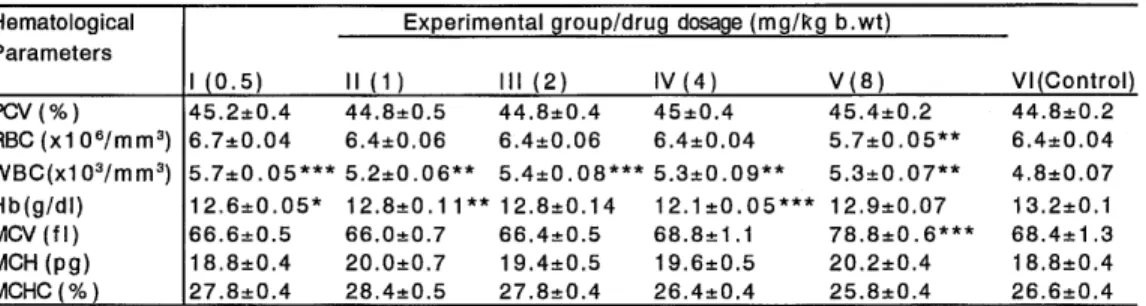
The data indicate that 8mg/kg CQ produced significant decrease in RBC, Hb, and in- crease in mean corpuscular volume (MCV) over the control values. All doses ranging between
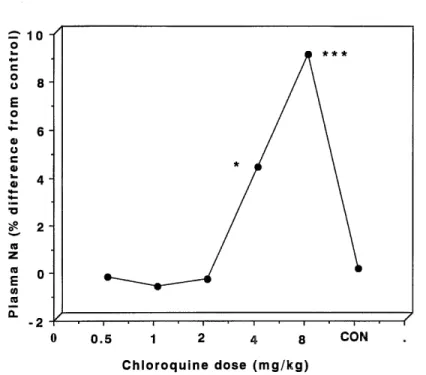
0.5 and 8mg/kg produced significant increase in WBC counts over the control values. Packed cell volume (PCV), mean corpuscular hemoglobin (MCH) and mean corpuscular hemoglobin concentration (MCHC) were not affected by all dose ranges (Table 1). There was significant increase in plasma Na+ with drug doses at 4mg/kg and 1.28mg/kg. Doses between 0.5 to 2mg/kg did not induce any significant change in plasma Na+ concentration (Fig. 1). Plasma K+ was significantly increased by drug doses of ranging between 2 to 8mg/kg but not by doses ranging between 0.5 to Img/kg (Fig. 2). Death was recorded in one rat receiving
8mg/kg.
Hematological Parameters
Experimental arouo/drua dosaae (ma/ka b.wt)
I(0.5) II(1 Ill(2) IV(41 vm Vl(Control)
PCV(%) RBC(x1 06/mm3) WBC(x1 03/mm3) Hb(g/dl) MCV(fl) MCH (pg) MCHC (%)
45.2±0.4 6.7±0.04 5.7±0.05***
12.6±0.05*
66.6±0.5 18.8+0.4 07 H^-n /I
44.8±0.5 6.4±0.06 5.2±0.06**
12.8+0.11*' 66.0+0.7 20.0±0.7
PR 4+n R
44.8±0.4 6.4±0.06 5.4±0.08***
12.8±0.14 66.4±0.5 19.4±0.5 27.8*0.4
45±0.4 6.4±0.04 5.3±0.09**
12.1+0.05***
68.8±1.1 19.6±0.5 26.4±0.4
45.4±0.2 5.7±0.05**
5.3±0.07**
12.9±0.07 78.8±0.6***
20.2±0.4 25.8±0.4
44.8±0.2 6.4±0.04 4.8±0.07 13.2±0.1 68.4±1.3 18.8±0.4 26.6±0.4
Table 1. Hematological changes following the administration of increasing doses of chloroquine.
Test group statistically significant at *P<0.01, **P<0.001 and ***P<0.0001) compared to control.
PCV=packed cell volume, RBC=red blood cells, WBC=white blood cells, Hb=hemoglobin, MCV=meancorpuscular volume, MCH =meanhemoglobin concentration, MCHC =mean corpus- cular haemoglobin concentration
** *
*
^10o
-2
0.5 CON
Chloroquine dose (mg/kg)
Fig. 1. Plasma sodium changes following the.administration of increasing doses of chloroquine. Test group statistically significant at *(P<0.01), and ***P<0.0001) compared to control.
o
1_
*-<
c o o
E o I_
M- 0>
u c 0) I_
0) M- H-
à"a
^
^
<a E<o CO a.
20
15
10
-5
* * * * * * * * *
P<0.0001
0.5 CON
Chloroquine dose (mg/kg)
Fig. 2. Plasma potassium changes following the administration of increasing doses of chloroquine. Test group statistically significant at ***P<0.0001) compared to control.
DISCUSSION
One of the prominent changes noticed following the administration of CQ on hematol- ogy is the increase in WBC count. Administration of the therapeutic as well as higher doses resulted in an increase in WBC, even though the increase was not in a strictly dose depen- dent manner. Because no differential leucocyte count was performed, it was not possible to determine whether the increase was due to lymphocytes or neutrophils. However, previous study had shown that polymorphonulear (PMN) leucocytes accumulates CQ more than mononuclear leucocytes and red blood cells. This was attributed to the acidic cellular or- ganelles such as lysosomes contained in the PMN Leucocytes which trap the weak base CQ (Raghoebar et al, 1986), and the accumulation of CQ in leucocytes is both dose and time dependent (French et al, 1987). The explanation for the increase in WBC count is that since the increase in WBC was detectable as early as 2 hours after CQ injection, the drug might have acted on the bone marrow reserve pool to release mature and immature neutrophils.
Although some other reports have shown an increase in leucocyte count following drug ad- ministration, these chemicals are not structurally related to CQ. The reports attributed such increase to direct stimulation of the immunological defence system due to the presence of the drug as a foreign compound in the body.
The result also showed that CQ induced no changes in RBC, Hb and MCV at doses below 8mg/kg. This mode of response indicate that induction of toxicity occurred in a dose-dependent manner. A previous study (Agomo et al 1992) found that CQ decreased the numbers of reticulocytes in normal mice. However, they also observed a decrease in the numbers of nucleated cells. Although the mechanisms responsible for the decrease in the RBC counts are not clear, compartmental shifts, hypotension, intravascular haemolysis or splenic sequestration of cellular blood elements are possible causes. Previous stuides has shown that ferriprotoporphyrin (FP) K induced RBC hemolysis is potentiated by CQ. The change in RBC numbers did not affect the PCV because probably this effect was counter- balanced by the increase in MCV.
Even though the cause of death in one rat receiving 8mg/kg was not investigated, it was attributed to CQ toxicity. Previous study have shown that CQ can induced potentially lethal hypotension, especially when given by intravenous injection (Krishna and White 1996).
High doses of CQ can also have some clinical implications since the result of a study in rats showed evidence that febrile illness can contribute to the potentiation of CQ toxicty (Osifo, 1980). There was evidence equally that digestion of hemoglobin by malaria parasites produces FP K which induces RBC hemolysis and its effect is potentiated by CQ. The pos- sibility exists therefore for an interactive effect with high CQ doses.
The absence of marked changes in PCV with increase in the concentration of plasma electrolyte in response to the high CQ doses may suggest that there was possibly no changes in fluid balance. Several drugs have been reported to induce inbalance in serum sodium and potassium (Brunner & Frick 1968, Feig & McCurdy 1977, Lawson, 1981). Some of the mechanisms suggested for such changes in the absence of fluid shifts is alteration of plasma membrane integrity which can result to changes in permeability. The significant increase in plasma Na+ and K+ observed may suggest impaired ability of erythrocytes to maintain ca- tion gradients through membrane perturbing at these high doses resulting to increased per- meability of cell membrane.
The overall result indicate that high doses of the CQ can affect cellular composition of the blood through alteration of blood cell numbers.
ACKNOWLEDGMENTS AND NOTICE
I wish to express my thanks to the University of Maiduguri postgraduate fellowship research grant which enabled me to carry out this work, and to the Department of Veterinary Physiology and Pharmacology, University of Ibadan for providing some of the materials used.
My thanks also goes to Professor Mitsuo Kosaka, Department of Environmental Physiology, Institute of Tropical Medicine, Nagasaki University for his valuable advice during the preparation of the manuscript.
REFERENCES
1) Aderounmu, A. F., Salako, L. A., Lindstriom, B., Walker, O. & Ekman, L. (1986): Comparison of
the pharmacokinetics of chloroquine after sinlge intravenous and intramuscular administration in healthy Africans. Br. J. Clin. Pharmacol., 22 (5), 559-564.
2) Agomo, P. U., Idigo, J. C. & Afolabi, B. M. (1992): "Antimalarial" medicinal plants and their impact on cell populations in various organs of mice. Afr. J. Med. Sci., 21 (2), 39-46.
3) Brunner, F. P. & Frick, P. G. (1968): Hypokalemia, metabolic alkalosis and hypernatremia due to massive sodium penicillin therapy. Brit. Med. J., 4, 550.
4) Estes, M. L., Ewing-Wilson, D., Chou, S. M., Matusmoto, H., Hanson, M., Shirey, E. & Ratliff, N.
B. (1987): Chloroquine neuromyotoxicity. Clinical and pathologic perspective. Am. J. Med., 82 (3), 447-455.
5) Feig, P. U. & McCurdy, D. K. (1977): The hypertonic state. New Eng. J. Med., 297, 1444.
6) French, J. K., Hurst, N. P., O'Donnel, M. L. & Betts, W. H. (1987): Uptake of chloroquine and
hydroxychloroquine by human blood leucocytes in vitro: relation to cellular concentrations during antirheumatic therapy. Ann. Rheum. Dis., 46 (19), 42-45.
7) Hinderling, P. H. (1997): Red blood cells. A neglected compartment in pharmakokinetics and phar- macodynamics. Pharmacol. Rev., 49 (3), 279-295.
8) Ganong W. F. Review of Medical Physiology. 17 ed. Appleton & Lange: USA 1995.
9) Krishna, S. & White, N. J. (1996): Pharmacokinetics of quinine, chloroquine and amodiaquine. Clin- ical implications. Clin. Pharmacokinet., 30 (4), 263-299.
10) Lawson, A. A. H. (1981): Potassium replacement: When is it necessary? Drug, 21, 354-361.
ll) Naisbitt, D. J., Rusco, J. E., Williams, D., O'Neill, P. M., Pirmohammed, M., & Park, B. K. (1997):
Disposition of amodiaquine and related antimalarial agents in human neutrophils: implications for
drug design. J. Pharm. Exp. Ther., 280 (2), 884-893.
12) Ndyomugyenyi, R. & Magnussen, P. (1997): In vivo sensitivity of plasmodium fakiparum to chloro- quine and sulffadoxine-pyremethamine in school children in Hoima district, Western Uganda. Acta Tropica, 66, 137-143.
13) Nicolas, X., Nicolas, F., George, 0., Ferret, J. L. & Touze, J. E. (1997): Malaria in expatriates in Africa. 154 cases. Clinical problems and therapeutic difficulties. Presse Med., 226 (4), 158-160.
14) Ochsendorf, F. R. & Runne, U. (1991): Chloroquine and hydroxychloroquine: side effect profile of important therapeutic drugs. Hautarzt, 42 (3), 140-146.
15) Odoi, R. A., Ortenblad, L. et al. (1995): Report on community drug use in Uganda. Makerere Inst.
Soc. Research. Uganda.
16) Osifo, N. G. (1980): Chloroquine pharmacokinetics in tissues of pyrogen treated rats and implications for chloroquine related pruritis. Res. Commun. Chem. Pathol. Pharmacol., 30 (3), 419-430.
17) Raghoebar, M., Peeters, P. A., van den Berg, W. B. & van Ginneken, C. A. (1986): Mechanisms of cell association of chloroquine to leucocytes. J. Pharmacol. Exp. Ther., 238 (1), 302-306.
18) Roth Jr, E. F., Brotman, D. S., Vanderberg, J. P. & Schulman, S. (1986): Malarial pigment-depen- dent error in the estimation of hemoglobin content in Plasmodium falciparum-infected red cells: im- plication for metabolic and biochemical studies of erythrocyte phases of malaria. Am.J. Trop. Med.
Hyg., 35, 906-911.
19) Salako, L. A. & Adeluis, S. A. (1983): Plasma, whole blood and red blood cell kinetics of chloroquine after oral and parenteral administration in rabbits. Arch. Int. Pharmacodyn. Ther., 261 (1), 4-15.
20) Sherman, I. W. (1979): Biochemistry of Plasmodium (malarial parasites). Microbiol, Rev., 43, 453-602.
21) Slater, A. F. (1992): Malarial pigment. Exp. Parasitol., 74, 362-365.
22) Yayon, A., Bauminger, E. R., Oer, S. & Ginsburg, H. (1984): The malarial pigment in rat infected erythrocytes and its interaction with chloroquine. A Mossbauer effect study. J. Biol. Chem., 259 (13), 8163-8167.