Teaching English to Students in a Complicated Setting:
Approaches and Challenges
難しい設定の状況下で英語の授業を行うこと
~ハードルとそれを乗り越えるための手法~
Tomomi Ohba
大場 智美
Abstract: This paper is about my experience mainly in 2011 working in a department of social welfare in a junior college in Japan. I was asked to be a guest lecturer to teach English in a large class where two-thirds of the students were local people with intellectual disabilities. I participated in the class as an observer for three months prior to my lesson and also visited a special school for investigation so that I could plan a lesson suitable to the students. In this paper I explain what I gained from my class observation by classroom ethnography approach in order to construct my lesson, and report my actual classroom practice. The background of the project of the lessons with local people with intellectual disabilities and students’ feedback of my lesson are also addressed in the paper.
Keywords: TESOL, people with intellectual disabilities, classroom ethnography, inclusive education, classroom practice
要旨:この論文は、平成 23 年度に日本の短期大学部社会福祉学科で行われた、通称 名「ふれあい大学」での講義実践例が基盤である。「ふれあい大学」は 1 クラス 72 名の大クラスであり、しかもそのうち学生の 3 分の 2 が地域の知的障がい者である という極めてユニークな講義である。地域の障がい者と短大生が一緒に通年様々な 科目を受講するのだが、筆者はその講義シリーズ中で 1 回英語を担当することにな った。特殊な状況下でいかに効率的に英語を教授するのかを模索するために、筆者 は講義 3 か月前からクラスルームエスノグラフィ手法を使い、学生に適した講義方 法を分析し習得していった様子を記録している。また、本稿では筆者の講義内容と 学生の感想、および平成 24 年度以降の課題と講義実践についても述べられている。
キーワード:英語科教育法、知的障がい者、クラスルームエスノグラフィ―、イン クルーシブ教育、授業実践
1. Introduction
This paper is about my experiences whilst working in the department of social welfare
in a junior college in Japan during the period 2011-13. It includes a classroom practice
report of teaching people with intellectual disabilities. I am, however, not going to delve
into the details of TESP (Teaching English for Specific Purposes) because this is not
about teaching specific kind of people. Rather, it is about a class of mixture in a form of
inclusive education.
I was asked by my colleague to teach English as a guest lecturer in one of his classes in a module commonly called Fureai Daigaku (‘Connection College’ in English).
1It is also named as Inclusive Education with People with Intellectual Disabilities in College:
this special course, much acclaimed in Japan, is a social welfare project for local people with intellectual disabilities to learn various skills in a classroom where they are integrated with junior college students.
I hesitated to accept the offer at first; I had no experience of teaching people with intellectual disabilities, and what made it especially daunting was that I was required to teach English to local people and junior college students together, which meant seventy- two people in a class. But I began to think I might be able to do it if I got to know the students well. My pride as a teacher-educator and a TESOL expert prevented me from answering ‘no, I can’t’, and besides, my appetite for a new challenge persuaded me to accept it. I replied to my colleague that I would accept only if I could join his module as a participating student for three months prior to my teaching: in order to plan a lesson suitable to the students it was necessary for me to familiarise myself with students as learners. I was later to discover that in choosing to do this, I had adopted something similar to the ‘participant observation approach’ recommended by Schensul and LeCompte (2013, p. 83), which they see as integral to identifying and building relationships important to the future of the research endeavour. They suggest that it provides an intuitive as well as an intellectual grasp of the way things are organized and prioritized, how people relate to one another, and the ways social and physical boundaries are defined.
The reasons for participating as a ‘student’ rather than an ‘observer’ were that I needed to acquire skills to support people with intellectual disabilities and establish a rapport with them, and, as a student, I had more chances to talk to them both in and out of class.
2. Background to Connection College
Connection College (hereafter CC) provides an inclusive education for people with intellectual disabilities at university level, and was founded in 2002 by Professor Hiroshi Kato, a psychiatric social worker and researcher of social welfare (Kato, 2004).
The curriculum in 2011 consisted of three modules: Drama therapy, Music therapy, and
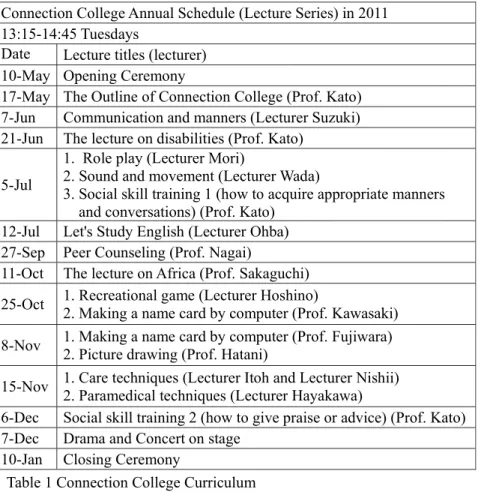
a series of lectures for learning various skills and knowledge (see Table 1). These
special elective modules were taught one day a week, and students usually took two or three modules in a year. I was invited to give an English language lesson as a part of the skill and knowledge series.
Connection College Annual Schedule (Lecture Series) in 2011 13:15-14:45 Tuesdays
Date Lecture titles (lecturer) 10-May Opening Ceremony
17-May The Outline of Connection College (Prof. Kato) 7-Jun Communication and manners (Lecturer Suzuki) 21-Jun The lecture on disabilities (Prof. Kato)
5-Jul
1. Role play (Lecturer Mori)
2. Sound and movement (Lecturer Wada)
3. Social skill training 1 (how to acquire appropriate manners and conversations) (Prof. Kato)
12-Jul Let's Study English (Lecturer Ohba) 27-Sep Peer Counseling (Prof. Nagai)
11-Oct The lecture on Africa (Prof. Sakaguchi) 25-Oct 1. Recreational game (Lecturer Hoshino)
2. Making a name card by computer (Prof. Kawasaki) 8-Nov 1. Making a name card by computer (Prof. Fujiwara)
2. Picture drawing (Prof. Hatani)
15-Nov 1. Care techniques (Lecturer Itoh and Lecturer Nishii) 2. Paramedical techniques (Lecturer Hayakawa)
6-Dec Social skill training 2 (how to give praise or advice) (Prof. Kato) 7-Dec Drama and Concert on stage
10-Jan Closing Ceremony
Table 1 Connection College Curriculum
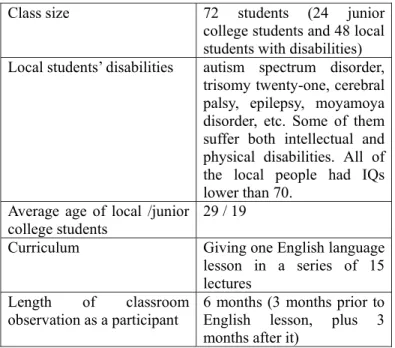
There were 48 local students with mental disabilities and 24 junior college students
enrolled in the module. Each junior college student was paired up with two local
students to perform group work and to support them when they needed help. The local
students varied in age and disability, and all of them were supported individually by
junior college students (see Table 2). There were 27 male and 21 female local students
whose average age was 29, and 6 male and 18 female junior college students, most of
whom were about 19 years old.
Class size 72 students (24 junior college students and 48 local students with disabilities) Local students’ disabilities autism spectrum disorder,
trisomy twenty-one, cerebral palsy, epilepsy, moyamoya disorder, etc. Some of them suffer both intellectual and physical disabilities. All of the local people had IQs lower than 70.
Average age of local /junior college students
29 / 19
Curriculum Giving one English language lesson in a series of 15 lectures
Length of classroom observation as a participant
6 months (3 months prior to English lesson, plus 3 months after it)
Table 2 descriptions of the complicated setting
3. Research Methods and Methodologies
Ethnography is a method of studying human behaviour by direct observation in a natural setting (Diesing, 1983). I carried out the research in ways similar to those described by Hammersley and Atkinson (2007, p. 3-7). These were as follows:
1. The researcher herself took to the ‘field’ as a participant in class for certain periods of time in order to find out students’ needs, without conducting experiments or highly structured interviews.
2. The researcher gathered data from a range of sources while focusing on participant observation.
3. The researcher collected all the data related to teaching in a special setting first, then designed her own teaching materials based on the results of her analysis.
4. The focus was on a small number of cases in a group to facilitate in-depth study.
The method of data collection included my conducting interviews with students and lecturers, observing the series of lessons in the module, taking field notes of students’
and lecturers’ behaviours and activities, visiting a high school for students with
intellectual disabilities, and reading literature related to teaching those students. I took
provisional field notes in Japanese during my participation in other lecturers’ classes,
and tried to reconstruct the data in English for this article.
24. Data Collection in and out of Class
The first stage of observation was a passive one (Diesing, ibid., p. 3), and I participated as a student trying to familiarise myself with the class. I noticed that most of the teaching materials other lecturers used were written in easy Japanese without Chinese characters; these were at a level of comprehensibility suitable to elementary school pupils aged eight to ten. Some lecturers prepared two different kinds of handout, one for junior college students and one for local students. Those for the junior college students contained instructions on how to support the students.
I was amazed in the first lecture to see that Professor Kato understood what students with speech impediments tried to say. I was not able to comprehend these students in the first few lectures, but, as I supported one of them, I gradually picked up some of his words such as ‘…love…picture…’, for example, and grew increasingly able to understand him. I also came to pay closer attention to students’ facial and non-verbal expressions, and eventually could use these to communicate with them. During class observation, I recognized the following:
1. We should avoid giving written information as much as possible. Local students had difficulty in reading, so if there was a need to give instructions in a written form, we should make sure to write them in easy Japanese.
2. Both local and junior college students were in favour of games or task-based activities. They both enjoyed cooperating together to carry out group activities when they played games during the Communication and Manners class and when writing a conversational sketch in Social Skill Training I.
3. Some local and junior college students were good at art performance. I came to realise this when I joined in Role Play and Sound and Movement sessions.
Besides drama and music therapy, I recognised that it might be a good idea to use their talents for English activities.
4. Local students were quite active in class. They were eager to study, and many of them, when asked, would always raise their hands to volunteer answers, etc.
5. Having a short break between activities was recommended. A ninety-minute lecture seemed quite long to many of the students and most of the lecturers gave a ten-minute break in the middle.
6. Audio-visual materials helped cultivate students’ understanding, and showing
videos or pictures was an effective way of teaching. All the lecturers used pictures or videos to teach their lessons.
7. Students loved watching TV and were engaged by popular trends. During their introduction to the course, many said they liked Hanshin Tigers (a local baseball team), AKB48 (a Japanese female group of singers), or Hollywood movies. We often talked about what we saw on TV in and out of class. I thought it might be effective to adapt teaching materials from sources in popular culture.
When I introduced myself to a local student during some group work in the third lecture, he said, “Oh, I learned English at high school.” It was not until this time that I realised some of the local students had been at high school after compulsory education.
Meanwhile, I began to feel that a classroom observation was not enough to plan a special English lesson, because there had been no English lessons held at CC before.
Furthermore, I did not know any experts in Teaching English for Specific Purposes who I could ask for advice. I therefore requested the module leader to arrange an English classroom observation at the High School for Special Education.
I carried out this observation on the morning of 17th June 2011. I met Mr Akira Kotozuka, an English teacher, who had worked for the school for ten years, and I observed two lessons. In the first lesson he gave students an activity in which they had to trace English sentences with a pen in order to practise writing them. He told me that writing was the most difficult skill for such students to learn. They also created a dialogue in English in pairs, and used it to practise an oral conversation based on it. In the second lesson, the teacher showed a music video clip of ‘We are The World’, and gave students the role of a singer to help them learn English phrases. They were going to be disguised as the singer and perform the song on stage at the school festival in October.
After the lessons I had a discussion with the teacher, and he suggested that I should
not treat students as children; their level of learning was slow, but I must bear in mind
their age. When teachers give a task, it must be relevant to their interests and needs. I
had a preconception that students with intellectual disabilities disliked learning, yet in
reality they were enthusiastic about studying. Given opportunities to learn, they show
positive attitudes towards studying. Mr. Kotozuka told me that most of the students had
at some point developed inferiority complexes, believing that they were not able to
perform adequately in class, so it was important for them to experience the joy of
learning. He recommended that I plan a lesson in which the students with disabilities
could perform as well as junior college students. It would foster their pride and
eventually nurture their learning.
5. Data Analysis for Designing a Teaching Plan
According to the annual lesson plan of guest lecturers (see Table 1), there were two types of approach to teaching: knowledge-based and skills-based (see Table 3).
Types of the lessons Names of the lessons
Knowledge-based The outline of Connection College The Lecture on Disabilities The Lecture on Africa
Social Skill Training 1 (how to acquire appropriate manners and tools for conversation)
Social Skill Training 2 (how to give praise or advice) Skills-based Communication and Manners
Role Play
Sound and Movement
Peer Counselling by making paper collages Recreational Games
Making a Name Card by Computer Picture Drawing
Care Techniques Paramedical Techniques Knowledge-based
and Skill-based
English Table 3 Types of the lessons
Another set of lectures focused on the role of junior college students. They were given the role of learning assistants for local students with disabilities in the lectures on Social Skill Training and Making a Name Card by Computer, whereas they mainly learned together with local students in the rest of the lectures.
When deciding which approaches and roles I should choose for my English lesson, I
aimed to give the same opportunity to learn English to both local and junior college
students through a mixture of knowledge-based and skills-based approaches. Because
the English level of the majority of junior college students was at false beginners, I did
not have to ask them to simplify the context of the lesson to transfer knowledge to local
people. Rather, I planned to let all of them acquire basic English phrases with
communicative and task-based methods. I revised my lesson to give all of them
something to learn. For example, I introduced eight new words to express feelings in
Activity 3 (Appendix 1-1, 1-2), and junior college students might not have learned
‘embarrassed’, ‘depressed’, ‘serious’ or ‘so-so’ at high school. They also had freedom to use new vocabulary from a dictionary to communicate their feelings, so as to prevent students who had known all the given words already from becoming bored in class.
When I distributed handouts or wrote English on the board, I accompanied Japanese characters with the English sentences so that students could pronounce them.
Both drawing and singing were enjoyable tasks for all the students, and I chose Queen’s ‘I was Born to Love You’ to work on because it was used in a TV commercial at that time so everyone knew it and was able to sing it. However, although it was famous, students presumably did not know the English lyrics or the meaning of the song, so it would be interesting for them to learn it.
6. English lesson and Students’ Feedback
In general all the students were active in class. For Activity 1 (Appendix 2), local students knew more English-speaking countries than I had expected, and it was easy for me to elicit the answers. I asked the module leader, Professor Kato, to demonstrate the English conversation with me (Appendix 1-3) and he set a good example; I knew his English competence was not good, but he tried to communicate in English nevertheless, and that sort of positive attitude encouraged students to perform (see Picture 1).
Picture 1 Students’ presentation in class
I showed students pictures with which they were to match correct vocabulary in Activity 3, and students enjoyed being quizzed. Time, duration and the degree of difficulty were appropriate to their level. However, I had a little trouble with manipulating the slide projector. My prediction that they would become fond of Queen’s song, ‘I was Born to Love You’ proved accurate and all of them sang enthusiastically.
What I had to be careful about was the level of sound; there was a local student who disliked loud sound and I had to lower the volume during the activity.
I distributed a questionnaire two months after the lesson, investigating what the participants remembered, learned, and found enjoyable or difficult. Interestingly, both local and junior college students had similar feedback: they enjoyed picture drawing and singing the song. Two junior college students responded that the vocabulary they learned was easy, but it had been difficult to communicate their feelings in English sentences. One local student and one junior college student said Professor Kato’s demonstration was pleasant. From their feedback I seemed to have succeeded in teaching English in one of the most difficult class settings.
7. Further Lessons
I found out that the brief duration - three months - for the research was not enough: it was impossible for me to figure out how to support all the students with intellectual disabilities because each of their disabilities was different. Besides, I participated as a
‘student’ in class, which meant that I paired up with only a few students for group activities in each lesson. Under the circumstances I was not able to investigate many participants, therefore I remained in class for a year in order to plan further lessons in 2012 and 2013.
The module leader told me that most of the students had never seen or talked with
non-Japanese people, thus I undertook a communicative lesson with international
students with the help of American ELT lecturers in 2012 and 2013 (Picture 2). Students
learned to talk about their favourite foods, stars, and sports in English, played bingo in a
group in 2012, and practised singing the Beatles’ song ‘Love me do’ together in 2013.
Picture 2 Lesson in 2013
8. Classroom Ethnography
Due to the unusual class teaching conditions this lesson was one of the most difficult of my teaching career. But through careful ethnographic observation I managed to evaluate students’ needs. As a result, I now encourage both pre-service and practising teachers to monitor students’ characteristics carefully, enabling them to adapt or revise their teaching materials and methods accordingly and thereby to facilitate students’
learning. Hargreaves (1996) asserts that teaching is more effective and satisfying when it is research-based, and Diesing (ibid., p. 3) states, “The ideal ethnographer should have the right balance of receptivity and skepticism, involvement and detachment”. I would argue that this goes for classroom practitioners, too.
9. Conclusion
One day, eight months after the lesson, while on the bus on the way home from town,
I bumped into a local student who suffered from trisomy twenty-one. When she recognized me, she began to recite the English phrases and to sing, with a smile, the English song I had taught her in the lesson. This made me realize how enjoyable and interesting my lesson had been to her. I had never encountered a student who could recite all the things I taught him/her eight months after a lesson.
This incident reassured me that people with intellectual disabilities were capable of learning: their modes of acquisition might be different from those of junior college students, but they still had an amazing capacity to learn.
Notes
1. Connection College is similar to what in English may be termed a ‘community college’, but different insofar as it is a colloquial name for a set of particular modules whose official title is ‘Special Lectures on Social Welfare’. There was no English name for Fureai Daigaku:
Fureai means ‘to touch or personally connect with each other’ in Japanese and Daigaku means ‘college’, so I have named it ‘Connection College’ as it sounds like and plays a role similar to a community college.
2. The Social Action Centre at junior college manages CC and holds ethical approval and informed consent of the participants. Thus I gained approval from the Dean of the Centre as well as instructors in the pictures prior to publishing this article.
Acknowledgement
My heartfelt appreciation goes to Professor Hiroshi Kato and Mr Akira Kotozuka whose comments and suggestions were of inestimable value for my study.
I dedicate this article to Tsukui Yamayuri En in Sagamihara City, Kanagawa-ken, declaring that every one of us -educators and researchers- work for the betterment of the society.
References
Diesing, P. (1983) Ethnography. Ethnography … and the English Classroom. New York: New York State English Council, 2-5.
Hammersley, M. and Atkinson, P. (2007). Ethnography: Principles in Practice.
London: Routledge.
Hargreaves, D. (1996) Teaching as a Research-based Profession: Possibilities and Prospects. In Hammersley, M (ed.) Educational Research and Evidence-based Practice. Milton Keynes: The Open University, 3-17.
Kato, H. (2004) Fureai Daigaku no Chosen (Challenges of Connection College).
Daigaku Kyoiku Kaihatsu Centre Tsusin (University Faculty Development Centre Report) Ryukoku University, 6, 7-11
Schensul, J. and LeCompte, M. (2013) Essential Ethnographic Methods. Plymouth:
Altamira Press.
Received on November 30, 2016.
Appendix 1-1 Handouts for English lesson in Connection College
I feel あいふぃーる…
fine(ふぁいん) げんき embarrassed
(えんばらすと) はずかしいsleepy(すりーぴー) ねむい great
(ぐれいと) とてもげんき!depressed(でぃぷれすと) がっくり happy(はっぴー) しあわせ
so-so (そーそー) まあまあ serious(しりあす) まじめ
Faces were retrieved from the following website: http://www.prisonmarriageministry.org/NMEPM/data/images/faces.jpg
Appendix 1-2 Handouts for English lesson in Connection College
Appendix 1-3 Handouts for English lesson in Connection College
ふれあいだいがく たんとう:おおば ともみ2011
ねん7
がつ12
にち (12 July 2011)えいかいわをれんしゅうしましょう (Let’s study English conversation)
Ms. OHBA: “Hello. What’s your name?”
おおばせんせい:「はろー。わっつ ゆあ ねいむ?」(はろー。あなたのなまえは?)
Mr. KATOH: “My name is Hiroshi.”
かとうせんせい:「まいねいむ いず ひろし」(わたしのなまえはひろしです)
Ms. OHBA: “Hiroshi, How do you feel today?”
おおばせんせい:「ひろし、はぅ どぅゆふぃーる つでい?」
(きょうはどんなきぶんですか?)
Mr. KATOH: “I feel fine.”
かとうせんせい:「あい ふぃーる ふぁいん」 (げんきです)